
Tag: Protects

  • Fifth Circuit: First Amendment protects drag show from campus censors

    Fifth Circuit: First Amendment protects drag show from campus censors

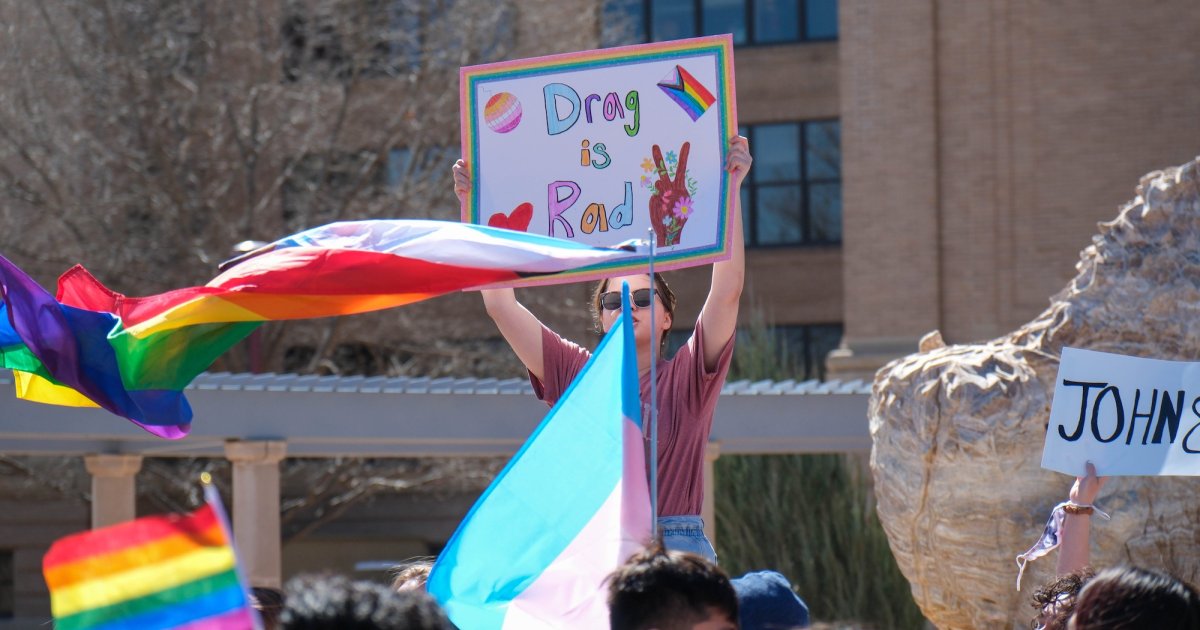
    On March 20, 2023, the students of Spectrum WT — an LGBTQ+ organization at West Texas A&M University — were in the final stages of preparing a charity drag show when University President Walter Wendler sent a community-wide email unilaterally banning all drag shows from campus. In his email, Wendler derided drag shows as “misogynistic,” and enacted the ban despite acknowledging that “the law of the land appears to require” him to allow the show to go on. 

    On Aug. 18, 2025, the U.S. Court of Appeals for the Fifth Circuit confirmed that, indeed, it does. The 2-1 panel opinion overturned the trial court’s denial of Spectrum WT’s motion for a preliminary injunction and ordered the lower court to block Wendler from enforcing the drag ban while the case proceeds. The court held the students are substantially likely to prevail on the merits of their claims that singling out drag performances to ban them from a campus theater, otherwise open to students and the public alike, violates the right to free speech. 

    To start, the court affirmed that the First Amendment protects drag performance — just as it protects other theatrical performance — rejecting the trial court’s holding that drag shows constitute nonexpressive conduct outside the First Amendment’s protection. The appeals court explained that like the “unquestionably shielded painting of Jackson Pollock, music of Arnold Schöenberg, or Jabberwocky verse of Lewis Carroll,” art, whether painted, sung, or performed on stage, is expressive as so long as it is “evident that conveying some message, even if nearly opaque or perhaps smeared, was intended.” 

    Spectrum WT’s drag show passes that test, the court explained, because “the message sent by parading on a theater stage in the attire of the opposite sex,” in support for the LGBTQ+ community, “would have been unmistakable” to its ticketed audience.

    The second question the court considered was whether the university could lawfully keep Spectrum WT’s drag show out of Legacy Hall, a performance venue the college allows both students and outside groups to rent for expressive events like magic shows, beauty pageants, and even a past drag show. Here, again, the court sided with Spectrum WT. The court conducted a public forum analysis, which examines the underlying purposes and practices of government property to determine what restrictions officials can place on protected expression in the property. 

    The court noted that the university had let pretty much anyone beside the plaintiffs use Legacy Hall for expressive events, including, “a local church group’s ‘Community Night of Worship and Prayer,’ a congressional candidate forum, a local high school’s ‘Casino Night’ dance, a local nonprofit’s benefit gala, Randall County’s livestock show, and a religious retreat center’s event dinner.”

    Because President Wendler singled out a particular type of expression to exclude from a space WTAMU generally opens to third parties for expressive use, his drag ban must survive strict scrutiny, the toughest level of judicial review. And because Wendler made no attempt to overcome strict scrutiny, the court held “the plaintiffs are entitled to an injunction protecting their rights, and the district court erred in concluding otherwise.”

    Spectrum WT’s legal battle may not be completely over, as the case waits to return to the trial court, but this opinion represents a real victory for all students at West Texas A&M, reaffirming the First Amendment principles that protect their free speech rights on campus. It’s also another victory for students across Texas — where drag performance bans have become all too common — whose abilities to express themselves shouldn’t be subject to the whims of censorial college administrators.
    Source link

  • Trump Team Weakens Bipartisan Law That Protects Students and Veterans From Predatory Colleges (David Halperin)

    Trump Team Weakens Bipartisan Law That Protects Students and Veterans From Predatory Colleges (David Halperin)

    On the eve of the 4th of July holiday, when they probably hoped no one was paying attention, the Trump Department of Education issued an Interpretive Rule that will make it easier for for-profit colleges to evade regulations aimed at protecting students, and especially student veterans and military service members, from low-quality schools.

    The Department’s 90-10 rule, created by Congress, requires for-profit colleges to obtain at least ten percent of their revenue from sources other than taxpayer-funded federal student grants and loans, or else — if they flunk two years in a row — lose eligibility for federal aid. The purpose is to remove from federal aid those schools of such poor quality that few students, employers, or scholarship programs would put their own money into them.

    For decades, low quality schools have been able to avoid accountability through a giant loophole: only Department of Education funding counted on the federal side of the 90-10 ledger, while other government funding, including GI Bill money from the VA, and tuition assistance for active duty troops and their families from the Pentagon, counted as non-federal. That situation was particularly bad because it motivated low-quality predatory schools, worried about their 90-10 ratios, to aggressively target U.S. veterans and service members for recruitment.

    After years of efforts by veterans organizations and other advocates to close the loophole, Congress in 2021 passed, on a bipartisan basis, and President Biden signed, legislation that appropriately put all federal education aid, including VA and Defense Department money, on the federal side of the ledger.

    The Department was required by the new law to issue regulations specifying in detail how this realignment would work, and the Department under the Biden administration did so in 2022, after engaging in a legally-mandated negotiated rulemaking that brought together representatives of relevant stakeholders. In an unusual development, that rulemaking actually achieved consensus among the groups at the table, from veterans organizations to the for-profit schools themselves, on what the final revised 90-10 rule should be.

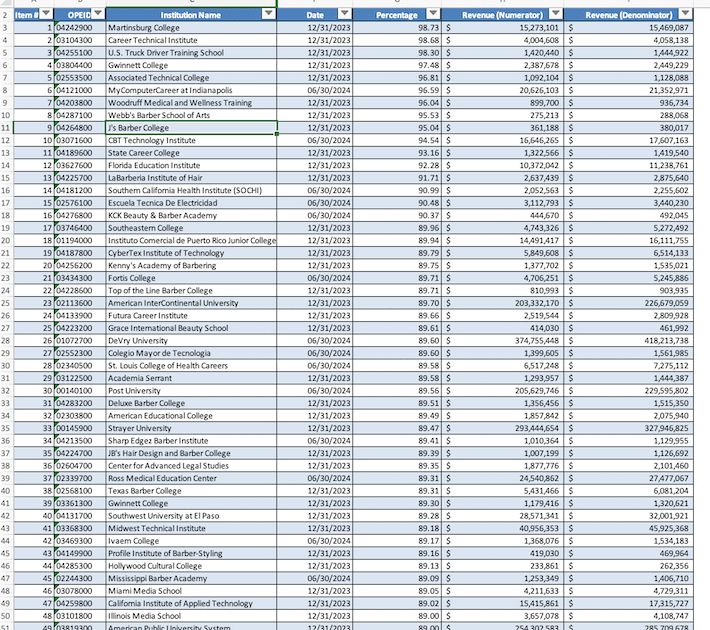
    The new rule took effect in 2023, and when the Department released the latest 90-10 calculations, for the 2023-24 academic year, sixteen for-profit colleges had flunked, compared with just five the previous year. These were mostly smaller schools, led by West Virginia’s Martinsburg College, which got 98.73 percent of its revenue from federal taxpayer dollars, and Washington DC’s Career Technical Institute, which reported 98.68 percent. Another 36 schools, including major institutions such as DeVry University, Strayer University, and American Public University, came perilously close to the line, at 89 percent or higher.

    The education department last week altered the calculation by effectively restoring an old loophole that allowed for-profit colleges to use revenue from programs that are ineligible for federal aid to count on the non-federal side. That loophole was expressly addressed, via a compromise agreement, after Department officials discussed the details with representatives of for-profit colleges, during the 2022 negotiated rulemaking meetings.

    All the flunking or near-flunking schools can now get a new, potentially more favorable, calculation of their 90-10 ratio under the Trump administration’s re-interpretation of the rule.

    In the lawless fashion of the Trump regime, the Department has now undermined a provision of its own regulation without going through the required negotiated rulemaking process. (The Department’s notice last week included a labored argument about why its action was lawful.)

    As it has done multiple times over its first six months, the Trump Department of Education, under Secretary Linda McMahon, has again taken a step that allows poor-quality predatory for-profit colleges to rip off students and taxpayers.

    Source link