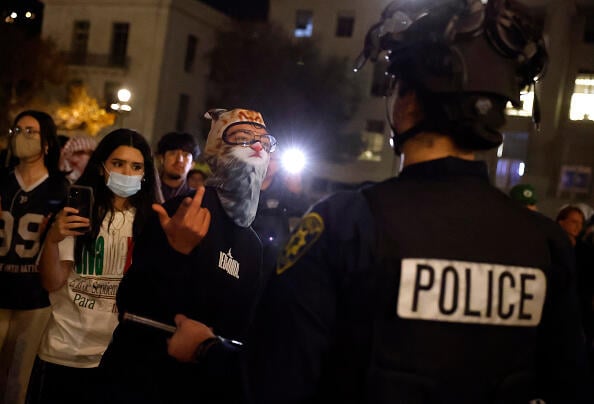
Four people were arrested at a Nov. 10 protest at UC Berkeley over an event for Turning Point USA.
Justin Sullivan/Getty Images
The Department of Education is reviewing potential violations of the Clery Act at the University of California, Berkeley following violence at a campus protest.
Fights broke out and four people were arrested at a Nov. 10 protest against an event for Turning Point USA, the conservative student group founded by Charlie Kirk, Cal Matters reported. The organization has received newfound attention after Kirk was shot and killed while speaking at Utah Valley University in September, exactly two months before the event at UC Berkeley.
The Department of Education announced the launch of the investigation Tuesday.
“Just two months after Turning Point USA founder Charlie Kirk was brutally assassinated on a college campus, UC Berkeley allowed a protest of a Turning Point USA event on its grounds to turn unruly and violent, jeopardizing the safety of its students and staff. Accordingly, the Department is conducting a review of UC Berkeley to ensure that it has the procedures in place to uphold its legal obligation to maintain campus safety and security,” U.S. Secretary of Education Linda McMahon said in a statement.
ED also accused the university of having “a history of violating the Clery Act” in a news release announcing the investigation, citing a $2.4 million fine and settlement agreement in 2020 for UC Berkeley’s failure to properly classify 1,125 crimes on campus and insufficient record keeping.
The Department of Justice previously announced a probe into the university earlier this month, claiming that “Antifa,” a decentralized, left-wing movement was involved in the Nov. 10 protests.
UC Berkeley spokesperson Dan Mogulof told Inside Higher Ed by email that the university “has an unwavering commitment to abide by the laws, rules and policies that are applicable to the university” and “will continue to cooperate with governmental inquires and investigations.”
Mogulof added that the university provided public reports about two violent crimes that occurred Nov. 10: a fistfight over an attempted robbery and someone being hit by a thrown object. He also highlighted efforts by administrators “to support the First Amendment rights of all by deploying a large number of police officers from multiple jurisdictions, and a large number of contracted private security personnel” and closing off parts of campus on the day of the protest.
The investigation comes as the Trump administration has clashed with the University of California system in recent months as it sought to cut off federal research funding over alleged antisemitism and how administrators handled pro-Palestinian campus protests in spring 2024. The federal government has also demanded the University of California, Los Angeles, agree to a $1.2 billion fine and make a number of changes in response to the administration’s concerns.
A federal judge recently ruled against the federal government and its “blanket policy of denying any future grants” to UCLA and determined that the Trump administration can’t demand payouts from University of California member institutions as it conducts civil rights investigations.
Members of the American Association of University Professors, the affiliated American Federation of Teachers and student groups are planning protests in more than 50 cities Friday against “the Trump administration’s broad assault” on higher ed, the AAUP announced in a news release.
The AAUP said demonstrators will urge institutions to continue rejecting Trump’s “Compact for Academic Excellence in Higher Education” and instead “commit to the freedom to teach, learn, research, and speak out without government coercion or censorship.”
“From attacks on academic freedom in the classroom to the defunding of life-saving scientific research to surveilling and arresting peaceful student protesters, Trump’s higher education policies have been catastrophic for our communities and our democracy,” AAUP president Todd Wolfson said in the release. “We’re excited to help build a coalition of students and workers united in fighting back for a higher education system that is accessible and affordable for all and serves the common good.”
The protests are part of a progressive movement called Students Rise Up, or Project Rise Up. The Action Network website says there will be “walkouts and protests at hundreds of schools” Friday—the start of a buildup “to a mass student strike on May 1st, 2026, when we’ll join workers in the streets to disrupt business as usual.”
“We’re demanding free college, a fair wage for workers, and schools where everyone is safe to learn and protest—regardless of their gender or race or immigration status,” the website says.
Other groups listed as organizing or supporting the protests include the Campus Climate Network, College Democrats of America, Florida Youth Action Fund, Frontline for Freedom, Higher Ed Labor United, Ohio Student Association, Sunrise Movement, Dissenters, Feminist Generation, Gen-Z for Change, Generation Vote (GenVote), March for Our Lives, Oil and Gas Action Network, Socialist Alternative, Together Across America, Voters of Tomorrow, Blue Future, Get Free, and NOW Young Feminists.
Asked for a comment from the Education Department, Madi Biedermann, deputy assistant secretary for communications, repeated statements the department previously made, saying, “The Trump Administration is achieving reforms on higher education campuses that conservatives have dreamed about for 50 years.”
“Institutions are once again committed to enforcing federal civil rights laws consistently, they are rooting out DEI and unconstitutional race preferences, and they are acknowledging sex as a biological reality in sports and intimate spaces,” she wrote.
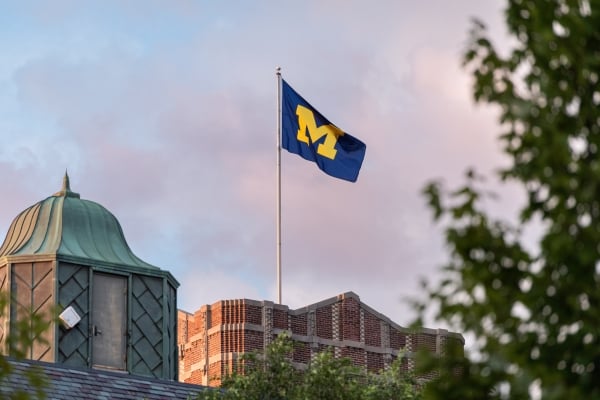
The arrests were made on the campus in Ann Arbor on Wednesday evening.
Courtesy of the University of Michigan.
Three pro-Palestinian protesters were arrested on the University of Michigan campus Wednesday, MLive Media Group, a local news organization, reported.
The TAHRIR Coalition, a campus student group, led the protest in response to an event held by the university’s Students Supporting Israel chapter, which featured several Israel Defense Forces soldiers.
Melissa Overton, the university’s deputy chief of public safety and security, told MLive that the individuals arrested were not affiliated with the university. She said the protesters blocked the exit to an underground parking garage and refused to move when ordered to.
They were charged with resisting and obstructing police, attempting to disarm an officer, disorderly conduct, and outstanding warrants, Overton said. The case has been forwarded to a prosecutor, she noted.
Erek Mirque, a member of TAHRIR, told MLive that the arrests came as a surprise and that he was unaware of any confrontation with officers before the arrests.
“We did not expect the situation to escalate the way that it did,” he said.
This week on the podcast as pro-Palestinian student protests mark the anniversary of October 7, an intervention from Keir Starmer sparks a national debate on campus safety, antisemitism, and free speech.
Plus the Prime Minister is leading a trade delegation to India alongside sector leaders, we explore the growing opportunities in transnational education and ask whether UK universities are ready for a TNE surge – and at Conservative Party Conference, Kemi Badenoch announces plans to slash student numbers and redirect funding.
With Jess Lister, Director (Education) at Public First, Liz Hutchinson, Chief Executive at London Higher, James Coe, Associate Editor at Wonkhe and hosted by Mark Leach, Editor-in-Chief at Wonkhe.
FIRE helped secure a victory this week for two educators in Oregon when the U.S. Court of Appeals for the Ninth Circuit sent Damiano v. Grants Pass School District back down to the federal district court, as FIRE had asked it to in our amicus brief.
When their school district passed a policy requiring teachers to address transgender students by their preferred names and pronouns, the plaintiffs, Oregon assistant principal Rachel Sager and teacher Katie Medart, started the grassroots campaign “I Resolve” to voice their opposition to the policy. Following complaints by students, parents, and community members, their local school district fired the teachers but later reinstated them to different roles.
The teachers sued. But the lower court ruled the school district was entitled to fire the teachers and granted summary judgment, meaning it did not see a need to go to trial.
FIRE saw things differently. And now, so has the appellate court. Our brief to the Ninth Circuit argued that Sager and Medart’s speech on a matter of public concern — as speech on the debate around gender issues undoubtedly is — must be properly balanced against the school district’s interest in providing services to the public. FIRE wrote:
Almost twenty years ago, this Court held “it is well-settled that a teacher’s public employment cannot be conditioned on her refraining from speaking out on school matters.” … Yet the district court here held that, under Pickering, Grants Pass School District could do exactly that. The court incorrectly concluded that the district did not violate the First Amendment by firing an assistant principal (Rachel Sager, née Damiano) and teacher (Katie Medart) for speaking out against the District’s gender identity policy … because their actions—namely, publishing an alternative model gender-identity education policy and accompanying video called “I Resolve”—allegedly caused significant community disruption.
The lower court put too much weight on the discomfort and controversy the teachers caused with their advocacy, and too little weight on their First Amendment right to speak as private citizens on a matter of public concern.
On top of that, the court found a genuine dispute to be resolved over whether the teachers’ advocacy actually disrupted the school’s operation. As such, the Ninth Circuit reversed the lower court’s opinion — meaning the educators’ First Amendment claim can now proceed to trial.
With its ruling, the Ninth Circuit has sent a pointed reminder that public employees don’t surrender their constitutional rights just because they work for the government.
On June 14—Flag Day—President Trump wants tanks in the street and a made-for-TV display of dominance for his birthday. A spectacle meant to look like strength. But real power isn’t staged in Washington. It rises up everywhere else.
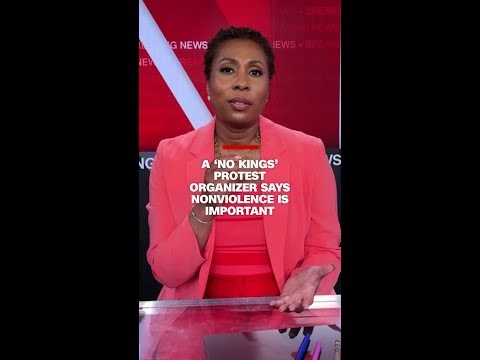
No Kings is a nationwide day of defiance. From city blocks to small towns, from courthouse steps to community parks, we’re taking action to reject authoritarianism—and show the world what democracy really looks like.
We’re not gathering to feed his ego. We’re building a movement that leaves him behind.
The flag doesn’t belong to President Trump. It belongs to us. We’re not watching history happen. We’re making it.
On June 14th, we’re showing up everywhere he isn’t—to say no thrones, no crowns, no kings.
A core principle behind all No Kings events is a commitment to nonviolent action. We expect all participants to seek to de-escalate any potential confrontation with those who disagree with our values and to act lawfully at these events. Weapons of any kind, including those legally permitted, should not be brought to events. Contact
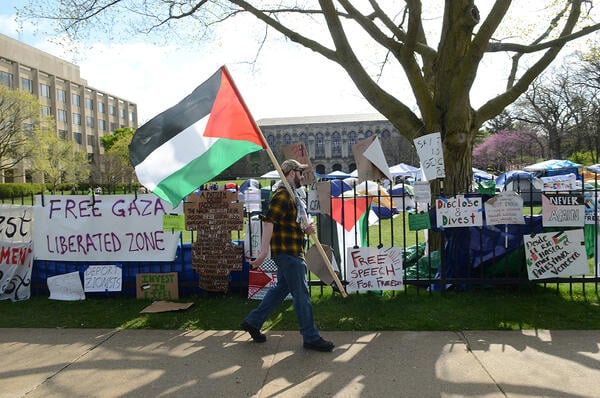
Last spring, as pro-Palestinian demonstrators set up encampments from coast to coast, a small number of college presidents struck agreements with students to get them to pack up their tents.
But a year after those protests ended, have the presidents lived up to their promises?
While the agreements varied widely by campus, the answer appears to mostly be yes, though many initiatives are still in progress.
Divestment from Israel or companies with ties to the Israeli government or military was the most common demand student protesters made, and while some presidents agreed to hold votes on the issue, they made no promises about how such decisions would go. In the vast majority of cases, universities outright rejected divestment demands; on rare campuses where administrators agreed to divest, the actions were largely contained, focused mostly on defense contractors.
Beyond divestment votes, colleges also struck agreements on multiple other points, including scholarships for displaced Palestinian students and increased support for Muslim students. Here’s a look at where such promises stand a year after the encampment protests ended.
Northwestern University
Few protest deals made more headlines than the one at Northwestern University, where President Michael Schill signed on to the Dearing Meadow agreement, as it came to be known, in late April of last year. Schill agreed to various concessions in exchange for protesters concluding the encampment. Those promises included support for Palestinian students and visiting Palestinian faculty, more space for Muslim student groups, and greater transparency in how the university invests its $14.3 billion endowment.
In signing the agreement, Schill caught the attention of Congress, which summoned him for a hearing last May alongside the leaders of Rutgers University and the University of California, Los Angeles. Schill defended the agreement, pushing back on GOP scrutiny.
The Daily Northwestern, the university’s student newspaper, confirmed that Schill has followed through on various initiativess; the university is currently supporting at least one Palestinian scholar and providing temporary space for Muslim students and the Middle Eastern and North African Student Association. (Renovation for a permanent space is ongoing.) The newspaper also confirmed that Northwestern added support for Jewish and Muslim students through the office of Religious and Spiritual Life, which funds weekly Shabbat dinners. But Northwestern officials have been reticent to discuss such efforts, ignoring requests for comment from the student newspaper and Inside Higher Ed.
(Multiple student activists also did not respond to requests for comment from Inside Higher Ed.)
Despite promising more transparency on its endowment, Northwestern does not appear to be living up to that part of the deal. According to the agreement, Northwestern “will answer questions from any internal stakeholder about specific holdings, held currently or within the last quarter, to the best of its knowledge and to the extent legally possible.” Officials promised to respond to such inquiries within 30 days or, if unable to do so, to “provide a reason and a realistic timeline.”
However, The Daily Northwestern reported last month that it sent officials questions about endowment holdings in February and did not receive a response within 30 days. The student newspaper noted that Northwestern did not provide a reason for the delay or a timeline for a response. A student reporter told Inside Higher Ed that the newspaper followed up on March 30 and the university then referred the questions to the Advisory Committee on Investment Responsibility.
The Daily Northwestern is still awaiting answers.
Rutgers University
Rutgers also struck a deal with encampment protesters last spring. As at Northwestern, that agreement landed then-president Jonathan Holloway in front of Congress mere weeks later.
Rutgers leaders agreed to eight of the students’ 10 demands; while they rejected calls to divest from Israel and terminate a partnership with Tel Aviv University, they agreed to accept 10 displaced Gazan students, establish Arab cultural centers at each Rutgers campus, seek a partnership with Birzeit University in the West Bank, hire faculty members who specialize in Palestinian and Middle East studies, and release a statement calling for a ceasefire, among other concessions.
Rutgers officials said all of the agreed-upon initiatives are currently in progress.
Rutgers agreed to eight out of 10 of the protesters’ demands.
“Work continues to advance a series of actions we believe will strengthen and build upon positive change across our community,” spokesperson Megan Schumann told Inside Higher Ed. “These efforts are grounded in the university’s values of free expression, inclusion, and mutual respect—and in the fundamental right of all members of our community to learn, teach, and carry out the university’s essential work in a safe and supportive environment.
University of Oregon
At the University of Oregon, the administration’s agreement with protesters included a statement calling for a ceasefire and condemning genocide, the addition of visiting scholars with expertise in Palestine and Israel, support for academics displaced by the war, new faculty hires with related expertise, new cultural spaces, and more.
Officials said they have lived up to their end of the agreement, though some initiatives are still underway. They noted that the university has already awarded its first International Crisis Response Scholarship, which was established by the agreement to support students affected by the conflict, and the recipient has begun studies at UO. The university has also funded two speaking events as part of its Special Initiative on Constructively Engaging the Conflict and the Pursuit of Peace in Palestine/Israel. Another five proposals for speaking events have already been approved, according to officials. Past and upcoming events have focused on topics such as Palestine and the future of U.S. campus activism and Palestinian identity.
Other efforts, such as faculty recruiting, are ongoing, with several academic units submitting hiring-plan proposals that are undergoing a standard review process. Plans to forge partnerships with Birzeit University in the West Bank and several universities in Israel are also underway.
Evergreen State College
The public institution in Washington agreed to various concessions in a deal with protesters. Officials launched four committees to work on different issues, including “divestment from companies that profit from gross human rights violations and/or the occupation of Palestinian territories,” according to language in the signed protest agreement. Another task force will develop policies to determine whether the college should accept or reject grants that “facilitate illegal occupations abroad, limit free speech, or support oppression of minorities.” The other two task forces are slated to review policing at Evergreen State and to develop a new “non–law enforcement” model for crisis responses.
President John Carmichael also kept his promise to protesters by making a statement on the bloodshed in Gaza last May, in which he called for a ceasefire, the release of hostages and the restoration of international law, which he wrote “requires that the International Court of Justice fairly adjudicate charges of genocide.” He also urged the university community to be “on guard against Islamophobia and antisemitism as we engage with each other in this moment.”
Those efforts are ongoing; the agreement provided a timeline for the task forces to complete their work, with deadlines to adopt their recommendations ranging from spring 2026 to 2030.
California State University, Sacramento
When Sacramento State struck an agreement with pro-Palestinian protesters last May, students framed the move as divestment in a social media post. But a more accurate reading would be that the university determined it did not have direct investments in companies profiting off the war effort and declared that it would not pursue such holdings. The university also established a “de minimis policy for indirect investments that prioritizes socially responsible investments,” a spokesperson wrote to Inside Higher Ed.
Sacramento State president Luke Wood said at the time, “The finance committee of our University Foundation has been so committed to socially responsible investments that we have no direct investments in any of the companies about which many of our students have concerns.” He also announced a policy to formalize socially responsible investment practices, in order to “avoid funding students’ education based on companies that profit from war and desolation,” the spokesperson said.
University leaders announced multiple other actions at the same time, which Wood said grew out of listening sessions with over 1,500 students, faculty, staff and alumni that began when he arrived the previous year. Those changes include introducing more halal and kosher food options on campus, new cultural centers and training on Islamophobia and antisemitism, as well as university task forces to address both Islamophobia and antisemitism. Other efforts include the development of recruitment plans to attract Palestinian and Jewish students to the university.
(This section has been updated to incorporate the university’s response.)
Sonoma State University
Sonoma State University may offer the most visible case of promises made and broken.
Last spring, then-president Mike Lee agreed to demands from protesters that included reviewing contracts to consider divestment opportunities, introducing a Palestinian studies curriculum and adding Students for Justice in Palestine members to a Sonoma State advisory council. Most controversially, he agreed to what was effectively an academic boycott, promising not to “pursue or engage in any study abroad programs, faculty exchanges, or other formal collaborations that are sponsored by, or represent, the Israeli state academic and research institutions.”
However, the agreement was not approved by his bosses in the California State University system, prompting officials to walk the deal back and Lee to retire suddenly. A new deal put forward by an acting president who replaced Lee scrapped much of the prior agreement.
A campus spokesperson noted that despite the changes to the initial agreement, SSU Foundation officials met with students to discuss investment holdings and launched other actions, including a three-part lecture series providing “differing viewpoints on the situation in Gaza and differing religious perspectives,” as well as new groups to support Jewish life.
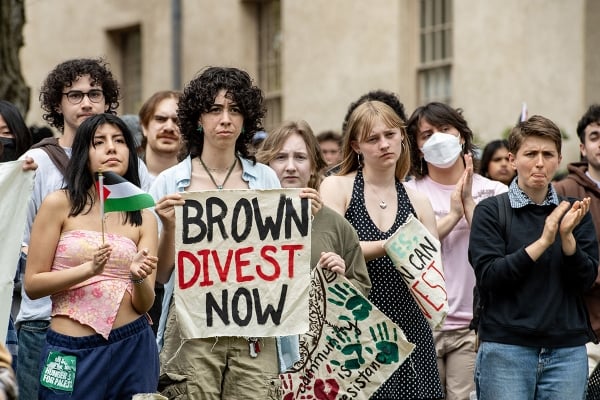
Protesters at Brown University demand divestment, April 29, 2024.
Joseph Prezioso/AFP/Getty Images
Divestment Demands
Multiple universities agreed to hold votes on some form of divestment in response to protesters, including Brown University, the University of Minnesota, the New School and others.
Governing boards, however, have largely rejected divestment except in a few cases.
The University of San Francisco announced several weeks ago that it would divest from four U.S. companies with ties to the Israeli military: Palantir, L3Harris, GE Aerospace and RTX Corporation. The university plans to sell off direct investments in those companies by June 1.
Nearby San Francisco State University has also adopted a form of divestment; in December, the public university’s governing board voted to add new investment screening policies. Now SFSU will no longer invest in companies that make 5 percent or more of their revenues from weapons manufacturing. SFSU also adopted more transparency around endowment holdings.
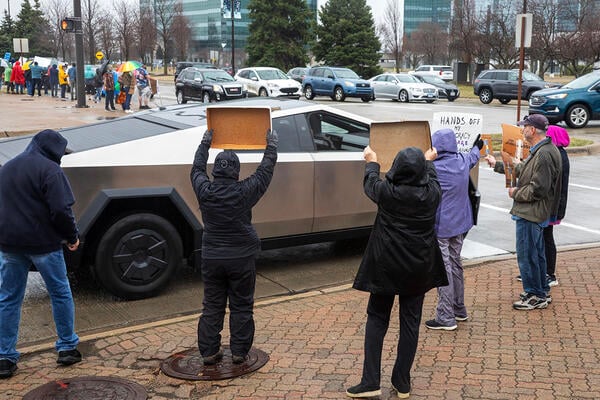
A part-time lecturer allegedly offered students extra credit for attending a Tesla protest.
Jim West/UCG/Universal Images Group/Getty Images
While many professors across the U.S. have protested federal funding cuts and other attacks on higher education by President Donald Trump and his campaign donor and aide Elon Musk without incident, two faculty members are now facing sharp scrutiny for their actions on and off campus.
At the University of Wisconsin–Eau Claire, José Felipe Alvergue, who chairs the English Department, is on leave after he allegedly flipped a table Tuesday set up by the College Republicans to encourage support for Brad Schimel in the Wisconsin Supreme Court race. A video posted by UW–Eau Claire’s College Republicans chapter showed the aftermath of the incident and accused Alvergue (who had not yet been identified when it was uploaded) of being a “violent” supporter of Susan Crawford, the Democratic-backed candidate who later won the race Tuesday.
“I am deeply concerned that our students’ peaceful effort to share information on campus on election day was disrupted,” UW–Eau Claire interim provost Michael Carney wrote in a statement to Inside Higher Ed. “UW–Eau Claire strongly supports every person’s right to free speech and free expression, and the university remains committed to ensuring that campus is a place where a wide variety of opinions and beliefs can be shared and celebrated. Civil dialogue is a critical part of the university experience, and peaceful engagement is fundamental to learning itself.”
Carney added that campus officials are working with the Universities of Wisconsin system and its Office of General Counsel, “which is conducting a comprehensive investigation of this matter.”
The incident prompted broad criticism, particularly from conservatives, many of whom called for the professor to be immediately fired.
“Outrageous. Yet sadly what many conservatives [sic] students deal with every day on so many campuses,” Scott Walker, a former Republican governor of Wisconsin, wrote on social media.
Alvergue did not respond to a request for comment.
On the other side of the country, a part-time lecturer at California State University, Fresno, has prompted outrage in conservative quarters over her social media posts, FOX26NEWS reported. Katherine Shurik, who teaches anthropology, allegedly posted an image of Trump in a casket with the caption “I have a dream for this to happen much sooner rather than later” and another of a gravestone with his name on it and a caption reading, “and take Musk and the rest of the Nazi (Republican) party members with you too!” Additionally, in a video of Shurik circulated by conservative influencers, she said students will “get extra credit for coming to the protest.” Some local news sites reported the extra credit was for protesting Tesla, owned by Musk.
The university was quick to distance itself from Shurik’s posts this week.
“While Fresno State firmly believes in the principles of free speech, we strongly condemn the abhorrent social media posts and comments made by one of our part-time instructors,” Fresno State officials wrote in a Tuesday statement. “As these views were published by the employee as a private citizen, they do not represent our university in any way. Fresno State firmly denounces wishes of death against any elected official, particularly the President of the United States—these go against our core educational values and are not consistent with our Principles of Community. As Americans and educators, we pride ourselves on democratic dialogue, not words of derision and contempt about the most important political figure of our country.”
Shurik did not respond to a request for comment from Inside Higher Ed.
Multiple social media users called for Fresno State to fire Shurik ,and local officials have also weighed in, including Gary Bredefeld, a member of the Fresno County Board of Supervisors.
“This is a professor at Fresno State posting about her longing for the deaths of President Trump, Elon Musk and Republicans. These are the unhinged radicals teaching our young kids at schools and universities across the country,” he wrote in a Sunday post on Facebook. “People like this are hate-filled, radical lunatics and have no business teaching anywhere. I would expect the President of Fresno State to address this immediately and denounce these postings.”
Even Musk himself noticed the uproar.
“Calling for the death of the President is a serious crime,” he wrote in a reply to a post about Shurik.