Tag: provide

  • Volunteer EMTs Provide Medical Response Support on Campus

    Volunteer EMTs Provide Medical Response Support on Campus

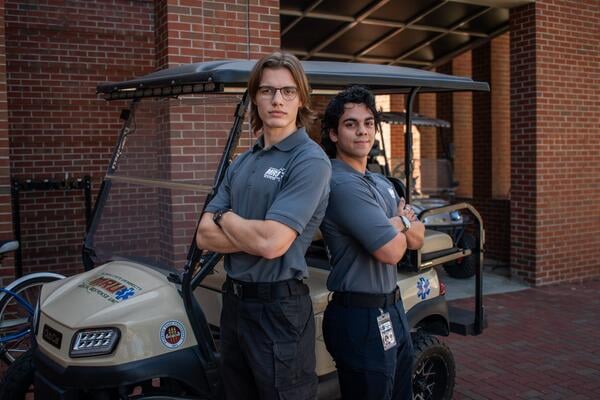
    On a normal day on the Florida State University campus, it’s not unusual to see a student drive by in a vehicle equipped with sirens and the name “Medical Response Unit” plastered to the side.

    “I saw everybody driving around in the golf carts and I really wanted to know what was happening,” said neuroscience major Anakha Vargheese.

    The vehicles are part of a student-led emergency medical response unit, connected to the student health center, that trains student volunteers to provide health care and assistance to their peers.

    For the university, the unit provides emergency response support and health education to all students. For volunteers, the experience gives them needed work-based learning and professional development for future careers as medical professionals.

    In action: FSU’s Medical Response Unit includes more than 150 trained student volunteers on staff, including Vargheese, who serves as director of administration for the unit. Volunteers are certified in various roles, including emergency medical technicians and paramedics.

    To be eligible, students must be empathetic and committed to improving campus health and welfare. All volunteers agree to participate for four semesters including training, so students are primarily admitted in their first or second year of college.

    The unit is well-known on campus, and the competition to earn a spot on the crew is fierce. In the most recent application cycle, MRU received 350 applications for 50 positions, said Bryce Couey, a senior biology major who serves as executive director for the MRU.

    At the start of the term, students accepted to the program are assigned to a crew of three or four people, including one trainee who shadows the crew for the semester. Crews serve two-hour-and-fifteen-minute shifts between 7:45 a.m. and 6 p.m. and may be called on to help bandage a sprained ankle, provide transport to the campus health center or address whatever other issues may arise.

    MRU volunteers provide care for campus community members at campus events, including football tailgates and an annual carnival.

    During the academic year, volunteers cover various campus events, including football tailgates, baseball games, student organization events, intramural sports, the homecoming parade and an annual circus event, which is Vargheese’s favorite.

    “One thing coming into the MRU that I really wanted to gain was clinical experience,” Vargheese said. “But another additional thing that I got out of it was the community and the people. So just being able to spend time with your friends and your crew at these really special events, it’s really fun.”

    The unit has an assortment of vehicles to perform emergency responses, including SUVs, electric carts and a mobile first aid trailer, each equipped with emergency lights, sirens and medical equipment.

    The unit also provides educational training sessions and certification for other students, including Stop the Bleed, which provides a national training certificate for bystanders to control a bleeding emergency before professionals arrive.

    In addition, the unit leads two trainings developed in house for FSU students to recognize and respond to emergency situations, said program director Michael Stewart-Meza; one is tailored for students in fraternity and sorority life and another for the general campus population.

    The impact: The unit is one way FSU hopes to destigmatize receiving help among the campus community.

    “Before and after their shifts, [volunteers] are roaming around campus and attending class in their MRU uniforms,” Stewart-Meza said. “It develops a comfortability that other students will have with them. They’re their classmates, they’re their friends and they’re in the sororities and fraternities with them.”

    Both Couey and Vargheese initially joined MRU to gain clinical experience for their premed education, but the experience has also taught them personal and professional skills, as well as helped them create a sense of connection on campus.

    “It has made me a better person,” Couey said. “I was very introverted when I joined the unit, and I feel as if the people in the unit and the unit itself have gotten me out of my shell and allowed me to grow into the best version of myself.”

    “Being out there in the field and treating patients, caring for them in whatever way that we can, it’s really affirming and rewarding,” said Vargheese. “Without MRU here at college, I don’t know what I’d be doing. I really found my place.”

    Source link

  • Public Ill. Universities Will Provide Medication Abortions

    Public Ill. Universities Will Provide Medication Abortions

    Public colleges and universities in Illinois will now be required by law to supply contraception and abortion medication in the student health center or pharmacy, according to Illinois Public Media.

    Democratic governor JB Pritzker signed HB 3709 into law Friday, requiring colleges to supply birth control and medication abortions starting this academic year. Only three other states—California, Massachusetts and New York—currently have similar laws.

    The law was inspired in part by a student referendum at the University of Illinois at Urbana-Champaign regarding whether the university health center should offer medication abortions. About three-quarters of the more than 6,000 undergraduates who voted were in favor of the idea, but the university didn’t implement the idea, saying it didn’t have the expertise to provide abortions.

    The governor also signed a bill increasing protections for abortion providers on the same day.

    Source link

  • Due Dates Provide a Structure for Spaced Learning – Faculty Focus

    Due Dates Provide a Structure for Spaced Learning – Faculty Focus

    Source link

  • Due Dates Provide a Structure for Spaced Learning – Faculty Focus

    Due Dates Provide a Structure for Spaced Learning – Faculty Focus

    Source link

  • As compliance deadline looms, colleges must resist censorship — and the feds must provide more clarity

    As compliance deadline looms, colleges must resist censorship — and the feds must provide more clarity

    Last week, FIRE wrote about how colleges should interpret President Trump’s recent executive orders, Attorney General Pam Bondi’s anti-discrimination memo, and the Department of Education’s Office for Civil Rights newest “Dear Colleague” letter. 

    At the same time, we asked OCR to give colleges additional guidance so they have a better idea of what type of speech or conduct might run afoul of its “Dear Colleague” letter. OCR has not yet done so, and with the compliance deadline set for tomorrow, we fear institutions will over-correct and engage in campus censorship.

    In fact, we’ve already seen evidence of exactly that. 

    Grand View University in Iowa, for instance, reportedly cancelled its planned International Women’s Day activities, allegedly to comply with federal DEI directives. This, even though Bondi’s Feb. 6 memo exempts “educational, cultural, or historical observances — such as Black History Month, International Holocaust Remembrance Day, or similar events — that celebrate diversity, recognize historical contributions, and promote awareness without engaging in exclusion or discrimination.” 

    This type of overcompliance — in this case, cancelling activities or events that are expressly exempted from enforcement — unnecessarily degrades the extracurricular educational environment at higher education institutions and harms the student learning experience. 

    As we said last week: OCR is bound by the First Amendment and cannot order or compel colleges and universities to violate it. If there is a conflict between federal guidance and the First Amendment, the First Amendment prevails. Whether institutions are overcomplying out of fear of losing federal funding, or in an attempt to prove a point about the directive’s vague language, colleges and universities like Grand View must not preemptively shut down speech.

    OCR’s new Title VI letter: FIRE’s analysis and recommendations

    News

    The Department of Education should provide more clarity about its ‘Dear Colleague Letter’ to ensure protected speech isn’t censored on campus.


    Read More

    This isn’t the first time institutions have overread government directives to justify censorship. In 2021, for example, Idaho passed the “No Public Funds for Abortion Act.” In implementing the bill, the University of Idaho demanded that faculty not “promote or advocate in favor of abortion” or discuss “abortion or contraception” in classroom conversations unless they remained “neutral.” FIRE wrote to the university explaining that such a reading was flatly at odds with the First Amendment. In a thorough memorandum, Idaho Attorney General Raúl Labrador agreed, explaining that the “plain text of the Act does not prohibit public university employees from engaging in speech relating to academic teaching and scholarship that could be viewed as supporting abortion,” thus ending that censorship policy at the University of Idaho. 

    In that same vein, OCR cannot force schools to violate the First Amendment, a point we’ve hammered since the Obama-era OCR’s “Dear Colleague” letters forced institutions to adopt harassment policies that did exactly that. 

    OCR must be clear about the type of conduct that runs afoul of its new directives so that institutions are on notice about what’s permissible and what is prohibited. The office has yet to address vagueness in the “Dear Colleague” letter about “institutional programming” that might violate Title VI. That silence is creating a lot of confusion and preemptive censorship, especially when paired with President Trump’s Jan. 21 executive order declaring that government contractors — which includes many institutions of higher education — cannot “operate any programs promoting DEI that violate any applicable Federal anti-discrimination laws.”

    FIRE again urges institutions to hold the line on defending the free speech and academic freedom rights of their students and faculty. And we again ask OCR and the federal government to respect those same rights by immediately clarifying that their directives don’t require colleges and universities to violate those well-established rights. 

    Last week, a federal court enjoined two executive orders — including the Jan. 21 executive order — that prohibit, among other things, “promoting DEI” in violation of federal anti-discrimination law. The district court held the orders violate the First and Fifth Amendments because they discriminate on the basis of viewpoint and content, and are unconstitutionally vague. 

    While the government will likely appeal and we won’t know the final resolution for some time, the court’s analysis properly identified the orders’ ambiguity as a damning constitutional flaw. What, precisely, constitutes “promoting DEI” in ways that violate anti-discrimination laws? Can colleges host or sponsor speakers on DEI-related topics? Can institutions advertise DEI-related coursework or promote academic research? Restrictions on these activities would violate the First Amendment, but government attorneys were unable to clarify the meaning of the order when asked by the judge. Precision matters, especially when it comes to restrictions on expression. Vague pronouncements that sweep in protected debate, discussion, and programming raise constitutional and practical problems. 

    The best way forward for colleges is obvious, even if it might not be easy: Irrespective of the federal DEI directives, ditch speech-restrictive, orthodoxy-enforcing DEI bureaucracies and stand up for free expression and academic debate — in every political season. 

    As Len Gutkin, editor at The Chronicle of Higher Education, recently wrote: “Colleges should draw a sharp distinction between, on the one hand, DEI used in hiring, promotion, and training, and, on the other, curricular and disciplinary offerings.”  

    That’s the right balance. FIRE again urges institutions to hold the line on defending the free speech and academic freedom rights of their students and faculty. And we again ask OCR and the federal government to respect those same rights by immediately clarifying that their directives don’t require colleges and universities to violate those well-established rights. 

    Source link

  • We provide help for IIM Raipur Students for mba project

    We provide help for IIM Raipur Students for mba project

    Our support included preparing an initial synopsis draft, and then once it’s approved, we prepare the final iim project report based on university mentors. Feedback. We offer complete handholding for all students who are looking to seek complete assistance from research to data analysis with primary data surveys and statistical analysis. 

    Our service also includes industrial guides who help with the project synopsis draughting, final year reports, viva support, and guidance until the iim project pdf is accepted in accordance with the university guidelines. We believe in well-researched, quality work and affordable fees to cater to all income group students, from working professionals to students who have not yet started earning.

    Source link