Tag: Provisions

  • LAWSUIT: FIRE challenges unconstitutional provisions Rubio uses in crusade to deport legal immigrants over protected speech

    LAWSUIT: FIRE challenges unconstitutional provisions Rubio uses in crusade to deport legal immigrants over protected speech

    • The First Amendment trumps the statutes that the government is abusing to deport people for speech alone
    • This lawsuit seeks a landmark ruling that the First Amendment forbids the government from deporting lawfully present noncitizens for constitutionally protected speech
    • FIRE attorney: ‘In a free country, you shouldn’t have to show your papers to voice your opinion’

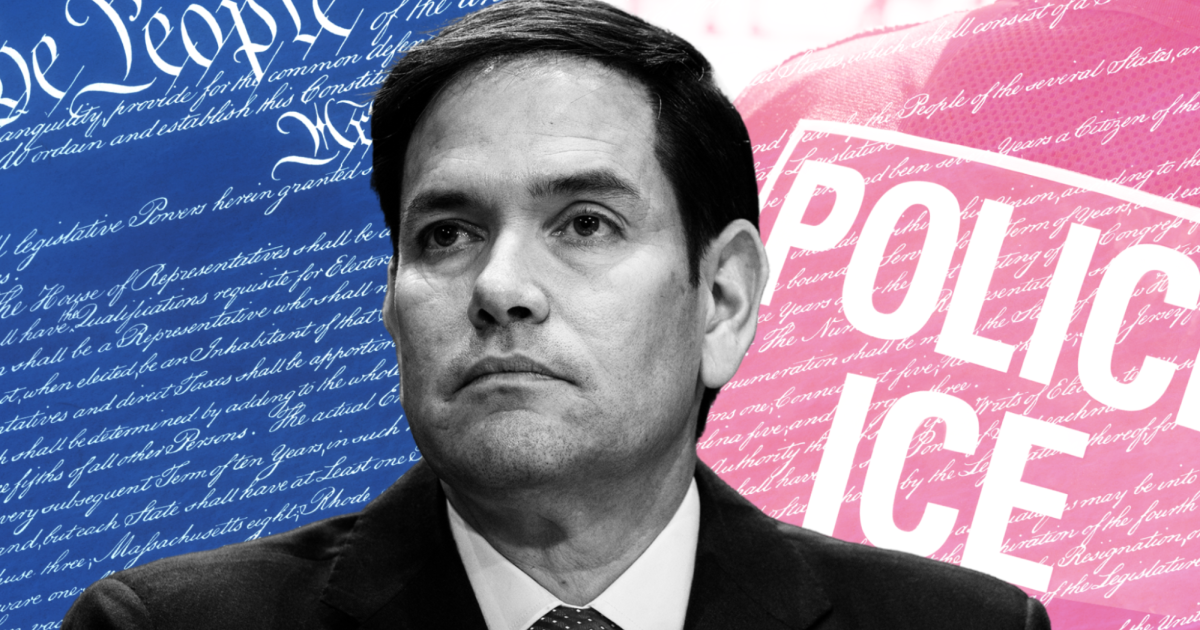
    SAN JOSE, Calif., Aug. 6, 2025 — Today, the Foundation for Individual Rights and Expression sued Secretary of State Marco Rubio, challenging two federal immigration law provisions that give him unchecked power to revoke legal immigrants’ visas and deport them for protected speech.

    “In the United States of America, no one should fear a midnight knock on the door for voicing the wrong opinion,” said FIRE attorney Conor Fitzpatrick. “Free speech isn’t a privilege the government hands out. Under our Constitution it is the inalienable right of every man, woman, and child.” 

    But since March, Rubio and the Trump administration have waged an assault on free speech, targeting foreign university students for deportation based on bedrock protected speech like writing op-eds and attending protests. Their attack is casting a pall of fear over millions of noncitizens, who now worry that voicing the “wrong” opinion about America or Israel will result in deportation.

    Noncitizens in the United States have First Amendment rights. Despite that, Rubio is wielding two provisions of the Immigration and Nationality Act to target lawfully present noncitizens for their opinions.

    • The first allows the secretary of state to initiate deportation proceedings against  any noncitizen for protected speech if the secretary “personally determines” the speech “compromises a compelling foreign policy interest.”
    • The second enables the secretary of state to revoke the visa of any noncitizen “at any time” for any reason. 

    As FIRE’s lawsuit explains, the provisions are unconstitutional when used to revoke a visa or deport someone for speech the First Amendment protects. 

    The Trump administration is proudly using the provisions to revoke the visas of and deport lawfully present noncitizens for their speech if the government deems it anti-American or anti-Israel. Rubio used the first provision to target Columbia University student Mahmoud Khalil for protected pro-Palestinian speech and the second to target Tufts University student Rümeysa Öztürk for coauthoring an op-ed.

    Rubio and the Trump administration claim — as all censors do — that this time is different. They claim that this political speech comes from noncitizens, which therefore warrants setting aside America’s protection of free speech.

    That’s wrong. America’s founding principle is that liberty comes not from the government, but is an inherent right of every individual. Every person — whether they’re a U.S. citizen, are visiting for the week, or are here on a student visa — has free speech rights in this country.

    “Two lawful residents of the United States holding the same sign at the same protest shouldn’t be treated differently just because one’s here on a visa,” said FIRE Legal Director Will Creeley. “The First Amendment bars the government from punishing protected speech — period. In our free country, you shouldn’t have to show your papers to speak your mind.”

    Plaintiffs in FIRE’s lawsuit represent the wide range of groups and individuals whose speech is threatened by the continued assault on noncitizens’ protected speech:

    • The Stanford Daily, the independent, student-run newspaper at Stanford University, where writers with student visas are declining assignments related to the conflict in the Middle East, worried that even reporting on the war will endanger their immigration status
    • Jane Doe and John Doe, two legal noncitizens with no criminal record who engaged in pro-Palestinian speech and now fear deportation and visa revocation because of their expression

    “There’s real fear on campus and it reaches into the newsroom,” said Greta Reich, editor-in-chief of The Stanford Daily. “I’ve had reporters turn down assignments, request the removal of some of their articles, and even quit the paper because they fear deportation for being associated with speaking on political topics, even in a journalistic capacity. The Daily is losing the voices of a significant portion of our student population.”

    There’s also historical context that should give the government pause. Congress passed the Alien and Sedition Acts 225 years ago. One of those acts allowed President John Adams to deport noncitizens if he thought they posed a “danger” to the country. It was one of the most unconstitutional laws in our nation’s history and died a quick death two years later, after the acts contributed to Adams’ resounding loss in the 1800 presidential election to Thomas Jefferson. 

    FIRE aims to stop the government’s use of the two provisions that stand counter to our ideals as a nation: Provisions that — in their expansive scope and unchecked authority — are more at home in countries like China and Russia than in a free America. By defeating these provisions, no administration of any party will be able to weaponize them against individuals for expression disfavored by the government.

    FIRE moved for a preliminary injunction to stop the government from abusing the visa provision while the case is ongoing.

    Marc Van Der Hout, Johnny Sinodis, and Oona Cahill at Van Der Hout LLP are serving as local and advisory counsel on the case.

    From today’s lawsuit: “Our First Amendment stands as a bulwark against the government infringing the inalienable human rights to think and speak for yourself.”

    The Foundation for Individual Rights and Expression (FIRE) is a nonpartisan, nonprofit organization dedicated to defending and sustaining the individual rights of all Americans to free speech and free thought — the most essential qualities of liberty. 

    CONTACT:

    Daniel Burnett, Senior Director of Communications, FIRE: 215-717-3473; [email protected]
    Source link

  • Preliminary Injunction Issued Against DEI Provisions in Two Executive Orders

    Preliminary Injunction Issued Against DEI Provisions in Two Executive Orders

    by CUPA-HR | February 24, 2025

    On February 21, a U.S. district judge issued a preliminary injunction against portions of two of the Trump administration’s executive orders regarding DEI programs. The decision, issued in U.S. District Court for the District of Maryland, blocks federal agencies from taking action to withhold federal funding from federal contractors that conduct programs or initiatives related to DEI.

    Broadly speaking, “EO 14151: Ending Radical and Wasteful Government DEI Programs and Preferences” and “EO 14173: Ending Illegal Discrimination and Restoring Merit-Based Opportunity” state that DEI and DEIA programs and initiatives violate federal civil rights law, and therefore terminate all DEI programs throughout the federal government. EO 14173 orders federal agencies to incorporate clauses in all federal contracts requiring each funding recipient to attest to compliance with all federal antidiscrimination laws and affirm that it does not operate any DEI programs.

    The preliminary injunction strikes down three separate provisions across these executive orders:

    • EO 14151 requires the federal government to terminate all equity-related grants or contracts within 60 days (known as the “Termination Provision”).
    • EO 14173 requires that every grant recipient or federal contractor affirm its compliance with all federal antidiscrimination laws and that it does not operate any DEI programs (known as the “Certification Provision”).
    • EO 14173 directs the attorney general, in consultation with other relevant agencies, to promulgate a report with recommendations to enforce civil rights laws and encourage the private sector to end DEI practices. The report is required to identify “the most egregious and discriminatory DEI practitioners in each sector of concern.” It also requires each agency to identify up to nine potential civil compliance investigations as a way to deter DEI programs or principles. The EO lists institutions of higher education with endowments over $1 billion as potential targets for the civil compliance investigations (known as the “Enforcement Threat Provision”).

    The National Association of Diversity Officers in Higher Education, the American Association of University Professors, Restaurant Opportunities Centers United, and the mayor and city council of Baltimore, Maryland, challenged these three provisions, arguing that they violate free speech rights under the First Amendment and are unconstitutionally vague — violating the Fifth Amendment. Plaintiffs additionally alleged four types of irreparable harm: threat of loss of funds, uncertainty regarding future operations, loss of reputation, and chilled speech.

    The court ultimately ruled that the plaintiffs were likely to succeed on their constitutional complaints and adequately demonstrated a sufficient likelihood of irreparable harm. The decision concluded that EO 14173 offers no guidance or notice of what the government now considers illegal DEI, and that plaintiffs showed “substantial evidence of the risks of such arbitrariness,” and that by “threatening the private sector with enforcement actions based on those vague, undefined standards, the Enforcement Threat Provision is facially unconstitutional under the due process clause of the Fifth Amendment.”

    The preliminary injunction means that federal agencies may not:

    • pause, freeze, impede, block, cancel or terminate any awards, contracts or obligations, or change any current obligation terms on the basis of the Termination Provision;
    • require any contractor to make any certification or other representation pursuant to the Certification Provision; or
    • bring any enforcement action under the False Claims Act in relation to the Enforcement Threat Provision.

    The injunction does not speak to actions that federal agencies may have already taken in response to both executive orders. Nonetheless, the Trump administration will likely appeal the ruling. Given that the policies raised in these executive orders will hold widespread implications for federal contractors in the higher education community, CUPA-HR will continue to share further developments.


    Source link

  • DOL Issues Report on Coercive Contractual Provisions

    DOL Issues Report on Coercive Contractual Provisions

    by CUPA-HR | October 22, 2024

    On October 17, the Department of Labor’s (DOL) Office of the Solicitor (SOL) issued a Special Enforcement Report on “coercive contractual provisions.” The report lists several provisions they have seen included in employment contracts that the department believes “may discourage workers from exercising their rights under worker protection laws.” The report demonstrates recent actions taken by SOL to combat such provisions, but it does not include new enforcement actions against employers that use these provisions.

    In the report, SOL claims the provisions discussed are coercive, violate the law and have significant impacts on the most vulnerable workers. The report details seven types of contractual provisions they find especially concerning:

    1. Contractual provisions requiring workers to waive statutory protections, including those requiring workers to waive their rights to bring claims and recover damages under the Fair Labor Standards Act
    2. Contractual provisions that purport to require employees to agree that they are independent contractors
    3. Indemnification-type provisions and related counterclaims purporting to shift liability for legal violations to workers or other entities
    4. “Loser pays” provisions attempting to require employees to pay the employer’s attorney’s fees and costs if the employees do not prevail in litigation or arbitration
    5. “Stay or pay” provisions, including some training repayment assistance provisions, that purport to require workers to pay damages to their employer for leaving a contract early
    6. Confidentiality, non-disclosure and non-disparagement provisions
    7. Company policies that purport to require workers to report safety concerns to their employer before contacting any government agencies

    The report emphasizes that the Department of Labor is “not bound by private contracts or arbitration agreements between workers and employers” and thus “has a unique role to play in fighting the use of these ‘fine print’ or ‘coercive’ contractual provisions.” It provides examples of cases where the courts have found such agreements unenforceable or where DOL has pursued an injunction in federal court seeking an order blocking one or more contract provisions.

    Importantly, the report is largely a restatement of current law and, for the most part, does not outline new enforcement actions against employers for using these provisions. Instead, the report outlines the work SOL has done recently to fight against the coercive contractual provisions, including cases and amicus briefs filed against employers using such business practices.

    CUPA-HR will continue to monitor for additional resources from the Department of Labor that may impact contractual labor provisions.


    Source link

  • NLRB Issues Decision Blocking Certain Provisions in Severance Agreements, CUPA-HR to Hold Webinar – CUPA-HR

    NLRB Issues Decision Blocking Certain Provisions in Severance Agreements, CUPA-HR to Hold Webinar – CUPA-HR

    by CUPA-HR | March 20, 2023

    On February 21, the National Labor Relations Board (NLRB) issued its decision in McLaren Macomb deciding that employers cannot offer employees severance agreements that require employees to waive rights under the National Labor Relations Act (NLRA), such as confidentiality and non-disparagement requirements.

    The Board explained in its press release on the decision that if an employer offers a severance agreement with a provision that requires the employees to broadly give up their rights under the Act, the employer violates the NLRA. The simple offering of the agreement “is itself an attempt to deter employees from exercising their statutory rights, at a time when employees may feel they must give up their rights in order to get the benefits provided in the agreement.” NLRB Chair Lauren McFerran said “It’s long been understood by the Board and the courts that employers cannot ask individual employees to choose between receiving benefits and exercising their rights under the National Labor Relations Act.”

    McFerran issued the decision alongside NLRB Democratic Members Gwynne Wilcox and David Prouty, while Republican Board Member Marvin Kaplan dissented. The decision reverses two Trump-era NLRB decisions, Baylor University Medical Center and IGT d/b/a International Game Technology. Both of these decisions determined severance agreements with confidentiality and non-disparagement provisions not unlawful in and of themselves.

    Importantly, this decision does not apply to public sector employees as the NLRB only has statutory jurisdiction over private sector employees. Additionally, the ruling does not apply to employees in supervisory or managerial positions.

    CUPA-HR will hold a webinar on this rulemaking and its potential impact on higher ed institutions on March 30, 2023 at 1:00 p.m. ET. Registration is required for participation, but free to all CUPA-HR members. To register, please visit the event’s web page.


    Source link