Combining trusted content from Wiley with Top Hat’s powerful student engagement platform gives educators new opportunities to personalize instruction, foster active learning, and improve outcomes.
TORONTO – January 12, 2026 – Top Hat, the leader in student engagement solutions for higher education, today announced a strategic partnership with Wiley, a global leader in authoritative content and research intelligence, that combines Wiley’s academic expertise and Top Hat’s innovative engagement tools. As part of the collaboration, select titles from Wiley’s widely respected Psychology and Anatomy & Physiology catalogs will be seamlessly integrated into the Top Hat platform, giving educators access to powerful features to personalize content, enhance student success, and save time on course preparation and delivery.
“At Wiley, we believe great content is the foundation of great teaching,” said Lyssa Vanderbeek, Wiley Group Vice President, Courseware. “Through our partnership with Top Hat, we’re delivering our respected titles in key disciplines through another avenue, a platform specifically designed to spark classroom engagement and support evidence-based teaching practices.”
Key Benefits of the Partnership
Easily Customize Trusted Wiley Content: Educators gain the flexibility to adapt select Wiley psychology and anatomy & physiology textbooks using intuitive content customization tools to rearrange, edit, delete or enrich with multimedia so course materials emphasize what matters most.
Promote In-Class Engagement: Wiley’s selected textbooks and ancillaries become the foundation for in-class engagement. Educators can use built-in classroom engagement tools, including 14 interactive question types, to make learning active and more impactful.
Make Learning Active Outside the Classroom:Wiley-authored teaching resources like question banks, slides and videos can be directly integrated within the textbook, to create a richer, more cohesive learning experience.
Enhance Teaching and Learning with Built-In AI Support: Ace, Top Hat’s AI-powered assistant, expands the impact of Wiley content by generating tailored polling questions, discussion prompts and relatable examples, while students benefit from on-demand study help and unlimited practice questions tied to assigned readings.
Support Student Success with Real-Time Data: With Top Hat, every interaction—from attendance, to readings and assessments—generates real-time insights, providing a holistic picture of student performance, and enabling timely interventions to help more learners succeed.“We are proud to partner with Wiley through a shared goal of supporting educators and students,” said Maggie Leen, CEO of Top Hat. “Together we’re redefining what’s possible with course materials and reimagining how courses can be delivered by making content more flexible, personalized, and accessible—taking another big step toward our vision to make learning personal for every student.”
Top Hat and Wiley share a common belief that by sparking better teaching and learning, we open up opportunities for fulfilling careers, better lives and a brighter world. Through this partnership, both organizations address the evolving needs of higher education, ensuring educators and students benefit from innovative, flexible and personalized learning experiences. For more information, visit tophat.com/partnerships/wiley.
About Top Hat
Grounded in learning science and powered by AI, Top Hat is the leader in student engagement solutions for higher education. We enable educators to adopt evidence-based teaching practices through interactive content, tools, and activities across in-person, online, and hybrid classrooms. Top Hat also provides access to thousands of digital textbooks and OER resources, along with authoring tools that let instructors customize or create their own accessible, interactive course materials. More than 1,500 institutions and thousands of faculty use Top Hat to support the learning of over three million students each year. To learn more, please visit tophat.com.
Starting college can be an exciting time for students to learn new things, make friends and live away from home for the first time. But not every student takes advantage of the opportunity.
Emmanuel College psychology professor Linda Lin said she’s seen students reluctant to engage with peers in public spaces, including on their own dorm floor, out of fear of being perceived as odd or intrusive.
“At the beginning of the semester, I always offer students extra credit points if they come see me for a 10-minute meeting and I just check in with them,” Lin said. Typically, a significant share of those students will say they have yet to make friends and get connected on campus.
“It’s become almost half or maybe a majority of the students are really struggling to find their people on campus and find their way,” Lin said.
Nationally, college students express high levels of social anxiety. One study, by the College Student Wellness Advocacy Coalition and the Hi, How Are You Project, found that 65 percent of students said they feel stress often or all the time, and 57 percent reported feeling anxious, worried or overwhelmed frequently.
Lin thinks this could be due in part to the pandemic’s role in hindering social skill development as well as changing social norms among adults in the U.S., who now prioritize relationships built online or via phone-enabled connections, rather than in shared physical spaces.
In response, Lin designed a course on positive psychology and happiness to demonstrate the evidence-based practices that can improve student well-being and push them out of their comfort zones.
How it works: The course covers topics in positive psychology and the research behind those principles. Content includes stress management, connection to nature, exercise and mental health, gratitude, spirituality, optimism, self-compassion, mindfulness, and generosity.
The class is an upper-level psychology elective, so the majority of students enrolled are junior or seniors majoring in psychology, though about 20 percent are nonmajors, Lin said.
Throughout the semester, students receive assignments to practice various techniques to boost their own well-being, ranging from taking a nature walk to writing a letter expressing thankfulness or performing a random act of kindness.
Lin’s most controversial assignment is asking students to talk to three people they don’t know over two or three days. “It can be a stranger you’re making small talk with, or someone that you see in your regular day that you’ve never introduced yourself to,” she said.
Students have said they’d rather drop her class than do the assignment, Lin said. “The social anxiety is so high, they anticipate it being super awkward, super anxiety-provoking, that people are gonna think they’re weird.”
But so far, none of her students has reported a bad experience; instead they’ve come back pleasantly surprised by the interactions. Some have even made lasting friends.
The impact: The class has received an overwhelmingly positive review from students who have taken it, Lin said, with some graduating seniors telling her it had a huge impact on them or that the course changed their life.
“A lot of students, generally, by the end of the course, are shocked that these little things make them feel better,” Lin said. “A lot of them were saying, ‘I technically know I should be doing these things, but this course gave me an opportunity to actually do them.’”
Some students shared her lecture recordings (PowerPoints with audio overlaid) and assignments with their families and friends, in the hopes that the content could benefit their health and well-being, as well.
Lin also conducts pre- and postassessments of student happiness and well-being throughout the term. She found that from the first class in September to the final one in December, students report a 20 percent jump in their scores. And that’s on top of seasonal blues and stressful final exam season feelings, Lin said.
The practices helped all students boost their happiness and well-being, but the greatest gains were among students who were already struggling, especially those receiving clinical mental health support.
“One student was like, ‘My therapist wants to talk to you—this made such a big difference in my life,’” Lin said.
Lin is collecting data from the course for future research and has also taken her curriculum out of the classroom, training resident advisers and other campus community members on how to make friends.
“I think everybody’s a little bit concerned about this, and I’m just trying to go out and take the science everywhere, because I think this should not be behind a paywall,” Lin said.
Are you noticing and responding to a lack of peer engagement and community on your campus? Tell us more about it.
Co-Authored By Aaliyah Lee-Raji, Amadis Canizales, Amaiya Peterson, Andrew Stillwell, Anessa Mayorga, Aniyah Campbell, A’niyah Leather, Anna Fleeman, Brookelyn Vivas, Cassandra Mathieu, Christian Bennett, Clio Chatelain, Daniel Abernethy, Fatoumata Sow, India Davis, Isabella Maiello, Jazmine Collins, Jennifer Sanchez-Martinez, Joseph Stauffer, Karlee Howard, Kaylee Japak, Keanell Tonny, Kristian Isom, Leonardo Pisa, Mackenzie Lemus, Maddox Wreski, Madelyn Beasley, and Saverio Consolazio
In higher education, one of the greatest challenges is getting students not only engaged in learning but also excited about research. An equally pressing issue is navigating the increasing role of artificial intelligence (AI) in the teaching and learning space. This semester, I aimed to tackle both by teaching a psychology of wellness class that integrated the principles of positive psychology with the use of AI tools. During the two-week module on positive psychology, I wanted students to experience research and writing as positive and engaging activities. I floated the idea of co-authoring an article on student wellness from their perspective, incorporating the responsible use of AI, fostering a passion for research, and ensuring that the process was enjoyable.
Here is how the project unfolded:
Day 1: Setting the Stage for Collaborative Writing
The project began by gauging student interest in co-authoring an article on student wellness. I asked those who wanted front-facing credit and authorship acknowledgment to text me their consent and indicate if they would be comfortable with their photo(s) being included. Importantly, students had the option to opt-out at any time if they felt uncomfortable with the direction of the article. I was fortunate because a large majority of the students showed a genuine interest in this assignment.
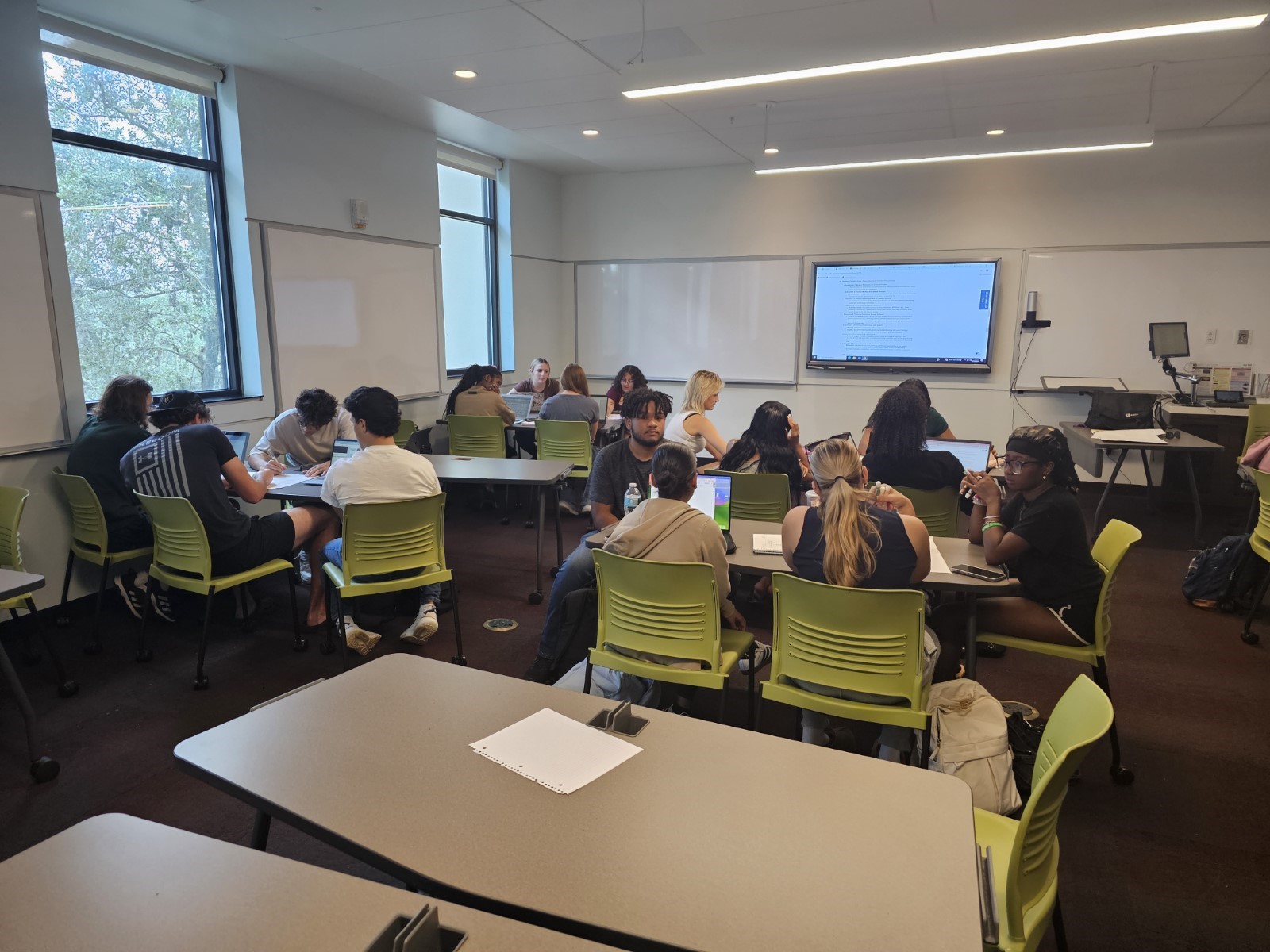
To kick off the project, I used ChatGPT to generate an outline based on positive psychology as aligned with the textbook chapters and student-led ideas and topics. The students were then divided into groups, where each group received a dedicated workspace in our learning management system, D2L. Each group selected a predetermined subtopic to focus on, and I tasked them with using ChatGPT to generate 20 ideas on that subtopic. From those 20 ideas, the groups narrowed it down to three, which they discussed in detail, considering both research-based and personal experiences. Each group member took notes to guide the next stage of the project.
Day 2: Mind Mapping and Cross-Pollination of Ideas
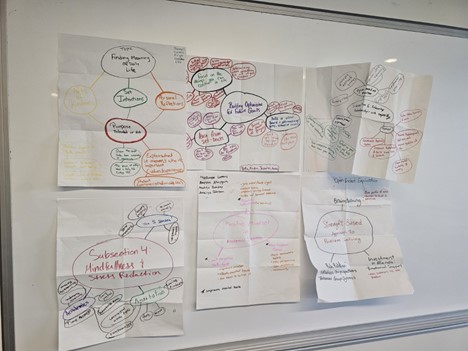
On the second day, students were given poster paper and markers to create mind maps of their ideas and help gain clarity on their discussions from the previous day. Each group placed their chosen topic at the center of the mind map and organized the associated ideas around it. The mind mapping exercise allowed students to visually connect their thoughts and discussions from day one.
One member from each group was nominated to circulate among the other groups, engaging in discussions about each team’s subsection of the article. This not only gave students a broader perspective on how their topics related to the overarching theme of student wellness but also facilitated the flow of information between teams. After gathering input from other teams, the group representative brought the new insights back to their original group, enhancing their understanding of their own topic and how it fit into the larger article. To ensure continuity, students took photos of their mind maps, which would later serve as guides for the writing process.
Day 3: Writing and Research Alignment
On the third day, each group was tasked with creating a document that contained a minimum of five references, with each group member responsible for contributing at least one reference. The document consisted of chunks of article drafts accompanied by their respective references. Students were asked to align these references with the ideas discussed during the earlier sessions and integrate them into their mind maps. Next, students took 15 minutes individually within a shared Google doc to write about their subsection, drawing from their mind maps and class discussions. This individual writing time allowed students to consolidate their thoughts and begin crafting their portion of the collaborative article.
Day 4: Ethical Use of AI in the Writing Process
The fourth day focused on ethical AI usage. We began with a discussion on how students had been using AI tools like ChatGPT and how they envisioned using any type of AI tools in the creation of this article. Together, we created an AI disclosure statement, agreeing on how AI would be used during the editing phase.
We explored specific AI prompts that could enhance their writing, including:
“Rephrase for clarity.”
“Organize this paragraph for the introduction, summary, or conclusion.”
“Give me a starting sentence for this paragraph.”
These prompts were designed to guide students in using AI as a tool to enhance clarity and organization rather than relying on it to write the content.
Day 5: Final Writing and Cohesive Editing
On the final day, students returned to their group documents and spent 15 minutes revising their sections. Afterward, they worked together to co-edit the document without the use of AI, striving to make the article more cohesive and polished. Finally, we revisited the agreed-upon AI prompts, and students were given the option to use AI only when they felt it was necessary for tasks like rephrasing sentences or organizing paragraphs.
The project culminated in a completed article on student wellness, co-authored by students and enhanced by responsible AI usage. The collaborative process not only demystified research and writing but also empowered students to see these activities as positive, engaging, and enjoyable experiences.
Takeaways From This Teaching Experience
The AI writing project was a valuable learning experience for the students, as it incorporated individual and collaborative learning elements alongside technology-based approaches. Reflecting on this experience, I have identified several key takeaways to carry forward into the new semester of teaching and learning.
The Importance of Throwback Learning Experience: Something Familiar Traditional tools like markers and poster boards remain essential in fostering cohesion, socialization, and competence-building. These activities encouraged students to engage in discussions and create visual representations of their ideas, which helped build their confidence and reinforce the collaborative process.
Starting With Original Ideas Matters Students benefited from discussing their ideas within the context of originality before integrating AI-generated content. Generative AI poses a potential threat to originality, emphasizing the need for human thought, discussion, and creativity to provide a benchmark for comparing the quality and intentionality of AI contributions.
Clear Parameters and Prompts Are Essential Defining the role of AI in the writing process was critical for success. Many students initially viewed AI as a tool for producing entire works. By discussing the parameters beforehand, it became clear that AI was to be used to supplement and enhance cohesion rather than replace the creative process.
The Importance of Prompt Development Students gained a growing understanding of the importance of crafting effective prompts for AI. Recognizing how prompts influence AI outputs is a crucial skill that was previously underdeveloped in many students. Moving forward, this skill will be vital as they navigate the intersection of human creativity and AI assistance.
Final Thoughts
Developing effective AI prompts is a pivotal skill that empowers students to use AI intentionally and meaningfully in their learning. A well-crafted prompt acts as the foundation for generating accurate, relevant, and cohesive responses, highlighting the importance of clarity, specificity, and purpose in the initial instructions given to the AI. By understanding how to formulate prompts, students can better harness the potential of AI to support their ideas, enhance their creativity, and improve the quality of their work without relying on AI to replace their original contributions.
This skill also encourages critical thinking, as students must evaluate the type of input needed to achieve a desired outcome, troubleshoot issues in responses, and refine their prompts for better results. Moreover, it aligns with the broader need for digital literacy in education, preparing students to interact responsibly and effectively with technology in academic, professional, and personal contexts.
Lastly, incorporating intentional AI use into teaching strategies ensures that students not only learn how to use these tools but also understand their limitations and ethical considerations. By balancing traditional methods, which foster originality and human connection, with innovative technologies like AI, educators can create a holistic learning environment that values both creativity and technological fluency. This balance will be crucial as AI continues to play an increasingly integral role in education and beyond.
Dr. Courtney Plotts’ students in class.A snapshot of the students’ work.
Special Note of Pride: I would like to note that this group of students worked on this project during class and completed this while two natural disasters accrued, power outages, remote and in person learning and did a great job considering the circumstances. I am so proud of each of them! We originally had bigger visions for the project but due to weather we had to make some changes to the plan!
Freshman College Students’ Advice to Peers for Health & Wellness in 2025
The new year always comes with the possibility of change and growth. As students, much of our growth focus is academics and learning-based. Being academically successful isn’t an easy task. Student wellbeing is an important factor in the learning process (Frazier & Doyle-Fosco, 2024). And for most of us, throwing ourselves into our studies and homework can come with negative side effects like burnout, stress, and decreased mood and motivation. But being successful doesn’t have to come at the risk of your mental health. In our view, academic success means more than good grades and knowledge. Although you may have gone through something last year, or are still going through it now, it doesn’t have to affect you in a negative way. There is so much more that goes into being successful. Success requires dedication, consistency, self-care, and a positive mindset. But for many of us a positive mind set is hard to come by.
The Collective Obstacle
The average age of our class is 19.7 years of age. We have lived with social media all of our lives. A lot of voices have imparted information. Some good, some not so good. The negativity that is readily accessible on social media can lead to negative self-talk. “Negative self-talk refers to your inner voice making critical, negative, or punishing comments. These are the pessimistic, mean-spirited, or unfairly critical thoughts that go through your head when you are making judgements about yourself” (Scott, 2023). Negative self-talk can be detrimental to your psychological well-being. It can really bring you down after you do it for too long. Negative self-talk can also induce stress, depression, and relationship problems. How you can start to believe the negative self-talk: you can start to believe negative self-talk after a while of you doing it. The more you start to tell yourself you can’t do something, the more you’ll start to believe it.
The effects of positive self-talk are the opposite of negative self-talk. It will improve your mental health, can reduce stress, lessen depression, and improve relationships. This not only impacts academics, but other aspects of life. To minimize negative self-talk, you can catch your inner critic when it’s happening and change your thinking to think more positive thoughts, remember that thoughts are not facts, contain your negativity, shift your perspective, think like a friend, or other trusted advisors.
Two Positive Ideas to Embrace in 2025
Two ideas to embrace in the new year that can jumpstart your positivity are evaluating how you think about failure and the control of your future. Failure is an inevitable part of life, but it is through our setbacks that we find opportunities for growth and success. How we respond to failure matters more than the failure itself, and cultivating a mindset of optimism is key to overcoming challenges (Hilppö & Stevens, 2020). Optimism, combined with grit—the perseverance and passion to achieve long-term goals—forms the foundation for a positive and resilient lifestyle. Together, these qualities enable us to turn obstacles into stepping stones and approach life’s difficulties with determination and hope. Think of failures as learning opportunities. Think about the knowledge you gain from hindsight when thinking about failure.
Additionally, understanding the distinction between what we can and cannot control is crucial for maintaining positivity and health (Pourhoseinzadeh, Gheibizadeh,& Moradikalboland, Cheraghian, 2017). Accepting that not everything is within our power allows us to shift our focus to areas where we can make a difference and grow from the experience. Remaining positive during challenging situations and remembering the aspects we can influence help us navigate adversity with a constructive mindset. It’s also important to respect that some factors are beyond our control and may happen for reasons we do not yet understand. By seeking to understand why certain things are outside our control, we can cultivate acceptance and use these moments as opportunities for reflection and personal growth.
The Importance of Health Communication in 2025
Healthy communication is critical to positive personal growth. Asking open-ended questions is important when engaging in meaningful communication because it ensures that there are no assumptions being made. One researcher found that assumptions “lead to consistent and unnecessary community failures” (Macrae, 2018, p.5). Additionally, healthy communication can build true connections among people and better understanding. Also, avoiding assumptions is a way to stay present in the moment allowing you to determine if there is genuine interest in the conversation. Most importantly, health aspects of communication like listening, reflecting, and pausing encourage new thinking and can develop new ideas just about anything.
In addition to healthy communication, think about sharing more of your experiences with peers. Starting from a place of curiosity and health, inquire about someone’s well-being. You can start with a simple phrase like “Are you ok?” Or be ready and willing to share your own personal experience when the time is right. Not only can this help someone else but sharing your story can also help you process what you have been through. Sharing and listening to each other’s experiences can show understanding and help you feel more willing to share now and in the future. Understanding and being present is a power combination for communication.
Lastly, remember that relationships are complex. Whether parental, academic, or personal, everyone has their relationships challenges. One tactic to strengthen relationships is humor. Remember to laugh and enjoy life and the people around you. Most people forget about light heartedness and humor, and how humor can help strengthen and resolve issues within a relationship. Humor can improve the quality of relationships by reducing the stress, tension, and anxiety of the people within the relationship. This effect can only occur if humor is used respectfully in relationships. When used right, humor also can create a more comfortable relationship with less anxiety and sadness for those in it. It’s ok to laugh—even in challenging times.
Summary
A positive mindset is the root of achieving any goal you put your mind to. As a collective voice, we hope the information we shared is valuable information. Our goal was to share meaningful information for your new year and new journey in 2025. As students, we fully understand the importance of mental health, especially because all of us experienced covid at some of the most challenging times of our lives. We hope this information helps you in the new year as much as it helped us learn and grow. Remember to stay happy, healthy, and safe in the new year and think positive!
Dr. Courtney Plotts is a Dynamic Keynote Speaker, Author, and Professor. Dr. Plotts is the National Chair of the Council For At-Risk Student Education and Professional Standards, the country’s only organization that provides standards for working with marginalized and nontraditional students in Kindergarten to College. Her role as National Chair includes training, consulting, and research. Her subject matter expertise has been used in a variety of book publications. Most recently “Small Teaching Online” By Flower Darby with James M. Lang published in June 2019. Dr. Plotts was recognized in 2017 by the California State Legislature for a bold commitment to change in education. She is currently in talks with higher education institutions to launch an institute that focuses on diversity and best practices in online teaching spaces to launch in 2021.
References
Frazier, T., & Doyle Fosco, S. L. (2024). Nurturing positive mental health and wellbeing in educational settings – the PRICES model. Frontiers in public health, 11, 1287532. https://doi.org/10.3389/fpubh.2023.12875
Hilppö, J., & Stevens, R. (2020). “Failure is just another try”: Re-framing failure in school through the FUSE studio approach. International Journal of Educational Research, 99, 101494. https://doi.org/10.1016/j.ijer.2019.101494
Macrae, C. (2018). When no news is bad news: Communication failures and the hidden assumptions that threaten safety. Journal of the Royal Society of Medicine, 111(1), 5–7. https://doi.org/10.1177/0141076817738503
Pourhoseinzadeh, M., Gheibizadeh, M., & Moradikalboland, M., Cheraghian, B. (2017). The Relationship between Health Locus of Control and Health Behaviors in Emergency Medicine Personnel. International journal of community based nursing and midwifery, 5(4), 397–407.
As anyone who has taken a psychology course likely knows, discussing parts of human psychology can inevitably lead to some uncomfortable places. Whether it’s discussing sensitive topics like the psychology of psychopathic violence, the ethics of human experimentation, or the sex-based roots of the concept of “hysteria,” psychology courses are often unavoidably provocative. That is especially so for doctoral courses.
For Gregg Henriques, a faculty member in James Madison University’s Clinical and School Psychology Doctoral program, these sorts of uncomfortable topics were a fundamental part of understanding the full range of human psychology. Henriques had taught in the program for more than 20 years, where he established his bona fides as a passionate, if colorful, professor.
That career longevity is part of the reason why Henriques was shocked to learn that a Title IX complaint had been filed against him by an anonymous student in April 2023. The complaint alleged that over the course of three classes and four months in early 2022, Henriques made two dozen harassing comments that created a hostile environment in his doctoral courses.
Among the objectionable comments were phrases like “emotions are like orgasms,” which was meant to analogize the experience of human emotion to the sexual response cycle, and “pinky dick” as a way of referring to inferiority complexes and overcompensation in a class on psychodynamic theory. Henriques also landed in hot water for acknowledging his own fundamental human desire to have sex during a lecture on Sigmund Freud.
Yes, Henriques often had a colorful way of describing psychological concepts. But he only used such phrases to convey concepts to his students in memorable ways. Faculty members enjoy wide protections regarding their pedagogical speech in the classroom because the First Amendment protects speech “related to scholarship or teaching.” That’s especially so when they approach difficult or controversial issues in the classroom, since even offensive speech that is “germane to the classroom subject matter” — including Henriques’s provocative descriptions of psychological concepts here — is protected.
We live in an age where heterodoxy is often called ‘harm’ and where every word out of a professor’s mouth is uttered beneath the brooding and Orwellian omnipresence of the Title IX Office.
Despite Henriques’ stellar reputation established over decades of teaching, James Madison plowed forward with the investigation. Henriques reached out to FIRE’s Faculty Legal Defense Fund, which provides faculty members at public universities with experienced First Amendment attorneys, free of charge. FLDF quickly set Henriques up with Justin Dillon, an accomplished attorney who helped Henriques navigate the investigatory process.
Over the course of nearly a year, JMU called Henriques into several meetings with investigators about the complaint. With the help of his FLDF attorney, Henriques was eventually cleared of all wrongdoing in January 2024, as the university determined that his comments were pedagogically relevant and did not constitute sexual harassment.
“I owe Justin and FIRE a tremendous debt of gratitude,” Henriques said. “As soon as he took the case, he homed in on the key issues, grasped the logic of why I taught the way I did and saw its value and legitimacy, and started to effectively game plan our approach. He was a tremendous help in navigating the system, understanding the procedures, and ensuring my rights were protected.”
“It’s hard to overstate the difference that I have seen the FLDF make in the lives of terrific professors like Gregg Henriques,” Dillon said. “We live in an age where heterodoxy is often called ‘harm’ and where every word out of a professor’s mouth is uttered beneath the brooding and Orwellian omnipresence of the Title IX Office. The FLDF helps keep the world safe for ideas, and I am so honored to be a part of it.”
With his pedagogical rights vindicated, Henriques is now back in the classroom, able to teach knowing that FLDF and FIRE have his back. But he is just one of the hundreds of scholars punished for their speech.
If you are a public university or college professor facing investigations or punishment for your speech, contact the Faculty Legal Defense Fund: Submit a case or call the 24-hour hotline at 254-500-FLDF (3533).