Last year, FIRE launched the Free Speech Dispatch, a regular series covering new and continuing censorship trends and challenges around the world. Our goal is to help readers better understand the global context of free expression. Want to make sure you don’t miss an update? Sign up for our newsletter.
Quebec secularism minister may ‘strengthen secularism’ by banning public prayer
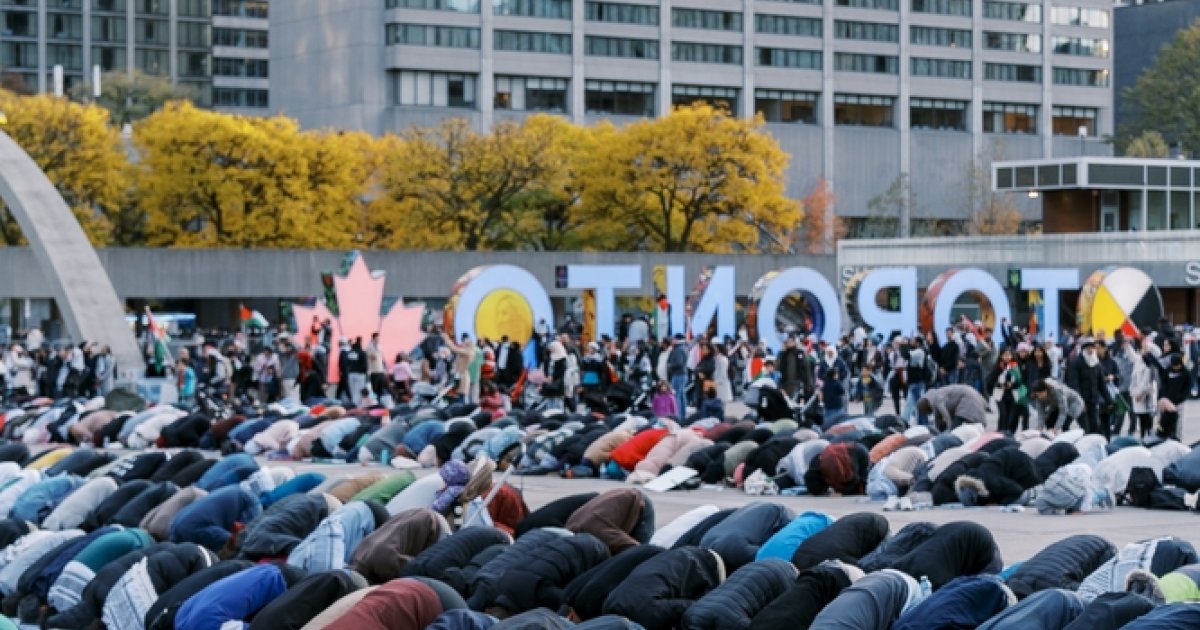
There doesn’t need to be a tension between secularism, free expression, and freedom of religion. Governments should ensure people are neither forced to adopt, nor abandon, religious views at the whims of the state. But Quebec is pursuing a different route, with the province’s Secularism Minister’s repeat public promises to ban public prayer.
The details of Jean-François Roberge’s planned legislation are not yet available but he has cited his “mandate to strengthen secularism” as a reason he’ll be introducing a bill to ban prayer in public places this fall. Roberge’s commitment follows earlier comments from Premier François Legault that “[w]hen we want to pray, we go to a church, we go to a mosque, but not in public places.” Legault also specifically mentioned Islamic prayer as a target.
Alarming new legislation in Canada, worsening repression in Hong Kong, and online global takedowns emerging from India
Alarming new legislation in Canada, worsening repression in Hong Kong, and online global takedowns emerging from India.
Enforcing neutral limits on public activity to ensure traffic isn’t disrupted, for example, would be one thing. But public comments by Quebec officials thus far have suggested this effort to enforce secularism in public spaces will be much broader and limit what religious expression can be conveyed outside the confines of houses of worship.
There’s other free speech news out of Canada, too. At Techdirt, Mike Masnick reports that on the other side of the country, the British Columbia Civil Resolution Tribunal issued a troubling $72,000 fine against X because it geo-blocked, rather than globally blocked, non-consensual intimate images the tribunal ordered to be taken down. As Masnick points out, it’s part of a growing broader challenge on the global internet where courts and officials are ordering extra-terroritorial takedowns — can one country censor the internet for everyone? As FIRE wrote about last year, Australia’s eSafety commissioner made a similar attempt to globally remove a video on X of a man stabbing a bishop.
And Kneecap, the Irish rap trio that’s faced controversy and even police investigation in the UK for band members’ speech about Israel, Hamas, and Hezbollah, has been banned from entering Canada. Parliamentary Secretary for Combating Crime Vince Gasparro cited their “hate speech” and “glorification of terrorism” that “are contrary to Canadian values and laws” as the reason.
Latest from the UK: Graham Linehan, Palestine Action, and Epstein projection arrests during Trump’s visit
- It seems the UK’s free speech woes are making headlines every week, but that was especially true with the arrest of Graham Linehan, who was detained by five officers when he arrived in Heathrow Airport from Arizona earlier this month. Linehan was arrested for a series of posts on X, including one where he said if “a trans-identified male is in a female only space…call the cops, and if all else fails, punch him in the balls.” As my colleague Jacob Mchangama explained about the arrest, “a provocative tweet from more than four months ago suggesting that someone ‘punch’ others in a hypothetical situation does not meet any meaningful threshold of incitement (imminent or not).”
- Public attention on the UK’s average of 30 arrests a day for online expression may be hitting its mark. Home Secretary Shabana Mahmood said in comments in the Commons that “there is a line between content that is offensive, rude, ill-mannered, and incitement to violence, incitement to hatred.” She added that “it is important that we police that line between these types of comments effectively, so that everybody in this country can have confidence in our policing system, but also confidence in exercising their rights under the law of our land.” Her words follow remarks from Met Police Commissioner Sir Mark Rowley, who said “I don’t believe we should be policing toxic culture wars debates and officers are currently in an impossible position.”
- The mass arrests of protesters who “express support” — to be clear, just through words — for banned group Palestine Action continue full steam ahead. In one weekend this month, police arrested over 400 protesters, some of whom were taken in just for holding signs reading, “I oppose genocide. I support Palestine Action.” Protest organizers were also charged.
- President Trump, fresh off threatening to set the U.S. Department of Justice on people who engage in so-called “hate speech” against him, was at the center of some speech controversies during his visit to the UK last week. First, four activists were arrested after projecting, without permission, images of Donald Trump and Jeffrey Epstein onto Windsor Castle. The statute under which they were arrested should certainly raise eyebrows. They were taken in for suspicion of “malicious communications,” which targets “indecent or grossly offensive” messages intended to “cause distress or anxiety to the recipient.” Similarly, activists cried foul when police stopped them from driving an advertising van featuring images of Trump and Epstein through Windsor, where the president was staying.
Blasphemy news: Nigerian mob executes alleged offender, and Moroccan feminist found guilty
As I write about regularly at the Free Speech Dispatch, blasphemy is not only still a criminal act in dozens of countries, but an offense for which the allegation alone can sometimes result in a public killing — no judge, no jury, just executioners. So was the case in Nigeria weeks ago when a mob executed a woman by burning her to death after she was accused of blaspheming against the Prophet Muhammad. The victim, a food vendor, was accused of making a blasphemous remark after “a man jokingly proposed marriage” to her.
And Moroccan feminist Ibtissam Lachgar, whose arrest I discussed in the last Dispatch, was found guilty and sentenced to two and a half years in prison, along with a $5,000 fine, for blasphemy after posting a photo of herself wearing a shirt with the message, “Allah is Lesbian.”
Chinese mining company weaponizes cybercrime law against Sierra Leone journalist
Chinese-owned mining company Leone Rock Metal Group filed a complaint with Sierra Leone’s Criminal Investigation Department against editor Thomas Dixon after he published an investigation alleging labor violations at the company. Dixon was detained and interrogated for hours on charges of “cyberbullying and stalking.” He also says the company “offered to drop its complaint if he agreed never to report on the company again—a condition he flatly rejected.” Another journalist was detained on similar charges just after Dixon was released on bail.
China’s censorship goes global — from secret police stations to video games
2025 is off to a repressive start, from secret police stations in New York to persecution in Russia, Kenya, and more.
Rapid free speech developments all across Asia
- Singapore’s Home Affairs and Law Minister Kasiviswanathan Shanmugam, who is and also coordinating minister for National Security, and Manpower Minister Tan See Leng are suing Online Citizen editor Terry Xu — and attempting to get a court in Taiwan, where Xu lives, to intervene. They’re suing over Xu’s reporting on Singapore’s luxury property market.
- India’s Supreme Court ordered content creators to apologize for mocking disabilities in their online content. “Influencers commercialise speech. When a speech falls in the ambit of commercial or prohibitive categories, the immunity under right to free speech is not available,” the justices said.
- Cambodia’s National Assembly unanimously passed legislation allowing those who “collude” with foreign forces or are involved in “destruction of sovereignty, territorial integrity and national security” to be stripped of citizenship. Rights groups said it “will have a disastrously chilling effect on the freedom of speech of all Cambodian citizens.”
- American comedian Sammy Obeid is alleging that shows he planned to hold in Singapore were canceled because the Infocomm Media Development Authority wouldn’t issue him the permits over the content of his comedy. IMDA said it wouldn’t issue the permits because Obeid submitted them too late — but Obeid claims the delays were ultimately because of issues with his script discussing Israel in the show. And under the Protection from Online Falsehoods and Manipulation Act, Obeid has also been ordered to carry corrections to social media posts accusing Singapore of censorship over the incident.
- The Chinese government has had a busy month of international art censorship. Weeks after successfully pressuring a Thai art gallery to censor an exhibit criticizing authoritarian governments, Chinese officials also pushed back against a Taiwanese art exhibit at the Republic of Kazakhstan’s Central State Museum. The day before the show was set to open “the museum abruptly announced that it would begin a one-month renovation.”
- Bihar police arrested a 20-year-old man for using “abusive language” against Indian Prime Minister Narendra Modi at a political rally.
- Hong Kong’s schools must now review details of activities held by all outside organizations and individuals, as well as the backgrounds of the organizers and guests, to ensure they “do not involve contents that endanger national security, nor promote political propaganda and improper values.”
Hong Kong, free speech, and what musing about sci-fi can teach us
- Indonesian officers have arrested thousands of protesters in recent weeks who demonstrated against President Prabowo Subianto Djojohadikusumo’s policies. The protests broadened “when an armored police vehicle hit and killed a rideshare driver.”
- Nepal is still reeling after mass protests in response to government corruption and unpopular policies, including a short-lived ban on social media platforms. Dozens were killed in the protests and the Prime Minister has since resigned and not been seen publicly.
- The full and total silencing of women under the Taliban continues. Now, books written by women are banned from Afghanistan’s higher education system.
- Punishment under Thailand’s ban on criticism or mockery of the royal family, lese-majeste, continues to crush political dissent in the country. People’s Party MP Chonthicha Jangrew was sentenced to two years and eight months for Facebook posts that “insulted the monarchy, incited social conflict and threatened national security.” Influencer Aniwat Prathumthin was given a suspended sentence for years old Facebook posts and, as part of her sentence, must complete community service on royal holidays. But there was some positive news: Anchan Preelert, a Thai woman who was sentenced to a shocking 43 years for lese-majeste in 2021, was pardoned and freed last month.
Powerful Israeli minister to cut funding for awards event over winning film’s content
Miki Zohar, Israel’s culture and sports minister, has promised to revoke funding for the Ophir Awards after “The Sea,” an “Arabic-language drama about a Palestinian boy from the West Bank who risks his life to go to the beach in Tel Aviv,” won the top prize. Zohar says the Ophir ceremony, for which film awards are voted on by the Israeli Academy of Film and Television, “spit in the face of Israeli citizens” and that “The Sea” portrays Israeli soldiers “in a defamatory and false way.”
It’s been a bad month for free speech, basically everywhere. But there is good news.
Egyptian-British writer and human rights activist Alaa Abd el-Fattah has been in prison in Egypt since 2019 for “spreading false news and harming Egypt’s national interest” after sharing a social media post about a prisoner’s death. But after years of campaigning from activists and his family — including his mother, who has undergone multiple hunger strikes — Abd el-Fattah will be freed after a pardon from Egyptian president Abdel Fattah al-Sisi.