
Tag: Queen

  • Higher education postcard: Queen Mary University of London

    Higher education postcard: Queen Mary University of London

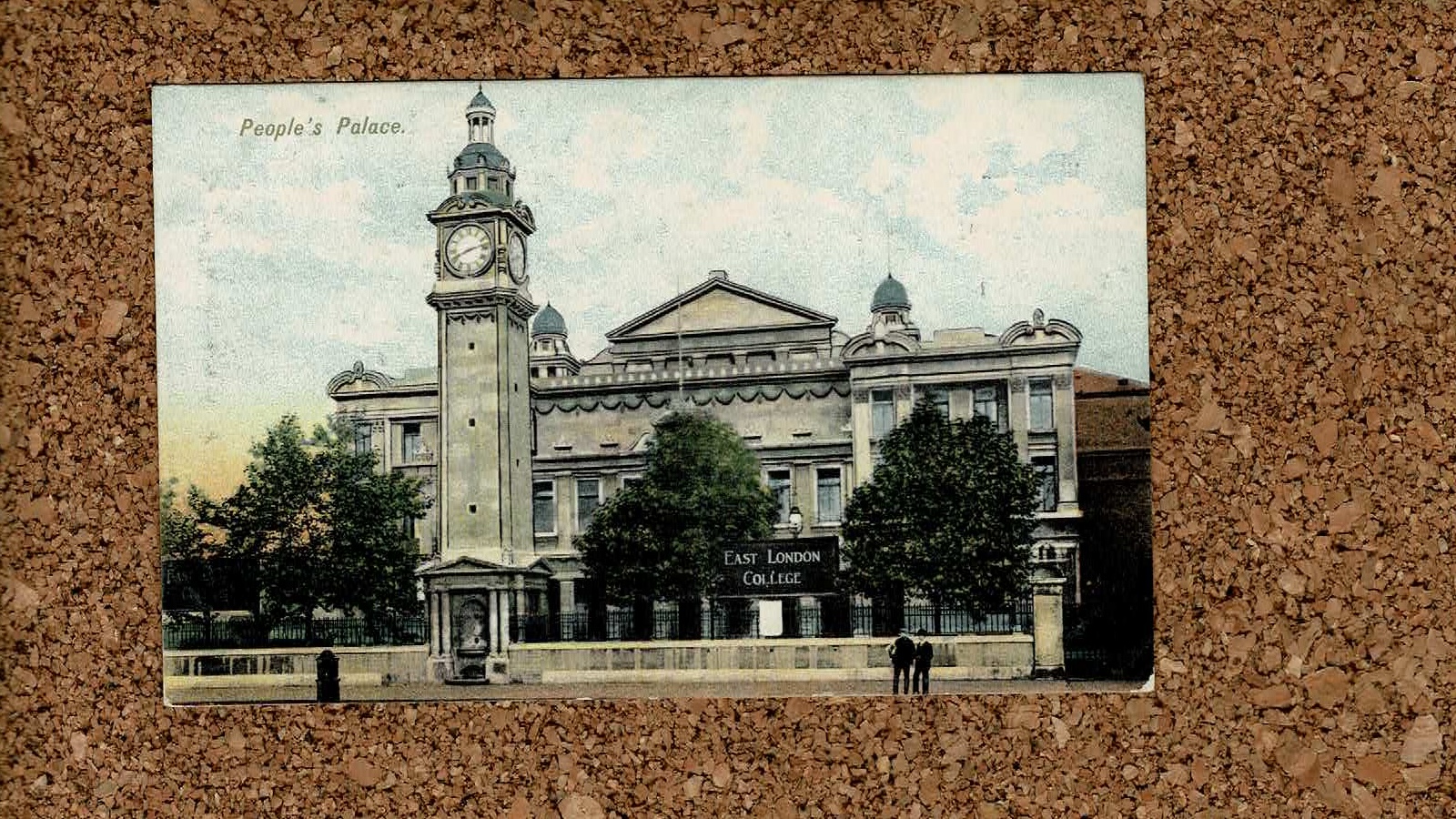
    Down on the Mile End Road in London, within the sound of Bow bells (and hence properly Cockney) you will find what used to be the People’s Palace, and is now Queen Mary University of London.

    The institution we see today has four antecedents: the medical schools at the London and at St Bartholomew’s hospitals, Westfield College, and Queen Mary College. The name which survives is that of the last-founded college: as this is also the largest campus by far, it does confirm that possession is nine-tenths of the law.

    The medical schools were the earliest to be founded: the London Hospital Medical College in 1785 and St Bartholomew’s Hospital Medical College in 1843 (although a lecture theatre had been in place in Barts since 1791). I’ve told a little of the story of medical education in London when I wrote about St George’s. At the end of the eighteenth century and into the nineteenth, hospitals were slowly putting medical education on a more formal footing, and the London Hospital was at the forefront.

    Next to come on the scene was Westfield College. Established in 1882, Westfield was a residential college for women. I’ve written about it before for Wonkhe, so for now I’ll keep the focus on the East End.

    And on 14 May 1887 Queen Victoria formally opened the People’s Palace on the Mile End Road. The picture below, from the Illustrated London News, shows the Great Hall, which was the only element which had been completed at the time. It had a capacity for 2000 people seated, and was most magnificent.

    The People’s Palace would host art exhibitions and concerts, and would have library and reading rooms, gardens and a swimming pool. Associated with it was a technical institute which would teach higher skills associated with East London’s industries and crafts. The technical institute was to be funded by the Draper’s Company; the People’s Palace was built following public subscriptions, much of it coming from the great and the good.

    (This, by the way, was the model for the technical and recreative institutes founded in south London soon thereafter, and which I wrote about in relation to London South Bank University.)

    In 1896 the People’s Palace Technical Schools became East London Technical College. I can’t be certain about this, but I imagine it had by that time been taken over by the relevant London borough, following enabling legislation in the early 1890s. It was by then supporting people studying for the civil service entrance examinations, and also for the University of London’s BSc degree examinations. The first students graduated early in the twentieth century.

    On 17 May 1907 the Morning Post reported that

    The East London College has been admitted by the Senate as a school of the University [of London] in the Faculties of Arts, Science, and Engineering for period of three years on the understanding that the governing body of the school shall do their utmost to satisfy the Senate upon certain points of educational organisation and finance.

    You’ll spot the associated name change – and this also gives us an earliest date for the picture on the postcard (look at the sign!).

    In 1910 the membership of the university was renewed for a further five years, and in 1915 granted without time limit. East London College was properly a school of the University of London. It was strong in science and engineering, particularly in aeronautical engineering. It had a wind tunnel – which was very new technology then – and was the first department of aeronautical engineering in the UK.

    The 1930s became a little exciting for the college, for good reasons and bad.

    The bad reason was a fire in the early hours of Wednesday 25 February 1931, which destroyed the Great Hall of the People’s Palace. So the illustration from 1897 is, sadly, all you’ll get of this today.

    But at a similar time, the college was considering seeking a royal charter, and it looks like the fire crystallised things. The Drapers’ Company facilitated the People’s Palace and the college becoming a single corporate body, and in 1934 a royal charter was granted. This was also the occasion for a change of name. East London College being felt by some, apparently, to be a bit déclassé. And so Queen Mary College – named for the then Queen, Mary of Teck – was born on 12 December 1934.

    And on 13 February 1937 the rebuilt People’s Palace was opened by the new King George VI and Queen Elizabeth (who most readers will know of better as the late Queen Mother.) The full-page spread from the Illustrated London News below gives some of the flavour. I wonder whether this was part of a post-abdication-crisis public relations push to ensure that the new King was perceived in a positive light? The tale of Margaret Paxton, who gave flowers to the Queen, and was descended from the child who gave flowers to Queen Victoria in 1897, is a publicist’s dream, and will no doubt have taken a bit of work to manage.

    Through the following decades Queen Mary College was forging links with the two medical schools – for example, a joint hall of residence was opened in Woodford in 1974. Further changes happened in the 1980s – firstly some changes to provision, when the University of London reshuffled. Queen Mary lost Classics and Russian, but gained lab science subjects from Westfield, Chelsea, Queen Elizabeth and Bedford colleges. This was only a precursor to the larger changes to come: in 1989 Westfield College merged with Queen Mary, which became Queen Mary and Westfield College. The merged college was based on the Mile End and associated campuses – the Westfield College buildings were sold off.

    Ten years later the two medical schools merged with the college to form the Barts and the London School of Medicine and Dentistry. This was simply one part of a general rationalisation of medical education in London which saw the small independent schools brought within the ambit of larger institutions.

    Let’s add a couple of things to bring the story up to date.

    Firstly, in 2012 Queen Mary joined the Russell Group, along with three other universities (pop quiz – without googling, can you name the other three?). It’s an unusual Russell Group in that its entry profile is much more reflective of its neighbourhood. It continues to do good things for the east London population.

    Secondly, in 2013 it formally changed its name from Queen Mary and Westfield College to Queen Mary, University of London. Which is tricky for dinosaurs like me who still think of it as QMW (and while were at it, Royal Holloway continues in my head to be RHBNC). But I will need to learn to deal with modernity as it approaches.

    The college has a good site on its history if you want to read more.

    Nine Nobel prize winners are connected with the college: six in physiology or medicine, one each in literature and physics, and one winner of the Nobel peace prize (pop quiz part two: again without googling, can you name the peace prize winner? I met them once…)

    And finally, here’s a jigsaw of the postcard. The card was written and posted, but it seems to have been stuck in an album or scrap-book at some point so the back is half covered in the remnants of brown paper. Anyway, it was posted at Paddington to an address in the Regent’s Park neighbourhood of London. All I can make of the written message is

    …before I left. I will certainly call and see you one day. I am not going ‘til next Tuesday…
    Source link

  • Queen Elizabeth’s school to open in August 2026

    Queen Elizabeth’s school to open in August 2026

    The new campus, Queen Elizabeth’s School in Dubai, will bring over 450 years of British academic heritage to the UAE, offering students access to the National Curriculum for England under the same standards that have made the Barnet school a consistent “outstanding” performer and a leader in UK education.

    Developed in partnership with GEDU Global Education, the project recently received initial approval from Dubai’s Knowledge and Human Development Authority (KHDA), making a historic move, as it is the first UK state grammar school to establish an international branch.

    “This landmark approval allows us to accelerate our vision to deliver world-leading K-12 education to students from across the UAE,” said Caroline Pendleton-Nash, CEO of Queen Elizabeth’s Global Schools.

    “The Dubai branch campus will remain faithful to the mission, ethos, tradition, and exacting academic standards of Queen Elizabeth’s School, Barnet, while embracing Dubai’s spirit of innovation and ambition,” she said.

    She added: “In uniting the heritage of one of the UK’s most distinguished schools with the vision of Dubai, we aspire to set a new global benchmark for educational excellence.”

    Opening initially from nursery to year 8, the Dubai campus will then expand in phases to include sixth form. The school’s location in Dubai Sports City provides access to exceptional athletic facilities, ensuring that sport and wellbeing remain integral.

    We are also excited by the potential for international collaboration, which, in time, will build a global network of Elizabethans for the benefit of our new students as well as those within the state sector in Barnet
    Neil Enright, Queen Elizabeth’s School, Barnet

    Neil Enright, headmaster of Queen Elizabeth’s School, Barnet, emphasised the school’s commitment to fostering opportunity and leadership, saying: “We are delighted to have received this encouragement from the KHDA to offer a rounded and enriching QE education to children in the UAE, spreading opportunity and supporting students to become the leaders of their generation.”

    “We are also excited by the potential for international collaboration, which, in time, will build a global network of Elizabethans for the benefit of our new students as well as those within the state sector in Barnet,” he said.

    “[That prior interest] confirmed to us the strength of our brand and the strength of a rounded but highly academic education. So the senior staff and governors here have been looking at this move for quite a long time,” he said.

    This time, though, working with GEDU, the school was confident it was the right move. “They’re educationalists, they are experienced at partnering with a number of universities in other parts of the world…we felt a real alignment of values with them,” said Enright.

    Dan Clark has been appointed as the school’s founding principal, having been deputy head of the elite Marlborough College since 2020.

    “Throughout my career in outstanding schools, I’ve seen how powerful education can be,” said Clark. 

    “It challenges pupils to think deeply, act responsibly and believe in their own capacity to achieve.”

    “These values are fundamental to the QE approach. As founding principal of QE Dubai Sports City, I’m excited to establish a community that will produce confident, able and responsible young people who are ready to shape the future.”

    Source link

  • Higher education postcard: Queen Alexandra’s House

    Higher education postcard: Queen Alexandra’s House

    Greetings from South Kensington!

    I’ve told elsewhere the story of how the Imperial Institute was founded following the Great Exhibition of 1851, and how the South Kensington site became a hub for colleges, museums and culture. And naturally, where there are students, there is a need to house students.

    And one group of students, in particular, exercised the Victorian imagination: women. Let’s take a look at The Era, of July 5, 1884:

    It’s clearly no use training the girls to be high class governesses, if you can’t keep them safe from the predations of that London.

    Step forward, Francis Cook. He was a rich man – head of Cook, Son and Co, traders in fabric and clothes – and became one of Britain’s richest men. He gave £40,000 to fund the construction of a hall of residence for women studying in South Kensington, which meant, at that time, at the Royal College of Art, the Royal College of Music, or the Royal College of Science. (It’s also worth noting another fact or two relating to Cook. His second wife, Tennessee Celeste Claflin was an American suffragist, clairvoyant and medium, who with her sister was one of the first women to open a Wall Street brokerage firm. The sister – Victoria Woodhull – was the first woman to run for the presidency of the United States, in 1872.)

    The hall was to provide 100 bedrooms, each two connected by a shared sitting room. Plans included a concert hall, gymnasium, library and common room. The concert hall would be used by the Royal College of Music, and there were music practice rooms and art studios too. A truly magnificent residence. There are images on the Queen Alexandra’s House website.

    It was named for Alexandra of Denmark, then Princess of Wales, who had taken a keen interest in the project. After the death of her husband King Edward VII, Alexandra became the Queen Mother, and suggested in 1914 that Alexandra House be renamed Queen Alexandra’s House.

    Also in 1914, a little scandal took place. Here’s a clipping from the Daily Chronicle of February 6 that year:

    The Ulster Volunteers were a paramilitary force, established in 1912, dedicated to the overthrow of Home Rule for Ireland. (And not to be confused with the unionist Ulster Volunteer Force which was active between 1966 and 2007, although they clearly shared a lot of aims and values!)

    As “Imperial Student” wrote, “I have known Irish women, Roman Catholics, Jewesses, Non-conformists there, and can safely say that all shades of opinion have been sheltered there. Are they expected to support such an entertainment as is to be held next Monday?” (To be clear, the scandal was the support for the Ulster Volunteers, not for the Student Christian Movement.) The correspondent continued:

    One feels sure that Queen Alexandra has no knowledge of the fact that an entertainment is to be held there in support of a hospital for volunteers armed to fight the forces of the Crown. It is to be hoped that this may be called to her Majesty’s attention and that she may intimate her disapproval of such a proceeding.

    I am sure you will be relieved to know that the Bucks Advertiser and Aylesbury News reported on 14 February that “the unfortunate incident at Queen Alexandra’s House has passed without causing trouble in Court of other circles.”

    Queen Alexandra’s House continues to serve today as when it was founded; it is an independent charity, still providing residential accommodation for female students, in a very desirable part of London.

    It’s royal connection continues; as shown in this February 1963 photograph in the Illustrated London News. I think that the Princess Alexandra in the photograph is the great granddaughter of the Alexandra after whom the House is named.

    The postcard was sent on 13 September 1914 – not long after the outbreak of World War I, to Miss Bates in Horsted Keynes, Sussex.

    Dear Winnie, Just a card of our house – no such houses at Horsted Keynes. Write soon, love from Gladys.

    And here’s a jigsaw.

    Source link