Tag: quiet

  • How I Used the Parking Lot to Turn Quiet Rooms into Engaged Classrooms – Faculty Focus

    How I Used the Parking Lot to Turn Quiet Rooms into Engaged Classrooms – Faculty Focus

    Source link

  • How I Used the Parking Lot to Turn Quiet Rooms into Engaged Classrooms – Faculty Focus

    How I Used the Parking Lot to Turn Quiet Rooms into Engaged Classrooms – Faculty Focus

    Source link

  • The white paper kept quiet on market exit

    The white paper kept quiet on market exit

    The Department for Science, Innovation and Technology’s annual report in early July said that the government was working on a legislative programme to “ensure higher education sector access to an insolvency regime.”

    Yet for all that Monday’s post-16 white paper compiled together much of the ongoing work that had been trickling out of Whitehall for the previous 12 months, such plans were notable by their absence.

    Similarly, the Office for Students’ 2025–26 business plan said it was putting together proposals for a system whereby a “validator of last resort” for the English sector, which would protect students if the provider that validates their degree exits the market, as well as a possible “bespoke clearing system” for students in the event that their institution closes.

    Again, neither of these ideas got airtime in the white paper, despite skills minister Jacqui Smith having given her endorsement to the latter in comments to the media.

    The white paper in fact steers wholly clear of policy thinking around what would happen in the (ever more likely) event that a large English higher education provider finds itself in severe financial distress threatening its very viability. This omission is even more stark even against a background where we know that this risk has been scored “critical” and “very likely” on the DfE risk register, and the Office for Students has told the Commons education committee that it would be unlikely that it could “secure reasonable outcomes” for students if a large multi-faculty university closed, reeling off a list of all the ensuing risks ranging from students losing access to their academic records to PGRs whose work is tied to a particular supervisor finding transfer “difficult or impossible.”

    Perhaps the government simply wanted to steer clear of any negative news as it seeks to pat itself on the back for putting higher education on a “firm financial footing”, by way of keeping tuition fees at the same level in real terms (as long as inflation forecasts do not prove to be underestimates) while piling on additional costs to universities in areas including national insurance, pensions and a future fee levy. But – especially given that the white paper rounded up almost every policy initiative that is currently underway elsewhere in government, OfS and UKRI – it does feel, rather, that the idea of making legislative change to pre-empt issues around “market exit” has disappeared from the government’s to-do list.

    Pros and cons

    The education committee’s ongoing inquiry into higher education funding, which has the risks around insolvency as one of its central concerns, is shedding some light on the issues involved, both in the written evidence that has come the committee’s way and the first hearing which took place on Tuesday this week.

    Neil Smyth of lawyers Mills & Reeve told the committee that the fundamental answer to the question of what happens to an insolvent university which is not incorporated as a company – a large slice of the sector – is that “no-one quite knows”. He emphasised that there is debate about what the law entails, noting:

    At the moment, it is believed that the only insolvency process that would be available for a royal chartered entity or non-corporate entity would be to be wound up by the court as an unregistered company. That is a terminal process, it is a shutdown process, it is not a process that allows you to continue to trade.

    This uncertainty complicates what advice can be given to university governors about their responsibilities and liabilities – and also makes it difficult to see how student protection can be regulated for in such a situation. Mills & Reeve’s evidence to the committee adds that the unclear dispensations for unsecured creditors has, in their experience, led to something of a “land grab” among creditors:

    Key creditors, including pension providers, have sought to improve their position by demanding legal mortgages over land as these confer the contractual remedy of fixed charge receivership. This leads to highly expensive and time-consuming legal due diligence at just the point where the HEI can ill-afford those costs.

    Smyth, as he has previously argued on Wonkhe, told the committee that the advantages of some kind of restructuring regime being introduced included clarity for governors, confidence for lenders, and – as exists in the relatively new further education special administration regime – the potential for legal protections for students’ academic interests. That said, he warned that he couldn’t see a university coming out intact from such a process, given that student demand would inevitably collapse once the institution went into administration.

    However, Universities UK – represented at the committee hearing by chief executive Vivienne Stern – has moved away from advocating for a special administration regime. As the representative body’s evidence to the committee puts it:

    Universities UK’s current view is that it would be preferable to work with government, regulators and other sector bodies to clarify how existing arrangements can apply to higher education institutions, supported by stronger contingency planning at institutional level, and at the level of government, regulators and funders.

    The consequences of a large scale institutional failure would be so significant that policy effort should be primarily focussed on averting this outcome, rather than on mitigating its impact after the event.

    Stern highlighted the risk that a formal administrative process could be drawn out and expensive, and might even make it more likely that an institution collapses once entry into regime had taken place.

    The committee’s report will make a recommendation – it could be that Universities UK’s line of thinking has already swayed the government away from such a move. Committee chair Helen Hayes hinted that the committee will conclude that formal systems are needed, via her question to the effect of what would happen if there were a slew of insolvencies in short succession which compromised governmental and regulatory capacity to thrash out suitable arrangements behind the scenes.

    Fuzzy logic

    Keeping the threat of market exit – and the massive and unpopular clean-up job that would accompany it – hanging over the government’s head rather than handing off responsibility to a predetermined legal and fiduciary process is, sad to say, probably one of the few trump cards the sector still has to play around advocating for greater government investment.

    The lessons from FE, where a special administration regime has been in place for a few years now, are that the government seems reluctant to let things go as far as formal processes. In higher education, while it would depend on geography and circumstances, the smart money is probably still on Labour stepping in before push came to shove in a similar way to how the SNP felt forced to in Dundee.

    But there won’t be a Labour government forever. Future ministers who were relaxed (on paper) about universities going bankrupt would almost certainly be less keen to have to step in and make the final decisions in the places affected – while perhaps not being so worried if it ended up being purely a matter for the courts and the banks – and so keeping things fuzzy might end up being a sensible long-term strategy for the sector with an eye beyond 2029.

    That said, the apparent move away from government interest in legislating for a higher education insolvency regime doesn’t really explain why the white paper was quite so silent on other mitigating actions and the whole question of student protection (especially given its inclination towards “consolidation”). Is it really betting the house on the magical healing properties of holding tuition fees stable in real terms?

    Source link

  • Without AI “Quiet Cars,” Learning Is At Risk

    Without AI “Quiet Cars,” Learning Is At Risk

    In the late 1990s, a group of commuters would board the early-morning Amtrak train from Philadelphia to Washington, D.C. They’d sit in the first car behind the locomotive, enjoying communal, consensual silence. Eventually and with the conductor’s help, their car was officially designated as a noise-free zone. Soon after, Denise LaBencki-Fullmer, an Amtrak manager, recognized the value of a peaceful ride and institutionalized the program as the quiet car. At the request of passengers, it soon spread to a number of other commuter services.

    The educational technology sector has something to learn from the Amtrak commuters’ deliberate design of their environment. Learning requires the ability to concentrate. You need a space where you are allowed to process information, recall facts, analyze complex questions and think creatively about ideas, problems and solutions. Learning is not a smooth and easy process—in fact, it is desirable that it’s a bit difficult, because that is how we actually learn. Getting someone to do learning tasks for you, as tempting or comfortable as that might be, won’t work.

    A great deal of learning still happens online, even at colleges that value in-person teaching as much as Princeton University does. The learning management system is where our students find readings, review lecture slides and practice their skills and comprehension on homework assignments. It is also where many instructors administer assessments, both low-stakes quizzes and high-stakes exams.

    Last month, Google launched a feature called “Homework help” in Chrome—a shiny blue button right in the address bar. By engaging it, a student could prompt Google Gemini to summarize a reading or solve a quiz question in a matter of seconds. It thereby robbed the student of the learning activity that they were there to do. A few weeks later Google repositioned the feature so it is a bit less obvious (at least for now), but the question remains: What kind of AI tools should we make available to our students in learning management systems and assessment platforms?

    You might be thinking that this is a pointless question: AI is going to be everywhere—it already is. And sure, that is true. Also, if a student wants to use AI, it is easy enough to open another browser tab and ask an LLM for help. But installing the AI right in the environment in which the student is trying to learn is equivalent to sitting next to the most obnoxious cell yeller on your train ride: You can’t think your own thoughts, because the distraction is so big.

    Just as there are quiet cars on trains, there can be quiet areas of the internet. Learning management systems and assessment platforms should be one such area. That doesn’t mean that there can’t be good uses of AI in learning. Our students should know how to use AI responsibly, thoughtfully and critically, as should the faculty who teach them (I sometimes use AI in my own teaching, for instance). But we should also ask that the companies that provide us with learning technologies think critically and carefully about whether AI aids the difficult, careful work that learning requires or, in fact, removes the opportunity for it. AI is inevitable, but that doesn’t mean we can’t be intentional about how, why and where we implement it.

    I have spent the last few weeks talking with colleagues at other colleges and universities and with the partners that provide our educational technology. Everyone I have spoken with cares about education, and none of them think it’s a good idea that we implement AI in a way that so clearly pulls students out of the learning process. It is actually not unrealistic that people in the tech industry and education sector come together to make the same kind of pact that the train commuters made some 25 years ago and declare our online learning systems an AI quiet zone. We would be doing the right thing by our students if we did.

    Mona Fixdal provides strategic planning and pedagogical leadership for Princeton University’s suite of teaching and learning technologies as well its online learning program. She has a Ph.D. in political science from the University of Oslo and is the author of Just Peace: How Wars Should End and a number of chapters and articles on postwar justice and third-party mediation.

    Source link

  • Quiet Moments Before Another Interview with James Lang – Teaching in Higher Ed

    Quiet Moments Before Another Interview with James Lang – Teaching in Higher Ed

    I’m sitting quietly this morning, reflecting in the final minutes before my interview with Jim Lang. Our conversation will focus on his latest book, Write Like You Teach. In the book, Jim suggests that we ought to be good company in our writing. He has embodied this guidance since I first met him more than a decade ago.

    Jim has been good company through his many books as I’ve yearned to be gentle with myself, resisting the urge to reinvent each class I teach with every new semester (Small Teaching). He’s helped me wrestle with what it might look like to ignite students’ imaginations rather than control their behaviors (Distracted). He transformed the way I think about academic integrity, encouraging me to focus on fostering intrinsic motivation and self-efficacy while cultivating the conditions in which mastery and deep learning can thrive (Cheating Lessons).

    The last time Jim was on Teaching in Higher Ed, he shared a piece he had written: Voltaire on Working the Gardens of Our Classrooms. He invites slowness and stresses:

    In the meantime, the gardens need tending. If you continue to believe in the value of the plants that have always flourished in your garden, keep growing them.

    In Jim’s eighth appearance on Teaching in Higher Ed, I have no doubt he will once again be good company. I’m thankful for all the ways he has shaped my teaching, my learning, and this podcast over the years.

    Source link

  • Among explosions and gunfire, a quiet place to study

    Among explosions and gunfire, a quiet place to study

    A 2017 study found that 45% of the adult population of the Kashmir Valley — around 1.8 million people — suffer from some form of psychological distress. It reported high rates of depression, anxiety and post-traumatic stress disorder.

    The most recent India-Pakistan escalation on May 7, involving cross-border shelling, further worsened conditions, damaging homes and killing civilians in border districts like Uri, Poonch and Kupwara.

    Jan said such stories often lead her to question what went wrong in their society and why such tragedies continue to emerge from her homeland. Her parents advised her to shift to a private reading hall. She describes the atmosphere there as refreshing — a place filled with peers preparing for the same exam. The environment, she says, is motivating and focused, making it easier to concentrate and feel a sense of community.

    Spaces for students

    In recent years, the trend of private reading halls has seen a sharp rise across Kashmir. More and more students now prefer these dedicated spaces over studying at home, seeking focus and stability amid the turmoil. While such reading halls were once limited to urban centres like Srinagar and semi-urban towns like Anantnag and Baramulla, they’ve now expanded into far-flung areas such as Achabal and Kupwara — regions located miles away from the city hubs.

    Muazim Altaf, a pharmacy graduate and the owner of Pulse Library in Achabal — where Jan studies — recalls how the idea for the reading hall came to him. 

    He noticed that many students from nearby villages were travelling all the way to Srinagar, which is 70 kilometres from Achabal, staying in hostels just to access reading halls and a better study environment. “That’s when I thought, why not create something similar here in Achabal?” he said.

    In October last year, he opened Pulse with the intention of offering an affordable alternative to students who couldn’t afford hostel rents in Srinagar. The initiative wasn’t purely profit-driven, he said. His goal was to support local students by providing a productive study space within their own region.

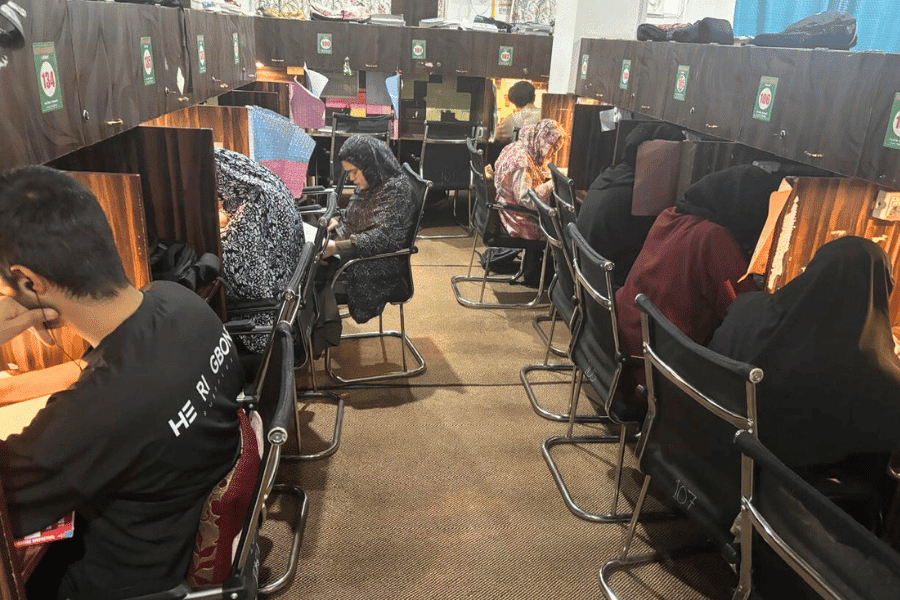
    Initially, he started with 60 study cabins, which were fully booked within days. Encouraged by the overwhelming response, he expanded the facility. “Now we have 120 cabins, all booked until June,” he said. Each student is charged a modest monthly fee of nine pounds to use the space.

    He admits he hadn’t anticipated such a strong turnout. Students aged 17 to 29 now frequent Pulse — some preparing for competitive entrance exams, while others focus on passing exams required for government jobs. 

    One trend stood out to him: nearly 60% of the students are girls.

    A hunger to learn

    In 2022, more than 250,000 people visited just 131 public libraries across Jammu and Kashmir, highlighting both a hunger for learning and the shortage of adequate study spaces. With thousands of aspirants preparing for exams, existing public libraries are overwhelmed and operate only during daytime hours, making it tough for students who need longer study sessions.

    In response, young people across the region have stepped in, launching private reading halls that offer 24/7 access. Equipped with Wi-Fi, heating, cooling, kitchen spaces and discussion zones, these modern study hubs have quickly become essential for serious exam takers in Kashmir.

    Javed Pathaan, a recent PhD graduate from Kashmir University, runs a private reading hall in Srinagar’s Rajbagh area. “Having personally gone through the rigors of competitive exam preparation, I understand how valuable these extras can be,” he said. “Students who study for long hours need occasional breaks, so we’ve created a designated space for short naps.”

    He said that young students face intense mental and physical strain while preparing for exams in a conflict-ridden region. That’s why many choose private services like his over free public libraries.

    Shazir Ahangar, who wants to pass an exam to get a government job in Kashmir, shifted to Pulse Library at Achabal after leaving the public library in Anantnag. He found the public facility overcrowded and said it was hard to concentrate there. 

    “They’re open for just eight to nine hours a day, which isn’t enough when you’re preparing for competitive exams,” he said.

    The exchange of knowledge

    One of Ahangar’s main concerns was the lack of basic facilities. The public libraries he visited didn’t offer air conditioning during summer or designated kitchens for making tea or coffee. Nor do they have discussion rooms. 

    “At Pulse, it’s more than just studying,” he added. Students engage in group discussions, exchange ideas and even enjoy small breaks together. He especially appreciated the privacy provided by individual study cabins.

    Last year, Manan Bhat, 28, from Soura area of Srinagar, secured the 88th rank in India’s civil service exam, a major feat considering that every year, more than one million people appear for India’s Civil Services Examination, but fewer than 1,000 candidates are selected.

    When he first began coming to reading halls they were often nearly empty. “Now, they’re packed with students,” he said. 

    Manan said that the biggest advantage of reading halls is the individual focus they offer, allowing students to concentrate without distractions. He also highlighted how being surrounded by peers preparing for similar exams creates a supportive environment that encourages the exchange of knowledge.

    Safe spaces to study

    Owners of reading halls often play an active role in encouraging students, staying in touch with their parents to share updates on their performance and dedication. The atmosphere in these halls is competitive, similar to coaching centres.

    Muazim Altaf said that admitting students to the reading hall comes with significant responsibility, as parents place a great deal of trust in them. 

    “We share weekly reports with parents, including details like how much time their children spend studying and whether they arrive on time,” he said. This becomes especially crucial in a region battling widespread drug addiction. Parents often urge him to keep a close watch on their children. According to Muazim, any form of indiscipline or violation of library rules results in immediate expulsion.

    In December last year, Shri B.L. Verma, the minister of state for social justice and environment, told the Indian parliament that more than 823,000 people in Jammu and Kashmir — around 8% of the region’s population — use drugs of some kind, including cannabis, opioids or sedatives.

    Basit Fayaz, who recently secured an All India Rank of 70 in the national exam that determines placement in professorships and research fellowships, believes that joining a reading hall played a crucial role in his success. He said that without the focused study environment it offered, cracking the exam — let alone making it to the top 100 — would have been nearly impossible.

    “The reading hall in Achabal [Pulse] provided exactly the kind of calm and distraction-free atmosphere I needed,” he said, adding that it helped him stay insulated from the recurring disturbances like crackdowns and gunfights that are common in Kashmir.

    Fayaz appreciated the peer group he found there. He recalled how group discussions and study sessions with fellow NEET aspirants added great value to his preparation. He added that without such spaces, constant exposure to conflict-related events often disturbs one’s mental state and heightens anxiety.

    “In situations like escalations between India and Pakistan, gunfights or political crackdowns, these spaces help us stay focused and shielded from the chaos,” Fayaz said.


    Questions to consider:

    1. What distractions from studying do so many young people in the Kashmir region face?

    2. How can political turmoil at the national level affect people who live far from city centres?

    3. How important is it for you to have a safe, quiet space to study?


    Source link

  • Why are campuses quiet as democracy is in crisis? (opinion)

    Why are campuses quiet as democracy is in crisis? (opinion)

    A close friend who works at a nearby college asked me why, in 2025, there haven’t been student protests of the kind that we saw during the Vietnam War and after the killing of George Floyd.

    She questioned why campuses seem eerily quiescent as events in Washington, D.C., threaten values essential to the health of higher education, values like diversity, freedom of speech and a commitment to the greater good. We also wondered why most higher education leaders are choosing silence over speech.

    Deans and presidents seem more invested in strategizing about how to respond to executive orders and developing contingency plans to cope with funding cuts than in exerting moral leadership and mounting public criticism of attacks on democratic norms and higher education.

    My students have their own lists of preoccupations. Some are directly threatened and live in fear; some see nothing special about the present moment. “It is just more of the same,” one of them told me.

    And many faculty feel especially vulnerable because of who they are or what they teach. They, too, are staying on the sidelines.

    All of us may be tempted by what a student quoted by the Yale Daily News calls “a quiet acceptance and a quiet grief.” None of us may see a clear path forward; after all, the president won a plurality of the votes in November. How can we save democracy from and for the people themselves?

    I do not mean to judge the goodwill or integrity of anyone in our colleges and universities. There, as elsewhere, people are trying their best to figure out how to live and work under suddenly changed circumstances.

    No choice will be right for everyone, and we need empathy for those who decide to stay out of the fray. But if all of us stay on the sidelines, the collective silence of higher education at a time when democracy is in crisis will not be judged kindly when the history of our era is written.

    Let’s start by considering the role of college and university presidents in times of national crisis. In the past, some have seen themselves as leaders not just of their institutions but, like the clergy and presidents of philanthropic foundations, of civil society.

    Channeling Alexis de Tocqueville, Yale’s Jeffrey Sonnenfeld explains that “the voice of leaders in civil society help[s] certify truth,” creating “priceless ‘social capital’ or community trust.” He asks, “If college presidents get a pass, then why shouldn’t all institutional leaders in democratic society shirk their duties?”

    In the 1960s and ’70s, some prominent college presidents refused to take a pass. The University of Notre Dame’s Theodore Hesburgh became a leading voice in the Black civil rights struggle. Amherst College president John William Ward not only spoke out publicly against the Vietnam War, he even undertook an act of civil disobedience to protest it.

    A half century earlier, another Amherst president, Alexander Meiklejohn, embraced the opportunity afforded by his position to speak to a nation trying to recover from World War I and figure out how to deal with mass immigration and the arrival of new ethnic groups.

    At a time of national turmoil, he asked Americans some hard questions: “Are we determined to exalt our culture, to make it sovereign over others, to keep them down, to have them in control? Or will we let our culture take its chance on equal terms … Which shall it be—an Anglo-Saxon aristocracy of culture or a Democracy?”

    Those questions have special resonance in the present moment.

    But, especially after Oct. 7, college presidents have embraced institutional neutrality on controversial social and political issues. That makes sense.

    Yet institutional neutrality does not mean they need to be silent “on the issues of the day when they are relevant to the core mission of our institutions,” to quote Wesleyan University president Michael S. Roth. And, as Sonnenfeld notes, even the University of Chicago’s justly famous 1967 Kalven report, which first urged institutional neutrality, “actually encouraged institutional voice to address situations which ‘threaten the very mission of the university and its values of free inquiry.’”

    Do attacks on diversity, on international students and faculty, and on the rule of law and democracy itself “threaten the very mission of the university”? If they don’t, I do not know what would.

    As Wesleyan’s Roth reminds his colleagues, “College presidents are not just neutral bureaucrats or referees among competing protesters, faculty and donors.” Roth urges them to speak out.

    But, so far, few others have done so, preferring to keep a low profile.

    The silence of college leaders is matched by the absence of student protests on most of their campuses. Recall that in 2016, when President Trump was first elected, “On many campuses, protests exploded late into election night and lasted several days.”

    Nothing like that is occurring now, even as the Trump administration is carrying out mass deportations, threatening people who protest on college campuses, attacking DEI, calling for ethnic cleansing in Gaza, ending life-saving foreign aid programs and trampling the norms of constitutional democracy.

    Mass protests on campuses can be traced back to 1936, when, as Patricia Smith explains, “college students from coast to coast refused to attend classes to express their opposition to the rise of fascism in Europe and to advocate against the U.S. involvement in foreign wars.”

    They were followed by the University of California at Berkeley’s free speech movement in the 1960s and protests against the Vietnam War, including those that occurred after fatal shootings of student protesters at Kent State University by the Ohio National Guard. There were anti-apartheid protests in the 1980s, and, more recently, students across the country organized protests against police brutality and racism after George Floyd’s death and against Israel’s military actions in Gaza in response to Hamas’s Oct. 7, 2023, attack.

    Though there have been small protests on a few college campuses, nothing like what occurred in response to those events has transpired in 2025.

    Students may have learned a bitter lesson from the crackdowns on protesters engaged in pro-Palestinian activism. And many of them are deeply disillusioned with our democratic institutions. They care more about social justice than preserving democracy and the rule of law.

    Students may not be following events in the nation’s capital or grasping the significance of those events and what they mean for them and their futures.

    It is the job of those of us who teach at colleges and universities to help them see what is happening. This is no time for business as usual. Our students need to understand why democracy matters and how their lives and the lives of their families will be changed if American democracy dies.

    Ultimately, we should remember that the costs of silence may be as great as the costs of speaking out.

    M. Gessen gets it right when they say, “A couple of weeks into Trump’s second term, it can feel as if we are already living in an irreversibly changed country.” Perhaps we are, but Gessen warns that there is worse to come: “Once an autocracy gains power, it will come for many of the people who quite rationally tried to safeguard themselves.”

    Gessen asks us to remember that “The autocracies of the 20th century relied on mass terror. Those of the 21st often don’t need to; their subjects comply willingly.”

    At present, college and university presidents, students and faculty must care about more than protecting ourselves and our institutions. We must speak out and bear witness to what Gessen describes and warn our fellow citizens against compliance.

    This will not be easy at a time when higher education has lost some luster in the public’s eyes. But we have no choice. We have to try.

    Austin Sarat is the William Nelson Cromwell Professor of Jurisprudence and Political Science at Amherst College.

    Source link

  • Colleges were quiet after the Nov. election. Students don’t mind

    Colleges were quiet after the Nov. election. Students don’t mind

    Colleges can be hot spots for debate, inquiry and disagreement, particularly on political topics. Sometimes institutional leaders weigh in on the debate, issuing public statements or sharing resources internally among students, staff and faculty.

    This past fall, following the 2024 presidential election, college administrators were notably silent. A November Student Voice survey found a majority (63 percent) of student respondents (n=1,031) said their college did not do or say anything after the election, and only 17 percent released a statement to students about the election.

    A more recent survey from Inside Higher Ed and Generation Lab found this aligns with students’ preferences for institutional response.

    Over half (54 percent) of respondents (n=1,034) to a December Student Voice survey said colleges and universities should not make statements about political events, such as the outcome of the 2024 presidential election. One-quarter of students said they weren’t sure if institutions should make statements, and fewer than a quarter of learners said colleges should publish a statement.

    Across demographics—including institution size and classification, student race, political identification, income level or age—the greatest share of students indicated that colleges shouldn’t make statements. The only group that differed was nonbinary students (n=32), of whom 47 percent said they weren’t sure and 30 percent said no.

    Experts weigh in on the value of institutional neutrality and how college leaders can demonstrate care for learners without sharing statements.

    What’s the sitch: In the past, college administrators have issued statements, either personally or on behalf of the institution, to demonstrate care and concern for students who are impacted by world events, says Heterodox Academy president John Tomasi.

    “There’s also an element, a little more cynically, of trying to get ahead of certain political issues so they [administrators] couldn’t be criticized for having said nothing or not caring,” Tomasi says.

    Students Say

    Even with a majority of colleges and universities not speaking out after the 2024 election, some students think colleges are still being supportive.

    The November Student Voice survey found 35 percent of respondents believed their institution was offering the right amount of support to students after the election results, but 31 percent weren’t sure.

    The events of Oct. 7, 2023, proved complicated for statement-issuing presidents, with almost half of institutions that published statements releasing an additional response after the campus community or others pushed back. Initial statements, according to one analysis, often lacked caring elements, such as the impact to students or health and well-being of university community members in the region.

    A growing number of colleges and universities are choosing to opt out of public political conversations at the executive level, instead selecting to be institutionally neutral. Heterodox Academy, which tracks colleges’ commitments to neutrality, saw numbers rise from a dozen in 2023 to over 100 in 2024.

    Some students are experiencing political fatigue in general, says Vanderbilt University chancellor Daniel Diermeier, particularly relating to the war in Gaza. “This dynamic of ‘which side are you on, and if you’re not with me, you’re against me’ was troubling to many students and was exhausting and had a detrimental impact on the culture of learning, exploration and discussion.”

    Vanderbilt University has held a position of neutrality for many years, part of a free expression policy, which it defines as a “commitment to refrain from taking public positions on controversial issues unless the issue is materially related to the core mission and functioning of the university.”

    College students aren’t the only group that want fewer organizations to talk politics; a November survey by Morning Consult found two-thirds of Americans believe companies should stay out of politics entirely after the 2024 presidential election and 59 percent want companies to comment neutrally on the results.

    However, an earlier survey by Morning Consult found, across Americans, 56 percent believe higher education institutions are at least somewhat responsible for speaking out on political, societal or cultural issues, compared to 31 percent of respondents who say colleges and universities are not too or not at all responsible.

    Allowing students to speak: Proponents of institutional neutrality say the practice allows discourse to flourish on campus. Taking a position can create a chilling effect, in which people are afraid to speak out in opposition to the prevailing point of view, Diermeier says.

    Recent polls have shown today’s college students are hesitant to share their political opinions, often electing to self-censor due to fears of negative repercussions. Since 2015, this concern has grown, with 33 percent of respondents sharing that they feel uncomfortable discussing their political views on campus, compared to 13 percent a decade ago.

    Part of this hesitancy among students could be an overstepping on behalf of administrators that affirms the institution’s perspective on issues one way or another.

    “I hear from students that they want to be the ones making the statements themselves … and if a president makes a statement first, that kind of cuts off the conversation,” says Tomasi, who is a faculty member at Brown University.

    A majority of campus community members want to pursue learning and research, Diermeier says, and “the politicization that has taken hold on many university campuses … that is not what most students and faculty want.”

    Institutional neutrality allows a university to step back and empower students to be political agents, Tomasi says. “The students should be platformed, the professors should be platformed, but the university itself should be a neutral framework for students to do all those things.”

    Neutral, not silent: One distinction Tomasi and Diermeier make about institutional neutrality is that the commitment is not one of silence, but rather selective vocalization to affirm the university’s mission.

    “Neutrality can’t just be the neutrality of convenience,” Tomasi says. “It should be a neutrality of a principle that’ll endure beyond the particular conflict that’s dividing the campus, because it celebrates and stands for and flows from that high ideal of university life as a community of imperfect learners that does value intellectual pluralism.”

    Another area in which universities are obligated to speak up is if the issue challenges the core mission of an institution. Examples of this could include a travel ban against immigration from certain countries, a tax on endowments, a ban on divisive topics or scrutiny of admissions practices.

    “On issues that are core to the academic mission, we’re going to be vocal, we’re going to be engaged and we’re going to be advocates,” Diermeier says, and establishing what is involved in the core mission is key to each institution. “Inside the core doesn’t mean it’s not controversial—it just means it’s inside the core.”

    So what? For colleges and university leaders considering how to move forward, Diermeier and Tomasi offer some advice.

    • Start with the mission in mind. When working with learners, practitioners should strive to advance the mission of seeking knowledge and providing a transformative education, Diermeier says. For faculty in particular, it’s important to give students “room to breathe” and to be exposed to both sides of an argument, because there’s power in understanding another position, even if it’s not shared.
    • Create space for discourse. “It’s expected that the groups that are organized and vocal, they’re more in the conversation and claiming more of the space,” Diermeier says. “It’s our responsibility as leaders of universities to make sure that we are not being unduly influenced by that.” Students should be given the opportunity to engage in free speech, whether that’s protesting or counterprotesting, but that cannot dictate administrative decisions. Vanderbilt student organizations hosted debates and spaces for constructive dialogue prior to the election, which were well attended and respectful.
    • Lean into the discomfort. Advancing free speech and scholarship can be complicated and feel “unnatural,” Tomasi says, because humans prefer to find like-minded people and others who agree with their views, “but there’s something pretty elevated about it that’s attractive, too,” to students. Colleges and universities should consider how promoting discourse can help students feel they belong.
    • Provide targeted outreach. For some issues, such as natural disasters, colleges and universities can provide direct support and messaging to impacted students. “It’s just so much more effective and it can be targeted, and then the messages are also more authentic,” Diermeier says.

    Not yet a subscriber to our Student Success newsletter? Sign up for free here and you’ll receive practical tips and ideas for supporting students every weekday.

    Source link