Tag: quietly

  • Reflective teaching: the “small shifts” that quietly change everything

    Reflective teaching: the “small shifts” that quietly change everything

    by Yetunde Kolajo

    If you’ve ever left a lecture thinking “That didn’t land the way I hoped” (or “That went surprisingly well – why?”), you’ve already stepped into reflective teaching. The question is whether reflection remains a private afterthought … or becomes a deliberate practice that improves teaching in real time and shapes what we do next.

    In Advancing pedagogical excellence through reflective teaching practice and adaptation I explored reflective teaching practice (RTP) in a first-year chemistry context at a New Zealand university, asking a deceptively simple question: How do lecturers’ teaching philosophies shape what they actually do to reflect and adapt their teaching?

    What the study did

    I interviewed eight chemistry lecturers using semi-structured interviews, then used thematic analysis to examine two connected strands: (1) teaching concepts/philosophy and (2) lecturer-student interaction. The paper distinguishes between:

    • Reflective Teaching (RT): the broader ongoing process of critically examining your teaching.
    • Reflective Teaching Practice (RTP): the day-to-day strategies (journals, feedback loops, peer dialogue, etc) that make reflection actionable.

    Reflection is uneven and often unsystematic

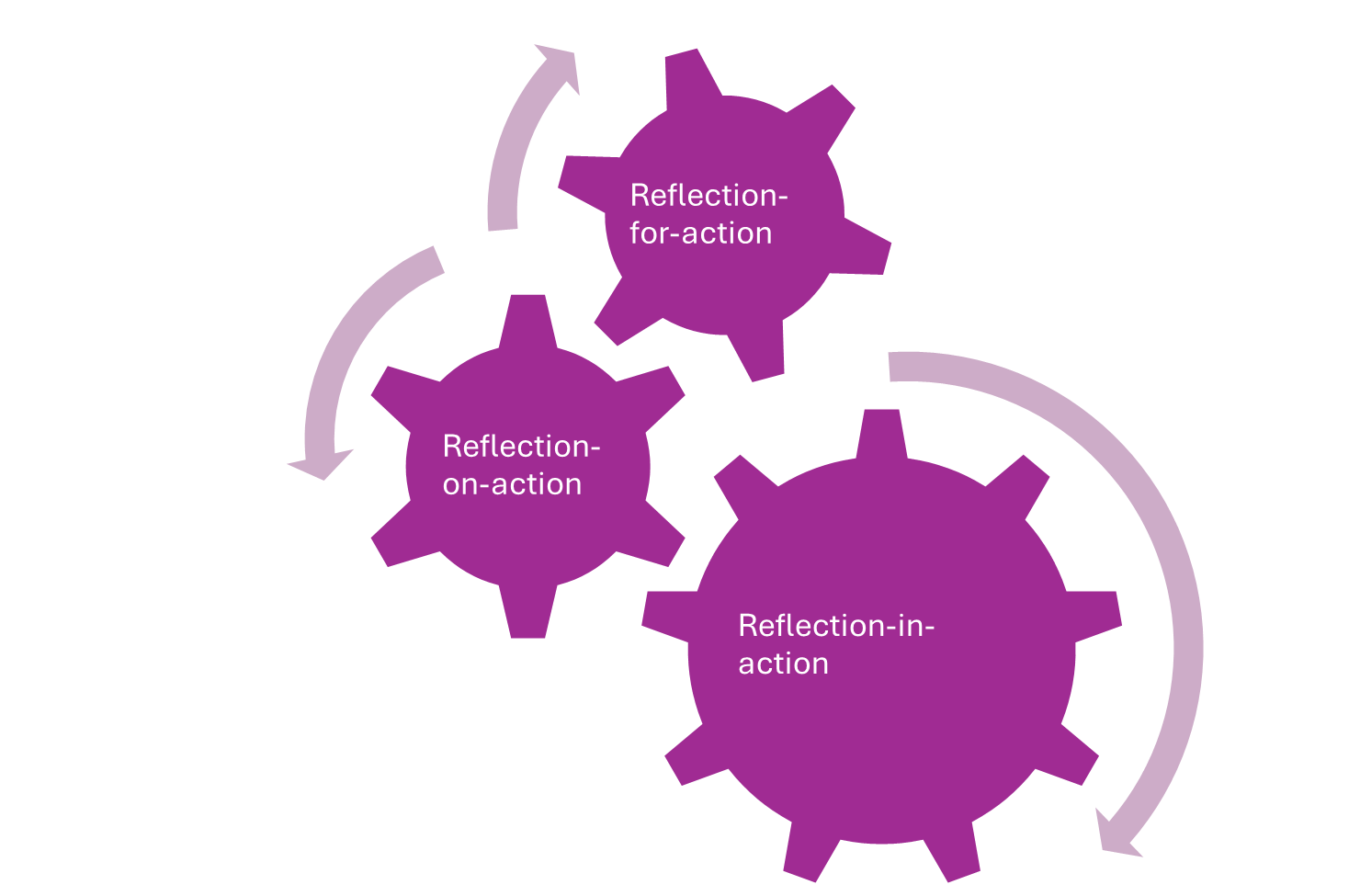
    A striking finding is that not all lecturers consistently engaged in reflective practices, and there wasn’t clear evidence of a shared, structured reflective culture across the teaching team. Some lecturers could articulate a teaching philosophy, but this didn’t always translate into a repeatable reflection cycle (before, during, and after teaching). I  framed this using Dewey and Schön’s well-known reflection stages:

    • Reflection-for-action (before teaching): planning with intention
    • Reflection-in-action (during teaching): adjusting as it happens
    • Reflection-on-action (after teaching): reviewing to improve next time

    Even where lecturers were clearly committed and experienced, reflection could still become fragmented, more like “minor tweaks” than a consistent, evidence-informed practice.

    The real engine of reflection: lecturer-student interaction

    Interaction isn’t just a teaching technique – it’s a reflection tool.

    Student questions, live confusion, moments of silence, a sudden “Ohhh!” – these are data. In the study, the clearest examples of reflection happening during teaching came from lecturers who intentionally built in interaction (eg questioning strategies, pausing for problem-solving).

    One example stands out: Denise’s in-class quiz is described as the only instance that embodied all three reflection components using student responses to gauge understanding, adapting support during the activity, and feeding insights forward into later planning.

    Why this matters right now in UK HE

    UK higher education is navigating increasing diversity in student backgrounds, expectations, and prior learning alongside sharper scrutiny of teaching quality and inclusion. In that context, reflective teaching isn’t “nice-to-have CPD”; it’s a way of ensuring our teaching practices keep pace with learners’ needs, not just disciplinary content.

    The paper doesn’t argue for abandoning lectures. Instead, it shows how reflective practice can help lecturers adapt within lecture-based structures especially through purposeful interaction that shifts students from passive listening toward more active/constructive engagement (drawing on engagement ideas such as ICAP).

    Three “try this tomorrow” reflective moves (small, practical, high impact)

    1. Plan one interaction checkpoint (not ten). Add a single moment where you must learn something from students (a hinge question, poll, mini-problem, or “explain it to a partner”). Use it as reflection-for-action.
    1. Name your in-the-moment adjustment. When you pivot (slow down, re-explain, swap an example), briefly acknowledge it: “I’m noticing this is sticky – let’s try a different route.” That’s reflection-in-action made visible.
    1. End with one evidence-based note to self. Not “Went fine.” Instead: “35% missed X in the quiz – next time: do Y before Z.” That’s reflection-on-action you can actually reuse.

    Questions to spark conversation (for you or your teaching team)

    • Where does your teaching philosophy show up most clearly: content coverage, student confidence, relevance, or interaction?
    • Which “data” do you trust most: NSS/module evaluation, informal comments, in-class responses, attainment patterns and why?

    If your programme is team-taught, what would a shared reflective framework look like in practice (so reflection isn’t isolated and inconsistent)?

    If reflective teaching is the intention, this article is the nudge: make reflection visible, structured, and interaction-led, so adaptation becomes a habit, not a heroic one-off.

    Dr Yetunde Kolajo is a Student Success Research Associate at the University of Kent. Her research examines pedagogical decision-making in higher education, with a focus on students’ learning experiences, critical thinking and decolonising pedagogies. Drawing on reflective teaching practice, she examines how inclusive and reflective teaching frameworks can enhance student success.


    Author: SRHE News Blog

    An international learned society, concerned with supporting research and researchers into Higher Education

    Source link

  • WEEKEND READING: What if, in trying to ‘fix’ universities, we are quietly unmaking them?

    WEEKEND READING: What if, in trying to ‘fix’ universities, we are quietly unmaking them?

    Join HEPI and Advance HE for a webinar on Tuesday, 13 January 2026, from 11am to 12pm, exploring what higher education can learn from leadership approaches in other sectors. Key topics will include innovative approaches to recruitment and diversity, and how to ensure future sector stability through effective leadership. Sign up here to hear this and more from our speakers.

    This blog was kindly authored by Dr Monica Franco-Santos, Reader in Organisational Governance and Performance, Cranfield University.

    Across the UK, it is widely recognised that universities are under intense financial pressure. The observable fact is simple enough: there is not enough money coming in to cover the costs of what universities are expected to do. The difficulty begins when leaders, advisers and commentators decide what kind of problem this is.

    How the financial problem is described is not neutral. It reflects and reinforces a particular way of understanding what a university is and how it should function. If the financial situation is framed as a classic demand-and-cost problem (i.e., demand is insufficient, prices are constrained, and unit costs are too high), then the university is, implicitly, being treated as a ‘service provider’ operating in a competitive international education market where students are customers. In that frame, the obvious actions are to emphasise tight cost controls and to strengthen output-focused performance metrics, targets and incentives such as promotions based on publications in highly rated journals, income generation or teaching satisfaction scores.

    If the same financial situation is framed instead as a system-level shock that threatens the conditions under which teaching, research and public service can flourish, then a different picture of the university comes into view: a ‘living knowledge ecosystem’ serving a public mission and facing financial constraints partly beyond its control. Within that frame, the responses appears quite different. Attention turns to protecting core capacities, reducing harm to the most vulnerable parts of the system and working with others to share risks and resources.

    In both cases, the numbers in the spreadsheets are the same. What differs is the story told about the problem, and the underlying image of the university that story presupposes. At present, the former factory-like framing is the most common. With it, the danger is that, under a narrative of financial constraints, universities take actions that emphasise governance practices that reshape behaviour so deeply that, over time, what remains may still be called a ‘university’, but no longer acts like one.

    What makes a university a university?

    Students come to university for far more than a certificate or a set of skills. They expect new knowledge, but also critical thinking, confidence, friendships, networks and the sense that they are part of something bigger than themselves. They hope that a university education will open doors and help them lead more meaningful and fuller lives.

    Academics are drawn to universities not only as workplaces. They want to pursue their passion, make meaningful contributions, explore new ideas, contribute to their disciplines and teach the next generation. Many accept lower pay and higher uncertainty than they might enjoy elsewhere because they believe in the university’s mission.

    Governments and taxpayers fund universities not because they are efficient ‘businesses’, but because they are essential public institutions. They generate research that underpins economic growth and cultural life. They educate professionals on whom society depends. They are meant to be spaces where difficult questions can be asked and discussed. They are fundamental institutions in a democratic society.

    None of this is easily captured by governance practices that focus on performance metrics, targets, incentives or cost controls. These governance practices convey a different message about what is valued and what counts, and over time, these messages have the power to reshape what people do and eventually, what a university is.

    The rise of ‘control-oriented governance practices’ and how they change the rules of the game

    In recent years, universities have increasingly adopted governance practices such as:

    • individual and departmental targets for income, outputs and student metrics;
    • performance indicators used in league tables and regulatory frameworks;
    • workload models that count every task in hours and allocate them through software;
    • performance-related pay and promotion criteria tied closely to measured outputs;
    • cost analysis that evaluates teaching programmes as if they were products or services in their own right.

    These control-oriented governance practices are introduced with good intentions. Leaders demand accountability and transparency. They want to reassure governors and regulators that they are ‘in control’. They want to show staff that decisions are based on objective data. However, these governance practices carry with them implicit assumptions: that performance is controllable, that it can be measured and managed in a hierarchical manner and that those who produce the measurable performance are likely to behave in self-interested, risk-averse, and effort-averse ways. As a result, cost control, monitoring, tight targets, and performance-contingent rewards are seen as necessary to secure results. In our current situation, that means financial results.

    What we tend to forget is that, as this style of governance spreads and becomes institutionalised, it often displaces older, more collegial arrangements in which academics and professional staff had greater discretion, participated in decisions and were trusted to act in line with the institution’s mission. Governance systems can become self-fulfilling. The assumptions on which they are based eventually appear to be true, not because they were accurate to begin with, but because the specific mechanisms introduced steadily guide people to behave as if they were.

    When these governance arrangements take hold, several things tend to happen:

    • academics who value autonomy, curiosity and public service may leave, or never enter, university life as they notice these values are no longer upheld. Others may be made redundant as part of cost-saving measures;
    • those who remain may adapt by focusing on what is measured rather than what matters. They learn to hit targets, manage their ‘scores’, and protect themselves. They eventually behave as the practices assume them to behave;
    • new entrants may be selected partly for their comfort with this environment. The population slowly changes.

    In this way, the market logic remakes the institution in its own image. At that point, the university may perform respectably in league tables and may have returned to healthy financial levels. But something more fundamental has shifted. The pattern of behaviour that governance practices value, reward and punish no longer aligns with the traditional mission of the university as a community of scholars serving the public good. The question then is not just “Are we financially sustainable?” It is “What kind of institution are we sustaining?”

    Questions for leaders and policymakers

    Policy work should offer alternatives, not only criticism. So what might it mean to protect the ’university-ness’ of universities under financial pressure?

    For governing bodies:

    • when you review performance information, ask not only “are we on target?” but also “what behaviours are these indicators encouraging or discouraging?”;
    • consider whether the balance between control and collegial governance is appropriate for different roles, especially for academic work.

    For vice-chancellors and senior teams:

    • before introducing new dashboards, workload systems or performance schemes, ask a simple question: “If this mechanism were the only thing staff knew about what we value, what would they infer?”;
    • involve staff from different groups in the design and review of governance mechanisms, and be open to evidence about unintended consequences, including effects on stress, trust and identity.

    For government and regulators:

    • recognise that the way funding and accountability regimes are structured shapes internal governance. If external frameworks reward narrow indicators, it is unsurprising that institutions pass that logic on to individuals;
    • consider how policy can support forms of governance that sustain academic stewardship, not only short-term performance.

    When do universities stop being universities?

    Universities can and must adapt. They have evolved many times in response to political, economic and technological shifts. No one is arguing for a return to a mythical golden age. However, if we allow a narrow, factory-style logic of control to dominate and we frame all our problems through that lens, we risk changing not only processes and structures, but the very rules of the game. When the values and behaviours that are made salient are those that undermine curiosity, critical thought and public service, the term ‘university’ begins to lose its substance.

    In my view, this is the core issue that staff, students, governors and policymakers should be debating. The question is not only how to keep universities solvent, but how to ensure that, in ten or twenty years’ time, they are still universities. And by that I mean: places where the pursuit of knowledge, the formation of judgement and the service to society remain at the heart of what they do.

    Source link

  • Degree apprenticeships are quietly redesigning how we teach at university

    Degree apprenticeships are quietly redesigning how we teach at university

    The apprentice-student is changing higher education – from curriculum to culture. It’s time we stopped treating them like traditional undergraduates.

    Degree apprenticeships (DAs) are not just reshaping the student experience – they’re redesigning the university itself. As the Office for Students (OfS) emphasises outcomes, progression, and employer engagement, and as Skills England continues to define standards for higher-level technical education, DAs are becoming a proving ground for some of higher education’s most urgent policy challenges.

    Yet they are often marginalised in strategic thinking, treated as vocational bolt-ons or niche offerings rather than core to institutional purpose. That’s a mistake. DAs demand that we think differently about curriculum, assessment, and academic infrastructure. Quietly but decisively, they are exposing the limitations of legacy systems, and pointing the way to a more integrated, future-facing university model.

    Different learners, different accountability

    Degree apprentices are full-time employees and students, legally entitled to spend 20 per cent of their working time on off-the-job learning. This is not simply “study leave” – it encompasses formal teaching, applied projects, reflective practice, and continuous professional development.

    This dual status creates a distinctive learner profile, and a distinctive teaching challenge. In designing a level 6 accounting and finance manager degree apprenticeship, we couldn’t simply repackage existing content. We had to co-develop new modules that satisfied two sets of demands: the academic rigour expected by the university and the occupational standards defined by the Institute for Apprenticeships and Technical Education (IfATE). These must also align with professional accounting syllabi from bodies such as CIMA, ACCA and ICAEW.

    This triple mapping – to university, regulatory, and professional standards – creates what might be called multi-stakeholder accountability. It requires curriculum teams to work in ways that are more agile, responsive, and externally engaged than many traditional degree programmes.

    Rethinking assessment

    If OfS regulation is pushing universities toward more transparent, outcomes-focused assessment practices, DAs offer a blueprint for how that can work in practice. Assessment in degree apprenticeships is not an end-of-module activity; it’s a longitudinal, triangulated process involving the learner, the employer, and the academic team. Learners are required to build portfolios of evidence, reflect on their practice, and complete an end-point assessment, which is externally quality-assured.

    In our programme, this means apprentices must show how they’ve applied ESG frameworks to real reporting challenges or used digital tools to improve efficiency. These are not hypothetical case studies, they’re deliverables with real organisational impact.

    This demands a fundamental shift in how we understand assessment. It moves from a one-directional judgement to a co-produced, real-world demonstration of competence and critical thinking. It also raises practical challenges: how do we ensure equity, consistency, and academic standards in these shared spaces?

    Practice must evolve too. Assessment boards and quality teams need confidence in workplace-verified evidence and dialogic tools like professional discussions. Regulations may need adjusting to formally recognise these approaches as valid and rigorous. Co-created assessment models will only work if they’re institutionally supported, not just permitted.

    Institutional systems still speak undergraduate

    Despite their growth – and repeated nods in policy papers from DfE, OfS, and IfATE (now Skills England) – DAs still struggle to integrate fully into institutional structures designed around traditional undergraduates.

    Timetabling, academic calendars, support services, and digital access systems are still largely predicated on a three-year, 18- to 21-year-old, campus-based model. Degree apprentices, who may study in blocks, access learning from workplaces, and require hybrid delivery modes, often fall through the gaps.

    This institutional lag risks positioning apprenticeships as peripheral rather than core to university provision, and undermines the very work-based, flexible, lifelong learning that national policy increasingly promotes.

    To move beyond legacy assumptions, institutional systems must adapt. Timetabling and delivery planning should treat block teaching as core, not marginal. Learner support must accommodate hybrid work-study lives with flexible pastoral care and digital access. Even workload models and quality assurance processes may need tailoring to reflect co-delivery demands

    If we are serious about the Lifelong Learning Entitlement, future modularity, and widening participation, DAs are not just a test case, they are the early evidence base.

    Who owns the curriculum?

    DAs also reconfigure academic authority. In designing the our degree apprenticeship programme, we co-developed curriculum with employers, professional bodies, and regulators. At its best, this is collaborative innovation. At its most complex, it’s curriculum by committee.

    Some employers overestimate their control over content or underestimate their responsibilities around mentoring and assessment. Professional bodies may be supportive in principle, but slow to recognise apprenticeship pathways in formal qualifications. The university becomes a mediator, balancing academic integrity, regulatory compliance, and employer priorities.

    This is delicate, sometimes frustrating work. But it also shifts the purpose of curriculum design, from academic transmission to negotiated, contextualised learning and demands that academic teams are supported to work across professional and regulatory boundaries without compromising standards

    What universities can learn

    DAs are more than a niche. They’re a stress test, revealing how well universities are equipped to deliver flexible, employer-engaged, outcome-driven learning.

    They challenge traditional pedagogies, reward authentic assessment, and open up new relationships between knowledge and practice. They also model the kinds of teaching and learning the sector is being increasingly nudged toward by policy: modular, flexible, accountable, and co-created with employers.

    This is not an argument for turning every degree into an apprenticeship. But it is a call to stop treating DAs as bolt-ons or exceptions. If we take seriously the structural and pedagogical shifts they demand, we may find in them a pathway to broader institutional transformation.

    In a higher education landscape increasingly shaped by regulation, scrutiny, digital disruption and workforce change, the apprentice-student may not just be part of the future – they may be leading it.

    Source link