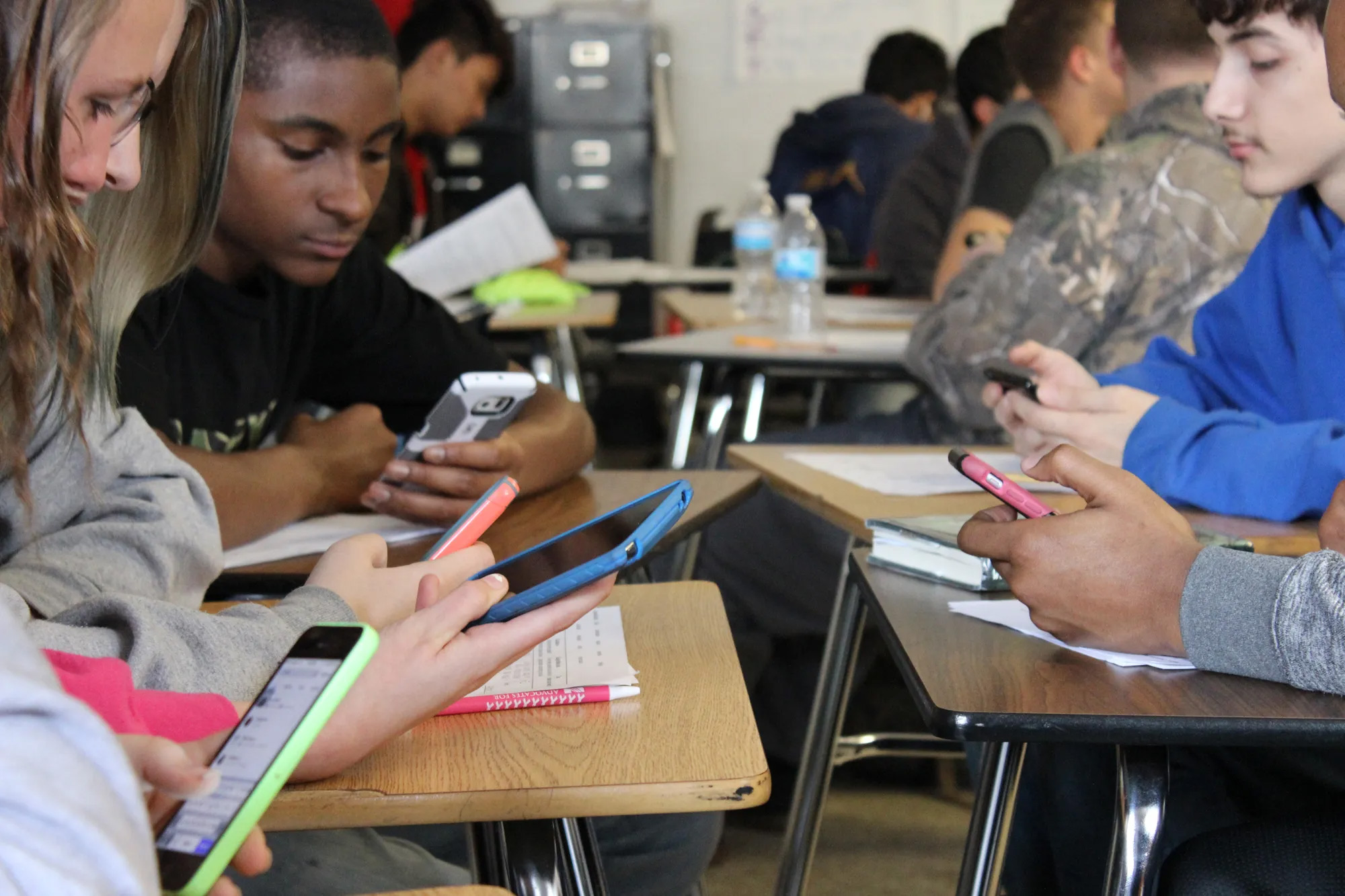
Thirty states now limit or ban cellphone use in classrooms, and teachers are noticing children paying attention to their lessons again. But it’s not clear whether this policy — unpopular with students and a headache for teachers to enforce — makes an academic difference.
If student achievement goes up after a cellphone ban, it’s tough to know if the ban was the reason. Some other change in math or reading instruction might have caused the improvement. Or maybe the state assessment became easier to pass. Imagine if politicians required all students to wear striped shirts and test scores rose. Few would really think that stripes made kids smarter.
Two researchers from the University of Rochester and RAND, a nonprofit research organization, figured out a clever way to tackle this question by taking advantage of cellphone activity data in one large school district in Florida, which in 2023 became the first state to institute school cellphone restrictions. The researchers compared schools that had high cellphone activity before the ban with those that had low cellphone usage to see if the ban made a bigger difference for schools that had high usage.
Indeed, it did.
Related: Our free weekly newsletter alerts you to what research says about schools and classrooms.
Student test scores rose a bit more in high cellphone usage schools two years after the ban compared with schools that had lower cellphone usage to start. Students were also attending school more regularly.
The policy also came with a troubling side effect. The cellphone bans led to a significant increase in student suspensions in the first year, especially among Black students. But disciplinary actions declined during the second year.
“Cellphone bans are not a silver bullet,” said David Figlio, an economist at the University of Rochester and one of the study’s co-authors. “But they seem to be helping kids. They’re attending school more, and they’re performing a bit better on tests.”
Figlio said he was “worried” about the short-term 16 percent increase in suspensions for Black students. What’s unclear from this data analysis is whether Black students were more likely to violate the new cellphone rules, or whether teachers were more likely to single out Black students for punishment. It’s also unclear from these administrative behavior records if students were first given warnings or lighter punishments before they were suspended.
The data suggest that students adjusted to the new rules. A year later, student suspensions, including those of Black students, fell back to what they had been before the cellphone ban.
“What we observe is a rocky start,” Figlio added. “There was a lot of discipline.”
The study, “The Impact of Cellphone Bans in Schools on Student Outcomes: Evidence from Florida,” is a draft working paper and has not been peer-reviewed. It was slated to be circulated by the National Bureau of Economic Research on Oct. 20 and the authors shared a draft with me in advance. Figlio and his co-author Umut Özek at RAND believe it is the first study to show a causal connection between cellphone bans and learning rather than just a correlation.
The academic gains from the cellphone ban were small, less than a percentile point, on average. That’s the equivalent of moving from the 50th percentile on math and reading tests (in the middle) to the 51st percentile (still close to the middle), and this small gain did not emerge until the second year for most students. The academic benefits were strongest for middle schoolers, white students, Hispanic students and male students. The academic gains for Black students and female students were not statistically significant.
I was surprised to learn that there is data on student cellphone use in school. The authors of this study used information from Advan Research Corp., which collects and analyzes data from mobile phones around the world for business purposes, such as figuring out how many people visit a particular retail store. The researchers were able to obtain this data for schools in one Florida school district and estimate how many students were on their cellphones before and after the ban went into effect between the hours of 9 a.m. and 1 p.m.
The data showed that more than 60 percent of middle schoolers, on average, were on their phones at least once during the school day before the 2023 ban in this particular Florida district, which was not named but described as one of the 10 largest districts in the country. (Five of the nation’s 10 largest school districts are in Florida.) After the ban, that fell in half to 30 percent of middle schoolers in the first year and down to 25 percent in the second year.
Elementary school students were less likely to be on cellphones to start with and their in-school usage fell from about 25 percent of students before the ban to 15 percent after the ban. More than 45 percent of high schoolers were on their phones before the ban and that fell to about 10 percent afterwards.
Average daily smartphone visits in schools, by year and grade level
Average daily smartphone visits during regular school days (relative to teacher workdays without students) between 9am and 1pm (per 100 enrolled students) in the two months before and then after the 2023 ban took effect in one large urban Florida school district. Source: Figlio and Özek, October 2025 draft paper, figure 2C, p. 23.
Florida did not enact a complete cellphone ban in 2023, but imposed severe restrictions. Those restrictions were tightened in 2025 and that additional tightening was not studied in this paper.
Anti-cellphone policies have become increasingly popular since the pandemic, largely based on our collective adult gut hunches that kids are not learning well when they are consumed by TikTok and SnapChat.
This is perhaps a rare case in public policy, Figlio said, where the “data back up the hunches.”
The Hechinger Report provides in-depth, fact-based, unbiased reporting on education that is free to all readers. But that doesn’t mean it’s free to produce. Our work keeps educators and the public informed about pressing issues at schools and on campuses throughout the country. We tell the whole story, even when the details are inconvenient. Help us keep doing that.
Tanish Doshi was in high school when he pushed the Tucson Unified School District to take on an ambitious plan to reduce its climate footprint. In Oct. 2024, the availability of federal tax credits encouraged the district to adopt the $900 million plan, which involves goals of achieving net-zero emissions and zero waste by 2040, along with adding a climate curriculum to schools.
Now, access to those funds is disappearing, leaving Tucson and other school systems across the country scrambling to find ways to cover the costs of clean energy projects.
The Arizona school district, which did not want to impose an economic burden on its low-income population by increasing bonds or taxes, had expected to rely in part on federal dollars provided by the Biden-era Inflation Reduction Act, Doshi said.
But under HR1, or the “one big, beautiful bill,” passed on July 4, Tucson schools will not be able to receive all of the expected federal funding in time for their upcoming clean energy projects. The law discontinues many clean energy tax credits, including those used by schools for solar power and electric vehicles, created under the IRA. When schools and other tax-exempt organizations receive these credits, they come in the form of a direct cash reimbursement.
At the same time, Tucson and thousands of districts across the country that were planning to develop solar and wind power projects are now forced to decide between accelerating them to try to meet HR1’s fast-approaching “commence construction” deadline of June 2026, finding other sources of funding or hitting pause on their plans. Tina Cook, energy project manager for Tucson schools, said the district might have to scale back some of its projects unless it could find local sources of funding.
“Phasing out the tax credits for wind and solar energy is going to make a huge, huge difference,” said Doshi, 18, now a first-year college student. “It ends a lot of investments in poor and minority communities. You really get rid of any notion of environmental justice that the IRA had advanced.”
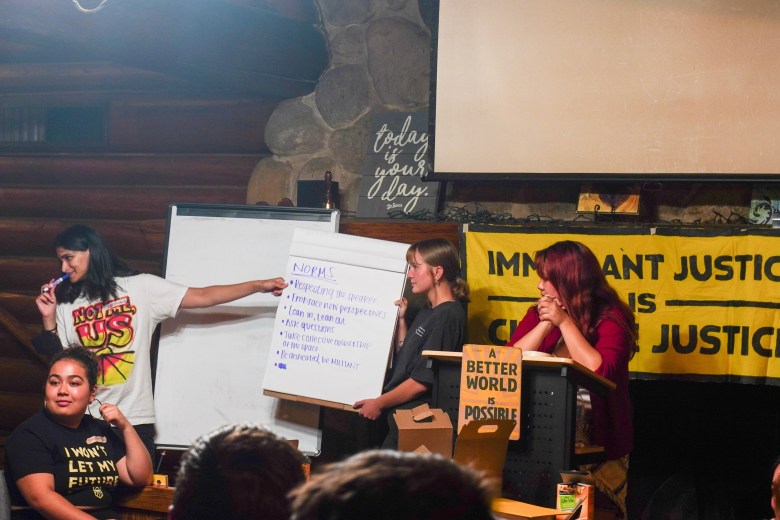
Emma Weber leads a chant at a Colorado state capitol rally in support of “The Green New Deal for Colorado Schools.” Credit: Courtesy of Emma Weber
The tax credits in the IRA, the largest legislative investment in climate projects in U.S. history, had marked a major opportunity for schools and colleges to reduce their impact on the environment. Educational institutions are significant contributors to climate change: K-12 school infrastructure, for example, releases at least 41 million metric tons of emissions per year, according to a paper from the Annenberg Institute at Brown University. The K-12 school system’s buses — some 480,000 — and meals also produce significant emissions and waste. Clean energy projects supported by the IRA were helping schools not only to limit their climate toll but also to save money on energy costs over the long term and improve student health, advocates said.
As a result, many students, consultants and sustainability leaders said, they have no plans to abandon clean energy projects. They said they want to keep working to cut emissions, even though that may be more difficult now.
Related: Become a lifelong learner. Subscribe to our free weekly newsletter featuring the most important stories in education.
Sara Ross, cofounder of UndauntedK12, which helps school districts green their operations, divided HR1’s fallout on schools into three categories: the good, the bad and the ugly.
On the bright side, she said, schools can still get up to 50 percent off for installing ground source heat pumps — those credits will continue — to more efficiently heat and cool schools. The network of pipes in a ground source pump cycles heat from the shallow earth into buildings.
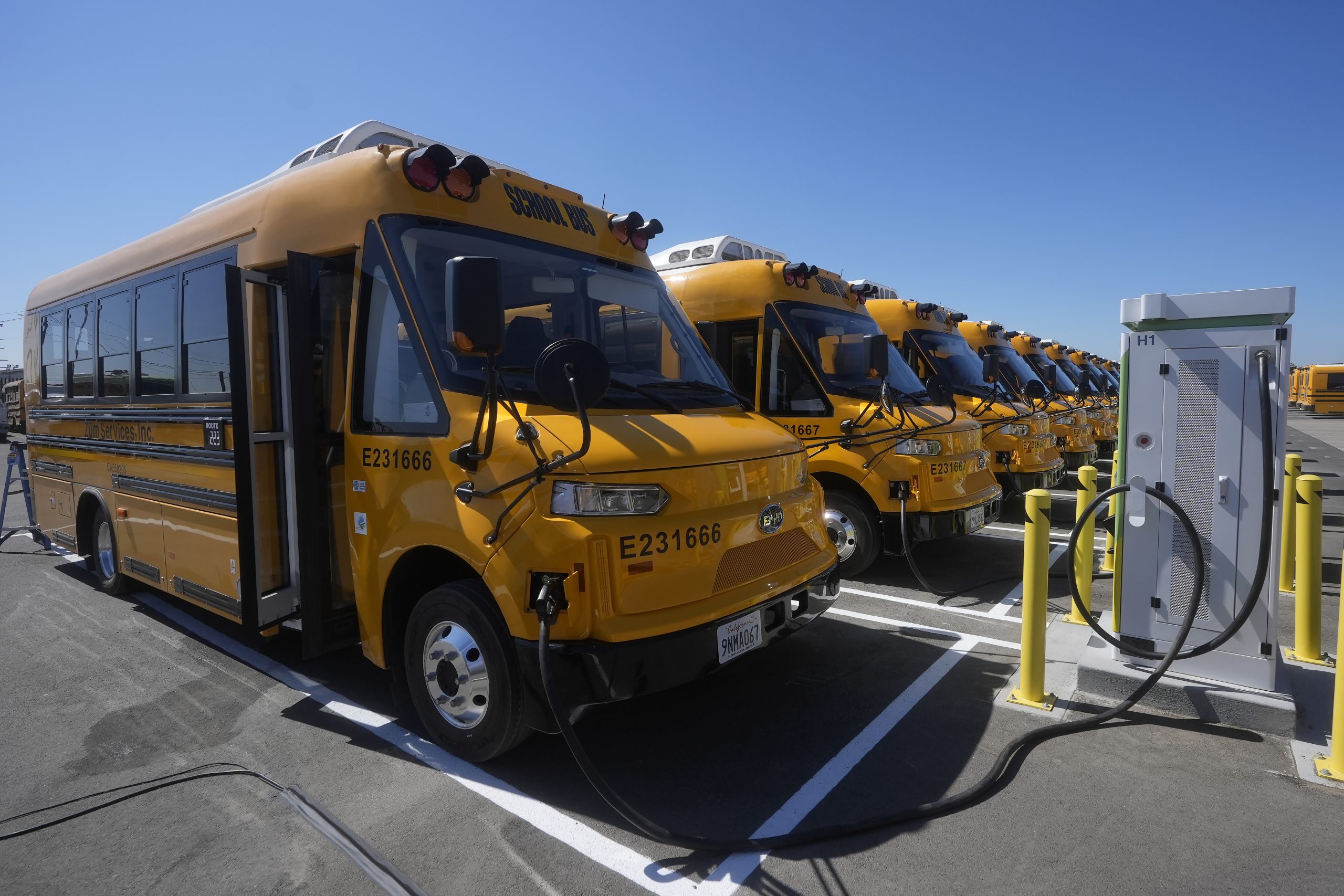
In the “bad” category, any electric vehicle acquired after Sept. 30 of this year will not be eligible for tax credits — drastically accelerating the IRA’s phase-out timeline by seven years. That applies to electric school buses as well as other district-owned vehicles. Electric vehicle charging stations must be installed by June 30, 2026 at an eligible location to claim a tax credit.*
The expiration of the federal tax credits could cost a district up to $40,000 more per vehicle, estimated Sue Gander, director of the Electric School Bus Initiative run by the nonprofit World Resources Institute.
Solar projects will see the most “ugly” effects of HR1, Ross said.
Los Angeles Unified School District is planning to build 21 solar projects on roofs, carports and other structures, plus 13 electric vehicle charging sites, as part of an effort to reduce energy costs and achieve 100 percent renewable energy by 2040. The district anticipated receiving around $25 million in federal tax credits to help pay for the $90 million contract, said Christos Chrysiliou, chief eco-sustainability officer for the district. With the tight deadlines imposed by HR1, the district can no longer count on receiving that money.
“It’s disappointing,” Chrysiliou said. “It’s nice to be able to have that funding in place to meet the goals and objectives that we have.”
Emma Weber, at left, trains student leaders at Sunrise Movement’s “summer intensive” in Illinois this year. Credit: Courtesy of Emma Weber
LAUSD is looking at a small portion of a $9 billion bond measure passed last year, as well as utility rebates, third-party financing and grants from the California Energy Commission, to help make up for some of the gaps in funding.
Many California State University campuses are in a similar position as they work to install solar to meet the system’s goal of carbon neutrality by 2045, said Lindsey Rowell, CSU’s chief energy, sustainability and transportation officer.
Tariffs on solar panel materials from overseas and the early sunsetting of tax credits mean that “the cost of these projects are becoming prohibitive for campuses,” Rowell said.
Sweeps of undocumented immigrants in California may also lead to labor shortages that could slow the pace of construction, Rowell added. “Limiting the labor force in any way is only going to result in an increased cost, so those changes are frightening as well,” she said.
New Treasury Department guidance, issued Aug. 15, made it much harder for projects to meet the threshold needed to qualify for the tax credits. Renewable energy projects previously qualified for credits once a developer spent 5 percent of a project’s cost. But the guidelines have been tightened — now, larger projects must pass a “physical work test,” meaning “significant physical labor has begun on a site,” before they can qualify for credits. With the construction commencement deadline looming next June, these will likely leave many projects ineligible for credits.
“The rules are new, complex [and] not widely understood,” Ross said. “We’re really concerned about schools’ ability to continue to do solar projects and be able to effectively navigate these new rules.”
Schools without “fancy legal teams” may struggle to understand how the new tax credit changes in HR1 will affect their finances and future projects, she added.
Some universities were just starting to understand how the IRA tax credits could help them fund projects. Lily Strehlow, campus sustainability coordinator at the University of Wisconsin, Eau-Claire, said the planning cycle for clean energy projects at the school can take ten years. The university is in the process of adding solar to the roof of a large science building, and depending on the date of completion, the project “might or might not” qualify for the credits, she said.
“At this point, everybody’s holding their breath,” said Rick Brown, founder of California-based TerraVerde Energy, a clean energy consultant to schools and agencies.
Brown said that none of his company’s projects are in a position where they’re not going to get done, but the company may end up seeing fewer new projects due to a higher cost of equipment.
Tim Carter, president of Second Nature, which supports climate work in education, added that colleges and universities are in a broader period of uncertainty, due to larger attacks from the Trump administration, and are not likely to make additional investments at this time: “We’re definitely in a wait and see.”
For youth activists, the fallout from HR1 is “disheartening,” Doshi said.
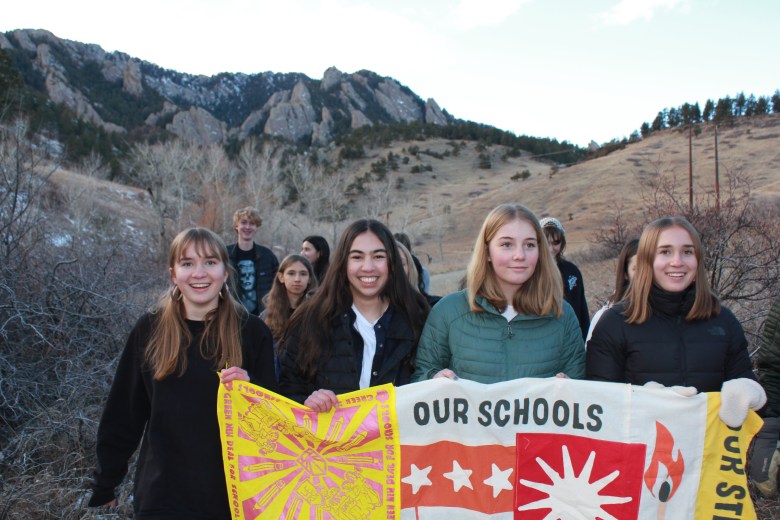
Emma and Molly Weber, climate activists since eighth grade, said they are frustrated. The Colorado-based twins, who will start college this fall, helped secure the first “Green New Deal for Schools” resolution in the nation in the Boulder Valley School District. Its goals include working toward a goal of Zero Net Energy by 2050, making school buildings greener, creating pathways to green jobs and expanding climate change education.
Emma, far left, and Molly Weber, far right, work with climate leaders from the Boulder Valley School District’s Sunrise Movement to prepare for Colorado’s legislative session. Credit: Courtesy of Emma Weber
“It feels very demoralizing to see something you’ve been working so hard at get slashed back, especially since I’ve spoken to so many students from all over the country about these clean energy tax credits, being like, ‘These are the things that are available to you, and this is how you can help convince your school board to work on this,’” Emma Weber said.
The Webers started thinking about other creative ways to pay for the clean energy transition and have settled on advocating for state-level legislation in the form of a climate superfund, where major polluters in a community would be responsible for contributing dollars to sustainability initiatives.
Consultants and sustainability coordinators said that they don’t see the demand for renewable energy going away. “Solar is the cheapest form of energy. It makes sense to put it on every rooftop that we can. And that’s true with or without tax credits,” Strehlow said.
*Correction: This version of the story includes updated information on the timeline for the expiration of tax credits for electric vehicle charging stations.
Contact editor Caroline Preston at 212-870-8965, via Signal at CarolineP.83 or on email at [email protected].
The Hechinger Report provides in-depth, fact-based, unbiased reporting on education that is free to all readers. But that doesn’t mean it’s free to produce. Our work keeps educators and the public informed about pressing issues at schools and on campuses throughout the country. We tell the whole story, even when the details are inconvenient. Help us keep doing that.
After a three-year pause prompted by the pandemic, the clock on student loan repayments suddenly started ticking again in September 2023, and forbearance ended last September. For millions of borrowers like Shauntee Russell, the resumption of payments marked a harsh return to financial reality.
Russell, a single mother of three from Chicago, had received $127,000 in student loan forgiveness through the SAVE program, and had experienced profound relief at having that $632 monthly payment lifted from her shoulders. SAVE exemplified both the transformative power of debt relief and the urgent need to continue this fight — but now SAVE has been suspended.
Such setbacks cannot be the end of our story, as I document in my forthcoming book. The resumption of loan payments, while painful, must serve as a rallying cry rather than a surrender. We stand at a critical juncture. The Supreme Court’s devastating blow to former President Biden’s initial forgiveness plan and the ongoing legal challenges to programs like SAVE have left 45 million borrowers in a state of financial limbo. The fundamental inequities of our higher education system have never been more apparent.
Black students graduate with nearly 50 percent more debt than their white counterparts, while women hold roughly two-thirds of all outstanding student debt — a staggering $1.5 trillion that continues to grow. These aren’t just statistics; they represent systemic barriers that prevent entire communities from achieving economic mobility.
Related: Interested in innovations in higher education? Subscribe to our free biweekly higher education newsletter.
The students I interviewed while reporting on this crisis reveal the human cost of inaction. They include Maria Sanchez, a nursing student in St. Louis who skips meals to save money and can only access textbooks through library loans.
Then there is Robert Carroll, who gave up his dorm room in Cleveland and now alternates between friends’ couches just to stay in school.
These students represent the millions who are working multiple jobs, sacrificing basic needs and seeing their dreams deferred under the weight of financial pressure.
Yet what strikes me most is their resilience and determination. Despite these overwhelming obstacles, these students persist, driven by the same belief that motivated civil rights leaders like Congressman Adam Clayton Powell Jr. — that education is the pathway to economic empowerment and social justice.
The current political landscape, with Donald J. Trump’s return to the presidency and a Republican-controlled Congress, presents unprecedented challenges. Plans to dismantle key borrower protections and efforts to eliminate the Department of Education signal a dark period ahead for student debt relief.
But history teaches us that progress often comes through sustained grassroots organizing and innovative policy solutions at multiple levels of government and society.
Universities must step up with institutional relief programs, as my own institution, Trinity Washington University, did when it settled $1.8 million in student balances during the pandemic.
The Black church, which has long understood the connection between education and liberation, continues to provide crucial support through scholarship programs. Organizations like the United Negro College Fund, the Thurgood Marshall College Fund and the National Association for Equal Opportunity in Higher Education remain vital pillars in making higher education accessible.
Still, individual, institutional and state efforts, while necessary, are not sufficient. We need comprehensive federal action that treats student debt as what it truly is: a civil rights issue and a moral imperative. The magnitude of the crisis — it affects Americans across every congressional district — creates unique opportunities for bipartisan coalition building.
Smart advocates are already reframing the narrative by replacing partisan talking points with economic arguments that resonate across ideological lines: workforce development, entrepreneurship and American competitiveness on the world stage.
When student debt prevents nurses from serving rural communities, teachers from working in underserved schools and young entrepreneurs from starting businesses, it becomes an economic drag that affects everyone.
The path to federal action may require creative approaches — perhaps through tax policy, regulatory changes or targeted relief for specific professions — but the political mathematics of 45 million impacted voters ultimately makes comprehensive action not just morally necessary, but politically inevitable.
Student debt relief is not about handouts — it’s about honoring the promise that education should be a ladder up, not an anchor weighing down entire generations; it’s about ensuring that Shauntee Russell’s relief becomes the norm, not the exception. The fight is far from over.
The young activists I met at the March on Washington 60th anniversary understood something profound: Their debt is not their fault, but their fight is their responsibility. They carry forward the legacy of those who came before them who believed that access to education should not depend on one’s family wealth, and that crushing debt should not be the price of pursuing knowledge.
The arc of history still bends toward justice — but in this era of political resistance, we must be prepared to bend it ourselves through sustained organizing, innovative policy solutions and an unwavering commitment to the principle that education is a right, not a privilege reserved for the wealthy.
The resumption of payments is not the end of this story. It’s the beginning of the next chapter in our fight for educational equity and economic justice. And this chapter, like those before it, will be written by the voices of the millions who refuse to let debt define their destiny.
Jamal Watson is a professor and associate dean of graduate studies at Trinity Washington University and an editor at Diverse Issues In Higher Education.
The Hechinger Report provides in-depth, fact-based, unbiased reporting on education that is free to all readers. But that doesn’t mean it’s free to produce. Our work keeps educators and the public informed about pressing issues at schools and on campuses throughout the country. We tell the whole story, even when the details are inconvenient. Help us keep doing that.
MOREHEAD, Ky. — The summer after ninth grade, Zoey Griffith found herself in an unfamiliar setting: a dorm on the Morehead State University campus.
There, she’d spend the months before her sophomore year taking classes in core subjects including math and biology and electives like oil painting.
For Griffith, it was an opportunity, but a scary one. “It was a big deal for me to live on campus at the age of 14,” she said. Morehead State is about an hour from her hometown of Maysville. “I was nervous, and I remember that I cried the first time that my dad left me on move-in day.”
Her mother became a parent as a teenager and urged her daughter to avoid the same experience. Griffith’s father works as a mechanic, and he frowns upon the idea of higher education, she said.
And so college back then seemed a distant and unlikely idea.
But Griffith’s stepsister had introduced her to a federal program called Upward Bound. It places high school students in college dorms during the summer, where they can take classes and participate in workshops on preparing for the SAT and financial literacy. During the school year, students get tutoring and work on what are called individual success plans.
Upward Bound students test the robots they built in their robotics class – evaluating for programming and mechanical issues. Credit: Photo courtesy of the Upward Bound Programs
It’s part of a group of federal programs, known as TRIO, aimed at helping low-income and first-generation students earn a college degree, often becoming the first in their families to do so.
So, thanks to that advice from her stepsister, Kirsty Beckett, who’s now 27 and pursuing a doctorate in psychology, Griffith signed up and found herself in that summer program at Morehead State. Now, Griffith is enrolled at Maysville Community and Technical College, with plans to become an ultrasound technician.
Related: Interested in more news about colleges and universities? Subscribe to our free biweekly higher education newsletter.
TRIO, once a group of three programs — giving it a name that stuck — is now the umbrella over eight some dating back to 1965. Together, they serve roughly 870,000 students nationwide a year.
It has worked with millions of students and has bipartisan support in Congress. Some in this part of the Appalachian region of Kentucky, and across the country, worry about students who won’t get the same assistance if President Donald Trump ends federal spending on the program.
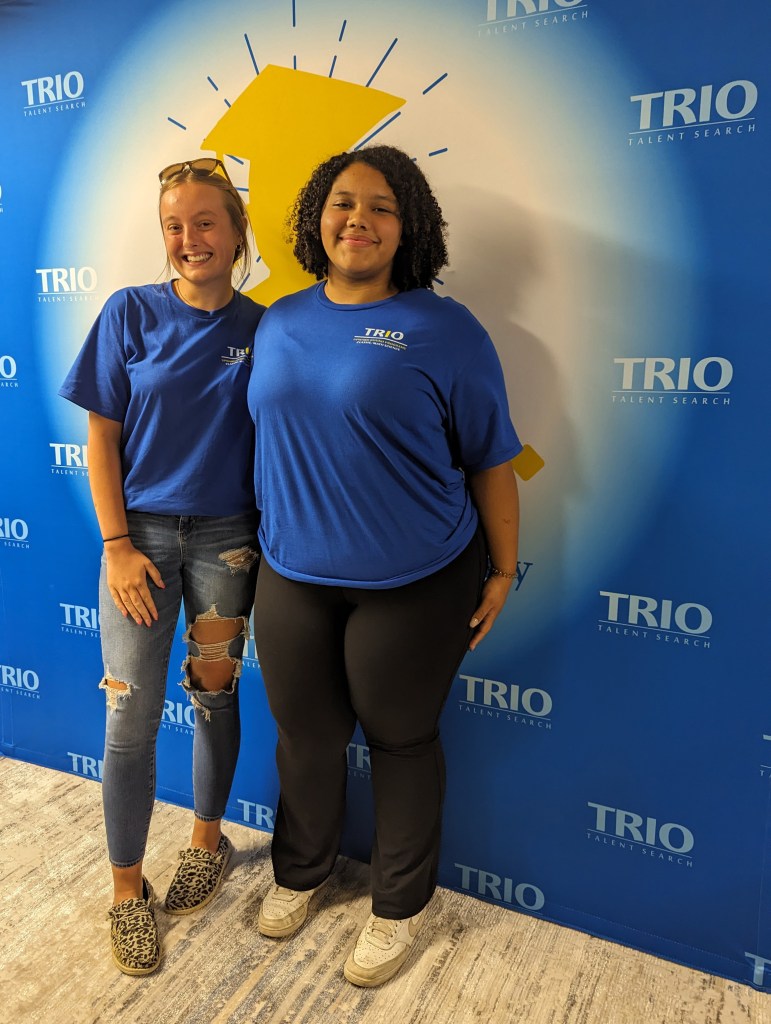
Students Zoey Griffith, left, and Aniyah Caldwell, right, say the Upward Bound program has been life-changing for them. Upward Bound is one of eight federal programs under the TRIO umbrella. Credit: Michael Vasquez for The Hechinger Report
A White House budget proposal would eliminate spending on TRIO. The document says “access to college is not the obstacle it was for students of limited means” and puts the onus on colleges to recruit and support students.
Advocates note that the programs, which cost roughly $1.2 billion each year, have a proven track record. Students in Upward Bound, for example, are more than twice as likely to earn a bachelor’s degree by age 24 than other students from some of the nation’s poorest households, according to the Council for Opportunity in Education. COE is a nonprofit that represents TRIO programs nationwide and advocates for expanded opportunities for first-generation, low-income students.
For the high school class of 2022, 74 percent of Upward Bound students enrolled immediately in college — compared with only 56 percent of high school graduates in the bottom income quartile.
Upward Bound is for high school students, like Griffith. Another TRIO program, Talent Search, helps middle and high school students, without the residential component. One called Student Support Services (SSS) provides tutoring, advising and other assistance to at-risk college students. Another program prepares students for graduate school and doctoral degrees, and yet another trains TRIO staff.
A 2019 study found that after four years of college, students in SSS were 48 percent more likely to complete an associate’s degree or certificate, or transfer to a four-year institution, than a comparable group of students with similar backgrounds and similar levels of high school achievement who were not in the program.
“TRIO has been around for 60 years,” said Kimberly Jones, the president of COE. “We’ve produced millions of college graduates. We know it works.”
Yet Education Secretary Linda McMahon and the White House refer to the programs as a “relic of the past.”
Jones countered that census data shows that “students from the poorest families still earn college degrees at rates far below that of students from the highest-income families,” demonstrating continued need for TRIO.
McMahon is challenging that and pushing for further study of those TRIO success rates. In 2020, the U.S. Government Accountability Office found that even though the Education Department collects data on TRIO participants, “the agency has gaps in its evidence on program effectiveness.” The GAO criticized the Education Department for having “outdated” studies on some TRIO programs, and no studies at all for others. Since then, the department has expanded its evaluations of TRIO.
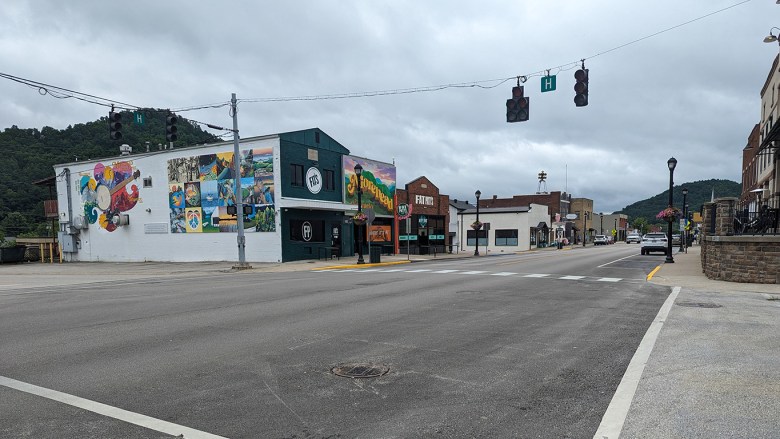
East Main Street in Morehead, Kentucky, just outside of Morehead State’s campus. Credit: Michael Vasquez for The Hechinger Report
During a Senate subcommittee hearing in June, McMahon acknowledged “there is some effectiveness of the programs, in many circumstances.”
Still, she said there is not enough research to justify TRIO’s total cost. “That’s a real drawback in these programs,” McMahon said.
Now, she is asking lawmakers to eliminate TRIO spending after this year and has already canceled some previously approved TRIO grants.
“What are we supposed to do, especially here in eastern Kentucky?” asked David Green, a former Upward Bound participant who is now marketing director for a pair of Kentucky hospitals.
Green lives in a region that has some of the nation’s highest rates of unemployment, cancer and opioid addiction. “I mean, these people have big hearts, they want to grow,” he added. Cutting these programs amounts to “stifling us even more than we’re already stifled.”
Green described his experience with TRIO at Morehead State in the mid-1980s as “one of the best things that ever happened to me.”
He grew up in a home without running water in Maysville, a city of about 8,000 people. It was on a TRIO trip to Washington, D.C., he recalled, that he stayed in a hotel for the first time. Green remembers bringing two suitcases so he could pack a pillow, sheets and comforter — unaware the hotel room would have its own.
He met students from other towns and with different backgrounds. Some became lifelong friends. Green learned table manners, the kind of thing often required in business settings. After college, he was so grateful for TRIO that he became one of its tutors, working with the next generation of students.
TRIO’s all-encompassing nature makes it unique among college access programs, said Tom Stritikus, the president of Occidental College, a private liberal arts college in Los Angeles. He was previously president of Fort Lewis College, a public liberal arts school in Colorado with a large Native American student population. At both institutions, Stritikus said, he witnessed the effectiveness of TRIO’s methods, which he described as a “soup to nuts” menu of services for at-risk students trying to be the first in their families to earn degrees.
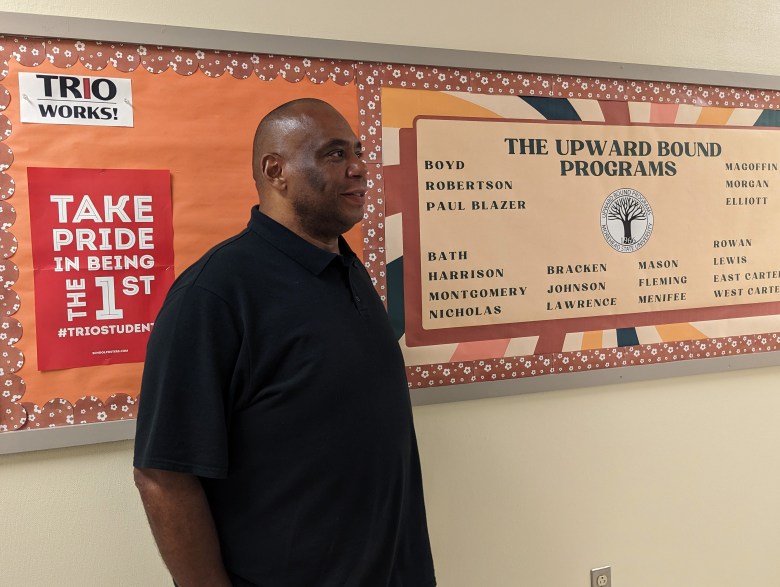
After participating in the Upward Bound program, David Green has had a successful career, becoming a community leader in his hometown of Maysville, Kentucky. Credit: Michael Vasquez for The Hechinger Report
Jones, of the Council for Opportunity in Education, said she is cautiously optimistic that Congress will continue funding TRIO, despite the Trump administration’s request. The programs serve students in all 50 states. According to the COE, about 34 percent are white, 32 percent are Black, 23 percent are Hispanic, 5 percent are Asian, and 3 percent are Native American. TRIO’s guidelines require that a majority of participants come from families making less than 150 percent of the federal poverty level. For a family of four living in the contiguous United States, that’s a max of $48,225 a year.
In May, Rep. Mike Simpson, an Idaho Republican, called TRIO “one of the most effective programs in the federal government,” which, he said, is supported by “many, many members of Congress.”
In June, Sen. Shelley Moore Capito, a Republican from West Virginia and a former TRIO employee, spoke about its importance to her state. TRIO helps “a student that really needs the extra push, the camaraderie, the community,” she said. “I’ve gone to their graduations, and been their speaker, and it’s really quite delightful to see how far they’ve come, in a short period of time.”
TRIO survived, with its funding intact, when the Senate appropriations committee approved its budget last month. The House is expected to take up its version of the annual appropriations bill for education in early September. Both chambers ultimately have to agree on federal spending, a process that could drag on until December, leaving TRIO’s fate in Congress uncertain.
While lawmakers debate its future, the Trump administration could also delay or halt TRIO funding on its own. Earlier this year, the administration took the unprecedented step of unilaterally canceling about 20 previously approved new and continuing TRIO grants.
At Morehead State, leaders say the university — and the region it serves — need the boost it receives from TRIO: While roughly 38 percent of American adults have earned at least a bachelor’s degree, in Kentucky, that figure is only 16 percent. And, locally, it’s 7 percent, according to Summer Fawn Bryant, the director of TRIO’s Talent Search programs at the university.
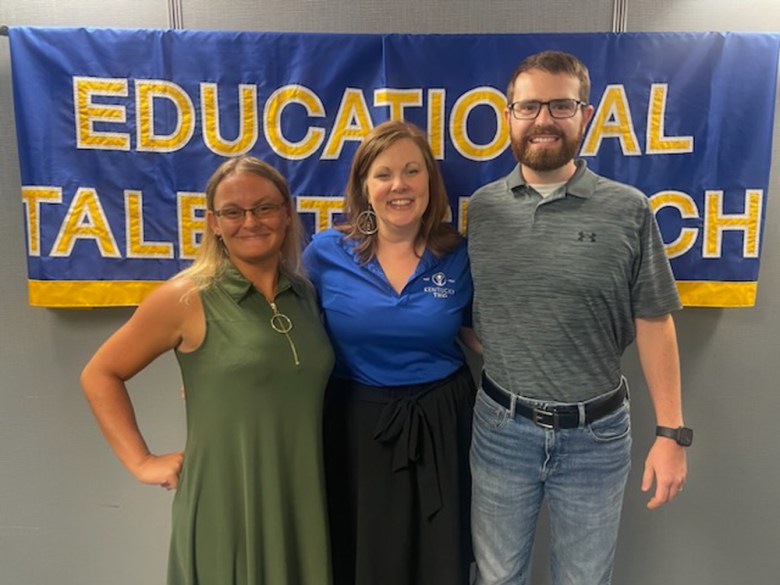
Summer Fawn Bryant, center, is director of TRIO’s Talent Search programs at Morehead State University in Kentucky. She stands with former TRIO students Alexandria Daniel, left, and Blake Thayer, right. Credit: Photo courtesy of Summer Fawn Bryant
TRIO works to counter the stigma of attending college that still exists in parts of eastern Kentucky, Bryant said. A student from a humble background who is considering college, she said, might be scolded with the phrase: Don’t get above your raisin’.
“A parent may say it,” Bryant said. “A teacher may say it.”
She added that she’s seen time and again how these programs can turn around the lives of young students facing adversity.
Students like Beth Cockrell, an Upward Bound alum from Pineville, Ky., who said her mom struggled with parenting. “Upward Bound stepped in as that kind of co-parent and helped me decide what my major was going to be.”
Cockrell went on to earn three degrees at Morehead State and has worked as a teacher for the past 19 years. She now works with students at her alma mater and teaches third grade at Conkwright Elementary School, about an hour away.
In a few years, 17-year-old Upward Bound student Isaac Bocook plans to join the teaching ranks too — as a middle school social studies teacher. Bocook said he was indecisive about what to study after high school, but he finally figured it out after attending a career fair at Morehead State’s historic Button Auditorium.
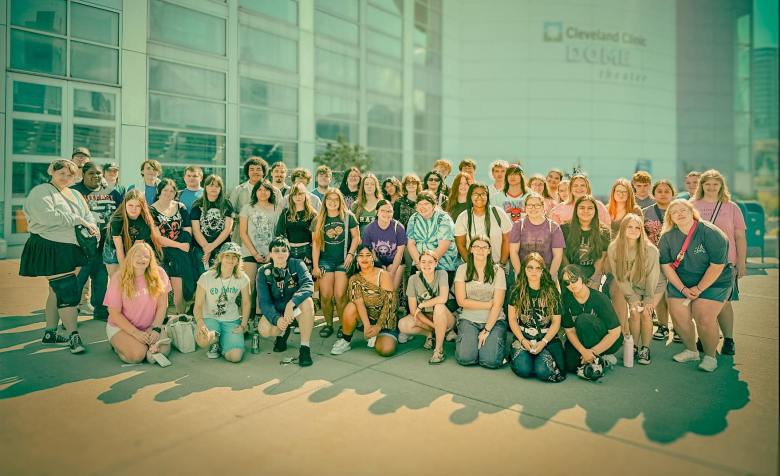
Upward Bound students visit the Great Lake Science Center in Cleveland for the end-of-summer educational trip. Credit: Photo courtesy of the Upward Bound Programs
Bocook lives in Lewis County, with just under 13,000 residents and a single public high school. At Morehead State’s TRIO program, Bocook met teenagers from across the entire region, which he said improved his social skills. TRIO also helped him with all kinds of paperwork on the pathway to adulthood. Filling out financial aid forms. Writing scholarship applications. Crafting a resume.
“I’m just truly grateful to have TRIO, as sort of like a hand to hold,” Bocook said.
His need for guidance is similar to what students at Morgan County High School in West Liberty, Kentucky, experience, said Lori Keeton, the school guidance counselor. The challenge facing these first-generation students, she said, is that “you just simply don’t know what you don’t know.”
As the sole counselor for 550 students, Keeton doesn’t have time to help each student navigate the complex college-application process and said she worries that some of her students will apply to fewer colleges, or no colleges at all, if TRIO disappears.
TRIO’s Talent Search program serves about 100 students at her high school, and roughly another dozen are part of Upward Bound. Each program has a dedicated counselor who visits regularly to guide and assist students.
Sherry Adkins, an eastern Kentucky native who attended TRIO more than 50 years ago and went on to become a registered nurse, said efforts to cut TRIO spending ignore the long-term benefits. “Do you want all of these people that are disadvantaged to continue like that? Where they’re taking money from society? Or do you want to help prepare us to become successful people who pay lots of taxes?”
As Washington considers TRIO’s future, program directors like Bryant, at Morehead State, press forward. She has preserved a text message a former student sent her two years ago to remind her of what’s at stake.
After finishing college, the student was attending a conference on child abuse when a presenter showed a slide that included the quote: “Every child who winds up doing well has had at least one stable and committed relationship with a supportive adult.”
“Forever thankful,” the student texted Bryant, “that you were that supportive adult for me.”
Contact editor Nirvi Shah at 212-678-3445, securely on Signal at NirviShah.14 or via email at [email protected].
The Hechinger Report provides in-depth, fact-based, unbiased reporting on education that is free to all readers. But that doesn’t mean it’s free to produce. Our work keeps educators and the public informed about pressing issues at schools and on campuses throughout the country. We tell the whole story, even when the details are inconvenient. Help us keep doing that.
The early years are a critical time to teach the foundations of math. That’s when children learn to count, start identifying shapes and gain an early understanding of concepts like size and measurement. These years can also be a time when children are confronted with preconceived notions of their abilities in math, often based on their race, which can negatively affect their math success and contribute to long-standing racial gaps in scores.
These are some of the motivating factors behind the Racial Justice in Early Math project, a collaboration between the Erikson Institute, a private graduate school focused on child development, and the University of Illinois Chicago. The project aims to educate teachers and provide resources including books, teacher tips and classroom activities that help educators combat racial bias in math instruction.
I sat down with Danny Bernard Martin, professor of education and mathematics at the University of Illinois Chicago, project director Priscila Pereira and Jennifer McCray, a research professor at the Erikson Institute, to learn more about their work. This conversation has been edited for length and clarity.
What are some of the key examples of racial injustice that you see in early math education?
Martin: If I say to you, ‘Asians are good at math,’ that’s something that you’ve heard, we know that’s out there. When does that kind of belief start? Well, there’s something called ‘racial-mathematical socialization’ that we take seriously in this project, that we know happens in the home before children come to school. Parents and caregivers are generating messages around math that they transmit to children, and then those messages may get reinforced in schools.
Even at the early math level, there are research projects beginning to construct Black children in particular ways, comparing Black children to white children as the norm. That is a racial justice issue, because that narrative about white children, Black children, Asian American children, Latinx children, then filters out. It becomes part of the accepted truth, and then it impacts what teachers do and what principals and school leaders believe about children.
What does this look like in schools?
McCray: Perhaps the math curriculum doesn’t represent them or their experience. We all know that often schools for children of color are under-resourced. What often happens in under-resourced schools is that the curriculum and the teaching tends to focus on the basics. There might be an overemphasis on drilling or doing timed tests. We also have those situations where people are doing ability grouping in math. And we know what the research says about that, it’s basically ‘good education for you, and poor education for you.’ It’s almost impossible to do any of that without doing harm.
One line of research has been to watch teachers interact with children and videotape or study them. And in diverse classrooms with white teachers … often it is observed that children who are Black or Latina aren’t called on as often, or aren’t listened to as much, or don’t have the same kind of opportunity to be a leader in the classroom.
What should teacher prep programs, administrators and families do to address racial justice issues in early math?
McCray: Maybe the white teacher is reflecting on themselves, on their own biases … trying to connect with families or communities in some way that’s meaningful. We want teachers to have that balance of knowing that sometimes you do want to teach a procedure, but you never want to be shutting down ideas for creative ways to solve a math problem, or culturally distinct ways to solve a math problem that might come from your students.
It might be something like, you’re working on sorting in an early childhood classroom. And what if a child is thinking about a special craft that their parent does that’s like the [papel picado], or papers that get cut in very elaborate designs in Mexico. … If the teacher doesn’t have space to listen, it could be a shutdown moment, instead of a moment of connection, where the child is actually bringing something … that is associated with their own identity.
Pereira: I do feel that sometimes the conversations of racial justice really put the weight on teachers and teachers alone. Teaching is part of a larger structure. Maybe your school will not allow you to do the work that is needed. I’m thinking about [a teacher] who was required to follow a scripted curriculum that did not promote the positive math identity for Black children. It needs to be a whole community effort.
How is your initiative changing this?
Pereira: There are resources in terms of opportunities that we offer to teachers to engage with our content and ideas: webinars, a fellowship and an immersive learning experience in the summer of 2026. These spaces are moments in which educators, researchers and people that are engaged in the education of young learners, can come together … and disrupt mainstream notions of understanding what is racial justice and how one gets that in the classroom.
Right now, research and initiatives zeroing in on race are under scrutiny, especially at the college level. Do you foresee any additional challenges to this work?
Pereira: There was a National Science Foundation grant program focused on racial equity in STEM and we had been planning to apply for funds to do something there. … It’s gone. … The only place we’re welcome is where there’s a governor who is willing to take on Trump. We just have to keep doing the work, because we know what’s right. But it is challenging, for sure.
The Hechinger Report provides in-depth, fact-based, unbiased reporting on education that is free to all readers. But that doesn’t mean it’s free to produce. Our work keeps educators and the public informed about pressing issues at schools and on campuses throughout the country. We tell the whole story, even when the details are inconvenient. Help us keep doing that.
At flagship universities across the United States, predominantly white sororities remain popular institutions. They offer young women a ready-made community, social capital, and access to alumni networks. But behind this appeal lies a system that reinforces race, class, and gender hierarchies—at a time when women’s rights are being rolled back nationally.
Race and Class Tradition: Who Belongs, Who Does Not
Sororities are not only racially homogeneous but also heavily skewed by class. Recruitment practices, legacy ties, and financial obligations ensure that sorority life remains a domain for the affluent.
At Princeton University, 77% of sorority members are white, compared with 47% of the student body overall.
Socioeconomic trends are even starker. In 1999, 31% of Greek-affiliated students at Princeton identified as middle-class, but by 2024 that number had dropped to 14%. Over the same period, those identifying as upper-class doubled from 14% to 28%.
At the University of Mississippi, 48% of high school graduates in the state were Black in 2021, but only 8% of first-year students at Ole Miss were Black. White-dominated Greek life continues to thrive in this climate of underrepresentation.
A multi-campus study found 72% of Greek members identified as middle- or upper-middle class, compared with just 6% from low-income families.
These figures reveal how sororities work to reproduce the advantages of affluent white families. Membership offers exclusive networking, internships, and social connections—often denied to working-class students, students of color, and first-generation college students.
Gender Tradition
Sororities also sustain a vision of femininity rooted in conformity, beauty standards, and heteronormativity. Social events are structured around fraternities, placing men as hosts and leaders, while sorority women serve as companions or supporters.
While some sororities claim empowerment through philanthropy and sisterhood, the cultural framework continues to emphasize women’s value through appearance and deference, not leadership. This pattern reflects broader societal pressures to restore traditional gender roles.
The Broader Context: The Right to Choose Lost
The Supreme Court’s 2022 reversal of Roe v. Wade has had profound consequences for women in the U.S.
More than 25 million women of reproductive age now live in states with abortion bans or severe restrictions.
States with the most restrictive abortion laws show a 7% increase in maternal mortality overall, and 51% higher rates where laws require procedures only from licensed physicians.
The loss of Roe’s protections especially harms women of color and low-income women, who already face barriers to healthcare and mobility.
Against this backdrop, sororities’ popularity at flagship universities is revealing. These organizations celebrate conformity to class privilege and traditional gender expectations, while millions of women outside those circles see their reproductive freedoms curtailed. The alignment of sorority culture with conservative visions of femininity makes them more than relics of tradition—they become cultural reinforcers of the very inequalities deepening in U.S. society.
Why Class Matters
Social class is at the heart of the issue. Sororities provide access to powerful networks that translate into internships, job placements, and lifelong advantages. These networks overwhelmingly serve the wealthy and exclude those already disadvantaged by race, class, and gender.
At a time when women’s bodily autonomy is under political attack, the popularity of predominantly white sororities signals how elite spaces continue to consolidate privilege for a narrow group of women—while the majority face shrinking freedoms and growing precarity.
This audio is auto-generated. Please let us know if you have feedback.
Dive Brief:
Under a proposed plan from the Trump administration, colleges would have to submit six years worth of application and admissions data — disaggregated by student race and sex — as part of the 2025-26 Integrated Postsecondary Education Data System reporting cycle.
President Donald Trump last week issued a memo requiring institutions to significantly expand the parameters of the admissions data they report to the National Center for Education Statistics, which oversees IPEDS.
Colleges would need to submit a multi-year report “to establish a baseline of admissions practices” beforethe U.S. Supreme Court’s 2023 ruling against race-conscious admissions, according to a notice filed Wednesday in the Federal Register.
Dive Insight:
The Trump administration has repeatedly charged that diversity efforts at colleges and elsewhere violate civil rights law.
“DEI has been used as a pretext to advance overt and insidious racial discrimination,” according to the Federal Register notice, which was signed by Brian Fu, acting chief data officer of the department’s Office of Planning, Evaluation and Policy Development.
The additional student data questions — collectively titled the Admissions and Consumer Transparency Supplement, or ACTS — are meant to create “greater transparency” and “help to expose unlawful practices” at colleges, the notice said. It added that, with more information, the Education Department can better enforce Title VI laws, which bar discrimination based on race, color or national origin at federally funded institutions.
Under ACTS, colleges would have to report extensive demographic data for applicants, admitted students and those that ultimately enroll. And for the first year, they would have to do so for every academic year dating back to 2020-21.
Colleges would also need to report on their graduation rates from 2019-20 to 2024-25, the notice said.
Officials would be required to disaggregate student demographics by race and sex and cross-reference it with the following data points:
Admissions test scores.
GPA.
Family income.
Pell Grant eligibility.
Parents’ educational level.
Previously, the Education Department only required colleges to submit data by race for enrolled students.
Institutions would also have to report the numbers of their admitted student pool that applied via early action, early decision and regular admissions.
Graduate student data would be required to be disaggregated by field of study, as applicants typically apply directly to departments, not to the college overall, the notice said.
The Education Department is gearing ACTS at four-year institutions with selective admissions processes, which its notice said “have an elevated risk of noncompliance with the civil rights laws,” both in admissions and scholarships.
The proposal says open-enrollment institutions like community colleges and trade schools are at low risk for noncompliance with Title IV in admissions.
However, the department on Wednesday requested public comment on open enrollment colleges’ policies for awarding scholarships, an area it flagged as potentially providing “preferential treatment based upon race.” It also asked for feedback about the types of institutions that should be required to submit the additional admissions information.
Public feedback could influence “whether we should narrow or expand the scope of institutions required to complete the ACTS component,” it said.
The Education Department is also seeking feedback on how it could reduce the administrative cost of the increased data collection.
It estimated that, across the higher ed sector, the change will create over 740,000 hours of new work.
U.S. Secretary of Education Linda McMahon fully endorsed Trump’s memo last week, saying the administration would not allow “institutions to blight the dreams of students by presuming that their skin color matters more than their hard work and accomplishments.” But it has yet to be seen how the agency will handle a dramatic increase in college data.
The Education Department’s workforce has been greatly diminished since Trump retook office. The Trump administration laid off half of the department’s employees in March. Although a federal judge temporarily blocked the mass terminations, the Supreme Court lifted that order last month while the litigation proceeds.
Peggy Carr, the ousted former commissioner of NCES, warned last month that the dramatic cuts to the department put it at risk of mishandling data and eroding the public’s trust in its data.
“Accurate, reliable, nonpartisan data are the essential foundations of sound education policy,” the long-time NCES official said in a statement. “Policy that isn’t informed by good data isn’t really policy — it’s guesswork.”
The Trump administration abruptly fired Carr in February. President Joe Biden had appointed her to the post for a six-year term in 2021.
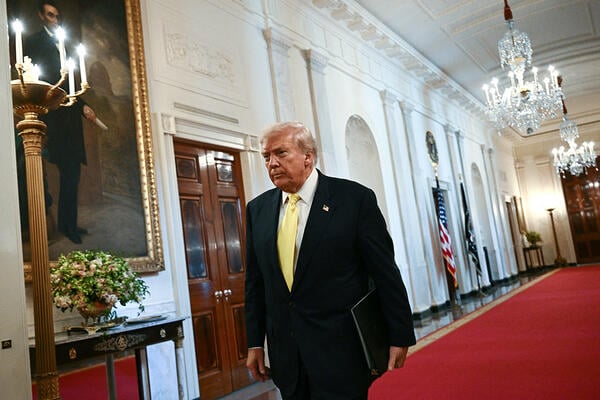
President Donald Trump issued an executive action Thursday directing colleges to prove they are not considering race in admissions.
Brendan Smialowski/AFP/Getty Images
President Donald Trump issued an executive action Thursday afternoon mandating colleges and universities submit data to verify that they are not unlawfully considering race in admissions decisions.
The order also requires the Department of Education to update the Integrated Postsecondary Education Data System to make its data more legible to students and parents and to “increase accuracy checks for data submitted by institutions through IPEDS,” penalizing them for late, incomplete or inaccurate data.
Opponents of race-conscious admissions have hailed the mandate as a victory for transparency in college admissions, but others in the sector have criticized its vague language and question who at the department is left to collect and analyze the data.
“American students and taxpayers deserve confidence in the fairness and integrity of our Nation’s institutions of higher education, including confidence that they are recruiting and training capable future doctors, engineers, scientists, and other critical workers vital to the next generations of American prosperity,” the order reads. “Race-based admissions practices are not only unfair, but also threaten our national security and well-being.”
It’s now up to the secretary of education, Linda McMahon, to determine what new admissions data institutions will be required to report. The administration’s demands of Columbia and Brown Universities in their negotiations to reinstate federal funding could indicate what the requirements will be. In its agreement with Brown, the government ordered the university to submit annual data “showing applicants, admitted students, and enrolled students broken down by race, color, grade point average, and performance on standardized tests.” Colleges will be expected to submit their admissions data for the 2025–26 academic year, according to the order.
What resources are in place to enforce the new requirements remains to be seen. Earlier this year the administration razed the staff at the Department of Education who historically collected and analyzed institutional data. Only three staff members remain in the National Center for Education Statistics, which operates IPEDS.
‘It’s Not Just as Easy as Collecting Data’
Since taking office, the Trump administration has launched a crusade against diversity, equity and inclusion in higher education, often using the Supreme Court’s 2023 ruling against race-conscious admissions as a weapon in the attacks.
Students for Fair Admissions, the anti–affirmative action advocacy group that was the plaintiff in the 2023 cases, called the action a “landmark step” toward transparency and accountability for students, parents and taxpayers.
“For too long, American colleges and universities have hidden behind opaque admissions practices that often rely on racial preferences to shape their incoming classes,” Edward Blum, SFFA president and longtime opponent of race-conscious admissions, said in a press release.
But college-equity advocates sounded the alarm, arguing that the order—which also claims that colleges have been using diversity and other “overt and hidden racial proxies” to continue race-conscious admissions post-SFFA—aims to intimidate colleges into recruiting fewer students of color.
“I will say something that my members in the higher education community cannot say. What the Trump administration is really saying is that you will be punished if you do not admit enough white students to your institution,” Angel B. Pérez, CEO of the National Association for College Admission Counseling, told Inside Higher Ed.
Like many of Trump’s other orders targeting DEI, that mandate relies on unclear terms and instructions. It does not define “racial proxies”—although a memo by the Department of Justice released last week provides examples—nor does it outline what data would prove an institution is or is not considering race in its admissions process.
In an interview with Inside Higher Ed, Paul Schroeder, the executive director of the Council of Professional Associations on Federal Statistics, questioned the government’s capacity to carry out the president’s order.
“Without NCES, who’s going to actually look at this data? Who’s going to understand this data? Are we going to have uniform reporting or is it going to be just a mess coming in from all these different colleges?” Schroeder said.
“It’s not just as easy as collecting data. It’s not just asking a couple questions about the race and ethnicity of those who were admitted versus those who applied. It’s a lot of work. It’s a lot of hours. It’s not going to be fast.”
Selina Likely, a child care director in Columbus, Ohio, understands the desperation that parents feel when they can’t find a good placement for their children with disabilities. When Likely’s daughter was a child, the little girl was abruptly kicked out of her daycare center for biting, leaving her mother with little recourse.
“I was so angry and mad at the time,” said Likely, whose daughter is now an adult. “How are you going to kick out a 1-year-old?”
Thanks to a new state initiative, Likely and other child care providers like her can now receive additional training on how to support children with disabilities, who are far more likely than other children to be expelled from child care programs. Some states have similar programs, with the ultimate goal of creating more child care slots where young children with disabilities and delays can thrive.
How Hechinger inspired a bill
Earlier this year, my colleague Sarah Carr published a piece revealing that in Illinois and other states many families of premature babies are leaving the hospital with no information or guidance on critical therapies they are entitled to. In June, the Illinois Legislature passed a bill that would require hospitals to distribute detailed information on early intervention — those required therapies for babies and toddlers with disabilities and developmental delays — to most families with severely premature infants. The new law was proposed by state Rep. Janet Yang Rohr after Sarah’s story was published.
The bill, which awaits action by the governor, would also require the state’s early childhood systems to prioritize, in a public awareness campaign, the early identification of infants who automatically qualify for the therapies because of their low birth weight.
This story about children with disabilities was produced by The Hechinger Report, a nonprofit, independent news organization focused on inequality and innovation in education. Sign up for the Hechinger newsletter.
The Hechinger Report provides in-depth, fact-based, unbiased reporting on education that is free to all readers. But that doesn’t mean it’s free to produce. Our work keeps educators and the public informed about pressing issues at schools and on campuses throughout the country. We tell the whole story, even when the details are inconvenient. Help us keep doing that.
The Trump administration moved quickly after taking office to open dozens of investigations into schools and universities nationwide. Most of those announced publicly mark a dramatic shift in priorities from previous administrations.
The Education Department and other agencies are looking into allegations of antisemitism and racial discrimination against white students at dozens of colleges. The agency also has begun investigating policies that protect transgender athletes and, in some cases, targeted entire state departments of education as part of that work.
Related: Become a lifelong learner. Subscribe to our free weekly newsletter featuring the most important stories in education.
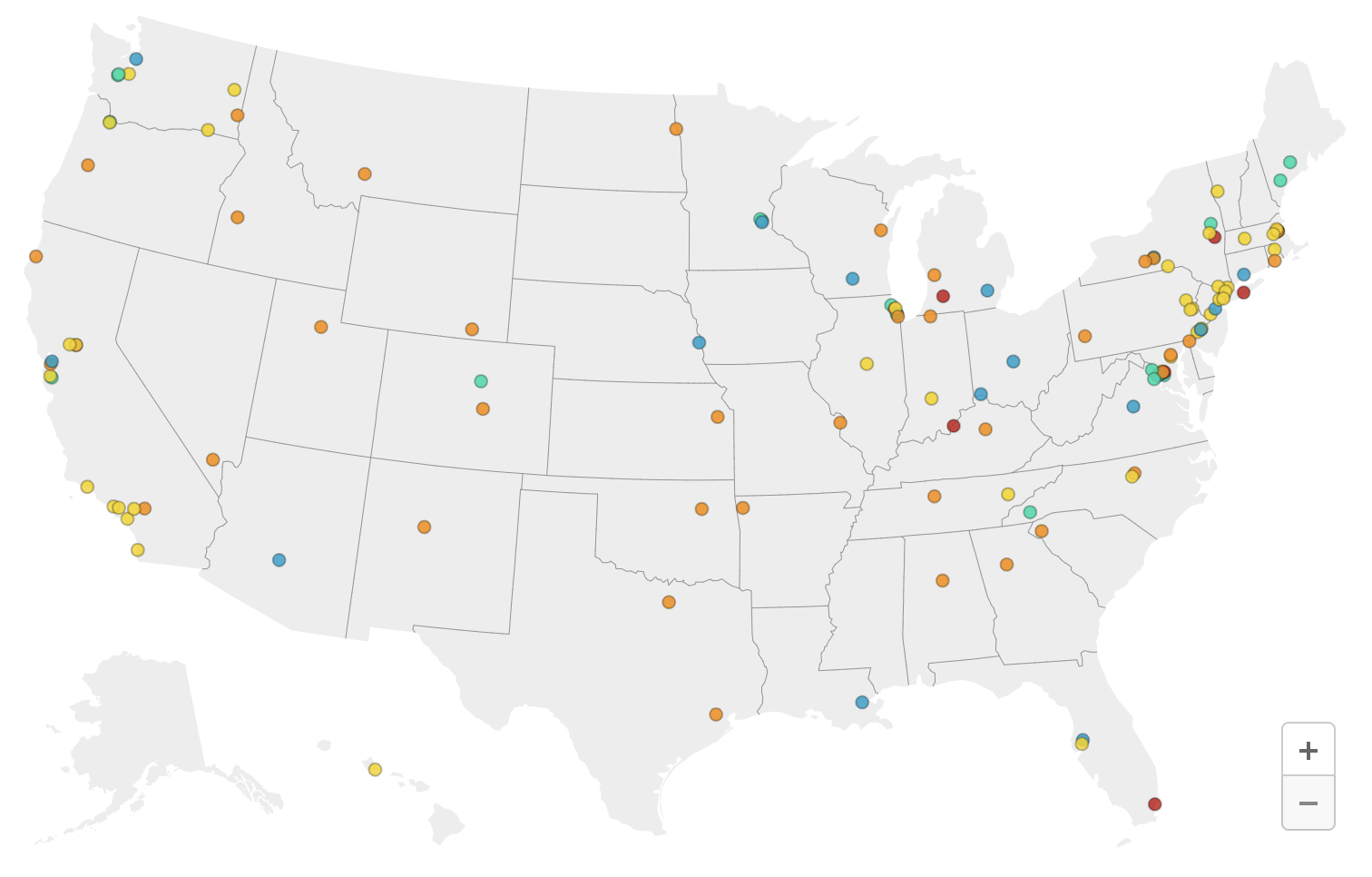
Here’s a look at investigations the Trump administration has announced. This map and list will be updated. Know of an investigation we missed? Tell us: [email protected].
Although the majority of investigations that have been opened are in states considered to be liberal, almost every state in the country has at least one entity under scrutiny. And many institutions face more than one investigation.
To date, colleges and universities have received the most attention from the administration, with more than 60 targeted over alleged incidents of antisemitism and another 45 under scrutiny over their work with a program that aims to increase diversity among Ph.D. candidates. Most of the K-12 investigations involve transgender policies, including those about access to sports and locker rooms.
Contact investigations editor Sarah Butrymowicz at [email protected] or on Signal: @sbutry.04
The Hechinger Report provides in-depth, fact-based, unbiased reporting on education that is free to all readers. But that doesn’t mean it’s free to produce. Our work keeps educators and the public informed about pressing issues at schools and on campuses throughout the country. We tell the whole story, even when the details are inconvenient. Help us keep doing that.