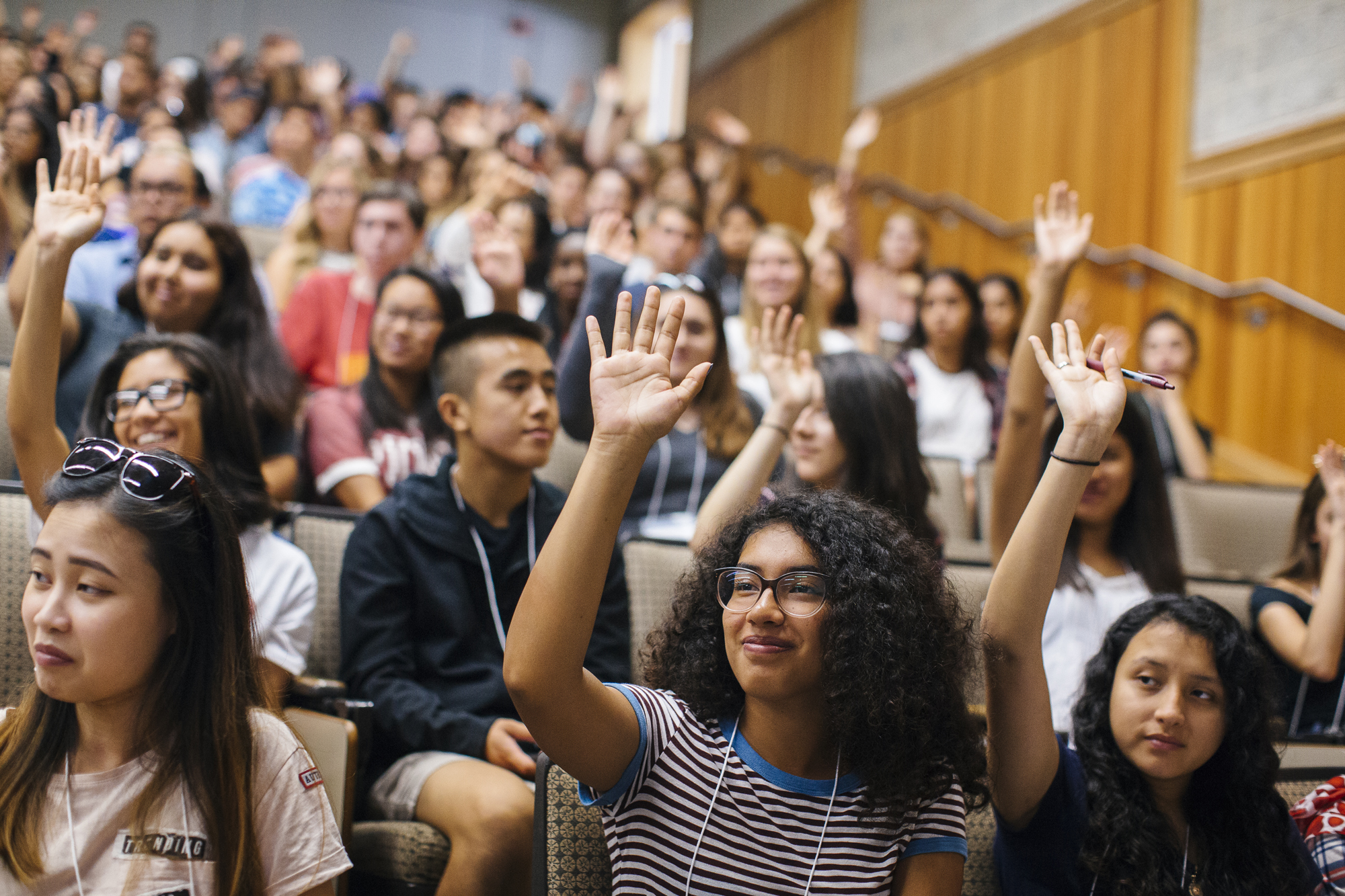
I recently stood before hundreds of young people in California’s Central Valley; more than 60 percent were on that day becoming the first in their family to earn a bachelor’s degree.
Their very presence at University of California, Merced’s spring commencement ceremony disrupted a major narrative in our nation about who college is for — and the value of a degree.
Many of these young people arrived already balancing jobs, caregiving responsibilities and family obligations. Many were Pell Grant-eligible and came from communities that are constantly underestimated and where a higher education experience is a rarity.
These students graduated college at a critical moment in American history: a time when the value of a bachelor’s degree is being called into question, when public trust in higher education is vulnerable and when supports for first-generation college students are eroding. Yet an affordable bachelor’s degree remains the No. 1 lever for financial, professional and social mobility in this country.
Related: Interested in innovations in higher education? Subscribe to our free biweekly higher education newsletter.
A recent Gallup poll showed that the number of Americans who have a great deal of confidence in higher education is dwindling, with a nearly equal amount responding that they have little to none. In 2015, when Gallup first asked this question, those expressing confidence outnumbered those without by nearly six to one.
There is no doubt that higher education must continue to evolve — to be more accessible, more relevant and more affordable — but the impact of a bachelor’s degree remains undeniable.
And the bigger truth is this: America’s long-term strength — its economic competitiveness, its innovation pipeline, its social fabric — depends on whether we invest in the education of the young people who reflect the future of this country.
There are many challenges for today’s workforce, from a shrinking talent pipeline to growing demands in STEM, healthcare and the public sector. These challenges can’t be solved unless we ensure that more first-generation students and those from underserved communities earn their degrees in affordable ways and leverage their strengths in ways they feel have purpose.
Those of us in education must create conditions in which students’ talent is met with opportunity and higher education institutions demonstrate that they believe in the potential of every student who comes to their campuses to learn.
UC Merced is a fantastic example of what this can look like. The youngest institution in the University of California system, it was recently designated a top-tier “R1” research university. At the same time, it earned a spot on Carnegie’s list of “Opportunity Colleges and Universities,” a new classification that recognizes institutions based on the success of their students and alumni. It is one of only 21 institutions in the country to be nationally ranked for both elite research and student success and is proving that excellence and equity can — and must — go hand in hand.
In too many cases, students who make it to college campuses are asked to navigate an educational experience that wasn’t built with their lived experiences and dreams in mind. In fact, only 24 percent of first-generation college students earn a bachelor’s degree in six years, compared to nearly 59 percent of students who have a parent with a bachelor’s. This results in not just a missed opportunity for individual first-generation students — it’s a collective loss for our country.
The graduates I spoke to in the Central Valley that day will become future engineers, climate scientists, public health leaders, artists and educators. Their bachelor’s degrees equip them with critical thinking skills, confidence and the emotional intelligence needed to lead in an increasingly complex world.
Their future success will be an equal reflection of their education and the qualities they already possess as first-generation college graduates: persistence, focus and unwavering drive. Because of this combination, they will be the greatest contributors to the future of work in our nation.
This is a reality I know well. As the Brooklyn-born daughter of Dominican immigrants, I never planned to go away from home to a four-year college. My father drove a taxi, and my mother worked in a factory. I was the first in my family to earn a bachelor’s degree. I attended college as part of an experimental program to get kids from neighborhoods like mine into “top” schools. When it was time for me to leave for college, my mother and I boarded a bus with five other students and their moms for a 26-hour ride to Vanderbilt University in Nashville, Tennessee.
Like so many first-generation college students, I carried with me the dreams and sacrifices of my family and community. I had one suitcase, a box of belongings and no idea what to expect at a place I’d never been to before. That trip — and the bachelor’s degree I earned — changed the course of my life.
First-generation college students from underserved communities reflect the future of America. Their success is proof that the American Dream is not only alive but thriving. And right now, the stakes are national, and they are high.
That is why we must collectively remove the obstacles to first-generation students’ individual success and our collective success as a nation. That’s the narrative that we need to keep writing — together.
Shirley M. Collado is president emerita at Ithaca College and the president and CEO ofCollege Track, a college completion program dedicated to democratizing potential among first-generation college students from underserved communities.
The Hechinger Report provides in-depth, fact-based, unbiased reporting on education that is free to all readers. But that doesn’t mean it’s free to produce. Our work keeps educators and the public informed about pressing issues at schools and on campuses throughout the country. We tell the whole story, even when the details are inconvenient. Help us keep doing that.
A Black History Month event, canceled. A lab working to fight hunger, shuttered. Student visas revoked, then reinstated, uncertain for how long. Opportunities for students pursuing science careers, fading.
The first six months of the Trump administration have brought a hailstorm of changes to the nation’s colleges and universities. While the president’s faceoffs with Harvard and Columbia have generated the most attention, students on campuses throughout the country are noticing the effects of the administration’s cuts to scientific and medical research, clampdown on any efforts promoting diversity equity and inclusion (DEI), newly aggressive policies for students with loan debt, revoking of visas for international students and more.
Many of the administration’s actions are being challenged in court, but they are influencing the way students interact with each other, what support they can get from their institutions — and even whether they feel safe in this nation.
The Hechinger Report traveled to campuses around the country to look at what these changes mean for students. Reporters visited universities in four states — California, Illinois, Louisiana and Texas — to understand this new era for higher education.
Related: Interested in more news about colleges and universities? Subscribe to our free biweekly higher education newsletter.
Louisiana State University
BATON ROUGE, La. — Last fall, Louisiana State University student A’shawna Smith had an idea for a new campus group to educate students about their legal rights and broader problems in the criminal justice system. Smith, a sociology major, had spent the prior summer interning at a law firm and noticed how many clients didn’t know their rights after an arrest.
Smith, now a rising senior, called it The Injustice Reform and soon recruited classmates and a campus adviser. They wrote a mission statement and trained as student group leaders. On Feb. 20, LSU’s student government, which awards money to campus groups that comes from student fees, gave them $1,200; Smith and her classmates planned to use the award to recruit members and organize events.
At Louisiana State University, in Baton Rouge, students say actions taken by the school’s administration in response to the federal crackdown on diversity, equity and inclusion are changing the campus culture and harming the operations of student government. Credit: Tyler Kaufman/AP Photo
But on April 8, Injustice Reform’s treasurer received a text message from Cortney Greavis, LSU’s student government adviser. She said LSU was rescinding the money: The group’s mission statement ran afoul of new federal and state restrictions on DEI. Its mission mentions racial disparities and police brutality, but the organizers were never told which words violated the rules. Smith and fellow leaders started chipping in their own money to keep the group going: $10 here and there, whatever they could afford, said Bella Porché, a rising senior on the group’s executive board.
Canceling awards to student groups is one way students say administrators at LSU, the state’s flagship university, have restricted what they can do and say since the U.S. Department of Education wrote to schools and colleges nationwide on Valentine’s Day. The letter described DEI efforts — designed to rectify current and historic discrimination — as discriminatory and threatened schools with the loss of federal money unless they ended the consideration of race in admissions, financial aid, housing, training and other practices.
Since the letter, discussion of DEI on campus “has become an anti-gay, anti-Black sort of conversation,” said Emma Miller, a rising senior and elected student senator. “People who are minorities don’t feel safe anymore, don’t feel represented, don’t feel seen, because DEI is being wiped away and their university is not saying anything.”
In a March 7 report, the university detailed dozens of changes made to comply with the letter’s demands. For example, it ended any preference granted to students from historically underrepresented groups for certain privately funded scholarships; opened membership in school-funded student organizations — like a women-in-business group — to all; and canceled activities perceived to emphasize race, even a fitness class kicking off Black History Month.
Student government leaders say the restrictions hinder their ability to operate. Rising junior Tyhlar Holliway, a member of the student government’s Black Caucus, said school administrators essentially shut down the caucus’ proposal that the student government issue a statement after the Department of Education letter in support of DEI programs and initiatives.
LSU public relations staff did not respond to interview requests or to an emailed list of questions, and the school’s civil rights and Title IX division director declined to speak.
Miller said administrators have told student leaders that all their proposed legislation must be reviewed by the school’s general counsel for compliance with the March 7 guidelines. The administration, for example, blocked a student government bill to fund a Black hair care event designed to help students prepare for career and professional opportunities, said senior Paris Holman, a student government member. “We have conferences and interviews and need to know how to take care of our hair,” said Holman, who is Black.
Students have also tailored the language of other bills to avoid the appearance of support for DEI. Holman said that in one case the student senate changed the language in a bill funding an end-of-year event for a minority student organization to remove any reference to the organization as serving minority students.
The school also overrode student government decisions about which groups, like A’shawna Smith’s, could be funded by student fees. In February, the student government voted to provide $641 to help a pre-med student, who is Black, attend a student medical education conference, in part so she could share what she’d learn with other pre-med students. A few weeks later, she received an email from Greavis, the student government adviser, saying she wouldn’t be able to attend with university funds because that money could no longer be used for “DEI-related events, initiatives, programs, or travel.” Greavis didn’t respond to requests for an interview.
The email didn’t specify why the medical conference crossed the line. But the sponsoring organization’s mission statement notes its commitment to “supporting current and future underrepresented minority medical students,” and a conference plenary speaker was scheduled to address the “enduring case for DEI in medicine.” Fewer than 6 percent of doctors are Black and research has shown improved health outcomes for Black patients who are seen by physicians of the same race.
“It doesn’t feel like a democracy,” said Holman of serving in student government at this moment.
She and other students say the university’s actions are starting to change the broader culture at LSU, which serves nearly 40,000 undergraduate and graduate students on its campus of Italian Renaissance buildings shaded by magnolias and Southern live oaks. About 60 percent of students are white and 18 percent are Black, according to federal data.
Mila Fair, a rising sophomore journalism major and a reporter for the campus TV station, said students tell her they’re afraid to join protests, in part because of LSU’s new anti-DEI rules and the national crackdown on student demonstrations. Those who do attend are often afraid to go on camera with her, she said.
Professor Andrew Sluyter of Louisiana State University. The university purged hundreds of webpages referencing DEI-related content, including a press release announcing a prestigious fellowship he’d won that mentioned “higher education’s racial inequities.” Credit: Steven Yoder for The Hechinger Report
Latin American studies professor Andrew Sluyter said administrators normally listen to the student government — even more than to the faculty government — but now worry about students getting the school into “political hot water.” He had his own run-in with the DEI ban: As part of a February effort to scrub school websites of diversity references, in which the university purged hundreds of webpages referencing DEI-related content, LSU deleted a 2022 press release announcing a prestigious fellowship he’d won that mentioned “higher education’s racial inequities.”
Students recognize the pressure LSU is under from the federal government, but they want administrators to stand up for them, said graduate student Alicia Cerquone, a student senator. “We want some sort of communication from the university that shows commitment to its community, that they have our backs and they’ll protect students,” she said.
— Steven Yoder
The University of California, Berkeley
BERKELEY, Calif. — Since early April, Rayne Xue, a junior at the University of California, Berkeley, has watched with trepidation as the Trump administration has taken one step after another to limit international students’ access to American higher education.
First came the abrupt cancellation, then reinstatement, of visas for 23 Berkeley students and recent graduates. Then the government cut off Harvard’s ability to enroll international students — a move since blocked by a federal judge — raising fears that something similar could happen at Berkeley. And late last month, as this year’s graduates were celebrating their recent commencements, Secretary of State Marco Rubio paused interviews for all new student visas and announced he would “aggressively revoke” those of Chinese students.
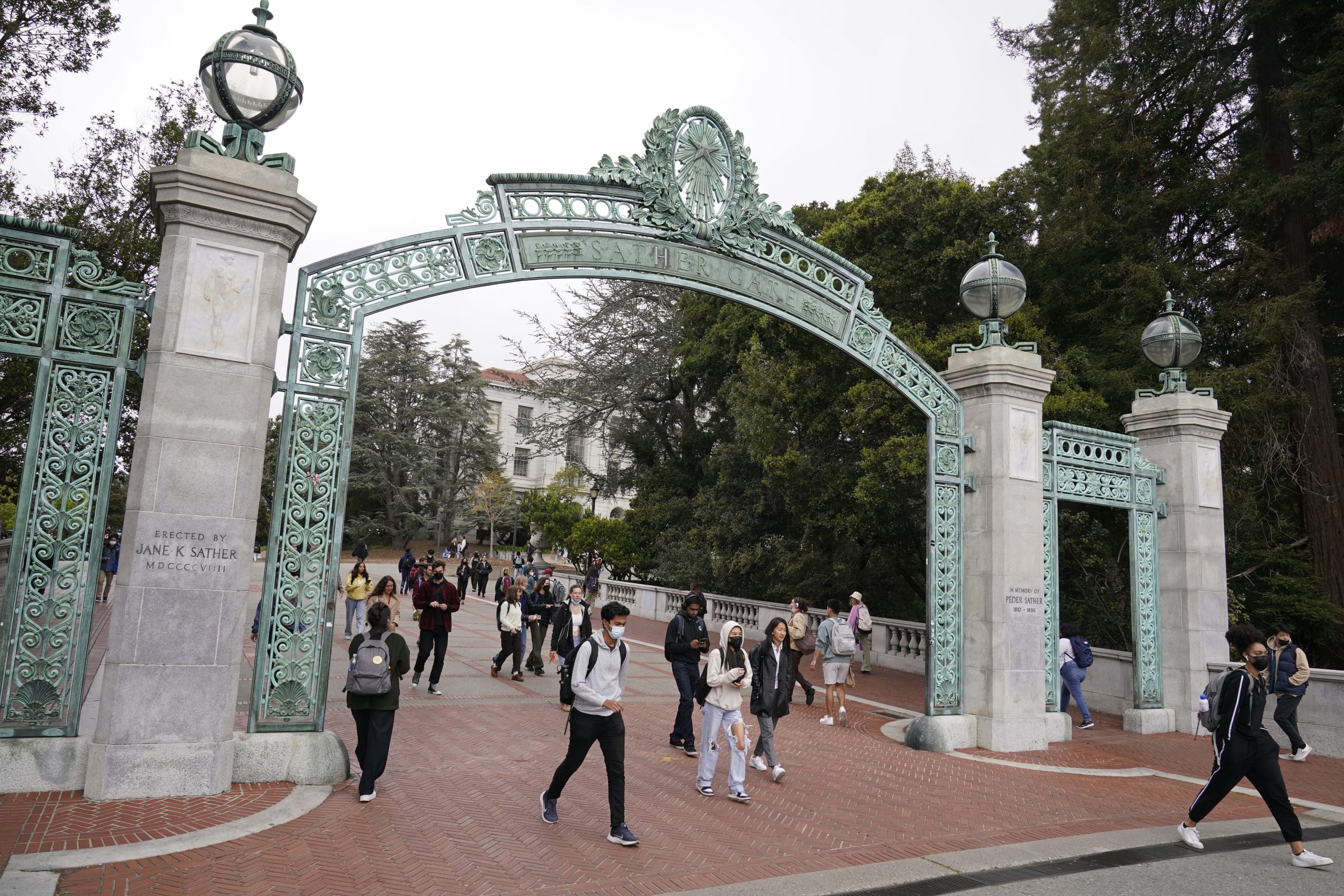
About 16 percent of University of California, Berkeley, students come from outside the United States. Credit: Eric Risberg/AP Photo
Xue, who is from Beijing and won a student senate seat this past spring on a platform of supporting international students, said the administration’s actions strike at a critical part of campus life at Berkeley.
“College is the opportunity of a lifetime to unlearn prejudices and embrace new perspectives, neither of which is possible without a student body that comes from a wide range of geographic and cultural backgrounds,” she said.
About 16 percent of UC Berkeley’s more than 45,000 students come from outside the United States to study at the crown jewel of California’s public research university system, where creeks run through campus beneath cooling redwoods and parking spaces are set aside for Nobel laureates. China, India, South Korea and Canada send the biggest numbers. International students pay higher tuition than California residents, boosting the university’s coffers and subsidizing some of their peers. Many of them conduct cutting-edge research in fields like computer science, engineering and chemistry.
Now the Trump administration’s immigration crackdown, magnified by the yanking of billions in federal research dollars, has international students worried about their future on campus. Many are changing their behavior to avoid scrutiny: Some canceled travel plans and many said they avoid walking near any campus protests in fear of being photographed.
“It’s difficult for international students to feel secure when they cannot anticipate what the administration might charge against them next — or whether they might be unfairly targeted,” said one global studies major who asked not to be identified for fear of attracting retaliation.
Tomba Morreau, a rising junior from the Netherlands studying sociology, said he stopped posting about politics on social media — just in case.
That kind of self-censorship troubles Paul Fine, co-chair of the Berkeley Faculty Association, which represents about a fifth of the university’s tenure-track faculty.
Federal policies are “creating this culture of fear where people start to censor themselves and try to stay under the radar and not show up in their full selves, whether for academic work or activism,” he said.
International students in Fine’s classes told him they wanted to attend a recent protest against federal threats to higher education but were afraid of the consequences, he said. Others told him they were skipping academic conferences outside the United States that they otherwise would have attended.
“Berkeley really prides ourselves on being an intellectual hub that convenes people from all over the world to work on the most important problems,” Fine said. Now that identity is at risk, he said, especially as actual and threatened cuts to grants make it harder for faculty to hire international graduate students and postdocs.
Most poignant, he said, was hearing from demoralized Chinese students who left a repressive government to come to the United States only to see attacks on academic freedom replicated here.
We want to hear from you.
Are you a student, professor, staff or faculty member? Our journalists want to know how the Trump administration is affecting higher education and life on your college campus.
Xue said she hopes the crisis facing universities would draw attention to the challenges international students face, including limited financial aid and the stereotype that all of them are wealthy. With her colleagues in student government, she is lobbying for Berkeley to spend more on the international office, which provides one-on-one advising on visa issues and employment.
For Lily Liu, a Chinese computer scientist, 2025 was shaping up to be a year of milestones. She graduated with a doctorate last month, has a job lined up at a leading artificial intelligence company and is engaged to be married in November.
But the Trump administration’s changing policies toward international scholars have complicated celebrations for Liu, who’s in a federal program that extends her visa for up to a year beyond graduation so she can gain work experience here. She canceled summer travel plans with her family, concerned she might not be let back into the country. And she’s considering moving her wedding to the United States from China, even though many of her relatives wouldn’t be able to attend.
“For international students, every policy affects us a lot,” she said. So Liu is careful. After the publication of her thesis was delayed, she visited Berkeley’s international office to make sure the setback wouldn’t affect her work permit. Her fiancé has a green card, which should theoretically mean his immigration status is more stable. But these days, she said, who knows?
— Felicia Mello
The University of Texas at San Antonio
SAN ANTONIO, Texas — Growing up here, Reina Saldivar had always loved science — all she wanted to watch on TV was “Animal Planet.” Yet until she applied on a whim to a program for aspiring researchers after her first year at the University of Texas at San Antonio, she assumed she would spend her life as a lab technician, running cultures.
The program, Maximizing Access to Research Careers, or MARC, was started by the National Institutes of Health decades ago at colleges around the country to prepare students, especially those from historically underrepresented backgrounds, for livelihoods in the biomedical sciences.
Saldivar got in. And through the program, she spent much of her time on campus in a university lab, helping develop a carrier molecule for a new Lyme disease vaccine. Now Saldivar, who graduated this spring, plans to eventually return to academia for a doctorate.
“What MARC taught me was that my dreams aren’t out of reach,” she said.
Saldivar is among hundreds who’ve participated in the MARC program since its 1980 founding at the University of Texas at San Antonio. She may also be among the last. In April, the university’s MARC program director, Edwin Barea-Rodriguez, opened his email inbox to find a form letter terminating the initiative and advising against recruiting more cohorts.
The letter cited “changes in NIH/HHS [Health and Human Services] priorities.” In recent months, the Trump administration has canceled at least half a dozen programs meant to train scholars and diversify the sciences as part of an effort to root out what the president labels illegal DEI.
In a statement to The Hechinger Report, NIH said that it “is committed to restoring the agency to its tradition of upholding gold-standard, evidence-based science” and is reviewing grants to make sure the agency is “addressing the United States chronic disease epidemic.”
With MARC ending, Barea-Rodriguez is searching for a way to continue supporting current participants until they graduate next academic year. Without access to federal money, however, the young scientists are anxious about their futures — and that of public health in general.
“It took years to be where we are now,” said Barea-Rodriguez, who said he was not speaking on behalf of his university, “and in a hundred days everything was destroyed.”
UTSA’s sprawling campus sits on the northwest edge of San Antonio, far from tourist sites like the Alamo and the River Walk. Forty-four percent of the nearly 31,000 undergraduate students are the first in their families to attend college; more than 61 percent identify as Hispanic or Latino. The university was one of the first nationwide to earn Department of Education recognition as a Hispanic-serving institution, a designation for colleges where at least a quarter of full-time undergraduates are Hispanic.
When Barea-Rodriguez arrived to teach at the school in 1995, many locals considered it a glorified community college, he said. But in the three decades since, the investments NIH made through MARC and other federal programs have helped it become a top-tier research university. That provided students like Saldivar with access to world-class opportunities close to home and fostered talent that propelled the economy in San Antonio and beyond.
The Trump administration has quickly upended much of that infrastructure, not only by terminating career pipeline programs for scholars, but also by pulling more than $8.2 million in National Science Foundation money from UTSA.
One of those canceled grants paid for student researchers and the development of new technologies to improve equity in math education and better serve elementary school kids from underrepresented backgrounds in a city that is about 64 percent Hispanic. Another aimed to provide science, technology, engineering and math programming to bilingual and low-income communities.
UTSA administrators did not respond to requests for comment about how federal funding freezes and cuts are affecting the university. Nationwide, more than 1,600 NSF grants have been axed since January.
In San Antonio, undergraduates said MARC and other now-dead programs helped prepare them for academic and professional careers that might have otherwise been elusive. Speaking in a lab remodeled and furnished with NIH money, where leftover notes and diagrams on glass erase boards showed the research questions students had been noodling, they described how the programs taught them about drafting an abstract, honing public speaking and writing skills, networking, putting together a résumé and applying for summer research positions, travel scholarships and graduate opportunities.
“All of the achievements that I’ve collected have pretty much been, like, a direct result of the program,” said Seth Fremin, a senior biochemistry major who transferred to UTSA from community college and has co-authored five articles in major journals, with more in the pipeline. After graduation, he will start a fully funded doctoral program at the University of Pittsburgh to continue his research on better understanding chemical reactions.
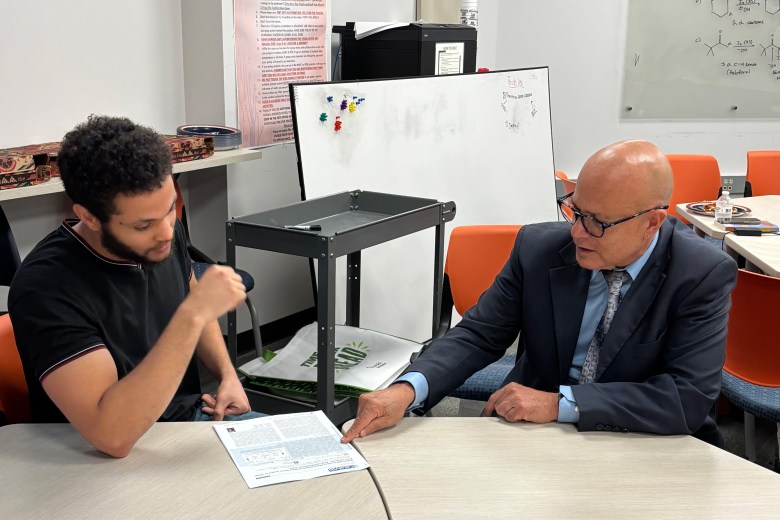
Seth Fremin, a senior biochemistry major at the University of Texas at San Antonio, with Edwin Barea-Rodriguez. Credit: Alexandra Villareal for The Hechinger Report
Similarly, Elizabeth Negron, a rising senior, is spending this summer at the Massachusetts Institute of Technology, researching skin microbiomes to see if certain bacteria predispose some people to cancers.
“It’s weird when you meet students who didn’t get into these programs,” Negron said, referring to MARC. “They haven’t gone to conferences. They haven’t done research. They haven’t been able to mentor students. … It’s very strange to acknowledge what life would have been without it. I don’t know if I could say I’d be as successful as I am now.”
With money for MARC erased, Negron said she will probably need a job once she returns to campus in the fall so she can afford day-to-day expenses. Before, research was her job.
“Without MARC,” she said, “it becomes a question of can I at least cover my tuition and my very basic needs.”
— Alexandra Villarreal
The University of Illinois Urbana-Champaign
CHAMPAIGN, Ill. — When Peter Goldsmith received notice in late January that his Soybean Innovation Lab at the University of Illinois would soon lose all of its funding, he had no idea it was coming. Suddenly Goldsmith, the lab’s director, had to tell his 30 employees they would soon be out of a job and tell research partners across Africa that operations would come to a halt. The lab didn’t even have money to water its soybean fields in Africa.
One employee, Julia Paniago, was in Malawi when she got the news. “We came back the next day,” she said of her team, “and it was a lot of uncertainty. And a lot of people cried.”
The University of Illinois’ Soybean Innovation Lab (SIL) was part of a network of 17 labs at universities across the country, all working on research related to food production and reducing global hunger, and all funded through the U.S. Agency for International Development — until the Trump administration shut down USAID.
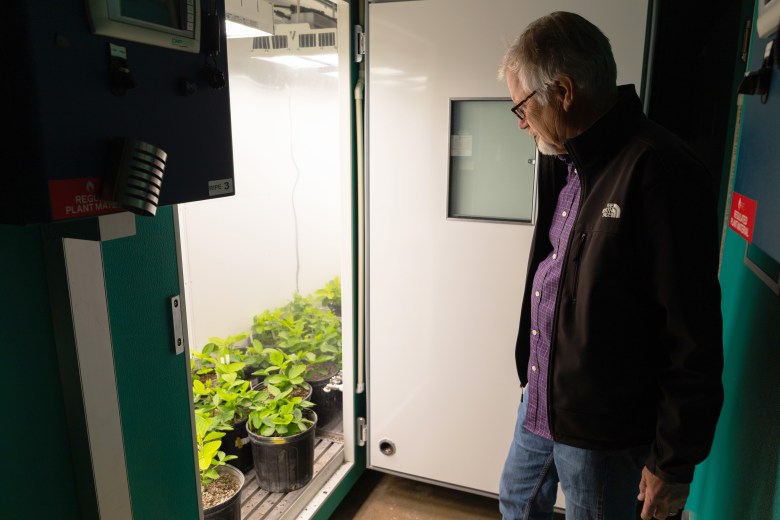
Brian Diers is former deputy director of the University of Illinois’ Soybean Innovation Lab. The lab lost its funding because of cuts to the U.S. Agency for International Development. Credit: Miles MacClure for The Hechinger Report
Soybeans — which provide both oil and high-protein food — aren’t yet commonly grown in Malawi. SIL researchers have been working toward two related goals: helping local farmers increase soybean production and ameliorate malnutrition and generating enough interest in the crop there that a new export market will open for American farmers.
The lab’s researchers work in soybean breeding, economics and mechanical research as well as education. They hope to show that soybean production in Africa is worth further investment so that eventually the private sector will come in after them.
“The people who work at SIL, they like being right at the frontier of change,” Goldsmith said. “It’s high-risk work — that’s what the universities do, that’s what scientific research is about.”
UI, the state’s flagship with a sprawling campus spread between the cities of Urbana and Champaign, is noted for its research work, especially agricultural research.
Labs and researchers across the university lost funding in cuts made by the Trump administration; more than $25 million from agencies including NIH, NSF and the National Endowment for the Humanities was cut, Melissa Edwards, associate vice chancellor for research and innovation, said, a total of 59 grants amounting to 3.6 percent of their overall federal grant portfolio.
Annette Donnelly, who just received her doctorate in education, is among those affected. Her research focuses on educating malnourished children in Africa and developing courses to help Africans learn how to process soybeans into oil.
In April, SIL was handed a lifeline — an anonymous $1 million gift that will keep the lab running through April 2026. The donation wasn’t enough for Goldsmith to rehire all of his employees; SIL’s annual operating budget before the USAID cuts was $3.3 million (and would have kept things running through 2027). But, he said, the money will allow SIL to continue its research in the Lower Shire Valley in Malawi, a project he hopes will attract future donors to fund the lab’s work.
The April donation saved Donnelly’s job, but her priorities shifted. “We’re doing research,” she said, “but we’re also doing a lot of proposal writing. It has taken on a much greater priority.”
Donnelly hopes to attract more funding so she can resume research she had started in western Kenya, demonstrating that introducing soy into children’s diets increased their protein intake by up to 65 percent, she said.
The impact that funding cuts will have on researchers at the soybean lab pales in comparison to the impact on their partners in Africa, Donnelly emphasized. There, she said, the cuts mean processors will likely slow production, limiting their ability to deliver soy products. “The consequences there are much bigger,” she said.
The Soybean Innovation Lab was funded through the Feed the Future initiative, a program to help partner countries develop better agricultural practices that began under the Obama administration in 2010. All 17 Feed the Future innovation labs funded through USAID lost funding, except for the one at Kansas State University, which studies heat-tolerant wheat.
The soybean lab’s office is housed on a quiet edge of the Illinois campus in a building once occupied by the university’s veterinary medicine program. Across the street, rows of greenhouses are home to the Crop Science Department’s experiments.
There, Brian Diers is breeding soybean varieties that resist soybean rust, a disease that’s been an obstacle to ramping up soybean production across sub-Saharan Africa. A professor emeritus who is retired, Diers works part-time at SIL to assist with soybean breeding. The April donation wasn’t enough to cover his work. Now he volunteers his time.
“ If we can help African agriculture take off and become more productive, that’s eventually going to help their economies and then provide more opportunities for American farmers to export to Africa,” he said.
Goldsmith drew an analogy between his lab’s work and the state of American agriculture in the 1930s. As the Dust Bowl swept through the Great Plains, Monsanto or another company could have stepped in to help combat it, but didn’t. Public land-grant universities did.
“That’s where the innovation comes from, from the public land grants in the U.S.,” Goldsmith said. “And now the public land grants still work in U.S. agriculture but also in the developing world.”
Commercial soybean producers hesitate to dip their toes into unproven markets, he said, so it’s SIL’s job to demonstrate that a viable market exists. “That was our secret sauce, in that lots of commercial players liked the products, the technologies we had, and wanted to move into the soybean space, but it wasn’t a profitable market,” Goldsmith said of the African soybean market.
Diers said federal funding cuts imperil not just the development of commerce and global food production but the next generation of scientists as well.
“We could potentially lose a generation of scientists who won’t go into science because there’s no funding right now,” he said.
— Miles MacClure
Contact editor Lawrie Mifflin at [email protected] or 212-678-4078. Contact editor Caroline Preston at 212-870-8965, via Signal at CarolineP.83 or on email at [email protected].
The Hechinger Report provides in-depth, fact-based, unbiased reporting on education that is free to all readers. But that doesn’t mean it’s free to produce. Our work keeps educators and the public informed about pressing issues at schools and on campuses throughout the country. We tell the whole story, even when the details are inconvenient. Help us keep doing that.
El College Board modificó este mes los criterios de concesión de becas del Programa Nacional de Reconocimiento o National Recognition Program, en una medida que podría desplazar decenas de miles de dólares de becas de estudiantes negros y latinos a estudiantes blancos.
Las universidades utilizaban los premios para contratar y ofrecer becas a estudiantes de alto rendimiento procedentes de grupos subrepresentados en la enseñanza superior. Anteriormente, el premio reconocía los logros académicos de estudiantes de cinco categorías: negros, hispanos, indígenas americanos, de primera generación y residentes en zonas rurales o ciudades pequeñas.
Las categorías raciales fueron eliminadas.
Ahora, los estudiantes que viven en ciudades pequeñas y zonas rurales pueden seguir obteniendo el premio si obtienen en el PSAT -precursor del SAT que se administra en las escuelas secundarias de todo el país- una puntuación que se sitúe en el 10% superior de todos los estudiantes de ciudades pequeñas y zonas rurales de su estado. Lo mismo ocurre con los estudiantes de primera generación, pero no con los de categorías raciales subrepresentadas.
Relacionados: ¿Le interesan más noticias sobre universidades? Suscríbase a nuestro boletín sobre educación superior quincenal gratuito .
Los críticos se mostraron decepcionados por la decisión del College Board.
“Creían que la desigualdad racial era algo importante que había que abordar ayer, y al cambiar eso, están dando a entender que no es algo importante por lo que luchar ahora”, dijo Rachel Perera, investigadora de estudios gubernamentales en la liberal Brookings Institution. “Esa es la cuestión central que se debate, aunque no se haga de forma explícita: ¿existe la discriminación racial?”.
En una declaración en su sitio web, el College Board recordó la sentencia del Tribunal Supremo de 2023 que prohibió el uso de la raza como criterio en las admisiones, aunque los premios del Programa Nacional de Reconocimiento se utilizaban para becas y contratación, no para admisiones.
“Las recientes acciones legales y regulatorias han limitado aún más la utilidad de estos premios para los estudiantes y las universidades”, dice la declaración. Además, el presidente Donald Trump ha dejado claro en repetidas ocasiones que desaprueba las políticas que tienen en cuenta la raza en la educación superior, y algunos estados han prohibido la consideración de la raza en las decisiones sobre becas.
En 2023-24, el College Board concedió 115.000 premios de reconocimiento y algo menos de la mitad correspondieron a categorías raciales. El año anterior hubo más de 80.000 premios y la mayoría fueron para estudiantes negros, hispanos e indígenas americanos. Aunque el College Board no reparte dinero por sí mismo, las universidades lo utilizan para seleccionar a los estudiantes que recibirán becas. Según Holly Stepp, directora de comunicaciones del College Board, éste no mantiene una lista de las instituciones que utilizaron las categorías raciales.
El College Board inició el programa en 1983 para reconocer a los estudiantes hispanos de alto rendimiento. En 2020, se añadieron las otras dos categorías raciales y las designaciones de ciudad pequeña y rural. Los estudiantes de primera generación pudieron ganar el premio a partir del año pasado. Las ciudades pequeñas podían incluir aquellas con ingresos modestos o enclaves ricos como Aspen (Colorado). Además, todos los estudiantes deben tener al menos una media de B+.
Aunque ahora estudiantes de todas las razas pueden obtener los premios, la supresión de las categorías raciales afectará probablemente de forma desproporcionada a los estudiantes negros e hispanos.
En promedio, los estudiantes asiáticos y blancos obtienen puntuaciones más altas en el PSAT. La puntuación media de los estudiantes blancos en el PSAT del año pasado fue de 994, frente a los 821 de los estudiantes negros, lo que supone una diferencia de 173 puntos. La media de los estudiantes asiáticos fue aún mayor, 1108, mientras que la de los hispanos y los indígenas americanos fue de 852 y 828 puntos, respectivamente.
“Se trata de un avance hacia las categorías que no tienen en cuenta la raza, cuando sabemos que la educación y el acceso a la educación no son independientes de la raza”, afirmó Wil Del Pilar, vicepresidente senior de EdTrust, un grupo político de tendencia izquierdista.
Sin embargo, algunos conservadores elogiaron la medida, argumentando que los programas de becas y contratación en función de la raza eran formas de eludir las sentencias de la Corte Suprema sobre la acción afirmativa y que constituían una forma de discriminación inversa.
Jonathan Butcher, investigador principal de política educativa en la conservadora Heritage Foundation, dijo que cree que la discriminación racial existe y debe abordarse, pero que las políticas educativas que tienen en cuenta la raza son ilegales e ineficaces.
“Si se utilizan preferencias raciales, se está preparando a los estudiantes para que pierdan la confianza en sí mismos cuando se enfrenten a una situación para la que no están preparados”, afirma Butcher.
En lugar de las categorías raciales, este año se ha añadido una nueva designación que reconoce a los estudiantes que obtienen una puntuación en el PSAT dentro del 10% de los mejores de su escuela secundaria.
Los expertos afirman que es poco probable que las universidades ofrezcan becas a todos los estudiantes que obtengan las mejores notas del 10% de todos las escuelas secundarias del país, dado el coste que ello supondría. Funcionarios de la Universidad de Nuevo México, por ejemplo, dijeron que dejarían de utilizar las designaciones del College Board a partir del año escolar 2026-27.
“Actualmente estamos analizando nuestra estrategia de becas, pero se harán cambios en todos los ámbitos”, dijo Steve Carr, director de comunicaciones de la universidad, en un correo electrónico.
En 2023-24, la Universidad de Nuevo México concedió becas por valor de 15.000 dólares cada una a 149 estudiantes negros, hispanos e indígenas americanos.
La Universidad de Arizona también ofreció becas a los estudiantes que obtuvieron premios del Programa de Reconocimiento Nacional en las designaciones raciales el año pasado.
“La universidad ya estaba evaluando su estrategia de becas y tendrá en cuenta el anuncio del College Board a la hora de determinar la mejor manera de avanzar y apoyar a nuestros estudiantes”, dijo Mitch Zak, portavoz de la Universidad de Arizona, en un correo electrónico.
Además de las puntuaciones obtenidas en el PSAT, los estudiantes pueden optar al premio del College Board si obtienen una puntuación de 3 o más en dos de los cinco exámenes de Colocación Avanzada o Advanced Placement realizados durante su noveno y/o décimo curso, aunque muchas escuelas secundarias no ofrecen de manera uniforme cursos AP a los estudiantes de primer y segundo año.
“No podemos hablar de méritos si no estamos todos en el mismo punto de partida en cuanto a lo que recibimos de nuestra educación primaria y secundaria”, dijo Del Pilar, “y cómo podemos desenvolvernos en el entorno de preparación de exámenes, o la falta de preparación de exámenes que reciben ciertas comunidades”.
Comunícate Meredith Kolodner en el 212-870-1063 o en [email protected] o en Signal en merkolodner.04
Esta historia sobre el College Board fue producida por The Hechinger Report, una organización de noticias independiente y sin ánimo de lucro centrada en la desigualdad y la innovación en la educación. Suscríbase al boletín de Hechinger.
The Hechinger Report provides in-depth, fact-based, unbiased reporting on education that is free to all readers. But that doesn’t mean it’s free to produce. Our work keeps educators and the public informed about pressing issues at schools and on campuses throughout the country. We tell the whole story, even when the details are inconvenient. Help us keep doing that.
The College Board this month changed the criteria for its National Recognition Program awards in a move that could shift tens of thousands of scholarship dollars from Black and Latino students to white students.
Colleges used the awards to recruit and offer scholarships to high-performing students from groups underrepresented in higher education. The award previously recognized academic achievement by students in five categories — Black, Hispanic, Native American, first-generation and those living in rural areas or small towns.
The racial categories have been eliminated.
Now, students living in small towns and rural areas can still earn the award if they score in the top 10 percent among all small-town and rural students in their state on the PSAT — a precursor to the SAT that is administered in high schools around the country. The same is true for first-generation students but not for students in underrepresented racial categories.
Related: Interested in more news about colleges and universities? Subscribe to our free biweeklyhigher education newsletter.
Critics said they were disappointed by the College Board’s decision.
“They believed racial inequality was something important to address yesterday, and by changing that, they’re implying that it’s not something important to fight for now,” said Rachel Perera, a fellow in government studies at the liberal Brookings Institution. “That’s the heart of the question that’s being debated — although it’s not being debated in explicit terms — does racial discrimination exist?”
In a statement on its website, the College Board noted the 2023 Supreme Court ruling that prohibited the use of race in admissions, although the National Recognition Program awards were used for scholarships and recruitment, not admissions.
“Recent legal and regulatory actions have further limited the utility of these awards for students and colleges,” the statement says. Also, President Donald Trump has repeatedly made clear his disapproval of race-conscious policies in higher education, and some states have banned consideration of race in scholarship decisions.
In 2023-24, the College Board issued 115,000 recognition awards, and a little less than half were in the racial categories. The previous year there were more than 80,000 awards and the majority were for Black, Hispanic and Native American students. While the College Board doesn’t hand out money itself, universities use it to select students for scholarships. The Board has not maintained a list of which institutions used the racial categories, according to Holly Stepp, College Board’s director of communications.
The College Board started the program in 1983 to recognize high-performing Hispanic students. In 2020, the other two racial categories and the small town and rural designations were added. First-generation students could win the award starting last year. Small towns could include those with modest incomes or wealthy enclaves like Aspen, Colorado. All students must also have at least a B+ average.
While students of all races can now earn the awards, the removal of the racial categories will likely disproportionately affect Black and Hispanic students.
On average, Asian and white students score higher on PSATs. White students’ average score on the PSAT last year was 994 last year compared with 821 for Black students — a gap of 173 points. Asian students’ average was even higher at 1108 while Hispanic and Native American students averaged 852 and 828 respectively.
“It’s a move towards race-blind categories when we know that education and access to education isn’t race-blind,” said Wil Del Pilar, senior vice president at the left-leaning policy and advocacy group EdTrust.
Some conservatives praised the move, however, arguing that race-conscious scholarship and recruitment programs were ways to get around the Supreme Court’s rulings on affirmative action and that they were a form of reverse discrimination.
Jonathan Butcher, senior research fellow in education policy at the conservative Heritage Foundation, said he believes that racial discrimination does exist and should be addressed, but that race-conscious education policies were both illegal and ineffective.
“If you are using racial preferences, you are setting students up for a loss of confidence when they struggle in a situation they’re not prepared for,” Butcher said.
In place of the racial categories, a new designation has been added this year that recognizes students who score in the top 10 percent of their high school on the PSAT.
Experts say colleges are unlikely to offer scholarships to all students who score in the top 10 percent of every high school in the country, given the cost that would entail. Officials at the University of New Mexico, for example, said they would stop using the College Board designations beginning in the 2026-27 school year.
“We’re currently analyzing our scholarship strategy, but changes will be made across the board,” said Steve Carr, the university’s director of communications, in an email.
In 2023-24, the University of New Mexico awarded scholarships based on the College Board designations worth $15,000 each to 149 Black, Hispanic and Native American students.
The University of Arizona also offered scholarships to students who earned National Recognition Program awards in the racial designations last year.
“The university was already evaluating its scholarship strategy and will consider the College Board’s announcement as we determine how best to move forward and support our students,” said Mitch Zak, spokesman for the University of Arizona, in an email.
In addition to the PSAT scores, students are eligible for the College Board award if they score a 3 or higher out of 5 on two Advanced Placement exams taken during their ninth and/or 10th grade year, although many high schools don’t uniformly offer AP courses to freshmen and sophomores.
“We can’t really have a conversation around merit if we’re not all at the same starting point in terms of what we receive from our K-12 education,” said Del Pilar, “and how we’re able to navigate the test prep environment, or the lack of test prep that certain communities receive.”
Contact senior investigative reporter Meredith Kolodner at 212-870-1063 or [email protected] or on Signal at merkolodner.04
The Hechinger Report provides in-depth, fact-based, unbiased reporting on education that is free to all readers. But that doesn’t mean it’s free to produce. Our work keeps educators and the public informed about pressing issues at schools and on campuses throughout the country. We tell the whole story, even when the details are inconvenient. Help us keep doing that.
RIVER FOREST, Illinois — Cuando Jacqueline Quintero empezó a explorar opciones para ir a la universidad cuando se graduara de secundaria, se dio cuenta de algo que muchas parecían tener en común.
“No me gusta decirlo, pero todo el mundo parecía tan blanco”, dijo Quintero, cuyos padres llegaron a Estados Unidos desde México. “Simplemente no sentía que yo pertenecía allí”.
Hasta que fue a una recepción para estudiantes admitidos en la Dominican University, cerca de donde creció en los suburbios del oeste de Chicago. Entre las cosas que la hicieron decidirse casi de inmediato a ir allí: Se proporcionaba información a las familias tanto en inglés como en español.
“Por fin mis padres pudieron hacer preguntas” en su lengua materna, dice Quintero, que ahora cursa el penúltimo año de la carrera de Derecho. “Estaba acostumbrada a traducirles toda mi vida. Me puse a llorar, literalmente”.
Este aparentemente pequeño detalle es uno de los muchos que han ayudado a impulsar la matrícula de Dominican en casi un 25 por ciento desde 2021, un período durante el cual las instituciones comparables han luchado por atraer estudiantes y cuando el número de jóvenes de 18 años está a punto de comenzar un largo declive.
Esto se debe a que la universidad ha aprovechado un grupo de clientes potenciales que está creciendo: Los graduados hispanos como Quintero.
Históricamente, a las universidades y escuelas superiores no les ha ido bien a la hora de reclutar estudiantes hispanos. Ahora su propio éxito puede depender en gran medida de ello.
“La demografía de nuestro país está cambiando, y la enseñanza superior tiene que adaptarse”, afirma Glena Temple, presidenta de Dominican.
O, como dijo Quintero, sonriendo: “Ahora nos necesitan”.
Relacionado: ¿Te interesa recibir más noticias sobre universidades? Suscríbete a nuestro boletín quincenal gratuito de educación superior.
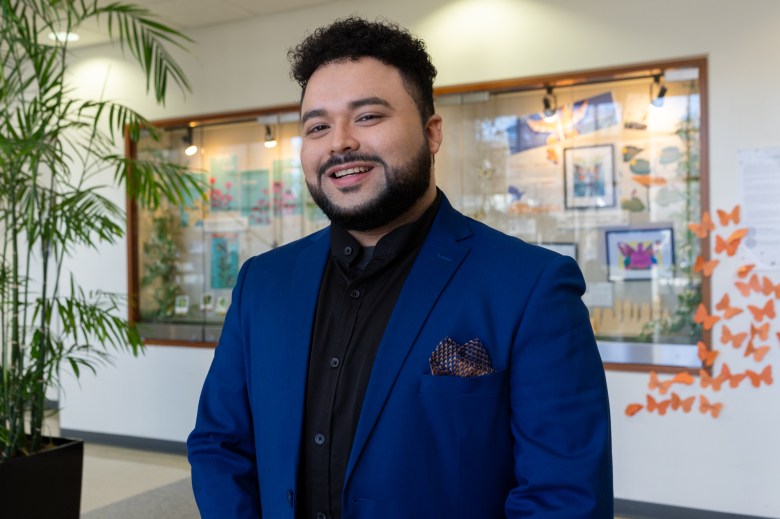
Jacqueline Quintero, hija de inmigrantes mexicanos, estudia en la Dominican University y tiene previsto estudiar Derecho. “Ahora nos necesitan”, dice refiriéndose a las universidades que reclutan estudiantes hispanos como ella. Credit: Camilla Forte/The Hechinger Report
Mientras que se prevé que en 2041 las cifras de graduados en enseñanza secundaria blancos, negros y asiáticos disminuyan en un 26%, un 22% y un 10%, respectivamente, se prevé que el número de graduados hispanos en enseñanza secundaria durante ese periodo aumente un 16%, según la Western Interstate Commission for Higher Education, que realiza el seguimiento de estos datos.
Según el Centro Nacional de Estadísticas Educativas, casi 1 de cada 3 alumnos desde preescolar hasta 12º curso es hispano. Esta cifra es superior a la de menos de 1 de cada 4 de hace una década. La proporción de alumnos hispanos en las escuelas públicas es aún mayor en algunos estados, como California (56%), Texas (53%) y Florida (38%).
Esto hace que estos jóvenes – a menudo hijos o nietos de inmigrantes, o inmigrantes ellos mismos – adquieran una nueva importancia para las universidades, que históricamente no han conseguido atraer a tantos estudiantes hispanos como a gente de otros orígenes raciales.
Sin embargo, en un momento en que la educación superior necesita que aumente, la proporción de estudiantes hispanos que van a la universidad ha ido disminuyendo. Invertir esa tendencia es todo un reto, por muchas razones – el elevado costo, la necesidad de encontrar un trabajo inmediatamente después de la secundaria, el hecho de que muchos proceden de familias sin experiencia universitaria a las que pedir consejo – agravadas por los ataques cada vez más agresivos a los programas de diversidad de los campus, que podrían dificultar aún más la captación y el apoyo a estos estudiantes.
En el pasado, según Deborah Santiago, directora ejecutiva de la organización de defensa de los hispanos Excelencia in Education, las instituciones de enseñanza superior “podían alcanzar sus cifras [de matriculación] sin implicar a esta población. Eso ya no es así”.
Ese gran número de estudiantes hispanos que se acercan a la edad universitaria “es para lo que tenemos que prepararnos como instituciones de enseñanza superior y para satisfacer las necesidades de nuestras comunidades”, afirma Greg Mosier, presidente del Kansas City Kansas Community College, que ahora se anuncia en periódicos en español y en la radio en español.
“A medida que los baby boomers se jubilan, la población joven es mucho menor y tiene que sostener a una población de más edad”, afirma Michael Collins, vicepresidente del Centro para la Equidad Económica Racial de la organización sin fines de lucro Jobs for the Future.
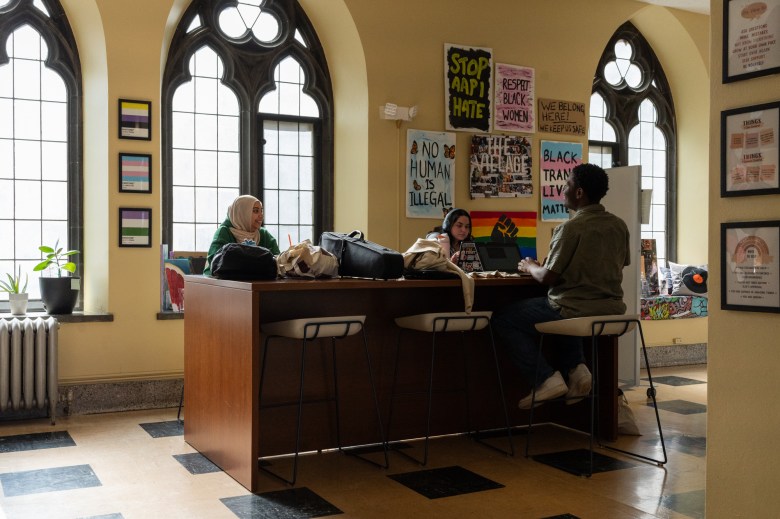
El Centro para la Liberación Cultural de la Dominican University, cerca de Chicago. La sala es un lugar de estudio, conversación y encuentro para estudiantes de todas las procedencias. Credit: Camilla Forte/The Hechinger Report
A menos que las universidades construyan redes más amplias, dijo Collins – incluyendo la ayuda para que más hispanoamericanos puedan acceder a empleos mejor pagados – “nuestra calidad de vida será menor. Es un panorama bastante desolador”.
Incluso los más pequeños esfuerzos por matricular y apoyar a los estudiantes hispanos se complican aún más con la retirada de los programas de diversidad y las ayudas económicas a los estudiantes indocumentados, muchos de ellos hispanos.
Aunque la base jurídica de esa decisión ha sido ampliamente cuestionada, tiene en vilo a las instituciones de enseñanza superior. Incluso muchos colegios y universidades que los activistas elogiaron por impulsar la matriculación de hispanos no quisieron hablar de ello.
Algunos expertos dicen que la mayoría de los programas para reclutar y apoyar a los estudiantes hispanos no se verían afectados por las campañas anti DEI, ya que se ofrecen a cualquiera que los necesite. “Estas cosas funcionan para todos los estudiantes”, dijo Anne-Marie Núñez, directora ejecutiva del Instituto para el Éxito de los Estudiantes Hispanos de la Universidad de Texas en El Paso.
La proporción de graduados de secundaria hispanos que van directamente a la universidad es inferior a la de sus compañeros blancos, y está disminuyendo: del 70% al 58% entre 2012 y 2022. Ese es el último periodo para el que se dispone de cifras del Centro Nacional de Estadísticas Educativas. Los estudiantes hispanos que se matriculan en la universidad también la abandonan en mayor proporción.
Hay razones económicas y culturales para ello.
Según la Oficina del Censo, el ingreso medio anual de las familias hispanas es más de un 25% inferior al de las familias blancas, lo que significa que la universidad puede parecer fuera de su alcance. El Center for Law and Social Policy ha calculado que más de tres cuartas partes de los estudiantes hispanos que acuden incluso a colegios comunitarios de bajo coste tienen necesidades financieras no cubiertas.
Esto empuja a muchos directamente al mercado laboral. Muchos estudiantes universitarios hispanos trabajan al menos a tiempo parcial mientras estudian, algo que, según las investigaciones, reduce la probabilidad de graduarse.
Cuando Eddie Rivera terminó la secundaria en Carolina del Norte, “la universidad no era realmente una opción. Mi consejero no me ayudó. Sólo seguí lo que mi cultura hispana nos dice, que es ir a trabajar”.
Cuando Eddie Rivera terminó la secundaria en Carolina del Norte, “sólo seguí lo que mi cultura hispana nos dice, que es ir a trabajar”. Animado por sus compañeros, acabó matriculándose en la Dominican University. Credit: Camilla Forte/The Hechinger Report
Rivera, que tiene el estatus DACA, o Acción Diferida para los Llegados en la Infancia, trabajó en una residencia de ancianos, en un parque de trampolines cubierto y en un hospital durante la pandemia, donde sus colegas le animaron a ir a la universidad. Con la ayuda de un programa de becas para estudiantes indocumentados, también terminó en Dominican, donde a sus 28 años es estudiante de tercer año y se especializa en relaciones internacionales y diplomacia, con planes de obtener una maestría en política exterior y seguridad nacional.
Dominican, una pequeña universidad católica que data de 1922 y que antes se llamaba Rosary College, tiene una historia de educación de hijos de inmigrantes, del norte y centro de Europa, inicialmente.
Hoy, de las farolas del campus de 30 acres cuelgan pancartas con fotos de antiguos alumnos hispanos de éxito, y una banda de mariachis dirige las celebraciones del Día de los Muertos.
Las visitas a la institución se realizan en inglés y español, se ofrece a los estudiantes trabajo en el campus y el personal ayuda a familias enteras a superar crisis sanitarias, de vivienda y financieras. Dominican añadió un campus satélite en otoño en el barrio mexicano-americano de Pilsen, en Chicago, que ofrece titulaciones de dos años orientadas al empleo. Todos los estudiantes de la universidad reciben ayuda financiera, según datos federales.
“Todos los días me encuentro con un miembro del personal o un profesor que me pregunta qué me pasa en la vida y cómo pueden ayudarme”, dice Aldo Cervantes, estudiante de tercer año de Negocios con especialización en Contabilidad, que quiere dedicarse a la banca o a los recursos humanos.
También hay una Academia Familiar para que los padres, abuelos, hermanos y primos de los estudiantes conozcan los recursos de la universidad; como incentivo, las familias que acudan a cinco sesiones obtienen créditos para que su estudiante realice un curso de verano sin costo alguno.
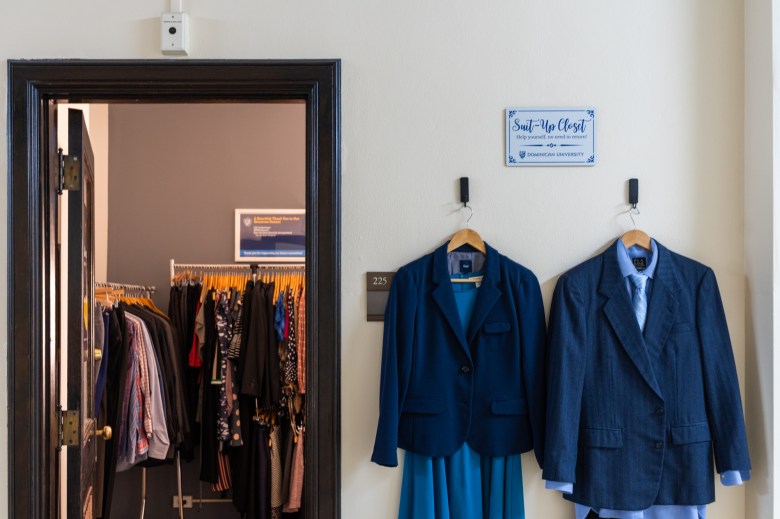
Un armario de ropa en la Dominican University para estudiantes que necesitan trajes de negocios para entrevistas de trabajo. Uno de los factores que frenan la matriculación de hispanos en la universidad es la menor renta media de los hogares. Credit: Camilla Forte/The Hechinger Report
“Cuando observamos a la población latina que va a la universidad, no se trata de una elección individual”, afirma Gabe Lara, Vicepresidente de Éxito y Compromiso Estudiantil, utilizando el término preferido por la universidad para referirse a las personas de ascendencia latinoamericana. “Es una elección familiar”.
Estas y otras medidas han contribuido a más que duplicar la proporción de estudiantes hispanos en los últimos 10 años, hasta casi el 70% de los 2.570 estudiantes de Dominican, según cifras facilitadas por la universidad.
Genaro Balcazar dirige las estrategias de matriculación y marketing como director de operaciones de la universidad, tiene una forma pragmátuca de ver la situación.
“Atendemos las necesidades de los alumnos no por quiénes son”, dijo Balcázar, “sino porque necesitan la ayuda”.
Este artículo sobre la enseñanza superior y el reclutamiento de alumnos hispanos fue producido por The Hechinger Report, una organización de noticias independiente sin fines de lucro centrada en la desigualdad y la innovación en la educación. Suscríbete a nuestro boletín. Escucha nuestro podcast sobre educación.
The Hechinger Report provides in-depth, fact-based, unbiased reporting on education that is free to all readers. But that doesn’t mean it’s free to produce. Our work keeps educators and the public informed about pressing issues at schools and on campuses throughout the country. We tell the whole story, even when the details are inconvenient. Help us keep doing that.
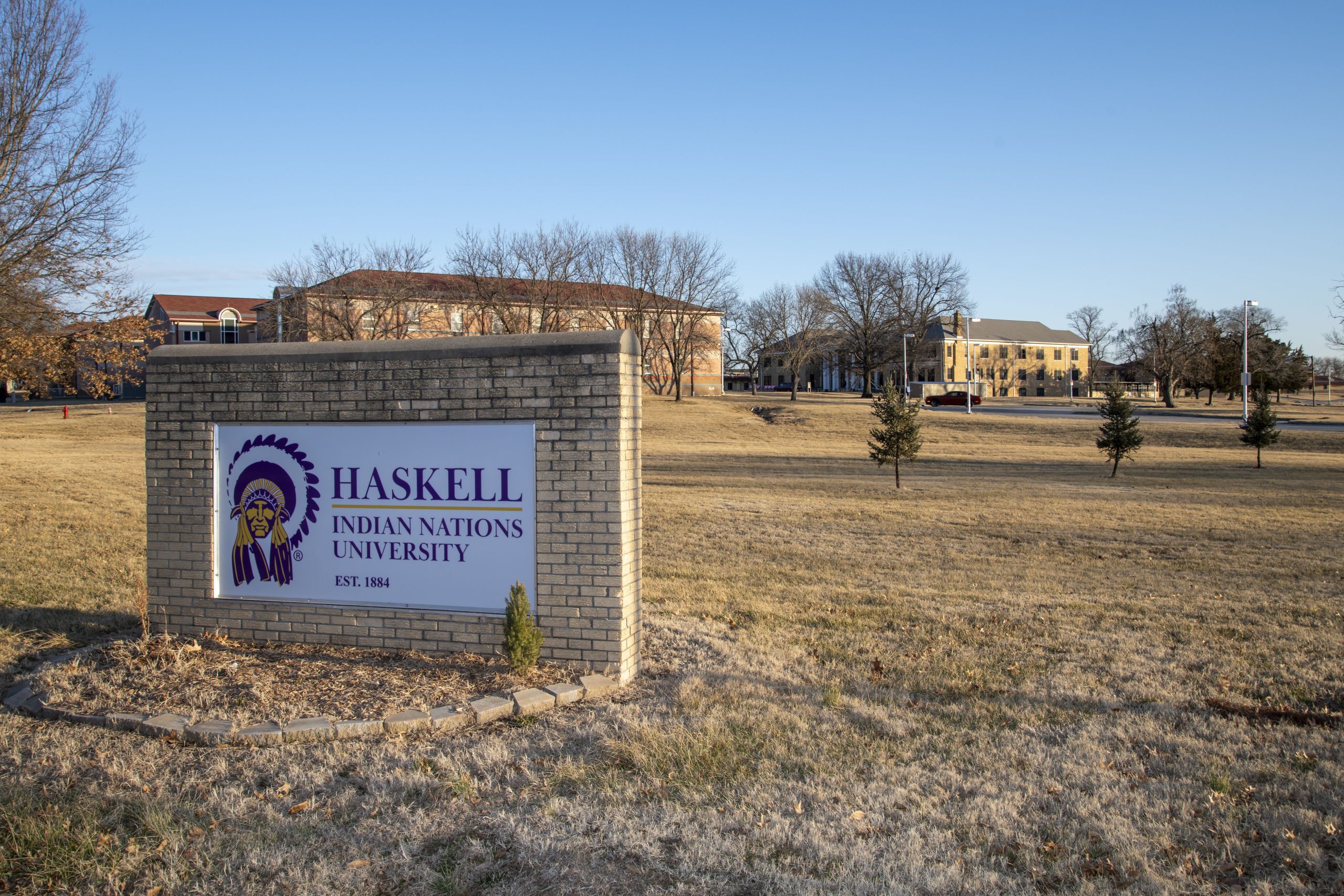
After weeks of uncertainty, two tribal colleges have been told they can hire back all employees who were laid off as part of the Trump administration’s deep cuts across the federal workforce in February, part of a judge’s order restoring some federal employees whose positions were terminated.
Haskell Indian Nations University in Kansas and Southwestern Indian Polytechnic Institute, widely known as SIPI, in New Mexico lost about 70 employees in mid-February amid widespread staffing cuts to federal agencies. While most of the nation’s 37 tribal colleges and universities are chartered by American Indian tribes, Haskell and SIPI are not associated with individual tribes and are run by the federal government.
About 55 employees were laid off and 15 accepted offers to resign, according to a lawsuit filed last month by tribes and students. The colleges were forced to cancel or reconfigure a wide range of services, from sports and food service to financial aid and classes. In some cases, instructors were hired by other universities as adjuncts and then sent back to the tribal colleges to keep teaching.
Related: Interested in more news about colleges and universities? Subscribe to our free biweekly higher education newsletter.
It was not clear this week when and if the workers would return, whether the employees who resigned would also be offered their jobs back, or if the government would allow colleges to fill vacancies. Both colleges said some employees had turned down the offers.
The Bureau of Indian Education, which runs the colleges, declined to answer questions except to confirm the laid-off workers would be offered jobs with back pay to comply with a judge’s order that the government reverse course on thousands of layoffs of probationary employees. But the agency also noted the jobs would be available “as the White House pursues its appeals process,” indicating possible turmoil if an appeals court reinstates the layoffs.
Both colleges said the bureau also has refused to answer most of their questions.
SIPI leaders were told last week that the positions were being restored, said Adam Begaye, chairman of the SIPI Board of Regents. The 270-student college lost 21 employees, he said, four of whom decided to take early retirement. All but one of the remaining 17 agreed to return, Begaye said.
The chaos has been difficult for those employees, he said, and the college is providing counseling.
“We want to make sure they have an easy adjustment, no matter what they’ve endured,” Begaye said.
The chairman of Haskell’s Board of Regents, Dalton Henry, said he was unsure how many of the 50 lost employees were returning. Like SIPI, Haskell was forced after the layoffs to shift job responsibilities and increase the workload for instructors and others.
Haskell was reviewed by accreditors in December, and Henry said he was worried how the turmoil would affect the process. Colleges and universities must be accredited to offer federal and state financial aid and participate in most other publicly funded programs.
Henry declined to discuss his thoughts on the chaos, saying there was nothing the college could do about it.
“Whatever guidance is provided, that’s what we have to adhere to,” he said. “It’s a concern. But at this point, it’s the federal government’s decision.”
The Bureau of Indian Affairs declined to make the presidents of the two colleges available for interviews.
Tribal colleges and universities were established to comply with treaties and the federal trust responsibility, legally binding agreements in which the United States promised to fund Indigenous education and other needs. But college leaders argue the country has violated those contracts by consistently failing to fund the schools adequately.
In the federal lawsuit claiming the Haskell and SIPI cuts were illegal, students and tribes argued the Bureau of Indian Education has long understaffed the colleges. The agency’s “well-documented and persistent inadequacies in operating its schools range from fiscal mismanagement to failure to provide adequate education to inhospitable buildings,” plaintiffs claimed.
Sen. Jerry Moran and Rep. Tracey Mann, both Kansas Republicans, said before Trump took office that they plan to introduce a bill shifting Haskell from federal control to a congressional charter, which would protect the university from cuts across federal agencies such as the Bureau of Indian Education.
“[F]or the last few years the university has been neglected and mismanaged by the Bureau of Indian Education,” Moran said in a written statement in December. “The bureau has failed to protect students, respond to my congressional inquiries or meet the basic infrastructure needs of the school.”
The February cuts brought rare public visibility to tribal colleges, most of which are in remote locations. Trump’s executive orders spurred outrage from Indigenous communities and a flurry of national news attention.
“We’re using this chaos as a blessing in disguise to make sure our family and friends in the community know what SIPI provides,” said Begaye, the SIPI board president.
The uncertainty surrounding the colleges’ funding has left a lasting mark, said Ahniwake Rose, president and CEO of the American Indian Higher Education Consortium, which advocates for tribal colleges. But she added she was proud of how the schools have weathered the cuts.
“Indian country is always one of the most resourceful and creative populations,” she said. “We’ve always made do with less. I think you saw resilience and creativity from Haskell and SIPI.”
Contact editor Christina A. Samuels at 212-678-3635 or [email protected].
The Hechinger Report provides in-depth, fact-based, unbiased reporting on education that is free to all readers. But that doesn’t mean it’s free to produce. Our work keeps educators and the public informed about pressing issues at schools and on campuses throughout the country. We tell the whole story, even when the details are inconvenient. Help us keep doing that.
Thisstory was produced by Floodlight and republished with permission.
President Donald Trump and his administration have called it the “Great American Comeback.” But environmental advocates say the U.S. Environmental Protection Agency’s reversing course on enforcing air and water pollution laws is more of a throwback — one that will exacerbate health risks for children who live and study in the shadows of petrochemical facilities.
The American Lung Association has found that children face special risks from air pollution because their airways are smaller and still developing and because they breathe more rapidly and inhale more air relative to their size than do adults.
Environmental lawyers say Trump and EPA Administrator Lee Zeldin’s slashing of federal protections against toxic emissions could lead to increased exposure to dangerous pollutants for kids living in fenceline communities.
Community advocates like Kaitlyn Joshua, who was born and raised in the southeast corridor of Louisiana dubbed “Cancer Alley,” say they are horrified about what EPA’s deregulation push will mean for the future generation.
“That is not an exaggeration; we feel like we are suffocating without the cover and the oversight of the EPA,” Joshua said. “Without that, what can we really do? How can we really save ourselves? How can we really save our communities?”
Kaitlyn Joshua is a native of the southeast corridor of Louisiana dubbed “Cancer Alley,” and has spent the last few years leading the fight against a hydrogen and ammonia facility being built within 2,000 feet of an elementary school in Ascension Parish. Joshua says she is ‘horrified’ about the recent deregulation measures the U.S. Environmental Protection Agency recently announced for the petrochemical industry. Credit: Claire Bangser/Floodlight
Ashley Gaignard knows how hard it is to keep kids safe when pollution is all around.
When Gaignard’s son was in elementary school, a doctor restricted him from daily recess, saying the emissions from an ammonia facility located within 2 miles of his playground could be exacerbating a pre-existing lung condition, triggering his severe asthma attacks.
“I had asthma as a kid growing up, and my grandfather had asthma, so I just figured it was hereditary; he was going to suffer with asthma,” said Gaignard, who was born and raised in Louisiana’s Ascension Parish, also located within Cancer Alley. She’s now chief executive officer of the community advocacy group she created, Rural Roots Louisiana.
“I just never knew until the doctor said, ‘Okay, we have to think about what he is breathing, and what’s causing him to flare up the minute he’s outside’,” she said.
Gaignard said the further her son got away from that school, as he moved through the parish’s educational system, the less severe his attacks were. She said he’s now an adult living in Fresno, California — and no longer suffers from asthma.
Zeldin sent shockwaves throughout the environmental justice sector on March 12 when he announced that the EPA was rolling back many of the federal regulations that were put in place under the administration of Joe Biden — many built around environmental justice and mitigating climate change.
Those included strengthening the Clean Air Act by implementing more stringent controls on toxic air emissions and increased air quality monitoring in communities near industrial facilities. The new standards were expected to reduce 6,000 tons of air toxins annually and reduce the emissions related to cancer risks in these communities in Texas, Louisiana, Delaware, New Jersey, the Ohio River Valley and elsewhere.
A new memo from the Office of Enforcement and Compliance Assurance, which serves as the law enforcement arm of the EPA — circulated the same day as Zeldin’s announcement — states that environmental justice considerations would no longer factor into the federal agency’s oversight of facilities in Black and brown communities.
Zeldin said the goal was “driving a dagger straight into the heart of the climate change religion.”
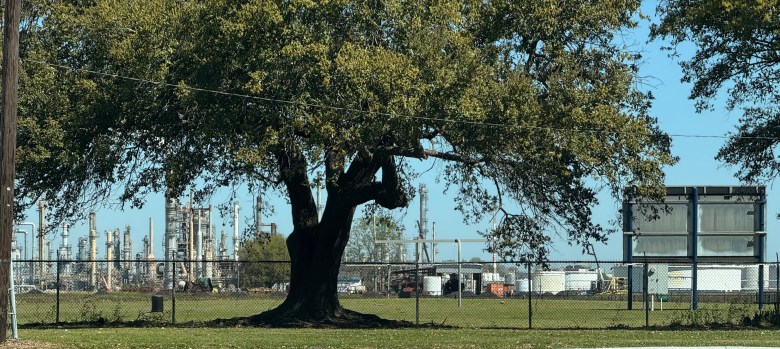
Port Allen Middle School sits in the shadow of the Placid petrochemical refinery in West Baton Rouge Parish, La. A 2016 report found nearly one in 10 children in the U.S. attends one of the 12,000 schools located within 1 mile of a chemical facility, which for environmental advocates highlights the danger of the recently announced rollbacks of air and water pollution regulations by the U.S. Environmental Protection Agency. Credit: Terry L. Jones / Floodlight
That means the EPA will no longer target, investigate or address noncompliance issues at facilities emitting cancer-causing chemicals such as benzene, ethylene oxide and formaldehyde in the places already overburdened with hazardous pollution.
“While enforcement and compliance assurance can continue to focus on areas with the highest levels of (hazardous air pollutants) affecting human health,” the memo reads, “…to ensure consistency with the President’s Executive Orders, they will no longer focus exclusively on communities selected by the regions as being ‘already highly burdened with pollution impacts.’”
The agency also will not implement any enforcement and compliance actions that could shut down energy production or power generation “absent an imminent and substantial threat to human health.”
In is prepared video statement about the EPA’s deregulation measures, Zeldin said, “The agency is committed to fulfilling President Trump’s promise to unleash American energy, lower cost of living for Americans, revitalize the American auto industry, restore the rule of law, and give power back to states to make their own decisions. ”
Top officials with the nonprofit environmental advocacy group Earthjustice recently said there is no way for the Trump administration to reconcile what it’s calling “the greatest day of deregulation” in EPA’s history with protecting public health.
Patrice Simms, vice president of litigation for healthy communities for Earthjustice, went a step further pointing out during a press briefing that the reason EPA exists is to protect the public from toxic air pollution.
“The law demands that EPA control these pollutants, and demands that EPA protect families and communities,” Simms said. “And these impacts on these communities most heavily land on the shoulders of children. Children are more susceptible to the harms from pollutants, and these pollutants are often happening right in the backyards of our schools, of our neighborhoods and our playgrounds.”
A 2016 report published by the Center for Effective Government found that nearly one in 10 children in the country attends one of the 12,000 schools located within 1 mile of a chemical facility. These children are disproportionately children of color living in low-income areas, the report found.
For the past several years, Joshua has been leading the opposition to a hydrogen and ammonia facility being built within 2,000 feet of an elementary school in Ascension Parish. Air Products plans to start commercial operation in 2028 where an estimated 600,000 metric tons of hydrogen will be produced annually from methane gas.
The $7 billion project has been touted as a clean energy solution because the company intends to use technology to collect its carbon dioxide emissions, and then transport them through pipelines to be stored under a recreational lake 37 miles away.
Carbon capture technology has been controversial, with skeptics highlighting the possibilities for earthquakes, groundwater contamination and CO2 leaking back into the atmosphere through abandoned and unplugged oil and gas wells or pipeline breaches. Pipeline ruptures in the past have also led to communities having to evacuate their homes.
Joshua said these communities need more federal regulation and oversight — not less.
“We had a community meeting … for our Ascension Parish residents, and the sentiment and the theme on that call was very much like ‘Kaitlyn, there is nothing we can do.’ Like, we just had to literally lie down and take this,” Joshua said. “We had to kind of challenge people and put them in the space, in time, of a civil rights movement. We have to get creative about how we’re going to organize around it and be our own version of EPA.”
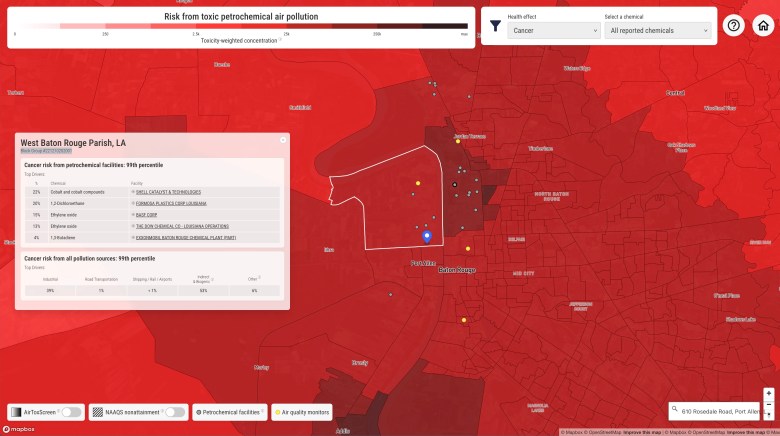
This screenshot from CLEAR Collaborative’s Petroleum Pollution Map models health risks from hazardous air pollution from petrochemical facilities around West Baton Rouge Parish near Port Allen Middle School. The map uses U.S. Environmental Protection Agency data analyzed by the Environmental Defense Fund. Environmental advocates have sounded the alarm on the dangers of the EPA’s rollback of air and water regulations for children in fenceline communities. Credit: Provided by The Environmental Defense Fund
Sarah Vogel, senior vice president of health communities with the Environmental Defense Fund, said the move toward deregulation comes as the U.S. Department of Justice announced on March 7 that it was dropping the federal lawsuit the Biden administration lodged against Denka’s Performance Elastomer plant in Louisiana. That plant had been accused of worsening cancer risks for the residents in the surrounding majority-Black community.
The DOJ said its decision was tied to Trump’s moves to dismantle all federal programs tied to diversity, equity and inclusion.
“What they’re trying to do is just completely deregulate everything for oil and gas and petrochemical facilities, just absolutely take the lid off,” Vogel said. “We have long known that children are uniquely susceptible to air pollution and toxic chemicals. Like they’re huge, huge impacts. It’s why what they are doing is so devastating and cruel in my mind.”
Floodlight, which produced this story, is a nonprofit newsroom that investigates the powers stalling climate action.
The Hechinger Report provides in-depth, fact-based, unbiased reporting on education that is free to all readers. But that doesn’t mean it’s free to produce. Our work keeps educators and the public informed about pressing issues at schools and on campuses throughout the country. We tell the whole story, even when the details are inconvenient. Help us keep doing that.
In the wake of federal and state bans on diversity, equity and inclusion, several colleges and universities are eliminating the option for students to live in culture-based housing starting next fall—a trend that could signal increased attacks on certain student resources that went largely untouched under previous state-level DEI bans.
The University of Iowa confirmed to Inside Higher Ed that it will be ceasing operations of three of its living-learning communities: All In, for LGBTQ students; Unidos, for Latino students; and Young, Gifted and Black, for Black students. North Carolina State University will also shut down two culture-based dorms—called Living and Learning Villages at NCSU—dedicated to Native American and Black students, as first reported in The Nubian Message, the college’s Black student-led newspaper.
In both cases, the institutions will no longer offer the residential communities starting next semester. Both NCSU and Iowa are retaining other learning communities focused on academic majors and other interests.
The cancellations come in the wake of President Donald Trump’s crusade against all things even tangentially related to diversity, equity and inclusion. A Feb. 14 Dear Colleague letter from the Department of Education stated that federal law prohibits the use of race in relation to a variety of campus programs and activities, including housing, going beyond the restrictions set by most statewide anti-DEI legislation.
In the aftermath of that letter, many universities—including some private institutions and institutions in solidly blue states—began scrubbing words related to DEI from their websites and shuttering DEI offices. But only a handful of institutions have gotten rid of the housing communities, which have often been lauded for strengthening students’ sense of belonging on campus. (Belonging is associated with higher rates of retention and mental well-being, multiple studies have found.)
A spokesman for the University of Iowa did not say what led to the decision to close the three living-learning communities. Iowa passed legislation last year banning diversity, equity and inclusion offices on college campuses. The university also announced Thursday that it would be permanently shuttering its DEI office, which it had rearranged and renamed to the Division of Access, Opportunity, and Diversity as a result of last year’s legislation.
NCSU did not respond to Inside Higher Ed’s request for comment but told The Nubian Message that the changes were “part of the university’s ongoing review of compliance with executive actions issued by the federal government and UNC System policy.”
Another institution, the University of Florida, has removed the option to sign up for any of its nonacademic learning communities for next semester, including those dedicated to Black, first-generation, international, LGBTQ+ and out-of-state students, plus one for students in the arts. According to The Alligator, the university’s student paper, the university also changed language on its housing website from describing the learning communities as “interest-based communities” to “academic-based communities.”
In an email to the campus community, the institution said the change was related to the university’s housing master plan.
“The University of Florida’s Housing & Residence Life is unwavering in our commitment to providing community-orientated facilities where residents are empowered to learn, innovate and succeed. As we enter a 10-year Housing Master Planning process, all programmatic offerings are being evaluated to ensure we continue to provide a premiere on-campus living experience,” the message read. “As a result, we are pausing all activities associated with non-academic Living Learning Communities.”
But some students have expressed concern that the elimination of the communities focused on identity may actually be related to Trump’s anti-DEI push or existing Florida anti-DEI legislation.
“Cancelling the activities of marginalized LLCs follows a long history of UF stripping protections from vulnerable students,” reads a petition calling on the university to reverse its decision. “It is clear that this latest attack on safe housing is only part of a larger plan to transform the UF campus into a space that is no longer safe for marginalized groups. LLCs will not be the last protection to be targeted.”
A Best Practice to Support Students
The Young, Gifted and Black learning community debuted in 2016 in response to a proposal by a group of students, The Daily Iowan, the University of Iowa’s student newspaper, reported at the time.
The university’s housing website says that students living in YGB “will be challenged to understand the various experiences among the African/Black diaspora, encouraged to learn and develop critical thinking skills outside the classroom, relate your passions to your academics and better Iowa’s Black Community through campus involvement.” Students who live on the floor are also required to take a course on African American culture.
Sandrah Nasimiyu, an Iowa alumna, lived in the community in the 2019–20 academic year—though, of course, her time there was cut short by the COVID-19 pandemic. Her happiest memories in college took place in the residence hall, she told Inside Higher Ed, from debriefing with her floor mates after a long day of classes to a memorable game night when her friends tried, unsuccessfully, to teach her to play spades.
“I was already at a [predominantly white institution]. We live in Iowa—I had grown up in the suburbs and really wanted to have some form of community,” she said. “Where you put your head at night, where you’re going to spend the most time, you have to feel comfortable … when I stepped off that floor, I was in an environment I see all the time that wasn’t made for me.”
Nasimiyu is still friends with several people she met in the brief time she lived there. Sometimes, she recalled, Black students who didn’t live on YGB would tell her that they struggled to make Black friends on campus; Black people make up just 2.8 percent of the student body at Iowa.
LGBTQ+ and culture-based residence halls have come under fire from conservatives before; in 2023, the conservative campus group Young Americans for Freedom criticized Lavender Living Learning Community, the LGBTQ+ dorm at UF, for “segregating” students and “bombarding” them with leftism because its residents were encouraged to take a course on social justice. Right-wing news sources like Campus Reform and The Daily Caller, too, have discredited affinity housing as segregation.
But advocates for these spaces have long countered that residents of learning communities are rarely, if ever, required to be a certain race or identity. Jason Lynch, a professor of higher education at Appalachian State University and an expert in housing and residential life, said he saw firsthand that a number of non-Black students lived in the Black residential community when he worked in residential life at a previous institution.
Beyond that, though, he noted that the communities “are seen as a best practice, a high-impact practice … LLCs are a direct way to combat loneliness and isolation. We’re going to see a rise in mental health [concerns], especially for these minority communities” if these communities vanish.
Restricting LGBTQ+ Housing
At the same time that some campuses are doing away with LGBTQ+ affinity housing, others are overhauling inclusive housing in other ways. Florida State University recently came under fire for removing an option on its housing application that allows students to indicate that they would like to live in LGBTQ-friendly housing.
Unlike the learning communities, this option doesn’t place students in a particular dorm, but rather attempts to pair the student with someone who would be accepting and welcoming of an LGBTQ+ roommate, Marco Lofaso, an FSU student and member of the campus’s Young Democratic Socialists of America chapter, told Inside Higher Ed. LGBTQ+ housing has been available at FSU since 2021.
But the option was soon reinstated after student backlash—though the university never directly answered why it had been removed, telling the student newspaper, “Florida State University routinely reviews and refreshes campus information and messaging on a regular basis to ensure information is up to date and accurate. During this review, a previously used question was omitted from the returning student housing application for the 2025–26 academic year. A revised version of the question will be included in the new student housing application when it is released Feb. 27.”
FSU did not respond to Inside Higher Ed’s request for comment.
The state of Utah also recently passed a law targeting trans students that requires any students who live in gender-segregated housing to live in the housing that aligns with their “biological sex.” However, the law doesn’t prevent institutions from offering gender-neutral housing.
At least one institution has updated its housing policies to comply with the law, which passed in February. In an emailed statement, a spokesman for Utah State University said that the institution “strives to create a welcoming environment where all students who live on campus are comfortable so they can focus on succeeding in their studies. Consistent with the new law, USU’s sex-segregated housing will be assigned based on an individual’s biological sex at birth.”
The spokesman added that the university will continue to provide gender-inclusive housing “that meet the needs of all residents and in a manner that treats everyone with dignity and respect.” He did not respond to a question about how the university will determine residents’ biological sexes.
Hancy Maxis spent 17 years incarcerated in New York prisons. He knew that he needed to have a plan for when he got out.
“Once I am back in New York City, once I am back in the economy, how will I be marketable?” he said. “For me, math was that pathway.”
In 2015, Maxis completed a bachelor’s degree in math through the Bard Prison Initiative, an accredited college-in-prison program. He wrote his senior project about how to use game theory to advance health care equity, after observing the disjointed care his mom received when she was diagnosed with breast cancer. (She’s now recovered.)
When he was released in 2018, Maxis immediately applied for a master’s program at Columbia University’s Mailman School of Public Health. He graduated and now works as the assistant director of operations at Montefiore Medical Center in the Bronx. He helped guide the hospital’s response to Covid.
Maxis is one of many people I’ve spoken to in recent years while reporting on the role that learning math can play in the lives of those who are incarcerated. Math literacy often contributes to economic success: A 2021 study of more than 5,500 adults found that participants made $4,062 more per year for each correct answer on an eight-question math test.
While there don’t appear to be any studies specifically on the effect of math education for people in prison, a pile of research shows that prison education programs lower recidivism rates among participants and increase their chances of employment after they’re released.
Hancy Maxis spent 17 years incarcerated in New York prisons. He now works as the assistant director of operations at Montefiore Medical Center in the Bronx. Credit: Yunuen Bonaparte for The Hechinger Report
Plus, math — and education in general — can be empowering. A 2022 study found that women in prison education programs reported higher self-esteem, a greater sense of belonging and more hope for the future than women who had never been incarcerated and had not completed post-secondary education.
Yet many people who enter prison have limited math skills and have had poor relationships with math in school. More than half (52 percent) of those incarcerated in U.S. prisons lack basic numeracy skills, such as the ability to do multiplication with larger numbers, long division or interpret simple graphs, according to the most recent numbers from the National Center for Educational Statistics. The absence of these basic skills is even more pronounced among Black and Hispanic people in prison, who make up more than half of those incarcerated in federal prisons.
In my reporting, I discovered that there are few programs offering math instruction in prison, and those that do exist typically include few participants. Bard’s highly competitive program, for example, is supported primarily through private donations, and is limited to seven of New York’s 42 prisons. The recent expansion of federal Pell Grants to individuals who are incarcerated presents an opportunity for more people in prison to get these basic skills and better their chances for employment after release.
Alyssa Knight, executive director of the Freedom Education Project Puget Sound, which she co-founded while incarcerated, said that for years, educational opportunities in prison were created primarily by people who were incarcerated, who wrote to professors and educators to ask if they might send materials or teach inside the prison. But public recognition of the value of prison education, including math, is rising, and the Pell Grant expansion and state-level legislationhave made it easier for colleges to set up programs for people serving time. Now, Knight said, “Colleges are seeking prisons.”
Related: Interested in innovations in higher education? Subscribe to our free biweekly higher education newsletter.
Jeffrey Abramowitz understands firsthand how math can help someone after prison. After completing a five-year stint in a federal prison, his first post-prison job was teaching math to adults who were preparing to take the GED exam.
Fast forward nearly a decade, and Abramowitz is now the CEO of The Petey Greene Program, an organization that provides one-on-one tutoring, educational supports and programs in reading, writing and now math, to help people in prison and who have left prison receive the necessary education requirements for a high school diploma, college acceptance or career credentials.
The average Petey Greene student’s math skills are at a fourth- or fifth-grade level, according to Abramowitz, which is in line with the average for “justice-impacted” learners; the students tend to struggle with basic math such as addition and multiplication.
“You can’t be successful within most industries without being able to read, write and do basic math,” Abramowitz said. “We’re starting to see more blended programs that help people find a career pathway when they come home — and the center of all this is math and reading.”
Abramowitz and his team noticed this lack of math skills particularly among students in vocational training programs, such as carpentry, heating and cooling and commercial driving. To qualify to work in these fields, these students often need to pass a licensing test, requiring math and reading knowledge.
The nonprofit offers “integrated education training” to help students learn the relevant math for their professions. For instance, a carpentry teacher will teach students how to use a saw in or near a classroom where a math teacher explains fractions and how they relate to the measurements needed to cut a piece of wood.
“They may be able to do the task fine, but they can’t pass the test because they don’t know the math,” Abramowitz said.
Math helped Paul Morton after he left prison, he told me. When he began his 10.5 years in prison, he only could do GED-level math. After coming across an introductory physics book in the third year of his time in prison, he realized he didn’t have the math skills needed for the science described in it.
He asked his family to send him math textbooks and, over the seven years until his release, taught himself algebra and calculus.
The recent expansion of federal Pell Grants to individuals who are incarcerated presents an opportunity for more people in prison to get these basic skills and better their chances for employment after release. Credit: Helen H. Richardson/The Denver Post via Getty Images
“I relentlessly spent six hours on one problem one day,” he said. “I was determined to do it, to get it right.”
I met Morton through the organization the Prison Mathematics Project, which helped him develop his math knowledge inside prison by connecting him with an outside mathematician. After his release from a New York prison in 2023, he moved to Rochester, New York, and is hoping to take the actuarial exam, which requires a lot of math. He continues to study differential equations on his own.
The Prison Mathematics Project delivers math materials and programs to people in prison, and connects them with mathematicians as mentors. (It also brings math professors, educators and enthusiasts to meet program participants through “Pi Day” events; I attended one such event in 2023 when I produced a podcast episode about the program, and the organization paid for my travel and accommodations.)
The organization was started in 2015 by Christopher Havens, who was then incarcerated at Washington State Penitentiary in Walla Walla. Havens’ interest in math puzzles, and then in algebra, calculus and other areas of mathematics, was ignited early in his 25-year- term when a prison volunteer slid some sudoku puzzles under his door.
“I had noticed all these changes happening inside of me,” Havens told me. “My whole life, I was searching for that beauty through drugs and social acceptance … When I found real beauty [in math], it got me to practice introspection.”
As he fell in love with math, he started corresponding with mathematicians to help him solve problems, and talking to other men at the prison to get them interested too. He created a network of math resources for people in prisons, which became the Prison Mathematics Project.
The group’s website says it helps people in prison use math to help with “rebuilding their lives both during and after their incarceration.”
But Ben Jeffers, its executive director, has noticed that the message doesn’t connect with everyone in prison. Among the 299 Prison Mathematics Project participants on whom the program has data, the majority — 56 percent — are white, he told me, while 25 percent are Black, 10 percent are Hispanic, 2 percent are Asian and 6 percent are another race or identity. Ninety-three percent of project participants are male.
Yet just 30 percent of the U.S. prison population is white, while 35 percent of those incarcerated are Black, 31 percent are Hispanic and 4 percent are of other races, according to the United State Sentencing Commission. (The racial makeup of the program’s 18 female participants at women’s facilities is much more in line with that of the prison population at large.)
“[It’s] the same issues that you have like in any classroom in higher education,” said Jeffers, who is finishing his master’s in math in Italy. “At the university level and beyond, every single class is majority white male.”
He noted that anxiety about math tends to be more acute among women and people of any gender who are Black, Hispanic, or from other underrepresented groups, and may keep them from signing up for the program.
Sherry Smith understands that kind of anxiety. She didn’t even want to step foot into a math class. When she arrived at Southern Maine Women’s Reentry Center in December 2021, she was 51, had left high school when she was 16, and had only attended two weeks of a ninth grade math class.
“I was embarrassed that I had dropped out,” she said. “I hated to disclose that to people.”
Smith decided to enroll in the prison’s GED program because she could do the classes one-on-one with a friendly and patient teacher. “It was my time,” she said. “Nobody else was listening, I could ask any question I needed.”
In just five months, Smith completed her GED math class. She said she cried on her last day. Since 2022, she’s been pursuing an associate’s degree in human services — from prison — through a remote program with Washington County Community College.
In Washington, Prison Mathematics Project founder Havens is finishing his sentence and continuing to study math. (Havens has been granted a clemency hearing and may be released as early as this year.) Since 2020, he has published four academic papers: three in math and one in sociology. He works remotely from prison as a staff research associate in cryptography at the University of California, Los Angeles, and wrote a math textbook about continued fractions.
Havens is still involved in the Prison Mathematics Project, but handed leadership of the program over to Jeffers in October 2023. Now run from outside the prison, it is easier for the program to bring resources and mentorship to incarcerated students.
“For 25 years of my life, I can learn something that I wouldn’t have the opportunity to learn in any other circumstances,” Havens said. “So I decided that I would, for the rest of my life, study mathematics.”
Contact editor Caroline Preston at 212-870-8965 or [email protected].
The Hechinger Report provides in-depth, fact-based, unbiased reporting on education that is free to all readers. But that doesn’t mean it’s free to produce. Our work keeps educators and the public informed about pressing issues at schools and on campuses throughout the country. We tell the whole story, even when the details are inconvenient. Help us keep doing that.
SALT LAKE CITY — Nineteen-year-old Nevaeh Parker spent the fall semester at the University of Utah trying to figure out how to lead a student group that had been undercut overnight by matters far beyond student control.
Parker, the president of the Black Student Union, feared that a new Utah law banning diversity, equity and inclusion efforts at public colleges had sent a message to students from historically marginalized groups that they aren’t valued on campus. So this spring, while juggling 18 credit hours, an internship, a role in student government and waiting tables at a local cafe, she is doing everything in her power to change that message.
Because the university cut off support for the BSU — as well as groups for Asian American and for Pacific Islander students — Parker is organizing the BSU’s monthly meetings on a bare-bones budget that comes from student government funding for hundreds of clubs. She often drives to pick up the meeting’s pizza to avoid wasting those precious dollars on delivery fees. And she’s helping organize large community events that can help Black, Asian and Latino students build relationships with each other and connect with people working in Salt Lake City for mentorship and professional networking opportunities.
Nineteen-year-old University of Utah student Nevaeh Parker is working hard to keep the Black Student Union going after the organization lost financial support. Credit: Image provided by Duncan Allen
“Sometimes that means I’m sacrificing my grades, my personal time, my family,” Parker, a sophomore, said. “It makes it harder to succeed and achieve the things I want to achieve.”
But she’s dedicated to keeping the BSU going because it means so much to her fellow Black students. She said several of her peers have told her they don’t feel they have a place on campus and are considering transferring or dropping out.
Utah’s law arose from a conservative view that DEI initiatives promote different treatment of students based on race, ethnicity, gender or sexuality. House Bill 261, known as “Equal Opportunity Initiatives,” which took effect last July, broadly banished DEI efforts and prohibited institutions or their representatives speaking about related topics at public colleges and government agencies. Violators risk losing state funding.
Now President Donald Trump has set out to squelch DEI work across the federal government and in schools, colleges and businesses everywhere, through DEI-related executive orders and a recent “Dear Colleague” letter. As more states decide to banish DEI, Utah’s campus may represent what’s to come nationwide.
Related: Interested in more news about colleges and universities? Subscribe to our free biweekly higher education newsletter.
Because of the new state law, the university last year closed the Black Cultural Center, the Center for Equity and Student Belonging, the LGBT Resource Center and the Women’s Resource Center – in addition to making funding cuts to the student affinity groups.
In place of these centers, the university opened a new Center for Community and Cultural Engagement, to offer programming for education, celebration and awareness of different identity and cultural groups, and a new Center for Student Access and Resources, to offer practical support services like counseling to all students, regardless of identity.
For many students, the changes may have gone unnoticed. Utah’s undergraduate population is about 63 percent white. Black students are about 1 percent, Asian students about 8 percent and Hispanic students about 14 percent of the student body. Gender identity and sexuality among students is not tracked.
For others, however, the university’s racial composition makes the support of the centers that were eliminated that much more significant.
In response to a new state law that broadly banned diversity, equity and inclusion efforts, the University of Utah closed its Center for Equity and Student Belonging, the Black Cultural Center, the Women’s Resource Center and the LGBT Resource Center. Credit: Olivia Sanchez/The Hechinger Report
Some — like Parker — have worked to replace what was lost. For example, a group of queer and transgender students formed a student-run Pride Center, with support from the local Utah Pride Center. A few days a week, they set up camp in a study room in the library. They bring in pride flags, informational fliers and rainbow stickers to distribute around the room, and sit at a big table in case other students come looking for a space to study or spend time with friends.
Lori McDonald, the university’s vice president of student affairs, said so far, her staff has not seen as many students spending time in the two new centers as they did when that space was the Women’s Resource Center and the LGBT Resource Center, for example.
“I still hear from students who are grieving the loss of the centers that they felt such ownership of and comfort with,” McDonald said. “I expected that there would still be frustration with the situation, but yet still carrying on and finding new things.”
One of the Utah bill’s co-sponsors was Katy Hall, a Republican state representative. In an email, she said she wanted to ensure that support services were available to all students and that barriers to academic success were removed.
“My aim was to take the politics out of it and move forward with helping students and Utahns to focus on equal treatment under the law for all,” Hall said. “Long term, I hope that students who benefitted from these centers in the past know that the expectation is that they will still be able to receive services and support that they need.”
The law allows Utah colleges to operate cultural centers, so long as they offer only “cultural education, celebration, engagement, and awareness to provide opportunities for all students to learn with and from one another,” according to guidance from the Utah System of Higher Education.
Given the anti-DEI orders coming from the White House and the mandate from the Department of Education earlier this month calling for the elimination of any racial preferences, McDonald said, “This does seem to be a time that higher education will receive more direction on what can and cannot be done.”
But because the University of Utah has already had to make so many changes, she thinks that the university will be able to carry on with the centers and programs it now offers for all students.
Research has shown that a sense of belonging at college contributes to improved engagement in class and campus activities and to retaining students until they graduate.
“When we take away critical supports that we know have been so instrumental in student engagement and retention, we are not delivering on our promise to ensure student success,” said Royel M. Johnson, director of the national assessment of collegiate campus climates at the University of Southern California Race and Equity Center.
Creating an equitable and inclusive environment requires recognizing that there is no one-size-fits-all approach to supporting students, said Paulette Granberry Russell, president of the National Association of Diversity Officers in Higher Education. A student who grew up poor may not have had the same opportunities in preparing for college as a student from a wealthy or middle-class family. Students from some minority groups or those who are the first in their family to go to college may not understand how to get the support they need.
“This should not be a situation where our students arrive on campus and are expected to sink or swim,” she said.
Student Andy Whipple wears a beaded bracelet made at a “Fab Friday” event hosted by the LGBT Resource Center at the University of Utah. The LGBT Resource Center was closed recently to comply with a new state law that limits diversity, equity and inclusion work. Credit: Olivia Sanchez/The Hechinger Report
Kirstin Maanum is the director of the new Center for Student Access and Resources; it administers scholarships and guidance previously offered by the now-closed centers. She formerly served as the director of the Women’s Resource Center.
“Students have worked really hard to figure out where their place is and try to get connected,” Maanum said. “It’s on us to be telling students what we offer and even in some cases, what we don’t, and connecting them to places that do offer what they’re looking for.”
That has been difficult, she said, because the changeover happened so quickly, even though some staffers from the closed centers were reassigned to the new centers. (Others were reassigned elsewhere.)
“It was a heavy lift,” Maanum said. “We didn’t really get a chance to pause until this fall. We did a retreat at the end of October and it was the first time I felt like we were able to really reflect on how things were going and essentially do some grief work and team building.”
Before the new state law, the cultural, social and political activities of various student affinity groups used to be financed by the university — up to $11,000 per group per year — but that money was eliminated because it came from the Center for Equity and Student Belonging, which closed. The groups could have retained some financial support from the university if they agreed to avoid speaking about certain topics considered political and to explicitly welcome all students, not just those who shared their race, ethnicity or other personal identity characteristics, according to McDonald. Otherwise, the student groups are left to fundraise and petition the student government for funding alongside hundreds of other clubs.
Parker said the restrictions on speech felt impossible for the BSU, which often discusses racism and the way bias and discrimination affect students. She said, “Those things are not political, those things are real, and they impact the way students are able to perform on campus.”
She added: “I feel as though me living in this black body automatically makes myself and my existence here political, I feel like it makes my existence here debatable and questioned. I feel like every single day I’m having to prove myself extra.”
In October, she and other leaders of the Black Student Union decided to forgo being sponsored by the university, which had enabled traditional activities such as roller skating nights, a Jollof rice cook-off (which was a chance to engage with different cultures, students said) and speaker forums.
Alex Tokita, a senior who is the president of the Asian American Student Association, said his group did the same. To maintain their relationship with the university by complying with the law, Tokita said, was “bonkers.”
Alex Tokita, a senior at the University of Utah, is the president of the Asian American Student Association. The organization chose to forgo university sponsorship because it did not want to comply with a new state law that restricts speech on certain topics. Credit: Olivia Sanchez/The Hechinger Report
Tokita said it doesn’t make sense for the university to host events in observation of historical figures and moments that represent the struggle of marginalized people without being able to discuss things like racial privilege or implicit bias.
“It’s frustrating to me that we can have an MLK Jr. Day, but we can’t talk about implicit bias,” Tokita said. “We can’t talk about critical race theory, bias, implicit bias.”
As a student, Tokita can use these words and discuss these concepts. But he couldn’t if he were speaking on behalf of a university-sponsored organization.
LeiLoni Allan-McLaughlin, of the new Center for Community and Cultural Engagement, said that some students believe they must comply with the law even if they are not representing the university or participating in sponsored groups.
“We’ve been having to continually inform them, ‘Yes, you can usethose words. We cannot,’” Allan-McLaughlin said. “That’s been a roadblock for our office and for the students, because these are things that they’re studying so they need to use those words in their research, but also to advocate for each other and themselves.”
Last fall, Allan-McLaughlin’s center hosted an event around the time of National Coming Out Day, in October, with a screening of “Paris Is Burning,” a film about trans women and drag queens in New York City in the 1980s. Afterward, two staff members led a discussion with the students who attended. They prefaced the discussion with a disclaimer, saying that they were not speaking on behalf of the university.
Center staffers also set up an interactive exhibit in honor of National Coming Out Day, where students could write their experiences on colorful notecards and pin them on a bulletin board; created an altar for students to observe Día de los Muertos, in early November, and held an event to celebrate indigenous art. So far this semester, the center has hosted several events in observance of Martin Luther King Jr. Day and Black History Month, including an educational panel, a march and a pop-up library event.
Such events may add value to the campus experience overall, but students from groups that aren’t well represented on campus argue that those events do not make up for the loss of dedicated spaces to spend time with other students of similar backgrounds.
Sophomore Juniper Nilsson looks at a National Coming Out Day exhibit in the student union at the University of Utah. The exhibit was set up by the new Center for Community and Cultural Engagement. Credit: Olivia Sanchez/The Hechinger Report
For Taylor White, a recent graduate with a degree in psychology, connecting with fellow Black students through BSU events was, “honestly, the biggest relief of my life.” At the Black Cultural Center, she said, students could talk about what it was like to be the only Black person in their classes or to be Black in other predominantly white spaces. She said without the support of other Black students, she’s not sure she would have been able to finish her degree.
Nnenna Eke-Ukoh, a 2024 graduate who is now pursuing a master’s in higher educational leadership at nearby Weber State University, said it feels like the new Center for Community and Cultural Engagement at her alma mater is “lumping all the people of color together.”
“We’re not all the same,” Eke-Ukoh said, “and we have all different struggles, and so it’s not going to be helpful.”
Contact staff writer Olivia Sanchez at 212-678-8402 or [email protected].
The Hechinger Report provides in-depth, fact-based, unbiased reporting on education that is free to all readers. But that doesn’t mean it’s free to produce. Our work keeps educators and the public informed about pressing issues at schools and on campuses throughout the country. We tell the whole story, even when the details are inconvenient. Help us keep doing that.