Tag: raises

  • Trump’s Deportation Campaign Raises FAFSA Privacy Concerns

    Trump’s Deportation Campaign Raises FAFSA Privacy Concerns

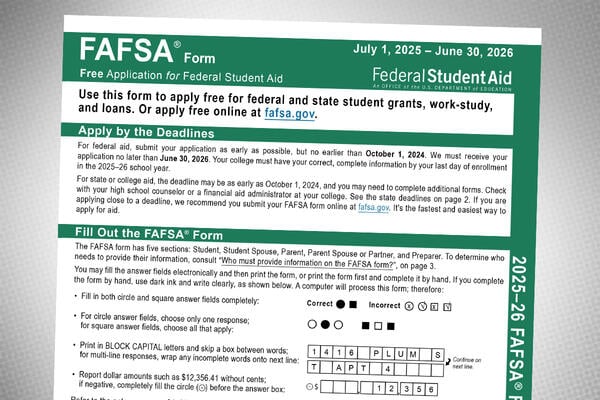
    College access organizations are raising concerns about students from mixed-status families—families with members who hold different immigration statuses—who are filling out the Free Application for Federal Student Aid amid the Trump administration’s mass deportation campaign.

    “Although the Higher Education Act prohibits the use of data for any purpose other than determining and awarding federal financial assistance, [the National College Attainment Network] cannot assure mixed-status students and families that data submitted to US Department of Education (ED), as part of the FAFSA process, will continue to be protected,” NCAN, which represents college access organizations across the nation, wrote in new guidance.

    The organization added that the Office of Federal Student Aid has said the Education Department won’t share information that breaks the law.

    But “we understand many families’ confidence in this statement may not be as certain under the current administration,” the organization continued. The post advised families to consider whether to submit a FAFSA on a “case-by-case basis.”

    The organization had previously published similar guidance before President Donald Trump even took office but updated it after the 2026–27 FAFSA opened late last month. Zenia Henderson, chief program officer for NCAN, said the organization has received a slew of questions about the security of the personal information entered into the FAFSA, and many of its member organizations are reporting that some of the families they work with are forgoing the FAFSA out of fear.

    Previously, the Trump administration has sought to use personal data from other agencies to assist in its deportation efforts, including requesting state voter rolls, public housing data, tax information and records of who applied for the Supplemental Nutrition Assistance Program. Federal courts have blocked some of these requests.

    The Trump administration has also attacked programs and initiatives that help undocumented students themselves access higher education. The administration has demanded states stop offering in-state tuition to undocumented students and has attempted to eliminate the Deferred Action for Childhood Arrivals program, which protects from deportation certain undocumented individuals who were brought to the country as children and has opened the door to higher education for this group.

    Other experts and advocacy groups agreed that there is cause for concern among mixed-status families.

    “Concerns are very much warranted in light of how cross-agency collaboration has been weaponized against immigrant families in recent months—including but not limited to the ostensible collusion between the Departments of Justice and Homeland Security to vacate active asylum cases when parents and children are lawfully appearing in immigration court, so that they can be apprehended on the premises by immigration enforcement and placed in detention,” wrote Faisal Al-Juburi, chief external affairs officer for RAICES, a nonprofit immigrant law center in Texas, in an email to Inside Higher Ed. “There is simply no indication that the Trump administration will adhere to legal precedent.”

    Will Davies, director of policy and research for Breakthrough Central Texas, a college access organization, noted in an email to Inside Higher Ed that, even though the Trump administration’s immigration attacks have been especially worrying for mixed-status families, such families have long had to make difficult decisions about when to submit personal information to the government.

    He also noted that FAFSA data is protected by the Privacy Act of 1974 and the Family Educational Rights and Privacy Act and said that, to his knowledge, no undocumented parent has ever been targeted using FAFSA data.

    Cutting Off Access

    For many families, the choice is not as clear-cut as simply not filling out the FAFSA. Most institutions and states calculate their financial aid offerings using the FAFSA’s formula and require students to fill out the FAFSA to take advantage of that aid. If mixed-status families do not complete the FAFSA, they are essentially cutting themselves off from almost all sources of assistance in paying for college.

    “It has the potential to close a lot of doors in terms of accessing aid that’s needed, from last-dollar scholarships to merit-based scholarships,” Henderson said. “There are so many folks that ask for FAFSA information and that [the] application be competed in order to check eligibility, because they may not have their own systems or processes in place. FAFSA really is the default way to prove need.”

    Three states—California, New York and Washington—have developed their own financial need calculation tools for individuals who want to be considered only for state and local aid. All three address privacy concerns, stating specifically that the data will not be provided to the federal government without a court order.

    “The opportunity to pursue an education is highly valued, and financial aid is the only way many students can afford college or training,” the Washington Student Achievement Council wrote in a message, released days after Trump entered office, about aid applicant privacy. WSAC administers Washington’s state aid calculator.

    “We sympathize deeply with anyone concerned about their privacy in applying for financial aid, and we support students and families in making decisions that best fit their educational goals and risk considerations. While WSAC cannot provide guidance on what a family should do in a specific situation, we do encourage students, families, educators, and advocates to review the following resources that may provide helpful information.”

    Alison De Lucca, executive director of the Southern California College Attainment Network, told Inside Higher Ed in an email that her organization is working with several families who are uncertain if they will fill out the FAFSA this year; an estimated one in every five individuals under the age of 18 in California comes from a mixed-status family.

    One SoCal CAN student opted to fill out just California’s state aid form, the California Dream Act Application, this year in order to protect her mother—even though she thought she might have benefited from federal aid.

    Source link

  • GAO Raises Concern About Future FAFSAs

    GAO Raises Concern About Future FAFSAs

    Photo illustration by Justin Morrison/Inside Higher Ed | sdominick/Getty Images | Ake/rawpixel

    The Education Department is on track to release the 2026–27 Free Application for Federal Student Aid by Oct. 1, but a government watchdog warned this week that future forms are at risk of technical issues.

    The Government Accountability Office, in its second report on the botched launch of the 2024–25 FAFSA, found that the department has yet to implement a number of its recommendations from the first report released in September 2024. Additionally, the agency needs to improve its oversight of contractors. The GAO also noted that the department doesn’t have a plan for testing future FAFSAs and that staff overseeing the application lack key experience and training.

    “Until [the Office of Federal Student Aid] makes progress in these important areas, [the FAFSA Processing System] is at risk of not functioning as intended in future releases, leading to students having trouble in obtaining timely aid,” the report states. “Further, the FPS contract is at risk of overexpenditure and potentially wasting taxpayer dollars. These risks are compounded by reductions in staff that likely impact the agency’s ability to carry out its mission to manage and oversee student financial assistance programs.”

    FSA officials took issue with parts of the report and recommendations in a response to the agency.

    “We believe that GAO’s analysis teaches the wrong lessons and, as an unintended consequence, reinforces the exact practices that led to the FAFSA’s initial challenges,” wrote Aaron Lemon-Strauss, executive director of the FAFSA program.

    Lemon-Strauss said GAO is applying a “more traditional, and somewhat outdated, project-based model that does not support modern technology development for scaled systems like the FAFSA.” He went on to outline a number of changes that the department made to improve the system, as well as the key challenges they faced.

    Among other things, he noted that FSA had no internal engineering expertise until last year and that contractors working on different pieces of the process used different tools that didn’t integrate with each other.

    “The team is still working to unwind these parallel environments and the technical debt created by these decisions today,” he wrote.

    GAO officials disagreed with some of the department’s statements and proposed changes to their recommendations, countering that the review was based on both federal and department guidelines and that ED needs a way to hold its contractors accountable.

    “As our report notes, FSA was not appropriately overseeing the work of its contractor and did not adequately ensure rigorous testing of the system,” officials wrote. “By not doing so, FSA put the FAFSA modernization effort at risk of failure, which their letter points out.”

    Source link

  • Increased ID Verification for Financial Aid Raises Questions

    Increased ID Verification for Financial Aid Raises Questions

    Photo illustration by Justin Morrison/Inside Higher Ed | michaeljung and robas/iStock/Getty Images

    College financial aid offices and students’ advocates say that a Trump administration plan to crack down on fraud in the federal aid system could burden university staff and hinder access to college programs.

    Although they support fighting fraud as a concept, they particularly worry that real, eligible Pell Grant recipients will get caught up in the detection system and won’t be able to jump through the extra hoops to verify their identity.

    “In general, verification is a little bit of threading the needle between making sure that the right dollars are going to the right students, but also not putting up an inordinate number of barriers, particularly to low-income students, that are insurmountable,” said Karen McCarthy, vice president of public policy and federal relations at the National Association of Student Financial Aid Administrators. “You have to walk a fine line between those two things.”

    Department of Education officials, however, say their plan, announced June 9, is necessary to protect American taxpayers from theft and won’t become a burden for colleges. They aren’t worried about students losing access, either.

    Ultimately, the Trump administration plans to verify the identity of each financial aid applicant with the help of a new system that should be up and running “this fall,” according to the department’s announcement. Before then, the department is planning to screen more first-time applicants for verification—a process that could affect 125,000 students this summer and will be handled by financial aid offices. (About 40,000 students were checked last year, according to a department spokesperson.)

    McCarthy, however, is concerned that if the new system isn’t ready by the fall, “institutions will be assuming this larger burden for a longer, indeterminate amount of time.” The department’s botched launch of the 2024–25 Free Application for Federal Student Aid showed the challenges of standing up new systems quickly, she noted.

    A senior official at the Department of Education told Inside Higher Ed that the Office of Federal Student Aid and the department procurement team are in the process of purchasing an identity-validation product similar to the ones used by financial services companies like banks. The product would be incorporated into the online FAFSA portal.

    If an individual is flagged for potential fraud at any point while filling out the form, a pop-up box would appear with a live staff member on the other side, the official explained. The applicant would then be asked to display a government-issued ID. If that ID is deemed valid, the person could then continue.

    “Once that’s done, the process is over,” the official said. “That’s really as simple as that effort is. I believe rental car companies are using it, too.”

    The official was optimistic that the department could have the system up and running by early September, though that won’t be soon enough to get aid disbursed in time for the fall semester. The official also acknowledged that the timeline means that colleges may have to do some verification in person even in the fall, but that process should not be too much of a burden for the college or the student. Similar to the online process, a student would just need to show a valid ID to a college financial aid administrator, either in person or over a video call. Previously, when identity verifications were conducted, students had to present a Statement of Educational Purpose and submit a notarized copy of their identification document.

    But advocacy groups that work with low-income students worry that even requiring a government-issued ID could give some students a leg up over others when it comes to accessing financial aid and affording to enroll in college.

    “We want to see fraud eliminated as much as anyone else … We just need to make sure that gets balanced with a reasonable process for students,” said MorraLee Keller, a senior consultant for the National College Attainment Network. “A lot of low-economic kids may not have secured, for example, a driver’s license. If they don’t drive, they may not have a driver’s license, and that is probably the primary form of a government-issued valid ID that most people would be able to present.”

    Keller noted that some states may have alternate IDs available for those who do not drive, but even that may take time to obtain if a student doesn’t already possess it.

    “We want to make sure that timing doesn’t interrupt the aid getting credited to their account to pay their bills on time so that they could start classes, get refunds to go get their books and all those kinds of things,” she said. “So one of the questions that we still need answered is, what else would be considered a valid ID?”

    The California Community College system, which has grappled with increasing financial aid fraud, recently considered an application fee to help screen legitimate students from fraudsters. A spokesperson for the system said they are waiting on additional guidance from the department before they can know how big a deal this shift will be.

    “We wouldn’t be able to speculate on the level of concern among students and institutions until the federal guidance is known,” she wrote. But “financial aid fraud is a nationwide trend and additional identification verification processes will help in the fight against it.”

    Source link

  • Most Higher Ed Employees Received Raises This Year, but Salaries Still Fall Short of Pre-Pandemic Pay

    Most Higher Ed Employees Received Raises This Year, but Salaries Still Fall Short of Pre-Pandemic Pay

    by CUPA-HR | April 8, 2025

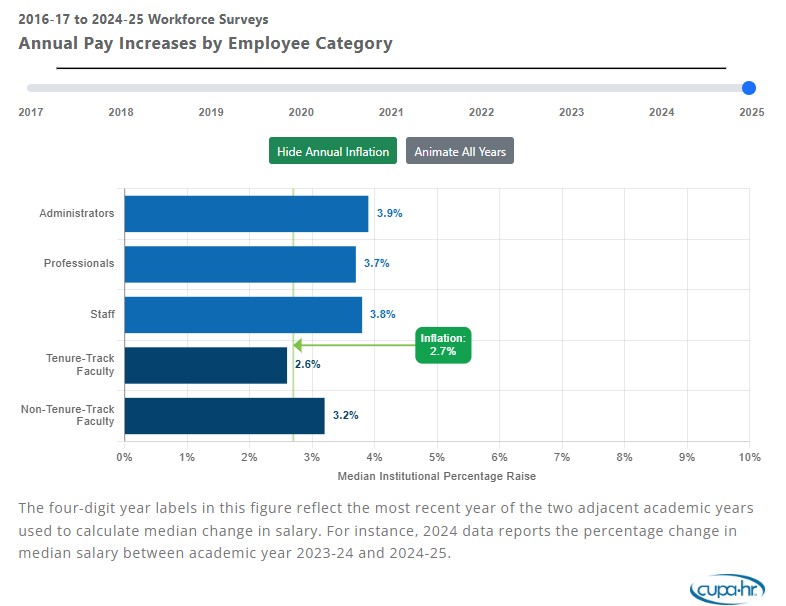
    New research from CUPA-HR shows that median pay increases for most higher education employees in 2024-25 remained strong, although they have dropped from the historically high increases seen in the previous two years. And although raises this past year for most employees outpaced inflation, they are still being paid less than they were in 2019-20 in inflation-adjusted dollars.

    The largest gap between pre-pandemic inflation-adjusted salaries and current salaries is for tenure-track faculty (who are paid 10.2% less), followed by non-tenure-track teaching faculty (paid 7.6% less). The smallest gap is for staff (paid 2.8% less).

    Some of the other key findings from an analysis of CUPA-HR’s higher ed workforce salary survey data from 2016-17 to 2024-25:

    • Staff employees continued to receive some of the highest pay increases compared to other workforce areas.
    • Non-tenure-track teaching faculty received a 3.2% salary increase, which is lower than last year’s high but still among the largest increases seen in recent years.
    • For the third consecutive year, tenure-track faculty received the lowest salary increase of all employee categories (2.6%). Across the nine years of data analyzed, tenure-track faculty salaries have not once exceeded the rate of inflation. This essentially means that — in real dollars — they have received salary decreases for the past decade.

    Explore this data and more in CUPA-HR’s newest interactive graphic.


    Source link

  • DOGE’s access to Education Department data raises concerns

    DOGE’s access to Education Department data raises concerns

    Just last month, Lorena Tule-Romain was encouraging families with mixed citizenship to fill out the Free Application for Federal Student Aid. She and her staff at ImmSchools, a nonprofit dedicated to improving educational access for immigrants in Dallas, walked students and parents through the complicated federal aid process. Along the way, they offered reassurance that information revealing their undocumented status would be securely held by the Department of Education alone.

    Two weeks ago, ImmSchools stopped offering those services. And Tule-Romain said they’re no longer recommending families fill out the FAFSA. 

    That’s because the Department of Government Efficiency, a White House office run by Elon Musk, now has access to Education Department data systems, potentially including sensitive student loan and financial aid information for millions of students, according to sources both outside and within the department who spoke with Inside Higher Ed

    With immigration officers conducting a blitz of deportations over the past few weeks—and the new possibility of ICE raids at public schools and college campuses—Tule-Romain is worried that applying for federal aid could put undocumented families in jeopardy. Instead of answering parents’ questions about the FAFSA contributor form, she’s hosting Know Your Rights workshops to prepare them for ICE raids.

    “Before, we were doing all we could to encourage families to apply for federal aid, to empower students to break cycles and go to college,” she said. “Now we are not in a position to give that advice. It’s heartbreaking.”

    Student data is technically protected by the Privacy Act of 1974, which prevents departments from sharing personally identifying information unless strict exceptions are met or a law is passed to allow it. The FUTURE Act, for example, gave the IRS access to financial aid data to simplify the FAFSA process. 

    Karen McCarthy, vice president of public policy and federal relations at the National Association of Student Financial Aid Administrators, told Inside Higher Ed that because DOGE has not said why they might be interested in department data or what data they have access to, it’s unclear if they’re acting in accordance with the law.

    In the past, that law has been strictly enforced for federal employees. In 2010, nine people were accused of accessing President Barack Obama’s student loan records while employed for an Education Department contractor in Iowa. The charges levied against them in federal court were punishable by up to one year in prison and a fine of up to $100,000, according to the Associated Press.   

    On Thursday, Democratic Representative Bobby Scott of Virginia wrote to the Government Accountability Office requesting a review of the Education Department’s information technology security and DOGE’s interventions in the department in order to determine their legality and the “potential impact on children.” On Friday, a group of students at the University of California sued department officials for allowing potential privacy act violations. 

    “The scale of the intrusion into individuals’ privacy is massive, unprecedented, and dangerous,” the plaintiffs wrote. 

    In recent days, labor unions and other groups have sued to block DOGE”s access to databases at several federal agencies and have secured some wins. Early Saturday morning, a federal judge prohibited DOGE from accessing Treasury Department data, ordering Musk’s team to “immediately destroy any and all copies of material” from the department’s systems.

    Concerns about DOGE’s use of private student data come as Musk and his staff take a hacksaw to agencies and departments across the federal government, seeking to cut spending and eliminate large portions of the federal workforce. The Trump administration has singled out the Education Department in particular, threatening to gut its administrative capacity or eliminate the department all together. 

    Spokespeople for DOGE did not respond to a list of questions from Inside Higher Ed. Madi Biederman, the Education Department’s deputy assistant secretary for communications, wrote in an email that DOGE staff “have the necessary background checks and clearances” to view department data and are “focused on making the department more cost-efficient, effective and accountable to the taxpayers.”

    “There is nothing inappropriate or nefarious going on,” she added. She did not respond to questions about what data DOGE has access to or how they plan to use it.

    A ‘Gaping Hole’ in Data Security 

    The Education Department’s student financial aid systems contain unique private information that families submit through FAFSA: not only social security numbers but also addresses of relatives, property taxes, sources of income and more. The National Student Loan Database, which tracks loan borrowers’ repayment history and which DOGE may also have access to, includes a wealth of personally identifying information for many more millions of current and former students. 

    A current department staffer provided Inside Higher Ed with a screenshot from the department’s email address catalog containing the names of 25 DOGE employees who may have access to student data—including a 19-year-old who, according to a Bloomberg report, was once fired by a cybersecurity firm for allegedly leaking internal data. And the Washington Post reported that DOGE employees fed sensitive education department data through artificial intelligence software.

    “It could become a gaping hole in our cybersecurity infrastructure,” a former department official said. “I cannot stress enough how unusual it is to just give people access willy-nilly.”

    Two former department officials told Inside Higher Ed it is unclear how the DOGE officials could have legally gained access to department data. McCarthy compared DOGE’s murky activity in the department to a “massive data breach within the federal government.”

    “Normally, there’d be a paper trail telling us what they’ve requested access to and why,” she said. “We don’t have that, so there’s a lot of uncertainty and fear.”

    A current department official told Inside Higher Ed that DOGE staff have been given access to PartnerConnect, which includes information about college programs that receive federal financial aid funding; and that they have read-only access to a financial system. Neither of those databases contain personally identifying information, but the official wasn’t sure DOGE’s access was limited to those sources—and said department staff are worried sensitive student information could be illegally accessed and disbursed. 

    “It just creates a kind of shadow over the work that everyone’s doing,” a prior department official said. 

    Fears of a FAFSA ‘Chilling Effect’

    Families with mixed citizenship status were some of the hardest hit by the error-riddled FAFSA rollout last year, with many reporting glitches that prevented them from applying for aid until late last summer. 

    Tule-Romain said mixed-status families in her community had only just begun to feel comfortable with the federal aid form. In the past few weeks that progress has evaporated, she said, and high school counselors working with ImmSchools report a concerning decline in requests for FAFSA consultations from mixed-status students. 

    “If they weren’t already hesitant, they are extremely hesitant now,” Tule-Romain said. 

    It’s not just mixed-status families who could be affected if data is shared or leaked. McCarthy said that concerns about privacy could have a wide-spread “chilling effect” on federal aid applications.

    “There have always been parents who are reluctant to share their information and the counterargument we always fall back on are the privacy laws,” she said. “A lot of Pell money could get left on the table, or students could be discouraged from going to college altogether.”

    Kim Cook, CEO of the National College Attainment Network, said that after last year’s bungled FAFSA rollout, community organizations and government officials had worked hard to rebuild trust in the system and get completion rates back to normal. She worries that fears about privacy could set back those efforts significantly. 

    “Chaos and uncertainty won’t give us the FAFSA rebound we need,” she said. 

    The confusion could also affect current college students who need to renew their FAFSA soon. Tule-Romain said one undocumented parent who filled out her first form with ImmSchools last year came back a few weeks ago asking for advice. 

    She was torn: on the one hand, she didn’t trust Musk and Trump’s White House not to use the information on the form to deport her. On the other, if her son didn’t receive federal aid, he’d have to drop out of college. Ultimately, she chose to renew the application.

    “If you came [to America] for a better life, you cannot let fear stop you from pursuing that,” Tule-Romain said. “Instead, you arm yourself with knowledge and you move forward—maybe with fear, but you move forward anyway.”

    Source link