

Tag: rare

  • How rare are colleges that enroll and graduate high shares of Pell Grant students?

    How rare are colleges that enroll and graduate high shares of Pell Grant students?

    This audio is auto-generated. Please let us know if you have feedback.

    When it comes to colleges where Pell Grant recipients are at least 55% likely to graduate, there are not a whole lot throughout the U.S. In fact, nearly half of states — many of them Southern with some of the highest poverty rates in the country — don’t have any at all.

    That’s what Becca Spindel Bassett, higher education professor at the University of Arkansas, discovered in a recent analysis in which she sought to identify and map institutions of higher education that she describes as “equity engines.” 

    These are colleges where at least 34% of the students receive Pell Grants and at least 55% of those Pell Grant recipients earn a bachelor’s degree within six years.

    Out of the 1,584 public and private nonprofit four-year institutions that Bassett studied nationwide, she found only 91 — or less than 6% — that qualified for her “equity engine” distinction

    And they’re all clustered in 26 states, resulting in what Bassett calls a “spatial injustice” for low-income students who live in one of the states without any equity engines or in areas with limited access to such institutions.

    The almost eight dozen existing equity engines represent a diverse range of institutional types, including regional public universities, small Christian colleges and historically Black institutions. 

    As for whether states can invest more in colleges that are close to being equity engines — a key recommendation of Bassett’s study — it all depends.

    “It’s worth noting that over half of Equity Engines are private colleges and universities, so their relationship to the state and dependency on state funding varies,” Bassett said in an email to Higher Ed Dive.

    But improving Pell graduation rates isn’t only a question of funding models, she said. 

    Leaders at aspiring equity engines can learn best practices and approaches from these colleges and should be prepared to enact “organizational learning and change,” Bassett said. However, much is unknown about what enables colleges to become equity engines, including whether it depends on their programs and services or their policy and funding environments. 

    While Bassett’s study doesn’t answer those questions, a forthcoming book will describe how two of the colleges she identified as equity engines were able to achieve their results, she said. 

    Michael Itzkowitz, founder and president of the HEA Group, a higher ed-focused research firm and consultancy, said in an email that identifying colleges with strong graduation rates is a “good first step” because students who earn a degree “typically earn more than those who do not.” 

    However, Itzkowitz, who under former President Barack Obama served as the director of The College Scorecard — an online federal tool with various data on higher education institutions — added that it’s also critical to consider whether graduates are actually better off economically since “not all institutions and degrees are created equal.”

    “Students who earn a credential at one institution may experience wildly different outcomes if they earned the same degree elsewhere,” he said.

    David Hawkins, chief education and policy officer at the National Association for College Admission Counseling, said in an email that colleges would do well to emulate the equity engines Bassett identified, such as the University of Illinois Chicago. Bassett’s study calls the university a “major driver” of bachelor’s degree completion among Pell Grant recipients in the state, noting those students have a 58% six-year graduation rate.

    Among other things, Hawkins said, such institutions deploy a wide range of services — such as evening or online courses for working students, and transportation to campus — that have been proven to help low-income students cross the finish line.

     “From my perspective, the United States will only remain competitive if we can invest in a postsecondary infrastructure that serves all students who seek opportunity through higher education,” Hawkins said.  
    Source link

  • Antisemitic beliefs rare among faculty, Brandeis University study finds

    Antisemitic beliefs rare among faculty, Brandeis University study finds

    Dive Brief:

    • Just 3% of non-Jewish faculty members hold views about Israel that would fit definitions of antisemitism put forward by Jewish groups, according to a spring survey of over 2,300 faculty members at 146 research universities released by Brandeis University in July. 
    • Less than 10% of faculty reported actively teaching about the Israel-Palestine conflict. Despite widespread media attention to campus protests and targeted attacks on universities by the Trump administration over allegations of antisemitism, more than three-fourths said the Israel-Palestine conflict never came up in class discussions. 
    • Only a minority of faculty were politically active or posted on social media about major current issues, including the Israel-Palestine conflict, racism in America, climate change and President Donald Trump’s impact on American democracy, the survey found. 

    Dive Insight:

    The new study comes at a time of roiling political tensions around college campuses. 

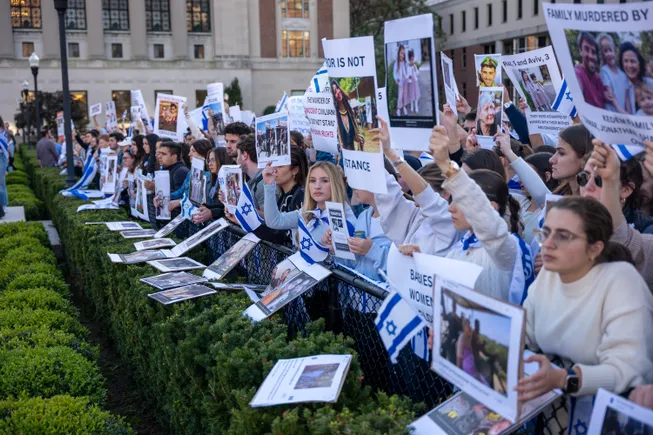
    On the campaign trail, Trump described colleges as being “dominated by Marxist maniacs and lunatics.” Since taking office in January, his administration has launched investigations and pulled research funding from major institutions — Columbia and Harvard universities, among others — over claims of rampant antisemitism on campus. 

    The administration has also sought to impose “intellectual diversity” on college faculties, including through an executive order on accreditation and in its dealings with individual universities. 

    While the Brandeis study found that nearly three-quarters of faculty — 72% — identify as liberal, they also hold “a wide range of views on controversial political issues,” the researchers wrote.

    For instance, when looking at the intensity of opinions, over 60% said they “strongly” believed that climate change was a crisis requiring immediate attention and that Trump represented a threat to democracy. 

    But only 33% expressed strong belief that racism was widespread in America and 14% that Israel is an apartheid state. (Overall, a majority of faculty backed those statements, including only those who somewhat agreed, with a much larger majority agreeing with the racism statement.) 

    That said, activism around any of those topics was relatively scant. With the Israel-Palestine conflict, 78% of faculty reported no activism at all, including on social media. Around two-thirds reported no activism around racism or climate change. 

    When it comes to teaching, a majority of faculty said they would present a variety of perspectives on those news topics, with the exception of climate change. Only 45% of faculty said they would present a variety of perspectives on climate change while another 40% said they would do so but with some perspectives “more justified than others.”

    When it came to the Middle East conflict, even among the 14% of faculty who said they strongly believed Israel to be an apartheid state, a majority (56%) said they would present a variety of perspectives when teaching about the issue.

    The researchers posed questions intended to study when faculty views of Israel veered into antisemitism as defined by Jewish groups, including the International Holocaust Remembrance Alliance, and that Jewish students frequently agree are antisemitic. They also used the definition by the Jerusalem Declaration on Antisemitism, which has accused the IHRA’s version of blurring the line between antisemitism and criticism of Israel. 

    The researchers asked whether survey respondents agreed with statements such as “Israel does not have the right to exist,” “all Israeli civilians should be considered legitimate targets for Hamas,” and “I wouldn’t want to collaborate with a scholar who supports the existence of Israel as a Jewish state.”

    Large majorities strongly disagreed with those statements, and fewer than 10% agreed with them with any intensity. Those who did were more likely to identify as liberal. 

    Likewise, a small minority of non-Jewish faculty — 7% — expressed views considered antisemitic about Jewish people as a group rather than Israel. Those faculty were more likely to be politically conservative, according to the study. 

    Amid the Trump administration’s attacks on colleges, close to half (46%) of faculty and a majority of those identifying as liberals expressed serious concerns about being targeted by the federal government for their political views, the study found.

    Source link