Tag: rate

  • Study visa applications to NZ dip, approval rate jumps nearly 7%

    Study visa applications to NZ dip, approval rate jumps nearly 7%

    According to data highlighted by Immigration New Zealand (INZ), the government agency responsible for managing the country’s immigration system, the first 10 months of 2025 saw 55,251 study visa applications, down from 58,361 in the same period last year.

    However, approval rates have risen sharply. In 2024, INZ approved 42,724 of 58,361 applications (81.5%) and declined 9,161 (17.5%). Meanwhile, in 2025, despite fewer applications at 55,251, approvals rose to 43,203 (88.2%) with 5,317 declined (10.9%).

    NZ sets itself apart from other key study destinations

    Even as major anglophone study destinations take a cautious approach to international education policy, New Zealand is aiming to be an outlier in the market.

    The country is looking to boost international student enrolments from 83,700 to 119,000 by 2034 and double the sector’s value to NZD$7.2 billion (GBP £3.2bn) under the recently launched International Education Going for Growth plan.

    This month, new rules came into effect allowing eligible international tertiary and secondary students with visas from November 3 to work up to 25 hours a week, up from 20, while a new short-term work visa for some vocational graduates is also expected to be introduced soon.

    “As part of the International Education Going for Growth Plan, changes were announced to immigration settings to support sustainable growth and enhance New Zealand’s appeal as a study destination. These changes aim to maintain education quality while managing immigration risk,” Celia Coombes, director of visas for INZ, told The PIE.

    “Immigration New Zealand (INZ) and Education New Zealand (ENZ) work in close partnership to achieve these goals.”

    We have more students applying for Pathway Visas year on year, which means more visas granted for longer periods, and less ‘year by year’ applications
    Celia Coombes, Immigration New Zealand

    Why the drop in study visa applications?

    While study visa approval rates have skyrocketed over the past year — a stark contrast to the Covid period, when universities across New Zealand faced massive revenue losses owing to declining numbers — stakeholders point to a mix of factors behind the drop in new applications.

    “There has been an increase in approvals, but overall, a slight decrease in the number of students applying for a visa. However, interest in New Zealand continues to grow,” stated Coombes, who added that the number of individuals holding a valid study visa rose to 58,192 in August 2025, up from 45,512 a year earlier.

    “We have more students applying for Pathway Visas year on year, which means more visas granted for longer periods, and less ‘year by year’ applications.”

    While multi-year pathway visas can cover a full planned study path, reducing the need for repeated applications, Richard Kensington, an NZ-based international education consultant, says refinements could make the route more effective in attracting international students.

    “The Pathway Visa, introduced nearly a decade ago as a trial, has never been fully expanded. Although reviews are complete and the scheme is set to become permanent, no additional providers have been given access,” stated Kensington.

    “Simple refinements — such as allowing pathways to a broad university degree rather than a specific named programme — would encourage more students to utilise this route.”

    The drop could also be linked to the underdeveloped school sector and the slower recovery of New Zealand’s vocational education sector, as noted by Kensington.

    “The school sector remains one of New Zealand’s most untapped international education markets. Demand is growing, especially from families where a parent wishes to accompany the student. The Guardian Parent Visa makes that a viable option,” stated Kensington.

    “Vocational education hasn’t rebounded in the same way. The loss of work rights for sub-degree diplomas has significantly reduced demand from traditional migration markets.”

    New Zealand’s vocational education woes

    Just this year, the New Zealand government announced the disestablishment of Te Pūkenga, the country’s largest vocational education provider, formed through the merger of 16 Institutes of Technology and Polytechnics.

    It is being replaced by 10 standalone polytechnics, following concerns that the model had become too costly and centralised.

    “Te Pūkenga’s rise and fall created real confusion offshore. With standalone polytechnics returning, we should see greater stability from 2026 onwards,” Kensington added.

    “Many polytechnics are now relying on degree and master’s programmes, putting them in more direct competition with universities.”

    Applications fall in China, climb in India

    As per data shared by INZ on decided applications across both 2024 and 2025 — including on ones submitted in earlier years — countries like India (+2.7%), Nepal (+26.8%), Germany (+5.2%), and the Philippines (+7.8%) have seen growth in the number of study visas approved.

    Meanwhile, many East and Southeast Asian markets have recorded year-on-year declines, most notably the largest sending market, China, which dropped by 9.9%.

    The data shows that while 16,568 study visas were approved for China in January–October 2024, this fell to 14,929 in 2025 though it remains the largest source country.

    Other markets such as Japan (-9.7%), South Korea ( -24.8%), and Thailand (-33.7%) also saw significant declines.

    According to Frank Xing, director of marketing and operations at Novo Education Consulting, the slowdown from China is clear, with weaker student interest reflected in both their enquiries and feedback from partners, and echoed by some New Zealand institutions.

    “It’s a mixed picture — a few schools, particularly in the secondary sector, are still doing well, but many providers are starting to feel the impact,” stated Xing, who believes several factors are driving the slowdown.

    “The first is the weaker Chinese economy — many families have been affected by job losses or lower business income. In the past, property assets often helped families fund overseas study, but the real estate downturn has reduced that flexibility,” he added, also noting New Zealand’s own unemployment challenges and competition from lower-cost destinations.

    “We’ve actually seen some students abandon their New Zealand study plans or switch to more affordable destinations such as Malaysia or parts of Europe.”

    According to Xing, while China remains one of New Zealand schools’ strongest markets, this could change as Chinese families place greater emphasis on career outcomes — an area where New Zealand’s slower job market remains a challenge.

    He added that New Zealand’s role as the 2025 Country of Honour at China’s premier education expo could help raise awareness among prospective students.

    False applications remain a major concern

    For Education New Zealand and INZ, the more immediate challenge now lies in addressing fraudulent applications, according to Coombes.

    “New Zealand sees a lot of false financial documents. To address this and help ensure students have the money they need to live and study in New Zealand, we are improving processes to maintain integrity and streamline processing,” stated Coombes.

    “This includes expanding the Funds Transfer Scheme, where students deposit their living costs in New Zealand, and they are released monthly.”

    According to Kensington, some agencies across South Asia and likely parts of Africa, where New Zealand has limited representation may not meet required standards, creating challenges. However, he believes improved processing is reducing the impact.

    “INZ only accepts financial evidence from specific banks in some jurisdictions. Student loans must be secured; unsecured loans aren’t accepted even from major banks,” stated Kensington.

    “It’s hard to say whether fraud is increasing, but the rise in high-quality applications means INZ can process many files quickly and devote more time to forensic checks where needed.”

    Source link

  • Survey Explores How Colleges Rate Their Value Versus Cost

    Survey Explores How Colleges Rate Their Value Versus Cost

    Growing public skepticism in higher education has fueled a number of polls and surveys aimed at understanding how families, students and taxpayers perceive the value of a college degree.

    For instance, a majority of Americans believe at least one type of postsecondary credential holds value, according to a 2025 study by Gallup, and most parents want their kids to attend college. But few of those studies have looked at how colleges and universities see themselves improving students’ lives.

    A new survey by Tyton Partners released Thursday found three in four college stakeholders strongly believe their institution’s education is worth the cost of tuition. However, two-year institutions were more likely to say this is true, compared to private universities.

    Only 28 percent of administrators and support staff working at private four-year institutions strongly agree that their institution’s education is worth the cost, compared to 68 percent of community colleges. The survey, fielded in late June and early July, includes responses from more than 1,600 stakeholders at 825 institutions.

    The sector breakdown wasn’t a surprise to Catherine Shaw, Tyton’s managing director, in part because of how the vocational missions of two-year colleges to prepare the local workforce compare to four-year private institutions that focus more on holistic student development.

    “That part of it was so squarely within the value proposition of the reasons we have two-year degrees,” Shaw said.

    For students, there’s a direct relationship between those who say their college is worth the cost and those who think the college prepares students well for jobs and careers. Among the 792 student respondents who do believe their college is worth the cost, 95 percent believe college is preparing them well for jobs and careers. Inversely, fewer than half (48 percent) of students who don’t see the value of their degree believe college is preparing them well for a career.

    “In short, perceptions of value hinge on whether institutions effectively prepare students for the workforce,” the report states. This was true regardless of an institution’s sector, size, selectivity or demographic makeup.

    This was the first time Tyton’s survey has asked respondents about perceived value, which Shaw said was in part because of larger national studies gauging perceived value among individuals in the U.S.

    “It was interesting that there wasn’t the institutional perspective captured at scale [in previous surveys],” Shaw said. “We wanted to contextualize [the conversation] and see if our institutional stakeholders and our students are asking themselves the same questions and how they feel relevant, because they’ve got skin in the game.”

    What Creates Value

    More than a quarter of all institutions pointed to career readiness as a top college outcome beyond earning a credential, but two-year colleges were most likely to say this was the top outcome (37 percent). In comparison, the most popular outcome among four-year public and private institutions was critical thinking skills (41 percent and 36 percent, respectively).

    Faculty members were most likely to say critical thinking skills were a top college outcome, which Shaw said makes sense given their role in higher education. Administrators and advisers were more likely to point to career readiness as a top outcome for students.

    Tyton’s survey also asked administrators, support staff and faculty members which support services improve students’ value of education. Academic and career advising rose to the top, with over half of respondents in all roles ranking these services higher than tutoring, financial aid counseling or mental health counseling.

    How institutions deliver high-impact career preparation varied based on institution type. Thirty-eight percent of community colleges said apprenticeships were the most meaningful measures to improve student employment metrics, followed by career pathways at 35 percent.

    In comparison, embedded career exploration ranked highest among four-year institutions (54 percent of public universities, 50 percent of private) as did guaranteed internships for all students (31 percent of four-year public institutions) and experiential learning coursework (33 percent of four-year privates).

    Student awareness of these opportunities is the greatest barrier to career readiness, according to career services professionals (45 percent), followed by limited capacity (17 percent) and a lack of consistent programming throughout the year (13 percent). Fewer than half of surveyed students (42 percent) said they were aware of career services available to them.

    “This focus is especially timely as institutions prepare for increased scrutiny under new federal measures, such as the earnings accountability test,” the report states. “Programs that do not result in gainful employment risk losing eligibility for federal aid. Embedding career readiness across offerings isn’t just about boosting ROI: It’s fast becoming essential for institutional viability.”

    Source link

  • Indiana’s College-Going Rate Drops Again, Dipping to 51.7% – The 74

    Indiana’s College-Going Rate Drops Again, Dipping to 51.7% – The 74


    Get stories like this delivered straight to your inbox. Sign up for The 74 Newsletter

    Fewer than 52% of Indiana high school graduates from the Class of 2023 went directly to college, according to the latest data quietly released by the Indiana Commission for Higher Education.

    That’s the state’s lowest rate in recent history and a continued decline from its previous plateau.

    Just 51.7% of 2023 graduates, about 39,000 students, enrolled in college within a year of finishing high school, data showed. That’s down from a steady 53% between 2020 and 2022, and far below the state’s peak of 65% a decade ago.

    Around 36% of all graduating seniors enrolled in one of Indiana’s public four-year institutions, followed by 8% who chose a private college or university.

    Another 7.6% went to a school outside of Indiana, according to the data.

    The figures, posted to the agency’s website earlier this month, reflect concerns state leaders have long expressed about Indiana’s declining college-going culture, especially as the state shifts focus toward career credentials and work-based learning.

    “The startling drop in our college-going rate yet again can be credited to the lack of two things: money and morale,” said Rep. Ed DeLaney, D-Indianapolis, in a statement released Wednesday.

    “While our governor has been taking a victory lap for getting our state universities to freeze tuition, he has failed to guarantee that his move will not decrease financial aid and scholarship opportunities,” DeLaney continued. “Any lack of opportunity for tuition support will lead to more Hoosiers not being able to afford college and being forced to choose a different path.”

    The 2023 numbers come just six months after the higher education commission approved sweeping changes to Indiana’s high school diploma, set to take effect statewide in 2029, that emphasize work-based learning and career readiness over traditional college preparation.

    High schoolers will be required to earn at least one “diploma seal” to graduate, including options for employment or postsecondary readiness. While some seal options are specifically geared toward college-bound students, graduates will no longer be required to complete all the coursework or meet other criteria typically expected for college admission.

    Rep. Ed DeLaney, D-Indianapolis, sits in the House Education Committee on Wednesday, Feb. 12. (Casey Smith/Indiana Capital Chronicle)

    DeLaney maintained that Republican leaders “have been devaluing the opportunities that our colleges and universities can offer students.”

    “At the same time, the supermajority has made attacking colleges and universities the centerpiece of their culture war agenda — from policing what can be taught in the classroom, to forcing institutions to eliminate hundreds of degree options, to creating an entirely new high school diploma that emphasizes the path directly into the workforce,” the lawmaker said.

    “Trying to bury this report in a website and not send a press release is a telling sign that the Commission on Higher Education knows this does not look good, and does not act to fix it,” DeLaney added. “It simply isn’t important enough to them. They are busy eliminating college courses and creating new tests. This is what the legislature has asked them to do.”

    CHE has not issued a press release on the latest data and did not immediately respond to a request for comment Wednesday.

    Indiana’s college-going rate has dropped more than any other state tracked by the National Center for Education Statistics over the past 15 years.

    Previously, Indiana reached a college-going rate of 65%.

    “We set a goal to get it back when it slumped,” DeLaney recalled. “Now, it doesn’t seem like we care to address the issue. That is a shame for our students, a shame for our economy, and a shame for our state.”

    Earlier this year, Republican lawmakers passed additional legislation requiring public colleges to eliminate low-enrollment degree programs. So far, Indiana’s public colleges and universities have collectively cut or consolidated more than 400 academic degree programs.

    “The supermajority has been in power for 20 years and this is their achievement,” DeLaney said. “At some point we have to ask ourselves: is a declining college-going rate not the result they want?”

    By the numbers

    According to the numbers published on CHE’s online college-going dashboard, the vast majority of 2023 grads who continued their education earned some form of college credit while still in high school: 85.6% of college-goers took and passed an Advanced Placement exam; 64.6% earned dual credit; 90.7% earned the Indiana College Core diploma, which comes with a block of 30 general education credits that can be transferred to and accepted at colleges across the state; 86.3% earned as associate’s degree; and 63.6% earned another type of credential.

    A quarter of postsecondary enrollees, 25%, are seeking STEM-related degrees, while:

    • 17.8% enrolled in business and communications programs
    • 16% enrolled in health programs
    • 11% enrolled in social and behavioral sciences and human services programs
    • 9.9% enrolled in arts and humanities programs
    • 7.4% enrolled in trades programs
    • 5.8% enrolled in education programs
    • 7% were undecided

    College-going among male students dropped to 45%, compared to 59% for female students — widening an existing gender gap.

    Among racial groups, Asian and white students had the highest college-going rates, at 70.7% and 54%, respectively. The college-going rates among other racial groups lagged, though, at 45.5% for Black students, and 41.7% for Hispanic students.

    The rate for students from low-income backgrounds — as measured by eligibility for free or reduced lunch — was 38.7%, compared to about 60% for their higher-income peers.

    More than 78% of college-bound graduates from the 2023 cohort were part of Indiana’s 21st Century Scholars program, according the the new data. The scholarship fund covers full tuition and fees at Indiana colleges and universities for low-income students, who enroll in the 8th grade.

    Also previewed in the data was an update on the Class of 2022.

    The CHE dashboard showed 53% of the 2022 cohort that enrolled in a postsecondary program within a year after high school graduation met all three early college success benchmarks: ​​they did not need remediation; they completed all courses they attempted during their first year of enrollment; and they persisted to their second year of schooling.

    According to the latest numbers, 77.5% of the 2022 cohort that enrolled in a postsecondary program persisted to the second year.

    Indiana Capital Chronicle is part of States Newsroom, a nonprofit news network supported by grants and a coalition of donors as a 501c(3) public charity. Indiana Capital Chronicle maintains editorial independence. Contact Editor Niki Kelly for questions: [email protected].


    Get stories like these delivered straight to your inbox. Sign up for The 74 Newsletter

    Source link

  • Westchester CC Sees 12-Point Growth in Graduation Rate

    Westchester CC Sees 12-Point Growth in Graduation Rate

    Providing students with wraparound support is one evidence-based practice that has demonstrated impact on student credit accumulation, persistence and graduation rates. In the mid-2000s, the City University of New York created a model of student support that has been duplicated at dozens of colleges to improve outcomes; now the State University of New York system hopes to build on this success on its own campuses.

    In 2018, Westchester Community College became the first SUNY campus to adopt CUNY’s initiative, which WCC calls Viking Resources for Obtaining Associate Degrees and Success (Viking ROADS). A March 2025 report from the nonprofit education-research group MDRC highlights the success of Viking ROADS during its initial three years: a 12-percentage-point increase in graduation rates among participants, despite headwinds from remote instruction during the COVID-19 pandemic.

    The background: CUNY created Accelerated Study in Associate Programs (ASAP) in 2007 as a comprehensive initiative to address barriers to student retention and completion.

    The core components of ASAP are personalized academic advising, specialized enrollment options and financial aid for course material and transportation costs for three years.

    Over the past decade, ASAP-inspired programs have been implemented at over a dozen institutions in seven states. WCC president Belinda Miles was a part of the ASAP replication initiative in Ohio in 2014, so when she began her role at WCC in 2015, “it wasn’t too long before I ran into ASAP,” she said.

    Arnold Ventures and MDRC, along with an anonymous donor to the WCC Foundation, provided financial support for the launch of Viking ROADS.

    In 2023, SUNY chancellor John B. King Jr. announced the system would implement ASAP at 25 of its 64 campuses starting in 2024. Now, results from a three-year MDRC evaluation of Westchester Community College’s program offer guiding principles to peer institutions scaling their own efforts.

    “We’re delighted to be that pivot campus and a leader amongst our peers,” Miles said.

    The study: MDRC’s study followed WCC staff and students from 2018 to 2021.

    Viking ROADS requires WCC students to be enrolled full-time in an eligible major, meet with a dedicated counselor and use college support services monthly, as well as be a New York resident, a first-time college student and only enrolled in one developmental education course.

    A majority of students involved in the Viking ROADS study were traditional college students, with about one in five identifying as a nontraditional student (defined as someone who is older than 24, works full-time, has children or does not have a high school diploma). One adaptation of ASAP that Viking ROADS staff implemented was to offer a transportation stipend, rather than a prepaid MetroCard; WCC is a commuter campus and students utilize both their own cars and public transport to reach campus, so having flexibility in how they addressed transportation barriers was key, Miles said.

    Over all, program participants were more likely to have higher enrollment rates over time and complete more credits, compared to their peers. By their fourth semester, 20 percent of program participants had earned degrees, compared with 13.3 percent of control group students. And by their sixth semester, 35 percent of program participants had completed an associate degree, compared to 23 percent of the control group.

    Researchers theorized this gap could be tied to the specialized course enrollment options and academic advising Viking ROADS participants receive, which could help students meet their course requirements and reduce their risk of earning excess credits that don’t support degree completion.

    “It’s critical that students begin with a person and a plan, or a plan and a person, [so] we can say, ‘Here’s the road map, here’s your guided pathway, here are the steps you take.’ But having a person that’s reliable is something that is critical for students, particularly first-generation students,” Miles said, because some learners may not have supporters at home who understand the bureaucracy of higher education.

    Program staff also reduce barriers to applying for graduation and making degrees official; among nonparticipants who earned 60 or more credits, only 69 percent earned a degree, compared to 83 percent of Viking ROADS students.

    “Despite the challenges that were posed by the COVID-19 pandemic, Viking ROADS still had large effects on three-year graduation rates, confirming the strength and adaptability of the ASAP model,” according to the report. “Viking ROADS not only helped students navigate the immediate disruptions that were caused by the pandemic but also supported their continued academic progress and degree attainment.”

    What’s next: In the same way Miles brought her work with ASAP to WCC, she and her staff plan to contribute to a community of practice for the other SUNY campuses joining these efforts.

    “I’m happy to share with colleagues what our story is and how we keep it going and how we keep expanding, albeit incrementally,” Miles said.

    Funding and providing resources for wraparound services can be a barrier to scaling initiatives, but reallocating and redesigning existing services to better address student needs is one way Miles said she is looking to expand student success efforts at WCC.

    Get more content like this directly to your inbox. Subscribe here.

    This article has been updated to reflect the correct name of Arnold Ventures.

    Source link

  • Achieving a 100% Completion Rate for Student Assessment at the University of Charleston

    Achieving a 100% Completion Rate for Student Assessment at the University of Charleston

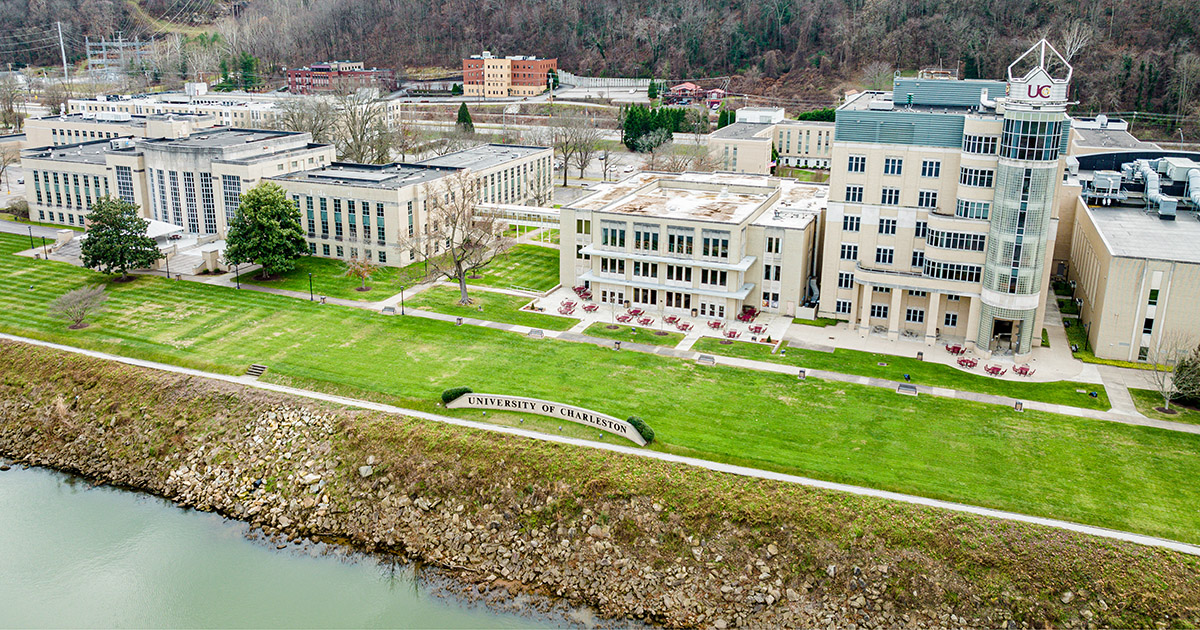
    Seated in beautiful Charleston, West Virginia, the University of Charleston (UC) boasts “a unique opportunity for those who want an exceptional education in a smaller, private setting.” UC provides a unique student experience focused on retention and student success even before students arrive on campus.

    Students are offered an opportunity to complete the College Student Inventory (CSI) online through a pre-orientation module. This initiative is reinforced through the student’s Success and Motivation first-year course. University instructors serve as mentors, utilizing the CSI results to capitalize on insights related to each individual student’s strengths and opportunities for success through individual review meetings and strategic support and skill building structured within this course.

    After achieving a 7% increase in retention, Director of Student Success and First-Year Programs Debbie Bannister says administering the CSI each year is non-negotiable. Additionally, the campus has refocused on retention, emphasizing, “Everyone has to realize that they are part of retention, and they’re part of keeping every single student on our campus.”

    UC has reinstated a Retention Committee that utilizes summary information from the CSI to understand the needs of its students. Of particular concern, UC notes that the transfer portal has created additional challenges with upperclassmen, so including a representative from the athletic department on the retention committee has been crucial.

    Through this focus on retention and strong implementation strategy, UC achieves a 100% completion rate for the CSI for their first-year student cohort. Building off the scaffolding support from early support meetings related to the CSI insights, first-year instructors are able to refer back to reinforce articulated support strategies and goals throughout the first-year experience. The structure and progression through this course reiterates college preparation skills and resources building motivation and a growth mindset to persist through college.

    Increase student success through early intervention

    Join institutions such as the University of Charleston by using the College Student Inventory with your incoming students. More than 1,400 institutions have used the CSI, and it’s been taken by more than 2.6 million students nationwide. Learn more about how you can use it to intervene earlier with students and increase student yield.

    Source link

  • Fun with Participation Rate Data

    Fun with Participation Rate Data

    Just a quick one today, mostly charts.

    Back in the fall, StatsCan released a mess of data from the Labour Force Survey looking at education participation rates—that is, the percentage of any given age cohort that is attending education—over the past 25 years. So, let’s go see what it says.

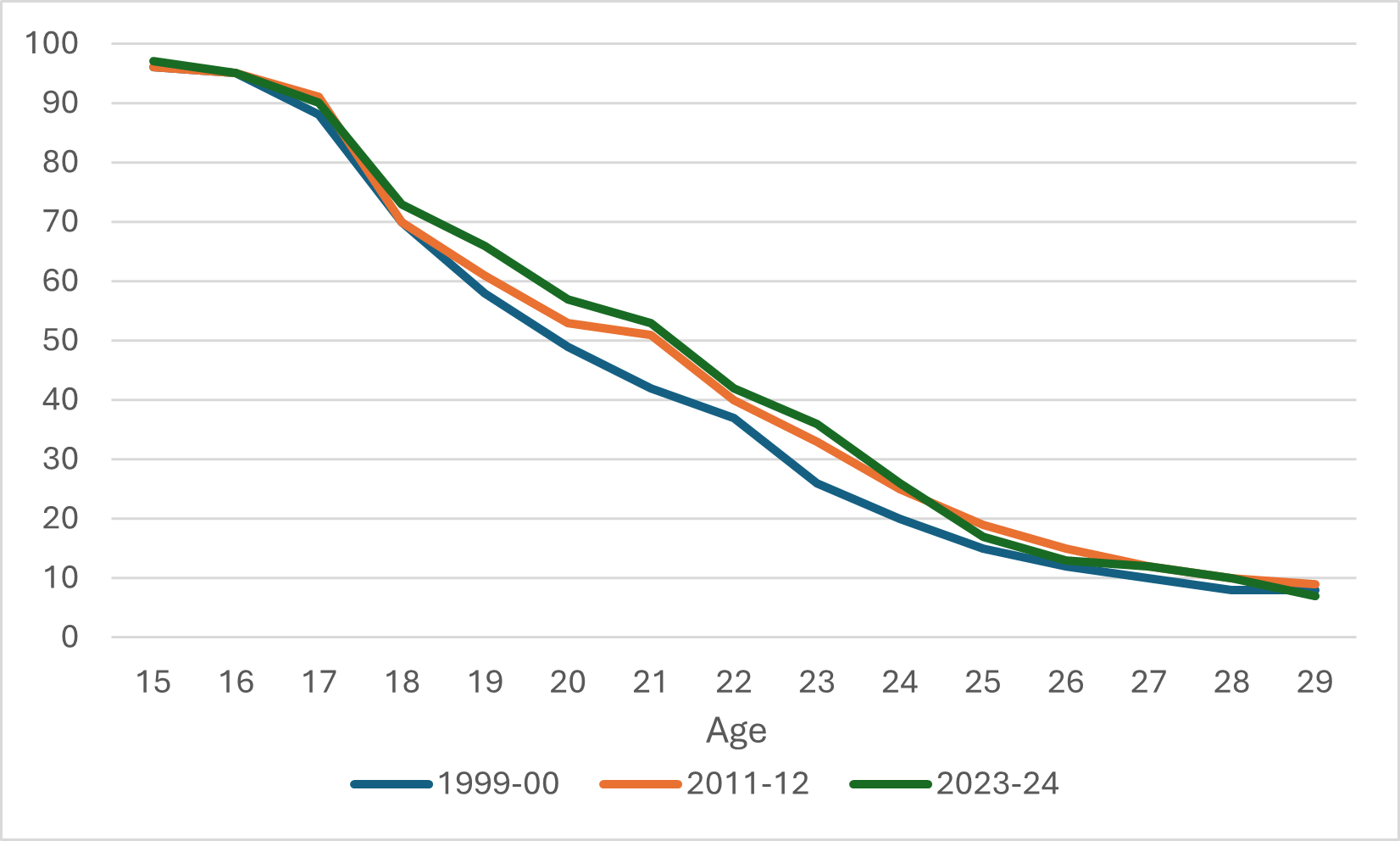
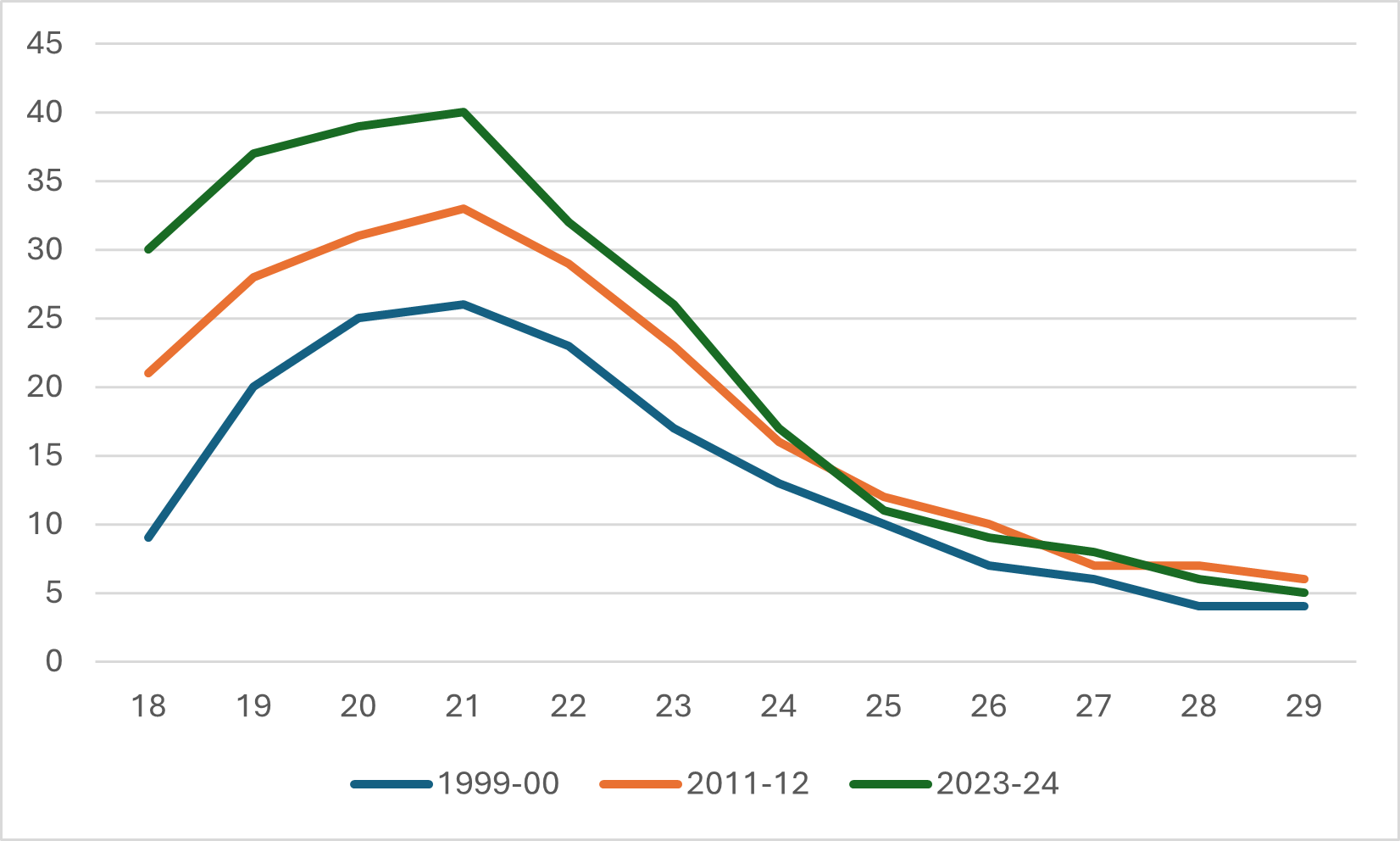
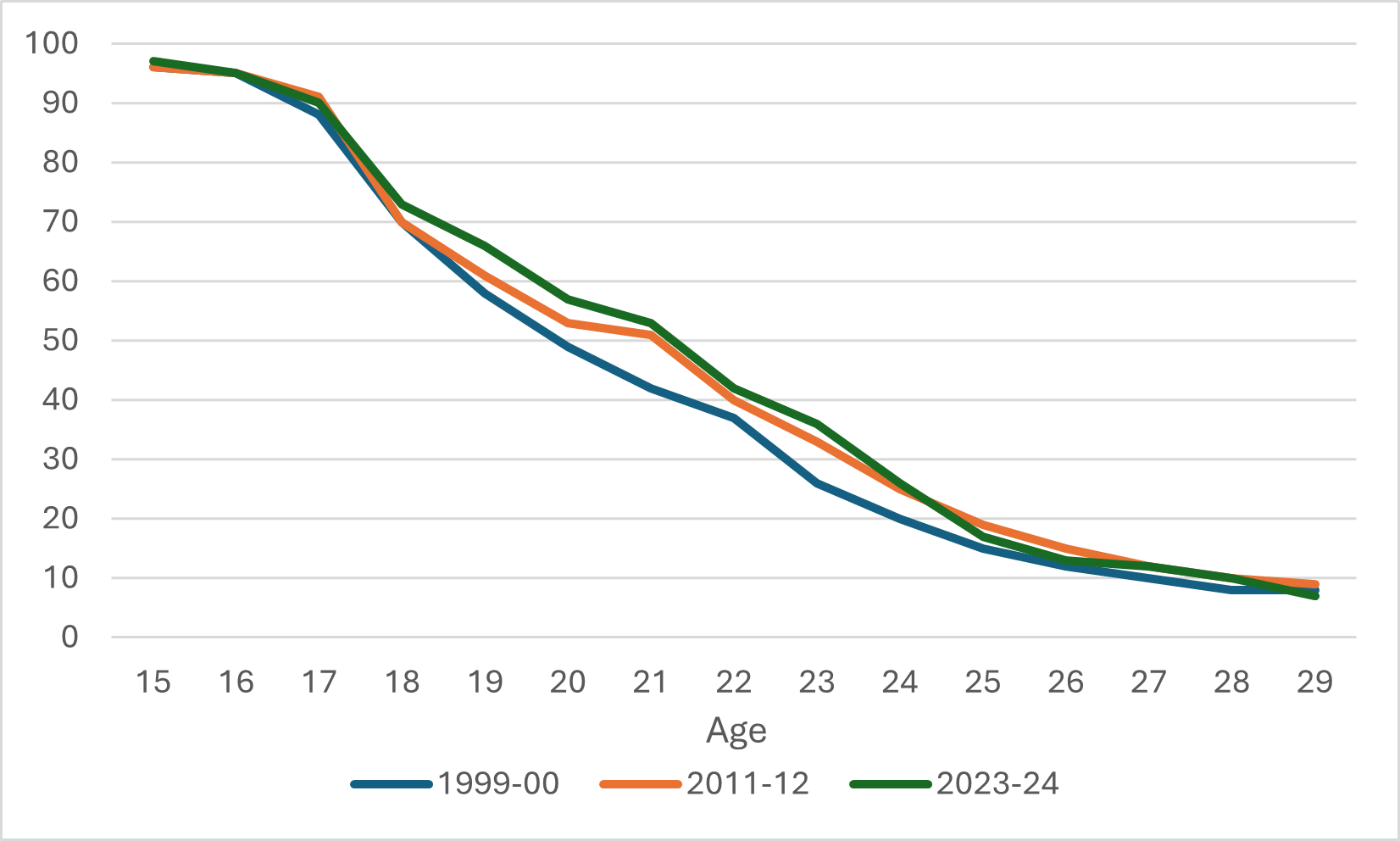
    Figure 1 shows total education participation rates, across all levels of education, from age 15 to 29, for selected years over the past quarter century. At the two ends of the graph, the numbers look pretty similar. At age 15, we’ve always had 95%+ of our population enrolled in school (almost exclusively secondary education, and from age 26 and above, we’ve always been in the low-tweens or high single digits. The falling-off in participation is fairly steady: for every age-year above 17, about 10% of the population exits education up until the age of 26. The big increase in education enrolments that we’ve seen over the past couple of decades has really occurred in the 18-24 range, where participation rates (almost exclusively in universities, as we shall see) have increased enormously.

    Figure 1: Participation rates in Education (all institutions) by Age, Canada, select years 1999-00 to 2023-24

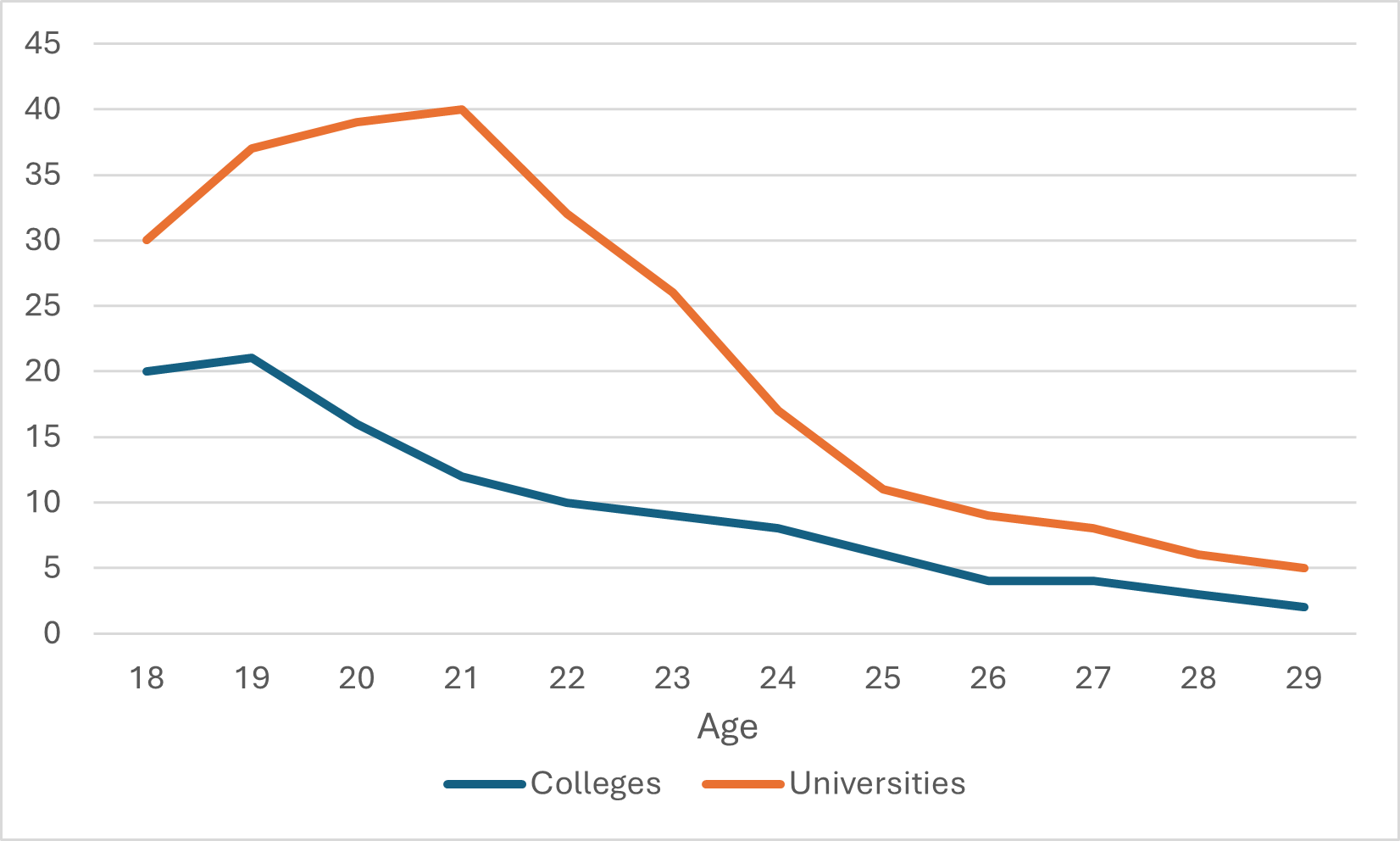
    Figure 2 shows current participation rates by age and type of postsecondary institution. People sometimes have the impression that colleges cater to an “older” clientele, but in fact, at any given age under 30, Canadians are much more likely to be enrolled in universities than in colleges. Colleges have a very high base in the teens because of the way the CEGEP system works in Quebec (I’ll come back to regional diversity in a minute), and it is certainly true that there is a very wide gap in favour of universities among Canadians in their mid-20s. But while the part rate gap narrows substantially at about age 25, it is never the case that the college participation rate surpasses the university one.

    Figure 2: Participation Rates by Age and Institution Type, Canada, 2023-24

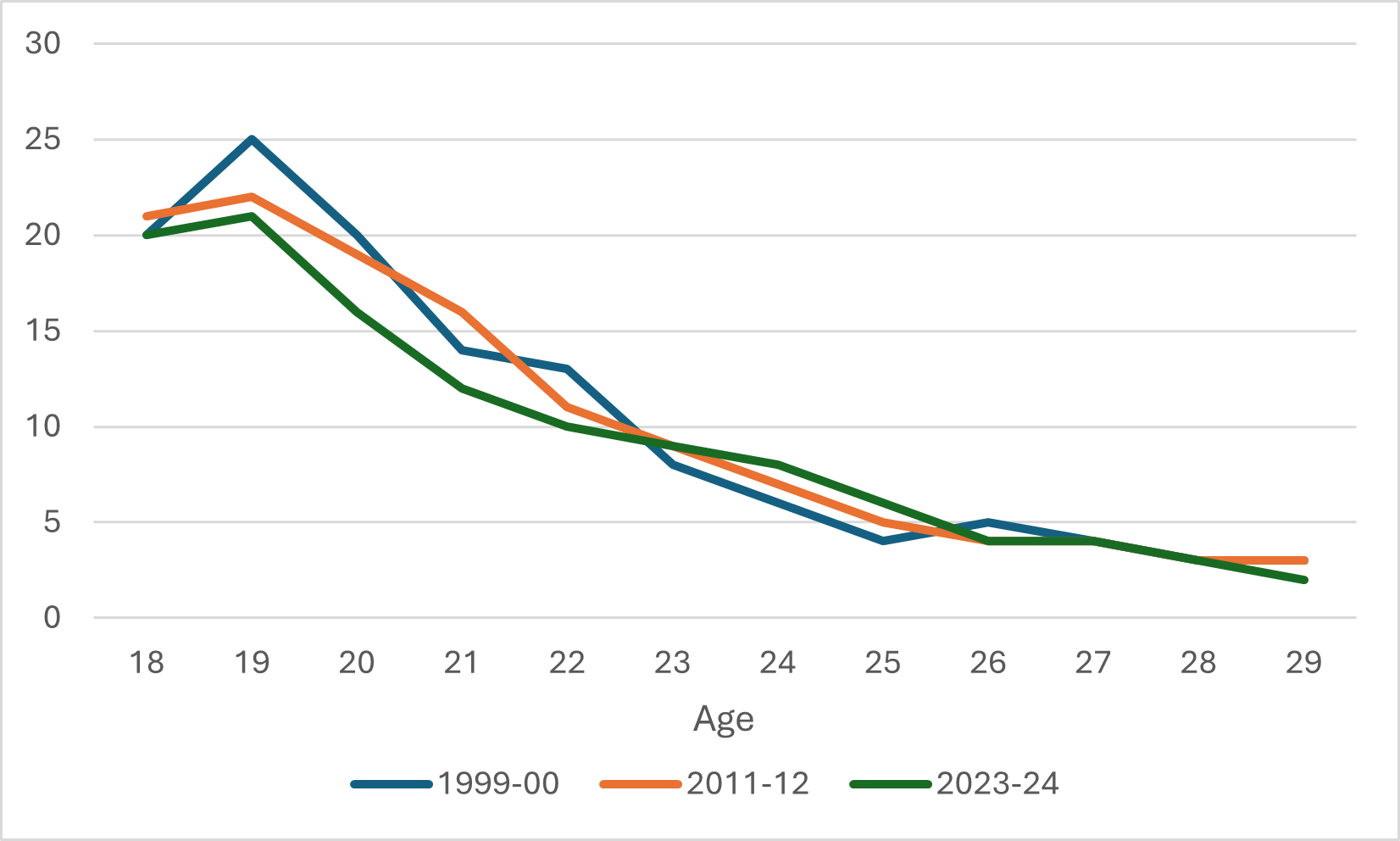
    Figure 3 shows college participation rates by age over time. What you should take from this is that there has been a slight decline in college participation rates over time in the 19-23 age range, but beyond that not much has changed.

    Figure 3: College Participation Rates by Age, Selected Years, 1999-2000 to 2023-24

    Figure 4 uses the same lens as figure 3 only for universities. And it’s about as different as it can be. In 1999, fewer than one in ten Canadians aged 18 was in university: now it is three in ten. In 1999, only one in four 21 year-olds was in university, now it is four-in-ten. These aren’t purely the effects of increased demand; the elimination of grade 13 in Ontario had a lot to do with the changes for 18-year-olds; Alberta and British Columbia converting a number of their institutions from colleges to universities in the late 00s probably juices these numbers a bit, too. But on the whole, what we’ve seen is a significant increase in the rate at which young people are choosing to attend universities between the ages of 18 and 24. However, beyond those ages the growth is less pronounced. There was certainly growth in older student participation rates between 1999-00 and 20011-12, but since then none at all.

    Figure 4: University Participation Rates by Age, Selected Years, 1999-2000 to 2023-24

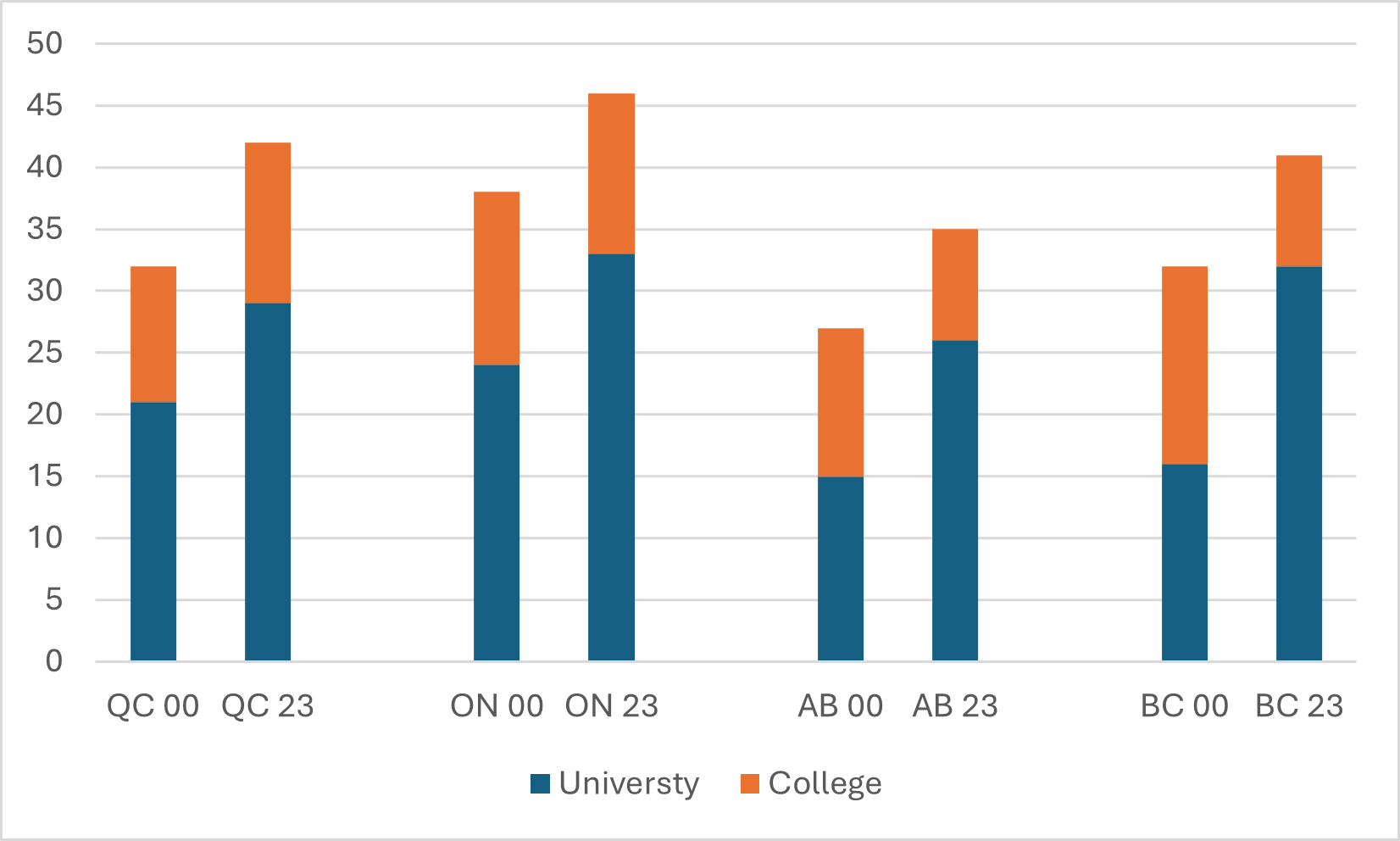
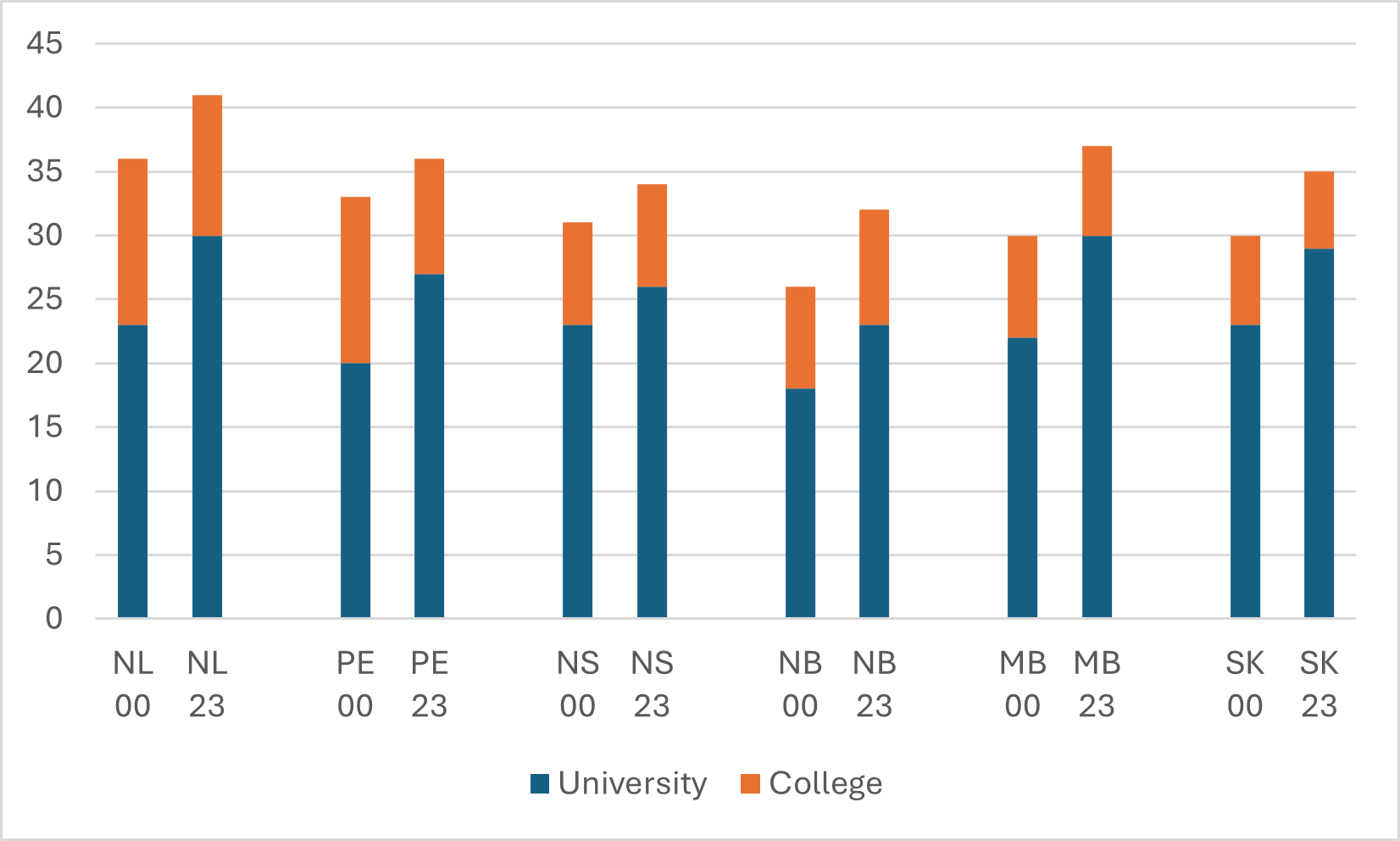
    So much for the national numbers: what’s going on at the provincial level? Well, because this is the Labour Force Survey, which unlike administrative data has sample size issues, we can’t quite get the same level of granularity of information. We can’t look at individual ages, but we can see age-ranges, in this case ages 20-24. In figures 5 and 6 (I broke them up so they are a bit easier to read), I show how each province’s university and college participation rates in 2000 vs. 2023.

    Figure 5: University Participation Rates for 20-24 Year-olds, Four Largest Provinces, 2000-01 vs. 2023-24

    Figure 6: University Participation Rates for 20-24 Year-olds, Six Remaining Provinces, 2000-01 vs. 2023-24

    Some key facts emerge from these two graphs:

    • The highest participation rates in the country are in Ontario, Quebec, and British Columbia.
    • In all provinces, the participation rate in universities is higher than it is for colleges, ranging from 2.5x in Quebec for over 4x in Saskatchewan.
    • Over the past quarter century, overall postsecondary participation rates and university participation rates have gone up in all provinces; Alberta and British Columbia alone have seen a decline in college participation rates, due to the aforementioned decision to convert certain colleges to university status in the 00s.
    • Growth in participation rates since 2000 has been universal but has been more significant in the country’s four largest provinces, where the average gain has been nine percentage points, and the country’s six smaller provinces, where the gain has been just under five percent.
    • Over twenty-five years, British Columbia has gone from ninth to second in the country in terms of university participation rates, while Nova Scotia has gone second to ninth.
    • New Brunswick has consistently been in last place for overall participation rates for the entire century.

    Just think: three minutes ago, you probably knew very little about participation rates in Canada by age and geography, now you know almost everything there is to know about participation rates in Canada by age and geography. Is this a great way to start your day or what?

    Source link

  • Yes, your yield rate is STILL Falling, 2023

    Yes, your yield rate is STILL Falling, 2023

    This now-annual post is one that boggles and befuddles people, especially those who think that your yield rate is something you control by flipping switches.  In reality, yield rate is controlled by something much more powerful: Algebra.

    First, let’s review what yield rate is:  Colleges get applications, and they admit a certain percentage of them.  In aggregate colleges admit the vast majority of applicants.  Even though this visualization shows an aggregate admit rate of 58.3% in 2023 (the red line at bottom left), the set of colleges in the data only include colleges required to report to IPEDS; this excludes community colleges and any other institution that considers itself an Open Admissions institution.

    Of that 58%, some percentage enroll, and that’s called the yield rate.  As you can see, the yield rate (the purple line at bottom center) has been falling every single year since 2001.  This is a function of math.  Applications (the orange bars at top left) have risen 211%, while the total enrolled has increased by only 43%.  If you do the mental math, you can tell that more students are applying to more institutions, and getting more offers of admission.  In this scenario, yield rate goes down based on simple algebra.

    Which is not to say, of course, that some colleges haven’t shown increases in yield rates. More on that in a moment.

    There is one more calculation of interest, called the Draw Rate.  I did not invent the Draw Rate figure, and I do not know who did.  I only remember hearing it referred to sometime in the mid-1980s as I was a young admission officer.  It’s the college’s yield rate divided by the admit rate, and it is in some sense the best measure of market power and position.  It only became interesting to me when colleges started trying to pump up applications in order to appear to be more selective, believing that selectivity was what students and parents wanted.

    When you drive up applications artificially via things like Fast Apps, Smart Apps, VIP Apps, massive fee waivers, and other things, you generate applications from students who are far less likely to enroll (or yield).  And even though you might get nominally more selective, you lose that value when your yield rate goes down as a result.  Draw Rate accounts for that, in some measure, although it too, can be manipulated by taking half (or more) of your class via Early Decision or Restrictive Early Action.  Draw rate goes up when your yield rate increases and/or your admit rate falls.

    The blue line shows what has happened to our collective fascination with application increases: We’re working harder, and spinning our wheels faster, all in vain.  To be sure, you have to do this because your competitors are.  But it would be great if we never would have started down this path.

    Remember what I said about some colleges increasing yield even when collectively the rate has gone down?  Use the control at top right to put only the 12 Ivy Plus institutions into the visualization, and see what happens. Note the Draw Rate, and remember that the collective average is 0.36.

    That’s why I like that measure: It helps separate the market’s most powerful entities from all the rest. 

    Stay tuned: We’ll have the 2024 data in about a year!

    Source link

  • Indiana University Faculty Who Focus on Student Engagement Using Top Hat See 11.5% Decrease in Student Withdrawal Rate

    Indiana University Faculty Who Focus on Student Engagement Using Top Hat See 11.5% Decrease in Student Withdrawal Rate

    Course withdrawals carry significant academic and financial consequences for students and universities. Studies consistently demonstrate that withdrawing from first-year courses can greatly increase a student’s risk of discontinuing their studies, reducing their likelihood of completing a degree (Akos & James, 2020).

    TORONTO – October 22, 2024 – Top Hat, a leading provider of student engagement solutions for higher education, has released the first significant finding in an ongoing research initiative with Indiana University exploring the impact of student engagement leveraging Top Hat on retention and academic outcomes. The study, involving an analysis of hundreds of courses from the Spring, Summer, and Fall semesters of 2023, observed that the use of Top Hat by instructors resulted in an 11.5 percent decrease in the mean student withdrawal rate compared to similar course types without using the platform. In absolute numbers, this would equate to approximately 289 of the sampled Indiana University students continuing their course work during the 2023 academic year. The findings highlight the positive impact of integrating Top Hat into course delivery on student retention, particularly in introductory courses that often have higher drop-out rates.

    The Top Hat platform empowers educators to use frequent low stakes assessments to increase student engagement during lectures through interactive polls, quizzes, and discussions. The use of frequent low stakes assessments have been shown to improve student confidence, academic outcomes and retention (Meer & Chapman, 2014). The principles of active learning can also be extended outside of class through Top Hat Pages, a content editing and personalization tool that enables instructors to create or customize their own interactive learning materials. Every interaction is captured by the platform, providing students with real-time feedback, while empowering faculty with data-driven insights they can use to identify struggling students and improve the impact of their instruction.

    “Indiana University is deeply committed to the success of our students, and the findings from this research demonstrate how the thoughtful integration of instructional technologies has contributed to strengthening our undergraduate retention,” said Gina Londino-Smolar, Ed.D., Teaching Professor at IU Indianapolis. “Implementing active learning and frequent assessment, which have been shown to improve student outcomes, has been an important focus for us and our partnership with Top Hat has been instrumental in enabling us to scale these practices across our institution, ensuring a consistent, high quality learning experience for our students.”

    The study’s primary objective is to evaluate the influence of Top Hat on various student outcomes, with an initial focus on withdrawal rates—a key indicator of student success. The collaborative research project, approved by the Institutional Review Board (IRB), involved analyzing data from thousands of individual courses. From the original large dataset, similar courses based on discipline and level were identified in order to equalize the sample size and undertake a more accurate analysis. After filtering the dataset, 235 unique Top Hat courses were compared against a similar set of 235 unique courses that did not use Top Hat.

    Indiana University began working with Top Hat in 2017 and, based on high rates of faculty adoption, made the decision to offer the platform free of charge to all students by entering into an enterprise license agreement the following year. By addressing concerns around equity, student affordability and ensuring compliance with respect to data privacy and standards for web accessibility, adoption has increased substantially. For the 2023/2024 academic year 1,022 faculty and 51,679 students across more than 1,900 individual courses from all nine IU campuses used Top Hat to enhance learning.

    “This study reinforces the importance of providing faculty with tools that make evidence-based practices, like active learning, easier to adopt,” said Maggie Leen, CEO of Top Hat. “The data speaks for itself—when instructors have access to the tools to support effective teaching methods, it can lead to stronger student engagement and higher persistence. We’re proud to be part of Indiana University’s efforts to increase on-time graduation rates for their students.”

    The 2030 IU Strategic Plan has one pillar dedicated to Student Success and Opportunity with a commitment to student affordability and experience throughout their educational journey to have success in the workplace and beyond. The incorporation of Top Hat to engage students with the course content, reducing withdrawal rates, can be seen as a direct contribution to the pillar for student success.

    Since its founding in 2009, Top Hat has continued to introduce new features to make proven teaching methods more accessible to instructors. Most recently, Top Hat announced the release of Ace, an AI-powered teaching and learning assistant that enables instructors to generate assessment questions and discussion prompts based on their lecture slides and course materials. As a personalized study assistant, Ace allows students to break down challenging concepts, find guidance tackling difficult homework assignments, and create on-demand practice questions they can use to prepare for high stakes assessments. 

    The initial findings will inform both Indiana University and Top Hat’s future strategies for enhancing student outcomes. The research initiative is currently focused on identifying patterns of usage by instructors across disciplines and their impact on student engagement and academic performance. Ongoing analysis is exploring the impact of Top Hat on the academic experience of various student populations, including historically underrepresented groups with a focus on how the platform supports equitable access to learning, improves engagement, and contributes to closing achievement gaps.

    About Indiana University

    Indiana University (IU) is one of the nation’s leading public research universities, with 90,000 students across 930+ academic programs, seven campuses, two regional academic centers and nine School of Medicine campuses. Since 1820, Indiana University has helped students create brighter futures while also driving innovation, from breakthroughs in DNA technology to cancer research to trailblazing cultural programs and resources. IU is home to world-class academics with the country’s largest medical school, the world’s first school of philanthropy, the top-ranked Kelley School of Business and O’Neill School of Public and Environmental Affairs, and the Luddy School of Informatics, Computing and Engineering, the nation’s first school of informatics. The university’s campuses are united by IU 2030, an aspirational vision for a bold and ambitious future focused on student success and opportunity, transformative research and creativity, and service to the state of Indiana and beyond. Learn more at iu.edu.

    About Top Hat

    As the leader in student engagement solutions for higher education, Top Hat enables educators to employ proven student-centered teaching practices through interactive content and tools enhanced by AI, and activities in in-person, online and hybrid classroom environments. To accelerate student impact and return on investment, the company provides a range of change management services, including faculty training and instructional design support, integration and data management services, and digital content customization. Thousands of faculty at 750 leading North American colleges and universities use Top Hat to create meaningful, engaging and accessible learning experiences for students before, during, and after class.

    Contact [email protected] for media inquiries.

    Source link

  • Data Show Women and People of Color Aren’t Advancing to Higher Faculty Ranks at the Same Rate as White Men – CUPA-HR

    Data Show Women and People of Color Aren’t Advancing to Higher Faculty Ranks at the Same Rate as White Men – CUPA-HR

    by CUPA-HR | May 2, 2024

    New research from CUPA-HR on the state of the faculty workforce in higher education shows that despite some growth in representation among tenure-track women and faculty of color in new hires, advancement to higher faculty ranks remains a barrier. What’s more, these promotion gaps are found in every faculty discipline.

    CUPA-HR’s research team analyzed data from the Faculty in Higher Education Survey, a comprehensive data source that collects salary and demographic data by tenure status, rank, and faculty discipline, to evaluate representation and pay equity for women and faculty of color from 2016-17 to 2022-23.

    In addition to the finding that women and faculty of color are not being promoted to senior faculty ranks at the same rate as White men, the data also show that women, Black, and Hispanic or Latina/o faculty are better represented in non-tenure-track than in tenure-track positions, and that pay gaps in non-tenure-track positions persist for these groups. Combined with the fact that these groups are less likely to be promoted to higher ranks in tenure-track positions, the result is that a substantial segment of faculty, primarily women and people of color, are employed in positions that pay lower salaries throughout their careers.

    Other Findings

    Tenure-track faculty positions are on the decline. There has been a decline in tenure-track positions and a corresponding increase in non-tenure-track positions over the past seven years. In 2016-17, tenure-track roles accounted for 73% of faculty, but by 2022-23, this proportion fell to 66%, with a marked increase in non-tenure-track positions over the last two years. Additionally, the percentage of new tenure-track assistant professor hires dropped in recent years, indicating a trend toward more new non-tenure-track hires.

    The representation of women and people of color in tenure-track faculty positions is increasing, yet challenges remain. There was a notable increase in the representation of tenure-track (TT) women and faculty of color from 2016-17 to 2022-23. In 2022-23, more than one-fourth (26%) of TT faculty were people of color. This marks a 28% increase over the span of seven years, compared to 2016-17, when faculty of color constituted closer to one-fifth (21%) of all TT faculty. However, the growth in racial/ethnic representation still lags when compared to the demographic composition of U.S. doctoral degree holders. Further, despite strides toward pay equity for tenure-track faculty of color, White women in tenure-track positions still face persistent pay gaps in 2022-23.

    Explore the interactive graphics and read the full report, Representation and Pay Equity in Higher Education Faculty: A Review and Call to Action.


    Source link

  • The annual graduation rate post

    The annual graduation rate post

    I know I’ve been barking up the tree of “Graduation Rates are inputs, not outputs” for a long time.  And I know no one is listening.  So I do this, just to show you (without the dependent variable) just how unsurprising they are.

    Here are four views of graduation rates at America’s four-year public and private, not-for-profit colleges and universities. And I’ve put them in four views, with several different ways to look at the data.

    The first (using the tabs across the top) shows four-, five-, and six-year graduation rates on the left, and “Chance in four” on the right.  In other words, since everyone pretty much thinks they’re going to graduate from the college they enroll in as a freshman, what are the chances of graduating in four years, rather than six?  There are some surprises there, as you’ll see.

    On all the visualizations, you can apply filters to limit the colleges you’re looking at.  The scroll bar (to move up or down) is on the right but it’s sometimes hard to see.  And the size slider is set to a minimum of 1,000 students, but you can change that; just beware that small colleges often have wonky data, for several reasons.

    The second view shows six-year rates by gender.

    The third view breaks out six-year rates by ethnicity, comparing African-American, Hispanic, and Asian rates (the shapes) to the rate for White students (on the gray bars).

    And the final view breaks out six-year rates by Pell Grant status, then shows the gap between the two on the right. On the gap chart, a negative number shows colleges where Pell graduation rates are higher than non-Pell rates.

    Enjoy! 

    Source link