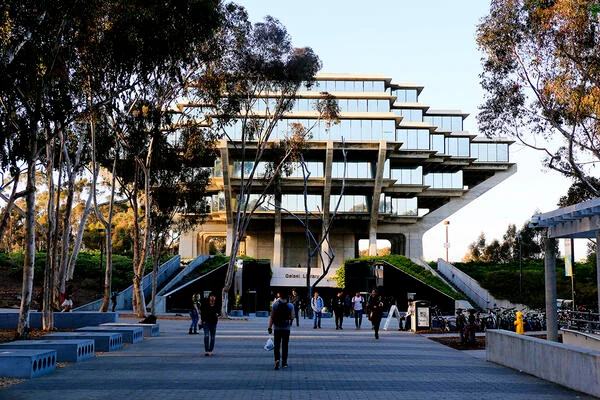
The University of California, San Diego, pictured here, is one of 10 UC system institutions.
Laser1987/iStock/Getty Images
The University of California system reached record enrollment this fall, surpassing 301,000 students across its 10 campuses. About 200,000 of them come from California; the share of students who come from outside the state has decreased by two percentage points over the past four years.
University officials said in a news release that the decline represents the system’s commitment to serving California residents.
“These numbers reflect California’s commitment to academic excellence, access, and innovation, values that have made the University of California the world’s greatest research university,” said UC president James B. Milliken. “The value of a UC degree is abundantly clear. An investment in UC is the best investment in the future of our students, California’s workforce, and the state’s economy.”
The release noted that this enrollment success comes at a time when UC campuses are facing increased costs, federal funding cuts and other financial hardships. Four hundred federal research grants remain suspended or terminated across the system.
Negotiations were held in-person for one week at the beginning of October and a second week in November.
Pete Kiehart/The Washington Post/Getty Images
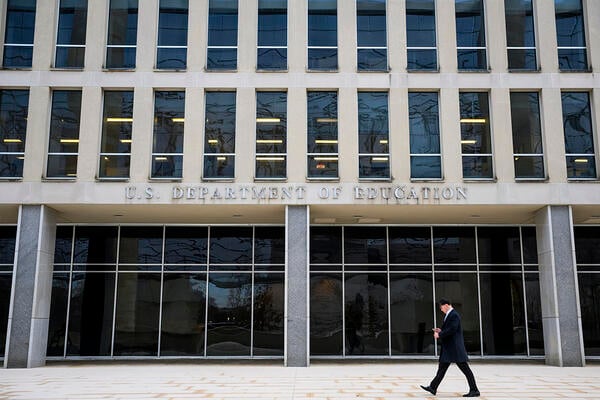
A very limited number of degree programs would have access to the highest level of loans under a new set of regulations that the Department of Education and its negotiating committee signed off on Thursday.
The regulations, written in response to the loan caps of Congress’s One Big Beautiful Bill Act, allow students in programs that qualify as professional to take out up to $200,000. Meanwhile, graduate students will only be able to take out up to $100,000.
What was up for debatethroughout the two-week negotiation process was which degree programs qualify for which level of loans.
And while Thursday’s definition of professional programs was slightly more inclusive than the department’s original suggestion—a list of 10 degrees, including medicine, law, dentistry and a masters of divinity—they are not as expansive as a third proposal put forward by Alex Holt, the committee member representing taxpayers and public interest.
The final definition limits professional programs to the original 10 programs, a doctorate in clinical psychology, and a handful of other doctorate programs that fall within the same four-digit CIP codes. By comparison, Holt’s plan would have included any program that is 80 credit hours long, regardless of whether it was a master’s or doctorate degree, so long as it fell within the same two-digit CIP code. (A CIP code, otherwise known as the Classification of Instructional Programs, is part of an organizational system used by ED to group similar academic programs.)
On Thursday, before the committee’s final consensus vote, department officials explained to committee members that if they did not agree to their definition of a professional degree, they could lose out on other “concessions” they had won from the department. Without consensus, the department would legally be free to rewrite any aspect of the proposal prior to releasing it for public comment. (The proposal that reached consensus will still be subject to public comment.)
“I also would like to remind everyone of numerous things that we have chosen to do in these negotiations that you requested for us to do,” said Tamy Abernathy, the department’s negotiator, before listing a slew of other changes the department made concerning the transition to new loan repayment plans and how to grandfather in existing borrowers to new loan policies.
Under Secretary Nicolas Kent noted before the vote that the proposal was “not a perfect definition, but … a perfect definition for the purposes of consensus.”
“We recognize that not every stakeholder group will be thrilled about our proposal,” Kent said. “But I want to remind everybody what consensus means, and that means that if you all agree, or can live with it—because we don’t have to love it—that we will take that regulatory language and put it into the notice of proposal.”
Multiple committee members told Inside Higher Ed they agreed with Kent’s evaluation of what it took to reach a compromise.
Kent closed the meeting by noting that “because we’ve reached consensus, negotiators and their employers will refrain from commenting negatively … as they agreed to do.”
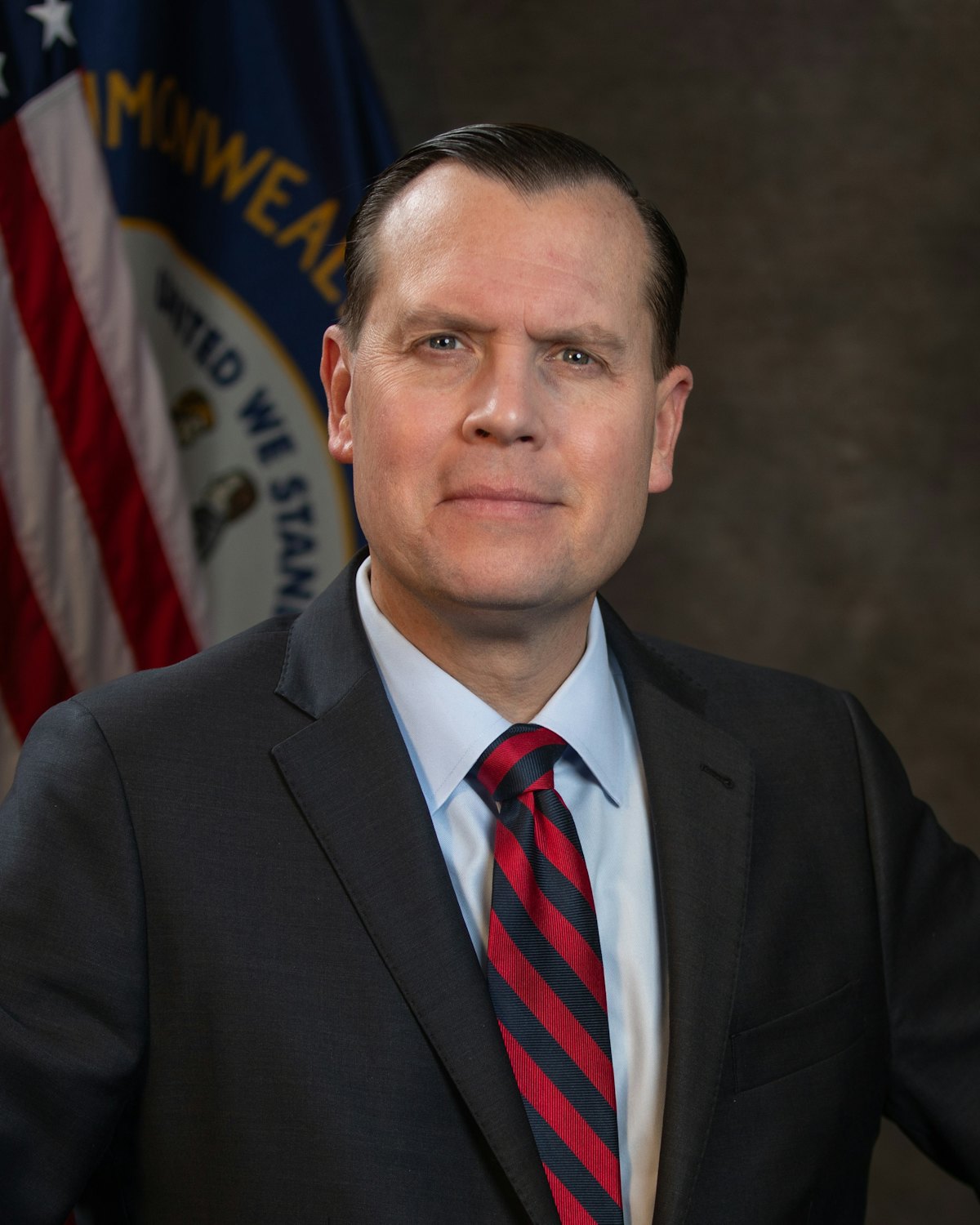
Kentucky Attorney General Russell ColemanThe U.S. Department of Justice and the Kentucky Council on Postsecondary Education have reached a preliminary settlement agreement that would end the state’s policy of offering in-state tuition rates to undocumented students who graduate from Kentucky high schools.
The agreement comes after the DOJ filed a federal lawsuit in June challenging Kentucky’s practice of extending in-state residency status—and the accompanying lower tuition rates—to any student who completes high school in the state, regardless of immigration status. The Justice Department argued this policy creates unequal treatment by providing financial benefits to undocumented immigrants while denying the same rates to U.S. citizens living in other states.
“No state can be allowed to treat Americans like second-class citizens in their own country by offering financial benefits to illegal aliens,” Attorney General Pamela Bondi said in announcing the federal lawsuit.
The legal challenge reflects broader federal immigration enforcement priorities under the Trump administration, which has issued executive orders aimed at preventing undocumented immigrants from accessing taxpayer-funded benefits or preferential treatment in government programs.
Kentucky’s Republican Attorney General Russell Coleman has supported the federal position, arguing that state policy conflicts with federal law prohibiting undocumented immigrants from receiving college benefits unless identical benefits are available to all U.S. citizens. In July, Coleman urged the Council on Postsecondary Education to voluntarily withdraw the regulation rather than pursue costly litigation.
“The federal government has set its immigration policy, and the Council must regulate in accordance with it,” Coleman wrote to the CPE. “To that end, I urge the Council to withdraw its regulation rather than litigate what I believe will be, and should be, a losing fight.”
Under the tentative settlement terms, the Kentucky Council on Postsecondary Education has acknowledged that its tuition policy violates federal law and agreed to terminate it immediately. However, the agreement remains pending approval from U.S. District Court Judge Gregory Van Tatenhove in the Eastern District of Kentucky.
The Kentucky case mirrors a similar federal challenge resolved earlier this year, when Texas reached a settlement with the DOJ over comparable in-state tuition policies for undocumented students.
The Mexican American Legal Defense and Educational Fund (MALDEF), a prominent Latino civil rights organization, has filed a motion seeking to intervene in the Kentucky lawsuit on behalf of affected students. The motion remains under judicial review. MALDEF was previously denied intervention rights in the parallel Texas case.
The policy change could significantly impact college affordability for undocumented students who have spent their formative years in Kentucky’s educational system. In-state tuition rates are typically substantially lower than out-of-state rates, making higher education more accessible for students from families with limited financial resources.
In the 1980s, a public interest law group sued the state of New Jersey, saying that the way it funded education left its low-income, urban school districts at a disadvantage compared to wealthier, suburban districts.
The lawsuit, Abbott v. Burke, yielded a number of different decisions, including a requirement that the state offer free, full-day, high-quality preschool for children ages 3 and 4 in 31 school districts.
This new school year marks the 26th since the program was created. Researchers have found that children who attend the preschool program are better prepared for school later on, but enrollment has been dwindling. And with New Jersey leaders now focused on bringing preschool to all districts, supporters worry that the early learning program focused on children in low-income areas may not get the attention it needs.
Park perk for kids
Did you know every fourth grader and their family can get free admission to national parks, monuments and forests? The Sierra Club’s Outdoors for All program launched in 2015 and offers free passes each school year. Vouchers for students can be downloaded through the program’s official website.
This story about free preschool was produced by The Hechinger Report, a nonprofit, independent news organization focused on inequality and innovation in education. Sign up for the early childhood newsletter.
The Hechinger Report provides in-depth, fact-based, unbiased reporting on education that is free to all readers. But that doesn’t mean it’s free to produce. Our work keeps educators and the public informed about pressing issues at schools and on campuses throughout the country. We tell the whole story, even when the details are inconvenient. Help us keep doing that.