Tag: ready

  • More South Carolina Students Are Graduating, But Many Aren’t Ready for Life After High School – The 74

    More South Carolina Students Are Graduating, But Many Aren’t Ready for Life After High School – The 74


    Get stories like this delivered straight to your inbox. Sign up for The 74 Newsletter

    COLUMBIA — South Carolina high schools posted their highest graduation rate in a decade, but a quarter of students still aren’t ready for college or the workforce, according to state report card data released Monday.

    Generally, South Carolina’s schools improved compared to last year, according to the statewide data that gauges how well schools perform based on test scores, classroom surveys and student growth, among other metrics. Education officials applauded a 10-year high in the number of students graduating on time — meaning they graduated four years after entering ninth grade — while saying they would continue pushing for programs to improve how well those students were prepared for life after high school.

    “We have to make sure that our diplomas are worth more than the piece of paper that they are written on,” said state Superintendent Ellen Weaver.

    Overall, 270 schools rated “excellent” this year, an increase from 232 last year. The bottom tier of “unsatisfactory” decreased from 49 to 31, and “below average” schools dropped from 186 to 145.

    Any time the number of schools in the lowest tier shrinks, that’s good news, since it means children across the state are getting a better education, said Patrick Kelly, a lobbyist with the Palmetto State Teachers Association.

    “There’s encouraging information here,” Kelly said of the report cards.

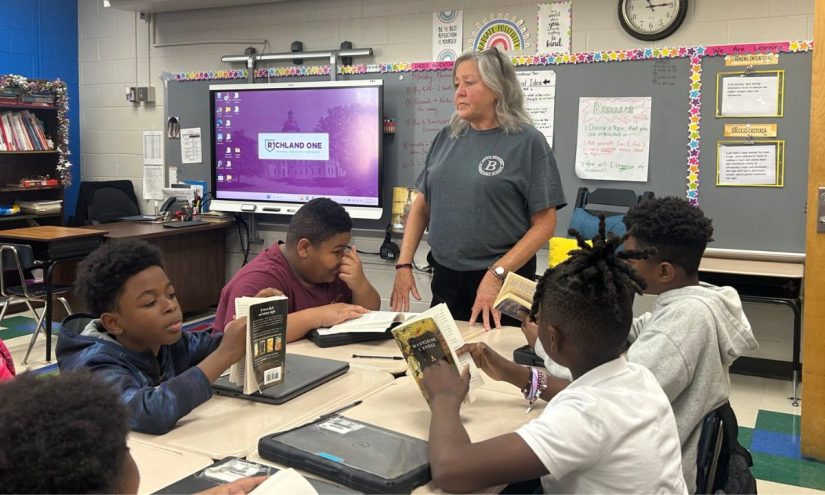
    Officials from the state Department of Education and the independent Education Oversight Committee, which is tasked by state law with grading schools, announced the results at Annie Burnside Elementary School in Columbia, which jumped two tiers this year, from “average” to “excellent.”

    At the Richland District One school, 83% of the 306 students live in poverty. The school’s big rating boost was due to significant student improvement, as shown by their test scores, and results on a survey about the school’s general environment, according to its report card.

    “Our academic gains are no coincidence,” said Principal Janet Campbell. “They are the result of setting measurable goals, challenging our students to reach them and supporting them along the way.”

    Graduation rates and readiness

    This year, 87% of high schoolers graduated on time, up from 85% last year. That’s worth celebrating, Kelly said.

    “Our goal should be for every student in South Carolina who has the ability to earn a high school diploma,” he said.

    Three-quarters of students were ready for either college or a career after graduation, a gain of 3 percentage points, according to the state data. Less than a third were ready for both.

    Although the gap between students who are graduating and those who are prepared for what comes next continues to shrink slightly, state officials remain concerned about it, Weaver said.

    “At the end of the day, we want our students, when they leave a South Carolina high school, to know that that diploma that they carry is a diploma of value,” Weaver said. “This is a diploma that is going to ensure that they are ready to go onto whatever post-secondary success looks like for them.”

    All 11th graders in the state take a test assessing skills commonly needed for jobs, divided into four areas: math, reading, understanding data and “soft skills,” which include aspects of a job such as dressing professionally and working well with others. Results are graded from 1 to 5, with higher scores suggesting students are ready to pursue more careers.

    Students are considered career-ready if they receive a score of 3 or higher on that test, earn a technical education certificate, complete a state-approved internship or receive a high enough score on the Armed Services Vocational Aptitude Battery to enlist in the military. This year, 73% of students met that benchmark, compared to 70% last year, according to report card data.

    College readiness is based on a student’s score on the ACT or SAT college entrance exam, college credit earned through a dual-enrollment course and/or scores on end-of-course Advanced Placement tests.

    One-third of graduating students were college-ready, which is on par with at least the past five years, according to state data. The rate of high school students applying for college also continued to decrease, with 59% reporting filling out applications this year, compared with 61% last year.

    A gap between graduation rate and readiness for the next step suggests schools are sometimes passing students without actually imparting the skills they need to succeed in life, Kelly said.

    For instance, district policies setting minimum grades teachers can give makes it easier for students to pass their classes, even if they haven’t actually done the work, Kelly said. Alternatives for students who fail tests or classes are sometimes easier, meaning a student can catch up without actually learning the same skills as their peers, he said.

    “We’ve put some policies in place that make it harder to evaluate what a student knows and can do,” Kelly said.

    Beginning this school year, students can follow a so-called pathway to earn credentials that build on each other every year, allowing students to learn more advanced skills meant to make it easier to find a job in the field they want to pursue, said April Allen, chair of the Education Oversight Committee’s governing board.

    “At the same time, we recognize that strengthening the system must go hand-in-hand with addressing the barriers that keep students from wholly engaging in school,” said Allen, who’s also a government relations director for Continental Tire.

    Chronic absenteeism and test scores

    For example, the number of students who missed at least 10 days of school this year remained a concern, Allen said.

    Around 23% of students were chronically absent, essentially the same number as last year. The more days of school a student misses, the less likely they are to perform as expected for their grade level on end-of-year tests, according to a report the committee put out last year.

    Those tests, in turn, play a role in determining how well a school or a district is performing. Officials and teachers’ advocates credited the Palmetto Literacy Project and a change in how early educators teach reading for improving English scores, but math scores remain low, with less than half of third- through eighth-graders able to perform on grade level, according to state testing data.

    Just over half the state’s high school students scored at least a C, which is a 70%, on their end-of-course Algebra I exams, often taken freshman year, according to report card data. Nearly 69% passed their English 2 exams, typically taken sophomore year.

    While rooting for improvement, teachers’ advocates also warned against depending too heavily on a single exam score in deciding how well teachers and students are performing. A single, high-pressure exam at the end of the year is not necessarily the best indicator of school performance, said Dena Crews, president of the South Carolina Education Association.

    “If people are making judgments based on that, they’re missing a whole lot about schools and districts,” Crews said.

    Teacher support

    The Department of Education plans to focus on teachers in 2026, Weaver said.

    “The No. 1 thing that we have to do to support student learning is take care of our teachers,” Weaver said.

    She is asking legislators to raise the minimum pay for a first-year teacher to $50,000, up from $48,500. Legislators have increased the pay floor in increments for years, with the stated goal of reaching $50,000.

    Weaver is also asking for $5 million to continue a pilot program that awards teachers bonuses based on how well their students perform on tests. She also wants to start a program that offers extra pay to exceptional teachers who mentor others. The additional responsibility would be another way to earn more money without leaving the classroom to go into school administration, she said.

    Supporting teachers is key in improving how well schools are performing, Kelly said. The promising results in this year’s report cards came after the first dip in teacher vacancies since 2019, he added.

    “It should not be a surprise to see school performance improve as teacher vacancies go down,” Kelly said.

    SC Daily Gazette is part of States Newsroom, a nonprofit news network supported by grants and a coalition of donors as a 501c(3) public charity. SC Daily Gazette maintains editorial independence. Contact Editor Seanna Adcox for questions: [email protected].


    Did you use this article in your work?

    We’d love to hear how The 74’s reporting is helping educators, researchers, and policymakers. Tell us how

    Source link

  • US students are voting with their feet – and global universities are ready

    US students are voting with their feet – and global universities are ready

    A record number of American students are applying to UK universities, with applications up nearly 14% over last year. The shift reflects something deeper than academic preference. It’s a response to uncertainty – political, cultural, and institutional – within the US higher education system.

    Students are assessing the climate as carefully as the curriculum, and for many, overseas options are starting to look more stable, more supportive, and more aligned with their values.

    For years, US institutions have concentrated on drawing international students into their classrooms and research labs. These efforts have been crucial to advancing STEM research, sustaining graduate-level enrolment, and feeding innovation pipelines. That trend continues, but the story is evolving.

    An outbound shift is now underway, with a growing number of American students pursuing degrees abroad. They’re no longer just participating in short-term exchanges or postgraduate fellowships, they’re committing to full undergraduate and master’s programs in other countries.

    This change matters – and it signals both a loss of tuition revenue and a weakening of domestic confidence in US higher education itself.

    Global competitors are moving decisively

    Universities in the UK, Canada, Australia, Germany, and the Netherlands have responded to this moment with strategy and urgency. They’ve expanded international recruitment offices, developed targeted campaigns for US students, and aligned their degree programs with global employment pathways.

    Tuition transparency, faster visa timelines, and the option to work post-graduation are all part of a larger value proposition. These countries have positioned themselves as predictable, inclusive, and serious about talent retention.

    When American students earn degrees abroad, they begin forming professional relationships, research collaborations, and employment ties in other countries

    The messaging stands in sharp contrast to the environment many students perceive at home in the US, where they’re regrettably familiar with ongoing threats to federal research funding, campus free speech tensions, and anti-immigrant rhetoric. Legislative actions in some states, such as restrictions on DEI programs or faculty tenure, further complicate the picture for students who see higher education as a place of openness and critical inquiry.

    Even where the academic offering remains strong, the broader social climate is giving students pause. Many now fear that attending university in the US could come with limitations on expression, uncertainty around institutional support, or even diminished international credibility. These concerns are pushing more prospective students, both international and domestic, to weigh their options with increasing care.

    The landscape is becoming borderless

    Higher education is no longer a domestically bounded experience. Today’s students are growing up in a digital-first world where comparison is constant and information is immediate. They can browse course catalogs from universities in five countries before lunch.

    They’re watching lectures on TikTok from professors in London, Melbourne, and Berlin. They’re discussing housing, scholarships, and career prospects with peers on Reddit, Discord, and WhatsApp. The idea of applying to college abroad no longer feels radical or risky – it feels strategic.

    At the same time, the financial argument for international study has grown stronger. In the UK and parts of Europe, undergraduate degrees often take three years instead of four. Tuition is fixed, predictable, and, in some cases, lower than the out-of-state rates at US public universities.

    Students can begin building global networks immediately, with exposure to cross-cultural collaboration built into the experience. That combination of efficiency, affordability, and international orientation is hard to ignore.

    Consequences will extend beyond enrollment trends

    If this shift continues, the implications go well beyond enrolment figures. When American students earn degrees abroad, they begin forming professional relationships, research collaborations, and employment ties in other countries. That international experience can strengthen global literacy, which is good in theory, but it may also weaken long-term institutional connections to the US – particularly if graduates choose to live, work, and innovate elsewhere.

    This becomes especially relevant in sectors where talent mobility drives economic growth. If a critical mass of globally minded US students pursue AI, climate tech, public health, or diplomacy degrees abroad and then launch their careers overseas, the domestic pipeline for advanced skills and leadership becomes harder to sustain. These are early signs of a broader trend, and we should treat them with urgency.

    The same applies to the soft power of US education. For decades, American universities have served as platforms for international exchange, not only bringing foreign students in, but equipping domestic students to become global ambassadors. If that dynamic begins to fade, so does the country’s influence in shaping global norms around research, ethics, and innovation.

    Prioritising stability and trust 

    Reversing this trend will require more than competitive admissions packages. US institutions – and the policymakers who shape their environment – must work to restore trust. That means safeguarding academic freedom, ensuring transparent financial support structures, and publicly affirming the value of international engagement.

    Students are listening closely. They are attuned to leadership choices and the broader societal signals surrounding higher education. If they sense instability or retreat, they will continue to look abroad.

    Universities also need to communicate more effectively with prospective students about their long-term value. That includes articulating what makes a US education distinctive, and doing so without leaning solely on prestige or nostalgia. There must be a renewed emphasis on civic purpose, global relevance, and practical opportunity. The next generation is looking for clarity, meaning, and alignment between their educational investment and the world they hope to shape.

    The US can lead again, if it chooses to

    The United States still possesses unmatched institutional capacity in research, innovation, and cultural reach. But influence is not a static asset. It depends on the willingness to adapt and lead with principle. The current wave of outbound student mobility should not be dismissed as an anomaly. It’s a signal. How US higher education responds – at both the institutional and national levels – will determine whether it remains a magnet for talent or becomes just one option among many.

    Source link

  • NAEP scores for class of 2024 show major declines, with fewer students college ready

    NAEP scores for class of 2024 show major declines, with fewer students college ready

    This story was originally published by Chalkbeat. Sign up for their newsletters at ckbe.at/newsletters.

    Students from the class of 2024 had historically low scores on a major national test administered just months before they graduated.

    Results from the National Assessment of Educational Progress, or NAEP, released September 9, show scores for 12th graders declined in math and reading for all but the highest performing students, as well as widening gaps between high and low performers in math. More than half of these students reported being accepted into a four-year college, but the test results indicate that many of them are not academically prepared for college, officials said.

    “This means these students are taking their next steps in life with fewer skills and less knowledge in core academics than their predecessors a decade ago, and this is happening at a time when rapid advancements in technology and society demand more of future workers and citizens, not less,” said Lesley Muldoon, executive director of the National Assessment Governing Board. “We have seen progress before on NAEP, including greater percentages of students meeting the NAEP proficient level. We cannot lose sight of what is possible when we use valuable data like NAEP to drive change and improve learning in U.S. schools.”

    These results reflect similar trends seen in fourth and eighth grade NAEP results released in January, as well as eighth grade science results also released Tuesday.

    In a statement, Education Secretary Linda McMahon said the results show that federal involvement has not improved education, and that states should take more control.

    “If America is going to remain globally competitive, students must be able to read proficiently, think critically, and graduate equipped to solve complex problems,” she said. “We owe it to them to do better.”

    The students who took this test were in eighth grade in March of 2020 and experienced a highly disrupted freshman year of high school because of the pandemic. Those who went to college would now be entering their sophomore year.

    Roughly 19,300 students took the math test and 24,300 students took the reading test between January and March of 2024.

    The math test measures students’ knowledge in four areas: number properties and operations; measurement and geometry; data analysis, statistics, and probability; and algebra. The average score was the lowest it has been since 2005, and 45% of students scored below the NAEP Basic level, even as fewer students scored at NAEP Proficient or above.

    NAEP Proficient typically represents a higher bar than grade-level proficiency as measured on state- and district-level standardized tests. A student scoring in the proficient range might be able to pick the correct algebraic formula for a particular scenario or solve a two-dimensional geometric problem. A student scoring at the basic level likely would be able to determine probability from a simple table or find the population of an area when given the population density.

    Only students in the 90th percentile — the highest achieving students — didn’t see a decline, and the gap between high- and low-performing students in math was higher than on all previous assessments.

    This gap between high and low performers appeared before the pandemic, but has widened in most grade levels and subject areas since. The causes are not entirely clear but might reflect changes in how schools approach teaching as well as challenges outside the classroom.

    Testing officials estimate that 33% of students from the class of 2024 were ready for college-level math, down from 37% in 2019, even as more students said they intended to go to college.

    In reading, students similarly posted lower average scores than on any previous assessment, with only the highest performing students not seeing a decline.

    The reading test measures students’ comprehension of both literary and informational texts and requires students to interpret texts and demonstrate critical thinking skills, as well as understand the plain meaning of the words.

    A student scoring at the basic level likely would understand the purpose of a persuasive essay, for example, or the reaction of a potential audience, while a students scoring at the proficient level would be able to describe why the author made certain rhetorical choices.

    Roughly 32% of students scored below NAEP Basic, 12 percentage points higher than students in 1992, while fewer students scored above NAEP Proficient. An estimated 35% of students were ready for college-level work, down from 37% in 2019.

    In a survey attached to the test, students in 2024 were more likely to report having missed three or more days of school in the previous month than their counterparts in 2019. Students who miss more school typically score lower on NAEP and other tests. Higher performing students were more likely to say they missed no days of school in the previous month.

    Students in 2024 were less likely to report taking pre-calculus, though the rates of students taking both calculus and algebra II were similar in 2019 and 2024. Students reported less confidence in their math abilities than their 2019 counterparts, though students in 2024 were actually less likely to say they didn’t enjoy math.

    Students also reported lower confidence in their reading abilities. At the same time, higher percentages of students than in 2024 reported that their teachers asked them to do more sophisticated tasks, such as identifying evidence in a piece of persuasive writing, and fewer students reported a low interest in reading.

    Chalkbeat is a nonprofit news site covering educational change in public schools.

    For more news on national assessments, visit eSN’s Innovative Teaching hub.

    Latest posts by eSchool Media Contributors (see all)

    Source link

  • Is Your Idea Op-Ed Ready? Here’s a Test to Find Out

    Is Your Idea Op-Ed Ready? Here’s a Test to Find Out

    You have expert insights—plenty of them. You give impromptu lectures in office hours, debate podcast guests midrun and readily join boisterous debates over dinner. Maybe you’re even drafting a book that builds a careful case from your expert point of view. But when it comes time to write your own op-ed? That sharp idea can start to feel too complex, too niche or—let’s be honest—too wordy for 800 words aimed at a general audience.

    That’s not a failing; it’s a feature of your training. Academics are trained to distill ideas for their peers, not for nonspecialists. You argue carefully, if not compactly. You cite meticulously, not conversationally. But public writing demands something different—skills to illuminate complex concepts in a way that an intelligent lay reader can follow, feel and act on.

    Before you spend an afternoon translating your expert insight into an 800-word article you pitch to a newspaper or magazine, run your idea through this op-ed readiness test. It won’t replace compelling writing, but it may help determine whether your idea is ready to leave the seminar room and live, persuasively, on the opinion page.

    1. Who cares? It’s a tough question, but not a cynical one. Just because something fascinates you doesn’t mean that it matters to the broader public. That’s not a judgment of your topic. It’s a reminder to find the resonance. What’s at stake beyond your personal experience or corner of the discipline? You don’t have to write about what’s already dominating headlines. In fact, if your idea surfaces something overlooked or offers a fresh lens, it may be exactly what public discourse needs. Urgency is not always about volume; it’s often about insight.

    So ask yourself: Who, beyond academia, might find your idea clarifying, challenging or useful? Who might see their own experience differently—or see someone else’s for the first time? Who, if they read what you have to say, might think differently about something that affects their life, work, vote or values? If your answer is, “Well, maybe more people should care,” you might be onto something. But part of your task is to show them why.

    1. Why now—or why always? Editors love a good news hook. If your idea connects to a breaking story, an upcoming decision or a public debate gaining steam, then run with it. But run fast. In journalism, “timely” means submitting within hours or a day or two, not weeks. If something is happening right now and you have a fresh angle, start writing.

    Of course, not every op-ed needs a news peg. If your idea speaks to an enduring question or a slow-burning issue—and does so with clarity, urgency or surprising insight—it still has a shot. Just know that in an editor’s crowded inbox, a time peg can help your piece stand out. An “evergreen” op-ed may need to work harder and land stronger to compete.

    1. Can you make your case by paragraph two? You don’t have to dumb down your argument, but you do have to speed it up. Public readers and their editors have strong opinions about long, slow windups. Spoiler: They don’t like them.

    Try writing a working headline for your piece that’s under 60 characters. Then distill your argument in one or two crisp, compelling sentences—no acronyms, no jargon and no “hence” or “thus.” (Also, no “as Foucault reminds us.”) These sentences should appear early, ideally by the end of paragraph two. At first, this mandate can feel reductive. But being concise isn’t a betrayal of complexity. It’s a tool for focus. You’re not flattening your idea; you’re making it easy to find. If your piece needs detailed footnotes or a literature review, it’s probably not (yet) an op-ed.

    1. What’s the aha? Your op-ed should offer insight that readers haven’t already heard several times this week. If your takeaway is “what you’ve heard, but with citations,” then it may still need sharpening. Some of the best pieces offer a twist such as an unexpected data point, an odd-but-illuminating comparison or a perspective that flips conventional wisdom on its head. You’re trying to make an intelligent reader think, “I hadn’t thought of that.”
    2. Are you writing to connect—or to impress? You’re not writing to prove you’ve done the reading; you’re writing to help someone else think differently. Your op-ed should feel like an intelligent conversation over coffee, not a cautious explanation in a lecture hall. You don’t have to be breezy or punchy (unless that’s your style), but you should sound like a real person with a distinct voice. This isn’t about being casual for its own sake. It’s about being readable.

    If your draft feels like it could be suitable for peer review, try loosening the syntax. Ask yourself: How would I say this to a smart friend who doesn’t share my training? Readers want active verbs, not hedges. When you write like someone who wants to be understood—not just cited—you don’t dilute your thinking; you make it land.

    1. Will a reader remember it tomorrow? A good op-ed doesn’t just inform, it lingers. It leaves a mark, even a small one, on a reader’s thinking. That might come from a vivid image, a well-turned phrase or a question that unsettles something they thought they knew. If your argument is technically sound but leaves no lasting impression, it’s worth asking: What do I know that will stay with the reader? What might echo later, in a moment of uncertainty, over a dinner-table debate or in a voting booth?

    If your idea for an op-ed makes it through these six questions, chances are it’s ready to leave the seminar room. From there, it’s all about shaping the piece—tightening the structure, sharpening the language and leading with your point. An op-ed doesn’t need to say everything you know on your topic. It just needs to make one point well, in a way that readers will remember.

    Not every idea belongs on the op-ed page—but yours might. Ask the questions, trust your instincts and, when you’re ready, write it, shape it and send it.

    And if you’d like more help along the way, sign up for my monthly newsletter. You’ll get notice of each new article in “The Public Scholar,” plus practical writing tips, behind-the-scenes insights from my work and inspiration from other academics finding their voice in public spaces. Your expertise is hard-won. What might happen if you shared what you know more broadly?

    Susan D’Agostino is a mathematician whose stories have published in The Atlantic, BBC, Scientific American, The Washington Post, Wired, The Financial Times, Quanta and other leading publications. Her next book, How Math Will Save Your Life, will be published by W. W. Norton. Sign up for Susan’s free monthly newsletter here.

    Source link

  • Why Philadelphia Teachers are Ready to Strike – The 74

    Why Philadelphia Teachers are Ready to Strike – The 74


    Get stories like this delivered straight to your inbox. Sign up for The 74 Newsletter

    This story was originally reported by Nadra Nittle of The 19th

    As a “pink-collar profession” — a nickname given to women-dominated occupations — teaching has historically paid less than comparable fields requiring a higher education degree, and in Philadelphia, the push to close the wage gap could lead to a strike by the end of the month.

    Salaries for Philly teachers — roughly 70 percent of whom are women — begin at $54,146. That’s far below the median earnings of Pennsylvania college graduates. Now, concern over pay has become a sticking point between the Philadelphia Federation of Teachers (PFT) and the School District of Philadelphia as they negotiate a new contract, with the current collective bargaining agreement expiring August 31.

    The PFT in June voted to authorize its executive board to initiate a strike if the union and the district don’t agree on a new contract by then. With the deadline imminent and no deal in sight, schools may open on August 25 only for teachers to appear on picket lines within days. A strike could leave working parents in a lurch, scrambling for childcare — a task moms usually have to complete. Many Philly teachers, however, are also parents and demanding higher salaries to better provide for their families.

    PFT President Arthur Steinberg pointed out that even suburban teachers with less education often out-earn Philadelphia’s top-performing educators by up to $22,000.

    “We would like to close that gap as much as we can with this next contract,” he recently told the Philadelphia Tribune.

    Amid ongoing negotiations, Steinberg appeared with School District of Philadelphia Superintendent Tony Watlington at a welcome event for new teachers on Wednesday.

    “We are optimistic about a successful conclusion by the end-of-the-month deadline, and it’s important to us that all of our employees feel seen, valued and heard,” said Watlington, who called Steinberg a “tough negotiator.”

    To reach an agreement, Steinberg said, “There’s significant work that has to be done, but it’s doable.”

    Still, union members are prepping for a strike, making protest slogans at the new teacher orientation. A strike would be the first in Philadelphia since 1981, when teachers walked out for 50 days.

    “Our schools are not safe, they’re not healthy for anybody to work in or go to school in,” chemistry teacher Kate Sundeen told local news station ABC 6. “We have a hard time with teacher retention and a hard time attracting new talent.”

    Philadelphia teachers complained to The 19th in 2023 about working in century-old buildings that swelter in early fall heat. Before then, the PFT expressed concerns to The 19th that the district was not taking robust action to prevent exposing teachers to COVID-19.

    The PFT represents nearly 14,000 teachers, counselors, school nurses, librarians and other educators. Just under 200,000 students attend the School District of Philadelphia, which has garnered nationwide attention since the hit workplace comedy “Abbott Elementary” — set in Philly — debuted in 2021.

    In recent years, a number of large urban school districts have gone on strike. They include classified workers in Los Angeles Unified School District in March 2023, teachers in Seattle Public Schools in September 2022 and classified workers and teachers in Minneapolis Public Schools in March 2022.

    On Friday, the national bus tour of the American Federation of Labor and Congress of Industrial Organizations (AFL-CIO) will arrive in West Philadelphia to support the PFT ahead of a possible strike. The event will be the last of six strike preparation events that have taken place before the teachers head back to work on Monday, a week before the first day of school.

    This story was originally published on The 19th.


    Get stories like these delivered straight to your inbox. Sign up for The 74 Newsletter

    Source link

  • Call an ambulance! But be ready to pay.

    Call an ambulance! But be ready to pay.

    Quick-commerce service Blinkit — best known in India for delivering groceries in 10 minutes — rolled out an ambulance service last winter promising the same speedy service and setting the nation off on a new debate about privatized medicine.

    Five ambulances equipped with lifesaving medical equipment, emergency medicines and a three-person team, including a paramedic, are now operating in Gurgaon, a relatively wealthy city north of Delhi, at 2,000 rupees or about US $23 per trip. That’s affordable for less than a third of the population.

    Touted as India’s first app-based private emergency healthcare service, this has set off a debate about its implications for a sprawling public health system that is notoriously overstretched, with only one ambulance per five million people.

    A few weeks after the service launched, one of its ambulance teams was able to stabilize a trauma patient on the way to the emergency department. This led neurosurgeon Deepak Agarwal at All India Institute of Medical Sciences, a premier medical college and hospital to laud the new service on social media. He called it a “healthcare revolution” that offers care he had only read about happening in developed countries.

    It was a stark contrast, though, with the experience of Roopa Rawat Singhvi, a regional nursing lead in emergency and trauma care, who encountered a road accident victim near the hospital on 3 March.

    “I continued to call 108 and 102 (India’s version of 911) to reach ambulance services,” she said. “However, the calls were not going through.”

    After call finally went through, it took half an hour for the first responders to arrive and they were police, not an ambulance, she said.

    Healthcare for those who can pay

    This contrast — one patient whisked away with ventilatory support and trained staff, another left waiting while vital minutes passed — captures the growing debate around Blinkit’s entry into emergency healthcare.

    This contrast shows the need to explore India’s first app-based private ambulance initiative as more than just a tech innovation story, but as a symptom of a deeper tension between privatization and public neglect.

    As India’s public health infrastructure is eroding, private players are stepping into the vacated spaces under the guise of innovation. The question is: Will this be a temporary fix or a long-term threat to equitable emergency care?

    It wasn’t meant to be this way. In 2007, P.V. Ramesh was the principal health secretary of the Indian state of Andhra Pradesh and worked on the first National Health Mission project to establish emergency ambulance services.

    He said that the public sector ambulance services that evolved into the current nationwide emergency service started as a partnership in Andhra Pradesh between the government and a not-for-profit entity, Byrraju Foundation.

    There was a clear understanding, he said, that it would be operated strictly as a public service without a profit motive.

    “It combined the ambulances equipped with essential emergency care infrastructure, trained human resources and a call center provided by the Byrraju Foundation with the funding, hospital network and effective oversight from the public sector that served all citizens of Andhra Pradesh in case of medical or surgical emergencies,” Ramesh said.

    A dire need for ambulances

    That not-for-profit plan quickly collapsed.

    “Ambulance drivers started taking money from the private hospitals to take patients there and the private sector companies that oversaw the operations also began to cut corners,” Ramesh said. “Even doctors became complicit in the slow rotting of the system. The system deteriorated when the political and bureaucratic masters stopped monitoring the system after awarding the contracts to their favorites.”

    Pre-hospital care is far from ideal in both the public and private sectors in India, says Gayatri, an emergency medicine physician in Mumbai. Gayatri, who asked that her last name not be used, has worked in both public and private hospitals.

    “I used to work in villages in Chhattisgarh and Bihar,” she said. “In some areas, we used to call the government ambulance, but they would often refuse to come, either because it was a conflict-ridden area or because the road was in poor condition. If we put pressure and keep calling, the ambulance would come, but then the driver would ask for 3,000 to 5,000 rupees from the patient to transfer them.”

    Gayatri said that because many of her patients feel scared and disempowered, they agree to pay. “Sometimes we have to fight with the ambulance drivers and tell them not to ask for money,” she said.

    Stalling for time when saving lives

    Gayatri vividly remembers a night when she was transferring a patient in a vehicle and the patient had a cardiac arrest. She called for an ambulance, but it arrived without essential medications or even an oxygen cylinder. They had to borrow an oxygen cylinder from a referral center in a nearby village, losing time.

    “In emergencies, every minute counts,” she said. “And not having access to even an oxygen mask or cylinder in the ambulance was shocking and distressing for me.”

    But even private sector hospitals where she has worked used to send doctors trained in traditional medicine who are not qualified to administer emergency care in place of paramedics to attend home emergencies or to transport patients from emergency sites to the hospital.

    India currently has an almost non-existent emergency response system.

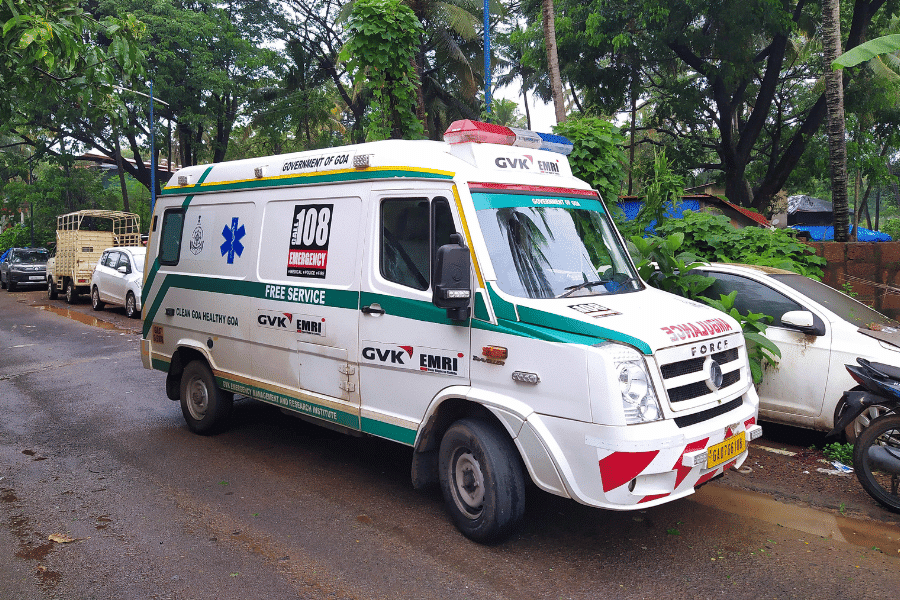
    According to Indian government data, there are a total of 28,250 ambulances across its states and Union Territories such as Jammu and Kashmir. This includes ambulances with advanced medical services and paramedics, vehicles that only transfer patients in non-emergency conditions, even bicycles.

    Meeting international standards

    While international standards recommend one ambulance for every 50,000 population, with one basic life support ambulance or BLS and one advanced cardiac life support ambulance or ACLS per 100,000 population, India has one ACLS ambulance for every five million people — the number in the United States is one per 25,000 population — and one BLS ambulance for every 100,000 people.

    Meanwhile, quality is a more persistent issue than quantity. According to a 2020 study by the All India Institute of Medical Science in Delhi and the National Institution for Transforming India, 90% of ambulances lacked essential medical equipment and 95% were operated by untrained professionals.

    “The corruption and deterioration of the service, coupled with a lack of infrastructure to provide adequate emergency referral systems, has created a vacuum that has invited private players to reframe this as a business opportunity,” Ramesh said.

    That’s why, he said, it makes sense for Blinkit to fill that hole. They recognized that the current system doesn’t meet the demand for reliable ambulance service in case of medical and surgical emergencies and realized they could develop a service to cater to those with the means to pay for it.

    Singhvi believes there are lessons to be learned from Blinkit’s efficiency. “They’ve hired trained paramedics, optimized logistics and used technology effectively,” Singhvi said. “Public systems could adapt these strategies to improve accessibility and response times.”

    Profits and regulations

    Ramesh said that with the current public infrastructure in shambles, he only hopes that the private ambulance companies run this service ethically and that there isn’t a monopoly that will allow them to charge unreasonable rates.

    But Gayatri does not offer them the benefit of the doubt. “Blinkit is a private company and private companies operate on the principle of making a profit,” she said. “It is unreasonable to expect that they will function in a way that keeps the welfare of the people in mind.”

    Gayatri believes that the gap is intentional. It is because of lobbying by the private sector that has made the public sector reluctant to invest in strengthening its health systems. Good regulatory oversight from the government, could prevent private companies from charging too much, but Ramesh is not optimistic it will happen.

    “Even if robust regulations are formulated and a law is enacted, does the government have the capacity to enforce it?” he said. “Regulations have not been successful in the health sector.”

    Instead, Ramesh said that the emergence of private ambulance services should be seen as a wake-up call to the government to strengthen public sector ambulance services.

    Ramesh acknowledges that Blinkit fills a need. But ultimately, while Blinkit’s initiative may cater to a small, affluent population segment, it underscores the urgent need to address the systemic inadequacies plaguing public healthcare.

    “If they provide equitable, high-quality service at a fair price, without bias toward certain hospitals, they could complement existing healthcare services,” he said. “But private models inherently exclude the poor. In a country where universal health care isn’t prioritized, do people have an alternative?”


    Questions to consider:

    1. What are the concerns some people have over private ambulance services?

    2. How can a government ensure that an ambulance service won’t gouge people in need?

    3. Do you know how to call for an ambulance and do you know how long it might take to reach you if you needed one?


    Source link

  • Many Kids Aren’t Ready for School Before Age 5. So Why Do They Have to Go Anyway? – The 74

    Many Kids Aren’t Ready for School Before Age 5. So Why Do They Have to Go Anyway? – The 74


    Get stories like this delivered straight to your inbox. Sign up for The 74 Newsletter

    This summer, Washington, D.C., parents were notified that they’d no longer be able to hold their child back from starting kindergarten if the student turned 5 years old before Sept. 30. Previously, the decision on so-called redshirting had been left up to families, with advice from pediatricians and child psychologists.

    In New York City, America’s largest school district, the birthday cut-off is even later: Dec. 31. One-third of children are required to begin kindergarten prior to turning 5. This is a cause of concern for many families.

    The city Department of Education doesn’t see it as a problem. In an email, a spokesperson told me its official stance is, “We work to provide all families access to a world-class education, and we work closely with families to ensure students’ placements are academically and developmentally appropriate, in alignment with state guidelines. Our policies allow for flexibility, our kindergarten curriculum is responsive to the needs of our younger learners, and our dedicated educators are prepared to support every student.”

    Not all are appeased.

    “I have a 4-year-old who will start kindergarten this fall but doesn’t turn 5 until after Thanksgiving,” worried mom CK told me. “I think it’s a big disservice to these kids. The amount of sitting isn’t developmentally appropriate, and the lack of free play is concerning.”

    Parents are justified in their concerns. As the Child Mind Institute summarized in June:

    Several studies have concluded that kids who are youngest in their class are disproportionately diagnosed with ADHD. A Michigan study found that kindergartners who are the youngest in their grade are 60% more likely to be diagnosed with ADHD than the oldest in their grade. And it doesn’t affect just kindergarteners: A North Carolina study found that in fifth and eighth grade, the youngest children were almost twice as likely as the oldest to be prescribed medication for ADHD.

    The research didn’t sit well with some teachers. One blasted my social media inquiry seeking views on redshirting by writing, “ADHD is a very serious IEP (Individualized Education Plan) and we don’t hand them out like candy.”

    Others, however, agreed.

    “My daughter was one of the youngest in her class,” wrote an anonymous mother. “The teacher and school counselor mislabeled her with psychological disorders that both NY special education testing and private neurological tests did not support.”

    “More of my students with an IEP have a birthday in the second half of the calendar year,” confirmed Mary C., who has been a special ed teacher for 12 years. “I understand where an incoming K parent would be concerned that their December baby is much younger than a June baby.”

    That was the case with Upper West Side parent KE’s son. “He is the youngest and smallest boy in the grade,” she wrote. “He started kindergarten at 4 years old, still sucking his thumb. The physical, emotional, social, psychological and other developmental differences between a 5-year-old born in January and a 4-year-old born in December impacts everything from holding a pencil to kicking a ball, to the length of time one can sit and concentrate. It was too early, too soon and too young, but we literally had no choice in the matter in order to enroll him.”

    The problems that pop up with younger students can reverberate beyond elementary school.

    Pree Kaur lamented that her daughter “is always the younger one and is not as mentally developed as her peers, so she always feels as if something is wrong with her.”

    The Riverdale dad of a son born in November wrote, “He had some difficulty following his teacher’s instructions in first grade, and his teacher repeatedly pointed out that he has difficulty sitting still, staying focused, etc. We had him evaluated by a pediatric developmental specialist and he was diagnosed with ADHD. I really struggle with the whole situation, as I believe if we were able to get him to go to school a year later, matters may have been different.”

    “My daughter attended a citywide gifted program. She was doing great, but it came with a price,” confessed Annie Tate. “She was high-functioning until high school, where she was overwhelmed and was diagnosed with ADHD, a diagnosis I believe she wouldn’t have received if I didn’t send her to school at 4 years, 8 months. She would have matured emotionally and physically to be a healthier, happier child.”

    Pediatric occupational therapist KJL sees this situation frequently: “Children with ADHD have a 30% delay in executive function compared to their peers. Combine that with young ages, and these children are set up to fail.”

    When I posed the question of allowing parents to hold back their children on my mailing list, the most frequent response I received was, “SOMEONE has to be the youngest.”

    That’s true. But the situation can still be ameliorated.

    Grades with multiple classes can be broken up into three- or four-month bands, so students are learning with a narrower-aged peer group.

    Repeating a year should be a more acceptable option, unlike the situation faced by mom Heather Hooks: “My son was very behind academically in first grade. The school refused to hold him back and cited studies on ‘retention’ being not good for kids in the long run. I found these didn’t take into consideration that this was not straight retention, but redshirting an ADHD kid. Other studies were significantly different, and suggested these kids have better outcomes and are less likely to be medicated.”

    Another mom was told her daughter “wasn’t behind enough,” despite the child’s pleas that “it’s too much for my head.”

    Any steps taken to help New York City’s youngest learners would provide the largest experimental sample size in the country, making those results potentially beneficial for students across America.

    Based on what happens in NYC, the educational system can stop treating children as developmentally identical and schools as one-size-fits-all, giving families more options.

    As Maureen Yusuf-Morales, who has worked at public, charter and independent schools, suggests, “Parents with children born after September should be allowed choice with guidance based on developmental milestones, as opposed to birthdays being the only hard-and-fast rule.”


    Get stories like these delivered straight to your inbox. Sign up for The 74 Newsletter

    Source link

  • Leading in complexity: Are higher education leaders ready for the age of austerity?

    Leading in complexity: Are higher education leaders ready for the age of austerity?

    by Robert Perich, Ladina Rageth, Danya He and Maryna Lakhno

    Higher education is at a crossroads. Across Europe and beyond, higher education institutions (HEIs) face increasing financial constraints, shifting political landscapes, and the growing challenge of digital transformation. In this turbulent environment, leadership is not just about managing institutions – it is about navigating uncertainty and ensuring that HEIs remain resilient, innovative, and globally competitive.

    Yet, are higher education leaders equipped for this challenge? A recent Swiss national study of senior leaders (detailed findings are available here) provides a reality check. Our study, the first of its kind in Switzerland, examined the career trajectories, competency sets, and strategic concerns of 312 leaders from 38 institutions. What it uncovered was both revealing and troubling: senior leaders felt largely unprepared for the mounting financial and structural pressures facing higher education.

    HEIs are no longer just institutions of knowledge – they are complex organisations requiring financial stewardship, strategic foresight, and the ability to manage significant institutional change. And yet, many senior leaders step into their roles with little to no formal management training. In a period where every budget decision can mean the difference between institutional sustainability and decline, this skills gap is more than an inconvenience – it is a challenge.

    Who runs Swiss HEIs today?

    The study reveals a leadership demographic that is surprisingly homogeneous. Despite years of diversity initiatives, Swiss HEI leadership remains overwhelmingly male (68%) and Swiss (80%). The average senior leader is in their mid-50s, has spent nearly 14 years at their institution, and was more likely than not promoted from within. Internal hires outnumber external appointments (55% vs 45%), and critically, almost 40% of senior leaders entered their positions without prior general management experience.

    This reliance on internal promotion, while preserving institutional knowledge, raises an uncomfortable question: Are HEIs prioritising academic credentials and institutional loyalty over strategic and managerial competence? As budget cuts tighten and HEIs are forced to make hard choices, is it enough for leaders to understand academic culture, or must they also master the art of institutional strategy and financial sustainability?

    The gap: what competencies do leaders need – and what are they lacking?

    Swiss HEIs, like their counterparts worldwide, are complex ecosystems requiring a balance of academic credibility and managerial acumen. Yet, when surveyed, senior leaders overwhelmingly ranked leadership and strategic design capabilities as the most essential competencies, both of which require years of cultivation. They also emphasised managing organisational change, a competency that will become even more critical as institutions face increasing financial pressures and demands for efficiency.

    The study highlights a concerning discrepancy between the skills leaders find most important and those in which they feel prepared. Many respondents wished they had received more targeted training in financial management, change leadership, and navigating the political landscape of higher education. Given that nearly half of respondents had never participated in formal leadership training before assuming their roles, it is clear that HEIs have largely relied on a ‘learn on the job’ approach to leadership development.

    The perils of academic self-governance

    One of the study’s most compelling findings is the tension between traditional academic self-governance and the need for growing professionalisation of higher education leadership. Research universities, in particular, still operate on a model where deans and department heads rotate through leadership roles while maintaining their academic careers. While this system ensures academic legitimacy, it creates discontinuity and limits long-term strategic vision.

    By contrast, universities of applied sciences, where leadership positions are more commonly filled through open application processes, exhibit a different pattern: leaders tend to have more professional experience and stronger management backgrounds. This divergence begs an essential question: Is the tradition of academic self-governance still fit for purpose in an era that demands more decisive, financially savvy and agile leadership?

    Budget cuts and the leadership challenge ahead

    Financial sustainability is now the defining challenge of higher education leadership. The study underscores that senior leaders see budget constraints as the most pressing issue their institutions face, followed closely by digital transformation and the rising demand for research excellence and collaboration. While leaders anticipate increasing demands in these areas over the next decade, many institutions lack systematic training programmes to equip their leaders for these challenges. The findings suggest that without structured leadership development – particularly in financial strategy, political negotiation, and crisis management – HEIs risk falling into reactive rather than proactive decision-making.

    Rethinking leadership development in higher education

    The data from Swiss HEIs mirror trends seen globally: while the challenges facing HEIs have evolved dramatically, leadership preparation has remained largely static. The fact that nearly 40% of leaders entered their roles with no formal management experience is a stark indicator that institutions must do more to develop leadership talent early in academic careers.

    Structured executive education programmes, mentorship initiatives, and cross-institutional leadership networks are critical. The study also raises the question of whether Switzerland – and other countries – should consider national leadership training programmes, similar to those in the Netherlands and Sweden, to systematically equip future leaders with the skills they need.

    Indeed, other countries have already taken significant steps in this direction. For instance, the UK has developed a comprehensive suite of leadership development programmes through Advance HE, targeting leaders at various career stages across the higher education sector. Such initiatives provide a valuable model for how leadership can be systematically cultivated, and they underscore the importance of moving beyond ad hoc, institution-specific training efforts.

    The future of higher education leadership: a critical juncture

    HEIs are facing a defining moment. Financial constraints, political pressures, and the complexities of global education demand leaders who are not just respected scholars but also strategic visionaries. The findings from our study highlight the urgent need for HEIs to rethink how they identify, train, and support their leaders. Will higher education rise to this challenge? Or will institutions continue to rely on traditional models of leadership selection, hoping that academic merits alone will make their leaders fit for the complexities ahead?

    Prof Dr Robert Perich is Academic Director, Swiss School of Public Governance SSPG, D-MTEC, ETH Zurich. He was CFO of ETH Zurich for 20 years and, as Vice President for Finance and Controlling, was responsible for financial strategy, budget management, asset management, risk management and the digitalisation of central processes. After completing his studies and doctorate at the University of St. Gallen (HSG), he gained 12 years of experience in various management roles at a major Swiss bank. In addition to earlier teaching activities at the University of St. Gallen, he currently lectures at D-MTEC and the University of Zurich (CHESS). He is also Deputy Chairman of the University Council of the University of Cologne.

    Dr Ladina Rageth is Executive Director, Swiss School of Public Governance SSPG, D-MTEC, ETH Zurich. She is a social scientist with extensive experience in research and project management in the academic, public and private sectors. She completed her Master’s degree in Sociology at the University of Zurich and her PhD at ETH Zurich at the Chair of Educational Systems. Her research focuses on the sociology of education, labour market outcomes and the institutionalisation of education systems, with a current emphasis on the functioning and management of HEIs.

    Danya He is Research Assistant, Swiss School of Public Governance SSPG, D-MTEC, ETH Zurich. She completed her Masters in Media and Communication Governance at the London School of Economics and Political Science (LSE) and worked as a research and teaching associate at the University of Zurich specialising in media and internet governance before joining the SSPG. She brings a wealth of experience in public institutions, media relations and legal affairs and has been recognised for her achievements in educational simulations such as the National Model United Nations.

    Dr Maryna Lakhno is the Programme Coordinator at the ETH Swiss School of Public Governance (SSPG), where she manages the school’s continuing education portfolio and oversees its communication. Maryna also contributes to the design of the curriculum and programme activities and is actively involved in research projects within the school. Her doctorate in Public Policy under the Yehuda Elkana Doctoral Fellowship at Central European University in Vienna focused on integrating the United Nations Sustainable Development Goals within higher education. She was awarded the Swiss Government Excellence Scholarship for Foreign Scholars in 2022/23. She co-authored a comprehensive report for the Global Observatory on Academic Freedom.

    Author: SRHE News Blog

    An international learned society, concerned with supporting research and researchers into Higher Education

    Source link