Last January, Alana Lewis felt an all-too-familiar dread as the Santa Ana winds tore through the tents above the playground at her home-based day care.
Little did she know, those winds weren’t just a harbinger of fire—they marked the beginning of a crisis that would leave lasting scars on her Altadena community.
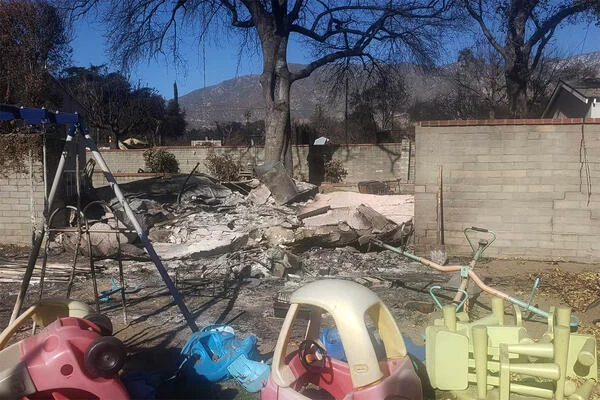
She watched in disbelief as the Eaton Fire raged through California’s San Gabriel Mountains, creeping close to the outdoor slide and toys in her yard, which she would later find melted into the artificial grass.
As fire sirens blared and acrid smoke filled her home, Lewis evacuated, helplessly watching nearby homes and child-care sites like hers go up in flames.
“I hate that it happened, but I thank God that it wasn’t in the daytime,” said Lewis, founder of Auntie Lana’s Daycare. “I thank God that when the fire did hit, it was at night when the children were already home safe.”
Today, on the one-year anniversary of the blaze, it’s clear the fire wasn’t just an environmental disaster; it upended the everyday rhythms of life for Lewis and many other child-care providers across Los Angeles.
Nearly 60 percent of licensed child-care sites in Altadena were damaged or destroyed, according to data from the Pasadena Community Foundation.
“Everything outside was completely destroyed, demolished and unrecognizable,” said Lewis, adding that the condition inside her home was no better. “The soot from the fire was so thick that when you walked on the carpet, it would get underneath and inside your tennis shoes.”
Lewis spent months living in hotels and with family as she repaired her home, discarding furniture and salvaging what little remained from a shed that once housed art materials, bikes, toys and other equipment for her day-care charges.
Although initial emergency subsidies helped Lewis and other child-care providers for 30 days after the fire, she says she felt abandoned and neglected as she continued to face mounting out-of-pocket costs.
Relief came when Lewis received a $45,000 grant from Pacific Oaks College, allowing her to reopen her day care in early July.
The Pasadena-based college, in partnership with the Pasadena Community Foundation and Save the Children, distributed about $2 million to 43 child-care sites affected by the Eaton Fire. Grants ranged from $900 to $45,000, helping providers like Lewis rebuild and continue serving families.
“It helped a lot of providers who were stressed out,” Lewis said, noting that the loss of income prevented many from paying rent and that some were denied small business loans.
Breeda McGrath, president of Pacific Oaks College, said she recognized early on that child-care providers were suffering and mobilized to find donors.
McGrath said the decision to support them came naturally, given the college’s roots as a preschool in the 1940s and its evolution by the late 1950s into a four-year institution known for its work in early childhood education and teacher training.
“The identity of Pacific Oaks College over the years … has been focused on social justice, equity and diversity,” McGrath said. “So if we are not at the table to help rebuild and sustain early childhood education in our area, then we’re forgetting who we are.”
She sent a formal proposal to the Pasadena Community Foundation requesting $1.3 million to help child-care providers rebuild or secure new leases, pay staff, replace lost materials, and provide tuition support for families.
Within two days, the philanthropic organization that funds nonprofits and community initiatives in the greater Pasadena area agreed to support the effort.
McGrath later secured an additional $800,000 from Save the Children, a nonprofit that provides health, education and emergency aid to support children’s rights and well-being.
“This is our responsibility as a true community leader,” she said. “If we believe in teacher preparation, if we believe in supporting children, this is part of what you do.”
Pacific Oaks Steps In: In the immediate aftermath of the fire, Pacific Oaks College served as a hub for local child-care providers seeking air purifiers, diapers and other essentials.
McGrath said this was critical because, although the Pasadena Convention Center operated as the main coordination and distribution site, it proved difficult for some child-care providers to access the specific supplies they needed.
Breeda McGrath (first photo, left) joins Pacific Oaks College staff and student workers in helping child-care providers stock up on critical items.
She said Pacific Oaks College not only served as a hub, but also provided the “human power” of its staff and students—many of whom are training to become early childhood educators themselves.
McGrath said higher education institutions play a unique role in disaster recovery, particularly in supporting and preparing the next generation of educators.
“I believe in the long-term investment that higher education makes in a community,” McGrath said, noting that many child-care providers in the area studied at Pacific Oaks College.
“So educating early childhood providers about the best ways to build strong community relationships, run their businesses, care for children and access opportunities for continued learning—that’s where we can contribute our knowledge,” she said.
One year later, McGrath said long-term recovery is top of mind as the community works to rebuild its child-care system and support students training to become early childhood educators.
“If you look at the destruction, the rebuilding process takes a lot of time, effort and energy,” McGrath said. “Not just in terms of the insurance process, but also how long it takes to decide what it means to return—or what it means not to return.”
Auntie Lana’s Daycare: For more than 13 years, Lewis has run her Altadena-based day care for children from infancy through age 12, many of whom are enrolled in Pasadena Unified elementary schools.
The district serves about 15,000 students, the majority Black and Latino, with more than 70 percent socioeconomically disadvantaged. During the Eaton Fire, five schools were destroyed or severely damaged, including Eliot Arts Magnet, Edison Elementary, Loma Alta Elementary, Noyes Elementary and Franklin Elementary.
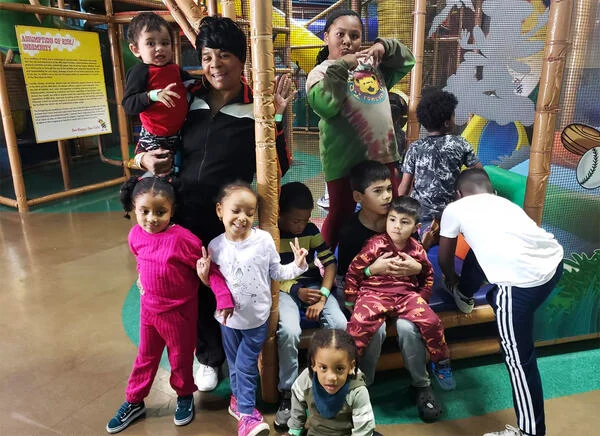
Lewis on a field trip with children from her Altadena-based day care.
Lewis said most of the children she cares for are Black and Latino, come from low-income families, and were directly affected by the fire, including three who lost their homes.
She added that some of the children had attended elementary schools destroyed by the fire and were displaced to other schools in Pasadena. That grief only deepened when they returned to their beloved day care and saw what had been lost.
“When the kids came back and saw that the things they played with were gone, you could see the look in their eyes—the disbelief,” Lewis said. “This will be with them forever.”

Some of Lewis’s charges work on a group project in her indoor play area.
McGrath said Altadena’s diverse history makes the loss of child-care providers especially profound.
“Over the years, families in Altadena have built strength and, across generations, a deep history in the community,” McGrath said. “A history of moving toward justice—a history of being a community that recognizes everyone’s desire to succeed and everyone’s right to earn a living wage.”
She said child-care providers are deeply woven into that history, often serving multiple generations of the same families and anchoring stability for working parents. That stability, McGrath added, is critical for college students—particularly student parents, who rely on child care to stay enrolled.
“To lose your day-care provider when you’re in those very vulnerable, sensitive stages of life is really destabilizing,” McGrath said. “That was a powerful loss—not just to families, but to long-held homes and to generational wealth that was deeply affected and destroyed.”
Lewis agreed, adding that child-care providers are often overlooked in conversations about disaster recovery and economic stability.
“As child-care providers, the role we play in the economy is extremely important,” Lewis said. “We help people go to work. We help mothers and fathers who are still in school. We have parents and grandparents who need their children cared for in a safe, quality learning environment.”
Lewis said her experience after the fire underscored just how essential—and vulnerable—the child-care sector is during times of crisis.
“We’re providing care to children who will run our economy someday,” Lewis said. “If we can come to the table and find a better solution, that would be awesome.”
Get more content like this directly to your inbox. Subscribe here.