

While the Trump administration has painted a bleak picture of the higher education sector as a costly enterprise that burdens taxpayers and pushes leftist ideologies, new survey data shows that most Americans—regardless of their political leanings—still value it.
“Increasingly, higher ed is being cast as elite, expensive and not connected with everyday Americans,” said Sophie Nguyen, senior policy manager with the higher education team at New America, the left-leaning think tank that published its annual Varying Degrees survey on Wednesday. “There’s a significant disconnect in the narrative about what higher ed is” and how it’s perceived.
Capturing the American public’s views on the purpose of higher education drove many of the questions Nguyen and her colleagues asked 1,631 respondents in March for the ninth iteration of the survey.
After reaching a low point last year, the data shows that satisfaction with higher education is on the rise: 40 percent of respondents—including 42 percent of both Republicans and Democrats—reported that higher education is “fine as it is,” compared to 36 percent who said the same last year.
“We see a lot of alignment between Democrats and Republicans, something we haven’t heard a lot about,” Nguyen said, describing such data points as “the common ground” colleges can tap into when defending their worth to both consumers and lawmakers.
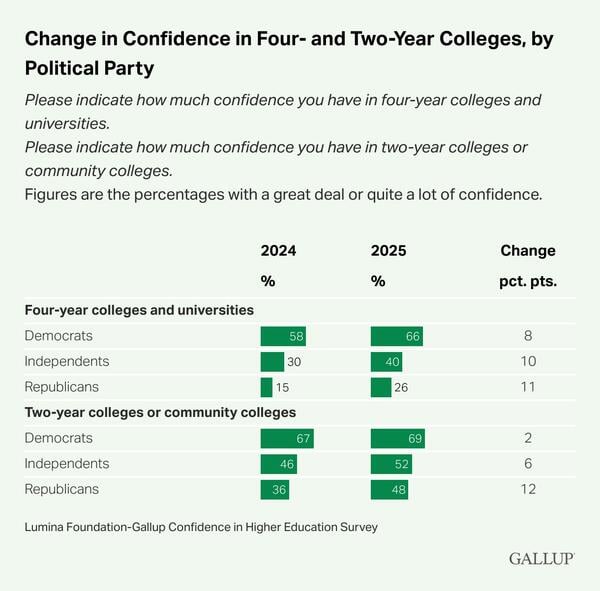
New America’s findings are in line with a poll Gallup also released Wednesday in partnership with the Lumina Foundation, which shows that 42 percent of Americans surveyed said they have a “great deal” or “quite a lot” of confidence in higher education, compared to a low of 36 percent in 2024 and 2023—though it’s still far from the nearly 60 percent confidence peak in 2015. The share of people who reported “very little” or no confidence is also on the decline, falling from 32 percent last year to 23 percent this year. Although Democrats reported much higher confidence in higher education institutions, Republican confidence in both four- and two-year colleges rose by 11 and 12 percentage points, respectively, compared to last year.
Respondents cited the economic and social benefits of higher education, its standing at the forefront of innovation, the quality of education and training—both for jobs and exposure to different viewpoints—as drivers of the uptick in their confidence.
The Trump administration’s war on higher ed may have played a role, said Courtney Brown, Lumina’s vice president of impact and planning.
“It is possible that we are seeing people in support of the sector because they see so many attacks,” she said. Whatever the reason, she said the new data is positive, and if institutions want to restore confidence to 2015 levels they should consider “how they can build on this moment and show up for students and ensure they’re getting value.”
Like Gallup’s report, New America’s survey revealed partisan divides as well as agreements. Sixty percent of Republicans said colleges are having a negative impact on the country, while 75 percent of Democrats said they’re having a positive impact. But respondents from both parties were much more aligned on questions about specific aspects of higher ed’s value and purpose.
While Republican lawmakers pressure universities into proving their return on investment, the vast majority of Americans, including both Republicans and Democrats, believe higher education should function as more than a transaction. They say it should not only equip students with the skills and knowledge to succeed in their chosen fields (97 percent of Democrats; 98 percent of Republicans), but also help students become informed citizens (97 percent of Democrats; 89 percent of Republicans) and critical thinkers (97 percent of Democrats; 92 percent of Republicans).
“The rhetoric coming from Washington tends to be a caricature of what are some real issues facing college campuses and the sector in general,” Beth Akers, a senior fellow at the right-leaning American Enterprise Institute who focuses on the economics of higher education, said at a media briefing about New America’s survey. While “there’s room for improvement … it’s unfortunate that the rhetoric is empowering misinformation about what institutions are doing.”
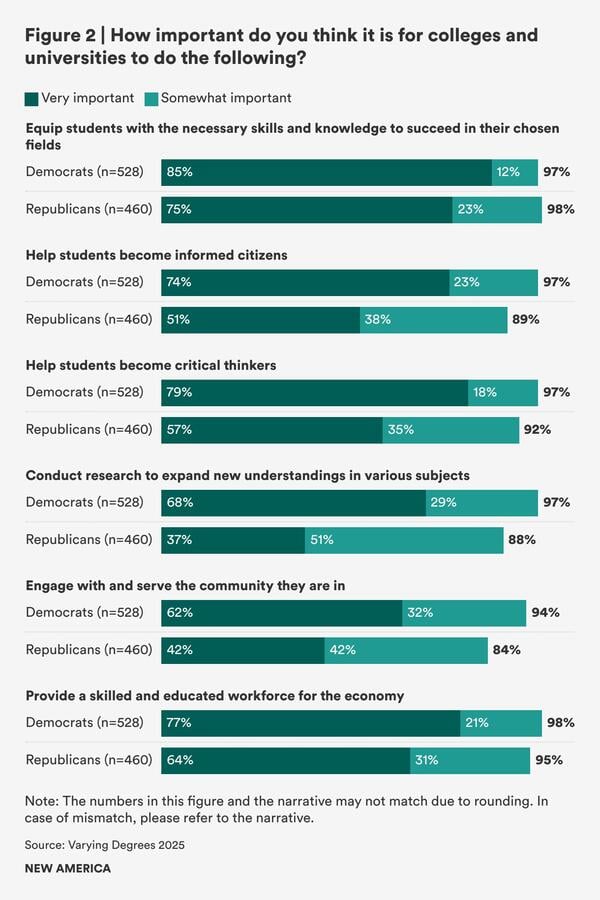
Even as Trump and his political allies move to dramatically cut federal funding for university research—which advocates say will devastate university budgets, local economies and progress toward lifesaving research—88 percent of Republicans and 97 percent of Democrats believe it’s important to some degree that colleges and universities conduct research to expand understanding in various subjects.
Despite political rhetoric that suggests otherwise, American higher education has delivered an array of personal and societal benefits for decades, Lynn Pasquerella, president of the American Association of Colleges and Universities, said during a news briefing on the report.
“Higher ed continues to be the single most powerful socioeconomic catalyst in America, which is associated not only with higher earnings, but longer productive lives, better physical and mental health, resilience, adaptability, and personal development and fulfillment,” she said. “At the societal level, education drives long-term economic growth for local communities and the nation.”
More broadly, it “strengthens our democracy,” because it “tends to mitigate or tame authoritarian tendencies” and “reduces individuals’ sensitivities to potential triggers by providing them with psychological protection in the form of self-esteem, personal security and autonomy,” she said. “It fosters a moral imagination—imagining what it’s like to be in the shoes of another, different from oneself—and interpersonal trust.”
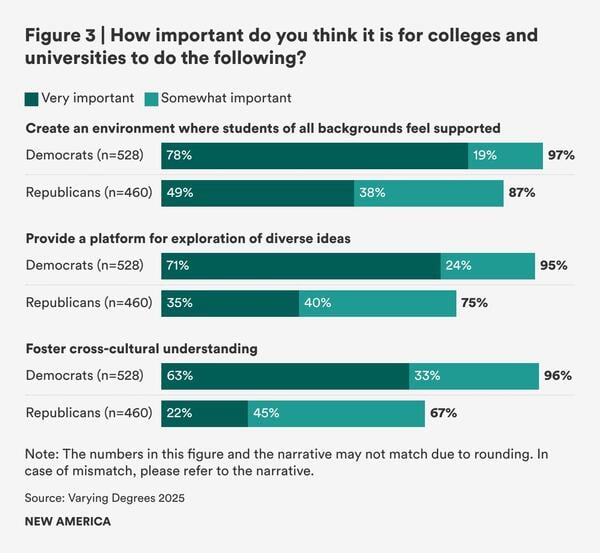
Despite the Trump administration and its allies’ attacks on diversity, equity and inclusion initiatives, the survey data shows that an overwhelming majority of Republicans and Democrats agree that higher education should create an environment where students of all backgrounds feel supported, provide a platform for exploration of diverse ideas and foster cross-cultural understanding.
Although New America’s survey suggests that most Americans recognize the layered value of higher education, Republican lawmakers have increasingly focused on both controlling the subjects colleges can teach and research and making it harder for students and colleges to access federal funding.
The sweeping policy bill Trump signed into law earlier this month requires colleges to show that their graduates earn more than an adult with only a high school diploma or risk losing access to federal loans. Trump has also proposed billions of dollars in cuts to education funding, including eliminating all federal support for college-access programs that have long helped low-income, first-generation and students with disabilities navigate higher education.
While Republicans and Democrats are divided on who they think should be primarily responsible for paying for college—76 percent of Democrats believe the government should; 67 percent of Republicans believe students should—respondents from both parties cited cost as the single biggest barrier to enrolling in or finishing college.
At the same time, 75 percent of respondents over all (91 percent of Democrats and 58 percent of Republicans) said the federal government should spend more on making college more affordable.
Hironao Okahana, vice president and executive director of the Education Futures Lab at the American Council on Education, said this data offers a ray of optimism for the higher education sector navigating an onslaught of partisan attacks from Republican policymakers.
“The public is seeing higher education as a sector beyond some of the sound bites we’re hearing,” he said. “They’re seeing that it has more nuance and texture, and that there’s not just one way higher education can contribute to society.”


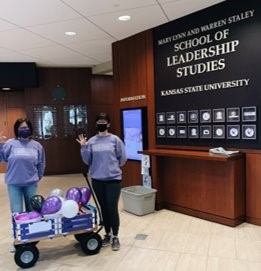 The Braggin’ Wagon was developed by K-State’s Staley School of Leadership, which has a strong partnership with HR. The decorative travelling wagon is filled with treats, candy, small toys and other fun items for the receiving team to enjoy. Once the wagon is delivered to a department, it is up to that department to restock the wagon and deliver it to another department in order to keep the recognition going.
 “When K-State resumed in-person work, it was important to put the emphasis on our employees and the solid work they were doing to make a difference. The Braggin’ Wagon was a way for departments to recognize other university partners who contributed to their work in a positive way,” says Shanna Legleiter, associate vice president of human capital services at K-State.