When the UK government unveiled its immigration white paper in May, my first reaction was simple: “A step in the right direction.”
Buried among the many proposals, five key policy reforms stood out for their potential to reshape international student recruitment for UK universities. The headline-grabber on social media was the shortening of the Graduate Route from 24 months to 18 months. But, truth be told, that’s not the change keeping universities awake at night.
The real shake-up comes from the Basic Compliance Assessment (BCA) reforms, expected to roll out in September 2025, which will prove especially tough for smaller universities.
What’s changing?
From next year, UK universities sponsoring international students will face much stricter BCA benchmarks:
Visa success rate: At least 95% of students issued a CAS must obtain their visa (up from 90%).
Enrolment rate: Of those, 95% must enrol on their course (up from 90%).
Completion rate: At least 90% must complete the course (up from 85%).
On paper, these increases might look like small percentage rises. In practice, they’re a gamechanger.
Why this is big
For years, many universities in the UK, both modern and traditional alike, have operated just above the current BCA thresholds, leaving little leeway for the inevitable drop-outs, deferrals, or visa refusals, especially from high-risk regions such as South Asia and Africa.
According to a recent story published by The PIE, quoting analysis from ApplyBoard’s study on visa refusal rates between Q1 2024 and the same period in 2025, Pakistan, Nepal and Bangladesh saw a notable decline in visa grant rates.
Pakistan’s visa grant rate fell from 82% to 74%, while the other two countries saw even sharper declines: Bangladesh dropped 15 percentage points from 78% to 63%, and Nepal fell by 14 percentage points from 98% to 84% during the same period.
But now, with the bar raised, there’s far less margin for error. To comply, universities will have to halve their visa refusal rate from 10% to 5% and simultaneously boost enrolment and completion rates. That means rethinking recruitment pipelines, especially in regions like South Asia and Africa, where volumes are high but visa risks can be significant.
The good news, though, is that some of the biggest countries in high-risk regions, such as India, Nigeria and Ghana, have seen a marginal increase in visa grant rates, providing a sigh of relief for universities heavily recruiting from these countries.
Why smaller universities are nervous
Large universities enjoy a buffer. Recruit 10,000 international students in an intake, and a 5% refusal rate gives you room for up to 500 refusals before you breach the threshold.
Small universities, however, don’t have that luxury. If you enrol fewer than 100 international students, even a handful of refusals could push you into the danger zone. This forces smaller institutions to be extremely selective, tightening quality control on applications and perhaps narrowing the recruitment pool altogether.
It’s worth considering whether the MAC and UKVI might allow different levels of flexibility for smaller institutions. Applying the same standards across the board could be unfair, as not all institutions recruit in the same way or at the same scale.
A small, specialist provider in creative or performing arts, for example, will naturally draw fewer students than a comprehensive university offering everything from anthropology to zoology. Even among smaller universities, subject mix matters, as one with business, engineering and computing courses is likely to recruit far more students than another of the same size focused on niche disciplines such as veterinary science or agricultural studies.
The bottom line?
While the Graduate Route change has stolen the spotlight, the new BCA rules may well prove the bigger disruptor. For universities in the UK and recruiters in India and South Asia, September 2025 isn’t far away. The scramble to adapt has already begun.
How the BCA could reshape international recruitment
The impact of these changes will likely be felt in four major ways.
First and foremost, managing recruitment agents will become significantly more crucial. With visa refusal rates coming under intense scrutiny, universities will increasingly demand stricter compliance and accountability from their recruitment partners.
This will likely lead to more thorough vetting processes for agents, more stringent contractual agreements, and widespread implementation of standards such as the Agent Quality Framework (AQF).
Agents with consistently poor performance, particularly those associated with high visa refusal rates, will face swift removal from university-approved lists.
While the exact timeline for these changes is not yet clear, the immigration white paper also suggested the possibility of introducing a public “traffic light” system to display the BCA data of the universities transparently.
It would therefore be reasonable to expect a similar public database for recruitment agents available in the public domain, allowing universities easier access to detailed track records of agencies. This increased transparency will empower institutions to make more informed decisions about which agents to collaborate with.
Second, admissions processes will become more selective. This means deeper scrutiny of financial documents, academic readiness, and genuine study intent before issuing a CAS. Universities may introduce additional pre-CAS interviews, English proficiency re-checks, or even conditional academic bridging programs to ensure higher completion rates.
Selective treatment may be reintroduced as a strategy once again. Historically, many global universities have adopted region-specific recruitment policies, tailoring their approaches to different cities or states within the same country. These variations are often influenced by factors such as past visa approval rates, the academic calibre of students from particular areas, and key market insights.
In a vast and diverse market like India, this approach becomes especially relevant. Universities tend to exercise greater caution when recruiting from certain states compared to others, reflecting the complex demographic, economic, and educational landscape of the country.
This nuanced strategy allows institutions to optimise their recruitment efforts by focusing resources where the chances of success are higher, while managing risks in regions with less favourable indicators.
Finally, market focuscould shift. Institutions heavily reliant on high-risk markets may diversify towards countries with stronger visa success rates, while in South Asia, universities may work more closely with fewer but higher-quality partners. In practice, this might mean fewer students being offered places, but with higher confidence that those who arrive will stay the course.
In essence, the proposed changes to the BCA thresholds signal a fundamental shift in how international student recruitment is approached. Rather than focusing primarily on sheer volume or the quantity of students recruited, the emphasis is moving decisively towards quality, ensuring that students admitted meet higher standards and contribute positively to the university community and the broader educational ecosystem.
This shift challenges universities to rethink their recruitment strategies, prioritising compliance, student success, and sustainable growth over simply hitting numerical targets. For institutions within the prestigious Russell Group as well as others across the sector, the ability to swiftly adapt to these new expectations will be critical.
Those that embrace the change and implement robust quality-focused recruitment processes will be the ones best positioned to maintain strong and healthy intake numbers in the evolving landscape. Ultimately, the future belongs to universities that recognise the importance of quality over quantity and act accordingly.
Unfortunately, it is no secret that the higher education sector has a long way to go when it comes to equity in progression to senior leadership.
While the number of staff from global majority ethnic backgrounds in universities has nearly tripled over the last 20 years (now c. 24 per cent), HESA data shows that still only 3.8 per cent of black academics in the UK hold the title of Professor, and less than one per cent of all professors in the UK are black. Though there has been an incredible 93.8 per cent increase since 2012–13, still only 30.8 per cent of professors in the UK identify as women. There has been real progress, but it has been slow.
Recruitment from the inside
In our position as a consultancy supporting talent development across higher education and wider sectors driven by social purpose, we’re constantly reminded of the barriers faced by global majority candidates in recruitment processes. We see selection bias; we see lack of communication and clarity around promotion criteria; we see challenges in individual confidence and imposter syndrome; we see anxiety around tokenism.
There’s additionally a risk that diversity is becoming less of a priority in these times of financial challenge, when obvious questions around sustainability come to the fore. With many institutions going through restructures and cost-saving exercises, executive boards are under enormous pressure to justify any new appointments and associated expenditure. The ability to lead change, diversify income streams, and drive growth with limited resources are now constant topics in our conversations with candidates for senior roles.
In part due to these pressures, recruitment panels seem increasingly less willing to think widely when appointing to leadership roles. There is often an increased sense of perceived risk when considering candidates from other sectors, overseas, or who would be taking a step up into the role, rather than making a sideways move. As domestic funding challenges worsen, international student numbers continue to decline, and operational costs rise across the sector, there’s understandably often a preference for candidates who have “been there, done that.” This has obvious implications for overall diversity in the sector.
Though there has been some improvement, staff from global majority backgrounds are still disproportionately concentrated in lower-level roles and underrepresented in senior roles across the sector. It is less likely that a candidate from a global majority background will be in a position to make such a sideways move for a senior role. In our search work, we encourage committees to place a greater emphasis on capability and competence, alongside experience, and to consider which essential requirements on the job description might be more flexible than others. We do also see a growing recognition that things have to change and a genuine commitment to strive for greater representation at all levels.
As headhunters, we have to strike a difficult balance between supporting and challenging the organisations we work with, particularly around such questions of equity of opportunity and perceived risk. We are committed to making a difference on a very practical level, and we work closely with clients and candidates to find ways to make our search processes more equitable. We take time in briefings meetings to really get a feel for the culture of each organisation we work with; we advise on the accessibility of recruitment material; and we structure interview processes so candidates can engage with an opportunity and organisation in multiple fora, for example.
There is an inherent limitation to the work that we do as advisors on senior appointment processes, however. Through the lists of candidates we bring together for a role, and the way we support candidates and panels through these processes, we can have a direct impact on the individual and organisation, but we often feel that the most positive impact we can have on the composition of senior teams is through our broader leadership development work.
Insider information
We’ve been involved in the London Higher Global Majority Mentoring Programme for the last few years. In our annual masterclass with the programme’s participants, we discuss practical topics about engaging with opportunities for development and progress including at the level of CVs and cover letters, navigating informal interviews, internal marketing, and LinkedIn. We aim to demystify the recruitment process and help equip them with some tools to help them move into their next leadership positions. These topics are framed in the context of structural barriers to progression facing individuals from marginalised groups, which often hold candidates back from bringing their authentic selves to recruitment processes.
We often hear about candidates’ experience of covering parts of their identities in interviews, feeling imposter syndrome when interviewing with a panel of white senior leaders, and concern around being a “token” on a shortlist.
Several years ago, we developed Aspire, which is a pro-bono programme that supports mid-career professionals from global majority ethnic backgrounds as they work to move into senior leadership positions. The programme runs over six months and explores themes such authenticity and leadership profiles alongside practical approaches to promotion and recruitment. The programme aims to create a space in which participants can share their lived experience and create a community of practice as they look for their next role.
Launched last year, Board Prospects pairs individuals from historically under-represented groups with non-executive boards. The participants join the board without voting rights for a year, before being appointed as full members.
Participants across the programmes we work on have reported promotions, external job offers and more – though it is of course impossible to determine exactly how much the specific programme contributed to this success. The most significant impact reported is often the networks created through the sessions, and the sense of empowerment which can develop from a space in which experiences, support, and advice are shared safely. We’ve seen research collaborations, invitations to conferences and more emerge from these communities of practice.
Our involvement in the Global Majority Mentoring Programme, and our work on our own leadership development programmes, is valuable in helping us shape our executive search work to be as inclusive and equitable as possible. We’ve learnt (and continue to learn) a huge amount from the programmes and their participants. Through hearing about participants’ lived experiences of career progression, we learn more about where we can provide the best support for development, and how we might advise clients on the “sticking points” in recruitment processes which can be especially limiting or off-putting to individuals from underrepresented groups.
We also recognise that recruiting diverse talent is just one step in building inclusive and equitable organisations. Creating an environment in which staff from marginalised groups can thrive and progress requires a much more holistic approach that seeks to fundamentally change working cultures. Our work with individual institutions, such as the LEAP into Leadership Programme with the University of Greenwich, in which a group of mid-career delegates from global majority ethnic backgrounds are formally paired with a senior sponsor within the institution, has also stressed to us the need to acknowledge and engage with structural barriers and allyship at all levels of an institution if we are to ever meaningfully break down barriers to senior leadership.
While recognising the huge amount of work that still needs to be done, and the ever-growing challenges facing universities across the UK, we’re hopeful that collaborative schemes like the Global Majority Mentoring Programme, alongside a commitment to challenging and adapting recruitment processes, can ultimately have a real impact in creating more diverse leadership teams which better reflect society and are best equipped to deal with sector challenges.
This article is one of four exploring London Higher’s Global Majority Mentoring Programme – you can find the others here.
Following publication of our joint GS/HEPI reporting into vice-chancellor recruitment and a vibrant LinkedIn debate, the complex dynamics shaping leadership in the sector have been brought to light. The conversation reveals a sector at a crossroads, wrestling with tradition and transformation.
Insider vs. Outsider: Who Should Lead?
Should vice-chancellors come from within academia or be recruited from other sectors? Out-of-sector candidates can bring a fresh perspective on leading change and challenging the status quo. Inside sector candidates offer deep cultural understanding, academic credibility, and governance experience. Many argue for a hybrid model and leaders who can bridge both worlds.
The CEO-ification of the VC Role
Today’s vice-chancellors are expected to be more than academic figureheads. They must be visionary strategists, financially astute operators, and empathetic people leaders. But, much more is needed to nurture leadership development pipelines with, perhaps, a reappraisal required of the very many leadership development programmes that exist already.
Diversity and Inclusion: Still a Distant Goal
Leadership in higher education remains homogenous. There remains a pressing need to broaden the pool, not just in terms of gender and ethnicity, but also professional and disciplinary backgrounds. Scepticism, especially in research-intensive institutions, about whether university leaders without academic credibility should lead universities persists. Valuing potential over pedigree could unlock untapped leadership talent.
Culture, Metrics, and Mission
Effective leadership in universities demands cultural intelligence and emotional literacy. Metrics like rankings and KPIs, while useful, often fail to capture the true impact of leadership. A more holistic, context-specific approach is needed; one that honours the civic and educational purpose of universities.
Collective Leadership and Cross-Sector Learning
Leadership should not and cannot rest on one individual. Distributed models featuring diverse senior teams and strategic co-leads are gaining traction. Embracing mobility between academia and industry can enrich leadership with fresh insights and mutual respect.
Join the Conversation: Upcoming Webinar
These themes and more will be explored in our upcoming webinar. Whether you’re an academic, policymaker, or sector professional, this is your chance to engage with thought leaders and shape the future of higher education leadership.
In today’s world, where attention spans are short and options are endless, student recruitment has become both an art and a science. Traditional methods (college fairs, brochures, high school visits) still play a role, but they can’t carry the weight alone anymore.
Gen Z expects more. And so do their parents. They want seamless digital experiences, personalized content, and authentic connections. If your institution isn’t delivering those things, you risk losing them to one that does. So, how do you stand out?
Whether you’re just starting to rethink your campus recruitment strategy or looking for new ways to level up, these 10 cutting-edge approaches, plus one powerful bonus, are designed to help you connect more deeply with prospective students and convert that interest into action.
Struggling with enrollment?
Our expert digital marketing services can help you attract and enroll more students!
1. Hyper-Personalize the Student Experience
Here’s the truth: blanket emails and generic web content just don’t cut it anymore.
Students today expect you to know them; their interests, their goals, even where they’re browsing from. That’s where hyper-personalization comes in. Rather than treating your prospects as a monolithic group, modern recruitment strategies for colleges leverage data to deliver one-to-one digital experiences at scale.
How does that look in action?
A high school student interested in business sees a landing page tailored with content about your BComm program, student stories, and upcoming info sessions.
An international applicant is greeted with region-specific admissions guidance and video testimonials from students from their home country.
A user who clicks on a scholarship link gets a follow-up email with a financial aid breakdown.
In short, personalization isn’t a perk. It’s expected.
Example: To personalize outreach at scale, the University of Idaho (U of I) introduced AI-driven personalized videos for interested applicants. Prospects received video messages addressing them by name, hometown, and academic interest.
Source: University of Idaho YouTube
2. Make Mobile a Priority, Not an Afterthought
More than 60% of student interactions with higher education websites now happen on mobile. If your site isn’t easy to navigate on a small screen, you’re likely losing leads by the dozen, especially since 53% of users will abandon a site that takes more than 3 seconds to load.
And it’s not just about having a “responsive” website anymore.
You also need:
Mobile-optimized application forms that are quick and easy to complete
Tap-friendly buttons and layouts that don’t frustrate the user
SMS alerts for key deadlines or virtual event reminders
Even better? Google’s mobile-first indexing means this doesn’t just affect UX, it directly influences your search rankings.
So if mobile optimization isn’t baked into your campus recruitment strategies, it’s time to fix that. Fast.
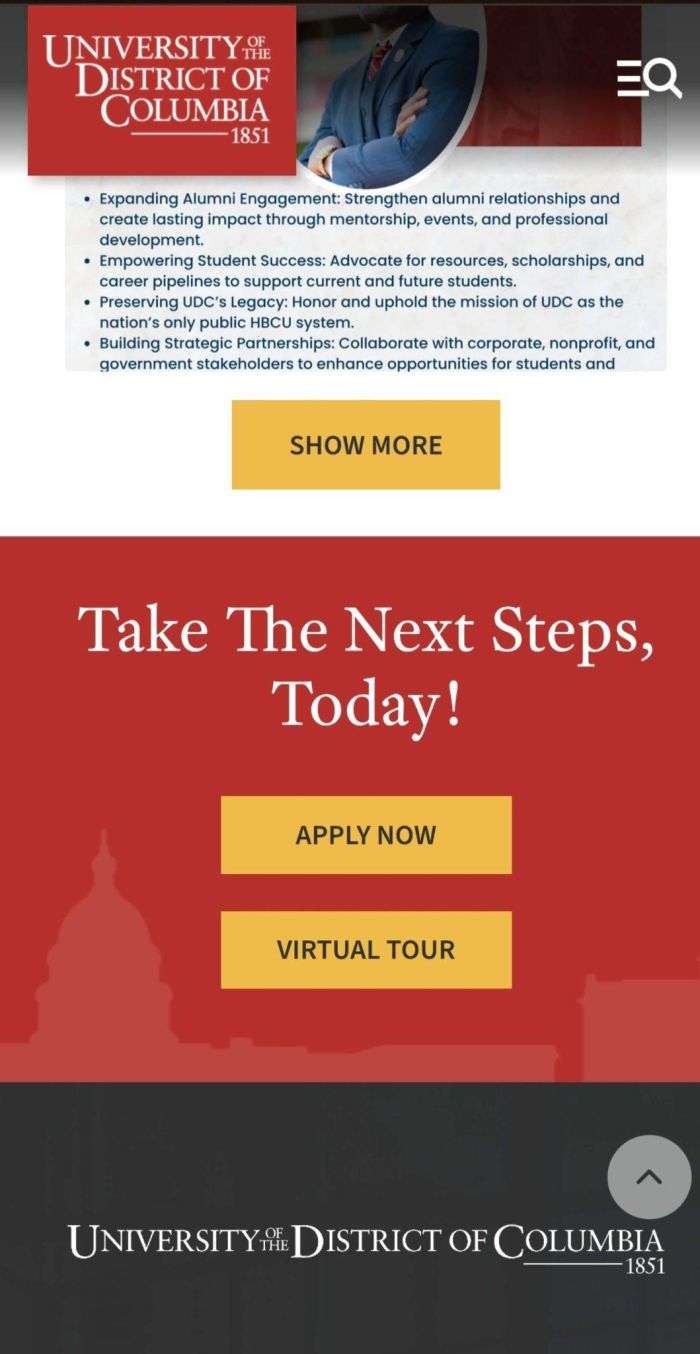
Example: University of the District of Columbia (UDC) launched a newly redesigned, mobile-first website in 2025 to enhance recruitment.
The site features a “mobile-friendly and accessible design” optimized for all devices. This responsive overhaul was part of a strategic initiative “aimed at…enhancing recruitment efforts” and making it easier for prospective students to explore academic programs. By improving navigation, search, and ensuring the site works seamlessly on phones, UDC’s digital entryway better serves today’s mobile-minded applicants.
3. Use Video to Tell Real Stories
Think about the last time you were captivated by a piece of content online. Chances are, it was a video. Video is more than just a nice-to-have. It’s one of the most effective ways to emotionally connect with prospective students and help them see themselves at your school.
Today’s students have grown up on YouTube, Instagram, and TikTok, and video content reigns supreme. Video accounts for over 80% of global internet traffic, and roughly 75% of video viewing now happens on mobile devices (aligning with Gen Z’s phone-first habits).
A recent guide on education video marketing noted that compelling videos can communicate complex ideas in seconds and resonate emotionally, which is why Gen Z “responds favorably to videos that are authentic, visually appealing, and emotionally resonant”.
Additionally, social algorithms favor video content, meaning your school’s videos are more likely to surface in feeds. With 80% of prospective students reporting that campus videos (tours, student stories, etc.) influenced their perception of a school, it’s clear that storytelling through video is no longer optional; it’s essential for recruitment success.
From quick TikToks to polished campus tours, the format you choose should match your audience and your message.
What works well?
Virtual tours for international students who can’t visit in person
Day-in-the-life vlogs from current students
Candid interviews with faculty or alumni
Instagram Reels that highlight clubs, campus life, or student events
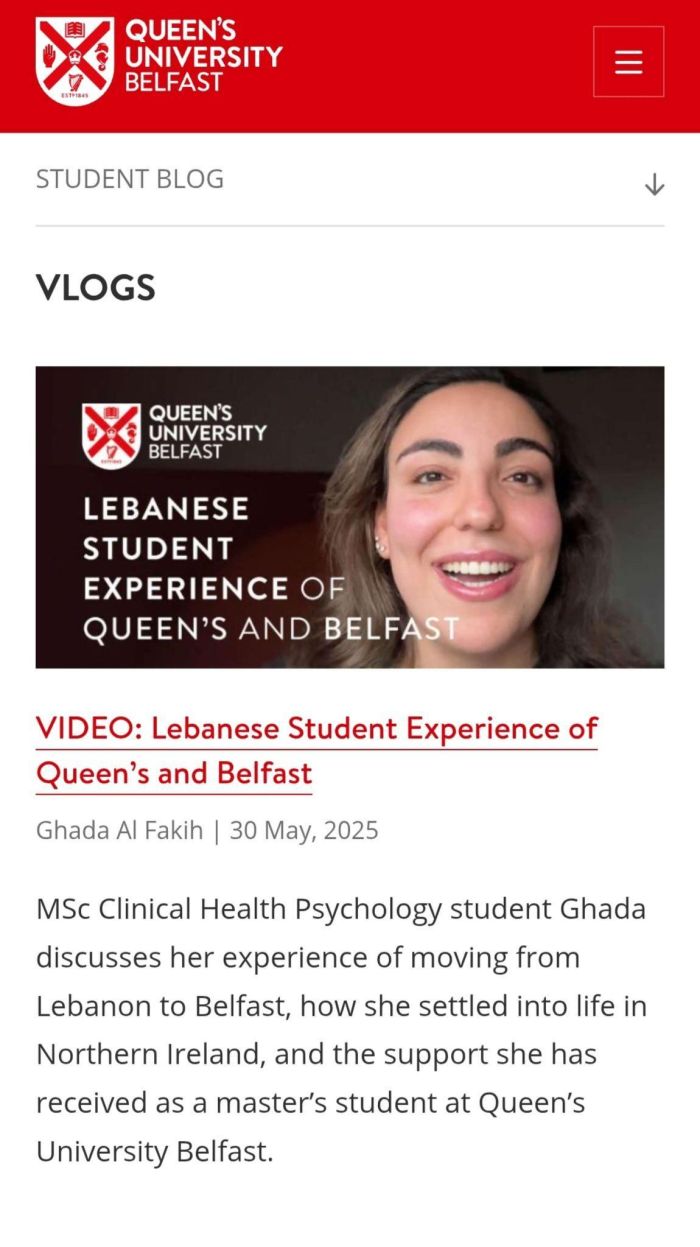
Example: Queen’s University Belfast’sofficial student blog features a dedicated “Vlogs” section where current students share their experiences via video.
These student-created videos range from day-in-the-life stories to campus tours and tips for new students. By showcasing real student life through vlogs, Queen’s gives prospective students an authentic, relatable window into the university experience.
4. Empower Student Ambassadors to Speak for You
No offense, but students trust other students more than they trust your marketing team.
That’s why student ambassadors are one of the most powerful (and underutilized) assets in your recruitment toolkit.
With just a little structure and support, they can:
Run TikTok takeovers during orientation week
Host live AMAs on Instagram about life at your school
Create vlogs or blog posts about their journeys
It’s authentic, it’s relatable, and it builds the kind of peer-driven trust that polished brochures never could. Best of all? Gen Z prefers real voices over institutional polish. So give them a platform and watch your reach expand.
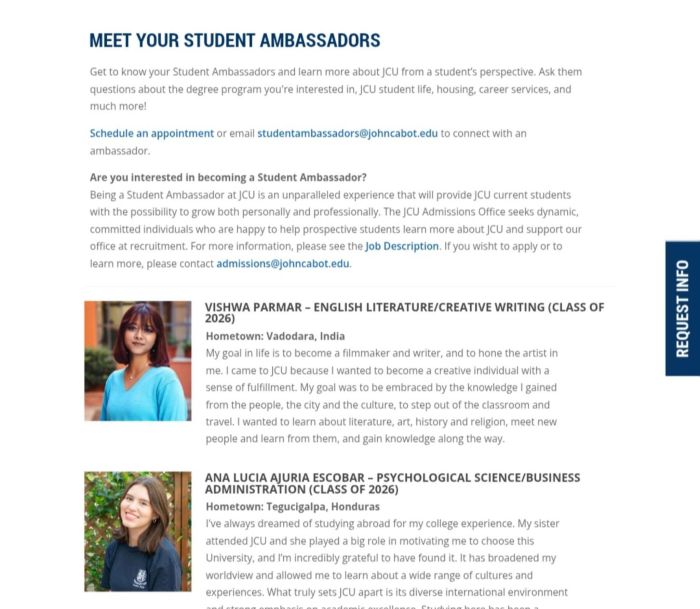
Example: John Cabot University (JCU) runs a robust Student Ambassador program that puts current students front and center in recruitment.
These ambassadors, hailing from around the world, actively engage with prospects through social media takeovers, Q&As, and one-on-one chats. JCU’s admissions website even features profiles and contact info for each student ambassador, inviting prospects to reach out directly.
5. Invest in SEO and Content That Answers Real Questions
You can’t enroll students who don’t know you exist. That’s where search engine optimization (SEO) and content marketing come in. When students start Googling “best film schools in Canada” or “how to get a student visa for the U.S.,” your institution should be right there with helpful, relevant answers.
Some essentials that build a strong foundation:
Blog posts that answer FAQs on tuition, housing, or programs
Program pages with embedded video, alumni outcomes, and clear CTAs
Long-tail keywords like “how to apply for nursing school in Ontario” that attract motivated searchers
Higher Education Marketing (HEM) helps clients rank on page one of Google for high-converting keywords, turning organic traffic into an ongoing stream of qualified leads.
And unlike paid ads, the impact of good SEO keeps compounding.
Example: Medix College attracts prospects by publishing a steady stream of useful, SEO-optimized content related to its healthcare programs. Its official blog functions as a hub of career tips, industry trends, and program insights tailored to prospective students.
By answering common career questions and highlighting emerging fields, Medix organically improves its search visibility. This content marketing strategy attracts web traffic from interested learners and establishes Medix as an authoritative, student-centric institution, leading to more inquiries and applications driven by informative content, rather than just ads.
6. Use CRM and Data Tools to Nurture Leads at Scale
Managing hundreds or thousands of prospective students without a proper system in place is a recipe for missed opportunities.
A CRM (Customer Relationship Management system) does more than just store contact info. It helps you track where students are in the funnel, personalize your outreach, and automate time-consuming tasks like follow-up emails or event reminders.
With the right CRM, you can:
Score leads based on engagement levels
Trigger personalized email or SMS messages based on behavior
Track ROI on every campaign or event
HEM’s CRM solutions are built specifically for higher ed, so you can identify, engage, and convert prospects without the guesswork.
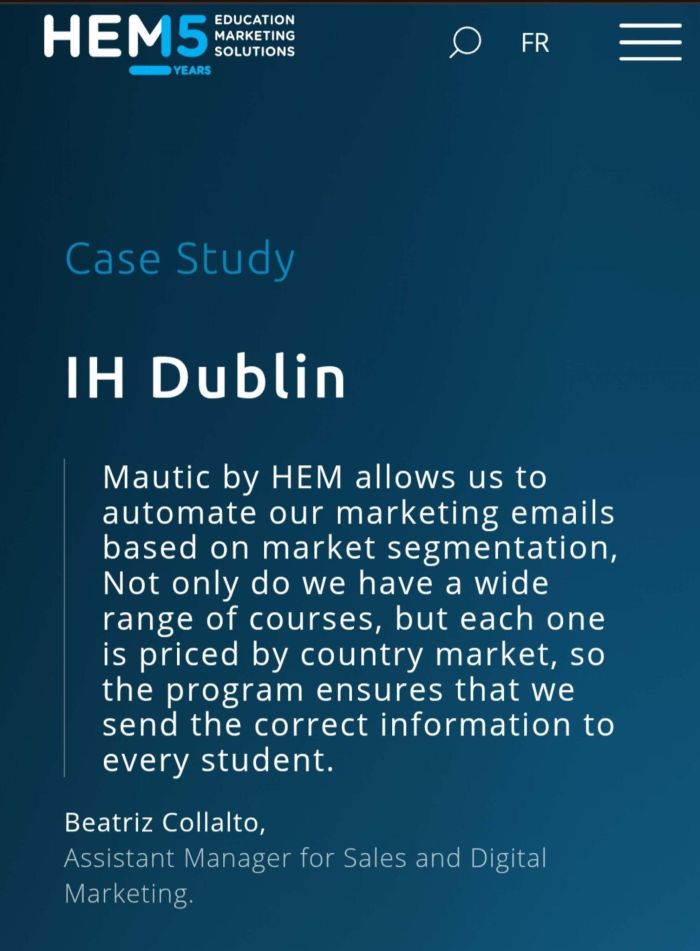
Example: IH Dublin implemented a customized CRM (Mautic by HEM) to automate and personalize its student recruitment communications, using market segmentation to ensure each prospective student receives course information tailored to their specific needs. This strategic CRM implementation streamlined lead management by automatically capturing inquiries and communications, saving staff countless hours and allowing them to focus on high-quality, individualized interactions with students.
By integrating web inquiry forms, social media, and email campaign data into one system, the school gained a comprehensive view of each prospect and leveraged these analytics insights to refine outreach strategies, improving the effectiveness of communications and boosting student recruitment conversions.
7. Strengthen Relationships with High Schools and Feeder Institutions
Want to build a pipeline that pays off year after year? Start earlier. By investing in relationships with guidance counselors, feeder schools, and partner institutions, you plant the seeds of trust long before application season.
What helps?
Hosting “College Nights” or virtual info sessions
Offering classroom-ready materials that educators can share
Regular check-ins with guidance counselors to keep your school top of mind
This long-game strategy ensures your name is the first one students hear when they start exploring their options.
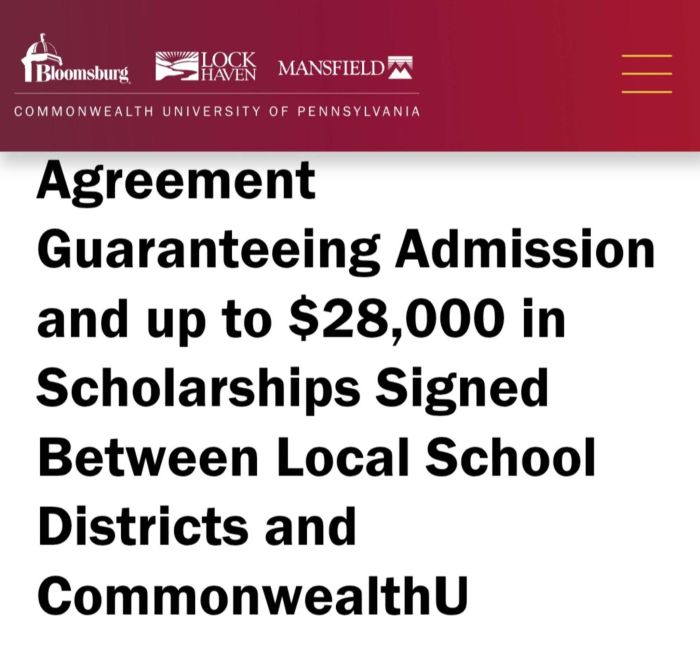
Example: Formed by the merger of Bloomsburg, Lock Haven, and Mansfield Universities, CommonwealthU has aggressively built feeder relationships in its region. In October 2022, it signed Local Scholar Agreements with 14 high school districts (expanding to 50 districts) in Pennsylvania to create a direct pipeline to its campuses. Under these agreements, any student graduating from a partner high school who meets basic criteria is guaranteed admission and up to $28,000 in scholarships to CommonwealthU.
Most application processes aren’t exactly thrilling. But what if they could be fun? That’s where gamification comes in. Adding interactive, game-like elements to your recruitment process can boost engagement and make your institution stand out. Ideas to try:
A quiz like “Which Degree Matches Your Personality?”
A digital scavenger hunt during virtual open houses
Points or prizes for completing milestones (like submitting an application or attending an event)
The result? More engagement, longer site visits, and a more memorable brand experience.
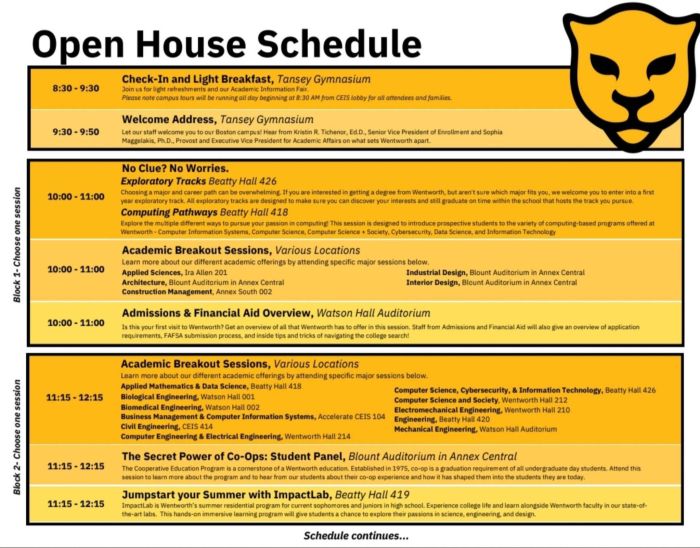
Example: To make campus visits and online events more engaging, Wentworth Institute of Technology (WIT) uses gamification elements in recruitment. For example, during a recent Open House, Wentworth organized a campus-wide scavenger hunt for visiting prospective students.
Attendees were challenged to explore campus and snap photos of specific “hidden” items or locations, then show an admissions staff member to collect a prize. This fun competition had students actively interacting with the campus environment. Wentworth also partnered with the ZeeMee app (a social platform for admitted students) to host virtual scavenger hunts and trivia nights for incoming freshmen, turning the admissions process into a game.
9. Remove Friction From the Application Process
What are the 7 steps of the recruitment process? They are planning, strategy, development, strategies, sourcing, screening, interviewing, selecting, and onboarding. Of these seven steps, the selection process is arguably the most crucial.
You’ve piqued their interest. Now don’t lose them at the finish line.
One of the biggest conversion killers? Complicated, outdated, or buggy application systems.
Here’s how to clean it up:
Make sure students can save their progress and come back later
Allow autofill using Google or LinkedIn accounts
Offer live chat support for real-time help
Automate gentle reminders for those who haven’t finished applying
The easier the process, the higher the completion rate. It’s that simple.
Example: A common trend in streamlining has been colleges joining the Common App or other unified platforms. This is because a simplified, one-stop application lowers the effort for students applying to multiple schools.
In this example, USI joins the Common Application, enabling students to apply to USI alongside multiple schools with one form. USI’s enrollment team notes that the Common App’s mobile-friendly interface and consolidation of application tasks meet students’ expectations for simplicity. Additionally, USI uses an online status portal where applicants can see missing items and upcoming steps at a glance, reducing back-and-forth emails.
10. Localize Your International Recruitment Strategy
Going global isn’t just about translation; it’s about cultural connection. To truly succeed in international markets, your recruitment approach needs to feel local, not foreign. That means:
Translating core content into key languages
Showcasing alumni from the same regions
Using familiar platforms like WeChat or WhatsApp to communicate
HEM specializes in multilingual campaigns that drive results across borders. Because when students see themselves represented, they’re more likely to say “yes.”
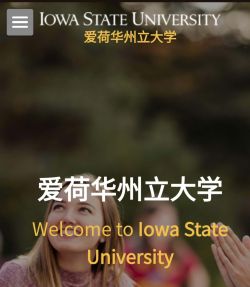
Example: To grow its Chinese student enrollment, Iowa State University invested in a heavily localized recruitment strategy for China. The university launched a fully localizedChinese-language website to engage students and parents in China on their terms. The site was hosted on a .cn domain for fast local loading and optimized for mobile, featuring ISU’s branding but with content written in Simplified Chinese.
Crucially, ISU didn’t just translate admissions info; it adapted content to address what Chinese families value (e.g., program outcomes, safety, career opportunities) and made navigation intuitive for that audience. In tandem, Iowa State ramped up its presence on Chinese social media: it ran an official WeChat account for one-to-one engagement and a verified Weibo account (China’s Twitter) for broader outreach.
BONUS: Align Marketing and Admissions
Too often, colleges treat marketing and admissions like separate silos. Be sure not to make this mistake.
Your recruitment strategy is only as strong as the connection between these two teams. When marketing generates leads but admissions isn’t looped in (or vice versa), those leads slip through the cracks. Here’s how to tighten things up:
Use shared dashboards so both teams see the same data
Hold weekly check-ins to align on goals, campaigns, and challenges
Make sure your CRM offers visibility and collaboration tools across departments
This alignment doesn’t just make your internal process smoother, it makes the entire student experience feel seamless.
Common Mistakes to Avoid
Even strong strategies can be weakened by a few missteps. Watch out for these:
Neglecting follow-up: Students expect timely responses. Delays kill momentum.
Generic messaging: One-size-fits-all language turns students off. Speak to their specific needs.
Skipping analytics: If you’re not tracking what works, how will you improve?
Fix these gaps, and your recruitment strategies for colleges will be far more effective.
HEM: Your Partner in Enrollment Success
At Higher Education Marketing, we’ve spent over a decade helping colleges and universities level up their recruitment.
We offer:
SEO and content strategy to boost visibility
CRM solutions to nurture leads efficiently
Paid ad campaigns across Google, Meta, and international platforms
Custom dashboards to track ROI and make data-informed decisions
No matter your goals, whether domestic growth, international expansion, or brand visibility. HEM is here to help you meet (and exceed) them.
Final Thoughts
The landscape of student recruitment is shifting, and fast. But that’s not something to fear. It’s an opportunity. Which is the best method for effective recruitment? A balanced mix of digital personalization and relationship-building tends to drive the best results.
By embracing data, technology, storytelling, and personalization, you can create a recruitment strategy that not only works but resonates. So here’s the real question: Are you ready to lead the way? Because the future belongs to the schools that adapt, connect, and engage with intention. Let’s build that future together.
Struggling with enrollment?
Our expert digital marketing services can help you attract and enroll more students!
Frequently Asked Questions
Question: What are the 7 steps of the recruitment process?
Answer: They are planning, strategy, development, strategies, sourcing, screening, interviewing, selecting, and onboarding.
Question: Which is the best method for effective recruitment?
Answer: A balanced mix of digital personalization and relationship-building tends to drive the best results.
Let’s be real: college planning is not the only thing on your prospective students’ minds. They’re juggling school, jobs, relationships, social media, and, you know, just trying to figure out life. So, when we talk about AI in college planning, it’s crucial to remember that it’s just one piece of a much larger puzzle.
At RNL, we’re constantly looking at the trends shaping higher education, and AI is definitely a big one. But here’s the thing: it’s not a one-size-fits-all solution. To truly connect with students, you need to understand how they’re using (or not using) these tools, and meet them where they are.
It’s all about personas
Our latest research dives deep into student attitudes toward AI in college planning, and the results are fascinating. We’ve identified four key “AI Adoption Personas” that can help you tailor your outreach and messaging:
Pioneers (early adopters, enthusiastic users): These digital natives are all-in on AI, using it for everything from college research to essay writing.
Key takeaway: Pioneers are already on board but value human guidance. 76% would feel more comfortable if a school advisor explained the benefits and risks of AI.
Aspirers (interested but cautious adopters): Aspirers see the potential of AI but need a little nudge.
Key takeaway: Show them the value! 51% are motivated by easy access to free AI tools, and 41% want to see success stories from other students.
Fence Sitters (uncertain, passive users): These students are on the fence about AI, often lacking confidence in their current college planning approach. Y
Key takeaway: Don’t overwhelm them. 40% haven’t even used online college planning tools! Focus on highlighting the potential of AI and offering advisor support.
Resistors (skeptical, avoid AI in college planning): Resistors are the most reluctant to embrace AI, preferring traditional methods like guidance counselors and college websites.
Key takeaway: Respect their preferences, but don’t write them off entirely. 48% would feel more comfortable with an advisor explaining AI, even if they’re not ready to use it themselves.
Beyond the bots: human connection still matters
No matter which persona your students fall into, one thing is clear: human connection still matters. While AI can provide valuable information and streamline certain tasks, it can’t replace the empathy, guidance, and personalized support students crave.
Think about it: choosing a college is a huge life decision, and students want to feel understood and supported throughout the process.
Our research shows that students use a variety of resources for college planning, and these often involve human interaction:
College websites (often reviewed with parents or counselors)
Parents/family (a trusted source of advice and support)
Social media (connecting with current students and alumni)
Guidance counselors (providing expert advice and personalized recommendations)
Friends/peers (sharing experiences and offering encouragement)
Books/online articles (supplementing their knowledge and exploring different options)
AI is just one tool in their toolbox. It’s a powerful tool, no doubt, but it works best when it complements these other resources, rather than replacing them.
What does this mean for you?
It means your staff—admissions counselors, enrollment specialists, and marketing team—are more important than ever. They are the human face of your institution, who can build relationships with prospective students, answer their questions, and alleviate their anxieties.
The good news is that institutions already know this. Our 2025 Marketing Practices For Undergraduate Students Report confirms that “human-based” enrollment strategies are consistently rated highly effective, often more effective than just two years ago.
For example, the report shows that:
In-person meetings remain a top strategy across all institution types (4-year private, 4-year public, and 2-year), with effectiveness ratings consistently at or near 100%.
Personalized videos sent directly to students have seen a significant rise in effectiveness, particularly for 4-year institutions.
Even with the rise of digital tools, strategies like SMS, social media, and email communications remain foundational and highly effective, largely because they enable personalized, one-on-one communication.
These findings underscore that in an increasingly digital world, the human touch truly sets institutions apart.
Here are a few ways to bring that human touch to your college planning efforts:
Invest in training for your staff. Ensure they understand AI’s benefits and limitations, and how to integrate it ethically and effectively into their work.
Encourage personalized communication. Don’t rely solely on automated emails and chatbots. Encourage your staff to contact students individually, offering tailored advice and support.
Create opportunities for connection. Host virtual or in-person events where students meet current students, faculty, and staff.
Highlight the human stories. Share stories of successful alumni, dedicated faculty, and supportive staff. Show prospective students what makes your institution unique.
Ultimately, success in today’s ever-evolving higher education landscape hinges on a delicate balance: embracing the power of technology like AI while never losing sight of the fundamental importance of human connection.
By deeply understanding your students – their individual needs, their preferred college planning resources, and their unique “AI Adoption Persona” – and leveraging data to personalize their experience, you can create an effective and genuinely human recruitment and enrollment strategy.
It’s about blending the efficiency of AI with the empathy and guidance that only your dedicated staff can provide, ensuring that every student feels seen, supported, and confident in their college journey.
Ready to dive deeper?
Do you want to learn more about AI in college planning and how to connect with today’s students?
European governments have sought to bolster their universities’ efforts to recruit international researchers, amid signs that an expected exodus in U.S.-based scholars is beginning.
On April 23, Norway’s education ministry announced the creation of a $9.6 million initiative, designed by the Research Council of Norway, to “make it easier to recruit experienced researchers from other countries.”
While the program will be open to researchers worldwide, the ministry said, research and higher education minister Sigrun Aasland suggested in a statement that the recruitment of U.S.-based scholars was of particular interest.
“Academic freedom is under pressure in the U.S., and it is an unpredictable position for many researchers in what has been the world’s leading knowledge nation for many decades,” Aasland said. “We have had close dialogue with the Norwegian knowledge communities and my Nordic colleagues about developments.
“It has been important for me to find good measures that we can put in place quickly, and therefore I have tasked the Research Council with prioritizing schemes that we can implement within a short time.”
The first call for proposals will open in May, Research Council chief executive Mari Sundli Tveit stated, with “climate, health, energy and artificial intelligence” among the fields of interest.
Last week, the French ministry of higher education and research launched the Choose France for Science platform, operated by the French National Research Agency. The platform will enable universities and research institutes to submit “projects for hosting international researchers ready to come and settle in Europe” and apply for state co-funding.
Research projects on themes including health, climate and artificial intelligence may receive state funding of “up to 50 percent of the total amount of the project,” the ministry said.
“Around the world, science and research are facing unprecedented threats. In the face of these challenges, France must uphold its position by reaching out to researchers and offering them refuge,” Education Minister Élisabeth Borne said.
The initiative follows efforts from individual French universities to recruit from the U.S.: The University of Toulouse hopes to attract scholars working in the fields of “living organisms and health, climate change [or] transport and energy,” while Paris-Saclay University intends to “launch Ph.D. contracts and fund stays of various durations for American researchers.”
Aix-Marseille University plans to host around 15 American academics through a Safe Place for Science program, announcing last week that almost 300 had applied. “The majority are ‘experienced’ profiles from various universities/institutions of origin: Johns Hopkins, University of Pennsylvania, Columbia, Yale, Stanford,” the university said.
In Spain, meanwhile, Science Minister Diana Morant announced the third round of the ATRAE international recruitment program, with a budget of $153 million, which will run from 2025 to 2027.
The plan, designed to “attract leading scientists to Spain in areas of research with a high social impact, such as climate change, AI and space technologies,” offers scholars an average of $1.13 million to conduct research at a Spanish institution. Successful applicants currently based in the U.S., meanwhile, will receive an additional $226,000 per project.
“We are not only a better country for science, for those researchers who currently reside in our country, but we are also a better country for elite researchers who seek out the productive scientific ecosystem we have in Spain,” Morant said.
Marketing messages bombard students from every direction, so capturing their attention—and inspiring them to take action—requires creative that truly stands out. That’s exactly what the RNL creative team delivers, crafting award-winning campaigns that engage, resonate, and drive results across every channel, from digital to direct mail. We work closely with our campus partners to ensure every undergraduate and graduate campaign is both strategic and impactful—proven by the many gold award-winning projects we’re celebrating this year.Here are 11 that took home gold medals—and one Best of Show—at the 40th annual Educational Advertising Awards.
Illinois College Agribusiness Management |SEO Video (Best of Show)
Video isn’t just eye-catching—it’s a powerful SEO booster that keeps visitors on the page longer to improve search rankings. For this project, we paired SEO-optimized web copy with a compelling long-form video designed to engage skimmers and drive inquiries. Illinois College’s campus team fully embraced the collaboration, delivering stunning unique footage that brought their story to life. The result? A versatile, high-impact asset that drove a 7,000% increase in web page visits. Watch the video.
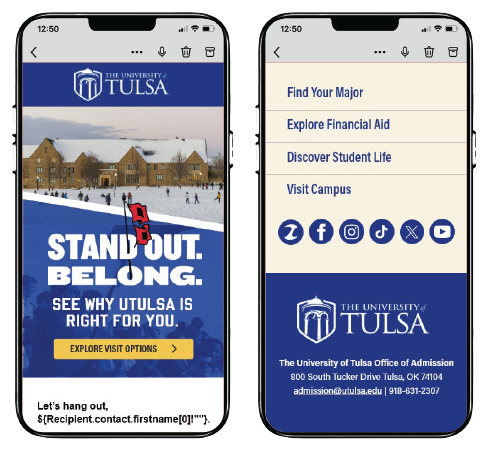
University of Tulsa | Standout Integrated Search Campaign
Reaching high school sophomores and juniors means meeting them where they are—in their inboxes, on their feeds, and in their hands. This multi-channel campaign reinforces the University of Tulsa’s bold message: students don’t have to choose between fitting in and standing out. Rich Art Deco design and conversational copy celebrating personal and academic uniqueness helped elevate brand nationwide while encouraging students to find their fit at UTulsa.
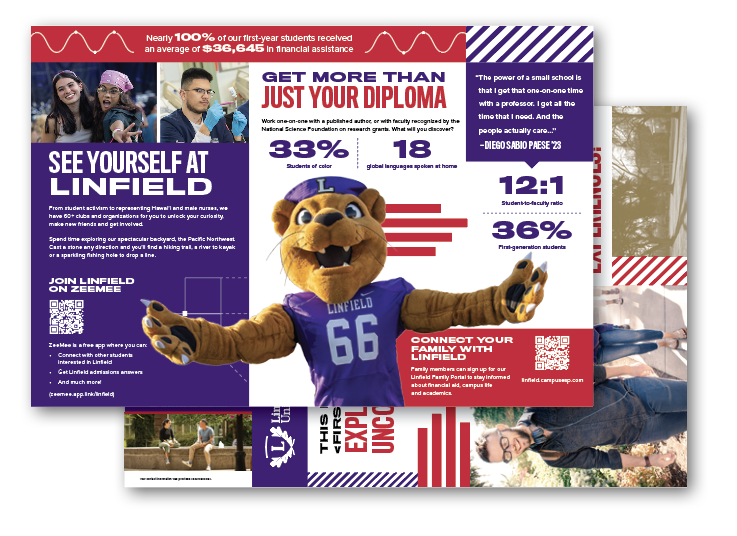
Linfield University | Personalized Applicant Direct Mail
This eye-catching mailer puts Linfield’s bold purple and cardinal branding front and center, using standout stats and a dynamic design to capture attention. Featuring Mack the Wildcat, it reinforces school spirit while guiding students toward their next step—applying with confidence.
American Musical and Dramatic Academy | Dream-Making Applicant Mailer
Designed to attract aspiring performers to perform, create, and wow at campuses in New York and Los Angeles, this high-energy mailer steals the spotlight with bold visuals and dynamic performance imagery. Filled with upbeat performance industry lingo, it sets the stage for students to step into their future—and apply.
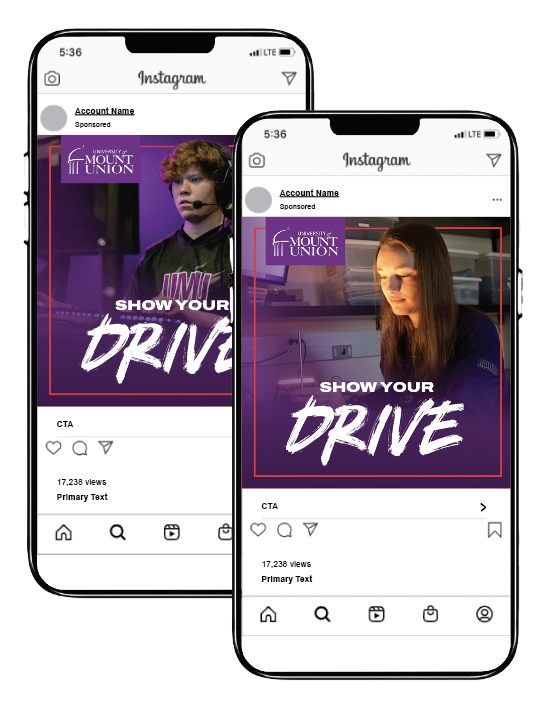
University of Mount Union | Bold, Strong Instagram Ads
These dynamic search campaign ads put real students front and center, showcasing hands-on learning in action. With bold visuals and empowering copy, the campaign encourages prospects to show up strong, seize opportunities, and own their moment—both in college and beyond.
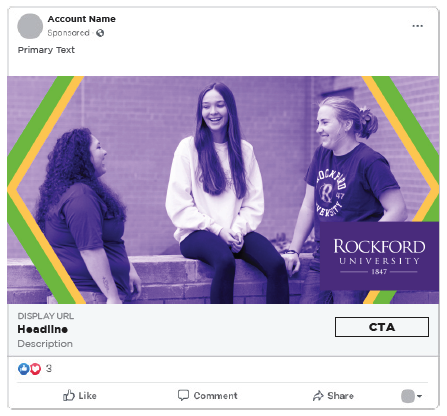
Rockford University | Feed-Stopping Facebook Ads
These bright branded ads grab attention alongside the question “RU Ready?”, sparking curiosity about the welcoming environment and numerous opportunities at “RockU.” The campaign is designed to stand out in feeds and aims to inspire students to see themselves on campus and take the next step toward getting there.
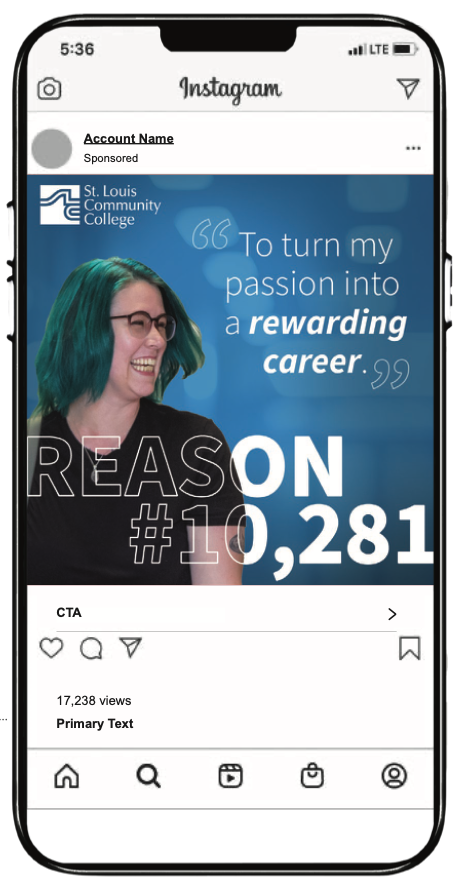
Featuring proud, hopeful, and joyful students, this campaign highlights reasons students choose STLCC to pursue their dreams. The result? Authentic, inspiring ads that encourage prospects to find their reason at STLCC.
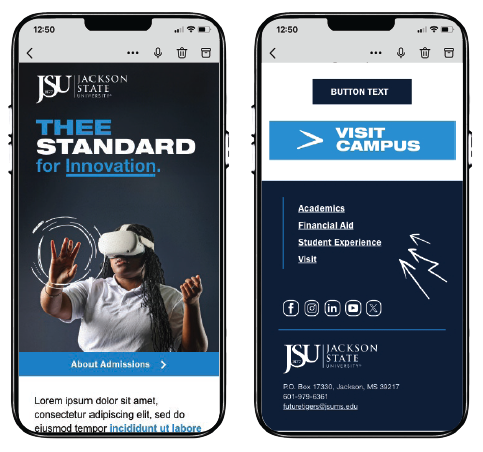
Jackson State University | THEE Standard for Search Campaigns
Inspired by Jackson State University’s iconic fight song, this email campaign set the tone with bold headers inviting prospects to learn more about THEE standard for research, academics, innovation, and success. Playful illustrations drawn over dynamic student portraits bring energy and spirit to every email, reinforcing why JSU is THEE place to be.
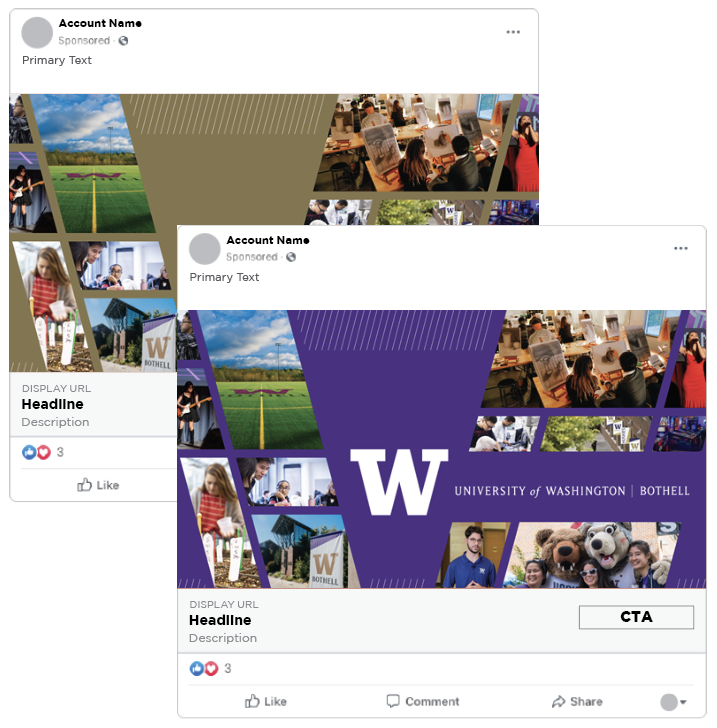
University of Washington Bothell | Find Your Fit Facebook Ads
This dynamic ad brings exciting campus life to the forefront, featuring lively action shots shaped into a bold “W.” Paired with inviting copy, it highlights the University of Washington Bothell’s close-knit community where students find big opportunities, exciting challenges, and lifelong friends.
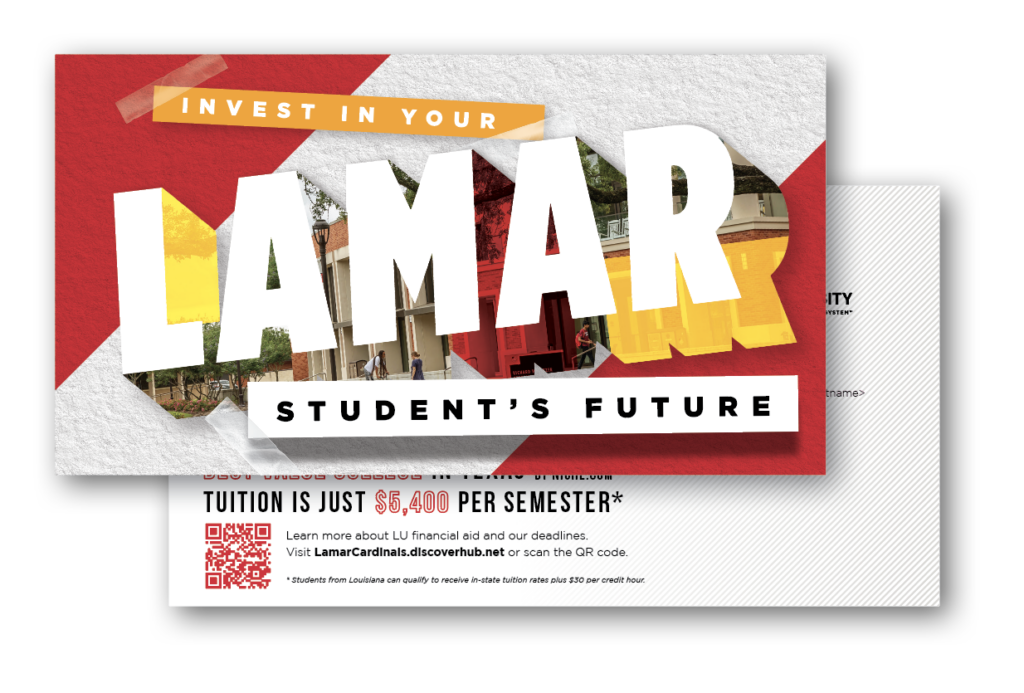
Lamar University | Parent Postcard
This gold award-winning postcard spoke directly to parents, highlighting the $20+ million in aid and low tuition that make Lamar University the best-value college in Texas. A clear, compelling message reassures families that a smart investment today means big opportunities for their student’s future.
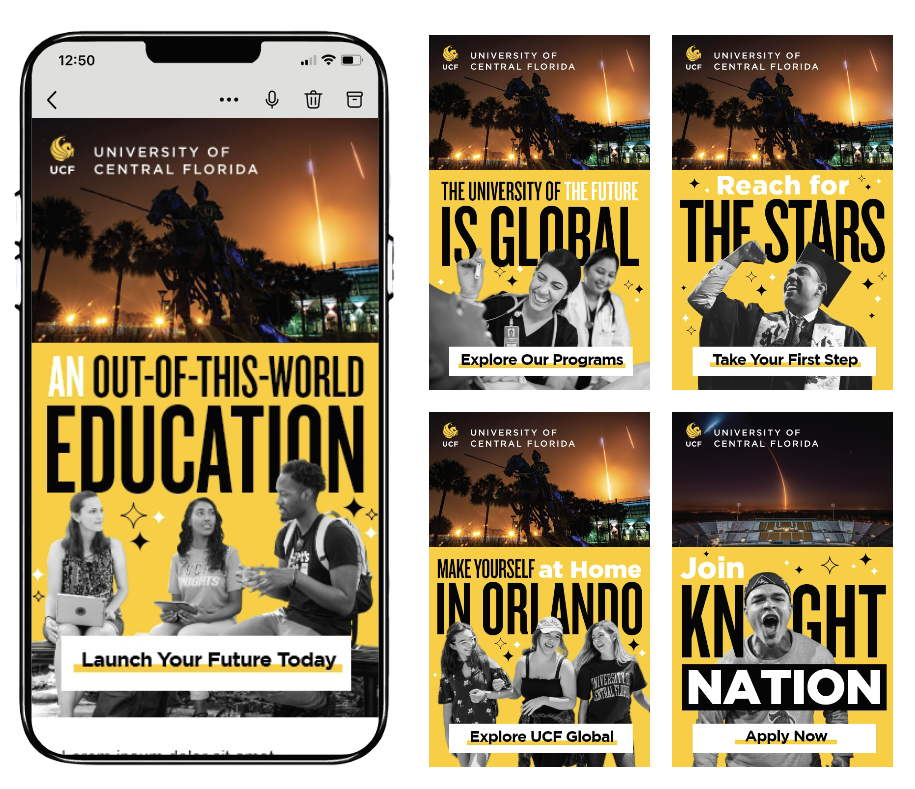
University of Central Florida | Universe of Opportunity Email Series
With a prime location between NASA, the Space Coast, and Orlando’s endless experiences, UCF Global offers a launchpad for limitless possibilities. This inquiry-to-application email flow features stunning nightscape imagery and star-inspired design elements reinforcing the university’s spirit of exploration and innovation.
Create your own winning connections with future students
Want to turn your marketing into an award-worthy success? RNL’s creative team brings strategic insight, compelling storytelling, and a track record of 100+ awards in five years to every campaign. Whether you’re engaging undergraduate, graduate, or online students, we’ll help you stand out and drive results. Let’s talk—schedule a complimentary consultation today.
What’s Working in 2025 (From Both Sides of the Desk)
Ever wonder if enrollment professionals and students actually speak the same language? Fresh data from RNL’s 2025 Marketing and Recruitment Practices for Undergraduate Students and the forthcoming 2025 E-Expectations reports reveal some fascinating alignments (and a few mismatches) between how we recruit and how students actually make decisions.
The human touch still rules (surprise!)
Remember when we thought Zoom would replace campus tours? Well, the data tell a crystal-clear story that shows the importance of face-to-face connections.:
In-person meetings hit 100% effectiveness across all institution types
88% of students who visit campus find it helpful
College fairs are crushing it with 85% helpfulness ratings
Translation: In our AI-everything world, humans still want to talk to actual humans. Revolutionary, right?
Digital sweet spots (when we get it right)
Here’s where it gets interesting. Both students and enrollment leaders agree that digital works best when it’s personal and purposeful.
What’s working:
Mobile-responsive websites: 100% effectiveness at private institutions (but only 77% are using them – make it make sense!)
SMS messaging: 100% effectiveness across the board
Personalized videos: 96% effectiveness when used (but only 49% of private institutions are creating them)
Student connection platforms: Up to 100% effective when used properly
The email plot twist
Breaking news: Students read your emails!
89% engage with college emails
88% find them helpful
96-100% effectiveness rating from institutions
61% either like or expect personalized experiences
The secret sauce? Personalization that doesn’t feel like it came from a robot.
The AI elephant in the room
Some interesting gaps here:
AI chatbots: 74% of students find them helpful (and 68% are using them)
Live chat: 79% helpful (71% usage)
Digital advertising: Up to 100% effectiveness for institutions
Key insight: Students are more open to AI than we think—they just need to know these tools exist.
Your game plan: 3 key takeaways
Keep it human: Those perfect effectiveness ratings on in-person meetings aren’t accidents
Double down on digital personalization: But please, make it authentic
Mind the gaps: Your most effective tools are often your least used (looking at you, personalized videos)
Stop choosing between high-tech and high-touch—you need both. Just make sure your human connection has a mobile-responsive website to back it up. Because some things never change, and some things really, really need to.
Find out more in our reports and even more at the RNL National Conference
Vincenzo Raimo is an independent international higher education consultant and a Visiting Fellow at the University of Reading where he was previously Pro Vice-Chancellor for Global Engagement.
In my recent article for The PIE News, I argued that the financial sustainability of international student recruitment deserves much closer scrutiny. With commissions, scholarships, marketing costs, and operational overheads taken into account, the margins on international enrolment are often far lower than they appear on paper – sometimes even negative.
At a time when the financial health of UK higher education is under intense pressure, it is right that we ask whether international recruitment is really worth it. But this doesn’t mean that every low-margin intake is necessarily a poor strategic decision.
In fact, there are good, sometimes essential, reasons why institutions might pursue or maintain international student recruitment with lower net financial return. But those decisions must be deliberate, transparent, and aligned with broader institutional aims. That’s not always the case.
So how can we assess whether low-margin recruitment is justified?
Here are five scenarios where low net revenue per student might make strategic sense:
1. Filling Capacity or Managing Fixed Costs
For many universities, fixed costs dominate the cost base. If recruiting a marginal cohort of international students helps fill underutilised teaching space or resources, and the marginal cost of teaching them is low, then even a small surplus can help improve the overall financial picture. This is particularly relevant in the context of declining domestic demand in some areas.
2. Maintaining Subject Diversity or Cross-Subsidising Departments
Low-margin international recruitment can sometimes help sustain strategically important but otherwise financially marginal subjects. This may include courses that support the university’s civic role or feed into regional skills needs. Used appropriately, it can help protect the breadth and integrity of an academic offer.
3. Building a Pipeline for Higher-Value Activities
In some cases, international student recruitment may have low margins, but it helps establish relationships that lead to high-value postgraduate, PhD, or alumni outcomes. It may also feed research collaborations, business engagement, or future TNE ventures. But such pipeline logic must be based on more than hope – institutions need to measure conversion, retention, and downstream value.
4. Advancing Strategic Partnerships or Market Development
An institution might accept lower margins to anchor a presence in a high-potential market or strengthen a bilateral partnership with a key international institution, government, or agency. These efforts can open the door to broader collaborations – but again, they require long-term planning and evidence of value beyond headcount.
5. Delivering Mission-Aligned Social or Cultural Impact
Some universities recruit from particular countries or communities not because it delivers high surplus, but because it aligns with their mission: widening access to UK education, supporting development goals, or enhancing campus diversity. These are valid choices – but they must be recognised as such, and the trade-offs clearly understood.
A Checklist: Is Low-Margin Recruitment Worth It?
To support institutions in making informed decisions, I’ve developed the following tool – a series of guiding questions to assess whether low-margin recruitment routes or cohorts align with institutional strategy.
This is not a tick-box exercise. Rather, it’s a framework to prompt a more strategic, evidence-based approach to planning.
The Danger of Denial
The real issue isn’t low-margin recruitment as such – it’s unexamined recruitment. Too often, institutions recruit internationally based on historic patterns, copying what others are doing or perceived opportunity, without fully evaluating cost, risk, or alignment with institutional strengths.
As pressures continue to mount, universities need to treat international recruitment with the same rigour they apply to research, teaching, and estates: as a strategic investment with benefits and risks. That starts with honest internal conversations about why we recruit, who we are recruiting, and what success looks like.
Conclusion
Low net revenue doesn’t automatically mean bad recruitment. But it should always prompt a question: Is this worth it – and why?
By adopting a more mature and transparent approach to international student recruitment strategy, UK universities can balance growth with sustainability, manage risk, and ensure they are maximising both financial and non-financial returns from their global engagement.
Catch up here on HEPI’s Weekend Reading on ‘Imperfect information in higher education’.
Graduate enrollment is more competitive than ever. As an admissions leader, you’re not just striving to hit enrollment targets––you’re also navigating the complex needs of prospects who are balancing careers, families, and other responsibilities. It’s no small task.
Our recent collaboration with UPCEA confirmed something many of us already suspected: Timely, meaningful communication is the key to standing out in a crowded market.
To dig deeper, we enlisted Kate Monteiro, associate director of communication strategy at Collegis Education, to share her perspective on why prompt, responsive interactions matter. Her insights reveal how intentional communication builds trust and drives results.
3 key benefits of effective, early communication
“Plans and interests can change as quickly as they develop,” Monteiro explains. “Capitalizing on a prospective student’s excitement early can help you keep their momentum going — and dramatically improve their likelihood of enrolling.”
From that very first touchpoint, graduate students are evaluating your institution. Are you responsive? Are you supportive? These early interactions set the tone for how they perceive your school will engage with them once they are enrolled – and this can make or break their decision. Here’s why they matter so much:
1. Making a strong first impression
Your first interaction says a lot. A quick, thoughtful response shows students that their time and interest matter. “Quick responses instill confidence,” Monteiro shares. “They signal that your institution is organized, efficient, and genuinely cares—all of which are qualities students associate with the experience they’ll have if they enroll.”
2. Alleviating anxiety and uncertainty
Navigating graduate admissions can be overwhelming, especially for students juggling applications to multiple institutions. A delayed response could be viewed as a red flag by students who feel overlooked or unworthy of attention.
On the flip side, timely and helpful communication reassures students that they’re a priority. That sense of trust could be the difference between a completed application and a missed opportunity.
3. Setting the tone for future interactions
“Students notice when there’s a lack of responsiveness,” Monteiro cautions. “If their early experiences are stressful or unclear, they’ll assume that’s what they can expect moving forward.”
Consistency is key. A reliable, nurturing communication strategy not only establishes trust but encourages forward momentum toward enrollment.
The data on communication preferences
If you’re wondering just how much communication matters, numbers tell the story. A 2023 Ruffalo Noel Levitz study found that 65% of enrolled students identified personalized attention as a critical factor in choosing their school.
And when it comes to how students want to connect, the data from our survey with UPCEA confirms that email is the clear favorite for all stages. Email was reported as preferred by 47% of students for initial inquiries, 67% for follow-ups, 74% when approaching application, and 69% for application decision notifications.
“Email provides a professional yet low-pressure way to engage,” Monteiro adds. “It’s also something students can reference later, which helps minimize miscommunication or misunderstanding.”
This data emphasizes a key takeaway: Schools that respond quickly and deliberately, particularly through the channels students prefer, are the most likely to earn trust and secure enrollments.
5 strategies to master timely communication
A thoughtful approach to communication doesn’t just make a good impression—it sets your team up for long-term success. Here are five strategies to help you get there:
1. Develop a structured outreach plan
Without a clear communication plan, students can easily fall through the cracks. Monteiro often sees institutions struggle here: “A lot of schools don’t have an outlined communication plan or fail to hold their staff accountable to it. By having a clear and structured plan, you ensure students receive the outreach they need at the right time.”
Your outreach plan should have a strategic mix of emails, calls, and texts, with pre-written templates, clear timelines, and designated responsibilities outlined for your team. This ensures consistent, proactive communication with prospective students throughout the funnel.
2. Leverage technology
Technology is your ally in timely communication, but its effectiveness depends on the strength of your data foundation. CRM systems, AI chatbots, and automated workflows streamline outreach while keeping things personal—provided your data is accurate and well-organized.
Automated emails can deliver the communication students prefer, and chatbots can address frequently asked questions 24/7, ensuring students get quick answers—even outside standard business hours. However, without a solid data infrastructure, these tools may fall short. While not a replacement for human connection, they can provide efficient support when and where students need it most—if your data house is in order.
3. Foster collaboration across teams
Admissions, marketing, and academic teams all play a role in student outreach. Monteiro highlights the disconnect she often sees: “Each team assumes the other is responsible. But ultimately, prospective students are everyone’s responsibility.”
Breaking down silos between teams ensures consistent messaging and a seamless student experience.
4. Use data to inform strategies
Data can reveal what’s working in your current graduate recruitment strategies—and what isn’t. For example, if students are engaging more with email than phone calls, it might be time to shift your focus toward crafting compelling email campaigns. Data can also provide insights into how long students typically take to move through the admissions funnel, allowing teams to optimize communication frequency, timing, and format.
5. Balance speed with personalization
Quick responses powered by automation are essential, but it’s the personal touch that leaves a lasting impression. Pairing automated emails with personalized follow-ups—whether by phone, text, or email—ensures your outreach feels both efficient and authentic.
Level up your graduate recruitment strategies
Improving communication isn’t just a nice-to-have—it’s a need-to-have for institutions looking to thrive in today’s competitive graduate market. With a structured plan, the right tools, and data-driven insights, you can build trust and guide more students to enrollment.
“Our Collegis Enrollment Specialists hear it all the time from the students at our partner institutions: The level of support and responsiveness is what ultimately compels them to move forward.”
– Kate Monteiro, Associate Director of Communication Strategy
To learn more about how Collegis Education can help enhance your graduate recruitment strategies, explore our Enrollment and Recruitment Services page. For more actionable insights on engaging and enrolling graduate students, request your copy of the report below.
Optimize Your Enrollment Funnel
Get the latest on graduate student enrollment trends. Download the full report now.