Tag: Reduces

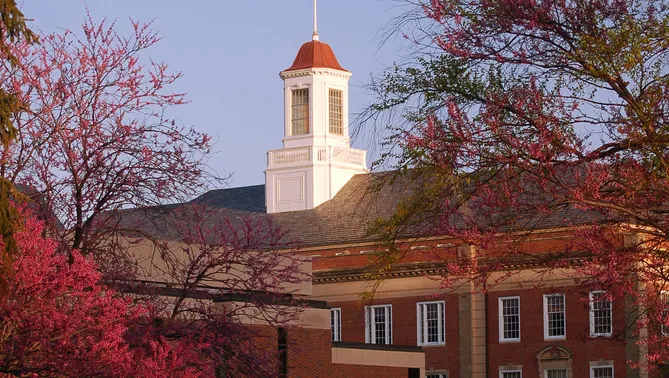
  • University of Nebraska-Lincoln leader reduces program cuts from 6 to 4

    University of Nebraska-Lincoln leader reduces program cuts from 6 to 4

    This audio is auto-generated. Please let us know if you have feedback.

    Dive Brief:

    • University of Nebraska-Lincoln’s chancellor on Monday unveiled a final budget recommendation that would cut four academic programs at the university, two fewer than he originally proposed in September.
    • However, Chancellor Rodney Bennett’s new plan would eliminate two programs that a university committee voted to recommend keeping. His proposal also comes amid concerns raised by faculty over program evaluation metrics and the budget reduction process.
    • The program cuts would trim $6.7 million from UNL’s budget, mainly through doing away with roughly four dozen full-time equivalent jobs. Bennett’s proposal also calls for merging four academic departments into two new schools and reducing budgets at four UNL colleges.

    Dive Insight:

    Ultimately, Bennett proposed axing UNL’s departments of Earth and atmospheric sciences; educational administration; statistics; and textiles, merchandising and fashion design — all as part of an effort to save $27.5 million annually to address a structural deficit. 

    He spared two programs that he recommended cutting earlier: landscape architecture, and community and regional planning. The University of Nebraska System’s regents plan to consider Bennett’s final recommendations at their December meeting. 

    Bennett’s initial proposal — and how he arrived at his recommended cuts — drew opposition from affected faculty and other stakeholders.

    Based on hearings and nearly 3,000 filed comments, UNL’s Academic Planning Committee — made up of faculty, staff, administrators and students — voted in October to oppose closing four of the programs in Bennett’s original plan. 

    Two of those programs — statistics, and Earth and atmospheric sciences — are nonetheless on the chopping block in Bennett’s final plan. 

    The committee didn’t oppose Bennett’s plans to cut the educational administration and textiles programs, or to merge UNL’s departments of entomology and plant pathology into one interdisciplinary school and the departments of agricultural economics and agricultural leadership, education and communication into another.

    However, the committee called on Bennett and UNL leaders to extend the timeline for making existential decisions about any of the programs. 

    “We strongly recommend to the Chancellor, the President, and the Board of Regents that the approval of any budget cuts be delayed allowing time for units to identify creative alternative solutions that reduce or prevent the need for these cuts,” the committee said in an Oct. 24 memo. But Bennett and UNL leaders appear undeterred and are sticking with their original timelines. 

    The committee also pointed to concerns raised by UNL stakeholders about the metrics and data that officials used to decide on programs. 

    Faculty members have said that the data was incomplete and sometimes incorrect and that the administration wasn’t transparent with them about how programs were being statistically evaluated. They also contended that the programs’ full value to the university and state weren’t taken into account. 

    UNL officials reviewed the programs “in accordance with performance metrics that align with UNL standards and external accountability frameworks,” Bennett said in a public message Monday. “The metrics were also shaped through extensive consultation in the spring with academic deans, college leadership teams, department executive officers and the APC.”

    Still, some faculty continued to slam the metrics for a lack of transparency. 

    “What are these new performance expectations, and where do we find them?” Sarah Zuckerman, an educational administration professor at UNL and head of its American Association of University Professors chapter, said in a Tuesday blog post titled “No Real Metrics, Only Vibes.” UNL’s AAUP chapter has actively opposed the cuts. 

    Zuckerman added, “This feels like not only have administrators changed the rules of the game while it is still being played, but they didn’t bother to tell us.”

    UNL’s faculty senate plans to consider a no confidence vote for Bennett on Nov. 18 over his handling of the budget cuts.


    Source link

  • UOW reduces job cuts again – Campus Review

    UOW reduces job cuts again – Campus Review

    The University of Wollongong (UOW) on Monday announced it now only needs to cut between 85 and 118 full-time positions instead of the originally proposed 155 to 185 jobs.

    Please login below to view content or subscribe now.

    Membership Login

    Source link

  • New UOW leadership reduces job cuts – Campus Review

    New UOW leadership reduces job cuts – Campus Review

    The new University of Wollongong (UOW) leader will cut senior staff and reduce non-salary spending to save some non-academic positions in the university’s restructure.

    Please login below to view content or subscribe now.

    Membership Login

    Source link

  • Taking Intermittent Quizzes Reduces Achievement Gaps & Enhances Online Learning – The 74

    Taking Intermittent Quizzes Reduces Achievement Gaps & Enhances Online Learning – The 74

    Inserting brief quiz questions into an online lecture can boost learning and may reduce racial achievement gaps, even when students are tuning in remotely in a distracting environment.

    That’s a main finding of our recent research published in Communications Psychology. With co-authors Dahwi Ahn, Hymnjyot Gill and Karl Szpunar, we present evidence that adding mini-quizzes into an online lecture in science, technology, engineering or mathematics – collectively known as STEM – can boost learning, especially for Black students.

    In our study, we included over 700 students from two large public universities and five two-year community colleges across the U.S. and Canada. All the students watched a 20-minute video lecture on a STEM topic. Each lecture was divided into four 5-minute segments, and following each segment, the students either answered four brief quiz questions or viewed four slides reviewing the content they’d just seen.

    This procedure was designed to mimic two kinds of instructions: those in which students must answer in-lecture questions and those in which the instructor regularly goes over recently covered content in class.

    All students were tested on the lecture content both at the end of the lecture and a day later.

    When Black students in our study watched a lecture without intermittent quizzes, they underperformed Asian, white and Latino students by about 17%. This achievement gap was reduced to a statistically nonsignificant 3% when students answered intermittent quiz questions. We believe this is because the intermittent quizzes help students stay engaged with the lecture.

    To simulate the real-world environments that students face during online classes, we manipulated distractions by having some participants watch just the lecture; the rest watched the lecture with either distracting memes on the side or with TikTok videos playing next to it.

    Surprisingly, the TikTok videos enhanced learning for students who received review slides. They performed about 8% better on the end-of-day tests than those who were not shown any memes or videos, and similar to the students who answered intermittent quiz questions. Our data further showed that this unexpected finding occurred because the TikTok videos encouraged participants to keep watching the lecture.

    For educators interested in using these tactics, it is important to know that the intermittent quizzing intervention only works if students must answer the questions. This is different from asking questions in a class and waiting for a volunteer to answer. As many teachers know, most students never answer questions in class. If students’ minds are wandering, the requirement of answering questions at regular intervals brings students’ attention back to the lecture.

    This intervention is also different from just giving students breaks during which they engage in other activities, such as doodling, answering brain teaser questions or playing a video game.

    Why it matters

    Online education has grown dramatically since the pandemic. Between 2004 and 2016, the percentage of college students enrolling in fully online degrees rose from 5% to 10%. But by 2022, that number nearly tripled to 27%.

    Relative to in-person classes, online classes are often associated with lower student engagement and higher failure and withdrawal rates.

    Research also finds that the racial achievement gaps documented in regular classroom learning are magnified in remote settings, likely due to unequal access to technology.

    Our study therefore offers a scalable, cost-effective way for schools to increase the effectiveness of online education for all students.

    What’s next?

    We are now exploring how to further refine this intervention through experimental work among both university and community college students.

    As opposed to observational studies, in which researchers track student behaviors and are subject to confounding and extraneous influences, our randomized-controlled study allows us to ascertain the effectiveness of the in-class intervention.

    Our ongoing research examines the optimal timing and frequency of in-lecture quizzes. We want to ensure that very frequent quizzes will not hinder student engagement or learning.

    The results of this study may help provide guidance to educators for optimal implementation of in-lecture quizzes.

    The Research Brief is a short take on interesting academic work.

    This article is republished from The Conversation under a Creative Commons license. Read the original article.

    Source link

  • Accelerated Business Degree Reduces Student Debt

    Accelerated Business Degree Reduces Student Debt

    As more students and parents consider the value of higher education and the cost of a four-year degree, interest has grown in three-year degree opportunities that allow students to complete their education in less time for a lower tuition rate.

    Westminster College in Pennsylvania launched a new Degree in Three program in the School of Business this year, allowing learners to graduate with 125 credits and shave a year off their time in undergraduate education. Additionally, the program pairs with the college’s master of business administration, so learners can complete two degrees in four years if they so choose.

    The background: There were a few catalysts for creating a formal three-year degree program, explains Robert Badowski, Westminster’s school of business chair. First, more students were coming in with credits from high school from AP or dual-enrollment programs, making their degree progress quicker. Second, more students and parents had noted the high cost of education and concerns about student debt.

    A May 2024 Student Voice survey by Inside Higher Ed and Generation Lab found seven in 10 respondents say higher education institutions in general charge too much for an undergraduate education.

    Westminster isn’t the only college facing pressure to get students to graduation sooner: Interest in formalized three-year degree programs has grown in recent years, and more institutions are looking to get in the game, even medical schools.

    At Westminster, the college had helped students shape their own schedules to graduate in three years rather than four, but a curriculum review and restructuring of elective courses has helped make this accessible to all students.

    What’s different: Westminster students can take up to 19 credit hours per semester and be considered full-time, but the business program offered primarily four-credit courses, making it difficult for students to max out their credit load.

    “You could take four classes, but if you took the fifth class, you were paying extra money, and most students don’t want to take on that burden, even if it was cutting off a year,” Badowski explains.

    Many three-year degree programs reduce the total number of credits students have to complete, but Westminster accelerated business students still complete at least 125 credits. To do so, faculty members reimagined their four-credit elective courses to be worth either one or two credits instead.

    Now, instead of engaging in a deep dive into an elective topic, students receive greater breadth in a variety of areas and are able to hit that 19-credit threshold exactly.

    “We had a meeting [with faculty members] as far as which courses made sense to do this with, and we found out in the process that a lot of [content] was stretched out purposefully just to be stretched out,” Badowski says. The process of removing content or packing it into seven or eight weeks, therefore, made more sense in many cases.

    The restructuring of elective courses is something that will benefit all business students, not just those participating in the accelerated degree program, giving them greater flexibility in scheduling.

    BOGO deal: In addition to removing costs associated with attending college, the Degree in Three program allows students to pair their undergraduate and graduate degrees in a four-year timeline.

    “We have a pretty neat deal that if students want to take one of their M.B.A. classes the last semester of their senior year, they can,” Badowski says. “We don’t charge for the M.B.A. course, so that gets them kind of jettisoned into the program.”

    The offering is particularly attractive to student athletes at the college, many of whom want to use all four years of eligibility.

    The price of an M.B.A. at Westminster is also around $10,000, so students spend less for a three-plus-one M.B.A. degree than four years in their undergraduate program, Badowski says.

    What’s next: Administrators are working on creating awareness of the offering among prospective students and particularly parents, who “are going to look at this and hopefully go, ‘I can help my kids save a year of tuition, maybe get them out of college a year faster,’” Badowski says.

    The college doesn’t have specific goals for enrollment, but Badowski would like to see 20 in the first year and consistent growth after that. “I’m hoping that people find it useful for them, [because] they’re still getting the same amount of credits. They’re taking the same classes as everybody else, it’s just faster.”

    Get more content like this directly to your inbox. Subscribe here.

    Source link