
|
|||||||||
|
|
||||||||
Tag: Register
-

Documents from US Department of Education (Federal Register)
-

The UK’s register of university spin-outs
It’s never been done before, anywhere in the world.
HESA’s experimental data (collected via part C of the HE-BCI questionnaire) shows 2,269 companies founded or owned by UK higher education providers, stretching as far back as 1969 (excluding 22 operating in “stealth mode” for reasons of commercial confidentiality.
It puts names and numbers on the phenomenon of the higher education provider spin-out – demonstrating a direct impact of research, development, and incubation activity.
A starting point
In itself, it is simply a list of company names, linked to provider names and showing foundation and incorporation dates (the former is the year when intellectual property was transferred to the spin-out, the later is the year it was registered with an appropriate authority like Companies House). It includes all spin-outs active during the 2023-24 academic year, plus spin-outs of any status since 1 August 2012. It will become more useful as more data is added year-by-year, and it is very much promoted as a starting point for data linking and further analysis. But even now, we can see the growth in numbers over time, and the way new spin-out numbers have declined since 2021.
With this in mind, we’ve linked via company registration number to the main Companies House free data source. The majority of companies are registered here – you can generally read an absence of registration as an indication that a company is no longer active, but there are also some edge cases..
Companies House data isn’t brilliant quality, but it allows us to unlock some additional information about each one. We can see an indication of status (confirmation that a spin-out is active, or details of what else – liquidation, administration – may be going on. We get an indication of the location of the spin-out, and the company type (is it a limited company?).
What are they up to?
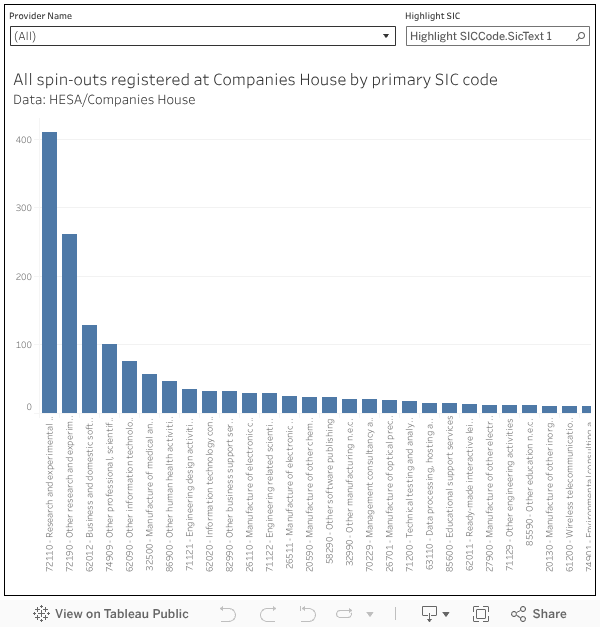
Of particular interest to us was the activity of the company in terms of the industry it is involved in. Companies House uses Standard Industrial Classification (SIC) codes – on registration and annual confirmation you can supply up to a total of four. Again I should emphasise that the quality of data isn’t fantastic, but this does give you a sense of what all of these spinouts may be up to.
By far the largest sphere of activity is biotechnology development, with the catch all “other research and development on natural sciences and engineering” in second place.
Five providers have more than 100 spin-outs registered – Cambridge, Oxford, UCL, Swansea, and Manchester (Imperial is at 97). It would perhaps be more surprising to many to see 72 spin outs from the Royal College of Art – these are not limited to arts-related activity although the majority will be design-led.
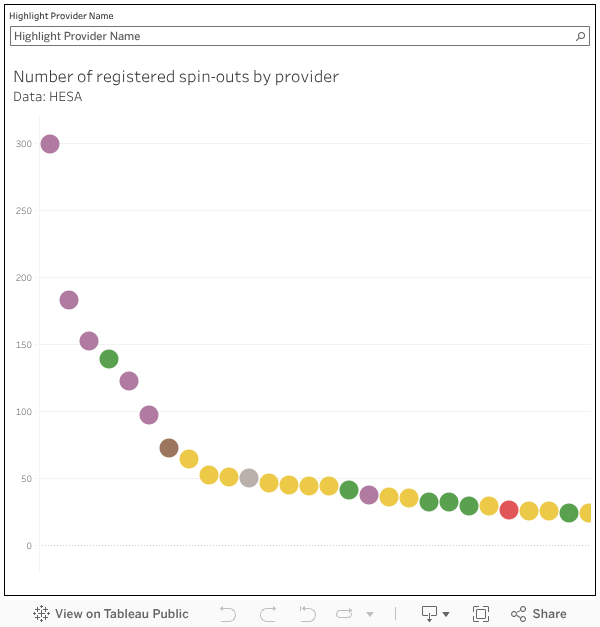
In total
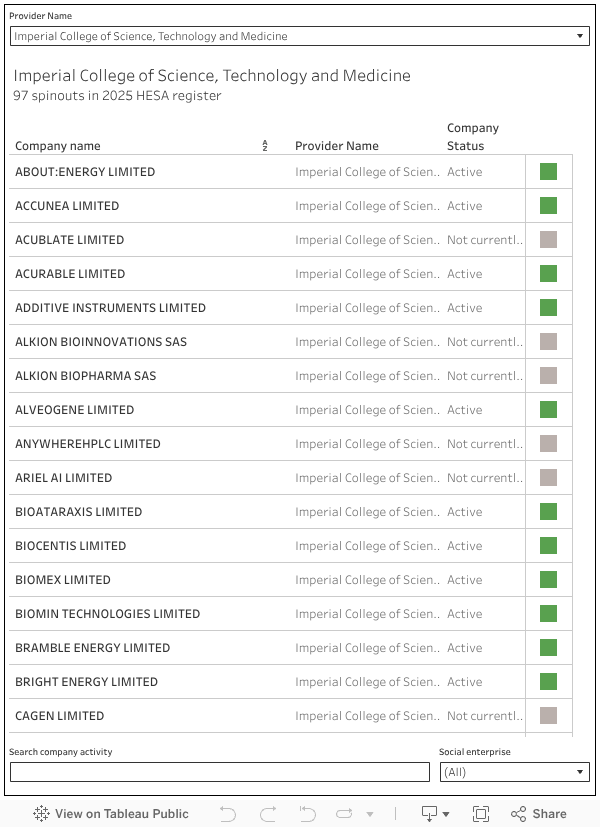
DK has put together a master search, allowing you to view salient details of every spin-out on the register. Choose a provider of interest with the filter on the top, or narrow down by company activity using the free text (you can enter up to five terms, and it is a little bit experimental so it may not always produce the results you would expect – but do persist) box at the bottom – and he’s also added a filter for social enterprises.
What have we learned?
Policy watchers may be interested in whether the spin-out ecosystem is getting stronger, or looking healthy, or as many in the sector would say that spinning-out is fine but spinning-up is really difficult.
Again, it’s hard to know without more data. Of the 2,269 companies on the register 526 are not currently registered with companies house, 67 are in liquidation, 30 have a “proposal to strike off”, and 8 are in administration. Another way to look at this of course is that 1,646 university spin-out companies stretching as far back as 1969 are, at least on paper, alive and well. This is in stark contrast to businesses more generally where only one-third of businesses started ten years ago are still in existence.
Another interesting question is whether various interventions, reviews, templates on equity, or missives from the government have made developing spin-outs any easier or more lucrative. Again, at the risk of sounding like a broken record, the register is not the right place to look for this information. It is tempting to say that as university finances came under real strain from 2021 onwards spin-out creation velocity declined. Clearly, universities need cash to invest in spin-outs and when they have less cash it would seem likely there would be fewer spin-outs. However, we just don’t have enough information in this register to suggest with confidence why the spin-out ecosystem looks like it does, even if we can describe what is happening.
-

FIRE Statement on City of Clarksdale v. Delta Press Publishing Company (Clarksdale Press Register)
Below is a statement from FIRE attorney Adam Steinbaugh on the restraining order against the Clarksdale Press Register:
The city of Clarksdale, Mississippi, thinks it knows better than the Founders. Clarksdale asked a court to order a local newspaper to remove an editorial asking why the city was not being more transparent about a proposed tax increase. As a result of the city’s lawsuit, a court ordered the Clarksdale Press Register to delete the online editorial.
That’s unconstitutional. In the United States, the government can’t determine what opinions may be shared in the public square. A free society does not permit governments to sue newspapers for publishing editorials.
The Foundation for Individual Rights and Expression (FIRE), a nonprofit organization dedicated to protecting First Amendment rights, is exploring all options to aid The Press Register in defending these core expressive rights.
-

When OfS reopens its register, there will be implications for everyone else
The process may be paused right now, but if you are thinking of registering with the Office for Students (by choice, or following the requirement for larger franchise providers to get on board) the game is changing.
The Office for Students has issued a consultation on two new initial conditions of registration.
Interested parties have until 23 April to offer feedback, with the overwhelming majority of conditions due to come into force from August – at the point where OfS is planning to resume registration activity following the current pause.
This will have a particular impact on providers who are currently planning (or preparing to restart) submissions quashed when the pause started. Expectations and requirements will change – and while OfS hopes to primarily assess documents a provider will already have, these things do tend to be tailored to fit requirements.
C5: Treating students fairly
New condition C5 replaces C1 (consumer law) and C3 (protection plans) as initial conditions – an assessment will be based on identifying behaviours that constitute unfair treatment of students (there is a list) from documents providers already have.
There are implications from that one that reach far beyond new applications to the register – Jim Dickinson has covered those in detail elsewhere on the site.
E7: Effective governance
This new initial condition replaces the current E1 (on public interest governance) and E2 (on management and governance), though those two remain as ongoing conditions. OfS offers a rationale:
We are increasingly finding that newly established providers (with less experience of delivering higher education) are less sure about what is required in terms of the self-assessment we ask for at registration. This leads to inefficiencies in the assessment.
Providers have been engaged in substantial back-and-forth conversations with OfS about what is expected during registration. The regulator has noted that people are describing existing documents where it would be quicker to submit them, and has spotted that what is submitted can often be poorly written and excessively tailored to paint a rosy (and hopefully successful) picture.
Some applicants have been borrowing and adapting plans and documentation from other providers that are inapplicable (a small, single subject, provider using processes developed for a traditional, multi-faculty, university) – in part because of perceived expectations that newly established providers need to have the same range of processes and policies.
So the self-assessment aspect will go – the plan is that providers should submit actual governance documents, a five year action plan, and other bits on the knowledge and experience of those involved.
One surprising shift is that there will no longer be an explicit test of “public interest governance” (the Nolan principles and suchlike) in the registration process. OfS reckon that the strengths of the rest of these new requirements, plus the continued inclusion in ongoing condition E1, makes up for this.
Ditto the absence of the (largely toothless) student protection plan – the line being that this should be visible to students via the documentation provided, which is a win for all those applicants who read governance documentation before they decide where to apply. See Jim’s piece for more detail.
Documentation
So what would you now need to submit:
- The governing body’s terms of reference (or similar), which would cover purpose, membership, appointment procedures, responsibilities, decision-making procedures, meeting frequency and the arrangements for reviewing effectiveness
- Establishing documents – like a Royal Charter or articles of association
- A scheme of delegation (or anything else useful) about who makes decisions and how
- Documentation pertaining to risk and audit – the operations of the committee responsible is given as one example
- A policy on conflict of interest
These are, to be clear, governance documents, not detailed operational arrangements – although of course such policies would need to be operationalised for ongoing conditions E1 and E2.
In assessing these documents, OfS intends to look at the “appropriateness of arrangements”, bearing in mind a provider’s size, complexity, context, and business plan.
Oh yeah, you need a five year business plan too. The regulator hasn’t been impressed with what has been seen so far.
Some providers applying for registration have not been able to demonstrate that they have sufficient understanding of how the higher education sector operates. This can result in a provider making unrealistic assumptions in its planning, such as overestimating its ability to recruit students in a competitive market, which can pose risks to the ongoing viability of the provider and cause associated harm to students.
Part of being sufficiently equipped to deliver higher education is preparing to meet the relevant regulatory requirements. We have encountered issues where newly registered providers were not sufficiently aware of the regulatory framework and so did not have robust plans in place to meet ongoing requirements
And there’s a telling indication that problems multiply pretty quickly when the plans get hit with a dose of operational reality.
Where a provider does not have robust plans in place, it may encounter financial challenges after registration. Providers have at times taken steps to address this without fully considering the risk of doing so, for example:
a. Rapidly entering into new partnership arrangements because of the unexpected withdrawal of a current partner without having the governance and management processes needed to manage this change properly.
b. Employing financially incentivised external recruitment agents to meet recruitment targets that are too ambitious.
c. Taking out additional unplanned borrowing to fund unanticipated expenditure.
All of these behaviours can result in negative consequences for students and taxpayers
Being objective
Who could possibly have foreseen, eh? Going forward OfS would like business plans to be comprehensive and clearly written – and demonstrate an understanding of the sector, of managing risks, and of the conditions of registration.
It’s all standard stuff (objectives and targets and how to achieve them, risks and how to manage them, regulatory compliance) over a challengingly long five-year period. OfS’ assessment will not be based on the targets themselves, but whether the provider can deliver these in practice given their resources and prevailing sector conditions. As an overriding primary consideration the plans need to focus on the interests of students.
There’s no expectation that there will be an assessment of the objectives in and of themselves (or whether they are a proper thing for the provider to pursue), and OfS would not endorse these objectives – it’s more a matter of understanding a provider’s chosen approach in looking at the plans it has to deliver. A neat distinction.
People who need people
So who will be delivering these plans? The new condition would set out key knowledge and expertise for the chair of the governing body, accountable officer, and where applicable, the person with overarching responsibility for financial management and an independent member of the governing body. There’s a sensible sounding list on pages 30-33, but the big shocker is that these would be assessed via an interview with OfS officers!
Yes, you read that right: 30 to 60 minutes based on key questions allowing said knowledge and experience to be demonstrated. On one level it feels sensible to talk to the people involved as a way of establishing the credibility of plans, but the feeling that OfS is appointing (or approving the appointment of) your chief financial officer is a hard one to shake.
In contrast the “fit and proper persons” test is pretty much as expected, with additional requirements to supply new information (if you are disqualified as a director or trustee, or declared bankrupt) during the course of the application process. This is a welcome admission that these processes can take a long time to work through.
You’ve probably spotted that OfS and government are now very focused on fraud in the sector – and assessment of arrangements to prevent fraud will focus on an institution’s track record where it has already been delivering higher education as part of a franchise or partnership arrangement.
Other requirements for registration applications
Got all that? Well strap in, there’s more.
There’s the new C5, the new E7, and OfS intends to beef up their financial information requirements from August 2025 too.
Financial viability and sustainability is currently assessed via initial condition D – providers already submit full, audited, financial statements for up to three years alongside four years of forecasts and a commentary on these. OfS has noted that new registrants tend to defer their first year of recruitment (setting up a HE provider is hard!) and substantially under recruit when they do – with current financial and recruitment pressures this isn’t going to improve any time soon.
The new requirement is an addition to the template, which allows a provider to model financial viability against different yet plausible scenarios: zero growth over four years and 40 per cent below forecast followed by three years of zero growth for those currently delivering HE – zero growth followed by 80 per cent below forecast for the next three years for those entirely new to the sector.
These aren’t set in stone – OfS reserves the right to tweak them based on emerging sector issues. And we may also get an alternative for providers whether the business model is not predominantly balanced on higher education provision.
The commentary to this new table would let the provider set out mitigations, or provide evidence that these scenarios are unrealistic. But even so, there is a risk here that condition D becomes the hard one to pass – OfS reckon this is fair enough given short– and medium– term challenges to the sector. Although one cannot help but think of the many existing registered providers that would not pass these tests.
By OfS request
There’s another welcome recognition that applying for registration takes ages in the requirement for a provider to submit updated finances, student numbers, and commentary in the late stages of application by OfS request. While this makes sense in that the regulator isn’t relying on year-old (and the rest…) numbers this is a hard sell for those prospective registrants now expecting to submit similar data twice – although it could be argued that this gets them used to regular submissions while registered.
Likewise, if the financial year turns over during the registration process you’ll need to put an extra batch of audited financial statements in for that year.
And, wonderfully, OfS wants an ownership and corporate structure diagram too – it’s been finding some structures “complex”, poor thing.
If your provider is or has been under investigation by another regulator – or awarding organisation, professional body, funding body, statutory body, and so forth – you’d better believe that OfS wants to know about that up front too. Apparently it keeps finding out about such things midway through the assessment process – and it does tend to be relevant, even if it is not an automatic fail.
The rules are for the 60 months proceeding application, any investigation that closed or opened during the application period is something OfS wants to know about: a brief description, the responsible body, the dates, and the findings and/or outcomes.
And if you are looking forward to the exciting world of “reportable events”, something similar now applies during registration. If stuff happens (there’s a long and familiar list on page 42) then you’d best drop OfS a note within 28 days.
Finally, from January 2026 you won’t be able to reapply within 18 months of an unsuccessful registration application. This “double jeopardy” rule is a new one, and it looks like it is aimed at ensuring that OfS capacity is not clogged with resubmissions of poor quality applications where identified weaknesses are not addressed. We learn that 40 per cent of applications don’t comply with the existing guidance.
There is the possibility of individual exemptions from this rule, for example where there have been IIT problems or where information that was not available for reasons outside of the provider’s control is now available.
How this will be done
The changes to application requirements were done via the same “manner of application” loophole – section 3(5) of HERA – that was used to pause the registration process. It is, as we said at the time, a reach in terms of legislative interpretation but it is difficult to argue against many of the principles here.
It is regrettable that the same group of providers that have been forced to delay or resubmit applications due to the pause will now have to do considerable extra work to get these into the new format.
While the principle of assessing existing documents rather than new ones is a good one, the reality of this is not as neat as regulators sometimes think. For an expected influx of new registrations – the franchise thing, and whatever ends up happening with the lifelong learning entitlement is expected to flush out at least a few – it makes sense to have all this in order. But there are always winners and losers with these things, and the losers have lost several times in a row here.
The only other disappointment is probably that these new approaches will apply only to new registrations – there’s clearly a lot of benefit to similar approaches (especially for C5 and the financial requirements) to be extended to existing registered providers, and it is likely that there is more to come on that front.
-

DfE steps in to require franchise partners to register with OfS
The Department for Education is consulting on a requirement for providers delivering courses under a franchise model to register with the Office for Students in order that they and their students can access student finance. We also get an impact assessment and an equalities assessment.
The consultation defines “franchise” as follows:
A ‘franchised student’ is one who is registered with a lead provider, but where more than 50% of their provision is taught by a delivery partner
The proposals suggest that should a provider delivering teaching as part of a franchise arrangement (a delivery partner) have over 300 (headcount) higher education students in a given year it would need to be fully registered with the Office for Students under the existing Approved or Approved (Fee Cap) rules. A failure to register would mean that the institution could not access fee loans, and that students could not access maintenance loans.
There would be some exceptions: providers already regulated elsewhere (schools, FE colleges, NHS trusts, local authorities, and Police and Crime Commissioners) would be exempt. Providers (not courses) would be designated (by DfE) as being eligible to access student finance, meaning that providers running courses regulated by a Professional Statutory Regulatory Body (PSRB) would not be exempt.
The consultation (which closes 4 April 2025) will inform regulation from April 2026 onwards, with the first decisions about designation made in September 2027 (based on 2026-27 student data) for the 2028-29 academic year. Once up and running this pattern will continue: providers will be designated (based on student numbers from the previous academic year) for the academic year starting the year after. This gives newly designated providers a year to register with OfS.
Student numbers would not be allowed to breach the 300 threshold without registration – the expectation is that providers should register the year before this happens. Should the threshold be breached, the provider will lose a year of eligibility for student finance for new students: the upshot being that if an unregistered provider had 300 or more students in 2026-27 and then registered with OfS, it would lose a year of designation (so would not be able to access student finance in 2029-30).
In November of each year, DfE intends to publish a list of designated providers for the following academic year – providing a point of reference for applicants looking to access finance. Interestingly, despite the requirement being to register with OfS it is intended that DfE runs the process: making decisions about eligibility, managing appeals, and communicating decisions.
The background
We’ve been covering some of the issues presented by a subset of franchise providers on Wonkhe for quite a while, and it is now generally accepted that higher education in the UK has a problem with the quality and ethics at the bottom end of such provision. Students either enrol purely to access student finance, or are duped (often by higher education agents rather than providers themselves) into accessing fee and maintenance loans for substandard provision. Continuation and completion rates are very low compared to traditional providers, and the qualification awarded at the end (despite bearing the name of a well-known university) may not open the career doors that students may hope.
We knew that an announcement on this issue was supposed to be coming in January via the government’s response to the former Public Accounts Committee’s report on franchising, which was sparked by a National Audit Office (NAO) report on the issue from a year ago – so the announcement today has just squeaked in under the Treasury’s wire.
There is a slightly longer backstory to all of this – and we’re not referring to the various bits of coverage on potential abuses in the system that we’ve run in recent years. It was back in 2023 when the Department for Education’s heavily belated response to the Augar review reached a conclusion – promising to “drive up” the of franchised provision, in part by promising to:
…closely consider whether we should take action to impose additional controls, in particular regarding the delivery of franchised provision by organisations that are not directly regulated by any regulatory body.
Given the NAO and the PAC’s interventions since, and the work of the OfS in addressing franchise (and other academic partnership failings) via the coming round of quality (B3) investigations, special investigations, and enhanced data gathering, it is perhaps a little surprising that it is DfE that is in the lead here.
There’s an important lesson in that to be drawn at some stage – the repeated pattern seems to be that an issue is raised, the sector is asked to self-regulate, it seemingly can’t, the regulator is asked to step in instead, and then it is discovered that what we actually need is secondary legislation.
How big a deal is franchising
Despite a number of years trying, OfS has never managed to compile full data on the extent of franchised, validated, and other partnership provision – the details are not in any current public dataset. It’s important here to distinguish between:
- Franchised provision: where a student is registered at one institution, but teaching is delivered at another
- Validated provision: where a student is both registered and taught at one institution, but receives an award validated by another institution on successful completion of their course
- Other academic partnerships: which include arrangements where students are taught by more than one institution, or where existing providers partner to allow students to apply to a “new” provider (like a medical or veterinary science school)
Of the three, it is just franchised provision that is in the scope of this new DfE requirement. It’s also (helpful) the most easily visible of the three if you are a fan of mucking about with Unistats data (though note that not all courses are in the unistats release, and the other vagaries of our least-known public data release continue to apply).
DfE has done a bang-up job in pulling together some statistics on the scale of franchise provision within the impact assessment. We learn that (as of 2022–23 – usual student numbers caveats for that year of data apply):
- There were currently 96 lead providers, franchising to 341 partners, of which 237 were unregistered.
- 135,850 students were studying via a franchise arrangement – some 80,045 were studying at unregistered providers (a proportional fall, but a numerical rise, over previous years)
- These students tended to study business and management courses – and were more likely to be mature students, from deprived areas, and to have non-traditional (or no) entry qualifications.
- An astonishing 92 per cent of classroom based foundation years delivered as an intercalated part of a first degree were delivered via franchise arrangements.
- There were 39 franchise providers teaching 300 students or more – of which four would be subject to the DfE’s proposed exemptions because of their legal status. These providers accounted for 66,540 students in 2022–23.
A note on OfS registration
Office for Students registration is confusing at the best of times. Though the registration route is currently paused until August 2025, providers have the choice of registering under one of two categories:
- Approved (fee cap) providers are eligible to access fee loan finance up to the higher limit if they have an approved access and participation plan, receive direct funding from OfS, and access Research England funding.
- Approved providers can access fee loan finance up to the “basic” fee limit. They are not eligible for OfS or Research England funding – but can directly charge students fees that exceed the “basic” fee limit.
In the very early stages of developing the OfS regulatory framework it was briefly suggested that OfS would also offer a “Basic” level of registration, which would confer no benefits and would merely indicate that a provider was known to the OfS. This was speedily abandoned, with the rationale being that it would suggest OfS was vouching in some way for provision it did not regulate.
The long and painful gestation of the Lifelong Learning Entitlement (LLE) also yielded suggestions of a third category of registration, which would apply to providers that currently offer provision backed by the Advanced Learner Loans (ALLs) that would be replaced by the LLE. We were expecting the Office for Students to consult on this new category, but nothing has yet appeared – and it does feel unlikely that anyone (other than possibly Jo Johnson) would be keen on a riskier registration category for less known providers that offers less regulatory oversight.
Statutory nuts and bolts
The proposal is to lay secondary legislation to amend the Education (Student Support) Regulations 2011 – specifically the bit that is used to designate types of courses for student finance eligibility. There is currently a specific section in this SI – section 5 part 1 subsection d, to be precise – that permits registered providers to franchise the delivery of courses to partners.
The plan appears to be to amend this section to include the stipulation that were more than 300 higher education students (in total, excluding apprenticeships) are taught at a given franchise provider (I assume in total, across all franchise arrangements) then it must be registered with the Office for Students in order to be designated for student finance (allowing students to receive maintenance loans or providers to receive fee loan income).
This might seem like a small technical change but the implications are surprisingly far reaching – for the first time, the OfS (as regulator and owner of the register) has the ability to decide who can and cannot deliver UK higher education. If anyone – even a well established university – is removed from the OfS register it will be unable to access fee loans (and students will be unable to access maintenance loans) for intakes above 300 students, even if it enters into a partnership with another provider.
Let’s say, for example, that a large university becomes financially unsustainable and thus breaches the conditions of registration D1 or D2. Under such circumstances it could no longer be registered with OfS and thus would no longer be able to award degrees. The hope would be that student interests would be protected with the support of another university, and one way that this could happen is that someone else validates the awards offered to students so they can be taught out (assuming temporary financial support is forthcoming from government or elsewhere). Under the new rules, this arrangement would only work for 300 students.
What might go wrong
OfS has classically regulated based on the registered student population – the implication being that providers involved in franchise provision would be responsible for the quality and standards of teaching their students experience wherever they were taught. There have been indications via the B3 and TEF dashboards that students studying at franchise partners tend to have a worse experience overall.
This does pose the question as to whether franchise partners who registered with OfS would now be responsible for these students directly, or whether there will be some sense of joint responsibility.
There’s also the question of how providers will respond. Those franchised-to providers who either worry about their own outcomes (no longer judged within a larger university’s provision) wouldn’t cut it might stay that way – an outcomes based system that is always playing catch up on experience could see some poor provision linger around for many years. On the other hand, if they are now to be subject directly to conditions like those concerning transparency, finances and governance, they might as well switch to validation rather than franchising, which will change the relationship with the main provider.
We might in aggregate see that as a positive – but that then raises the question as to whether OfS itself will be any better at spotting issues than universities have previously been. They could, of course, not fancy the scrutiny at all, and disappear with a rapidity that few student protection plans are designed to withstand.
It’s also worth asking not just about OfS’ capacity or regulatory design, but its powers. Many of the issues we’ve identified (and that have been called out by the NAO and the PAC) concern how the courses are sold – OfS’ record on consumer rights is at best weak, and completely untested when the profit incentives are so high.
And even if the sunlight of better outcomes data puts pressure on over outcomes, we do have to worry about how some of the providers in this space get there. In at least one of the providers that we have seen an OfS report for, a call centre team in another country that is supposed to offer support to students sounds more like a debt collection agency, chasing students up to submit, with academic staff paid partly on outcomes performance. Remember, providers that do this are already registered with OfS – so clearly the registration process itself is not enough to weed out such practices.
The impact assessment is very clear that it expects some (an oddly precise four in the first year and two in subsequent years) unregistered franchise partners to drop out of HE provision altogether rather than applying for registration. The unspoken codicil to this is that everyone hopes that this will be the poor quality or otherwise suspect ones – but many excellent independent providers (including a number of Independent HE members) have struggled to get through a lengthy and often bureaucratic process, even before registration was temporarily closed because OfS decided it didn’t have capacity to run it this year.
The line between supporting students and spoon feeding them is often debated in HE, but we might worry that a decent dose of it in a way that few would think appropriate could enable providers to evade regulation for some time – especially if validation (and therefore less risk to the validator) becomes the norm.
And naturally, this is an approach that ignores two other things: whether a demand-led system at the edges should respond to the sort of demand that seems to come from those profiting from selling more than it does from students themselves, and whether it’s right. Even if you accept some for-profit activity, for anyone to be arranging for predominantly low-income and disadvantaged students to be getting into full tuition fees debt when sometimes more than half is kept in profits, and what is spent seems to include high “acquisition” costs and quite low delivery and support costs.
In other words, one of the tests should be “does any of this change the incentives,” and it’s not at all clear that it does.
-

Learn more about the Upcoming Forum on Education Abroad Annual Conference and Register #ForumEA21
Learn more about the upcoming Forum on Education Abroad annual conference and register at https://forumea.org/training-events/annual-conference/general-info-2/ #ForumEA21
Note: I’ve been invited to attend the Forum on Education Abroad annual conference and will be tweeting and posting to IHEC Blog‘s Facebook page during the conference as well as doing an end of conference summary blog post.

