Tag: Reinstate

  • Portland State Ordered to Reinstate Some Laid-Off Faculty

    Portland State Ordered to Reinstate Some Laid-Off Faculty

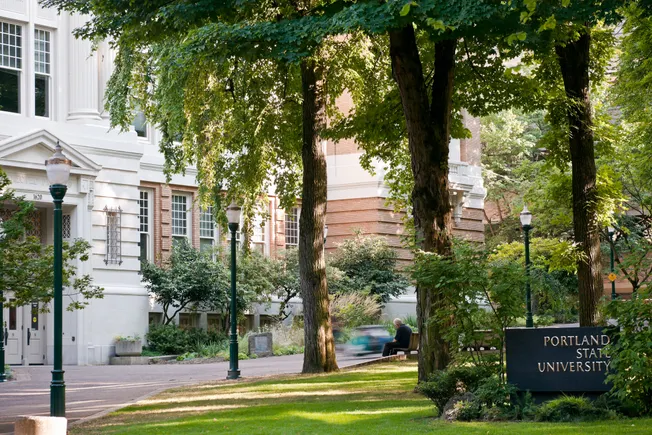
    An independent arbitrator ordered Portland State University to reinstate 10 faculty members after determining the university violated its collective bargaining agreement with the Portland State University American Association of University Professors, Oregon Public Broadcasting reported.  

    The faculty senate in April voted no confidence in the administration’s “Bridge to the Future” plan to address an $18 million budget deficit, and the vote “underscores the fact that the university made its layoff decisions before it had sufficient evidence to support them. That is a violation of the collective bargaining agreement,” the arbitrator wrote in her decision

    PSU-AAUP filed a labor grievance after the university laid off 17 non-tenure-track professors at the end of the 2024–25 academic year as part of its plan to close the deficit before the end of the spring term. The remaining seven employees declined to grieve their layoffs. 

    “[The decision] forces the university to respect the concept of shared governance,” union president Bill Knight told OPB. “It’s a reminder to the university that they can’t simply make arbitrary administrative decisions without involving the faculty.”

    The union contract requires university officials to follow a specific, lengthy process to lay off faculty members for economic reasons—as opposed to eliminating courses or programs—which the arbitrator determined they did not do. Portland State is considering an appeal.

    The budget cuts were successful in closing the deficit, OPB reported. Recent financial documents show the university saved more than $12.3 million—about 88 full-time faculty positions—in its academic affairs division. But more personnel cuts are likely. In September, the Portland State University Board of Trustees approved a plan to address a $35 million shortfall over two years.

    Source link

  • Education Department ordered to reinstate mental health grants

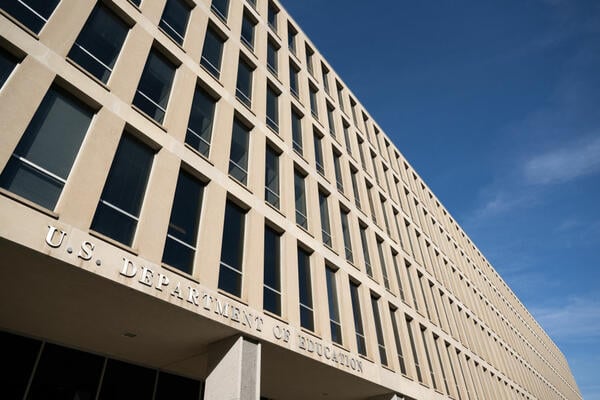
    Education Department ordered to reinstate mental health grants

    Dive Brief:

    • The U.S. Department of Education must reinstate, for now, canceled federal grants for student mental health services due to “numerous irreparable harms flowing from the discontinuation decisions,” according to an Oct. 27 order by a federal judge.
    • Sixteen states sued the Education Department in late June after the Trump administration in April canceled the multi-year congressionally approved funding for the School-Based Mental Health Services Grant Program and the Mental Health Service Professional Demonstration Grant. The order only applies to about 50 colleges, school districts and nonprofit entities who received the grants in the plaintiff states.
    • In the order, the judge said grant discontinuations were likely “arbitrary and capricious” because they were not renewed based on individual reasons, but rather were discontinued with a generic message saying that the grants “were not in the best interests of the federal government.”

    Dive Insight:

    On Tuesday, an Education Department spokesperson said the agency stands by its grant decisions and will appeal the order. 

    The Education Department announced in September that their new $270 million grant competition is accepting applications to use the federal funds from the two programs that were canceled in April. The department issued new priorities prohibiting the mental health grant money to be used for “promoting or endorsing gender ideology, political activism, racial stereotyping, or hostile environments for students of particular races.”

    The Education Department spokesperson, in a Tuesday email, said, “Our new competition is strengthening the mental health grant programs in contrast to the Biden Administration’s approach that used these programs to promote divisive ideologies based on race and sex.” 

    Some education organizations said they were concerned that the new competition focuses only on school psychologists and does not include school counselors and social workers who also provide student mental health supports.

    The canceled grants, which were set to expire on Dec. 31, were focused on increasing the pipeline of credentialed school-based mental health professionals working in rural and underserved areas and providing direct services to students in high-needs schools, according to court documents. Court records said that the Education Department valued the canceled grants at about $1 billion. 

    Addressing the discontinuation of the grants, Judge Kymberly Evanson in the U.S. District Court Western District of Washington said in the order that there was no evidence the Education Department “considered any relevant data pertaining to the Grants at issue,” leaving it difficult to determine “whether the Department’s decision bears a rational connection to the facts.”

    Kelly Vaillancourt Strobach, director of policy and advocacy for the National Association of School Psychologists, called the ruling “a win for children, families, and educators across the country.” 

    Vaillancourt Strobach said in an email Tuesday that the grants “have proven essential in addressing nationwide shortages of school psychologists and other school mental health professionals.”

    Source link

  • University of South Dakota must reinstate professor on leave over Kirk comments, judge orders

    University of South Dakota must reinstate professor on leave over Kirk comments, judge orders

    This audio is auto-generated. Please let us know if you have feedback.

    Dive Brief:

    • A federal judge has ordered leaders at the University of South Dakota to temporarily reinstate Phillip Michael Hook, a tenured art professor it sought to fire over a social media post critical of Charlie Kirk.
    • On Sept. 12, the university notified Hook he would be placed on administrative leave and that it intended to terminate his contract over a private Facebook post he shared criticizing Kirk the day of the conservative firebrand’s killing. 
    • Hook is suing university leaders, alleging they unconstitutionally retaliated against him over his political speech. The professor’s case has a “fair chance of prevailing,” U.S. District Judge Karen Schreier said Wednesday in granting the temporary restraining order.

    Dive Insight:

    Hook is just one of an increasing number of college employees who have been reprimanded or fired over their speech about Kirk following his killing on Sept. 10. And a growing number of the educators affected are taking their cases to court. Schreier’s ruling this week represented one of the first court actions in such a lawsuit.

    The federal judge said Hook must prove he made his comments as a citizen on “a public matter of concern” and that the University of South Dakota’s actions came as a result of that speech.

    Hours after Kirk was killed, Hook said on his private Facebook account that he had no “thoughts or prayers” for Kirk.

    In 2012, Kirk founded Turning Point USA, a conservative advocacy group geared toward young people, and became a prominent figure on college campuses in the process. Many of his political beliefs — such as opposition to race-conscious college admissions and gun control — fell in line with those of the conservative movement more broadly. 

    But his comments on some issues regularly prompted significant outcry and backlash, such as when he called Supreme Court Justice Ketanji Brown Jackson a “diversity hire” and said “prowling Blacks go around for fun to go target White people.” He also espoused the great replacement theory, which labels immigration policies as part of a plot to undermine the power and influence of White people.

    “I’m sorry for his family that he was a hate spreading Nazi and got killed. I’m sure they deserved better,” Hook said in his Facebook post. “But geez, where was all this concern when the politicians in Minnesota were shot? And the school shootings? And Capitol Police?”

    A few hours later, Hook deleted the post and shared “a public apology to those who were offended” by it on the same account. He published both posts while he was off work, according to court documents. 

    However, Hook’s original comments gained significant attention after conservative politicians shared a screenshot of them online.

    Jon Hansen, the Republican speaker for South Dakota’s House and a 2026 candidate for governor, on Sept. 12 called Hook’s speech disgusting and “unbecoming of someone who works for and represents our University.”

    “Yesterday, after seeing the post, I immediately reached out to USD President Sheila Gestring and called on the professor to be fired. I understand that the professor is likely to be terminated from his position,” Hansen said on social media.

    A few hours later, South Dakota Gov. Larry Rhoden said Hook’s post made him “shaking mad” and that the South Dakota Board of Regents intended to fire the professor, a decision he applauded.

    The same day, Hook received a letter from Bruce Kelley, the university’s fine arts dean, notifying him of the university’s “intent to terminate” his employment. 

    The letter alleged that Hook had violated two university policies, according to court documents. 

    One bans “neglect of duty, misconduct, incompetence, abuse of power or other actions” that diminish trust in faculty or prevent them from doing their job. The other requires that faculty “at all times be accurate, show respect for the opinions of others and make every effort to indicate when they are not speaking for the institution.”

    University of South Dakota officials said this week that, over the two days between Hook’s post and Kelley’s letter, the university and the South Dakota Board of Regents received hundreds of messages criticizing Hook’s comments and calling for his removal. They confirmed that one such call came from Hansen.

    However, the federal judge who ordered Hook’s temporary reinstatement said the officials failed to show that the reaction to the professor’s private comments disrupted his lessons or the university’s operations.

    The Sept. 12 letter “identifies Hook’s social media post as the single piece of evidence it used to support its decision to terminate Hook’s position,” Schreier wrote. 

    Kelley had placed Hook on administrative leave until Sept. 29, when a personal conference was to be held to “discuss this matter and intended disciplinary action.”

    Hook sued Kelley and Gestring, along with board president Tim Rave, on Tuesday seeking to have their decision ruled unconstitutional.

    Schreier’s order will remain in effect until Oct. 8, when the court is scheduled to hear arguments over a more permanent preliminary injunction. The temporary restraining order allows for the Sept. 29 meeting to still occur, should the defendants choose.

    Source link

  • Federal Judge Orders NSF to Reinstate Suspended UCLA Grants

    Federal Judge Orders NSF to Reinstate Suspended UCLA Grants

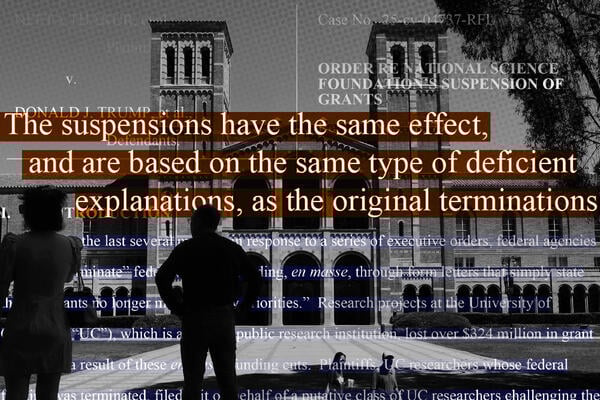
    Photo illustration by Justin Morrison/Inside Higher Ed | Genaro Molina/Los Angeles Times/Getty Images | US District Court for the Northern District of California

    The National Science Foundation restored grants it recently suspended for researchers at the University of California, Los Angeles, following a court order late Tuesday, a spokesperson for the agency said.

    The NSF and UCLA didn’t tell Inside Higher Ed how much funding had been restored, but the Los Angeles Times reported it’s roughly $81 million.

    It’s a blow to the Trump administration, which had multiple agencies cut off more than $500 million in research funds to UCLA earlier this month and, according to the UC system, demanded a $1 billion settlement payment.

    UCLA is the latest target of the Trump administration’s use of mass federal research grant suspensions to pressure prominent universities to change policies and pay restitution, ranging from tens of millions of dollars for Brown University to the billion-dollar demand of UCLA. Federal agencies justify cutting off grants by accusing targeted institutions of failing to address pro-Palestine protesters’ alleged antisemitism, and accusing universities of other transgressions, such as letting transgender women compete in women’s sports or promoting racial preferences.

    But this is the first known court order blocking one of those blanket funding freezes. Harvard University also challenged the administration’s decision to suspend more than $2.7 billion in funds, but a judge has a yet to rule in that case.

    UCLA didn’t sue, though.

    Instead, the ruling came from a lawsuit that UC researchers filed in early June against President Trump, the NSF and other federal agencies and officials that challenged previous NSF grant terminations.

    On June 23, U.S. District Court judge Rita F. Lin, of the Northern District of California, issued a preliminary injunction restoring grants that the administration terminated en masse via form letters that didn’t provide grant-specific explanations for the terminations. When the NSF recently cut off grants again, specifically to UCLA, the researchers’ attorneys alleged the agency violated the preliminary injunction.

    Lin agreed, writing in an opinion Tuesday that the new “suspensions have the same effect, and are based on the same type of deficient explanations, as the original terminations.”

    The NSF wrote in a July 30 letter justifying the new suspensions that “NSF understands that [UCLA] continues to engage in race discrimination including in its admissions process, and in other areas of student life, as well as failing to promote a research environment free of antisemitism and bias.” Two days later, the NSF sent a second letter, alleging that UCLA furthermore “engages in racism” and “endangers women by allowing men in women’s sports and private women-only spaces.”

    According to Lin, the NSF argued that its recent funding cuts “are not within the scope of the preliminary injunction because it suspended, rather than terminated, the grants.” She said the agency argued that suspensions, unlike terminations, “can be lifted once the grantee takes certain corrective actions.”

    However, Lin said the NSF had labeled these “suspensions” as “final agency decision[s] not subject to appeal.”

    “There is no listed end date for the suspensions, nor is there any path for researchers to restore funding for their project. If any curative action is actually feasible, it would need to be undertaken by UCLA,” the judge wrote. “In other words, researchers have no guarantee that funding will ever be restored and no way to take action to increase the likelihood of restoration.”

    She added that “NSF claims that it could simply turn around the day after the preliminary injunction issued, and halt funding on every grant that had been ordered reinstated, so long as that action was labeled as a ‘suspension’ rather than a ‘termination.’ This is not a reasonable interpretation of the scope of the preliminary injunction.”

    Researchers told the court that as a result of the latest suspensions, “projects are already losing talented graduate students, staff will soon be laid off, and years of federally funded work will go to waste,” Lin wrote. Researchers also said the defunded projects include “multi-year research into global heat extremes, a project to address environmental challenges in the Southwestern United States, and another to enhance veteran participation and leadership in STEM fields,” the judge added.

    A UC system spokesperson said in an email Wednesday that, “while we have not had an opportunity to review the court’s order and were not party to the suit, restoration of National Science Foundation funds is critical to research the University of California performs on behalf of California and the nation.”

    Source link

  • District Court Judge Continues to Demand OCR Reinstate Staff

    District Court Judge Continues to Demand OCR Reinstate Staff

    Saul Loeb/AFP via Getty Images

    A federal district court judge refused the Trump administration’s request to vacate a previous ruling that prohibited the Department of Education from laying off nearly half its Office for Civil Rights staff.

    The decision was made by Massachusetts judge Myong Joun on Wednesday and involved the case Victim Rights Law Center v. Department of Education. It comes just a month after the Supreme Court reversed a preliminary injunction in a similar case, New York v. McMahon, which Joun also oversaw. 

    In the new order, the district court judge argues that the cases, and therefore their related rulings, are separate. 

    The New York case, which was filed by multiple state attorneys general, addressed the reduction in force more broadly, Joun said. By comparison, the Victim Rights Law Center case more specifically addresses the RIF at OCR and how it may hold the office back from completing its statutory mandate of protecting students from discrimination.

    So, although the Supreme Court allowed the Trump administration to continue with the reduction in force broadly, Joun argues, it does not mean the enjoinment of layoffs within OCR is no longer applicable.

    Trump officials “present two arguments for why vacatur or a stay are appropriate: first, that the Supreme Court granted the stay in a related case, and second, that the two related cases are ‘indistinguishable in all pertinent respects.’ I am unconvinced by either argument,” Joun wrote. “Although this case and New York are related, I issued a separate Preliminary Injunction Order to address the unique harms that Plaintiffs alleged arose from their reliance on the OCR.”

    He also noted that even though the high court judges reversed one preliminary injunction, that does not mean they have made a final ruling on the merit of the RIF.

    Finally, Joun went on to say that the defendants’ motion for stay has little standing, as “they have not substantially complied with the preliminary injunction order” in the first place. Reporting from The 74 backs this up, showing that none of the 276 fired OCR employees have been reinstated.

    Source link