Tag: Release

  • Reflections from the Higher Education for Good Book Release Celebration – Teaching in Higher Ed

    Reflections from the Higher Education for Good Book Release Celebration – Teaching in Higher Ed

    What a way to start my week!

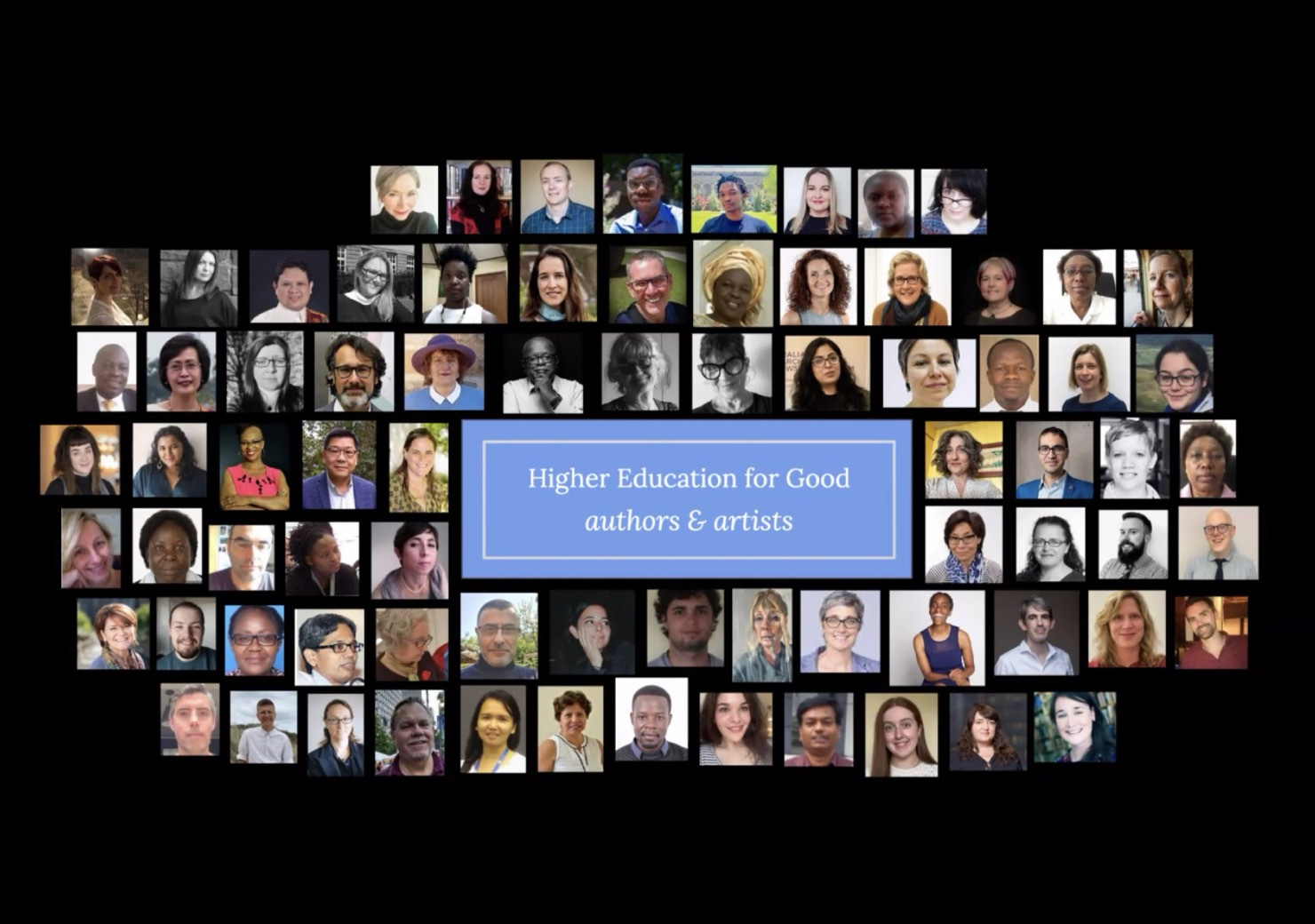
    November 20, 2023, I attended an online launch celebration event for a magnificent project. The book Higher Education for Good: Teaching and Learning Futures brought together 71 authors around the globe to create 27 chapters, as well as multiple pieces of artwork and poetry. Editors Laura Czerniewicz and Catherine Cronin shared their reflections of writing the book and invited chapter authors, and Larry Onokpite, the book’s editor, to celebrate the release and opportunities for collaboration. In total, the work represents contributions from 29 countries from six continents. Laura Czerniewicz was invited to talk about the book by the Academy of Science of South Africa (ASSAf), where she describes the values of inclusion woven throughout this project.

    Higher Ed for Good Aims

    At Monday’s book launch, Laura shared how the authors aimed to write about the tenants that were directed toward the greater aims of the book. Catherine described the call for authors to engage in this project, such that the resulting collection would help people:

    • Acknowledge despair
    • Engage in resistance
    • Imagine alternative futures and…
    • Foster hope and courage

    Laura stressed the way articulating what we stand for and not simply what we are against is essential in facilitating systemic change. Quoting Ruha Benjamin, Laura described ways to courageously imagine the future:

    Only by shifting our imagination, can we begin to think of a world that is more egalitarian, less extractive, and more habitable for everyone not just a small elite.

    It was wonderful to see the community who showed up to help celebrate this magnificent accomplishment. Toward the end of the conversations, someone asked about what might be next for this movement. Frances Bell responded by joking that she wasn’t sure she was necessarily going to answer the question, as she is prone to do. Instead, she described her use of ‘a slow ontology,’ a phrase which quickly resonated with me, even thought I didn’t know exactly what it meant.

    In some brief searching, I discovered a bit more about slow ontology. My novice understanding is that slow ontology asks the question of what lives might look like, were we to live them slowly and resist the socialization of speed as productivity and self-worth. Ulmer offers a look at a slow ontology for writing, while Mol uses slowness to analyze archeological artifacts. One piece I absolutely want to revisit is Mark Carrigan’s Beyond fast and slow: temporal ontology in critical higher education scholarship

    Next Steps

    I’ll have the honor, soon, of interviewing Laura and Catherine for the Teaching in Higher Ed podcast. I’m ~30% through Higher Education for Good and am glad I don’t have to rush through the reading too quickly. I mentioned as a few of us remained online together after the book release celebration that reading Higher Education for Good and Dave Cormier’s forthcoming Learning in a Time of Abundance has been an interesting juxtaposition. Rissa Sorensen-Unruh described a similar serendipity of reading Belonging, by Geoffrey Cohen at the same time as Rebecca Pope-Ruark’s Unraveling Faculty Burnout. After skimming the book description of Belonging, I instantly bought it… adding it to the quite-long digital to-read stack. I suppose that while I struggle with slowing down, that challenge doesn’t apply when it comes to my reading practice.

    Resources:

    Source link

  • Department of Education Delays Target Release of Title IX Rulemaking to October – CUPA-HR

    Department of Education Delays Target Release of Title IX Rulemaking to October – CUPA-HR

    by CUPA-HR | May 30, 2023

    On May 26, the Department of Education published a blog post stating that the release of the anticipated Title IX final rule will be delayed until at least October 2023. The final rule was previously targeted in the Fall 2022 Regulatory Agenda for May 2023.

    In the blog post, the department states that they need additional time to review the 240,000 comments they received in response to the Title IX proposed rule that was issued in July 2022. The department said that the 240,000 comments are nearly twice the number of comments the department received during the Trump administration’s Title IX rulemaking process, which included the release of a proposed rule in November 2018 and the subsequent final rule in May 2020. The department added that the new target date of October 2023 will be reflected in the upcoming Spring 2023 Regulatory Agenda, which will likely be released in the next month.

    As a reminder, the Biden administration’s Title IX rulemaking rolls back the Trump administration’s 2020 regulations, specifically with respect to its grievance procedures, while simultaneously expanding protections against sex-based discrimination to cover sexual orientation, gender identity, and pregnancy or related conditions. CUPA-HR filed comments in September 2022 in response to the NPRM, in which we brought attention to the possible impact the proposed regulations could have on how higher education institutions address employment discrimination.

    In addition to the Title IX rulemaking, the blog post also states that the final rule on transgender student eligibility in athletic programs under Title IX will also be delayed until at least October 2023. Released on April 6, the proposed rule establishes that schools that receive federal funding would not be permitted to adopt or apply a one-size-fits-all ban on transgender students participating on teams consistent with their gender identity and would instead allow schools the flexibility to develop team eligibility criteria that serves important educational objectives, such as fairness in competition and preventing sports-related injuries.

    CUPA-HR will continue to monitor for updates on the Title IX final rule.


    Source link

  • Fall 2022 Regulatory Agenda Targets Release Dates for DOL’s Overtime Proposal and Final Title IX Rule – CUPA-HR

    Fall 2022 Regulatory Agenda Targets Release Dates for DOL’s Overtime Proposal and Final Title IX Rule – CUPA-HR

    by CUPA-HR | January 10, 2023

    On January 4, 2023, the Biden administration released the anticipated Fall 2022 Unified Agenda of Regulatory and Deregulatory Actions (Regulatory Agenda), providing the public with a detailed glimpse into the regulatory and deregulatory activities under development across approximately 67 federal departments, agencies and commissions. Agendas are generally released in the fall and spring and set target dates for each agency and sub-agency’s regulatory actions for the coming year.

    After completing a thorough review of the items included in the Regulatory Agenda, CUPA-HR put together the following list of significant proposed actions for members.

    Department of Labor

    Wage and Hour Division — Defining and Delimiting the Exemptions for Executive, Administrative, Professional, Outside Sales and Computer Employees

    According to the Regulatory Agenda, the Department of Labor (DOL)’s Wage and Hour Division (WHD) is now planning to release a Notice of Proposed Rulemaking (NPRM) to address changes to the Fair Labor Standards Act (FLSA)’s overtime pay requirements in May 2023. The WHD first announced their intention to move forward with the NPRM in the Fall 2021 Regulatory Agenda, stating its goal “to update the salary level requirement of the section 13(a)(1) exemption [under the FLSA].”

    As a refresher, changes to overtime pay requirements have been implemented through regulations under both the Obama and Trump administrations. In May 2016, the Obama administration’s DOL issued a final rule increasing the salary threshold from $23,660 to $47,476 per year and imposed automatic updates to the threshold every three years. However, court challenges prevented the rule from taking effect and it was permanently enjoined in September 2017. After the Trump administration started the rulemaking process anew, the DOL issued a new final rule in September 2019 raising the minimum salary level required for exemption from $23,660 annually to $35,568 annually. This final rule went into effect January 1, 2020 and remains in effect today.

    Since the regulation’s reintroduction in the Fall 2021 Regulatory Agenda, CUPA-HR has participated in several DOL listening sessions and has sent letters to the DOL expressing concerns with the timing of the rulemaking. Specifically, our concerns highlight the ongoing challenges of the COVID-19 pandemic and the continued reliance on hybrid and remote work, a historically tight labor market in the U.S. and the effects of inflation on the workforce.

    Wage and Hour Division — Employee or Independent Contractor Classification Under the Fair Labor Standards Act

    In May 2023, the WHD anticipates issuing a final rule to amend the current method for determining independent contractor status for workers.

    On October 13, 2022, the DOL published an NPRM to rescind the current method for determining independent contractor status under the FLSA. The current test finalized by the Trump administration in 2021 has two core factors of control and investment with three additional factors (integration, skill and permanency) that are relevant only if those core factors are in disagreement. The Biden rule proposes a return to a “totality-of-the-circumstances analysis” of multiple factors in an economic reality test, including the following six factors, which are equally weighted with no core provisions:

    • the extent to which the work is integral to the employer’s business;
    • the worker’s opportunity for profit or loss depending on managerial skill;
    • the investments made by the worker and the employer;
    • the worker’s use of skill and initiative;
    • the permanency of the work relationship; and
    • the degree of control exercised or retained by the employer control.

    Employment and Training Administration — Strengthening Wage Protections for the Temporary and Permanent Employment of Certain Aliens in the United States 

    In September 2023, the DOL’s Employment and Training Administration (ETA) plans to issue an NPRM to establish “a new wage methodology for setting prevailing wage levels for H-1B/H-1B1/E-3 and PERM programs consistent with the requirements of the Immigration and Nationality Act.” The proposal will likely amend the Trump administration’s final rule that was scheduled to take effect on November 14, 2022, but was subsequently vacated by a federal court in June 2021. The new proposal will take into consideration the feedback it received in response to a Request for Information (RFI) on data and methods for determining prevailing wage levels “to ensure fair wages and strengthen protections for foreign and U.S. workers.”

    CUPA-HR filed comments in opposition to the Trump administration’s regulations on the issue and in response to the Biden administration’s RFI.

    National Labor Relations Board

    Joint Employer

    In August 2023, the National Labor Relations Board (NLRB) plans to release its anticipated final rule to amend “the standard for determining whether two employers, as defined under the National Labor Relations Act (NLRA), are a joint employer under the NLRA.”

    On September 7, 2022, the NLRB issued an NPRM on the joint employer standard. The NPRM establishes joint employer status of two or more employers if they “share or co-determine those matters governing employees’ essential terms and conditions of employment,” such as wages, benefits and other compensation, work and scheduling, hiring and discharge, discipline, workplace health and safety, supervision and assignment and work rules. According to the NLRB’s press release, the Board “proposes to consider both direct evidence of control and evidence of reserved and/or indirect control over these essential terms and conditions of employment when analyzing joint-employer status.”

    Department of Education

    Office for Civil Rights — Nondiscrimination on the Basis of Sex in Education Programs or Activities Receiving Federal Financial Assistance 

    In May 2023, the Department of Education’s Office for Civil Rights (OCR) plans to release its highly anticipated Title IX final rule. The rulemaking would finalize the June 2022 NPRM to rollback and replace the Trump administration’s 2020 regulations, specifically with respect to its grievance procedures, while simultaneously expanding protections against sex-based discrimination to cover sexual orientation, gender identity and pregnancy or related conditions.

    CUPA-HR filed comments in September 2022 in response to the NPRM. In our comments, we tried to bring attention to the possible impact the proposed regulations could have on how higher education institutions address employment discrimination. The Department of Education received over 200,000 comments in response to the NPRM, which they must review prior to issuing a final rule to implement their changes.

    In addition to the Title IX rulemaking, the OCR also announced its intention to issue an NPRM to address Title IX protections as it relates to athletics programs at educational institutions. The Department of Education announced its intention to pursue a separate rulemaking to address transgender students participation in athletic programs at institutions of higher education and such protections afforded to them under Title IX after the topic was frequently discussed in the media and in Congress in 2022. According to the Regulatory Agenda, the NPRM was set to be released in December 2022, but it has not yet been released.

    Department of Homeland Security

    U.S. Immigration and Customs Enforcement — Optional Alternative to the Physical Examination Associated With Employment Eligibility Verification (Form I-9) 

    According to the Regulatory Agenda, the Department of Homeland Security (DHS) plans to issue a final rule in May 2023 that would finalize the agency’s proposed rule aiming to “revise employment eligibility verification regulations to allow the Secretary to authorize alternative document examination procedures in certain circumstances or with respect to certain employers.”

    On August 18, 2022, the DHS published its NPRM on optional alternative examination practices for employers when reviewing an individual’s identity and employment authorization documents required by the Form I-9, Employment Eligibility Verification. If finalized, the proposed rulemaking would create a framework under which the Secretary of Homeland Security could allow alternative options for verifying those documents, such as reviewing the documents via video, fax, or email rather than directly allowing employers and agents to use such alternative examination options. According to the NPRM, the Secretary would be authorized to implement the alternative examination options in a pilot program if they determine such procedures would offer an equivalent level of security, as a temporary measure to address a public health emergency declared by the Secretary of Health and Human Services, or a national emergency declared by the President.

    CUPA-HR filed comments in response to the DHS NPRM in October 2022. The comments were supportive of the Department moving forward with the NPRM, but cautioned against requiring secondary, in-person review of I-9 documents after virtual inspection and once an employee is in-person on a regular and consistent basis; issuing training for document detection and/or anti-discrimination training that may be offered at a high cost without proper vetting, and requiring institutions to be enrolled in E-Verify to participate in the alternative options.

    U.S. Citizenship and Immigration Services — Modernizing H-1B Requirements and Oversight and Providing Flexibility in the F-1 Program

    In October 2023, the DHS’s United States Citizenship and Immigration Services (USCIS) plans to release an NPRM to “amend its regulations governing H-1B specialty occupation workers and F-1 students who are the beneficiaries of timely filed H-1B cap-subject petitions.” The NPRM will specifically propose to “revise the regulations relating to ‘employer-employee relationship’ and provide flexibility for start-up entrepreneurs; implement new requirements and guidelines for site visits including in connection with petitions filed by H-1B dependent employers whose basic business information cannot be validated through commercially available data; provide flexibility on the employment start date listed on the petition (in limited circumstances); address ‘cap-gap’ issues; bolster the H-1B registration process to reduce the possibility of misuse and fraud in the H-1B registration system, and clarify the requirement that an amended or new petition be filed where there are material changes, including by streamlining notification requirements relating to certain worksite changes, among other provisions.”

    Department of Agriculture

    Agriculture Acquisition Regulation: Internal Policy and Procedural Updates and Technical Changes

    In May 2023, the Department of Agriculture (USDA) plans to re-propose an NPRM that was previously issued in February 2022 and included controversial provisions that would require federal contractors on projects procured by the agency to certify their compliance with dozens of federal and state labor laws and executive orders.

    In the February NPRM, the USDA provided only 32 days for stakeholder comment submissions on the proposal. CUPA-HR filed an extension request with the department asking for an additional 90 days to “evaluate the NPRM’s impact on [members’] research missions and collect the information needed in order to provide thoughtful and accurate input to the USDA,” as well as official comments that were pulled from 2012 comments CUPA-HR submitted with the Society for Human Resource Management (SHRM).

    While it is unclear whether the May NPRM will include the blacklisting language again, the abstract of the re-proposal states that “the new proposed rule would be responsive to the comments received on our February 2022 proposal.”


    Source link

  • DOL Targets October 2022 for Release of a New Overtime Proposal – CUPA-HR

    DOL Targets October 2022 for Release of a New Overtime Proposal – CUPA-HR

    by CUPA-HR | June 29, 2022

    On June 21, the Biden administration released the anticipated Spring 2022 Unified Agenda of Regulatory and Deregulatory Actions (Regulatory Agenda), providing the public with a detailed glimpse into the regulatory and deregulatory activities under development across approximately 67 federal departments, agencies and commissions. Agendas are generally released in the fall and spring and set target dates for each agency and sub-agency’s regulatory actions for the coming year.

    Based on a thorough review of the Regulatory Agenda, CUPA-HR would like to highlight the following proposed actions for members, including an updated target date for the release of a new overtime proposal.

    Department of Labor

    Wage and Hour Division – Defining and Delimiting the Exemptions for Executive, Administrative, Professional, Outside Sales and Computer Employees

    According to the Regulatory Agenda, the Department of Labor (DOL)’s Wage and Hour Division (WHD) is now planning to release a Notice of Proposed Rulemaking (NPRM) to address changes to the Fair Labor Standards Act (FLSA)’s overtime pay requirements in October 2022. In the Fall 2021 Regulatory Agenda, WHD announced their intention to move forward with the NPRM with the goal “to update the salary level requirement of the section 13(a)(1) exemption [under the FLSA].”

    Changes to overtime pay requirements have been implemented through regulations under both the Obama and Trump administrations. In May 2016, the Obama administration’s DOL issued a final rule increasing the salary threshold from $23,660 to $47,476 per year and imposed automatic updates to the threshold every three years. However, court challenges prevented the rule from taking effect and it was permanently enjoined in September 2017. After the Trump administration started the rulemaking process anew, in September 2019, DOL issued a new final rule raising the minimum salary level required for exemption from $23,660 annually to $35,568 annually. This final rule went into effect January 1, 2020, and it remains in effect today.

    From April through June 2022, DOL held several listening sessions for interested stakeholders to discuss any support or concerns they may have with the anticipated rulemaking. CUPA-HR participated in all of the calls, expressing our concerns with the timing of the rulemaking as it relates to the ongoing challenges of the COVID-19 pandemic, a historically tight labor market, and increasing inflation.

    Employment and Training Administration – Strengthening Wage Protections for the Temporary and Permanent Employment of Certain Aliens in the United States

    In October 2022, DOL’s Employment and Training Administration (ETA) plans to issue an NPRM to establish “a new wage methodology for setting prevailing wage levels for H-1B/H-1B1/E-3 and PERM programs consistent with the requirements of the Immigration and Nationality Act.” The proposal will likely amend the Trump administration’s final rule that was scheduled to take effect on November 14, 2022, but was subsequently vacated by a federal court in June 2021. The new proposal, which is included in the Department’s Statement of Regulatory Priorities, will take into consideration the feedback it received in response to a Request for Information (RFI) on data and methods for determining prevailing wage levels “to ensure fair wages and strengthen protections for foreign and U.S. workers.”

    CUPA-HR filed comments in opposition to the Trump administration’s regulations on the issue and in response to the Biden administration’s RFI.

    National Labor Relations Board

    Joint Employer

    In July 2022, the National Labor Relations Board (NLRB) is planning to release an NPRM to potentially amend the standard determining when two employers may be considered joint employers under the National Labor Relations Act. The new standard will revise the 2020 Trump Administration’s final rule, which reversed the Obama-era NLRB decision in the 2015 Browning-Ferris Industries case and established that an entity can only be a joint employer if it actually exercises control over the essential terms and conditions of another employer’s employees. While details of the Democratic-majority NLRB’s NPRM on joint employer status are unknown, we would expect them to revise the current standard to reflect the Obama-era decision.

    Department of Homeland Security

    USCIS – Modernizing H-1B Requirements and Oversight and Providing Flexibility in the F-1 Program

    In May 2023, the Department of Homeland Security (DHS)’s United States Citizenship and Immigration Services (USCIS) plans to release an NPRM to “amend its regulations governing H-1B specialty occupation workers and F-1 students who are the beneficiaries of timely filed H-1B cap-subject petitions.” The NPRM will specifically propose to “revise the regulations relating to ‘employer-employee relationship’ and provide flexibility for start-up entrepreneurs; implement new requirements and guidelines for site visits including in connection with petitions filed by H-1B dependent employers whose basic business information cannot be validated through commercially available data; provide flexibility on the employment start date listed on the petition (in limited circumstances); address ‘cap-gap’ issues; bolster the H-1B registration process to reduce the possibility of misuse and fraud in the H-1B registration system; and clarify the requirement that an amended or new petition be filed where there are material changes, including by streamlining notification requirements relating to certain worksite changes, among other provisions.”

    ICE – Optional Alternative to the Physical Examination Associated With Employment Eligibility Verification (Form I-9)

    According to the Regulatory Agenda, DHS plans to issue an NPRM in July 2022 to “revise employment eligibility verification regulations to allow the Secretary to authorize alternative document examination procedures in certain circumstances or with respect to certain employers.”

    DHS has provided temporary flexibility in the Form I-9 verification process since the beginning of the COVID-19 pandemic. Specifically, the flexibility guidance allows for remote inspection of Form I-9 documents in situations where employees work exclusively in a remote setting due to COVID-19-related precautions. While that guidance is only temporary, DHS issued a Request for Public Input (RPI) on October 26, 2021, to determine whether those flexibilities should be kept in place permanently. It is possible that DHS will use that feedback to develop and implement this NPRM.

    CUPA-HR has engaged with DHS on the Form I-9 flexibilities through the pandemic. Most recently, DHS announced an additional extension of the Form I-9 flexibility guidance through October 31, 2022. CUPA-HR sent a letter to USCIS Director Ur M. Jaddou asking for this additional extension. Additionally, CUPA-HR submitted comments in response to the RPI based on a recent survey detailing members’ experiences with the Form I-9 verification process flexibilities.

    On June 7, ICE sent its proposal to the Office of Information and Regulatory Affairs (OIRA). OIRA is the White House office responsible for reviewing regulations and proposed regulations before they are publicly released and generally takes 30-90 days for this review, indicating ICE is on target to issue their proposal in July.

    Department of Agriculture

    Agriculture Acquisition Regulation: Internal Policy and Procedural Updates and Technical Changes

    In December 2022, the Department of Agriculture (USDA) plans to re-propose an NPRM that was previously issued in February 2022 and included controversial provisions that would require federal contractors on projects procured by the agency to certify their compliance with dozens of federal and state labor laws and executive orders.

    In the February NPRM, USDA provided only 32 days for stakeholder comment submissions on the proposal. CUPA-HR filed an extension request with the department asking for an additional 90 days to “evaluate the NPRM’s impact on [members’] research missions and collect the information needed in order to provide thoughtful and accurate input to the USDA,” as well as official comments that were pulled from 2012 comments CUPA-HR submitted with the Society for Human Resource Management (SHRM).

    While it is unclear whether the December NPRM will include the blacklisting language again, the abstract of the re-proposal states that “the new proposed rule would be responsive to the comments received on our February 2022 proposal.”


    Source link