
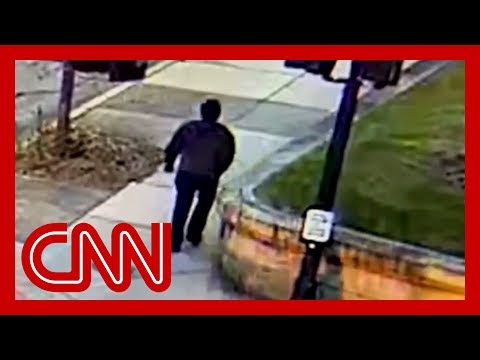
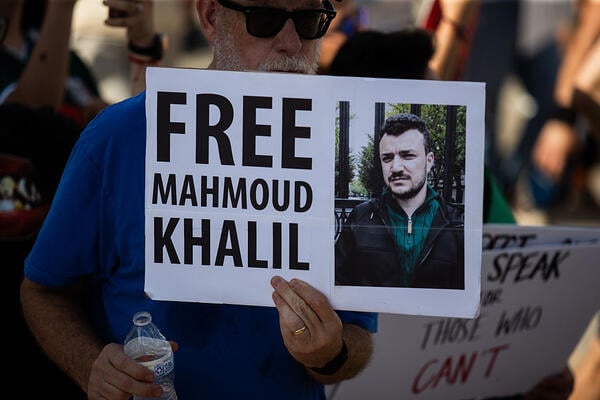
A federal judge ordered that Mahmoud Khalil, the Columbia University graduate and student protest leader who was detained by ICE agents in March, be released from a detention center in Louisiana. News outlets reported that he walked out of the detention center around 6:40 Central time Friday evening.
U.S. District Judge Michael Farbiarz ruled on Friday that Khalil, a legal permanent resident who has not been accused of any crime, should be released on bail and that continuing to hold him was highly unusual and could constitute “unconstitutional” punishment for his political beliefs. The Trump administration had sought to keep Khalil imprisoned based on a minor alleged immigration infraction after another judge ruled earlier this month that it could not continue to hold him purely based on the State Department’s claim that his continued presence in the U.S. posed a foreign policy threat.
Khalil’s arrest made national headlines and kicked off the Trump administration’s months-long campaign of detentions, visa revocations and threats of deportation against international students.

Badar Khan Suri, a postdoctoral fellow and professor at Georgetown University, was released from a federal detention center in Texas on Wednesday after being held for two months.
Suri, an Indian national, was arrested in March under government claims that he was a threat to U.S. interests and had close connections to a known or suspected terrorist. This week a federal judge in Virginia ordered Suri’s immediate release due to a lack of evidence to support such claims.
Suri is one of about a dozen foreign nationals in the U.S. targeted by the Trump administration for pro-Palestinian activism, including Mahmoud Khalil, Mohsen Mahdawi, Rümeysa Öztürk and Momodou Taal. While Khalil remains in custody, Mahdawi was released on bail on April 30 and Öztürk was released from federal custody last week. Taal chose to leave the U.S. in April.
Prior to his arrest, Suri had been in the U.S. for three years on a student visa and was teaching a course on minority rights in South Asia at Georgetown, according to The New York Times. Suri’s lawyers believe he was targeted because his father-in-law served as a political adviser to the Hamas-led government in Gaza in the early 2000s.
Suri was apprehended outside his home in Rosslyn, Va., on March 15 and was moved among detention centers in Virginia, Louisiana and Texas. Suri described his treatment in the Prairieland Detention Center in Texas as subhuman, saying he was chained at the ankles, wrists and body.
Other international academics are locked in legal battles with the federal government over challenges to their standing in the U.S.
A University of Minnesota student, Dogukan Gunaydin, has been in ICE custody since March despite having his case overturned. Alireza Doroudi, who was a doctoral student at the University of Alabama, requested voluntary departure to avoid prolonged detention, according to his attorney. Columbia student Leqaa Kordia was arrested in March and remains in an immigration detention center in Texas.

U.S. District Judge William K. Sessions III ordered Öztürk’s immediate release, stating she had raised “substantial claims” of both due process and First Amendment violations. The 30-year-old Turkish national, who was arrested on March 25 outside her Somerville, Massachusetts home by masked federal agents, had been detained at the South Louisiana ICE Processing Center in Basile, Louisiana—more than 1,500 miles from her university.
“Continued detention potentially chills the speech of the millions and millions of individuals in this country who are not citizens. Any one of them may now avoid exercising their First Amendment rights for fear of being whisked away to a detention center,” Judge Sessions stated during Friday’s hearing.
Öztürk’s legal team argued that her detention was directly connected to her co-authoring a campus newspaper op-ed critical of Tufts University’s response to the war in Gaza. During the hearing, Judge Sessions noted that “for multiple weeks, except for the op-ed, the government failed to produce any evidence to support Öztürk’s continued detention.”
The Trump administration had accused Öztürk of participating in activities supporting Hamas but presented no evidence of these alleged activities in court. Öztürk, who has a valid F-1 student visa, has not been charged with any crime.
Öztürk’s case is part of what appears to be a growing pattern of detentions targeting international students involved in pro-Palestinian activism. Her arrest by plainclothes officers, captured on video showing her being surrounded as she screamed in fear, sparked national outrage and campus protests.
“It’s a feeling of relief, and knowing that the case is not over, but at least she can fight the case while with her community and continuing the academic work that she loves at Tufts,” said Esha Bhandari, an attorney representing Öztürk.
The same day as Öztürk’s release, the U.S. Second Circuit Court of Appeals in New York denied an administration appeal to re-arrest Columbia University student and lawful permanent resident Mohsen Mahdawi, another case involving a student detained after pro-Palestinian advocacy.
During her six weeks in detention, Öztürk, who suffers from asthma, experienced multiple attacks without adequate medical care, according to testimony. At Friday’s hearing, she briefly had to step away due to an asthma attack while a medical expert was testifying about her condition.
Judge Sessions cited these health concerns as part of his rationale for immediate release, noting Öztürk was “suffering as a result of her incarceration” and “may very well suffer additional damage to her health.”
In his ruling, Judge Sessions ordered Öztürk’s release without travel restrictions or ICE monitoring, finding she posed “no risk of flight and no danger to the community.” Despite this clear order, her attorneys reported that ICE initially attempted to delay her release by trying to force her to wear an ankle monitor.
“Despite the 11th hour attempt to delay her freedom by trying to force her to wear an ankle monitor, Rümeysa is now free and is excited to return home, free of monitoring or restriction,” said attorney Mahsa Khanbabai.
by CUPA-HR | November 4, 2021
On November 4, the Department of Labor’s Occupational Safety and Health Administration (OSHA) and the Department of Health and Human Services’ Centers for Medicare & Medicaid Services (CMS) issued their highly anticipated Emergency Temporary Standard (ETS) and interim final rule (IFR) setting vaccination requirements for employers with 100 or more employees and healthcare workers, respectively. Under the new policies, covered employers with 100 or more employees, healthcare workers at facilities participating in Medicare or Medicaid, AND federal contractors requiring vaccinations under Executive Order 14042 (EO) will be required to be fully vaccinated — either two doses of Pfizer or Moderna, or one dose of Johnson & Johnson — by January 4, 2022.
A Fact Sheet announcing the new vaccinations rules provides the following information on the OSHA ETS, CMS IFR and federal contractor vaccination requirements:
In lieu of full vaccination, the OSHA ETS for employers with 100 or more employees (covered employers) also offers the option for unvaccinated employees to produce a verified negative COVID-19 test to employers on at least a weekly basis. OSHA does clarify, however, that the ETS does NOT require employers to provide or pay for tests, but notes that employers may be required to pay for testing due to other laws or collective bargaining agreements.
The ETS also establishes policies that require covered employers to provide paid time off (PTO) for their employees to get vaccinated and, if needed, sick leave to recover from side effects that keep them from working. Additionally, all covered employers will be required to ensure that unvaccinated employees wear a face mask in the workplace. While the testing and vaccination requirements will begin after January 4, the ETS states that covered employers must be in compliance with the PTO for vaccination and masking for unvaccinated workers requirements by December 5, 2021.
Importantly, OSHA clarifies in the ETS that the rule will not apply to workplaces already covered by the CMS IFR, as well as the federal contractor vaccination requirement set forth by President Biden’s EO and the Safer Federal Workforce Task Force’s vaccination guidance.
According to CMS, the IFR requiring full vaccination of healthcare employees applies to employees regardless of whether their positions are clinical or non-clinical and includes employees, students, trainees and volunteers who work at a covered facility that receives federal funding from Medicare or Medicaid. It also includes individuals who provide treatment or other services for the facility under contract or other arrangements. Among the facility types covered by the IFR are hospitals, ambulatory surgery centers, dialysis facilities, home health agencies and long-term care facilities.
In an effort to streamline implementation of the vaccination requirements, the Biden administration is also announcing that the deadline for previously issued federal contractor vaccination requirements will be extended to January 4, 2022, setting one deadline across the three different vaccination policies. The vaccine requirement for federal contractor compliance was previously set for December 8, 2021.
Additionally, as mentioned above, federal contractor employers who may otherwise fall under the OSHA ETS covered employer definition will not be required to follow the rules established under the ETS and must continue compliance with the vaccination guidance and requirements set forth by the EO and Safer Federal Workforce Task Force for federal contractors.
Early reports of the rules also state that both the OSHA ETS and CMS IFR make it clear that their requirements “preempt any inconsistent state or local laws, including laws that ban or limit an employer’s authority to require vaccination, masks or testing.” More information is likely to follow.
Additional information is likely to arise as we learn more from the actual text of the ETS and IFR. CUPA-HR will keep members apprised of all new information.
