Tag: Relevant

  • Higher Education Inquirer : Art Laffer at YAF: Still Relevant, Still Wrong

    Higher Education Inquirer : Art Laffer at YAF: Still Relevant, Still Wrong

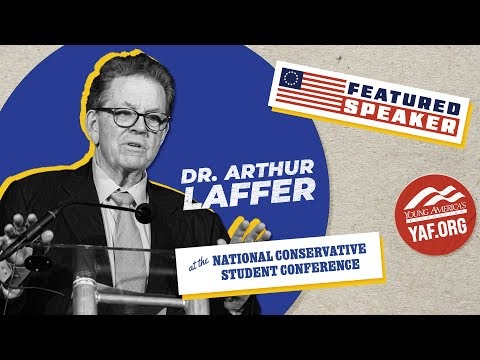
    Arthur Laffer, the Reagan-era economist best known for the “Laffer Curve,” appeared recently at a Young America’s Foundation (YAF) event, still making the same tired claims that have shaped decades of economic inequality, deregulation, and magical thinking. The event, broadcast on C-SPAN, was marketed as a fresh take on conservative economics. What it delivered instead was a rerun of discredited supply-side talking points—punctuated by jokes that fell embarrassingly flat.

    Laffer claimed that Donald Trump’s tariffs were a strategy to bring about more free trade in the future—a baffling contradiction to anyone who understands trade policy or the basics of coercive economic diplomacy. The idea that protectionism is a roundabout route to free markets would be laughable if it weren’t so destructive. But Laffer, like many libertarians, thrives on contradiction. The audience—young, mostly white, mostly male—nodded along as if it all made sense.

    He also defended increased U.S. military spending, invoking Ronald Reagan’s 1980s arms buildup. What he didn’t mention: Reagan was in the early stages of dementia during his presidency, and his military strategy deepened the national debt, even as Laffer’s beloved tax cuts starved the government of revenue. That context never surfaced, of course.

    Laffer’s appearance was followed by Linda McMahon, former WWE executive and Small Business Administration head under Trump. The tag team pairing reinforced the spectacle of right-wing economic theater disguised as intellectual discourse.

    YAF, a competitor to Turning Point USA, presents itself as the more polished brand of conservative youth organizing. It’s backed by deep pockets and institutional support, but its message remains the same: glorify the market, demonize government, and elevate charisma over critical thinking. Its speakers are well-coached in rhetorical sparring, skilled in sophistry, and eager to exploit the inexperience of their college-aged audience.

    Laffer fits that mold perfectly. He’s less a thought leader than a relic of failed policy, propped up by a movement that rewards ideological loyalty over intellectual honesty. His ideas can’t really be called “theories” anymore—empirical evidence has repeatedly debunked them. But among libertarians and the far right, evidence is optional, and repetition is persuasive.

    Young America’s Foundation is adept at drawing youth into a worldview of individualism that rarely benefits individuals. It relies on the passion and ignorance of its followers, asking them to embrace contradictions: that tariffs bring freedom, that debt from war is freedom, that cutting taxes magically increases revenue. It’s a faith-based economics, and Laffer remains its high priest.

    In the end, the only thing more stale than the Laffer Curve is the attempt to keep it alive.

    Sources:

    • C-SPAN: Art Laffer speech at YAF

    • Reagan’s Alzheimer’s revelations: The New York Times

    • Critiques of supply-side economics: Brookings, Economic Policy Institute

    • YAF background: Media Matters, The Nation

    Source link

  • How should higher education respond to calls to be relevant?

    How should higher education respond to calls to be relevant?

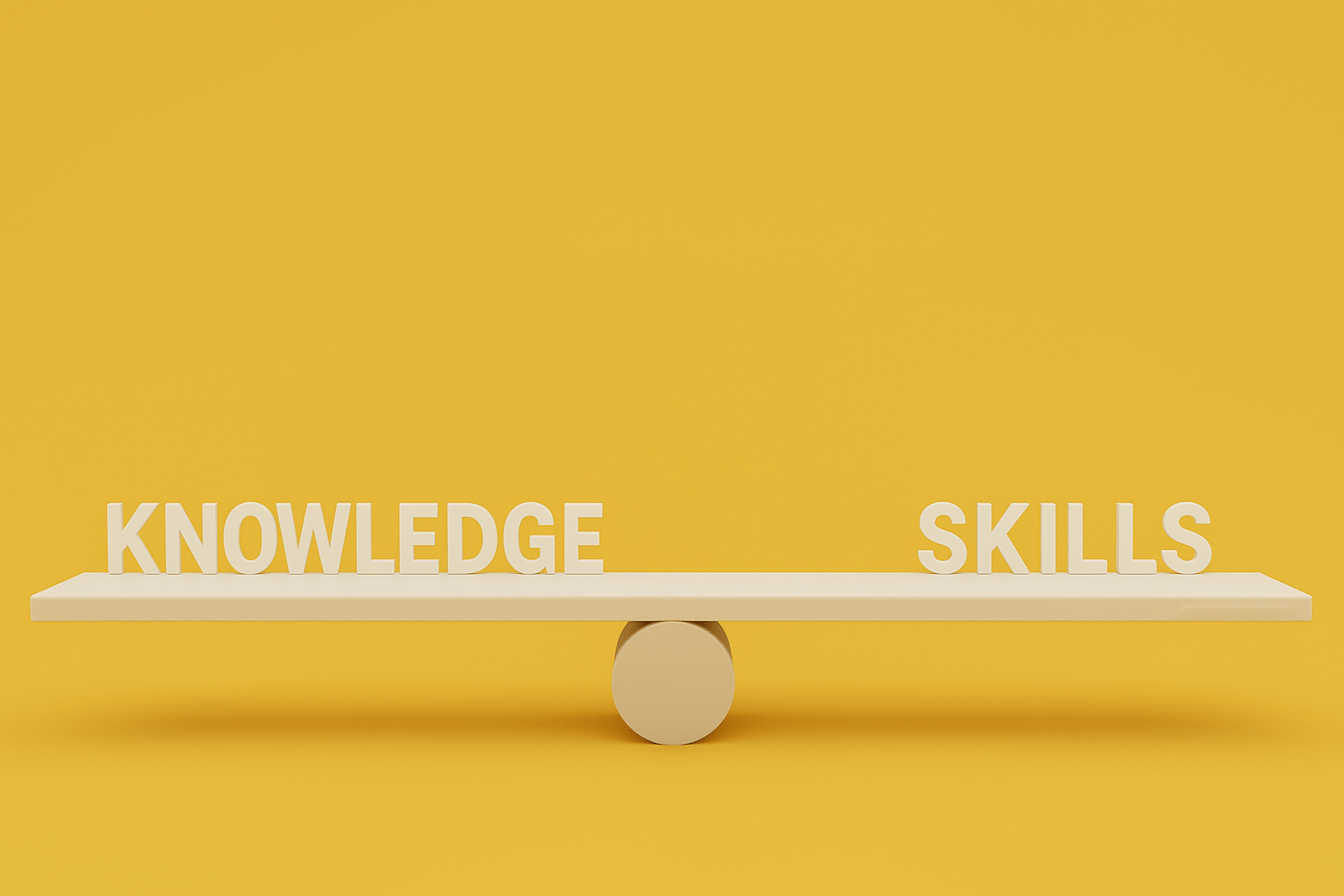
    In their examination of ten trends that will shape the future of the campus university, Edward Peck, Ben McCarthy and Jenny Shaw set out a compelling account of the factors that will shape English higher education. As a result of these factors, they argue that, in the future, ‘Academic awards will focus as much on the development of employment and generic skills as the acquisition and retention of specific knowledge’. Given that it is co-authored by a long-standing vice chancellor, who will shortly take on the role of the Chair of the higher education regulator, this can be read as an urgent call for higher education to be clear about how it produces graduates who will make important contributions to society.

    While I agree that higher education needs to be open to discussing the value of its education for graduates and society, I do not think a convincing case can be made by focusing on the distinction between generic skills and specific knowledge. Instead, my argument is that higher education needs to develop a much better account of how the knowledge that students engage with through their degrees prepares them to make important contributions to society. There are four elements to this. 

    First, the development of generic skills and the acquisition of specific knowledge are not alternative educational objectives for degree programmes. Rather, they are different elements of a rich educational environment. More fundamentally, the educational power of higher education does not lie in either of these options. What is educationally powerful about higher education is the way in which it offers students access to structured bodies of knowledge. Seeing these bodies of knowledge from the inside gives students and graduates the opportunity to view themselves and the world differently. It is the structure of these bodies of knowledge that allows students and graduates to develop ways of engaging with the world that make use of this knowledge and related skills in a diverse range of contexts. Generic skills and specific knowledge are generated as part of this engagement with structured bodies of knowledge, but they are not where the educational treasure of higher education lies. Indeed, our seven-year international longitudinal study of those who studied degrees in Chemistry and in Chemical Engineering found that those who focused on specific knowledge rather than the ways of engaging with the world they gained from their degrees tended to benefit less from their education. 

    Second, showing that higher education is about gaining access to structured bodies of knowledge explains why it requires programmatic study over the three or four years of a degree. If it were simply about generic skills or specific knowledge, then there would be no need for the systematic and sustained engagement that we currently demand of students. Presenting higher education as about generic skills or specific knowledge risks it appearing very obvious that demanding several years of sustained study is an unnecessary and expensive luxury. It is only by showing the importance of students’ gaining access of bodies of knowledge that we can explain why alternative forms of higher education that are already boxing higher education in, such as micro-credentials, are not up to the job of supporting students to see these bodies of knowledge from the inside and engaging with the world from the perspective of this knowledge.

    Third, understanding the importance of the structured nature of this knowledge helps to highlight the importance of producing graduates from a rich diversity of disciplinary, interdisciplinary and professional subjects, who engage with the world in different ways. Addressing the challenges facing the world will require drawing on the diversity of these perspectives which cannot be gained through being taught generic skills or unconnected stores of specific knowledge.

    Fourth, ensuring that higher education maintains its focus on structured bodies of knowledge is key to challenging educational inequalities. Otherwise, it is entirely predictable that the education offered by ‘elite’ institutions will remain focused on structured bodies of knowledge while ‘mass’ higher education shifts to focus on generic skills. Given that those with the greatest resources are most likely to access elite higher education, the poor will be left with an education that leaves them rooted in the contexts in which they have developed their generic skills whereas the privileged will benefit from the ways in which structured bodies of knowledge support them to move between contexts.

    The great higher education advocate David Watson urged universities and academics to ‘guard your treasure’. The treasure of higher education is the collective structured bodies of knowledge that we are stewards of for society. Our role is to support society and students to understand the power of this knowledge and what it can do in the world. In response to the important questions raised by Edward Peck, Ben McCarthy and Jenny Shaw, we need to develop much more compelling accounts of how access to these structured bodies of knowledge provides an education that is qualitatively different from an education focused on developing generic skills and specific knowledge. We need to show how this qualitative difference is crucial in offering a relevant education that has the potential to change students and society.  If we fail to do this, then we are in great danger of throwing away our greatest treasure.

    Source link

  • Higher Education Inquirer : Higher Education Inquirer: Increasingly Relevant

    Higher Education Inquirer : Higher Education Inquirer: Increasingly Relevant

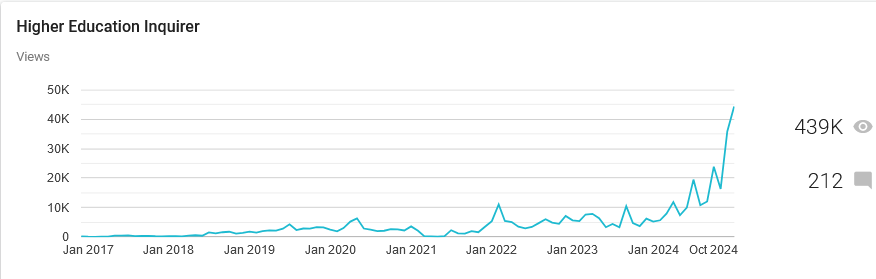
    The Higher Education continues to grow. We believe our growth stems largely from our increasing relevance and in our truth telling, which other higher education news outlets are unwilling to do in these times.

    Our devotion to transparency, accountability, and value for our readers guides us. 

    We invite a diverse group of guest authors who are willing to share their truths. The list includes academics from various disciplines, advocates, activists, journalists, consultants, and whistleblowers. We back up all of this work with data and critical analysis, irrespective of politics and social conventions. We are willing to challenge the higher education establishment, including trustees, donors, and university presidents.

    Our articles covering student loan debt, academic labor, nonviolent methods of protest, and freedom of speech are unparalleled. And we are not shy about including other issues that matter to our readers, including stories and videos about mental health, student safety, technology (such as artificial intelligence), academic cheating, and the nature of work.  And matters of of war, peace, democracy, and climate change

    Our focus, though mainly on US higher education, also has an international appeal

    Some of our work takes years to produce, through careful documentation of primary and secondary sources, database analysis, and Freedom of Information Act (FOIA) requests. We share all of this information for everyone to see, at no cost.  

    Of course, we could not operate without all your voices. We welcome all your voices. Something few other sources are willing to do.    

    Source link