Tag: remove

  • George Mason demands pro-Palestinian student group remove video from social media, but public universities can’t do that

    George Mason demands pro-Palestinian student group remove video from social media, but public universities can’t do that

    Late last month, the student chapter of Students for Justice in Palestine at George Mason University posted a video on a social media account that criticized U.S. foreign policy and Israel. The video (now removed), which apparently stylistically mimicked a Hamas video, included phrases such as “genocidal Zionist State,” “the belly of the beast,” and “from the river to the sea.” It also specifically addressed conditions in Gaza and GMU’s alleged oppression of pro-Palestinian protestors. 

    Regardless of one’s views on Israel and Gaza, all of this is protected speech. But rather than protecting student political discourse, GMU demanded the SJP chapter take down the video explicitly because its language ran afoul of the International Holocaust Remembrance Alliance’s vague definition of antisemitism, which has been incorporated into GMU’s anti-discrimination policy. The school warned that failure to comply could result in disciplinary action.  

    Student groups at public universities have the First Amendment right to post videos expressing their views on international conflicts, even if some members of the campus community are offended by the viewpoints expressed. We’ve seen no evidence the video constituted incitement, true threats, intimidation, or student-on-student harassment — narrow categories of speech unprotected by the First Amendment.

    When campus administrators invoke the IHRA definition and its examples to investigate, discipline, or silence political expression, the distinction between conduct and speech becomes meaningless.

    This is not the first — nor will it be the last — instance of universities relying on vague, overbroad anti-harassment definitions to censor speech some members of the campus community find offensive. In fact, overbroad anti-harassment policies remain the most common form of speech codes on college campuses. But it does point to the clear and growing threat the use of the IHRA definition poses to campus discourse about the Israel-Palestine conflict. It’s a danger about which FIRE has warned of since 2016, a danger we’ve seen in application, and one that the IHRA definition’s supporters routinely brush aside. As more and more states adopt IHRA for the purpose of enforcing anti-discrimination law, we’re likely to see increasingly more instances of campus censorship in the future.

    IHRA defines antisemitism as:

    a certain perception of Jews, which may be expressed as hatred toward Jews. Rhetorical and physical manifestations of antisemitism are directed toward Jewish or non-Jewish individuals and/or their property, toward Jewish community institutions and religious facilities.

    The document also provides a list of examples of antisemitism that include, among others:

    • Applying double standards by requiring of [Israel] a behavior not expected or demanded of any other democratic nation.
    • Drawing comparisons of contemporary Israeli policy to that of the Nazis.

    Language that does this (and that does not also fall into a specific category of unprotected speech) may offend some or many people. It nevertheless constitutes core political speech. Supporters of the use of the IHRA definition on campus insist that the definition does not restrict free speech, but rather helps identify antisemitic intent or motive when determining whether a student has created a hostile environment in violation of anti-discrimination laws. But this attempted distinction collapses in practice. 

    When “intent” is inferred from political expression — as it has at GMU and other campuses across the country — speech itself becomes evidence of a violation. Under this framework, students and faculty learn that certain viewpoints about Israel are per se suspect, and both institutional censorship and self-censorship follow. Despite its defenders’ claims, when campus administrators invoke the IHRA definition and its examples to investigate, discipline, or silence political expression, the distinction between conduct and speech becomes meaningless.

    Analysis: Harvard’s settlement adopting IHRA anti-Semitism definition a prescription to chill campus speech

    Harvard agreed to settle two lawsuits brought against it by Jewish students that alleged the university ignored “severe and pervasive antisemitism on campus.”


    Read More

    The problem is compounded by the Trump administration’s Title VI enforcement. Its unlawful defund-first, negotiate-second approach places universities’ federal funding — sometimes hundreds of millions or even billions of dollars — at the mercy of the administration’s Joint Antisemitism Task Force. That threat alone is enough to force campus administrators to make a choice: censor student speech critical of Israel, or risk losing access to federal funding. All too often, as we have seen repeatedly, institutions choose access to money over standing up for student rights.

    Instead of relying on IHRA’s vague definition for anti-discrimination purposes, FIRE has long supported efforts to constitutionally and effectively address antisemitic discrimination on college campuses by passing legislation to: 

    • Prohibit harassment based on religion.
    • Confirm that Title VI prohibits discrimination based on ethnic stereotypes.
    • Codify the Supreme Court’s definition of discriminatory harassment. 

    These options would better address antisemitic harassment and would do so without suppressing free speech.

    Source link

  • Proposal would remove federal data collection for special education racial disparities

    Proposal would remove federal data collection for special education racial disparities

    This audio is auto-generated. Please let us know if you have feedback.

    The U.S. Department of Education is proposing to remove a requirement for states to collect and report on racial disparities in special education, according to a notice being published in the Federal Register on Friday.  

    The data collection is part of the annual state application under Part B of the Individuals with Disabilities Education Act. The application provides assurances that the state and its districts will comply with IDEA rules as a condition for receiving federal IDEA funding. 

    The data collection for racial overrepresentation or underrepresentation in special education — known as significant disproportionality — helps identify states and districts that have racial disparities among student special education identifications, placements and discipline. About 5% of school districts nationwide were identified with significant disproportionality in the 2020-21 school year, according to federal data.

    The Education Department said it wants to remove the data collection because the agency anticipates it will reduce paperwork burdens for the states. According to several state Part B applications filed earlier this year, the significant disproportionality data collection adds more hours in paperwork duties. 

    For example, Florida’s application said it records an average of 25 additional hours for responses reporting data related to significant disproportionality in any given year, including the time for reviewing instructions, searching existing data sources, gathering and maintaining the data needed, and completing and reviewing the collection of information. Alabama’s and Oregon’s applications also cite an additional 25 hours each for the collections. 

    The department has not said it wants to rescind or pause the significant disproportionality regulation, a rule known as Equity in IDEA, which was last updated in 2016. 

    However, under the first Trump administration, the rule became a hot button issue when then-U.S. Education Secretary Betsy DeVos said its implementation would be delayed. 

    The Council of Parent Attorneys and Advocates, a nonprofit supportive of education rights for students with disabilities, sued the Education Department and won, and by April 2019, the rule was back in full effect. 

    Denise Marshall, CEO of COPAA said in a Thursday email to K-12 Dive that the proposal to remove the Equity in IDEA federal data collection was “yet another unlawful attempt by the Administration to shirk its obligations under the law to students of color.”

    Marshall added that the data collection fulfills a critical role in enforcing the significant disproportionality requirement in IDEA. The collection allows states and districts to examine the data, determine if there is racial disproportionality, and develop measures to address the problem. Marshall points out that IDEA does not declare significant disproportionality unlawful. Rather, the law and regulations provide a method for states and districts to address systemic racial disproportionality in special education.  

    Robyn Linscott, director of education and family policy at The Arc, an organization that advocates for people with intellectual and developmental disabilities, said that even if in the future there is no longer a data collection for significant disproportionality at the federal level, the information would still need to be collected by states and districts as required by IDEA.

    But the loss of the central repository of information on significant disproportionality in schools will make it more difficult for advocacy groups and technical assistance centers to support school and district efforts to reduce racial disparities in special education.

    In the absence of the data being available at the federal level, it will be “much more difficult” for people not within a state education agency to be able to access the data, Linscott said.

    Correction: A previous version of this article erred in spelling out the IDEA acronym. It stands for the Individuals with Disabilities Education Act. We have updated our story.

    Source link

  • Let’s remove the roadblocks to four-year STEM degrees for community college transfer students

    Let’s remove the roadblocks to four-year STEM degrees for community college transfer students

    In the nearly two years since the U.S. Supreme Court struck down race-conscious admissions, there have been repeated calls for universities to address the resulting decline in diversity by recruiting from community colleges.  

    On the surface, encouraging students to transfer from two-year colleges sounds like a terrific idea. Community colleges enroll large numbers of students who are low-income or whose parents did not attend college. Black and Latino students disproportionately start college at these institutions, whose mission for more than 50 years has been to expand access to higher education. 

    But while community colleges should be an avenue into high-value STEM degrees for students from low-income backgrounds and minoritized students, the reality is sobering: Just 2 percent of students who begin at a community college earn a STEM bachelor’s degree within six years, our recent study of transfer experiences in California found.  

    There are too many roadblocks in their way, leaving the path to STEM degrees for community college students incredibly narrow. A key barrier is the complexity of the process of transferring from a community college to a four-year institution. 

    Related: Interested in innovations in higher education? Subscribe to our free biweekly higher education newsletter. 

    Many community college students who want to transfer and major in a STEM field must contend with three major obstacles in the transfer process: 

    1. A maze of inconsistent and often opaque math requirements. We found that a student considering three or four prospective university campuses might have to take three or four different math classes just to meet a single math requirement in a given major. One campus might expect a transfer student majoring in business to take calculus, while another might ask for business calculus. Still another might strongly recommend a “calculus for life sciences” course. And sometimes an institution’s website might list different requirements than a statewide transfer site. Such inconsistencies can lengthen students’ times to degrees — especially in STEM majors, which may require five- or six-course math sequences before transfer.  

    2. Underlying math anxiety. Many students interviewed for the study told us that they had internalized negative comments from teachers, advisers and peers about their academic ability, particularly in math. This uncertainty contributed to feelings of anxiety about completing their math courses. Their predicament is especially troubling given concerns that required courses may not contribute to success in specific fields. 

    3. Course scheduling conflicts that slow students’ progress. Two required courses may meet on the same day and time, for example, or a required course could be scheduled at a time that conflicts with a student’s work schedule. In interviews, we also heard that course enrollment caps and sequential pathways in which certain courses are offered only once a year too often lengthen the time to degree for students. 

    Related: ‘Waste of time’: Community college transfers derail students 

    To help, rather than hinder, STEM students’ progress toward their college and professional goals, the transfer process needs to change significantly. First and foremost, universities need to send clear and consistent signals about what hoops community college students should be jumping through in order to transfer.  

    A student applying to three prospective campuses, for example, should not have to meet separate sets of requirements for each. 

    Community colleges and universities should also prioritize active learning strategies and proven supports to combat math anxiety. These may include providing professional learning for instructors to help them make math courses more engaging and to foster a sense of belonging. Training for counselors to advise students on requirements for STEM pathways is also important.  

    Community colleges must make their course schedules more student-centered, by offering evening and weekend courses and ensuring that courses required for specific degrees are not scheduled at overlapping times. They should also help students with unavoidable scheduling conflicts take comparable required courses at other colleges. 

    At the state level, it’s critical to adopt goals for transfer participation and completion (including STEM-specific goals) as well as comprehensive and transparent statewide agreements for math requirements by major. 

    States should also provide transfer planning tools that provide accurate and up-to-date information. For example, the AI Transfer and Articulation Infrastructure Network, led by University of California, Berkeley researchers, is using artificial intelligence technology to help institutions more efficiently identify which community college courses meet university requirements. More effective tools will increase transparency without requiring students and counselors to navigate complex and varied transfer requirements on their own. As it stands, complex, confusing and opaque math requirements limit transfer opportunities for community college students seeking STEM degrees, instead of expanding them. 

    We must untangle the transfer process, smooth pathways to high-value degrees and ensure that every student has a clear, unobstructed opportunity to pursue an education that will set them up for success. 

    Pamela Burdman is executive director of Just Equations, a California-based policy institute focused on reconceptualizing the role of math in education equity. Alexis Robin Hale is a research fellow at Just Equations and a graduate student at UCLA in Social Sciences and Comparative Education.  

    Contact the opinion editor at [email protected]. 

    This story about community college transfers was produced by The Hechinger Report, a nonprofit, independent news organization focused on inequality and innovation in education. Sign up for Hechinger’s weekly newsletter. 

    The Hechinger Report provides in-depth, fact-based, unbiased reporting on education that is free to all readers. But that doesn’t mean it’s free to produce. Our work keeps educators and the public informed about pressing issues at schools and on campuses throughout the country. We tell the whole story, even when the details are inconvenient. Help us keep doing that.

    Join us today.

    Source link

  • Michigan Governor Declines to Remove Two MSU Trustees

    Michigan Governor Declines to Remove Two MSU Trustees

    After more than a year of uncertainty, Michigan governor Gretchen Whitmer has decided not to remove two Michigan State University trustees as requested by the board, The Lansing State Journal reported.

    Michigan State’s Board of Trustees asked the Democratic governor to remove Rema Vassar and Dennis Denno last year after a university investigation found both trustees violated MSU’s code of conduct. The investigation determined that the pair had “created a fear of retaliation amongst administrators and other MSU personnel,” according to the report, which said they encouraged students to call a frequently critical faculty member a racist. Vassar also accepted gifts from donors, including flights and tickets to athletic events, the report said.

    (Vassar and Denno are currently facing a lawsuit from the professor they allegedly targeted.)

    The report also found the duo intended to “embarrass and terrify” former interim president Teresa Woodruff. The trustees have refuted most allegations and taken issue with the findings.

    Both trustees were stripped of their duties by the board and Vassar stepped down as chair.

    While Whitmer called Vassar and Denno’s actions “shameful,” she decided not to remove her fellow Democrats. (Trustees at Michigan State are elected, unlike at most institutions nationally.)

    “The denial of the request by no means indicates a condoning of the conduct alleged in the referral,” Whitmer’s deputy legal counsel Amy Lishinski wrote in a letter to the MSU board obtained by the newspaper. “Rather, it only means that other considerations related to the Governor’s removal authority weigh against removal under these circumstances at this time.”

    Source link

  • Columbia University vows to remove any future encampments

    Columbia University vows to remove any future encampments

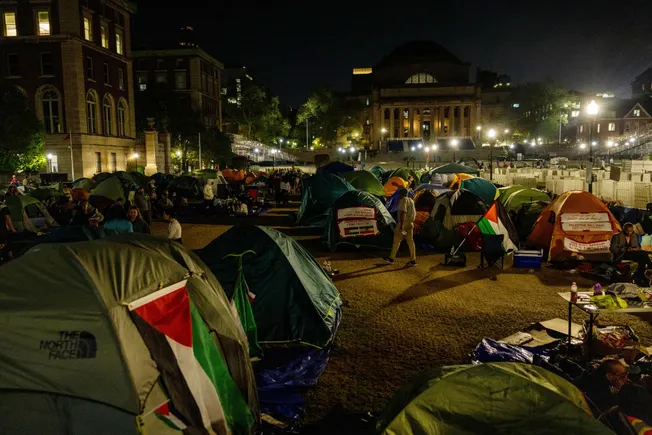
    Columbia University officials said Wednesday they would immediately remove any future encampments on campus and threatened demonstrators with arrest amid reports that students were planning another wave of pro-Palestinian protests. 

    We have been made aware of possible plans to establish encampments on Columbia’s campuses,” the New York institution said in a public safety notice. “We want to clearly communicate that camping and encampments on Columbia’s campuses are prohibited by University Policy.”

    More than 100 people wearing masks to hide their identities met Tuesday to discuss establishing multiple encampments at Columbia this week, according to an NBC News report based on anonymous sources and a recording of the meeting. 

    At the time, the protesters intended to begin demonstrating at Columbia’s main campus in the Morningside Heights neighborhood on Thursday, followed by the Ivy League institution’s Manhattanville location on Friday, NBC reported Wednesday. 

    The planned demonstrations would come about a year after Columbia students first erected an encampment to protest the Israel-Hamas war and call on the university to divest from companies with links to Israel. The encampment at Columbia kicked off similar demonstrations across the nation’s colleges, stoking anger from conservative lawmakers and leading to hundreds of student arrests. 

    Since then, the university said it has hired more public safety officers, increased campus patrols and restricted access to its main campus.

    Still, President Donald Trump threatened to pull federal funding from colleges that don’t crack down on “illegal protests” in a March social media post that drew backlash from free speech and civil rights advocates.

    The Trump administration made good on this threat when it pulled $400 million in federal contracts and grants from Columbia in March, claiming it was yanking the funding over concerns the university hasn’t done enough to protect Jewish students from harassment. The administration has since pulled large swaths of fundingor threatened to — from other well-known colleges over similar allegations.

    A growing number of lawmakers, free speech experts and academics are accusing Trump of weaponizing antisemitism to target colleges. On Thursday, five Jewish Democratic senators lambasted the president for using “what is a real crisis as a pretext to attack people and institutions who do not agree with you.”

    “By doing so, he not only fails to address the threat of antisemitism but also exploits it to delegitimize higher education, while often ignoring or downplaying the rise of antisemitism within his own party,” they said in a statement.

    Last month, Columbia ceded to several demands from the Trump administration — including revamping its protest policies — with the hopes of retaining access to its federal funding

    U.S. Education Secretary Linda McMahon, along with other federal officials, has praised the university’s compliance. But the Trump administration has yet to publicly reinstate its funding and is reportedly pursuing a consent decree against Columbia, which would give a federal judge oversight of the institution’s compliance with the administration’s demands. 

    The administration is facing at least one lawsuit over allegations that it is overstepping its authority at Columbia.

    If protesters establish a new encampment at Columbia, the university vowed to immediately remove tents and other structures, restrict access to the campus and instruct demonstrators to leave, according to Wednesday’s announcement. If they don’t leave, they could face “removal from campus and possible arrest,” Columbia’s notice said. 

    Source link

  • Gov. Hochul orders CUNY to remove Palestine scholar job post

    Gov. Hochul orders CUNY to remove Palestine scholar job post

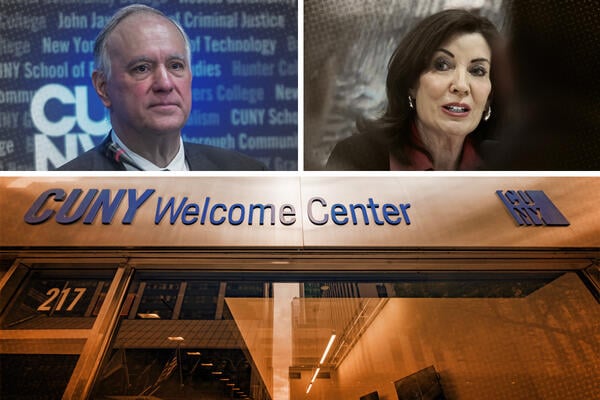
    New York governor Kathy Hochul took an unusual interest in the hiring practices of the City University of New York on Tuesday when she ordered the public system to take down a job posting for a professorship in Palestinian studies at Hunter College.

    CUNY quickly complied, and faculty at Hunter are up in arms over what they call a brazen intrusion into academic affairs from a powerful state lawmaker.

    The job posting was for “a historically grounded scholar who takes a critical lens to issues pertaining to Palestine including but not limited to: settler colonialism, genocide, human rights, apartheid, migration, climate and infrastructure devastation, health, race, gender, and sexuality.”

    “We are open to diverse theoretical and methodological approaches,” the posting continued.

    In a statement Tuesday night, Hochul said the posting’s use of the words “settler colonialism,” “genocide” and “apartheid” amounted to antisemitic attacks and ordered CUNY to “immediately remove” the posting.

    A few hours later, CUNY complied, and system chancellor Félix Matos Rodríguez echoed Hochul’s criticisms of the posting.

    “We find this language divisive, polarizing and inappropriate and strongly agree with Governor Hochul’s direction to remove this posting, which we have ensured Hunter College has since done,” he wrote in a statement.

    Hochul also directed the university system to launch an investigation at Hunter “to ensure that antisemitic theories are not promoted in the classroom.” Matos Rodríguez appeared to imply the system would follow that order as well, saying, “CUNY will continue working with the Governor and other stakeholders to tackle antisemitism on our campuses.”

    A CUNY spokesperson declined to say whether the system would launch a probe into the posting at Hunter but wrote in an email that “each college is responsible for its own faculty job posting.”

    Hochul’s order came after pro-Israel activists, including a former CUNY trustee and current professor, publicly voiced concerns about the posting.

    “To make a Palestinian Studies course completely about alleged Jewish crimes is akin to courses offered in the Nazi era which ascribed all the world’s crimes to the Jews,” Jeffrey Weisenfeld, who served as a CUNY trustee for 15 years, told The New York Post.

    Faculty at Hunter are livid about the decision, according to multiple professors who spoke with Inside Higher Ed both on the record and on background. They say it’s a concerning capitulation to political pressure from an institution they long believed to be staunchly independent.

    One longtime Hunter and CUNY Graduate Center professor, who spoke with Inside Higher Ed on the condition of anonymity out of fear for their job, said faculty across the system were “outraged at this craven act by our governor and our chancellor.”

    “It shows that [Matos Rodríguez] has no commitment to academic freedom or moral compass that would allow him to stand up at this moment of political repression,” they said.

    CUNY’s Professional Staff Congress, the union representing more than 30,000 faculty and staff members across the system’s 25 campuses, wrote a letter to Matos Rodriguez on Wednesday evening condemning the posting removal and calling on leadership to reverse their decision.

    “An elected official dictating what topics may be taught at a public college is a line that should not be crossed,” the letter reads. “The ‘divisive concepts’ standard for universities is something devised in Florida that shouldn’t be exported to New York. What’s needed are inclusive ways of teaching, not canceling concepts and areas of study.”

    It was unclear Wednesday whether the job posting would be edited and reposted or if the opening would be eliminated. A CUNY spokesperson declined to respond to questions about the job’s future, but the anonymous faculty member said they believed Hunter officials were revising the post, intending to relist it.

    The anonymous professor said they were worried that Hunter president Nancy Cantor, who took on the role last August after leading Rutgers University–Newark for a decade, could face severe scrutiny after the posting.

    “We fully support this initiative by our president to make this Palestinian studies cluster hire,” the anonymous professor said. “I’m very worried about Nancy Cantor’s tenure at Hunter. I think this is part of a campaign by the far right to get rid of Félix [Matos Rodríguez], and it would not surprise me in the least if he threw Nancy Cantor under the bus to save his own skin.”

    Heba Gowayed, an associate professor of sociology at Hunter, said she was shocked that Hochul had made the job posting a priority, especially as threats to academic freedom and attacks on higher education from Republicans are intensifying.

    “This is an unprecedented overstep in authority, but instead of coming from Republicans, it’s coming from a Democrat in one of the bluest states in the country,” she said. “They’re the ones that are supposed to be fighting to protect academic freedom. This is a tremendous abdication of that responsibility.”

    ‘A Climate of Fear’

    The anonymous professor said their colleagues are grappling with contending emotions: rage and fear. There’s a great appetite to speak up, they said, but they also feel it’s more dangerous than ever, even for tenured faculty.

    “People are worried across the board,” they said. “That is the kind of climate of fear that this sort of action creates.”

    It’s not the first time CUNY has responded to pressure from pro-Israel activist groups in faculty workforce decisions. Since the Oct. 7, 2023, Hamas attacks, CUNY institutions have declined to renew contracts for two vocally pro-Palestinian professors: Danny Shaw at John Jay College of Criminal Justice, who says he was the target of a pro-Israel pressure campaign to get him fired after 18 years of teaching, and lecturer Lisa Hofman-Kuroda at Hunter, who was reported for pro-Palestinian social media posts.

    Shaw, who is currently suing CUNY for breach of contract, told Inside Higher Ed that the decision to remove the job posting did not surprise him.

    “This is McCarthyism 2.0,” he said. “Administrators won’t protect us. It’s been made pretty clear that at the end of the day, it’s either their necks on the chopping block or ours.”

    Last spring, when the student-led pro-Palestinian encampment protests spread from Columbia University across town to the City College of New York, CUNY leadership drew criticism for calling the New York Police Department to disperse students. Gowayed said that decision shocked faculty across the system, who took pride in their institution’s progressive reputation and history of academic integrity.

    Even then, she said she was “disturbed that they have let it get to this higher level of censoring faculty for a completely legitimate job posting.”

    The Palestinian studies position was one of two Hunter planned to hire, and Gowayed said faculty and leadership at Hunter had been supportive of the plans to expand their research and teaching capacity in an area of growing interest.

    “Whatever your feelings on Palestine, this is a research area in a widely recognized field of scholarship on genocide and apartheid,” Gowayed said. “These are well-established fields, whether you’re studying the Belgian Congo or Rwanda or Palestine, and the posting wasn’t even saying what approach the faculty should take … The reaction to this posting is so discrepant from the actual academic integrity of the job search.”

    Source link