Tag: rent

  • Removing the rent guarantor barrier to safe and stable accommodation

    Removing the rent guarantor barrier to safe and stable accommodation

    Universities talk about widening participation – but how many ensure every student has a home to go to, so they really can participate?

    Rent guarantor requirements are a routine part of student housing, yet they exclude those without family support. It’s time for the sector to take responsibility for removing this barrier.

    Most students will need a rent guarantor to secure university halls or private housing.

    Imagine how much harder that is if you can’t turn to family members for that support – often the case for young people that have experience of the care system or are estranged from their parents.

    Young people in this position can face sofa surfing, dangerous housing situations and dropping out of university. According to NUS research in 2024, 14 per cent of low-income students are reconsidering university due to accommodation costs – with guarantor requirements cited as a major barrier.

    Lack of information is a compounding issue. Students without easy access to a guarantor might not even know they need one until the moment they go to sign a new contract with peers – often with whom they have not shared their status and only known for a matter of weeks.

    Getting things clear

    At the Unite Foundation, we encourage all universities to include clear information about rent guarantors on their housing webpages and on any other pages specifically for students like care leavers, estranged, or international students. It’s vital that any student without UK family to rely on knows what a rent guarantor is before having to suddenly find one or miss out on a home at university.

    In Summer 2025, we commissioned a student-led audit of over 180 university websites. 60% included clear information about rent guarantors. This is positive progress, up from 45% in 2024 and 36% in 2022 when we started this work. But that’s still 40% of university websites that don’t provide clear information about this key element of the university accommodation journey.

    Impact of Renters Rights Act

    When the Renters Rights Act comes into force in 2026, it will shift the challenge faced by students unable to secure a guarantor.

    Despite lobbying by NUS for the abolition of guarantor requirements entirely, the Act will not stop landlords from requiring a guarantor, but it will limit upfront rent payments to a maximum of one month’s rent.

    Whilst a positive step for the majority of students, the unintended consequence may be to prevent students who are unable to source a guarantor from making a large advance rent payment instead. Paying large advances causes its own set of issues for students, but is often seen as the lesser of two evils compared to homelessness.

    It’s anticipated that the legislation may stimulate an increased market for commercial guarantor providers. Commercial providers – companies which act as guarantor for a fee – can be a valuable service, but it is a varied market that sits outside Financial Conduct Authority regulation.

    Emerging fees can be between 4 and 15 per cent of annual rent if paying upfront, and up to 20 per cent if paying monthly. Disadvantaged students paying an unregulated premium to access a routine tenancy would be a perverse outcome of measures intended to strengthen tenant rights.

    What are the alternatives?

    The Unite Foundation has launched our Blueprint for a #HomeAtUniversity – a guide to support universities in ensuring a safe and stable home for care experienced and estranged students. We set out six areas through which universities and PBSA providers can use housing as a widening participation tool. And removing the rent guarantor barrier is one of these.

    We know that the context of each university is different, and there are different ways to approach removing the rent guarantor barrier.

    Universities like Imperial and Cardiff offer their own guarantor schemes. Some university halls don’t require a guarantor at all. Other universities cover the cost of a commercial guarantor provider, through a negotiated partnership between provider and university.

    And it’s great to see Unite Students, our founder and long-term champion, pilot an approach enabling their university partners to step into the role of guarantor for care-experienced and estranged students, at zero cost or risk.

    Availability of safe, affordable accommodation is at the heart of many current social policy debates and like wise is fundamental to the sustainability and accessibility of higher education.

    There are significant structural issues at a national level in ensuring a home at university for all students – including lack of coordination between universities and local authorities and the level of student maintenance loan. At the Unite Foundation, we do not believe that practice in universities and PBSA providers should replace systemic change. But we also believe that whilst we wait for that change, there is more impact that accommodation providers at university can make.

    At the Unite Foundation we are here to help with case studies and peer support webinars sharing what is happening on the ground in the sector. If you deliver an intervention evidenced to support a safe and stable home at university for care experienced and estranged students, or if you want to learn more about what your university could be doing, please get in touch.

    A safe and stable #HomeAtUniversity isn’t a luxury — it’s a prerequisite for participation, success, and equity in higher education.

    Source link

  • Intl students not behind rent crisis: RBA – Campus Review

    Intl students not behind rent crisis: RBA – Campus Review

    A Reserve Bank of Australia (RBA) analysis has found the post-pandemic international student boom only marginally drove up the price of rent and inflation.

    Please login below to view content or subscribe now.

    Membership Login

    Source link

  • AUD $50bn net gain from students with minimal rent price impact

    AUD $50bn net gain from students with minimal rent price impact

    International students are not responsible for sky-high rental price hikes, according to the latest analysis produced by Australia’s central bank, the Reserve Bank of Australia.

    In its latest bulletin assessing the role international students play in Australia’s economy, it estimated a AUS$50bn net gain from students and underlined their value as employees too.

    Spending by international students was also an important contributor to growth in consumer demand in Australia following the pandemic, it declared.

    “In periods of strong inflows of students, such as just after borders reopened after the pandemic, this likely had an important effect on aggregate demand in the economy.”

    And the report pointed out that international students constitute the second largest group of temporary visa holders with work rights in Australia after New Zealand citizens.

    “A greater share of international students work in accommodation and food, as well as retail, compared with the share of the total labour force,” detailed report authors.

    “Further, an increasing share of students are now working in health care, consistent with strong labour demand in this sector.”

    The report noted this contribution was important in helping businesses in these sectors facing labour shortages in the tight labour market that emerged post-pandemic.

    The timing of the report is useful, as new ESOS legislation is considered and the government is facing calls from the sector to stop stifling international student demand – with the latest calls relating to the new visa application fee which is killing demand from short-term students.

    When it comes to the political hot potato of international student populations squeezing out domestic renters or contributing to accommodation price surges, RBA was dismissive of that thesis.

    The rise in international student numbers is likely to have accounted for only a small share of the rise in rents since the onset of the pandemic
    Reserve Bank of Australia

    Models of the housing market used by the RBA suggest that a 50,000 increase in population would raise private rents by around 0.5 per cent compared with a baseline projection. The marginal effect of an additional renter may be greater in periods where the rental market is tight and vacancy rates are low, such as occurred post-pandemic.

    “Nonetheless, the rise in international student numbers is likely to have accounted for only a small share of the rise in rents since the onset of the pandemic, with much of the rise in advertised rents occurring before borders were reopened.”

    One area where higher international student numbers have generated a supply response has been in purpose-built student accommodation, noted the report, with rapid growth in building approvals for such projects in recent years.

    Note the gov plan to expand cap for insttutions investing in PBSA.

    Another interesting fact shared was that International students make up around one-third of Australia’s permanent resident intake –  around 30 per cent of international students went on to apply for temporary graduate visas in the five years to 2022, said the report citing 2022 data.

    There is less expected flow into temporaray labour market now – “this is because the recent tightening in visa policy has targeted groups of students who were more likely to be seeking to work” explained RBA.

    “That is, those international students who do receive visas going forward are less likely to be focused on employment opportunities in Australia on average,” said the report, citing Andrew Norton.

    In sum, “rapid growth in the international student stock post-pandemic likely contributed to some of the upward pressure on inflation from 2022 to early 2023, especially as arriving students frontloaded their spending as they set up in Australia and took time to join the labour market. However, the increase in international students was just one of many other forces at play in this time that drove demand above supply in the economy, and hence higher inflation. For instance, supply-side factors were the biggest driver of the increase in inflation in 2022 and 2023 (RBA 2023; Beckers, Hambur and Williams 2023) while strong domestic demand arising from supportive fiscal and monetary policy also played an important role.”

    Source link

  • Euro visions: Everything’s going on in Basel but the rent

    Euro visions: Everything’s going on in Basel but the rent

    This year’s Eurovision host city is Basel in Switzerland (“tiny but shiny”), which is also home to the country’s biggest and best Fasnacht.

    Every year at the start of lent, the German-speaking regions hold a huge carnival with elaborate parades, artistic masks, and costumes, along with Guggenmusik – brass bands playing loud, off-beat music.

    It’s the world’s only major carnival with Protestant rather than Catholic roots – so there’s all sorts of weird rules – picking up confetti from the ground is frowned upon, you must be a member of a registered “clique” to participate in costume, and masked participants have to remain completely anonymous during the parade.

    It’s more focused on satire and social commentary than pure revelry, and naturally universities and their students have historically played a big role in that – faculties host workshops where students craft “Zeedel” (satirical verses distributed during Fasnacht) that cleverly comment on academic life or current events.

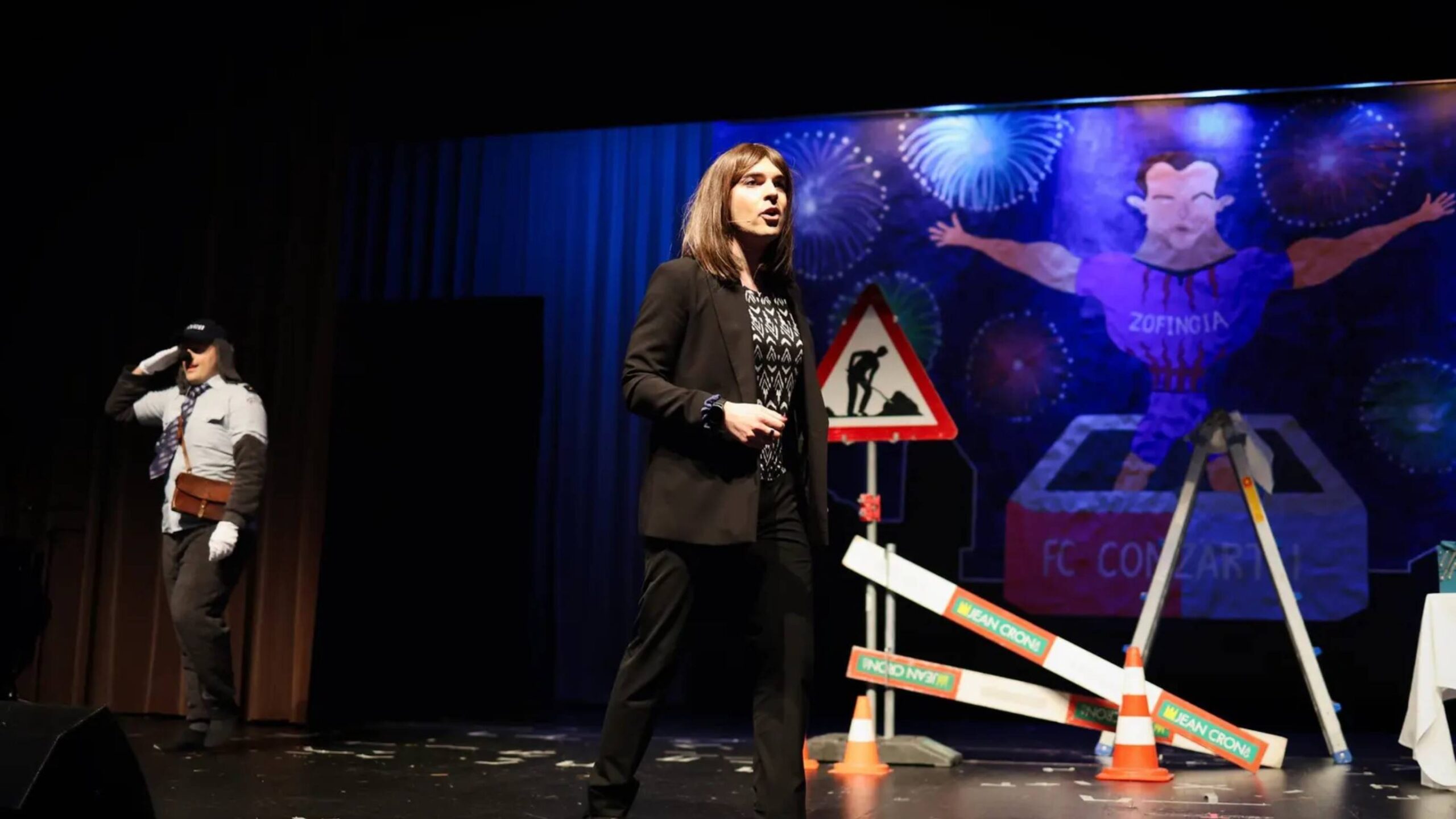
    Some of the old student fraternities like Zofingia organise events like the Zofingerconzärtli, a big pre-Fasnacht performance featuring satire on key figures – this year there a parody of the University of Basel’s Rector Andrea Schenker-Wicki, with a cracking line about overstaying students who’ve “occupied study places for years and now even buildings”.

    Drink a sip of beer as punishment

    Zofingia has a problem, mind – its membership is male only, and last year the University of Lausanne and the Swiss Federal Institute of Technology Lausanne (EPFL) derecognised it as a result. The case escalated to the Swiss Federal Supreme Court – which ultimately ruled that public universities have the right to revoke recognition of associations that don’t align with gender equality principles:

    “It is undoubtedly very valuable and can represent an advantage for one’s future professional network. If female students are denied access to this network solely because of their gender, they do not have the same opportunities as male students.

    A few years ago, the Antifa student group in Basel attempted to prevent Zofinga students from making a public appearance at the Dies academicus (a big day when regular classes are suspended to allow for academic and cultural activities, and awards) on the basis of their discriminatory practices – activists pelted them with water balloons.

    Having been the object of some of Zofingia’s Zofingerconzärtli jokes, it’s the activists that’ll be having the last light now, not leat because the University of Basel was the first in Switzerland to admit women as students in 1890 and is now under pressure to follow suit.

    We noticed it and were surprised

    Anyway back to this year’s Fasnacht – which starts at an ungodly 4am. This year one of the other cliques – the Central Club Basel (CCB) – created a theme for their lanterns criticizing breakdowns in communication in society and people existing in filter bubbles, all under the slogan “I won’t talk to you”.

    The problem was that their 4am lantern depicted Donald Trump on a middle finger, and members wore giant middle finger masks. When videos went viral on TikTok and X (with over 23 million views), it was misinterpreted internationally as an anti-Trump protest rally in Switzerland – causing both diplomatic confusion and online outrage.

    In the aftermath the clique’s leader, Andi Meier, argued they’d “hit the nail on the head” with the theme:

    What’s happening now is, in fact, exactly that: A judgment is simply made and uploaded to social media without checking the facts.

    Ding-a-dong every hour

    Outside of carnival season, the University of Basel feels like a lot of elite-ish universities around Europe – although there are some distinctive things to note.

    Its “double bell” system marks the “akademisches Viertel” (academic quarter), a centuries-old tradition dating back to the university’s 1460 founding. The first bell rings on the hour to signal the official class time, while the second bell 15 minutes later indicates when classes actually begin.

    The tradition originated from practical needs – navigating between scattered medieval buildings, allowing professors preparation time, and accommodating imprecise timekeeping. Today, courses are designated as either “cum tempore” (c.t.), beginning 15 minutes after the hour, or “sine tempore” (s.t.), starting precisely on time, with most following the c.t. convention.

    It offers a fascinating “try before you buy” thing. The “Course Auditing Program” allows anyone that’s interested to attend specific lectures without formal enrollment – participants pay CHF 60 per credit hour, with a strong conversion rate into actual applications, as well as a healthy level of attendance from the general public.

    Just as in plenty of other European universities, there’s an Ombudsman’s Office – available to all university members for the purpose of dealing with internal university concerns and complaints. There’s also an (academic) integrity ombudsperson and a personal integrity function that attempts to set professional standards for studying and working together in a respectful and professional way.

    Regular readers will know I’ve started to become obsessed with degree structures – here the finances of delivery hang together via the sort of interdisciplinary approach we’ve seen elsewhere, such that UG 180 students studying (for example) English complete 75 credits in the Wahlbereich (intra-faculty electives outside of the subject), picking and mixing their way astound core modules in other disciplines.

    Students can also pick up 6 ECTS for internships, and because the university puts a high value on student participation and associative activity, those organising groups and events or sitting on university committees can earn “campus credits” worth 6 ECTS towards their actual degree, as long as they demonstrate the hours they’ve put in and the learning gained.

    Pharma chameleon

    The student housing association, known as “WoVe,” was founded by students in 1970 as a self-help organization to draw attention to the precarious situation students faced on the housing market at the time – today it operates thousands of bedspaces with rents as low as £350 a month – no mean feat in a city where a schnitzel and chips in the university canteen can set you back £15.

    Its AI initiative is interesting too – a broad-based project aimed at addressing the challenges posed to our society by the ongoing development of artificial intelligence. New research findings are bundled and made visible, university teaching is being developed for the age of AI, and employees are being empowered to deal constructively with AI in the course of their work.

    Basel is big in pharma – home to giants like Roche and Novartis – but its innovation ecosystem has only recently gained momentum despite the city’s understated culture where “billionaires cycle to bakeries.” Its new Innovation Office has dramatically increased spinout rates by benchmarking against powerhouses like Oxford and MIT – and takes just 4-6 per cent equity in spinouts with no upfront license fees, though entrepreneurs still face Switzerland’s high incorporation costs (CHF100,000).

    My favourite thing, though, is the day long matriculation ceremony for new students – which along with the usual inspiring talks and introduction to the university’s history and traditions, involves students queuing up to sign an ornate matriculation book with carefully preserved pages of signatures dating back decades – all of which creates a profound sense of continuity and belonging that the Freshers Foam Party back home is never going to match.

    Source link