Tag: repayment

  • American Financial Solutions and Borrower Defense to Repayment

    American Financial Solutions and Borrower Defense to Repayment

    [Editor’s Note: The Higher Education Inquirer has submitted a Freedom of Information Request F-2025-02034 for any Federal Trade Commission consumer complaints against American Financial Solutions. We expect student loan relief scams to grow over the next few years as federal government oversight is reduced.]

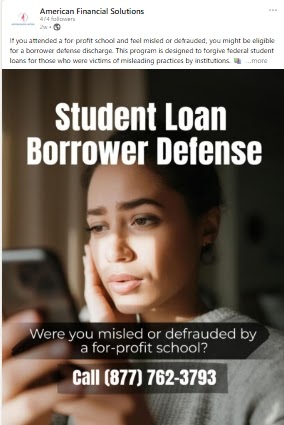
    American Financial Solutions (AFS) positions itself in social media as a lifeline for student loan borrowers, offering help with programs like Borrower Defense to Repayment (BDR), PSLF, closed-school discharge, teacher loan forgiveness, and income-driven repayment. They advertise a “95 percent success rate,” more than $25 million in loans discharged, and over 10,000 clients helped. AFS promotes a three-step approach: a free consultation, documentation collection, and federal application submission—with implied guarantees of approval. They even suggest that discharges can occur in as little as 12 to 36 months.

    Behind this polished marketing is a disturbing reality. When contacted directly, AFS quoted a $1,500 fee to file a Borrower Defense claim. The Department of Education provides this service for free, which makes the fee an unnecessary financial burden on people already struggling with debt. Worse still, AFS representatives falsely claimed that approval would be “guaranteed” because the borrower’s school was named in the Sweet v. Cardona settlement. That is not how the Sweet settlement worked, and no private company can guarantee outcomes in federal relief programs.

    AFS also collects a troubling amount of data from borrowers. According to its own disclosures, the company asks for names, contact information, educational histories, student loan details, financial information, and documentation of borrowers’ school experiences. It also stores communications and any additional information provided. Beyond that, the company automatically harvests website usage data, including IP addresses, device and operating system information, pages visited, time spent on the site, referring websites, and even search terms. This means that vulnerable borrowers are not only charged excessive fees but also exposed to unnecessary risks regarding their personal and financial data.

    While AFS presents itself as a nonprofit credit counseling agency with A+ BBB accreditation, consumer complaints suggest a lack of transparency and responsiveness. One unresolved 2024 complaint alleged billing issues, with the consumer insisting they were not liable for a debt and had no contract, while the company failed to respond. Independent review platforms show a mix of praise and criticism, with some clients reporting successful debt management experiences, but others raising questions about hidden costs, communication problems, and misleading claims.

    The bigger problem is that AFS fits a well-documented pattern of predatory practices in the student loan relief industry. Over the past decade, the Federal Trade Commission (FTC) and the Consumer Financial Protection Bureau (CFPB) have repeatedly shut down companies that charged for free government services, misrepresented their powers, and lied about forgiveness guarantees. In one case, the CFPB shut down Student Aid Institute, only to see its operator resurface under a new name and steal more than $240,000 from borrowers. In another, Monster Loans and its associates were sued for defrauding over 23,000 borrowers. The FTC has also acted against multiple operations that bilked millions of dollars from borrowers by pretending to be affiliated with the Department of Education. Even Navient, a major loan servicer, agreed in 2024 to pay $120 million after deceiving borrowers about repayment options.

    The risks to borrowers are increasing as federal oversight weakens. In 2025, reports revealed that the CFPB planned to scale back enforcement of student loan cases, leaving state regulators—who often lack resources—to fill the gap. Critics warned this would create “open season” for scammers. Against that backdrop, companies like AFS are free to charge high fees, collect sensitive data, and make deceptive promises while vulnerable borrowers remain unprotected.

    American Financial Solutions is not a solution. It is part of the problem, a business model that profits by charging people for free services, misrepresenting the law, and exposing them to new risks. Unless stronger oversight and enforcement are restored, borrowers will continue to be victimized first by predatory schools and then by predatory “relief” companies cashing in on their desperation.


    Sources

    American Financial Solutions marketing claims. amerifisolutions.com

    AFS data collection disclosure (website policy provided by user)

    Better Business Bureau profile. bbb.org

    BBB consumer complaint (2024). bbb.org

    Trustpilot reviews. trustpilot.com

    ConsumerAffairs reviews. consumeraffairs.com

    BestCompany review. bestcompany.com

    CuraDebt expert analysis. curadebt.com

    Federal Trade Commission. “American Financial Benefits Center Refunds.” ftc.gov

    Consumer Financial Protection Bureau. “CFPB Seeks Ban Against Operator of Student Loan Debt Relief Scam Reboot.” consumerfinance.gov

    Consumer Financial Protection Bureau. “CFPB Takes Action Against Operators of an Unlawful Student Loan Debt Relief Scheme.” consumerfinance.gov

    Federal Trade Commission. “FTC Acts to Stop Scheme that Bilked Millions out of Student Loan Borrowers.” ftc.gov, December 2024

    Federal Trade Commission. “Student Loan Debt Relief Scam Operators Agree to be Permanently Banned.” ftc.gov, May 2025

    Time Magazine. “Navient Settlement: Student Loan Borrowers to Receive Payments.” time.com, 2024

    The Guardian. “Brad Lander: CFPB Cuts Create Open Season for Fraudsters.” theguardian.com, May 2025

    Source link

  • Documents from Education Department (includes 90/10 Rule and Income-Driven Repayment)

    Documents from Education Department (includes 90/10 Rule and Income-Driven Repayment)

    Rules

    Classification of Revenue under Title IV

    FR Document: 2025-12554
    Citation: 90 FR 29734
    PDF Pages 29734-29737 (4 pages)
    Permalink
    Abstract: The U.S. Department of Education (Department) is revising its prior interpretation and clarifying its classification of revenue received by a proprietary institution of higher education under the Title IV Revenue and Non-Federal Education Assistance Funds regulations called the “90/10 Rule”.

    Notices

    Agency Information Collection Activities; Proposals, Submissions, and Approvals:

    Impact Aid Program—Application for Section 7002 Assistance
    FR Document: 2025-12529
    Citation: 90 FR 29854
    PDF Pages 29854-29855 (2 pages)
    Permalink
    Abstract: In accordance with the Paperwork Reduction Act (PRA) of 1995, the Department is proposing an extension without change of a currently approved information collection request (ICR).
    Impact Aid Program—Application for Section 7003 Assistance
    FR Document: 2025-12530
    Citation: 90 FR 29855
    PDF Page 29855 (1 page)
    Permalink
    Abstract: In accordance with the Paperwork Reduction Act (PRA) of 1995, the Department is proposing an extension without change of a currently approved information collection request (ICR).

    Income Driven Repayment Plan Request for the William D. Ford Federal Direct Loans and Federal Family Education Loan Programs; Correction

    Matching Documents

    Subscribe to Any Search Result

    Did you know that you can subscribe to any search result? After performing any search on FederalRegister.gov you can choose to receive any future documents that match your search via email. Just click the subscribe button on the right side of the search box.

    Subscribe to an Agency’s Documents

    From any agency page on FederalRegister.gov you can choose to receive email updates of new documents from that agency. Choices of subscriptions include Documents on Public Inspection, Newly Published Documents, and Documents Deemed Significant.

    Source link

  • Latest Borrower Defense to Repayment Numbers (US Department of Education)

    Latest Borrower Defense to Repayment Numbers (US Department of Education)

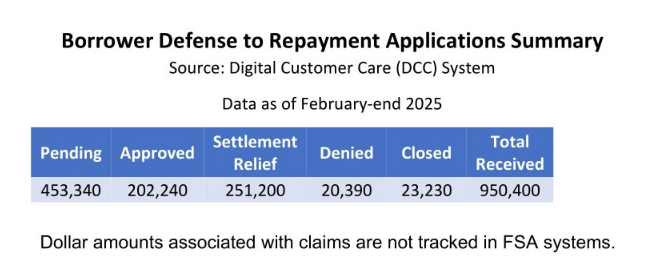
    The Higher Education Inquirer has received information today from the US Department of Education about Borrower Defense to Repayment claims.  Here are the results from ED FOIA 25-02047-F.  


    Source link

  • Agency Information Collection Activities; Submission to the Office of Management and Budget for Review and Approval; Comment Request; Borrower Defense to Loan Repayment Universal Forms

    Agency Information Collection Activities; Submission to the Office of Management and Budget for Review and Approval; Comment Request; Borrower Defense to Loan Repayment Universal Forms

    A Notice by the Education Department on 05/19/2025

    Department of Education[Docket No.: ED-2025-SCC-0002]

    AGENCY:

    Federal Student Aid (FSA), Department of Education (ED).

    ACTION:

    Notice.

    SUMMARY:

    In accordance with the Paperwork Reduction Act (PRA) of 1995, the Department is proposing a revision of a currently approved information collection request (ICR).

    DATES:

    Interested persons are invited to submit comments on or before June 18, 2025.

    ADDRESSES:

    Written comments and recommendations for proposed information collection requests should be submitted within 30 days of publication of this notice. Click on this link www.reginfo.gov/​public/​do/​PRAMain to access the site. Find this information collection request (ICR) by selecting “Department of Education” under “Currently Under Review,” then check the “Only Show ICR for Public Comment” checkbox. Reginfo.gov provides two links to view documents related to this information collection request. Information collection forms and instructions may be found by clicking on the “View Information Collection (IC) List” link. Supporting statements and other supporting documentation may be found by clicking on the “View Supporting Statement and Other Documents” link.

    FOR FURTHER INFORMATION CONTACT:

    For specific questions related to collection activities, please contact Carolyn Rose, 202-453-5967.

    SUPPLEMENTARY INFORMATION:

    The Department is especially interested in public comment addressing the following issues: (1) is this collection necessary to the proper functions of the Department; (2) will this information be processed and used in a timely manner; (3) is the estimate of burden accurate; (4) how might the Department enhance the quality, utility, and clarity of the information to be collected; and (5) how might the Department minimize the burden of this collection on the respondents, including through the use of information technology. Please note that written comments received in response to this notice will be considered public records.

    Title of Collection: Borrower Defense to Loan Repayment Universal Forms.

    OMB Control Number: 1845-0163.

    Type of Review: A revision of a currently approved ICR.

    Respondents/Affected Public: Individuals and Households.

    Total Estimated Number of Annual Responses: 83,750.

    Total Estimated Number of Annual Burden Hours: 217,750.

    Abstract: On April 4, 2024 the U.S. Court of Appeals of the Fifth Circuit granted a preliminary injunction against 34 CFR 685.400 et seq. (“2023 Regulation”) enjoining the rule and postponing the effective date of the regular pending final judgment in the case. The current Borrower Defense to Repayment application and related Request for Reconsideration are drafted to conform to the enjoined provisions of the 2023 Regulation. This request is to revise the currently approved information collection 1845-0163 to comply with the regulatory requirements of the borrower defense regulations that are still in effect, 34 CFR 685.206(e) (“2020 Regulation”), 34 CFR 685.222 (“2016 Regulation”), and 34 CFR 685.206(c) (“1995 Regulation”) (together, the “current regulations”). These regulatory requirements are distinct from the 2023 Regulation’s provisions. The revision is part of contingency planning in case the 2023 Regulation is permanently struck down. The Department of Education (“the Department”) is attaching an updated Borrower Defense Application and application for Request for Reconsideration. The forms will be available in paper and electronic forms on studentaid.gov and will provide borrowers with an easily accessible and clear method to provide the information necessary for the Department to review and process claim applications. Also, under the current regulations, the Department will no longer require a group application nor group reconsideration application.

    Dated: May 13, 2025.

    Brian Fu,

    Program and Management Analyst, Office of Planning, Evaluation and Policy Development.

    [FR Doc. 2025-08857 Filed 5-16-25; 8:45 am]

    BILLING CODE 4000-01-P
    Published Document: 2025-08857 (90 FR 21296)

    Source link

  • Income-driven repayment applications on hold for three months

    Income-driven repayment applications on hold for three months

    Student loan borrowers won’t be able to apply for income-driven repayment plans for at least three months, The Washington Post reported.

    The Post obtained a memo sent last week from the Department of Education to student loan servicers directing them to stop processing all income-driven repayment and consolidation applications until at least May. The memo offers more clarity on how the department plans to proceed after a federal appeals court blocked the department from implementing a new income-driven repayment option for borrowers put in place by the Biden administration. That injunction also implicated parts of other income-driven repayment plans.

    Up until this point, all that student aid experts knew was that the department had disabled new online applications. Now, they know that all existing applications have also been included in the freeze.

    The application freeze is a problem for some borrowers who rely on income-driven repayment plans for more affordable payments and to avoid default. Under the plans, borrowers’ monthly payments are based on their disposable income and other factors, and after 20 to 25 years of payment, the remaining balance would be forgiven. But now, millions of borrowers no longer have access to IDR and are left with only the most expensive loan repayment options.   

    Scott Buchanan, executive director of the Student Loan Servicing Alliance, a trade group for loan servicers, told the Post that “there is a lot to clean up.”

    “We will be working for [the Office of Federal Student Aid] to implement that transition once courts clear things up and bring some finality so borrowers can have certainty and confidence in their options now and in the future,” Buchanan said.

    The Education Department has said the pause is necessary under the U.S. Court of Appeals for the Eighth Circuit ruling, but paper applications for loan consolidation will be allowed. 

    “A federal Circuit Court of Appeals issued an injunction preventing the U.S. Department of Education from implementing the SAVE Plan and parts of other income-driven repayment (IDR) plans,” a department spokesperson said. So “The department is reviewing repayment applications to conform with the Eighth Circuit’s ruling.” 

    But legal experts on federal loans have told Inside Higher Ed taking down the applications entirely is not necessary. As the department noted in its statement, the injunction only declares “parts” of the IDR plans—such as the end-of-program loan forgiveness—illegal. It does not ban the use of lessened monthly payments.

    Source link