Tag: Report

  • HELU’s Wall-to-Wall and Coast-to-Coast Report – July 2025

    HELU’s Wall-to-Wall and Coast-to-Coast Report – July 2025

    Upcoming Events: 

    Building Campus Solidarity Across Job Categories: Lessons from Recent Strikes & Adjunct Struggles
    Weds., July 30 at 6pm ET/5pm CT/4pm MT/3pm PT

    Join the Contingency Taskforce (CTF) of Higher Ed Labor United (HELU) for an urgent strategy discussion of how we can build campus solidarity among faculty and other higher ed workers, across job ranks, in light of the severe threats we now face. How can we organize broadly to defend the most vulnerable members of our communities? How can we help people overcome isolation and fear, discovering new courage and power by connecting with others? How can we raise up the voices and needs of historically marginalized workers and students within the broader fight to defend higher ed? Register here.

    International Campus Worker & Student Organizing Meeting
    Monday, August 4 at 2pm ET/1pm CT/12pm MT/11am PT

    Attacks from the Trump administration are putting international students and workers in our campuses at risk. Mass SEVIS terminations, cancellations of Visa appointments, targeted attacks against Chinese nationals, ICE detentions and threats of raids in our campuses are making our jobs, our livelihoods, and the mission of our institutions unsafe. These actions follow the same pattern: attacking those who are in the most vulnerable positions to create a chilling effect on the rest of us. We demand action from colleges and universities now! Join us on Zoom August 4th at 2pm ET/1pm CT/12pm MT/11am PT to plan next steps and organizing strategies. Register here.
     

    HELU Open House 
    Thursday, August 14 at 6 pm ET/5 pm CT/4 pm MT/3 pm PT

    HELU has been organizing since 2021 and is growing. On Thursday, August 14, at 6pm ET/5pm CT/4pm MT/3pm PT we will be hosting another HELU Open House, designed to welcome folks into the national higher ed organizing space and help everyone find a way to plug in. Join HELU on Thursday, August 14th, at 6pm ET/5pm CT/4pm MT/3pm PT. Register here
     

    Library Workers Organizing Meeting & Strategy Session
    Weds., August 20 at 7pm ET/6pm CT/5pm MT/4pm PT

    On August 20, 2025, HELU is bringing together higher ed library workers across the country to strategize against threats to our livelihoods and profession. We will come together to meet and set our agenda, then we will break into small groups to discuss crises in academic freedom, disparities between library staff categorizations, labor organizing, austerity, and more. Our goal is to develop a platform for library worker protections to advocate for and implement across the country. Register here

    Source link

  • Epstein, Donald Trump and Sexual Blackmail Networks w/ Nick Bryant (The Chris Hedges Report)

    Epstein, Donald Trump and Sexual Blackmail Networks w/ Nick Bryant (The Chris Hedges Report)

    Despite a strong desire from the public to get to the bottom of the Jeffrey Epstein case, which saw the trafficking and sexual exploitation of thousands of young girls, the cabal associated with Epstein continues its conspiracy to suppress the ugly truth of the ruling class.

    Source link

  • WEEKEND READING: Should the seminal Robbins report inform the forthcoming post-16 strategy?

    WEEKEND READING: Should the seminal Robbins report inform the forthcoming post-16 strategy?

    HEPI’s Director, Nick Hillman, spent Friday at a conference organised by SKOPE (the Centre for Skills, Knowledge, and Organisational Performance), part of the University of Oxford’s Department of Education. It was overseen by James Robson, Professor of Tertiary Education Systems, and featured the Minister for Skills, Baroness (Jacqui) Smith, among many others.

    In his opening address, Professor Robson articulated the growing consensus that, when it comes to post-school education, the time has come:

    1. to replace competition with coordination;
    2. to allow place-based approaches to flourish; and
    3. to unlock new opportunities for the benefit of students and employers.

    In her remarks, Jacqui Smith agreed, arguing for an end to ‘town / gown’ splits. The Minister emphasised she thinks higher education must reach out to other parts of the education sector: while she recognises the majority of future skills needs will be at a higher level, she wants to bring down the ‘artificial’ barriers between FE and HE in a ‘coordinated’ and ‘facilitated’ way.

    Some people in the audience interpreted this as meaning universities’ only hope of more money is to do the Government’s bidding and, either way, the higher education sector clearly needs to get ready for a more directive approach from a more active state. The basic idea seems to be to have everyone work together to raise productivity, level up the regions outside London and deliver more social mobility.

    It may sound lovely but these issues are as old as houses and, whenever I think of them, I think of those paragraphs from the Robbins committee – which was designed ‘to review the pattern of full-time higher education’ – that wrestle with freedom versus direction. The Robbins report struggled with the right level of co-ordination and, while much of what it said reflected Lionel Robbins’s liberal views, it also envisaged a role for oversight and direction:

    Will it be possible to secure the advantages of co-ordination while preserving the advantages of liberty? The question is of critical importance. Freedom of institutions as well as individual freedom is an essential constituent of a free society and the tradition of academic freedom in this country has deep roots in the whole history of our people. We are convinced also that such freedom is a necessary condition of the highest efficiency and the proper progress of academic institutions, and that encroachments upon their liberty, in the supposed interests of greater efficiency, would in fact diminish their efficiency and stultify their development. …

    We believe that a system that aims at the maximum of independence compatible with the necessary degree of public control is good in itself, as reflecting the ultimate values of a free society. We believe that a multiplicity of centres of initiative safeguards spontaneity and variety, and therefore provides the surest guarantee of intellectual progress and moral responsibility. We do not regard such freedom as a privilege but rather as a necessary condition for the proper discharge of the higher academic functions as we conceive them. …

    The difficulties are greatest when it is a question whether institutions of higher education should have the ultimate right to determine their own size. … if funds are available, refusal to co-operate in national policies or to meet national emergencies is an unsympathetic attitude, and it would be easy to think of reasons why it should be overruled. … If, when all the reasons for change have been explained, the institution still prefers not to co-operate it is better that it should be allowed to follow its own path. This being so, it must not complain if various benefits going to co-operating institutions do not come its way. … [My emphasis]

    it is unlikely that separate consideration by independent institutions of their own affairs in their own circumstances will always result in a pattern that is comprehensive and appropriate in relation to the needs of society and the demands of the national economy. There is no guarantee of the emergence of any coherent policy. And this being so, it is not reasonable to expect that the Government, which is the source of finance, should be content with an absence of co-ordination or should be without influence thereon. …

    It all goes to show, yet again, that there is no such thing as a new education policy question. 

    There are a number of tests we should perhaps apply to the let’s-coordinate-everything-to-elevate-skills approach that is likely to form the core of the forthcoming post-16 strategy / white paper that is due ‘soon’ – very soon if some of those attending the conference are to be believed and not at all soon if others there are to be believed.

    First, if we can’t even build a high-speed speed trainline on budget and on time, why are we so confident we can easily build an integrated skills and education system (and without a material increase in spending)? It is surely right to at least ask whether public authorities really do know so much about the future economy’s needs that individuals should cede control over who should study what and where. Clearly, Skills England could be important here, but it is an untested beast. (I note in passing that the Smiths, Jacqui and Phil [Chair of Skills England], are getting back together to do a webinar this week.)

    Secondly, the broken model that tends to be held up in contrast to the coming smooth one is a market in which there is lots of wasteful competition, excessive homogeneity and a lack of focus on the country’s needs. But the idea that the only alternative to a coordinated system is a pure and chaotic market is bunkum. We’ve not had a pure market in higher education and I’ve never met anyone who wants one. Neither the political centre nor the Far-byn (or is it Cor-age?) axis want one. Perhaps we are letting ourselves be blinded by the idea that there are only two options: a pure red-in-tooth-and-claw market, which is a caricature of what we have, and a cuddly coordinated system, which will be harder to deliver than we pretend.

    Thirdly, where is the space for education for education’s sake? As one member of the audience pointed out at the SKOPE conference, current discussions are so focused on ‘skills’ and the economy that education is sometimes becoming lost. Yet FE and HE collaboration is difficult at a practical and day-to-day level. Kath Mitchell, the Vice-Chancellor of Derby University, pointed out the challenges of running an FE college and a university together – for example pointing out that Buxton and Leek College is (absurdly) barred from receiving FE capital funding because it counts as part of the University of Derby.

    Fourthly, we should question the assumption underlying current critiques that our universities are much too homogeneous. They do have some things in common, though one might just as well point out that all education institutions that share a legally-protected title controlled by strict criteria, such as ‘university’, are always going to have some things in common. But I’ve visited pretty much every UK university, and many of them multiple times, and I would urge anyone who thinks they’re all the same to do something similar. Just compare the two universities I know best (as I’m on their boards), Manchester and Buckingham: the former is a research-intensive institution with a turnover of £1.4 billion,  12,000 staff and 47,000 students while the other is a teaching-intensive place (‘the home of two-year degrees’) with a turnover of £50 million, 500 staff and 3,500 students as well as the only private medical school in the UK. Or compare the LSE and UCA (the University of the Creative Arts). Or Falmouth University and Newcastle University. These things are not the same.

    Finally / fifthly, as Andy Westwood pointed out in his remarks at the SKOPE conference, devolution is ‘non-existent’ in large parts of the country. So what does ‘a coordinated place-based approach’ really mean there? It’s one thing if you’re in Greater Manchester; it’s quite another if you’re in a rural area far from the nearest town or city, college or university. Moreover, while it is true that the old Higher Education Funding Council for England (HEFCE) had a regional aspect to its work which we could well copy today, it was a big funder as well as a regulator and it had a substantial regional presence.

    Source link

  • Talking about Palestine a “career killer“: report – Campus Review

    Talking about Palestine a “career killer“: report – Campus Review

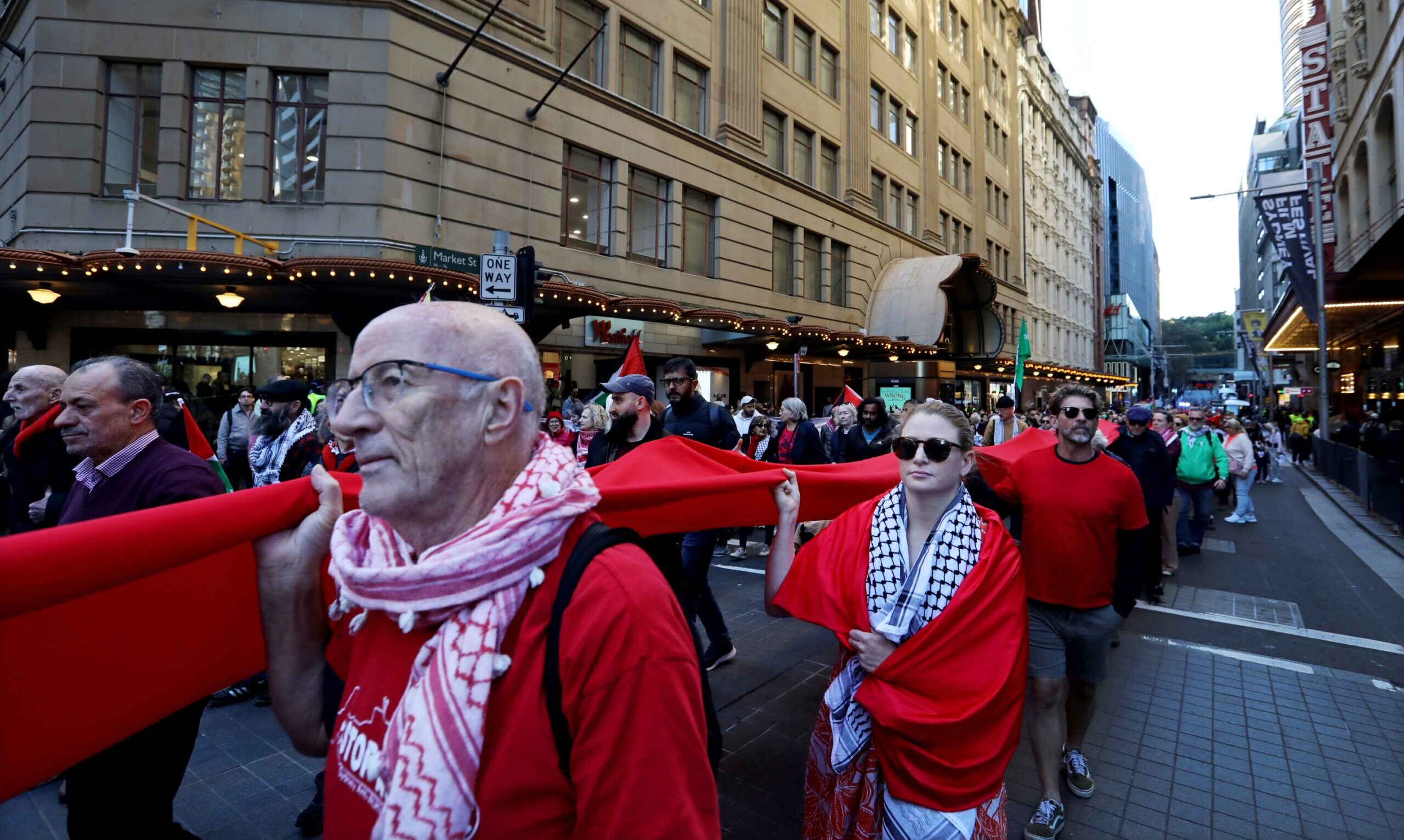
    Over 150 students and staff from 20 separate universities claim free speech about Palestine has been restricted on campus, according to a report released on Thursday.

    Please login below to view content or subscribe now.

    Membership Login

    Source link

  • International students “crucial” for US growth, states new report

    International students “crucial” for US growth, states new report

    The study, published by the Institue of International Education (IIE), outlines the importance of expanding international study to the US over the next five years as American universities brace for an impending domestic “enrolment cliff”. 

    “Attracting global talent is crucial to driving the US economy and growth, and maintaining US leadership” IIE’s head of research, evaluation and learning Mirka Martel told The PIE News. 

    Martel, co-author of the Outlook 2030 Brief, highlighted the unique capacity of the US to host more international students, who currently make up just 6% of the overall student population.  

    In comparison, international students comprise a much larger proportion of the total student body in the UK (27%), Australia (31%) and Canada (38%). 

    Notably, 36 US states were identified by IIE with international student populations below the 6% line, with Massachusetts, New York and Washington DC the regions with the highest proportions of international students.  

    Meanwhile, US universities are facing a much reported on domestic enrolment cliff, with government figures showing undergraduate enrolment declining by more than two million between 2010 and 2022. 

    What’s more, projections indicate that the number of high school graduates will peak in 2025 and decline by 13% by 2041, with IIE warning that US colleges and universities will be left with “empty seats” if they do not focus on international enrolments.  

    Despite recent reports of declining student interest in the US driven by the Trump administration’s hostile policies, IIE’s Fall 2024 Snapshot predicted a 3% growth in international student levels in the 2024/15 academic year.  

    Martel said she expected this forecast to hold true, pointing to the “exciting” fall increase in undergraduate rates for the first time since Covid and the continuing increase in Optional Practical Training (OPT) stemming from rising graduate rates over the last three years. 

    Outside the US, the total number of globally mobile students has seen exponential growth in recent years, nearly doubling over the past decade to reach 6.9 mil in 2024.   

    With last year witnessing the largest growth since the pandemic, some expect global mobility to exceed 9 million by 2030, driven by the growth of youthful populations in South Asia and Sub-Saharan Africa.  

    This, the report says, will create “a steady pipeline of students seeking future academic study”, highlighting the case of Nigeria where the country’s universities can only admit one-third of the two million annual applicants due to capacity constraints.  

    Elsewhere in India, domestic institutions have significantly expanded their undergraduate studies, but “there remains a strong interest in pursuing graduate studies abroad,” according to IIE. 

    Attracting global talent is crucial to driving the US economy and growth

    Mirka Martel, IIE

    In 2023/24, the number of international students in the US reached a record level of 1.1 million, which was primarily driven by a surge in OPT rather than new enrolments.  

    IIE’s 2030 Outlook highlights the $50bn contribution of international students to the US in 2024, with California ($6.4bn), New York ($6.3bn) and Massachusetts ($3.9) reaping the highest economic benefits.  

    What’s more, last year international students created nearly 400,000 jobs in the US, with the report highlighting their role in driving innovation in key industries, as more than half of international students in the US graduate from STEM fields.  

    It points to Chamber of Commerce predictions of incoming labour market shortages across healthcare, computer and mathematical sciences, and business and financial operations, with international students with US training well-poised to fill the gaps.  

    Beyond the numbers, “[international students] are a political and economic asset for America,” states the report: broadening perspectives in the classroom and furthering business, cultural, economic and political ties after they return home.  

    Source link

  • Book Report Summer 2025 | HESA

    Book Report Summer 2025 | HESA

    Morning everyone.  The days are getting long, so that means it’s getting close to the time when I need to wrap up this blog for the (northern hemisphere) summer.  And that, in turn, means book report time, where I round up everything I’ve read on higher education for the past six months.

    (If you’re looking for non-higher education recommendations: Terry David Martin’s The Affirmative Action Empire: Nations and Nationalism in the Soviet Union 1923-1939 will re-wire your thinking about what the early Stalinism actually looked like, and Ashoka Mody’s India is Broken will probably do the same for post-Independence India.  Can’t give you much on the fiction side because most of what I have read is pretty meh, but if you’re into the detective genre, I can recommend Inspector Imanishi Investigates by Seicho Matsumoto.  Not quite as good as his earlier Tokyo Express – which is the most brilliant novel-length thriller based on train timetables ever written – but still pretty good.)

    Let’s start with institutional histories, of which I read two: A European University: The University of Helsinki 1640-2010 and A History of Temple University Japan: An Experiment in International Education.  The first is an absolute doorstopper (over 800 pages – down from about 1500 in the original Finnish) but from a scholarly perspective it is genuinely top-notch.  Because fundamentally it is not just a history of the university, but an intellectual history of the country as a whole.  In that sense, it recalls my favourite book of last year Université de Montréal: une historie urbaine et internationale, but also to some extent Martin Friedland’s history of the University of Toronto.  The Temple Japan was also pretty interesting.  Branch campuses don’t often get their own histories, and this one is a doozy: a roller-coaster story which shows exactly how hard it is to lay down roots in a country where you don’t really speak the language, where government is mostly hostile, and your partners – even where they are legitimate (which not all of Temple’s were) – don’t always have similar goals in mind.  Great stuff.

    Searching for Utopia: Universities and Their Histories by Hanna Holborn Grey is a good short book with a misleading title.  It’s not actually about the histories of the American university, but a history of the ideas that animate them and how these ideas echo across a century or more, animated for the most part by the words of Robert Hutchins (U Chicago) and Clark Kerr (U California). 

    I was in Japan for a bit back in March, and so decided to pick up Shigeru Nakayama’s Science, Technology and Society in Postwar Japan. It’s at least 25 years out of date but it is a pretty interesting read as a kind of pre-history of the modern Japanese scientific enterprise and helpful to understand why university science is such a small part of the overall equation.  I also read Grant Black’s Education Reform Policy at a Japanese Super Global University, a book about Tsukubu U, from Routledge.  It reads like a Master’s thesis and is mostly pretty banal, but it does have just enough interesting nuggets about how top-tier institutions in Japan are re-imagining their offerings in the early twenty-first century to make it worth a skim at least.

    Two books I read focusing specifically on American university finances were Let Colleges Fail: The Power of Creative Destruction in Higher Education by Richard K. Vedder and Joshua Travis Brown’s Capitalizing on College: How Higher Education Went from Mission-Driven to Margin-Obsessed.  You can skip the Vedder book; over his career he has written a lot of useful stuff about college cost structures but now in his 80s this (apparently) farewell book contains far too much “colleges are woke so fuck ‘em” for my taste.  Capitalizing on College is a lot more interesting, containing as it does eight case studies of religious colleges and how the various financial strategies they have adopted to stave off financial decline have worked out.  The answer – mostly pretty badly except for the one who traded God for Mammon – might not sound riveting or surprising, but the routes that each institution takes towards the bottom of the canyon are varied and collectively tell a pretty interesting story, all of which come down to “nobody really wants to pay for higher education”.  Thought-provoking even if it is 50-100 pages longer than it needed to be and is too casual with use of the term “neoliberal”.

    Sticking with the theme of books with lots of institutional case studies, I also polished off two books that are heavy on case studies: Inside College Mergers: Stories From the Front Lines (Mark La Brance, editor) and Strategic Mergers in Higher Education by Ricardo Azziz, Guilbert Henschke, Lloyd Jacobs and Sonita Jacobs.  The former is seven first-person accounts of mergers, some of which worked and some of which didn’t (which is great because failure cases are always underexplored in the literature), while the latter is a more analytical look at university mergers over time.  The latter is arguably the more significant book both because of its attempts at theory-building (its typology of mergers is particularly helpful, I think) and because in many ways its checklists of how to run a merger right are actually applicable to all universities at all times!  Its inclusion of European and Canadian experiences are commendable, even if they get some of the details wrong and is awkwardly-placed in a book which is fundamentally America-focused.  Two thumbs up anyway.

    Tenure Tracks in European Universities, (free download at the link) is a collection of essays edited by Elias Pekkola and Taru Siekkinen.  Following the introduction of global rankings, there was a widespread desire to copy this North American invention partly in order to incentivize greater productivity, but also to make researcher careers more attractive to international scholars (broadly speaking, the old European systems were nicer to early career academics and much harder on mid-career academics than the North American system).    Generally speaking, tenure never replaced the old hierarchy but rather now sits uneasily beside it, but the specific manner in which reform was implemented differed from place to place, and this book is a very helpful overview.

    Two books on UK higher education to look out for.  The first was The Secret Lecturer by…well, it’s a secret (the idea is a play on a series of articles and books in the Guardian called The Secret Footballer, in which a professional talked a lot about what goes on behind the scenes on a professional soccer team…the footballer was never named but most people think it was Dave Kitson).  It was interesting in many ways, showing what day-to-day life in a UK university looks like, and it is in many ways very disappointing.  It’s a bit blighted by the lecturer’s insistence on centering his own views about the relationship between universities and the arms trade, but that’s a minor quibble: I sure would like a Canadian equivalent.  The second was Higher Imagination: A Future for Universities by British/Australian policy wonk Ant Bagshaw, which was…intriguing.  Some bits of it will probably enrage a lot of faculty – in particular the bits about being relentlessly focused on programs as “products”, but the bits stressing that one of the key outputs of universities should be “joy” are pretty original (and, IMHO, true, even if it would be madness for any institution to say stuff like this out loud).

    Education, Skills and Technical Change: Implications for Future US GDP Growth is a book I should have read when it came out a few years ago.  It’s a series of quite technical economic papers from some of the biggest names in US economics, not about higher education itself, for the most part, but mostly about returns to skills.  Of the two which are more specifically about institutional production functions, the one by Caroline Hoxby is interesting, the other one, about the rise in college costs, is garbage (as the article’s discussant in the book, Sandy Baum, ably points out).  It’s one of those books where you don’t necessarily need to buy all the results, or believe that the results hold outside the United States, but you do just sort of stand slack-jawed in wonder at how many different ways they have to analyze a problem thanks to a system of economic and institutional data collection which doesn’t suck the way Canada’s does.

    The Promise of Higher Education: Essays in Honour of 70 Years of the International Association of Universities(also availableas a free download here) is a boatload of short ideas on the idea of higher education written on the occasion of the International Association of Universities.  Most of the individual articles are forgettable – the way to best experience this book is as a kind of mood music in favour of higher education’s greatest kumbaya themes.  But a couple are superb: in particular Simon Marginson and Lili Yang’s dissection of Chinese versus Western conceptions of institutional autonomy, as well as Pedro Teixera and Manja Klemencic’s article on the Civic Role of universities (also of interest is Daniel Levy’s screed against management-led institutional activism, which might be the politest and most substantive critique of institutional DEI approaches ever written). 

    The Learning-Centered University, whose author Steven Mintz I interviewed back here, is a book that was somewhat let down by poor editing.  The subject is interesting and Mintz is well-informed on the subject, but while the material is good, it’s presented in a somewhat disorganized fashion, which undermines the point a bit.  Knowledge Towns: Colleges and Universities as Talent Magnets, by David Staley and Dominic Endicottis…almost interesting.  That is to say: it has an interesting thesis about how cities can use educational institutions to re-define themselves, especially in periods of demographic change, but it is marred by some wishful thinking about the flexibility of institutional forms and a bunch of wishful thinking about things like “micro-colleges”.  Finally, there was Polarized by Degrees: How the Diploma Divide and the Culture War Transformed American Politics by Matt Grossman and David Hopkins, which is probably of more interest to political scientists studying voting patterns than it is to educationists trying to work out how to de-polarize the sector in the current environment of wild right-wing vandalism.

    On the subject of science more generally, I read Science of Science by Alexander Krauss (open access version available here), which is an interesting approach to the subject without being anywhere near as revolutionary as the author claims.  His central insight, though – that the history of science is to a very large extent a history of methodologies and the measurement tools that permit new methodologies to sprout – is pretty interesting and I am looking forward to the companion volume coming out later this year called The Motor of Scientific Discovery.  In the history of science category, I also picked up Scientific Babel: the Language of Science from the Fall of Latin to the Rise of English  by Michael Gordin which is about how over the course of two centuries English won out over German, French, Russian and a plethora of constructed languages like Volapuk, Esperanto and Ido (many of which, to my surprise, were actually constructed with the specific intention of being languages for the transmission of sciences) to become the lingua franca of sciences.  It’s terrific and I heartily endorse it.

    I think that’s it.  Hope you get some good reading this summer and if you find anything you think I need to read, drop me a line!

    Source link

  • Fake Citations Appeared in Federal Chronic Diseases Report

    Fake Citations Appeared in Federal Chronic Diseases Report

    The Department of Health and Human Services cited fake publications in a report on children’s health issues issued last week, The New York Times reported

    The Make America Healthy Again Commission claims its report—which blamed chronic disease in children on ultraprocessed foods, pesticides, lack of physical activity and excessive use of prescription drugs, including antidepressants—was produced with a “clear, evidence-based foundation.”

    However, some of the researchers it cited said they didn’t write the papers the report attributed to them. 

    In one example, the report cited a paper on the link between mental health and substance use in adolescents by Katherine Keyes, an epidemiology professor at Columbia University. But Keyes told the Times that she didn’t write the paper. And no paper by the title cited—written by anyone—appears to exist at all. 

    The report cited another paper about psychiatric medications and advertising that was allegedly published in 2009 in The Journal of Child and Adolescent Psychopharmacology by “Findling, R. L., et al.” But the Times confirmed that Robert L. Findling, who is a psychiatry professor at the University of Virginia, did not author the paper. 

    The newspaper also found numerous other instances of mischaracterized or inaccurate summaries of research papers. 

    After both the Times and NOTUS reported on the false citations Thursday, the White House promptly updated the report with corrections. In response to questions from reporters about whether generative artificial intelligence—which is notorious for “hallucinating” information and failing to provide accurate citations—was used to produce the errant report, Emily Hilliard, a spokesperson for HHS, did not provide an answer.

    Instead, she characterized the false citations as “minor citation and formatting errors,” according to the Times, and doubled down on the report’s “substance” as “a historic and transformative assessment by the federal government to understand the chronic-disease epidemic afflicting our nation’s children.”

    Source link

  • New Report From CUPA-HR Explores Changes in Faculty Size, Pay and Tenure Status Over the Past 20 Years – CUPA-HR

    New Report From CUPA-HR Explores Changes in Faculty Size, Pay and Tenure Status Over the Past 20 Years – CUPA-HR

    by CUPA-HR | May 20, 2025

    How has the higher education faculty workforce changed over the past 20 years? What disciplines have emerged as frontrunners in hiring? What disciplines pay the most? What disciplines pay the least?

    In the new research report, Two Decades of Change: Faculty Discipline Trends in Higher Education, CUPA-HR presents findings from an analysis of data from its Faculty in Higher Education Survey from 2003-04 to 2023-24.

    Some key findings highlighted in the report:

    • The disciplines of Health Professions and Business have experienced the most growth in number of faculty over the past 20 years. The number of faculty in Health Professions more than doubled from 2003-04 to 2023-24, and the number of Business faculty grew by 20.8% over the same period.
    • The disciplines of Theology, Liberal Arts and Humanities, and English Language/Literature are experiencing very little growth in terms of hiring new faculty. These disciplines also have high numbers of non-tenure-track faculty and are among the lowest-paying disciplines — all of which point to institutions’ divestment in these disciplines.
    • Business ranked among the top four highest-paid disciplines every year from 2003-04 to 2023-24 and has been the highest-paid discipline for the past nine years. In addition, Business saw the largest percentage increase in median salary across all disciplines, with an increase of 66.2% since 2003-04.
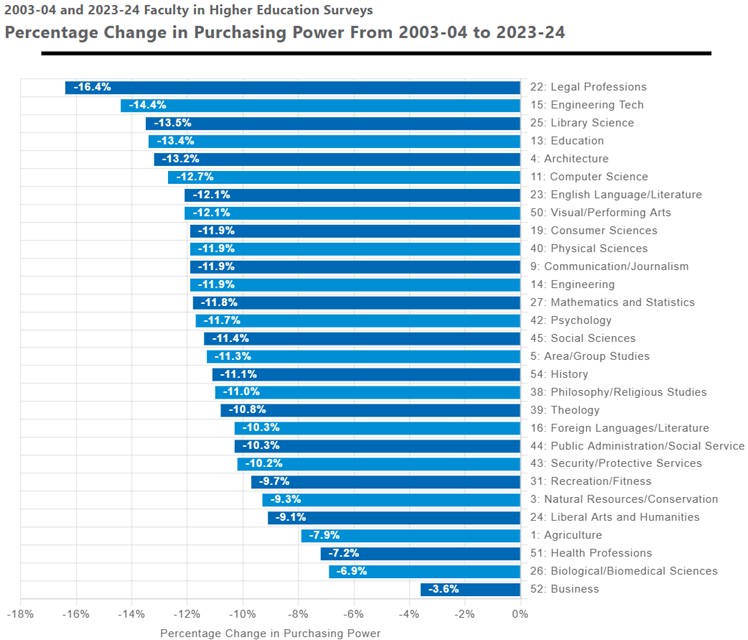
    • No discipline’s pay increases beat inflation. Although many disciplines appeared strong based on changes in size and salary over time, all disciplines reported median salaries in 2023-24 that were lower than inflation-adjusted salaries based on 2003-04 salary data. Overall, faculty in all disciplines have less purchasing power with their salaries in 2023-24 than they did in 2003-04.


    Read the full report and explore the data with interactive graphics.


    Source link

  • National Urban League Report Examines Five Years After George Floyd: “A Movement, Not a Moment”

    National Urban League Report Examines Five Years After George Floyd: “A Movement, Not a Moment”

    The National Urban League has released a new report examining the progress and setbacks in the fight for racial justice in the five years since George Marc MorialFloyd’s murder, challenging Americans to view the ongoing struggle as “a movement, not a moment.”

    The report, titled “George Floyd Five Years Later: Was it a Moment or a Movement?” traces the trajectory of racial justice initiatives since May 25, 2020, when Floyd was killed by Minneapolis police officer Derek Chauvin. It details how initial outrage and corporate pledges of more than $66 billion for racial justice programs have faced increasing backlash, culminating in recent executive orders eliminating federal diversity programs.

    “History will judge us – not by how we responded in the days after George Floyd’s death, but by what we are building five, ten, and twenty years later,” said Marc H. Morial, President and CEO of the National Urban League. “The fight for justice, safety, and dignity is far from over—and the stakes for our democracy could not be higher.”

    The report chronicles how Floyd’s murder ignited what it calls “one of the most significant calls for racial justice in generations,” with protests spanning from Minneapolis to Madrid demanding police accountability and government action to address systemic inequities.

    While the initial response was robust – with corporations, higher education institutions, philanthropy, and nonprofits pledging billions to confront systemic racism – the report documents how commitments have significantly eroded. Data revealed that DEI job postings declined 44% from 2022 to 2023, and major companies like Google and Meta scaled back programs supporting Black talent.

    The report details a pattern of progress and regression across several administrations. Under President Biden, the Department of Justice’s Civil Rights Division, led by Kristen Clarke, convicted more than 180 police officers for civil rights violations and investigated 12 police departments. President Biden’s executive order on safe policing created a national database to track police misconduct and banned chokeholds for federal officers.

    In stark contrast, the report notes that the second Trump administration “eliminated all DEI initiatives across the federal government on Day One” and “froze all open DOJ civil rights investigations.”

    “Five years after George Floyd’s murder, we are living in a different America,” the report states. “As President Trump began his second term, he signed various executive orders gutting federal diversity programs and efforts. This led to corporations and institutions of higher education abandoning their commitments to racial justice and eliminating their diversity programs altogether.”

    The National Urban League’s response has been multifaceted. The organization established a new division, Equitable Justice and Strategic Initiatives (EJSI), to advocate for justice system reforms. It developed “21 Pillars for Redefining Public Safety and Restoring Community Trust” as a framework for police reform and created a “D3” platform based on three principles: Defend Democracy, Demand Diversity, and Defeat Poverty.

    In early 2025, the organization convened the Demand Diversity Roundtable, an emergency strategy session to confront threats posed by the new administration’s actions against civil and human rights. With partners, they filed a lawsuit challenging what they describe as “unconstitutional anti-equity executive orders.”

    “It is of the utmost urgency that we rise to defend not only the progress made in the years immediately after George Floyd’s murder, but of the last 60 years,” Morial emphasized in the report.

    Despite the setbacks, the report presents evidence that public sentiment still largely supports diversity efforts. It cites polling showing 61% of Americans believe diverse employees positively impact organizations, and 75% agree more needs to be done to guarantee everyone is advancing.

    “Despite challenges and headwinds coming our way, we are doubling down on the fight for a more equitable and just world, where our classrooms, offices, and boardrooms reflect who America is,” the report concludes.

    The 14-page report, designed with a striking red cover featuring Floyd’s name, includes a timeline of events from 2020 to 2025 and offers practical guidance for citizens wanting to protect their rights, including consistently checking voter registration status and supporting organizations fighting for equity.

    Morial’s message is clear: “As the moment of 2020 fades for some, we are positioned to lead the movement for a more just America where all Americans can live safe, full lives and thrive.”

    Source link

  • REPORT: More than 600 college students and student groups punished or investigated for speech in five years

    REPORT: More than 600 college students and student groups punished or investigated for speech in five years

    • 63% of over 1,000 efforts to suppress student speech resulted in administrative investigation or punishment.
    • In the wake of Hamas’s 2023 attack on Israel, administrators overtook students as the main instigators of attempted speech suppression.
    • Speech about race and the Israeli-Palestinian conflict led to most attempts.

    PHILADELPHIA, May 15, 2025 — A new report from the Foundation for Individual Rights and Expression found that 637 college students and student groups were punished or investigated by administrators for their constitutionally protected expression between 2020-2024.

    “Students Under Fire” documents over 1,000 efforts to punish students for speech and expression over a five-year span, 63% of which resulted in some form of administrative punishment. The research provides the most detailed collection of speech-related campus controversies involving students to date. The underlying data will be compiled in an interactive database that will be regularly updated and searchable by the source of the outrage, demands made of the institution, whether the pressure is from the political left or right of the student’s speech, the outcome, and more.

    “Every instance of censorship threatens students’ ability to engage in a free exchange of ideas,” said FIRE Senior Researcher Logan Dougherty. “Open minds and free debate, not self-censorship and punishment, must be the standard across our nation’s campuses.”

    There were two dominant incendiary topics on campus: race and the Israeli-Palestinian conflict. The report found that following the murder of George Floyd in 2020, race was the topic that most commonly landed a student in hot water. The Oct. 7 Hamas attacks on Israel, and subsequent debates over the Israeli-Palestinian conflict and Israel’s military response, then quickly became the topic that most often produced attempts at punishment. 

    Other notable findings from the report include:

    • The problem spans ideologies. When it comes to speech about race, most students are targeted from their left, while students speaking out about the war in Gaza are more likely to be targeted from their right.
    • Among the worst punishments were 72 students or groups who were suspended, 55 who were expelled, lost student group funding, or were otherwise separated from their university, and 19 more who were unenrolled under ambiguous circumstances. In one case, a student had to sleep in his car after his university kicked him out of campus housing. In another, a student was suspended for sending a survey about mental health to his peers.
    • The most frequently targeted or punished student groups spanned the political divide: Students for Justice in Palestine (75 incidents), Turning Point USA (65 incidents), and the College Republicans (58 incidents)

    The report also found that after a decade of surging efforts by students to silence campus speech, administrators have taken up the censorial mantle in the wake of the Israeli-Palestinian conflict. In 2020, only 27% of cases were initiated by administrators. By 2024, that number increased to 52%.

    “This is unacceptable coming from people whose job it is to serve college students and ensure that their rights are protected,” said FIRE Chief Research Advisor Sean Stevens. “Their job should be to protect students’ free speech rights, not torpedo them.” 

    The First Amendment protects students at public institutions — and those institutions cannot legally punish students for the expression in the report (though they often do). Private institutions, though not directly bound by the First Amendment, often make institutional promises of free speech and academic freedom. FIRE advocates for targeted students at both types of institutions.

    Students at public institutions should contact FIRE if they face punishment for their expression by submitting a case.

    The Foundation for Individual Rights and Expression (FIRE) is a nonpartisan, nonprofit organization dedicated to defending and sustaining the individual rights of all Americans to free speech and free thought — the most essential qualities of liberty. FIRE educates Americans about the importance of these inalienable rights, promotes a culture of respect for these rights, and provides the means to preserve them.

    CONTACT
    Katie Stalcup, Communications Campaign Manager, FIRE: 215-717-3473; [email protected] 

    Source link