Tag: Report

  • More Schools Report Visa Revocations and Student Detentions

    More Schools Report Visa Revocations and Student Detentions

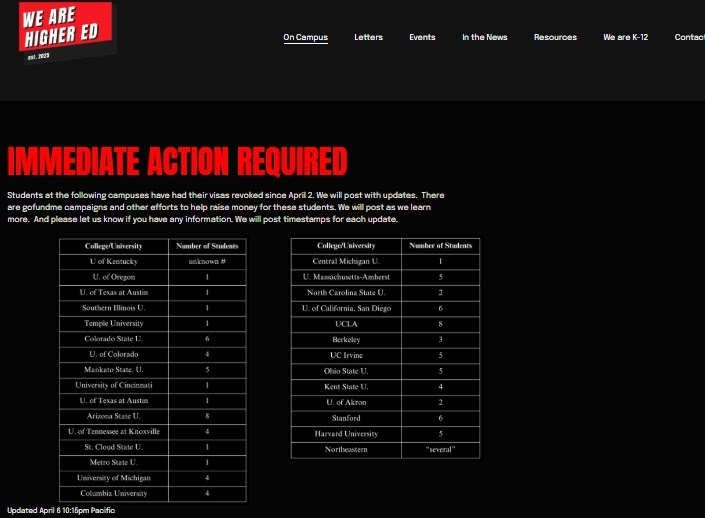
     Reports have surfaced of a significant increase in the number of international student visas being revoked and students being detained across various universities in the United States. This follows heightened immigration scrutiny, particularly under the administration of Donald Trump. According to Senator Marco Rubio, more than 300 international student visas have been pulled in recent months, primarily targeting students involved in political activism or minor infractions. WeAreHigherEd has named 30 schools where students’ visas have been revoked. 

    Campus Abductions — We Are Higher Ed

    Key Universities Affected

    • University of California System (UCLA, UC San Diego, UC Berkeley):
      Universities within the University of California system, which hosts a large international student population, have reported multiple visa cancellations. These revocations have affected students involved in pro-Palestinian protests, political activism, or perceived violations of U.S. immigration policies. For instance, the University of California has seen as many as 20 students affected in recent weeks.

    • Columbia University:
      At Columbia University, the case of Mahmoud Khalil, a student activist, has gained significant media attention. Khalil, who was detained and faced deportation, exemplifies the growing concerns over student rights and the growing impact of politically charged visa revocations.

    • Tufts University:
      Tufts University is currently battling the Trump administration over the case of Rümeysa Öztürk, a Turkish graduate student whose visa was revoked. Her detention and the ensuing legal battles highlight the growing tensions between academic freedom and government policy. Tufts and its student body are advocating for Öztürk’s release and seeking clarification on the legal processes involved.

    • University of Minnesota:
      At the University of Minnesota, one international graduate student was detained as part of an ongoing federal crackdown on visa violations. The U.S. Immigration and Customs Enforcement (ICE) actions continue to raise concerns over the rights of international students to remain in the country, especially as visa renewals and compliance checks become more stringent.

    • Arizona State University:
      Arizona State University has also reported incidents of international students having their visas revoked without prior notice. These revocations have affected students from various countries, creating uncertainty within the international student community at the university.

    • Cornell University:
      At Cornell University, international students have similarly faced unexpected visa cancellations. This has raised concerns about the ability of universities to adequately support their international student populations, as students are left to navigate the complexities of visa status without sufficient notice or explanation.

    • North Carolina State University:
      North Carolina State University is another institution where international students have had their visas revoked without notice. The university has expressed concern over the lack of clarity from immigration authorities, which has left students in a precarious situation.

    • University of Oregon:
      The University of Oregon has experienced several cases of international students having their visas revoked. This has been particularly troubling for students who were actively pursuing their education in the U.S. and now face the prospect of deportation or being forced to leave the country unexpectedly.

    • University of Texas:
      At the University of Texas, international students have faced visa issues, with several reports of revocations and detentions, affecting students who are working toward completing their degrees. This has sparked protests and advocacy efforts from both students and university administration, seeking more transparency in the process.

    • University of Colorado:
      The University of Colorado has similarly reported instances of international student visa revocations, particularly affecting those involved in political activism. The university has been working to support students impacted by these actions, although many are left in limbo regarding their ability to continue their studies.

    • University of Michigan:
      The University of Michigan has also been impacted by a wave of visa revocations. Similar to other institutions, students involved in political protests or activism have found themselves under scrutiny, facing the risk of detention or deportation. Students, faculty, and staff are pushing for clearer policies and legal protections to support international students, who are increasingly at risk due to the political environment.

    The Broader Implications

    These incidents of visa revocation and detentions are seen as part of a broader trend of increasing immigration enforcement under the Trump administration. Critics argue that these actions infringe upon students’ rights, potentially violating freedom of speech and academic freedom. International students, especially those participating in protests or political discourse, have found themselves at risk of being detained or deported, with little prior notice or transparency regarding the reasons for such actions.

    Moreover, the economic impact of these actions is significant. In 2023, a record 253,355 student visa applications were denied, representing a 36% refusal rate. This has major implications not only for the affected students but also for U.S. universities that rely heavily on international students for tuition revenue. The financial loss could be as much as $7.6 billion in tuition fees and living expenses, further emphasizing the broader consequences of these policies.

    Legal and Administrative Responses

    Many universities are rallying behind their international student populations, with advocacy efforts from institutions like Tufts University and Columbia University. These universities have criticized the abruptness of the visa cancellations and detentions, calling for more transparency and due process.

    However, despite these efforts, the political climate surrounding U.S. immigration remains volatile, and it is unclear whether policy changes will result in more lenient or more restrictive measures for international students.

    Conclusion

    These stories underscore the fragile position of international students in the U.S. today. With incidents of detentions and visa revocations increasing, students face significant challenges navigating the complexities of U.S. immigration law, particularly those involved in political or activist circles. University administrations and students alike continue to call for clearer policies, protections for international student rights, and more transparent practices to avoid the unintended consequences of politically motivated visa actions.

    This issue remains ongoing, with much at stake for both 

    Source link

  • Report details uneven AI use among teachers, principals

    Report details uneven AI use among teachers, principals

    Key points:

    English/language arts and science teachers were almost twice as likely to say they use AI tools compared to math teachers or elementary teachers of all subjects, according to a February 2025 survey from the RAND Corporation that delves into uneven AI adoption in schools.

    “As AI tools and products for educational purposes become more prevalent, studies should track their use among educators. Researchers could identify the particular needs AI is addressing in schools and–potentially–guide the development of AI products that better meet those needs. In addition, data on educator use of AI could help policymakers and practitioners consider disparities in that use and implications for equitable, high-quality instruction across the United States,” note authors Julia H. KaufmanAshley WooJoshua EaganSabrina Lee, and Emma B. Kassan.

    One-quarter of ELA, math, and science teachers used AI tools for instructional planning or teaching in the 2023–2024 school year. Nearly 60 percent of surveyed principals also reported using AI tools for their work in 2023-2024.

    Among the one-quarter of teachers nationally who reported using AI tools, 64 percent said that they used them for instructional planning only, whether for their ELA, math, or science instruction; only 11 percent said that they introduced them to students but did not do instructional planning with them; and 25 percent said that they did both.

    Although one-quarter of teachers overall reported using AI tools, the report’s authors observed differences in AI use by subject taught and some school characteristics. For instance, close to 40 percent of ELA or science teachers said they use AI, compared to 20 percent of general elementary education or math teachers. Teachers and principals in higher-poverty schools were less likely to report using AI tools relative to those in lower-poverty schools.

    Eighteen percent of principals reported that their schools or districts provided guidance on the use of AI by staff, teachers, or students. Yet, principals in the highest-poverty schools were about half as likely as principals in the lowest-poverty schools to report that guidance was provided (13 percent and 25 percent, respectively).

    Principals cited a lack of professional development for using AI tools or products (72 percent), concerns about data privacy (70 percent) and uncertainty about how AI can be used for their jobs (70 percent) as factors having a major or minor influence on their AI use.

    The report also offers recommendations for education stakeholders:

    1. All districts and schools should craft intentional strategies to support teachers’ AI use in ways that will most improve the quality of instruction and student learning.

    2. AI developers and decision-makers should consider what useful AI applications have the greatest potential to improve teaching and learning and how to make those applications available in high-poverty contexts.

    3. Researchers should work hand-in-hand with AI developers to study use cases and develop a body of evidence on effective AI applications for school leadership, teaching, and learning.

    Laura Ascione
    Latest posts by Laura Ascione (see all)

    Source link

  • What will NCES layoffs mean for the Nation’s Report Card?

    What will NCES layoffs mean for the Nation’s Report Card?

    This audio is auto-generated. Please let us know if you have feedback.

    The Trump administration has all but axed the U.S. Department of Education’s statistical research arm — the National Center for Education Statistics — sparing only a handful of employees who are left without department staff needed to analyze education data. 

    “They didn’t just RIF a few people, they deleted the agency for all intents and purposes,” said an NCES employee of more than a decade who was part of the massive March 11 layoffs

    The loss of over a hundred Institute of Education Sciences employees — including almost all of the NCES staff comes as part of sweeping cuts to the Education Department that left the federal agency with only half of its workforce. NCES, which traces its existence to an 1867 law establishing a federal statistical agency to collect, analyze and report education data,  has been tasked with research and analysis on everything from graduation rates and student outcomes to teacher and principal development. 

    Overall, NCES research tracked the condition of education in the nation, including gaps in achievement and resources for underserved students. During the pandemic, the unit closely analyzed trends in school resources and educator and student mental health. 

    Perhaps most notably, NCES oversaw and ensured the quality of the Nation’s Report Card, along with other key student outcome studies. School and college leaders rely on such NCES research to improve student performance, and its findings often help inform federal and state policymakers on funding decisions.

    Now, those caught in the latest wave of the administration’s cuts are warning that their haphazard nature will lead to a decline in the quality of assessments and data overseen by NCES. Longtime NCES employees report being fired at a moment’s notice and abruptly losing access to years — sometimes decades — of work, with no communication from the administration about how to offboard so as to preserve and pass on critical information. 

    “A lot of institutional knowledge is going to be lost,” said another former NCES employee who worked closely on the Nation’s Report Card. This employee and the others who spoke to K-12 Dive asked to remain anonymous for fear that identification could affect their severance terms.

    NAEP and international assessment employees impacted

    Although NCES employees are nearly all gone, many of NCES’ functions they previously carried out are congressionally mandated, meaning they will still need to be done. That includes portions of the National Assessment of Educational Progress, commonly known as the Nation’s Report Card. 

    The required parts include: reading and math assessments in 4th and 8th grade, long-term trend assessments for 9, 13 and 17-years-olds, and 12th grade reading and math assessments. The long-term assessment for 17-year-olds was last administered in 2012, having been canceled during the pandemic, and again for this spring due to what the Education Department cited as funding issues.

    Other portions of the federal test such as science, U.S. history and civics are optional. 

    The federally mandated assessment has often served as a yardstick for student performance in various subjects, most notably reading and math. Following the pandemic, it helped educators understand which subject areas students struggled in the most during and following school closures. 


    “Despite spending hundreds of millions in taxpayer funds annually, IES has failed to effectively fulfill its mandate to identify best practices and new approaches that improve educational outcomes and close achievement gaps for students.”

    Madi Biedermann

    U.S. Department of Education’s Deputy Assistant Secretary for Communications


    Congress also mandates that student performance be compared on an international level, a requirement usually fulfilled by the Program for International Student Assessment, or PISA. 

    The latest round of PISA testing was expected to begin by the end of March. Plus, the main NAEP for grades 4, 8 and 12 was supposed to begin early next year — preparation for which was set to begin this summer, according to former NCES employees. 

    The Education Department, in a March 13 statement emailed to sister publication Higher Ed Dive, said, “IES employees impacted by the reduction in force conducted none of the research related to NAEP, the College Scorecard, and IPEDS.”

    “That work is all done through contracts that are still maintained by the Department,” said Madi Biedermann, deputy assistant secretary for communications at the department, in the statement.

    Source link

  • What will NCES layoffs mean for the Nation’s Report Card?

    What will NCES layoffs mean for the Nation’s Report Card?

    This audio is auto-generated. Please let us know if you have feedback.

    The Trump administration has all but axed the U.S. Department of Education’s statistical research arm — the National Center for Education Statistics — sparing only a handful of employees who are left without department staff needed to analyze education data. 

    “They didn’t just RIF a few people, they deleted the agency for all intents and purposes,” said an NCES employee of more than a decade who was part of the massive March 11 layoffs

    The loss of over a hundred Institute of Education Sciences employees — including almost all of the NCES staff comes as part of sweeping cuts to the Education Department that left the federal agency with only half of its workforce. NCES, which traces its existence to an 1867 law establishing a federal statistical agency to collect, analyze and report education data,  has been tasked with research and analysis on everything from graduation rates and student outcomes to teacher and principal development. 

    Overall, NCES research tracked the condition of education in the nation, including gaps in achievement and resources for underserved students. During the pandemic, the unit closely analyzed trends in school resources and educator and student mental health. 

    Perhaps most notably, NCES oversaw and ensured the quality of the Nation’s Report Card, along with other key student outcome studies. School and college leaders rely on such NCES research to improve student performance, and its findings often help inform federal and state policymakers on funding decisions.

    Now, those caught in the latest wave of the administration’s cuts are warning that their haphazard nature will lead to a decline in the quality of assessments and data overseen by NCES. Longtime NCES employees report being fired at a moment’s notice and abruptly losing access to years — sometimes decades — of work, with no communication from the administration about how to offboard so as to preserve and pass on critical information. 

    “A lot of institutional knowledge is going to be lost,” said another former NCES employee who worked closely on the Nation’s Report Card. This employee and the others who spoke to K-12 Dive asked to remain anonymous for fear that identification could affect their severance terms.

    NAEP and international assessment employees impacted

    Although NCES employees are nearly all gone, many of NCES’ functions they previously carried out are congressionally mandated, meaning they will still need to be done. That includes portions of the National Assessment of Educational Progress, commonly known as the Nation’s Report Card. 

    The required parts include: reading and math assessments in 4th and 8th grade, long-term trend assessments for 9, 13 and 17-years-olds, and 12th grade reading and math assessments. The long-term assessment for 17-year-olds was last administered in 2012, having been canceled during the pandemic, and again for this spring due to what the Education Department cited as funding issues.

    Other portions of the federal test such as science, U.S. history and civics are optional. 

    The federally mandated assessment has often served as a yardstick for student performance in various subjects, most notably reading and math. Following the pandemic, it helped educators understand which subject areas students struggled in the most during and following school closures. 


    “Despite spending hundreds of millions in taxpayer funds annually, IES has failed to effectively fulfill its mandate to identify best practices and new approaches that improve educational outcomes and close achievement gaps for students.”

    Madi Biedermann

    U.S. Department of Education’s Deputy Assistant Secretary for Communications


    Congress also mandates that student performance be compared on an international level, a requirement usually fulfilled by the Program for International Student Assessment, or PISA. 

    The latest round of PISA testing was expected to begin by the end of March. Plus, the main NAEP for grades 4, 8 and 12 was supposed to begin early next year — preparation for which was set to begin this summer, according to former NCES employees. 

    The Education Department, in a March 13 statement emailed to sister publication Higher Ed Dive, said, “IES employees impacted by the reduction in force conducted none of the research related to NAEP, the College Scorecard, and IPEDS.”

    “That work is all done through contracts that are still maintained by the Department,” said Madi Biedermann, deputy assistant secretary for communications at the department, in the statement.

    Source link

  • Impact of Technology on Student Retention Report

    Impact of Technology on Student Retention Report

    Facing challenges in enrollment, retention, or tech integration? Seeking growth in new markets? Our strategic insights pave a clear path for overcoming obstacles and driving success in higher education.

    Unlock the transformative potential within your institution – partner with us to turn today’s roadblocks into tomorrow’s achievements. Let’s chat.

    Source link

  • Heterodox Academy report finds spike in neutrality statements

    Heterodox Academy report finds spike in neutrality statements

    Since Hamas attacked Israel on Oct. 7, 2023, triggering a brutal retaliatory war in Gaza, at least 140 colleges and universities have adopted statements of institutional neutrality—up from just eight prior to the attacks, according to a new report from Heterodox Academy, a nonprofit advocacy group seeking to promote viewpoint diversity on college campuses.

    The vast majority of institutions—97 percent—cited the values of “community and inclusion” to justify their embrace of statement neutrality. “Free speech and academic freedom” and “public trust” were each referenced as a rationale by 88 percent of institutions; 64 percent attributed the move to “balancing rights and responsibilities.”

    Of the institutions that have adopted neutrality statements since 2023, 78 percent are public and 22 percent private. Governing boards drove the change at 68 percent of the public institutions; at more than a quarter of those—including in Indiana, Utah and North Carolina—state legislatures mandated the shift. At private institutions, presidents and faculty were much more likely than governing boards to instigate the push for institutional neutrality.

    “The rapid adoption of institutional statement neutrality policies marks a major shift in how colleges and universities engage with broader societal debates,” the Heterodox report reads. “Statement neutrality not only empowers students, faculty, and staff to engage in robust debate, it also reinforces the critical values of seeking truth and generating knowledge rather than advocating for partisan political positions. In an era of declining public confidence in higher education, these policies represent a critical step toward restoring universities as trusted spaces for free inquiry and intellectual growth.”

    Source link

  • Report finds racial disparities in STEMM degree persistence

    Report finds racial disparities in STEMM degree persistence

    A new report from the Common App found major racial disparities in persistence rates for students who enter college pursuing degrees in science, technology, engineering, mathematics or medicine.

    Just over half of all college applicants express interest in a STEMM field before entering college—except for Asian American students, 72 percent of whom are interested in STEMM. But while more than half of white and Asian students pursuing STEMM obtain a degree in their chosen field within six years, only one-third of first-generation and Latino students who pursue STEMM, and 28 percent of Black or African American students, persist to earn a degree.

    The disparities go beyond race. While 54 percent of continuing-generation STEMM students earn a degree in their chosen field, only 34 percent of first-gen students do so. And 51 percent of STEMM-interested students from above the median household income earn a degree in their field, compared to 38 percent of students from below median income levels.

    “Our research finds many more talented STEMM aspirants from underrepresented backgrounds applying for college than completing it,” the report concludes.

    The study also found that more female STEMM students switch their degree paths (18 percent) than male students (14 percent), though they complete STEMM degrees at similar rates.

    Source link

  • Report card: Accord recommendations 12 months on

    Report card: Accord recommendations 12 months on

    Education Minister Jason Clare handed down the final report in February 2024. Picture: Martin Ollman

    The 408-page Universities Accord document has shaped the past year of university reform discussions. The document includes 47 recommendations that are expected to take up to 25 years to implement.

    Please login below to view content or subscribe now.

    Membership Login

    Source link

  • The legion of journalists who report unbiased news

    The legion of journalists who report unbiased news

    Are you frustrated because politics is bitterly polarized? Have you almost given up on finding news that is fair, accurate, dispassionate and digestible?

    If so, I have a tip for you: Take a look at some of the major international news agencies. It may change how you consume news while making you better informed.

    Also called wire services, news agencies like the Associated Press (AP), Reuters and Agence France-Presse (AFP) have thousands of multimedia journalists — and clients — spread out around the world. With roots in the 19th century, they have impartiality and a commitment to accuracy in their DNA.

    No news organization can be perfectly impartial. But the better wire services offer an antidote to the slanted and unreliable offerings that often pose as “news” on the internet but can represent little more than one-sided, sensationalized accounts that stoke social and political discord.

    Check out this chart: There’s a reason the AP, Reuters and AFP are considered among the most reliable and balanced Western news sources. It has a lot to do with their history and purpose.

    Fast and factual

    The AP, Reuters and AFP were founded in the 19th century to serve a cross-section of newspapers that could ill afford to have journalists around the world at a time when the appetite for international news was on the rise.

    To succeed, the agencies sought to play it straight and to deliver the news quickly and accurately. Their stock-and-trade was unvarnished, accurate, fast coverage that could win space in any newspaper, regardless of its owners’ or readers’ political leanings.

    “To achieve such wide acceptability, the agencies avoid overt partiality,” Jonathan Fenby wrote in a 1986 book on international news agencies. “They avoid making judgments and steer clear of doubt and ambiguity. Though their founders did not use the word, objectivity is the philosophical basis for their enterprises — or failing that, widely acceptable neutrality.”

    By the 1980s, the four biggest news agencies accounted for the vast majority of foreign news printed in the world’s newspapers.

    A great deal has since changed in the news ecosystem, much of it due to the invention of the internet. But most wire services continue to strive to offer comprehensive, impartial and accurate news reports, complemented nowadays by photographs, video and graphics.

    Keeping a cool head in hot spots

    If you’re home watching the news and there is a video report of an event in a far-away country, chances are it was produced by a news agency. Similarly, reports in newspapers, on the radio or even on the internet often come from news agencies, which typically have many more journalists on the ground than other news organizations, especially in hot spots.

    “The first word of natural disasters in out-of-the-way places invariably comes from agencies,” said News Decoder correspondent Barry Moody, who worked for decades at Reuters and ran the agency’s news coverage during the second Iraq war at the beginning of this century.

    “During the Iraq war, we had an army of staff in Middle Eastern capitals, embedded with American and British troops and as ‘unilaterals’ roaming the front. I can remember watching as we filed snaps revealing the speed of the American advance into Iraq and seeing the tickers on TV stations and the market screens lighting up at every new alert.”

    News agencies have been playing a similar role more recently in the conflict in Gaza. Although the outlets’ international correspondents have been barred from entering Gaza, Palestinian journalists have risked their lives to deliver timely accounts to the wire services from inside the enclave.

    With journalists and clients around the world, the big international news agencies look at events through a global lens. 

    Balanced news in a biased world

    Many of the thousands of correspondents who report for newswires are in war zones or disputed territories. To protect their staff and reputations, the agencies need to be sensitive to conflicting viewpoints, to cite reputable, credible sources and to avoid taking sides. That explains why, in a world full of shrill, partisan bickering, their reports can seem dispassionate, neutral and tolerant.

    Such balance is not always easy.

    Randall Mikkelsen, another News Decoder correspondent, remembers being a White House reporter for Reuters after the 9/11 attacks in the United States. Bucking intense pressure from the U.S. administration and public, the news agency refused to call the attackers “terrorists,” instead opting for “militants” or “designated by the State Department as ‘terrorists.’”

    “Our stories were read around the world,” Mikkelsen said. “In some places, people the United States called terrorists were considered by the readers of our work as ‘freedom fighters.’”

    The internet has all but ended two of the biggest advantages that news agencies held during the analog era — speed and the ability to break news to huge numbers of people around the world.

    Increased competition for fast news

    The low cost of entry for competitors into the news ecosystem has undermined the agencies’ traditional, business-to-business model, which was based on the sale of news stories to mainstream media organizations, themselves under financial stress.

    So, the wire services have launched news portals for the public, giving consumers around the world direct access to agency reports. It’s been a challenge for the agencies to make money off of their consumer business, and services like Reuters and Bloomberg continue to pocket the lion’s share of their revenue from well-heeled clients in the financial markets even as they continue to sell content to news organizations.

    If you peruse the agencies’ websites, you’ll find a vast array of multimedia reports from points around the world. Their global footprint remains a competitive advantage.

    Still, as hard as the international agencies try to be balanced and fair, bias can at times creep in. Their journalists are not spread evenly around the world; many more tend to be in Western nations, whose businesses, advertisers and subscribers provide most of the big agencies’ revenues.

    So while a disaster that kills hundreds in a developing country in the Global South may merit coverage, it can be dwarfed by the attention the same agency will pay to an accident or event in a rich nation. As they say, follow the money.

    Still, as News Decoder correspondent Helen Womack put it: “International news agencies are on the ground in all sorts of places where other media cannot be, and they help to give us the bigger picture.”

    In some countries, local news agencies are controlled by the government or focus almost exclusively on that nation’s interests. They do not have the footprint of the big, international agencies.

    Said another News Decoder correspondent, Maggie Fox: “News agency-style coverage is just what’s called for in this age of mistrust and distrust of news — calm, dispassionate, just-the-facts reporting.”


    Three questions to consider: 

    1. What is a “newswire”?
    2. Why must newswires report news without bias?
    3. If you were a news reporter why might it be difficult for you to report without bias? 


    Source link