Tag: reputation

  • Reputation versus sunlight – universities and the new Duty of Candour

    Reputation versus sunlight – universities and the new Duty of Candour

    The idea of a “Hillsborough Law” has been in circulation for years.

    Campaigners – led by families of those who died at at Hillsborough Stadium in 1989, and joined more recently by those bereaved by Grenfell, Covid, and the death of headteacher Ruth Perry – have long argued that public authorities must be placed under a clear, statutory duty to tell the truth.

    Manchester Mayor (and emergent Labour leadership hopeful) Andy Burnham first introduced a Private Members’ Bill in 2017, but it fell with the general election.

    Labour then adopted the idea as policy in 2022, and after years of pressure – including a personal promise from Keir Starmer in the run-up to the 2024 election – the King’s Speech in July 2024 confirmed it would be brought forward.

    A year later, ministers missed the April anniversary deadline – triggering frustration from campaigners and months of rumour about officials attempting to water down the Bill – before finally introducing the Bill to Parliament now under the stewardship of new Justice Secretary David Lammy.

    To campaigners’ relief, this is not just symbolic legislation – it’s about correcting a deep structural imbalance, and very much connects to what little there is in Starmer’s vision – the idea and ideals of public service and a public realm “on the side of truth and justice”.

    For decades, bereaved families navigating inquests have faced publicly funded barristers representing the police, the NHS, local councils, or universities – while they themselves have been forced to crowdfund. They have seen evidence lost, withheld, or destroyed, and have encountered institutions that default to defensive strategies – preferring to protect their reputation than face accountability.

    The Public Office (Accountability) Bill (along with its explanatory notes and multiple impact assessments) – colloquially known as the Hillsborough Law – attempts to change that dynamic. It is about “candour”, legal aid, and cultural reform. And although the national debate has focused on disasters and policing, the legislation will very much apply to universities.

    What the Bill does

    At its core, the Bill does two things. First, it imposes a statutory duty of candour on public authorities and officials. That means a proactive obligation to be frank, open, and transparent when dealing with inquiries, investigations, and inquests. In some cases, it criminalises obstruction, dishonesty, and selective disclosure.

    Second, it guarantees non-means-tested legal aid for bereaved families involved in inquests and inquiries where public authorities are represented. That ends the unjust asymmetry of families crowdfunding – while the state and its arms funds lawyers to defend itself.

    Alongside this, the Bill codifies a replacement for the common law offence of misconduct in public office, creates new statutory misconduct offences, and requires public authorities to adopt and publish their own codes of ethical conduct embedding candour and the Nolan principles.

    The schedules name government departments, police forces, NHS bodies, schools, and further education corporations. But it also applies to any body carrying out “functions of a public nature” – a familiar phrase from the Human Rights Act and the Freedom of Information Act. Universities are covered.

    Pre-1992 universities were founded by Royal Charter or statute, and their governing bodies often include members approved by ministers or the Crown. Post-1992 universities are higher education corporations created by the 1992 Act. They fit easily within the test. Whether private providers, where they are registered with the Office for Students (OfS) and teach (quasi-)publicly funded students, will be caught under the “functions of a public nature” clause.

    For universities and their staff, this ought to be a profound change to the way they respond to tragedy, handle complaints, and manage their obligations to students and the public.

    Candour in inquiries and inquests

    In Part 2, Chapter 1, the Bill sets out the statutory duty of candour in relation to formal, statutory inquiries, investigations, and inquests.

    The duty is not passive – it requires public authorities to notify an inquiry if they hold relevant material, preserve records, provide assistance, and correct errors or omissions. Institutions can’t wait until a chair or coroner demands disclosure – they have to surface relevant material themselves.

    A new mechanism – a compliance direction – then strengthens the framework. Chairs of inquiries and coroners can issue formal directions requiring disclosure, written statements, clarifications, or corrections. These are binding. If an authority, or the official responsible for compliance, ignores, delays, or obstructs such directions, it becomes a criminal offence if done deliberately or recklessly.

    For universities, the most direct likely application will likely be to coroners’ inquests into student deaths. If, for example, a university was aware that it held key documents about a student’s support plan, assessment records, or internal communications, the duty would compel it to notify the coroner and disclose them proactively. The current norm – where families must ask precise questions and often guess at what exists – would be replaced by a statutory expectation of candour.

    If, as another example, a coroner designated a university as an interested person, a compliance direction could require a formal position statement explaining its role, structured disclosure of documents, and timely corrections if errors emerged. Senior officers will be personally responsible for compliance.

    And if relevant staff had first-hand knowledge of a critical incident – say, supervising an assessment where a student’s distress became acute – they could not quietly stay in the background. The university would be under pressure to identify and disclose their evidence candidly.

    The Bill also extends legal aid. Families would be guaranteed representation in any inquest where a public authority is an interested person. That means if, for example, a university and an NHS trust were both in scope, the family would not have to crowdfund tens of thousands of pounds to achieve parity of arms.

    At present, coroners have wide powers, but families often lack the leverage to ensure they are exercised fully. Coroners have to answer the four statutory questions – who, where, when, how – and they often interpret “how” narrowly. Families often push for broader scope, but institutions can resist. A statutory duty of candour would not change the coroner’s legal remit, but it should alter the behaviour of institutions within that remit. Selective disclosure, defensive positioning, and late document dumps would become high-risk strategies.

    It’s also notable that the Bill places the duty personally on those in charge of public authorities. In the university context, that means senior leadership cannot outsource disclosure entirely to lawyers or middle managers. Accountability flows up to the governing body and vice chancellor.

    And coroners’ Prevention of Future Deaths reports (PFDs) matter too. With fuller disclosure under candour, coroners are more likely to identify systemic failings in universities and recommend changes. While coroners cannot assign civil liability, their reports can shape policy and practice across the sector.

    Crucially, the Bill specifically recognises the problem of “information asymmetry.” Families can’t know what to ask for if they do not know what exists. By flipping the responsibility – making universities proactively disclose rather than forcing families to drag material into the open – the duty addresses that asymmetry head-on.

    The scope of this bit of the Bill is wide, but not limitless. It clearly applies to coroners’ inquests, Fatal Accident Inquiries in Scotland, and statutory public inquiries under the 2005 Act. It also extends to non-statutory inquiries set up by ministers, and there is a power for the Secretary of State (or devolved governments) to designate other investigations by regulation.

    But it does not automatically capture every process that universities are familiar with – complaints investigated by the OIA in England and Wales, regulatory investigations by OfS, Medr or the SFC, professional regulator fitness to practise panels, or independent reviews commissioned internally are all outside its scope as drafted.

    In those arenas, candour would only bite through the separate Chapter 2 duty to adopt and apply an ethical code (see below), rather than through the compliance-direction machinery of Chapter 1. But for those types of iniquity and investigation explicitly covered, it means candour is no longer optional or reputational – it is statutory, enforceable, and personal.

    Candour in day-to-day conduct

    If Part 2, Chapter 1 is about how institutions behave in high-profile inquiries, Chapter 2 is about how they behave every day. The Bill as drafted would require every public authority to adopt and publish a code of ethical conduct. In that Code, universities will be required to:

    • articulate the Nolan principles (selflessness, integrity, objectivity, accountability, openness, honesty, leadership);
    • define a duty of candour for the authority’s context;
    • explain consequences for breaches, including disciplinary and professional sanctions;
    • set out whistleblowing and complaint routes for staff and the public;
    • be public, regularly reviewed, and supported by training.

    For universities, this will mean embedding candour into teaching, research, administration, and student support.

    There are all sorts of potential implications. Consider complaints handling – at present, plenty of universities instruct lawyers at an early stage to assess litigation risk. For complainants, that shifts the emphasis to protecting the institution rather than resolving the complaint candidly. A student might receive partial explanations, documents only when pressed, or carefully worded responses that obscure institutional failings.

    If the idea is that the Code required under Chapter 2 incorporates and translates the principles reflected in Chapter 1, that approach to complaints would be unacceptable. The code should require:

    • proactive disclosure of relevant information during a complaint;
    • corrections when errors are identified;
    • clear explanations of decisions, not just outcomes;
    • openness even where disclosure is uncomfortable.
    • and a failure to act candidly could itself be misconduct, separate from the original complaint.

    For staff, the implications are significant. An academic accused of discrimination could no longer rely on the institution minimising disclosure to reduce liability. If records show concerns were raised earlier, candour might require acknowledging that, not burying it. Someone processing appeals could not quietly omit inconvenient information from a report.

    It raises staff-side concerns. The NHS experience shows frontline workers often feel candour exposes them personally, while leadership remains insulated. In universities, staff already operate under high pressure – REF, TEF, student satisfaction surveys, and reputational risk all loom large.

    A candour duty could feel like additional personal exposure – unless universities design their codes carefully, the burden may fall disproportionately on individual staff rather than leadership.

    And the implications extend beyond complaints. In admissions, candour could mean being frank with applicants about course viability or resource constraints. In research, it could mean full disclosure of conflicts of interest. In governance, it could mean sharing risk assessments with staff and students rather than keeping them confidential.

    The duty also requires universities to build internal systems – staff will have to be trained to understand candour, managers will be required to reinforce it, and whistleblowing protections will have to be clear. And codes will need to specify sanctions for breaches – shifting candour from an abstract principle to a live HR and governance issue. If the Higher Education (Freedom of Speech) Act offers staff protection for saying things out loud, at least in theory the Public Office (Accountability) Bill will require universities to require staff to say (some) things out loud.

    Legal context

    There are still limits. The Bill is explicit that candour doesn’t override other legal restrictions – data protection, privilege, and statutory exemptions still apply. A university can’t disclose student medical records without consent, nor breach confidentiality agreements lawfully in place. But the default flips – the presumption is disclosure unless legally barred, not concealment unless forced.

    That will all interact directly with stuff like Equality Act duties and consumer protection law. Universities might resist admissions in complaints because acknowledging discrimination or misleading marketing creates liability. Under Chapter 2, the risk is reversed – concealing those admissions would itself be a statutory breach. The Digital Markets, Competition and Consumers Act 2024 and CMA guidance already push towards transparency in student marketing. A candour duty would add a new, statutory dimension.

    In practical terms, universities will need to rewrite policies, retrain staff, and rethink how they interact with students. Complaints offices, HR teams, and legal advisers will all have to internalise the new default of candour. The reputational instinct to minimise admissions of fault will be directly challenged by statutory obligation.

    In theory, as liability risk increases, so should trust. Universities are often criticised for opacity, defensiveness, and spin – a statutory candour duty offers a chance to change that culture. Students making complaints would be entitled not just to process fairness but to institutional honesty, and staff accused of misconduct would know that concealment or minimisation would itself be a breach. Governing bodies would have to lead by example, publishing codes and demonstrating compliance.

    Regulators and adjudicators

    Of course if candour becomes law, regulators and adjudicators will need to respond. As it stands, no specific regulator is identified for monitoring compliance with the “devolved” duty under Chapter 2 – that may get added as the Bill progresses, but even if it doesn’t, the interactions with other areas of regulation make it wise for there to be change.

    In England and Wales, the Office of the Independent Adjudicator (OIA) already reviews individual complaints and publishes a Good Practice Framework. It emphasises fairness, transparency, and clarity, but not candour as a statutory duty per se.

    Once Chapter 2 is in force, the OIA would likely need to update its framework to reference candour explicitly. It would then be able to hold universities to account not just against good practice, but against a legal standard – did the university act candidly in its handling of this complaint?

    The Office for Students (OfS) then has wider systemic oversight. The regulatory framework includes Condition E2 on management and governance, and requires compliance with Public Interest Governance Principles. These do currently cover accountability and academic freedom – but not candour. If universities are under a statutory candour duty, OfS will almost certainly need to amend the PIGPs or issue guidance to reflect it.

    How this all sits with other existing regimes like the Freedom of Information Act (FOIA) will be another big question. FOIA already imposes transparency duties, but universities often take a restrictive approach, especially private providers not designated as public authorities under FOIA. The candour duty would run in parallel – requiring disclosure in complaints and inquests even where FOIA might not apply.

    Other sections of the Bill

    While most attention has focused on the duty of candour and the reforms to inquests, the Bill also contains other important provisions that will reshape the accountability of public authorities.

    Part 1 of the Bill tackles the long-running debate around misconduct in public office. The common law offence – dating back centuries – has long been criticised as vague, inconsistently applied, and overly reliant on judicial interpretation.

    The Bill abolishes the common law offence and replaces it with a new statutory framework, creating clear offences for serious misconduct by public officials, defining more precisely what counts as abuse of position or wilful neglect of duty. For universities, where senior leaders or governors are increasingly seen as “public officials” when exercising functions of a public nature, this should provide sharper statutory clarity on when misconduct could cross from an HR or governance issue into criminal liability.

    The Bill also addresses investigations and inquiries more broadly. It enhances powers for inquiry chairs and coroners not just to compel evidence, but to ensure compliance is timely and truthful. The creation of compliance directions backed by criminal sanction sits here, but the wider context is about rebalancing relationships.

    Families and victims have long argued that inquiries too often become adversarial battles against obfuscating institutions. As the Bill shifts legal duties onto the institutions themselves, it tries to realign incentives so truth-seeking, not reputation-protection, dominates. And Part 2 expects those principles to be reflected inside universities too.

    Another significant element is the reform of legal aid at inquests. For the first time, non-means-tested legal aid will be automatically available for bereaved families whenever a public authority is represented at an inquest. This is not just a financial change – it’s another attempt to end the asymmetry that has often characterised high-profile inquests. For universities, it should mean that whenever they are an interested person, families will now face them on an equal legal footing.

    The Bill also contains provisions on whistleblowing and reporting duties – where staff often feel trapped between loyalty to the institution and responsibility to students or the public. Public authorities will have to create clear internal mechanisms to support those who raise concerns, and codes of conduct will have to integrate protections and processes for staff who disclose wrongdoing.

    Taken together, these other sections of the Bill flesh out the candour framework, create sharper criminal liability for misconduct, and give families, the public and/or students and staff stronger levers for truth and accountability.

    Territorial application

    The Bill extends to England and Wales, with many provisions applying directly to public authorities operating there. Scotland and Northern Ireland have their own legal systems and inquest regimes, so the Bill’s application is more limited. But universities across the UK will need to pay attention.

    In Scotland, there is no coroner system, but Fatal Accident Inquiries serve a similar role. While the Bill itself does not apply wholesale, the Scottish Government and the Scottish Funding Council are likely to face pressure to adopt parallel reforms – particularly on candour and legal aid – to avoid a two-tier approach for bereaved families.

    In Wales, higher education is now regulated under the Tertiary Education and Research (Wales) Act 2022, with the new Commission for Tertiary Education and Research (CTER) taking over regulatory functions. Although the Bill applies to Wales, CTER will need to consider how candour duties interact with its quality and governance oversight.

    And in Northern Ireland, inquests operate differently again, and universities there are few in number. The territorial extent of the Bill is narrower, but questions will inevitably arise about parity of rights for families and students.

    For providers operating across borders – particularly cross-UK institutions or partnerships – the patchwork will be complex. Consistency will matter, and regulators in devolved nations might usefully align their governance principles and duties to ensure students and families are not disadvantaged by geography.

    Culture change

    Of course, policy is one thing – culture is another. The NHS has had its own statutory duty of candour for a decade, requiring openness with patients when things go wrong. But implementation has been patchy – studies and reviews have found variability, defensiveness, and resistance. In practice, candour clearly depends not just on statutory text but on leadership, training, and incentives.

    The same will be true in higher education. Universities are complex, professionalised, and reputationally sensitive – candour is simply not their default culture. Embedding it will require governing bodies and senior staff to model openness, leaders to embrace uncomfortable truths, and lawyers to reframe their advice.

    The risk is that candour becomes yet another procedural box-tick – a paragraph in a code, a slide in induction training – while the real behaviours remain defensive. The opportunity is for universities to embrace candour as a chance to rebuild trust with students, staff, and the public.

    A particularly thorny question is how the Bill will apply to the growing number of private higher education providers. A brief glance at WhatDoTheyKnow suggests that they routinely refuse Freedom of Information requests on the basis that they are not designated as public authorities under FOIA, despite (in England) often being registered with the Office for Students and enrolling thousands of publicly funded students.

    On the face of the Bill, they would only fall within scope of the candour duty where they are performing “functions of a public nature” – a phrase that has generated years of litigation under the Human Rights Act and remains contestable.

    That creates a risk of a two-tier candour regime in higher education – so one way to resolve it would be for OfS to hardwire candour into its Public Interest Governance Principles, explicitly requiring all registered providers – public and private – to adopt candour codes and to respond to FOI requests as a condition of registration (especially if registration does eventually end up covering franchised-to providers not on the OfS register).

    That would extend the protections in practice, ensuring that students and families do not see their access to information and honesty diluted simply because their provider is incorporated as a private company. Similar steps could be taken by the Scottish Funding Council and Medr in Wales, embedding candour and transparency as regulatory expectations across the UK.

    Oh – and the position of partners and contractors is also significant, and may need exploration as the Bill progresses. Under Chapter 1, some may be caught directly where they are exercising functions of a public nature or hold relevant health and safety responsibilities – for example, halls providers, outsourced counselling services, or teaching partners.

    And even where they are not formally within scope, the spirit of the Bill makes clear that universities cannot sidestep candour by outsourcing – they will effectively be expected to build equivalent obligations into contracts, ensuring that candour duties flow through to partners so that evidence and disclosure gaps do not open up when multiple organisations are involved.

    A different kind of leadership

    The coverage might not point directly at universities – but the Hillsborough Law is not just about disasters, policing, or health. It is about the way the state – and those who exercise public functions – treat people when things go wrong.

    For universities, inquests into student deaths should be different – candour will be mandatory, legal aid automatic, and compliance enforceable. Day-to-day complaints handling should be reshaped – defensive, lawyer-led strategies will sit uneasily alongside statutory candour codes. Regulators and adjudicators should respond, updating frameworks and guidance.

    But as I say, just as the OIA’s “Bias and the perception of bias” expectations haven’t automatically made complaints handling any less… biased, legislation of this sort alone will not fix culture. The challenge for leaders will be to embed candour not just in codes and conditions, but in the behaviours of academics, professional services staff, their partners, and themselves.

    In an ideal world, universities would embrace transparency organically, driven by their educational mission rather than legal compulsion. The best learning happens when trust and openness prevail, not when compliance regimes loom.

    But not only have academic careers forever been about reputation, universities have evolved into large, corporatised institutions with competing pressures – league tables, reputational risk, financial sustainability. In this environment, in the teeth of a crisis or complaint, the truth is that abstract appeals to academic values often lose out to immediate institutional interests.

    Rather than hoping for cultural transformation, the Hillsborough Law reshapes incentives. When concealment becomes legally riskier than disclosure, and when defensive strategies carry criminal liability, candour becomes not just morally right but institutionally smart.

    For students, families, and staff facing institutional defensiveness at vulnerable moments, legal leverage may be the only way to level the playing field. Too many public authorities have failed to redefine reputation to mean trustworthiness rather than unblemished image – now the law will redefine it for them.

    That will mean shifting from reputation management to truth telling, from legal defensiveness to openness, and from institutional self-interest to public accountability. In a sector so dominated by the powerful incentives of reputation, that will be no simple task – but it will be a vital one.


    Source link

  • more international students citing quality and reputation as key factors in decision making

    more international students citing quality and reputation as key factors in decision making

    As the global education landscape evolves, understanding what motivates international students has never been more critical. NCUK’s annual student survey series, Transforming Student Futures, provides essential insights into the aspirations of approximately 1,000 international students from 88 countries participating in NCUK’s in-country pathway programmes worldwide.

    The latest findings reveal clear patterns in student priorities that demand attention from educators, policymakers, and universities. 

    Maintaining quality and reputation is key

    Quality of education stands as the decisive factor for international students, with 69.9% of respondents selecting it as their primary motivation for pursuing overseas qualifications, up from 58% in 2024. Career-focused motivations follow closely, with over half of students (56.4%) motivated by career development opportunities, including increased employability and monetary benefits.
     
    This emphasis on educational excellence is particularly pronounced among students from Nigeria, Pakistan, Myanmar, and Peru, where quality ranks as the top motivation. In Kenya, quality shares the top position with career development, while in Ghana, it ties with gaining new knowledge as the primary driver.

    Interestingly, students from China present a unique pattern, with gaining new knowledge emerging as their main motivation rather than quality alone, suggesting different educational priorities for NCUK students across source markets.

    The rise of TNE and changing learning preferences

    Traditional learning models continue to dominate student preferences, with 66% favouring fully on-campus learning experiences. However, the survey indicates growing consideration for online provision as an increasingly viable alternative, reflecting evolving attitudes toward flexible education delivery.
     
    The year-on-year increases in demand for full online learning (up from 10% to 22%), full on-campus learning at a local institution in the students home country (up from 16% to 32%) and full on-campus learning but half taught at a branch campus in the student’s home country and half taught at a main campus overseas (up from 14% to 20%) all  signal a move toward flexibility.

    This shift aligns with the recent growth of TNE, and NCUK’s in-country model and diverse qualification offerings cater to this demand, enabling students to access global education without relocating immediately.

    Is it worth us considering whether, as a sector, we sometimes place too much emphasis on policy change?

    The high confidence level in NCUK pathways – with 94% of students believing these programs will enhance their career prospects (a 5% year-on-year increase) – demonstrates strong programme satisfaction and perceived value among participants.
     
    Policy changes: The US coming up Trumps but overall, NCUK students unaffected by policy changes

    In 2025, 52% of respondents expressed concern about UK visa restrictions, up from 38% in 2024, reflecting recent tightening of post-study work policies. Conversely, the USA saw a 12% rise in positive sentiment (to 29%) due to perceived stability in immigration rules, while Australia’s appeal dipped 8% (to 22%) amid cost-of-living concerns.
     
    These shifts highlight a nuanced landscape: students from Ghana and Pakistan are more deterred by UK policy changes, while Nigerian students remain optimistic about the USA. However, the overall message here is that NCUK students’ decision making does not seem significantly influenced by policy changes, with 80% of respondents choosing the UK as their preferred destination, despite the above findings.

    Is it worth us considering whether, as a sector, we sometimes place too much emphasis on policy change?

    Implications for the future
     
    The emphasis on quality demands continued investment in academic excellence and institutional reputation to meet rising student expectations, particularly in competitive source markets like Nigeria. And further, expanding TNE and hybrid learning options will cater to students seeking quality education with flexibility, reducing reliance on traditional study-abroad models.

    NCUK’s in-country pathway programmes demonstrate strong alignment with student needs and aspirations, offering the academic preparation, university access to high-ranking institutions, and career development support that international students prioritise. As the education sector continues to evolve, maintaining focus on quality, flexibility, and comprehensive student support will remain essential for meeting the diverse and changing needs of international students.

    About the author: Andy Howells is the Chief Marketing Officer for NCUK, a leading global pathway provider. He has worked in higher education for over 15 years in senior marketing and student recruitment roles at Royal Holloway, University of London, the University of Southampton and most recently, Universities UK International (UUKi).

    Andy has won several awards, including ‘Best Issues and Crisis Campaign’ at the PR Week Global awards in 2022 for UUKi’s We Are Together campaign, and ‘Marketing Campaign of the Year’ at the PIEoneer Awards in 2023 for UUKi’s Twin for Hope campaign. In 2023, Andy led the relaunch of the UK higher education sectors, #WeAreInternational campaign.

    Andy is a father of two young children and his claim to fame is delivering his second child himself, in his car, in a supermarket car park during the first weeks of Covid lockdowns! 

    Source link

  • Choosing a Reputation Management Partner with AI in Mind

    Choosing a Reputation Management Partner with AI in Mind

    In the not-so-distant past, colleges and universities had tremendous control over how their brands were perceived. From glossy viewbooks mailed to high school students to well-crafted press releases, institutions shaped their reputations from the inside out.

    The rise of digital media, the power of algorithms and now the proliferation of AI-generated content have fundamentally reshaped the reputation landscape. Today, your institution’s brand is built not just by what you say, but by what others say — and how machines interpret it.

    This major shift was a focus of our recent webinar, Reimagine Higher Ed: Connecting Revenue and Reputation for Sustainable Growth. If you missed it, here’s a summary: Forward-thinking leaders recognize that reputation shapes not only enrollment outcomes, but philanthropy, faculty and staff recruitment, media visibility and institutional resilience. Take heart: You can manage and strengthen your institution’s reputation with the right approach and partners. First, let’s take a brief trip down a reputation memory lane.

    A Historical Look at How Reputation Management Transformed Higher Education

    The 1980s–1990s: Print and Prestige

    If we look back to the 1980s-1990s, when some of us were around (I will admit it) to help tell it, the story one told was the story the public heard. Colleges curated narratives via brochures, campus tours and alumni magazines. Prospective students and parents rarely heard as many counterpoints to what a college wanted them to hear. The media coverage was more limited to local newspapers, occasional coverage in national outlets and at least one higher ed publication you may have heard of: The Chronicle of Higher Education.

    Rankings began to chip away at this monopoly. When U.S. News & World Report published its first college rankings in 1983, Special Projects Editor Mel Elfin introduced a powerful player in the perception game. Institutions adapted begrudgingly, and many eventually developed strategies to boost their standing. Reputation was still primarily within institutional control, but cracks were forming.

    The 2000s: Rise of the Website

    By the early 2000s, the college website was the brand’s central hub. Information had to be continuously updated, visually compelling and accessible to increasingly tech-savvy audiences. Students and families could compare dozens of institutions side-by-side, all without speaking to an admissions officer. We referred to it as people doing their “stealth research.”

    Still, institutions owned their domains, literally and narratively. Marketing teams curated words and images, yet they were certainly no longer the only storytellers.

    The 2010s: Social Media Disrupts the Narrative

    Social media decentralized brand authority and reputational control even further. A single tweet or post could go viral, or a family member’s or alum’s Facebook rant could spiral into a local news headline. Yelp and RateMyProfessor gave voice to myriad opinions, no matter how informed or unfounded. Remember when that was one of the worst things to happen, a bad rating on RateMyProfessor?

    Reputation was co-created. Marketing teams needed to monitor, engage and adapt. Reputation management moved from sending press releases and posting web stories to real-time response.

    For higher education, the stakes became exceptionally high. Campus incidents that may have once stayed local or at least close to internal could quickly play out nationally and globally. Institutional values, leadership decisions and student culture became fair game for public scrutiny and judgment. All laundry could be aired, and anonymity made it even harder.

    The 2020s: The Machines Are Interpreting Your Brand

    If social media “democratized” storytelling, AI is mechanizing it.

    Search engines, generative AI tools and digital assistants now synthesize information from thousands of sources to summarize, even simplify what your institution appears to represent. AI scrapes your website, news articles, Reddit threads, government databases and third-party rankings. Go ahead and enter this overly basic and now common prompt, “Is my [fill in name of your college here] college a good college?” and prepare to see what we mean.

    These AI tools are increasingly the first line of engagement for prospective students, donors or reporters. So, what does the digital world say about your institution? Do you know what’s out there? Are outdated rankings or older controversies showing up in summaries about your institution? Is your website giving the right signals to large language models? Is the content you prefer to share getting picked up, or is it buried?

    The Right Reputation Partner Pays Off

    This is a defining moment. The institutions that adapt now will build durable brands and resilient reputations. Those that don’t may find others writing, rewriting and rewriting their narrative again.

    We work with campus communications and marketing teams that are doing more than ever, including working on enrollment, advancement, student engagement, crisis response, and day-to-day storytelling. Modern reputation management is an interdisciplinary, 24/7 task. It requires real-time media monitoring, data analysis, content optimization, stakeholder engagement and increasingly, AI fluency. That’s where the right partner comes in.

    An effective reputation partner does more than defend against crises. You’re often kept busy with that, to be sure, but what about proactively monitoring sentiment, amplifying your institution’s wins, ensuring alignment across your digital footprint and preparing your team for the fast-evolving reputational challenges ahead?

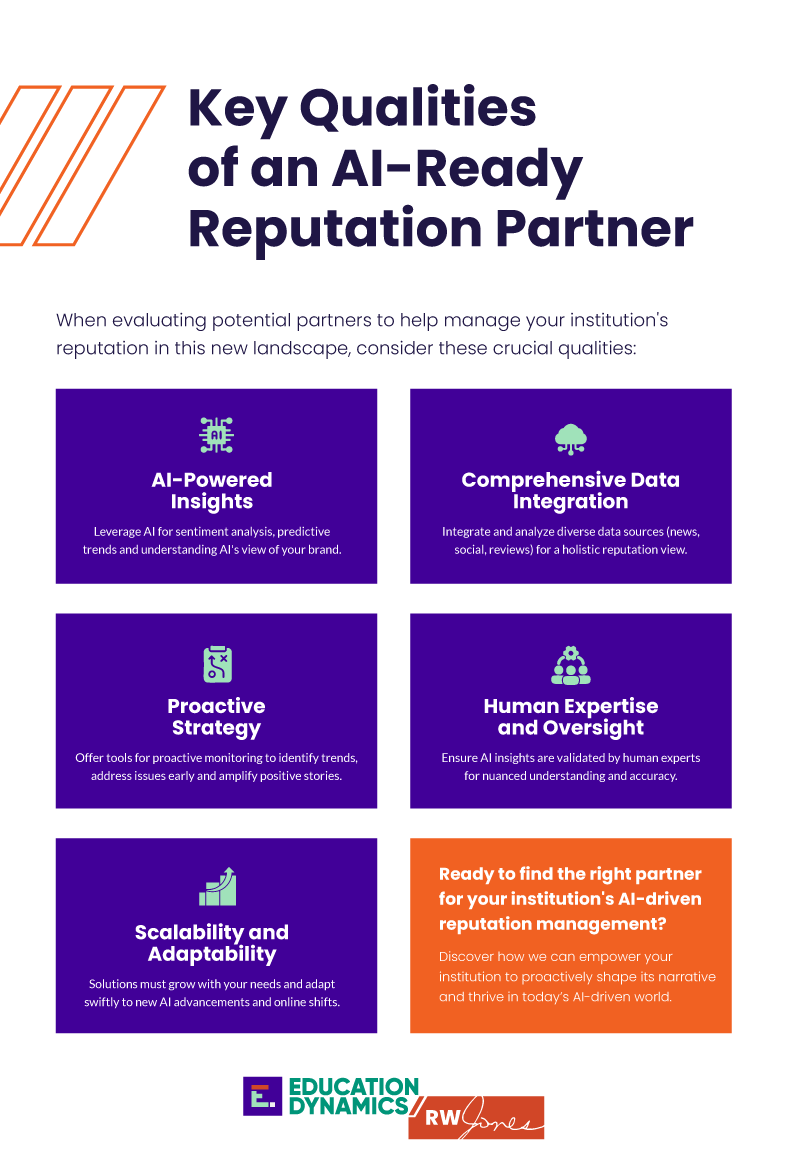
    Key Qualities of an AI-Ready Reputation Partner

    When evaluating potential partners to help manage your institution’s reputation in this new landscape, consider these crucial qualities:

    • Specific AI Capabilities
      Do they leverage AI for sophisticated sentiment analysis, predictive analytics to foresee potential issues, or to help you understand how AI models are interpreting your institution’s online presence?
    • Comprehensive Data Integration
      Look for partners who can integrate and analyze information from a wide array of sources—news articles, social media, review platforms, and your own digital assets—to provide a holistic and accurate view of your reputation.
    • Proactive Monitoring and Strategy
      Beyond simply reacting to crises, a strong partner will offer tools and strategies for proactive monitoring. This allows you to identify emerging trends, address minor issues before they escalate, and seize opportunities to amplify positive stories.
    • Human Expertise and Oversight
      While AI is powerful, human insight remains indispensable. Inquire about their process for ensuring that AI-generated insights are reviewed and validated by experienced professionals to provide nuanced understanding and prevent misinterpretations or “hallucinations.”
    • Scalability and Adaptability
      The digital and AI landscapes are constantly changing. Your partner should offer solutions that can scale with your institution’s evolving needs and adapt swiftly to new technological advancements and shifts in online behavior.

    Take Back Your Narrative

    Colleges and universities never fully owned their institutions’ reputations, but they once controlled more of the variables. Today, this equation is far more complex. What hasn’t changed is the ability to set the tone, guide the conversation and invest in the tools and partners to shape your institution’s future resilience.

    Your institution’s story is being written and rewritten daily. Make sure it is one you want to read and repeat.

    Discover how we help institutions proactively shape their narrative in an AI-driven world. Contact us at RW Jones and EducationDynamics for a personalized discussion.

    Source link

  • Reputation Is Revenue: Why Brand Equity Matters in Higher Ed

    Reputation Is Revenue: Why Brand Equity Matters in Higher Ed

    If you’re a university leader today, you’re juggling a lot: enrollment challenges, tightening budgets, shifting student expectations, and the rise of non-traditional competitors. Amid all this, one asset might not be getting the attention it deserves — your university’s brand.

    No, not just your logo or tagline. We’re talking about brand equity — the value your institution holds in the minds of students, parents, alumni, faculty, employers, and the public. It’s about reputation, trust, recognition, and connection. And in a competitive market, it matters now more than ever.

    What is brand equity in higher education?

    Think of it this way: Brand equity is what people think and feel when they hear your university’s name. It’s the difference between being someone’s first-choice school versus just another option.

    It shows up in the pride alumni feel when they wear your sweatshirt, the confidence prospective students have when they see your graduates succeed, and the trust employers place in your credentials. It’s shaped by every experience — from the way your website tells your story, to how your faculty engage in the classroom, to the tone of your communications during a crisis.

    It’s what drives alumni to give, students to enroll, and faculty to choose you over other institutions. When a university has strong brand equity, people trust it, recognize it, and feel loyal to it. That kind of reputation can spark a ripple effect of positive influence across an entire institution.

    Understanding the impact of brand equity across an institution

    Brand equity touches every dimension of institutional life, influencing how people experience, perceive, and engage with your university across the student and stakeholder journey. Let’s take a look at its impact in six key areas.

    1. Enrolling new students

    Choosing a college is a huge decision for students and their families. Today’s students are more informed than ever and expect an institution that’s respected, innovative, and committed to their success.

    That’s where your brand can make an impact. If your university has a strong, positive reputation, you’re more likely to make their shortlist. Schools with solid brand equity are seen as high-quality, forward-thinking, and worth the investment, which makes all the difference in a world where competition is fierce and the landscape is changing fast.

    2. Attracting top faculty

    It’s not just students who care about a school’s reputation — faculty and academic leaders do too. A strong, well-respected brand sends a clear message: This place is serious about excellence, values academic freedom, and encourages innovation.

    It’s not just about prestige — top talent also wants to be somewhere that fosters genuine, supportive relationships with students. A respected brand signals a vibrant academic culture where everyone’s invested in each other’s success.

    3. Fostering alumni pride

    When a university has strong brand equity, it’s not just about reputation — it’s about the sense of pride and connection it creates. Alumni who feel proud of their alma mater are more likely to stay involved, whether that means attending events, volunteering, or giving back financially.

    A strong brand also helps foster a lasting sense of community and belonging well beyond graduation. In short, when your brand is trusted and respected, alumni remain engaged — and they’re more likely to support the institution not only with their resources but by recommending it to future students within their networks.

    4. Securing strategic partnerships

    Whether you’re aiming to partner with major companies, secure government grants, or build global collaborations, having a strong brand can be a significant factor. Organizations want to work with universities they respect, trust, and recognize as leaders in their field.

    When your university’s brand is strong and clear, opportunities that are imperative to your institution open up more quickly. Meanwhile, lesser-known schools often struggle to get noticed. Building a strategic and strong brand is your best way to stand out and secure meaningful partnerships that benefit your students and your bottom line.

    5. Staying resilient amid market disruption

    Higher education is under pressure from various directions shifting demographics, financial constraints, and evolving expectations. A strong brand is essential to stay resilient and relevant.

    When controversy, crises, or big changes hit, your brand becomes your safety net. People are far more likely to give you the benefit of the doubt if they already respect and trust you. That reputation can be the difference between weathering the storm and facing long-term damage.

    6. Boosting visibility through rankings

    While rankings aren’t everything, they do influence perception. Many ranking systems factor in peer reputation, which is directly tied to your brand. The same goes for media coverage. The stronger your brand, the more likely you are to be recognized as a thought leader and trusted voice in the field.

    Ready for a Smarter Way Forward?

    Higher ed is hard — but you don’t have to figure it out alone. We can help you transform challenges into opportunities.

    Practical tips for building brand equity that lasts

    University leaders can’t afford to view brand as merely a marketing function— it’s so much more than that. Brand must be seen as a strategic asset embedded in everything from big-picture planning to day-to-day decisions. It’s part of how you attract students, build partnerships, and earn trust.

    So how can you turn brand equity into a competitive advantage for your institution? Here are a few key moves to get started:

    1. Know what you stand for

    Start with a clear sense of who you are and what makes your school unique. What do you want people to feel when they think of your institution? Your brand promise should reflect your values, vision, and personality — and it should feel real, not like something cooked up in a boardroom.

    2. Take time to truly know your audience

    What matters most to your students, parents, alumni, and faculty? What are they proud of, and what do they wish were better? Take time to listen — through surveys, conversations, and social media — and use those insights to shape your strategy and message.

    3. Tell one clear, consistent story

    Your brand shows up everywhere: your website, your campus tours, your social media posts, even how your staff answers the phone. Make sure that story feels authentic, easy to understand, and consistent across every touchpoint. Developing comprehensive brand guidelines, share them widely across the institution, and conduct regular audits to ensure every touchpoint reinforces a unified, memorable experience for all audiences.

    4. Get your people involved

    Your brand isn’t just a logo — it’s how people talk about your institution and the trust they place in it. That means faculty, staff, students, and alumni all have a role to play. Keep them in the loop, give them the tools to share your story, and make them feel like part of the bigger picture. Want to get more people talking about — and proud of — your school? Make it easy for them. Share what’s happening through newsletters and social media and provide your community with tools that help them show off their connection. When faculty, staff, students, and alumni feel informed, celebrated, and included, they’re more likely to stay engaged — and more likely to brag about being part of your institution.

    5. Make sure the experience matches the message

    If you’re promising innovation, inclusivity, or career readiness, you better be delivering that on campus, in the classroom (both online and in person), and beyond. Brand equity grows when expectations match real experiences. That’s why creating a seamless website experience is so important — it directly impacts how much trust students place in your institution and it’s offerings.

    6. Get the word out (strategically)

    Raising awareness isn’t just about marketing louder — it’s about marketing smarter. Use the right mix of channels, from digital ads and social media to speaking opportunities for university leaders. And don’t forget about earned media and storytelling that highlights real student success. Do this by building a strategic content plan that aligns messaging across platforms, targets the right audiences, and consistently showcases the impact your institution makes.

    7. Keep a pulse on your reputation

    What are people actually saying about your school? Check in regularly using surveys, online reviews, social listening, and even informal feedback. This will help you spot issues early and see what’s working.

    8. Be prepared to evolve

    Higher ed is changing fast, so your brand needs to be flexible. Stay grounded in your core values, but be open to shifting your tone, visuals, or messaging as your audience and the world around you change.

    Build a brand with a lasting legacy and immediate impact

    In an age of increasing competition and shifting student expectations, brand equity is no longer a luxury — it’s a leadership priority. With students having endless options, donors getting more selective, and reputations spreading instantly, your brand equity can be a serious competitive edge.

    Investing in a strong, authentic, and trusted brand can lay the foundation for long-term success. The institutions that thrive in the years ahead will be those that treat their brand as a central part of their overall strategy instead of a marketing afterthought.

    Because in higher ed, your brand isn’t what you say it is — it’s what people believe it to be. And that belief? That’s your brand equity.

    Ready to strengthen your institution’s brand equity? Explore how a strategic marketing approach can help you stand out and thrive. Let’s talk!

    Innovation Starts Here

    Higher ed is evolving — don’t get left behind. Explore how Collegis can help your institution thrive.

    Source link

  • Protecting Revenue and Reputation from Fraud  

    Protecting Revenue and Reputation from Fraud  

    A New Era of Risk and Responsibility  

    Higher Education is under intensifying scrutiny as federal regulations tighten, and public trust continues to waver. A growing threat to this is student aid fraud. Organized schemes are exploiting institutional systems to siphon millions in financial aid, particularly targeting Pell Grant disbursements and student aid refunds. The result is a direct hit to both institutional revenue and reputation. Institutions can no longer afford to operate passively. They must lead with transparency, accountability and systems built to withstand obstacles. In an era already marked by increasing skepticism surrounding higher education, this is a risk that institutions cannot afford to ignore 

    In June 2025, The US Department of Education announced identity verification measures for over 125,000 FAFSA applicants—a clear signal that proactive fraud prevention is no longer optional. Failure to act risks financial loss, audit exposure and reputational damage. Explore how your institution can recognize the warning signs, implement smart prevention strategies and build a strong foundation of trust that supports both reputational and revenue goals.  

    Understanding the Modern Fraudster’s Playbook  

    Today’s fraudsters are highly strategic. They understand how to game institutional processes—enrolling just long enough to trigger student aid refunds, then disappearing soon after. By carefully selecting enough credits to qualify for more aid, these fraudsters have fueled the rise of “ghost enrollments” — fraudulent student records created to claim federal aid without actual attendance.  

    This surge is fueled by gaps in infrastructure, less stringent verification procedures and siloed systems, all challenges that hit resource-limited institutions hardest. The rapid expansion of online learning has outpaced the sophistication of verification systems, reducing touchpoints to confirm student legitimacy. Adding to this challenge, outdated or isolated internal systems often lack real-time data sharing between critical departments such as admissions, financial aid and academic offices. 

    These deceptive tactics lead to more than just financial losses; they corrupt enrollment data, misguide long-term strategic planning and damage an institution’s reputation. Enrollment fraud is not just a compliance problem but a strategic issue that compromises the very accuracy of the data institutions depend on to create budgets, predict enrollment trends and allocate resources effectively.  

    Without real-time data sharing and alignment between systems, institutions remain vulnerable to fraud and flawed decision-making. EducationDynamics supports colleges and universities in closing these gaps through integrated data strategies that prioritize accuracy and system-wide consistency. 

    Identifying the Warning Signs 

    Early detection is an institution’s strongest defense against coordinated financial aid fraud. As schemes grow more sophisticated, so must the systems and vigilance required to stop them. Fraudsters are increasingly leveraging tools like AI to complete assignments, VPNs to hide their locations and fake identities to access financial aid. Even with these evolving tools, fraud leaves detectable patterns—and catching these patterns can become a valuable asset for institutions. 

    Red Flag Reports are among the most valuable tools institutions can use to identify fraudulent activity before financial aid is disbursed. These reports highlight anomalies in student data that may otherwise go unnoticed, offering a proactive mechanism to pause and review questionable activity. Implementing this type of reporting is a critical step toward closing system gaps and elevating your fraud prevention infrastructure. 

    To effectively intercept fraud, institutions should actively monitor for specific indicators across the enrollment and financial aid process, such as: 

    • Multiple students tied to the same bank account or IP address  
    • Invalid or recycled phone numbers tied to applicants  
    • Unusual enrollment or participation patterns, such as registering for the maximum credit load with no subsequent academic engagement 
    • Last-minute documentation or sudden changes to refund delivery preferences 
    • VPN usage that obscures geographic location, particularly when login or application behavior conflicts with submitted residence information 

    In response to these growing concerns,  The Department of Education has expanded identity verification requirements under V4/V5 processes, encouraging institutions to adopt similar protocols—including video-based ID confirmation and tighter front-end validation of applicant information.  

    By actively seeking out these red flags and embracing modern verification practices, institutions can significantly bolster their defense.

    Actionable Strategies for Institutional Defense 

    This is the era of proactive defense, demanding that institutions build workflows that not only accommodate scrutiny but leverage it to strengthen their practices. 

    To achieve this, institutions must: 

    Empower Staff for Early Detection 

    Use Red Flag Reports to monitor for suspicious indicators such as shared IP addresses, duplicate bank accounts and invalid phone numbers. These reports empower your staff to pause questionable disbursements and trigger manual reviews, catching issues that might otherwise slip through. 

    Build Verification Workflows to Withstand Volume  

    Build scalable, repeatable workflows to efficiently handle identity checks, document intake and federal verification requirements. Implement triage systems that ensure timely reviews, minimizing student disruption while maintaining operational efficiency and compliance.   

    Create Strategic Friction 

    Introduce intentional friction points that deter fraudsters without impeding legitimate students. Examples include phone verification for refund information or holding disbursements until after the add/drop period. These small process shifts significantly raise the barrier for fraudulent activity, preventing large-scale losses. 

    Require the Financial Responsibility Agreement  

    Make it standard practice to collect signed Financial Responsibility Agreements (FRAs) before disbursement. Doing so strengthens your paper trail and creates another point of identity verification, helping deter those attempting to abuse the system.  

    Modernize Refund Security  

    Require muti-factor authentication (MFA) when students update refund profiles, and default to e-refunds over checks. Limit paper disbursements and ensure funds are only returned to verified payment methods, significantly reducing fraud risk and maintaining transaction integrity. 

    Showcase Strong Digital Infrastructure 

    When institutions adopt secure, transparent payment systems, they project competence. Adopting strong digital infrastructure is more than an operational improvement; it’s a powerful brand message. A secure system builds public trust and reinforces your institution’s responsible stewardship of student funds. 

    Break Down Silos and Align Teams

    Financial Aid cannot combat fraud in isolation. Establish a collaborative task force with key stakeholders from IT, Registrar and Academic Affairs. Faculty, for instance, are often early observers of suspicious academic behavior. When departments share insights, vulnerabilities are closed far more swiftly. 

    Create Real-Time Communication Loops  

    Facilitate consistent touchpoints between Financial Aid, Accounts Receivable and IT to rapidly flag and act on anomalies. Integrated communication accelerates response times and minimizes oversight risks. 

    Strengthen Awareness Across Campus 

    Incorporate scam awareness into existing financial literacy programs. Students who understand phishing and fraud risks are less likely to fall victim and more likely to report suspicious behavior.  

    Develop a Crisis Communication Playbook 

    A public incident of financial aid fraud extends beyond headlines; it directly threatens an institution’s credibility. Build a comprehensive crisis communication playbook that ensures a fast, transparent, and coordinated response. Proactive planning is crucial, and institutions can significantly strengthen their efforts by partnering with trusted reputation management experts

    When institutions elevate fraud prevention to a core business function, they safeguard far more than their balance sheets, protecting their reputation, enrollment pipeline and overall standing. 

    Why This Matters for Institutional Leaders 

    Fraud prevention is a strategic responsibility that demands the attention of every institutional leader. The consequences of fraud aren’t limited to financial aid offices. Fraud compromises presidential planning, marketing performance and enrollment numbers—all while chipping away at public trust.  If institutional leaders want to chart a course for sustainable growth, defense against fraud must be built into the foundation of that strategy.  

    Presidents

     For presidents, fraud erodes the central pillars that define institutional stability—financial resilience and decision-making confidence. Ghost enrollments and fake students distort budget forecasts, inflate success metrics and mask areas of real vulnerability. 

    Fraud prevention supports long-term vision by ensuring that enrollment, funding and performance data reflect institutional realities, not manipulations. In an environment where every resource must be justified, clarity is a leadership requirement.  

    Marketing Leaders

    Marketing teams are measured by outcomes. Fraud makes those outcomes unreliable. Invalid inquiries and ghost enrollments inflate to the top of the funnel, while wasting precious budget. For leaders who rely on brand perception to drive engagement and attract prospects, fraud directly undermines their efforts, risking a loss of trust and diminished return on investment.  

    Enrollment Leaders

    Enrollment leaders face rising stakes driven by declining traditional student populations and heightened expectations for conversions. In this environment, fraud distorts the metrics that enrollment leaders depend on. It artificially inflates applicant numbers, conceals melt and obscures true student movement through the funnel.  

    More importantly, fraudulent applications divert the time and energy of enrollment coaches. Every moment spent chasing a ghost applicant is a moment stolen from a real applicant who may never get the support they need. Over time, this leads to higher melt, poorer service and declining performance. Strategic financial aid conversations can refocus coaching efforts on real prospects and improve yield through trust-building and transparency. 

    Fraud prevention empowers enrollment leaders to understand their true audience and make decisions rooted in authentic student behavior, not artificial patterns. Aligning enrollment management strategies with proactive fraud prevention creates a foundation that drives sustained success.  

    Building a Resilient Institution 

    Fraud prevention is an ongoing commitment to institutional resilience. As fraudsters evolve their tactics, institutions must continually refine their defenses with smarter workflows, updated red flag criteria and technology. The most resilient schools treat fraud prevention as core infrastructure, integrating it into strategic planning rather than siloing it within financial departments. More importantly, many fraud safeguards also enhance the experience of students and staff by eliminating confusion and freeing teams to focus on supporting real students. When institutions take a proactive approach to fraud, they’re not only protecting their operations—they’re actively preserving the credibility and brand reputation that define long-term success. 

    EducationDynamics is here to help you turn defense into momentum. By aligning revenue strategy with reputation stewardship, we empower institutions to lead with clarity, act with confidence and build a foundation for success in an increasingly high-stakes environment.    

    Source link

  • 10 Website Marketing Strategies for Building Your Reputation

    10 Website Marketing Strategies for Building Your Reputation

    The internet has dramatically transformed and so has university website marketing. From basic online brochures relying on a “build it and they will come” approach, websites evolved into dynamic, interactive platforms driven by search engine optimization (SEO) and mobile optimization. Now, website marketing blends AI-driven insights with omnichannel experiences, as prospective students expect seamless, personalized interactions that clearly articulate an institution’s value. 

    With Google’s widespread release of AI-powered search to all users, your brand and reputation are more critical than ever. The internet’s collective opinion of your institution, interpreted by AI, now directly influences search results. Strong, positive brand reputations inherently signal authority and trustworthiness to AI, increasing visibility and recommendations.  

     This moment opens new doors for higher ed digital marketing. A website that simply exists today is a missed opportunity. If it doesn’t connect with the Modern Learner or clearly articulate your institution’s unique value, you’re not just losing their interest; you’re losing enrollments and damaging your reputation. For today’s Modern Learner, who expects seamless digital experiences and values authenticity and flexibility, your website is their first impression of your brand and reputation. 

    To transform your website into a reputation-building, revenue-generating asset, you need a holistic website marketing strategy that positions your EDU website as a strategic asset that continuously adapts to learner needs, builds authentic connections and signals authority to AI. Explore 10 essential website strategies to that will ensure your institution is found and chosen by the Modern Learner.

    1. Optimize Content to Feed AI Robots  

    The Modern Learner’s journey now begins with AI. To stand out, your website needs to engage prospective students and be optimized for how AI tools find and present information. At EducationDynamics, we’ve anticipated the rise of AI in search and adapted our website marketing strategies to help institutions stay ahead and continue to outrank the competition.     

    To optimize content for both audiences, structure it clearly with descriptive headings, concise copy and consistent formatting so AI can accurately surface your programs. Highlight outcomes like career paths, program value and student success to connect your offerings to what students truly want.  

    Use natural, straightforward language that’s easy for humans and AI to interpret. Prioritize content types that AI favors, such as FAQs, career guides and student stories, to build trust and boost discoverability.  

    Your website is a pivotal opportunity to tell a compelling story that highlights your institution’s core values and unique strengths. That way, when students ask the search engines questions about the right institution for them, your website is positioned to be a top answer.  

    2. Ensure Your Website Provides a Seamless User Experience (UX) and Prioritizes Accessibility 

    Modern Learners expect fast, intuitive and accessible digital experiences. From the moment a prospective student lands on your site, navigation should feel natural. Clear headers, streamlined menus and a consistent experience across all devices ensure visitors can easily find the information they need without frustration. 

    First impressions matter, and your website’s speed and mobile responsiveness are non-negotiables. Slow load times or clunky mobile layouts can lose students before they even reach your message. A user-centric website builds trust and reflects your institution’s commitment to meeting students where they are.  

    Accessibility isn’t an add on—it must be built into your website’s infrastructure. Inclusive design ensures every user, regardless of ability, can engage with your content.  

    At EducationDynamics, we consistently stay ahead by adopting UX and CRO technologies early, allowing our team to rapidly launch A/B tests and uncover what truly resonates with students. Through continuous optimization and real-time insights, we help institutions create user experiences that reflect their brand, support enrollment goals and keep prospective students moving forward. 

    3. Optimize for Modern Search (SEO & GEO) 

    The Modern Learner demands more. As search evolves with AI, your institution’s digital visibility isn’t just important—it’s paramount.  Traditional SEO, while foundational, falls short in today’s evolving search ecosystem where the rules of digital visibility are being rewritten. 

    With the widespread release of AI-powered search, prospective students are discovering their educational options without clicking on an actual link. As a result, institutions must embrace Generative Engine Optimization (GEO). GEO isn’t just about keywords; it’s about optimizing for how AI interprets, ranks and amplifies your institution’s content. A GEO-first strategy demands prioritizing well-structured content, rich media and authentic first-person perspectives from your students and faculty to command visibility in this new, AI-driven search reality. 

    EducationDynamics doesn’t just adapt to these shifts; we innovate by anticipating emerging trends, leveraging cutting-edge technology and leveraging data-driven insights.  Our research-driven approach to SEO for higher education and GEO is continuously evolving, placing your institution at the forefront of how Modern Learners discover and engage. We ensure your visibility, credibility and competitive edge are undeniable, whether through traditional search or the power of AI. 

    4. Amplify Your Brand Voice Across All Digital Touchpoints 

    In a crowded digital landscape, fragmented messaging is a liability. For the Modern Learner, a unified brand voice across every digital touchpoint isn’t just a best practice; it’s the foundation of trust and the catalyst for lasting connection. When prospective students move between your website, social media, emails and ads, they should encounter consistent messaging that reaffirms your brand identity. Anything else risks confusion. Consistency, on the older hand, builds clarity and drives connection.   

    That alignment must be grounded in a strong brand narrative that communicates your institution’s values, mission and what sets you apart. In a market where students are inundated by options, your ability to clearly communicate your institution’s unique offerings is critical and helps students quickly understand why your institution is the right choice.  

    Real stories from students and alumni bring that narrative to life. These experiences do more than inspire; they create emotional ties that help prospective students see themselves in your community. 

    A clear, consistent brand voice, supported by a strong website content strategy, is more than a marketing asset. It is a strategic imperative, turning interest into action that builds lasting loyalty from enrollment to graduation and beyond.  

    5. Personalize the Digital Experience for Each Prospective Student 

    Personalization is no longer optional. It is essential for driving engagement, building trust and supporting students through the enrollment process. 

    By leveraging personalized content marketing, institutions can create a one-to-one experience that feels relevant and responsive. Customized email campaigns, dynamic landing pages and virtual campus tours foster connections with students. These experiences demonstrate your institution’s understanding of Modern Learners and help each individual develop a meaningful connection. 

    Personalization works best when guided by data. By monitoring behavioral cues such as pages viewed, time spent and programs researched, institutions can tailor content and messaging to align with each student’s needs. This enhances the user experience and makes students feel understood. 

    This is more than optimization. It’s relationship-building. Strategic personalization transforms passive interest into meaningful engagement and builds confidence in your institution’s ability to support each student’s journey. 

    Modern Learners don’t respond to static messages. They engage in dynamic conversations. Through data-driven personalization, institutions can build digital experiences that feel tailored and conversational, moving students from curiosity to commitment faster and with greater trust. 

    6. Build Your Advocate Community  

    he most powerful testimonials come from those who live your brand. By cultivating a vibrant advocate community, your institution doesn’t just enhance its reputation; it ignites a powerful, authentic narrative that deeply connects with prospective students, solidifying their confidence and accelerating their enrollment decision.  

    Student testimonials and reviews are among the most effective tools for building trust and credibility on your website. Authentic stories bring your brand to life, helping prospective students envision themselves thriving at your institution. Featuring a diverse range of testimonials across various website pages ensures these voices resonate with a wide audience and reflect the true student experience. 

    Provide opportunities for students and alumni to share their stories, then amplify their voices across your website and broader digital presence. This cohesive approach weaves authentic advocacy into all touchpoints, enhancing emotional connection and making your institution more relatable. 

    By rooting your brand in real experiences, you strengthen reputation and build lasting relationships. Authentic connection sets your institution apart and drives enrollment in a competitive market. 

    7. Facilitate Communication and Engagement 

    In today’s fast-moving digital world, access matters. Offering multiple communication channels on your website such as forms, live chat, text messaging, email and phone ensures prospective students can easily reach out in the way that suits them best. Making information and enrollment support readily accessible improves the overall student experience and fosters a sense of control during the decision-making process. 

    Incorporating AI-powered chatbots can further enhance engagement by providing instant answers and personalized guidance 24/7. These tools handle routine questions efficiently, allowing your team to focus on high-impact interactions that require a human touch. 

    When institutions prioritize fast, flexible communication across digital, they do more than offer convenience. They build trust, open the door to deeper engagement and provide the seamless support that moves students closer to enrollment. 

    8. Use Data and Analytics for Continuous Improvement

    Website optimization isn’t a one-time task; it is a continuous process driven by data.  Institutions should regularly track key metrics such as page engagement, bounce rates, conversions and time spent on site to understand how visitors interact with their content. Tools like heatmaps and A/B testing provide valuable insights into user behavior and help identify what elements resonate and where improvements are needed. 

    By leveraging data-driven insights from user search patterns, click paths and drop-off points, institutions can make informed decisions to enhance user engagement and increase conversion rates. Testing different headlines, layouts and calls to action allows for experimentation that drives measurable results. In addition, effective website management requires a robust Content Management System and a clear governance policy to ensure ongoing maintenance and optimization. 

    As leading market research experts in higher education, EducationDynamics knows what it takes to transform data into action.  Our team’s relentless focus on analytics and optimization isn’t just about attracting students; it’s about continuously refining a digital experience that fortifies your institution’s reputation. We empower you to harness insights, ensuring your website is a dynamic asset that converts curiosity into committed enrollment and lasting brand loyalty. 

    9. Showcase Real Outcomes with Career-Focused Tools and Resources

    Today’s students are looking for more than a degree. They want a clear path to a successful future. Your website must deliver on this expectation by showcasing tangible outcomes that prove your institution’s value. Highlighting real-world results is one of the most powerful ways to build credibility and elevate your brand.  

    Integrate features that demonstrate the long-term impact of your programs. Job placement stats and alumni success stories reinforce your institution’s influence and give students confidence in their future. Spotlight employer partnerships and accessible career services to position your school as career-connected and student-focused. Interactive tools like salary calculators, career pathway infographics and program-matching quizzes deepen engagement and help students make informed decisions. 

    By clearly communicating return on investment through your website, you do more than just inform prospective students — you build trust, strengthen your institution’s reputation and guide students closer to enrollment. This isn’t merely sharing information, it’s about demonstrating that your institution delivers on its promises. When you connect outcomes to the student experience, you create the kind of meaningful, value-driven journey that today’s Modern Learners actively seek.  

    10. Develop a Robust Content Hub That Positions Your Institution as a Thought Leader 

    In today’s competitive higher education environment, institutions must take every opportunity to showcase their unique brand proposition. Your website is a mission-critical touchpoint with power to either build or break institutional reputation. When used strategically, it becomes more than a source of information. Rather, it can be a content hub that reflects your institution’s unique offerings, while building trust and elevating your brand. 

    By highlighting content such as faculty research, student initiatives, alumni achievements and blogs on timely topics, your institution can build relevance and authority. Your website content strategy should ensure your website becomes a living representation of your institution’s values and vision. This makes your website a living representation of the institution’s values and vision, creating an integral link to your audience and ultimately leading to stronger brand credibility, increased organic engagement and a lasting reputation as a thought leader in higher education.

    The Moment is Now: Elevating Reputation in the AI Era 

    Your website is more than a digital touchpoint; it is the heartbeat of your brand and foundation of your institution’s future. In an AI-driven world, standing still means falling behind.  

    At EducationDynamics, we’re here to help you navigate these changes with confidence. Transforming lives through higher education is at the core of our mission, and that means anticipating trends, understanding shifts and equipping our partners to thrive. 

    This is not merely an opportunity to adapt; it is an imperative to lead. Now is the decisive moment to fundamentally reimagine your website’s strategic role in driving unparalleled visibility, sustainable growth, and a strong reputation. Join John Weaver and Karina Kogan for “The New Rules of Website Marketing,” a live virtual masterclass that will show you how to turn your website into a high-impact tool for success in an AI-driven world. Secure your institution’s future advantage by reserving your spot today

    Source link

  • Melbourne has the best academic reputation of any Australian uni, Times Higher Education says

    Melbourne has the best academic reputation of any Australian uni, Times Higher Education says

    Melbourne University Campus in Carlton.
    Picture: NCA NewsWire / David Geraghty

    The University of Melbourne has topped the list of Australia’s most prestigious higher education facilities globally.

    Please login below to view content or subscribe now.

    Membership Login

    Source link