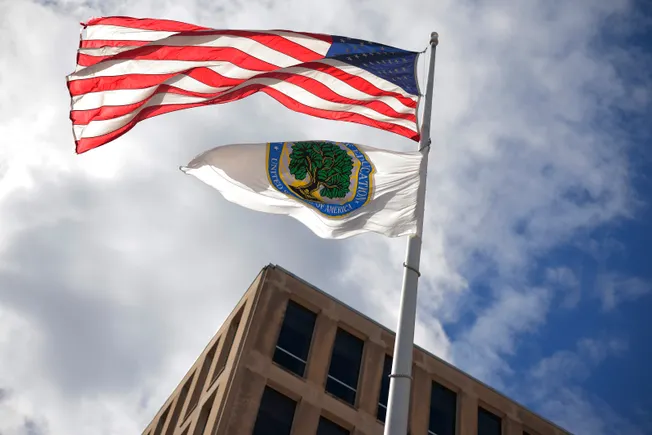
Many institutions, including the SUNY system, have invested in Title VI coordinators in recent months.
Photo illustration by Justin Morrison/Inside Higher Ed | howtogoto/iStock/Getty Images
New York is mandating that all colleges in the state designate a coordinator to oversee investigations into discrimination on the basis of race, color, national origin and shared ancestry, which is prohibited under Title VI of the Civil Rights Act of 1964, Gov. Kathy Hochul’s office announced Wednesday.
According to Hochul, the state is the first in the country to pass such a law.
“By placing Title VI coordinators on all college campuses, New York is combating antisemitism and all forms of discrimination head-on,” she said in the press release. “No one should fear for their safety while trying to get an education. It’s my top priority to ensure every New York student feels safe at school, and I will continue to take action against campus discrimination and use every tool at my disposal to eliminate hate and bias from our school communities.”
Many colleges have begun hiring for Title VI coordinator roles in the past several months in response to the surge in reports of antisemitism and Islamophobia following Hamas’s fatal Oct. 7, 2023 attack on Israeli civilians. In some cases, the Department of Education’s Office for Civil Rights required institutions to add these roles after finding that they failed to adequately address complaints of discrimination on their campuses.
The State University of New York system had already mandated each of its campuses to bring on a Title VI coordinator by the fall 2025 semester.
Illinois hospital staff will soon be required by law to refer parents of severely premature infants to services that can help prevent years of intensive and expensive therapy later, when the children are older. The new law follows reporting from The Hechinger Report that exposed how hospitals often fail to connect many eligible parents to these opportunities for their children after they leave neonatal intensive care units.
Earlier this year, Hechinger contributor Sarah Carr wrote about how, across the country, far too few parents are made aware of the kinds of therapies their babies are entitled to under federal law. Such early intervention services can ultimately reduce the need for these children to require costly special education support as schoolchildren.
Carr noted: “Federal law says children with developmental delays, including newborns with significant likelihood of a delay, can get early intervention from birth to age 3. States design their own programs and set their own funding levels, however. They also set some of the criteria for which newborns are automatically eligible, typically relying on qualifying conditions like Down syndrome or cerebral palsy, extreme prematurity or low birthweight. Nationally, far fewer infants and toddlers receive the therapies than should. The stats are particularly bleak for babies under the age of 1: Just 1 percent of these infants get help. Yet an estimated 13 percent of infants and toddlers likely qualify.”
After the Hechinger Report story was published, Illinois state Rep. Janet Yang Rohr authored legislation to require that hospitals distribute materials informing parents of premature and low birth weight babies about their eligibility for early intervention therapies. The bill also required that hospitals make a nurse or physical therapist available to explain these rights to families.
Related: Young children have unique needs and providing the right care can be a challenge. Our free early childhood education newsletter tracks the issues.
“The problem is that these families often don’t know about these services,” Yang Rohr said last spring, after her chamber passed the bill. “So this bill improves that early intervention process by requiring NICU staff to share information about these services and requires hospital staff to write a referral to these programs for families that are eligible.”
Illinois Representative Janet Yang Rohr Credit: ILGA
Carr also wrote: “The stakes are high for these fragile, rapidly growing babies and their brains. Even a few months of additional therapy can reduce a child’s risk of complications and make it less likely that they will struggle with talking, moving and learning down the road. In Chicago and elsewhere, families, advocates and physicians say a lot of the failures boil down to overstretched hospital and early intervention delivery systems that are not always talking with families very effectively, or with each other hardly at all. ‘They really put the onus of helping your child get better outcomes on you,’ said Jaclyn Vasquez, an early childhood consultant who has had three babies of her own spend time in the NICU.”
“Early intervention is life-changing for many families, as these programs provide critical services and therapies as children develop,” Illinois state Sen. Ram Villivalam said when the bill was sent to Pritzker. “But, these services can only benefit those they are able to reach, which means uplifting the program and expanding its outreach to those who need it is imperative.”
Contact editor Nirvi Shah at 212-678-3445, securely on Signal at NirviShah.14 or via email at [email protected].
The Hechinger Report provides in-depth, fact-based, unbiased reporting on education that is free to all readers. But that doesn’t mean it’s free to produce. Our work keeps educators and the public informed about pressing issues at schools and on campuses throughout the country. We tell the whole story, even when the details are inconvenient. Help us keep doing that.
This audio is auto-generated. Please let us know if you have feedback.
A federal judge is standing by his June decision requiring the U.S. Department of Education torestore its Office for Civil Rights “to the status-quo” so it can “carry out its statutory functions.” The order, which prevents the department from laying off OCR employees, comes despite a U.S. Supreme Court emergency order in a separate case allowing the agency to move forward with mass layoffs across the department.
The case challenging the gutting of OCR, which included the shuttering of seven out of 12 regional OCR offices, was brought by two students who “faced severe discrimination and harassment in school and were depending on the OCR to resolve their complaints so that they could attend public school,” said Judge Myong Joun in his Aug. 13 decision.
The Education Department appealed Joun’s ruling Thursday to the U.S. First Circuit Court of Appeals, asking the court to allow the department to move forward with its OCR closures.
The court battle prolongs the administrative leave of OCR employees that began in March, after the department laid off more than 1,300 staff across the entire Education Department. President Donald Trump and U.S. Education Secretary Linda McMahon pushed the layoffs as a way to “end bureaucratic bloat” and downsize the federal government, including its expenses.
However, according to American Federation of Government Employees Local 252, the union representing a majority of the laid-off Education Department employees, the federal government has been paying around $7 million a month just for employees to sit idle on administrative leave.
The employees’ administrative leave that began in March originally ended with their termination on June 9. However, court cases blocking the department’s gutting have prolonged their employment.
According to the numbers released by the agency last year, OCR received a record number of complaints against K-12 and higher education institutions in 2023, the most recent year for which numbers are available, surpassing a previous all-time high set in 2022.
This audio is auto-generated. Please let us know if you have feedback.
A federal judge is standing by his June decision requiring the U.S. Department of Education torestore the Office for Civil Rights “to the status-quo” so it can “carry out its statutory functions.” The order, which prevents the department from laying off OCR employees, comes despite a U.S. Supreme Court emergency order in a separate case allowing the agency to move forward with mass layoffs across the department.
The case challenging the gutting of OCR, which included the shuttering of seven out of 12 regional OCR offices, was brought by two students who “faced severe discrimination and harassment in school and were depending on the OCR to resolve their complaints so that they could attend public school,” said Judge Myong Joun in his Aug. 13 decision.
The Education Department appealed Joun’s ruling Thursday to the U.S. First Circuit Court of Appeals, asking the court to allow the department to move forward with its OCR closures.
The court battle prolongs the administrative leave of OCR employees that began in March, after the department laid off more than 1,300 staff across the entire Education Department. President Donald Trump and U.S. Education Secretary Linda McMahon pushed the layoffs as a way to “end bureaucratic bloat” and downsize the federal government, including its expenses.
However, according to American Federation of Government Employees Local 252, the union representing a majority of the laid-off Education Department employees, the federal government has been paying around $7 million a month just for employees to sit idle on administrative leave.
The employees’ administrative leave that began in March originally ended with their termination on June 9. However, court cases blocking the department’s gutting have prolonged their employment.
According to the numbers released by the agency last year, OCR received a record number of complaints against K-12 and higher education institutions in 2023, the most recent year for which numbers are available, surpassing a previous all-time high set in 2022.
Senator Bernie SandersSenator Bernie Sanders introduced legislation last Thursday requiring all public school teachers to earn at least $60,000 annually, calling America’s teacher pay crisis a “national emergency” during a Capitol Hill town hall with more than 200 educators.
The Pay Teachers Act, co-sponsored by eight Democratic senators including Elizabeth Warren and Ed Markey, would establish the first federal mandate for teacher salaries and represents the most ambitious federal intervention in educator compensation in decades.
“Just four hedge fund managers on Wall Street make more money in a single year than every kindergarten teacher in America combined—over 120,000 teachers,” Sanders said. “No public school teacher in America should make less than $60,000 a year.”
The legislation comes as schools nationwide face unprecedented staffing shortages, with nearly 200,000 teaching positions either vacant or filled by underqualified educators. According to the bill’s findings, 38% of teachers nationwide earn less than $60,000 annually, with starting teachers averaging $44,530.
Maria Gonzalez, a third-grade teacher from Arizona who testified at the town hall, said she drives for Uber on weekends and tutors after school to pay rent.
“My students ask why I look tired. How do I tell them their teacher can’t afford to live in the community where she teaches?”
The crisis extends beyond low pay. Twenty-one percent of elementary and middle school teachers’ families rely on public assistance programs including Medicaid, food stamps, and the Earned Income Tax Credit, according to a University of California, Berkeley study cited in the legislation. Additionally, 44% of public school teachers quit within five years, and 17% worked multiple jobs during the 2020-2021 school year.
The comprehensive bill would cost approximately $400 billion over five years, funded through mandatory appropriations. Beyond the $60,000 minimum salary requirement, the legislation would triple Title I funding, provide teachers with at least $1,000 annually for classroom supplies, and mandate that paraprofessionals and education support staff earn at least $45,000 annually or $30 per hour.
States would have four years to implement the salary requirements, with extended timelines available for states demonstrating substantial financial need. The bill also includes $50 billion annually for career ladder programs allowing teachers to advance without leaving the classroom.
The teacher shortage disproportionately affects schools serving students of color and low-income communities, which are four times more likely to employ uncertified teachers than schools with low minority enrollment, according to federal civil rights data cited in the legislation.
James Williams, a high school mathematics teacher from North Carolina, told the town hall that his salary purchased “a decent life” 15 years ago but now forces him to choose between car repairs and classroom supplies.
The legislation faces significant political obstacles with Republicans controlling the House. GOP lawmakers have criticized the massive federal spending, while some education policy experts question federal involvement in traditionally state and local compensation decisions.
Major education unions endorsed the proposal. American Federation of Teachers President Randi Weingarten called it “a crucial federal investment to help sustain the teaching profession,” while National Education Association Vice President Princess Moss praised it as legislation that “invests in our students, educators, and public schools.”
Sanders criticized recent Republican legislation that he said provides “$900 billion in tax cuts to large, profitable corporations and a $1 trillion tax cut to the top 1%” while cutting over $300 billion in education funding. The Trump administration is also withholding nearly $5.5 billion in congressionally appropriated education funding, according to Sanders and his colleagues.
“If we can provide over a trillion dollars in tax breaks to the top 1% and large corporations, please don’t tell me that we cannot afford to make sure that every teacher in America is paid at least $60,000 a year,” Sanders said.
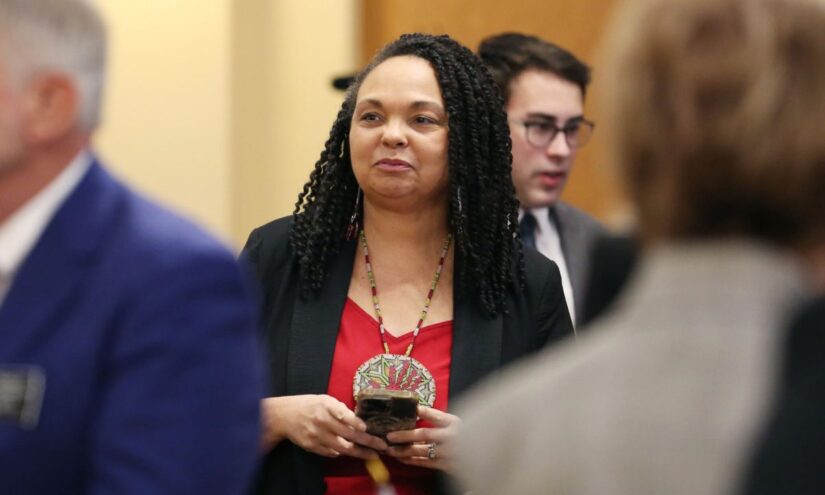
South Dakota public schools would be required to teach a specific set of Native American historical and cultural lessons if a bill unanimously endorsed by a legislative committee Tuesday in Pierre becomes law.
The bill would mandate the teaching of the Oceti Sakowin Essential Understandings. The phrase “Oceti Sakowin” refers to the Lakota, Dakota and Nakota people. The understandings are a set of standards and lessons adopted seven years ago by the South Dakota Board of Education Standards with input from tribal leaders, educators and elders.
Use of the understandings by public schools is optional. A survey conducted by the state Department of Education indicated use by 62% of teachers, but the survey was voluntary and hundreds of teachers did not respond.
Republican state Sen. Tamara Grove, who lives on the Lower Brule Reservation, proposed the bill and asked legislators to follow the lead of Sisseton Wahpeton Oyate Chairman J. Garret Renville. He has publicly called for a “reset” of state-tribal relations since the departure of former Gov. Kristi Noem, who was barred by tribal leaders from entering tribal land in the state.
“What I’m asking you to do today,” Grove said, “is to lean into the reset.”
Joe Graves, the state secretary of education and a Noem appointee, testified against the bill. He said portions of the understandings are already incorporated into the state’s social studies standards. He added that the state only mandates four curricular areas: math, science, social studies and English-language arts/reading. He said further mandates would “tighten up the school days, leaving schools with much less instructional flexibility.”
Members of the Senate Education Committee sided with Grove and other supporters, voting 7-0 to send the bill to the full Senate.
The proposal is one of several education mandates that lawmakers have considered this legislative session. The state House rejected a bill this week that would have required posting and teaching the Ten Commandments in schools, and also rejected a bill that would have required schools to post the state motto, “Under God the People Rule.”
South Dakota Searchlight is part of States Newsroom, a nonprofit news network supported by grants and a coalition of donors as a 501c(3) public charity. South Dakota Searchlight maintains editorial independence. Contact Editor Seth Tupper for questions: [email protected].