OpenAI announced Tuesday that it’s investing $50 million to start up NextGenAI, a new research consortium of 15 institutions that will be “dedicated to using AI to accelerate research breakthroughs and transform education.”
The consortium, which includes 13 universities, is designed to “catalyze progress at a rate faster than any one institution would alone,” the company said in a news release.
“The field of AI wouldn’t be where it is today without decades of work in the academic community. Continued collaboration is essential to build AI that benefits everyone,” Brad Lightcap, chief operating officer of OpenAI, said in the news release. “NextGenAI will accelerate research progress and catalyze a new generation of institutions equipped to harness the transformative power of AI.”
The company, which launched ChatGPT in late 2022, will give each of the consortium’s 15 institutions—including Boston Children’s Hospital and the Boston Public Library—millions in funding for research and access to computational resources as part of an effort “to support students, educators, and researchers advancing the frontiers of knowledge.”
Institutional initiatives supported by NextGenAI vary widely but will include projects focused on AI literacy, advancing medical research, expanding access to scholarly resources and enhancing teaching and learning.
Dr Elizabeth Morrowis Research Consultant, Senior Research Fellow Royal College of Surgeons in Ireland, & Public Contributor to the Shared Commitment to Public Involvement on behalf of National Institute for Health and Care Research.
Professor Fiona Ross CBE is Professor Emerita Health and Social Care Kingston University, Deputy Chair Westminster University Court of Governors & Trustee Great Ormond Street Hospital Charity.
Commitment and Motivation for Inclusive Research
The commitment to inclusivity in UK research cultures and practices will endure despite political shifts abroad and continue to thrive. Rooted in ethical and moral imperatives, inclusivity is fundamentally the right approach. Moreover, extensive evidence from sources such as The Lancet, UNESCO and WHO highlights the far-reaching benefits of inclusive research practices across sectors like healthcare and global development. These findings demonstrate that inclusivity not only enhances research quality but also fosters more equitable outcomes.
We define ‘inclusive research’ as the intentional engagement of diverse voices, communities, perspectives, and experiences throughout the research process. This encompasses not only who conducts the research but also how it is governed, funded, and integrated into broader systems, such as policy and practice.
Beyond higher education, corporate leaders have increasingly embraced inclusivity. Research by McKinsey & Company shows that companies in the top quartile for gender diversity are 25% more likely to outperform their peers in profitability, while those leading in ethnic diversity are 36% more likely to do so. This clear link between inclusivity, innovation, and financial success reinforces the value of diverse teams in driving competitive advantage. Similarly, Egon Zehnder’s Global Board Diversity Tracker highlights how diverse leadership enhances corporate governance and decision-making, leading to superior financial performance and fostering innovation.
Inclusion in research is a global priority as research systems worldwide have taken a ‘participative turn’ to address uncertainty and seek solutions to complex challenges such as Sustainable Development Goals. From climate change to the ethical and societal implications of Artificial Intelligence (AI), inclusive research is a track that ensures that diverse perspectives shape solutions that are effective, fair and socially responsible.
Take the example of AI and gender bias – evidence shows that women are frequently not included in technology research and are underrepresented in data sets. This creates algorithms that are biased and can have negative consequences of sensitivity, authenticity, or uptake of AI-enabled interventions by women. Similar biases in AI have been found for other groups who are often overlooked because of their age, gender, sexuality, disability, or ethnicity, for example.
Accelerating Inclusion in UK Research
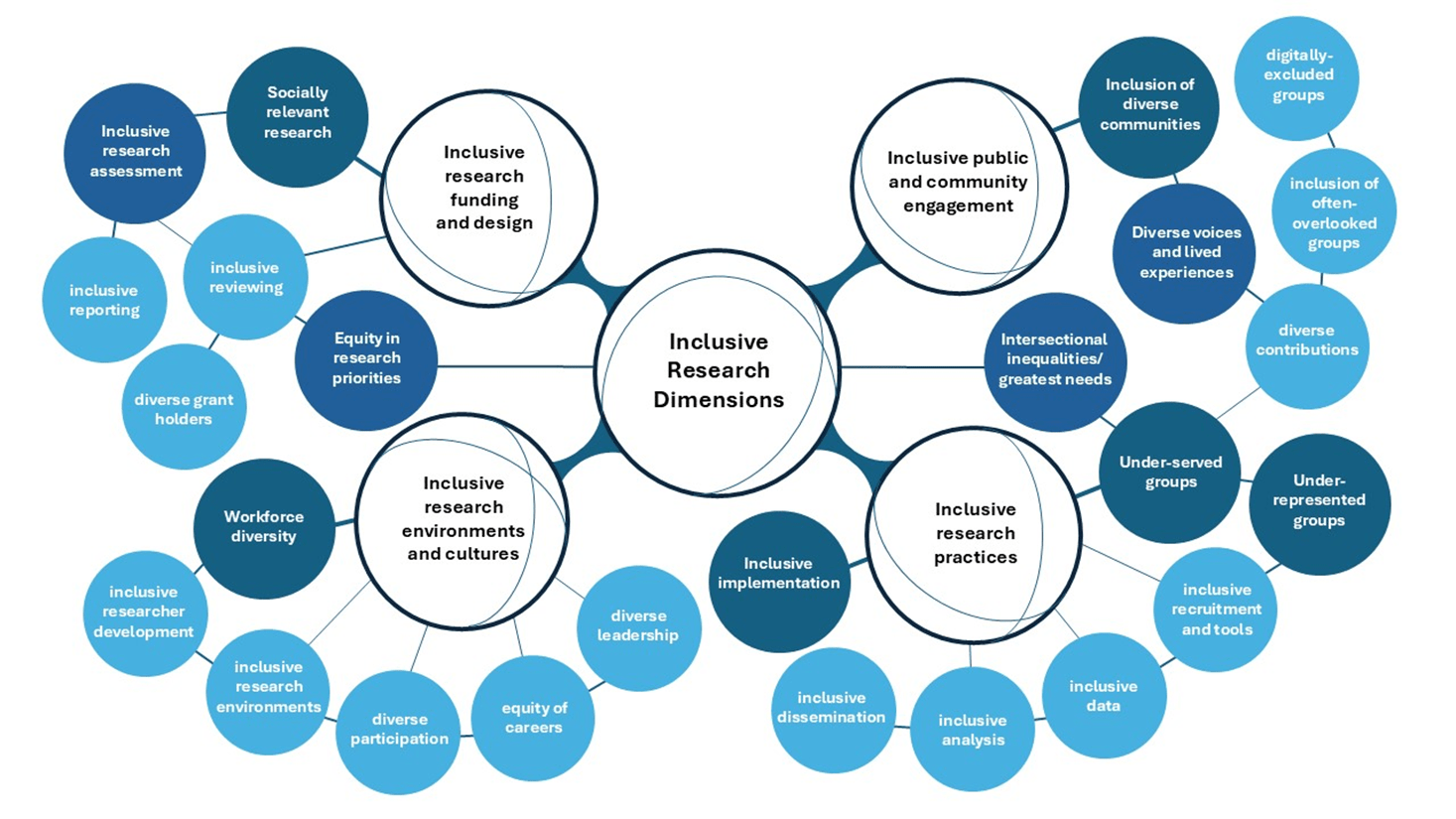
A recent horizon scan of concepts related to the UK research inclusion landscape indicates domains in which inclusive research is being developed and implemented, illustrated by Figure 1.
Inclusion is being accelerated by the Research Excellence Framework (REF) 2029, with a stronger focus on assessing People, Culture, and Environment (PCE). REF 2029 emphasises the integration of EDI considerations across research institutions, with a focus on creating equitable and supportive cultures for researchers, participants and communities. The indicators and measures of inclusion that will be developed and used are important because they can encourage diversity of perspectives, knowledge, skills and worldviews into research processes and institutions, thereby increasing relevance and improved outcomes. All units of assessment and panels involved in the REF process will have guidance from the People and Diversity Advisory Panel and the Research Diversity Advisory Panel. This means that inclusion will develop in both the culture of research institutions and the practices that shape research assessment.
The National Institute for Health Research, which is the largest funder of health and social care research, has pioneered inclusion for over 30 years and prioritises inclusion in its operating principles (see NIHR Research Inclusion Strategy 2022-2027). NIHR’s new requirements for Research Inclusion (RI) will be a powerful lever to address inequalities in health and care. NIHR now requires all its domestic commissioned research to address RI at the proposal stage, actively involve appropriate publics, learn from them and use this learning to inform impact strategies and practices.
Given the learning across various domains, we ask: How can the broader UK system share knowledge and learn from the setbacks and successes in inclusion, rather than continually reinventing the wheel? By creating space in the system between research funders and institutions to share best practices, such as the Research Culture Enablers Network, we can accelerate progress and contribute to scaling up inclusive research across professional groups and disciplines. There are numerous examples of inclusive innovation, engaged research, and inclusive impact across disciplines and fields that could be shared to accelerate inclusion.
Developing Shared Language and Inclusive Approaches
Approaches to building inclusive cultures in research often come with passion and commitment from opinion leaders and change agents. As often happens when levering change, a technical language evolves that can become complex and, therefore, inaccessible to others. For example, acronyms like RI can apply to research inclusion, research integrity and responsible innovation. Furthermore, community-driven research, public and community engagement, and Patient and Public Involvement (PPI) have become synonymous with inclusive research, and such participation is an important driver of inclusion.
The language and practices associated with inclusive research vary by discipline to reflect different contexts and goals. This can confuse rather than clarify and form barriers that possibly get in the way of trust and more effective inclusion strategies and practices. We ask: How can we establish shared understanding, methods of participation, accountability pathways and mechanisms that will promote inclusion in the different and dynamic contexts of UK research?
With over 20 years of experience in the fields of inclusion and equity, like other researchers, we have found that interdisciplinary collaboration, participatory methods, co-production, and co-design offer valuable insights by listening to and engaging with publics and communities on their own terms and territory. An inclusive approach has deepened our understanding and provided new perspectives on framing, methodological development, and the critical interpretation of research.
Final reflection
Key questions to overcome EDI cynicism are: How can we deepen our understanding and integration of intersectionality, inclusive methods, open research, cultural competency, power dynamics, and equity considerations throughout research processes, institutions, and systems? There is always more to learn and this can be facilitated by inclusive research cultures.
This audio is auto-generated. Please let us know if you have feedback.
With the U.S. Department of Education’s cancellation of the National Assessment of Educational Progress for 17-year-olds, education researchers are losing one resource for evaluating post-high school readiness — though some say the test was already a missed opportunity since it hadn’t been administered since 2012.
The department cited funding issues in its cancellation of the exam, which had been scheduled to take place this March through May.
Since the 1970s, NAEP has monitored student performance in reading and math for students ages 9, 13 and 17. These assessments — long heralded as The Nation’s Report Card — measure students’ educational progress over long periods to identify and monitor trends in academic performance.
The cancellation of the NAEP Long-Term Trend assessment for 17-year-olds came just days before the Trump administration abruptly placed Peggy Carr, commissioner of the National Center for Education Statistics and as such, the public voice of NAEP, on paid leave.
Carr has worked for the Education Department and NCES for over 30 years through both Republican and Democratic administrations. President Joe Biden appointed her NCES commissioner in 2021, with a term to end in 2027.
The decision to drop the 2025 NAEP for 17-year-olds also follows another abrupt decision by the Education Department and the Department of Government Efficiency, or DOGE, to cut about$881 million in multi-year education research contracts earlier this month. The Education Department had previously said NAEP would be excluded from those cuts.
Compounding gaps in data
“The cancellation of the Long-Term Trend assessment of 17-year-olds is not unprecedented,” said Madi Biedermann, deputy assistant secretary for communications for the Education Department, in an email.
The assessment was supposed to be administered during the 2019-20 academic year, but COVID-19 canceled those plans.
Some experts questioned the value of another assessment for 17-year-olds since the last one was so long ago.
While longitudinal studies are an important tool for tracking inequity and potential disparities in students, the NAEP Long-Term Trend Age 17 assessment wasn’t able to do so because data hadn’t been collected as planned for more than a decade, according to Leigh McCallen, deputy executive director of research and evaluation at New York University Metropolitan Center for Research on Equity and the Transformation of Schools.
“There weren’t any [recent] data points before this 2024 point, so in some ways it had already lost some of its value, because it hadn’t been administered,” McCallen said.
McCallen added that she is more concerned about maintaining the two-year NAEP assessments for 9- and 13-year-olds, because their consistency over the years provides a random-sample temperature check.
According to the Education Department’s Biedermann, these other longitudinal assessments are continuing as normal.
Cheri Fancsali, executive director at the Research Alliance for New York City Schools, said data from this year’s 17-year-olds would have provided a look at how students are rebounding from the pandemic. Now is a critical time to get the latest update on that level of information, she said.
Fancsali pointed out that the assessment is a vital tool for evaluating the effectiveness of educational policies and that dismantling these practices is a disservice to students and the public. She said she is concerned about the impact on vulnerable students, particularly those from low-income backgrounds and underresourced communities.
“Without an assessment like NAEP, inequities become effectively invisible in our education system and, therefore, impossible to address,” Fancsali said.
While tests like the ACT or SAT are other indicators of post-high-school readiness at the national level, Fancsali said they offer a “skewed perspective,” because not every student takes them.
“The NAEP is the only standard assessment across states and districts, so it gives the ability to compare over time in a way that you can’t with any other assessment at the local level,” Fancsali said.
Fancsali emphasized the importance for parents, educators and policymakers to advocate for the need for an assessment like NAEP for both accountability and transparency.
LIkewise, McCallen said that despite the lack of continuity in the assessment for 17-year-olds, its cancellation offers cause for concern.
“It represents the seriousness of what’s going on,” McCallen said. “When you cancel these contracts, you really do lose a whole set of information and potential knowledge about students throughout this particular point of time.”
Peter Goldsmith knows there’s a lot to love about soybeans. Although the crop is perhaps best known in America for its part in the stereotypically bougie soy milk latte, it plays an entirely different role on the global stage. Inexpensive to grow and chock-full of nutrients, it’s considered a potential solution to hunger and malnutrition.
For the past 12 years, Goldsmith has worked toward that end. In 2013, he founded the Soybean Innovation Lab at the University of Illinois at Urbana-Champaign, and every day since then, the lab’s scientists have worked to help farmers and businesses solve problems related to soybeans, from how to speed up threshing—the arduous process of separating the bean from the pod—to addressing a lack of available soybean seeds and varieties.
The SIL, which now encompasses a network of 17 laboratories, has completed work across 31 countries, mostly in sub-Saharan Africa. But now, all that work is on hold, and Goldsmith is preparing to shut down the Soybean Innovation Lab in April, thanks to massive cuts to the federal foreign aid funds that support the labs.
A week into the current presidential administration, Goldsmith received notice that the Soybean Innovation Lab, which is headquartered at the University of Illinois, had to pause operations, cease external communications and minimize costs, pending a federal government review.
Goldsmith told his team—about 30 individuals on UIUC’s campus that he described as being like family to one another—that, though they were ordered to stop work, they could continue working on internal projects, like refining their software. But days later, he learned the university could no longer access the lab’s funds in Washington, meaning there was no way to continue paying employees.
After talking with university administrators, he set a date for the Illinois lab to close: April 15, unless the freeze ended after the government review. But no review materialized; on Feb. 26, the SIL received notice its grant had been terminated, along with about 90 percent of the U.S. Agency for International Development’s programs.
“The University of Illinois is a very kind, caring sort of culture; [they] wanted to give employees—because it was completely an act of God, out of the blue—give them time to find jobs,” he said. “I mean, up until [Jan. 27], we were full throttle, we were very successful, phones ringing off the hook.”
The other 16 labs will likely also close, though some are currently scrambling to try to secure other funding.
Federal funding made up 99 percent of the Illinois lab’s funding, according to Goldsmith. In 2022, the lab received a $10 million grant intended to last through 2027.
Dismantling an Agency
The SIL is among the numerous university laboratories impacted by the federal freeze on U.S. Agency for International Development funds—an initial step in what’s become President Donald Trump’s crusade to curtail supposedly wasteful government spending—and the subsequent termination of thousands of grants.
Trump and Elon Musk, the richest man on Earth and a senior aide to the president, have baselessly claimed that USAID is run by left-wing extremists and say they hope to shutter the agency entirely. USAID’s advocates, meanwhile, have countered that the agency instead is responsible for vital, lifesaving work abroad and that the funding freeze is sure to lead to disease, famine and death.
A federal judge, Amir H. Ali, seemed to agree, ruling earlier this month that the funding freeze is doing irreparable harm to humanitarian organizations that have had to cut staff and halt projects, NPR and other outlets reported. On Tuesday, Ali reiterated his order that the administration resume funding USAID, giving them until the end of the day Wednesday to do so.
But the administration appealed the ruling, and the Supreme Court subsequently paused the deadline until the justices can weigh in. Now, officials appear to be moving forward with plans to fire all but a small number of the agency’s employees, directing employees to empty their offices and giving them only 15 minutes each to gather their things.
About $350 million of the agency’s funds were appropriated to universities, according to the Association of Public and Land-grant Universities, including $72 million for the Feed the Future Innovation Labs, which are aimed at researching solutions to end hunger and food insecurity worldwide. (The SIL is funded primarily by Feed the Future.)
It’s a small amount compared to the funding universities receive from other agencies, like the National Institutes of Health, also the subject of deep cuts by Trump and Musk. But USAID-funded research is a long-standing and important part of the nation’s foreign policy, as well as a resource for the international community, advocates say. The work also has broad, bipartisan support; in fiscal year 2024, Congress increased funding for the Feed the Future Initiative labs by 16 percent, according to Craig Lindwarm, senior vice president for government affairs at the APLU, even in what he characterized as an extremely challenging budgetary environment.
Potential Long-Term Harms
Universities “have long been a partner with USAID … to help accomplish foreign policy and diplomatic goals of the United States,” said Lindwarm. “This can often but not exclusively come in the form of extending assistance as it relates to our agricultural institutions, and land-grant institutions have a long history of advancing science in agriculture that boosts yields and productivity in the United States and also partner countries, and we’ve found that this is a great benefit not just to our country, but also partner nations. Stable food systems lead to stable regions and greater market access for producers in the United States and furthers diplomatic objectives in establishing stronger connections with partner countries.”
Stopping that research has negatively impacted “critical relationships and productivity,” with the potential for long-term harms, Lindwarm said.
At the SIL, numerous projects have now been canceled, including a planned trip to Africa to beta test a pull-behind combine, a technology that is not commonly used anymore in the U.S.—most combines are now self-propelled rather than pulled by tractor—but that would be useful to farmers in Africa. A U.S. company was slated to license the technology to farmers in Africa, Goldsmith said, but now, “that’s dead. The agribusiness firm, the U.S. firm, won’t be licensing in Africa,” he said. “A good example of market entry just completely shut off.”
He also noted that the lab closures won’t just impact clients abroad and U.S. companies; they will also be detrimental to UIUC, which did not respond to a request for comment.
“In our space, we’re well-known. We’re really relevant. It makes the university extremely relevant,” he said. “We’re not an ivory tower. We’re in the dirt, literally, with our partners, with our clients, making a difference, and [that] makes the university an active contributor to solving real problems.”
New research suggests that the Department of Government Efficiency has been making inaccurate claims about the extent of its savings from cuts to the Department of Education.
DOGE previously posted on X that it ended 89 contracts from the Education Department’s research arm, the Institute of Education Sciences, worth $881 million. But an analysis released Wednesday by the left-wing think tank New America found that these contracts were worth about $676 million—roughly $200 million less than DOGE claimed. DOGE’s “Wall of Receipts” website, where it tracks its cuts, later suggested the savings from 104 Education Department contracts came out to a more modest $500 million.
New America also asserted that DOGE is losing money, given that the government had already spent almost $400 million on the now-terminated Institute of Education Sciences contracts, meaning those funds have gone to waste.
“Research cannot be undone, and statistics cannot be uncollected. Instead, they will likely sit on a computer somewhere untouched,” New America researchers wrote in a blog post about their findings.
In a separate analysis shared last week, the American Enterprise Institute, a right-leaning think tank, also called into question DOGE’s claims about its Education Department cuts.
Nat Malkus, senior fellow and deputy director of education policy studies at AEI, compared DOGE’s contract values with the department’s listed values and found they “seldom matched” and DOGE’s values were “always higher,” among other problems with DOGE’s data.
“DOGE has an unprecedented opportunity to cut waste and bloat,” Malkus said in a post about his research. “However, the sloppy work shown so far should give pause to even its most sympathetic defenders.”
Co-Authored By Aaliyah Lee-Raji, Amadis Canizales, Amaiya Peterson, Andrew Stillwell, Anessa Mayorga, Aniyah Campbell, A’niyah Leather, Anna Fleeman, Brookelyn Vivas, Cassandra Mathieu, Christian Bennett, Clio Chatelain, Daniel Abernethy, Fatoumata Sow, India Davis, Isabella Maiello, Jazmine Collins, Jennifer Sanchez-Martinez, Joseph Stauffer, Karlee Howard, Kaylee Japak, Keanell Tonny, Kristian Isom, Leonardo Pisa, Mackenzie Lemus, Maddox Wreski, Madelyn Beasley, and Saverio Consolazio
In higher education, one of the greatest challenges is getting students not only engaged in learning but also excited about research. An equally pressing issue is navigating the increasing role of artificial intelligence (AI) in the teaching and learning space. This semester, I aimed to tackle both by teaching a psychology of wellness class that integrated the principles of positive psychology with the use of AI tools. During the two-week module on positive psychology, I wanted students to experience research and writing as positive and engaging activities. I floated the idea of co-authoring an article on student wellness from their perspective, incorporating the responsible use of AI, fostering a passion for research, and ensuring that the process was enjoyable.
Here is how the project unfolded:
Day 1: Setting the Stage for Collaborative Writing
The project began by gauging student interest in co-authoring an article on student wellness. I asked those who wanted front-facing credit and authorship acknowledgment to text me their consent and indicate if they would be comfortable with their photo(s) being included. Importantly, students had the option to opt-out at any time if they felt uncomfortable with the direction of the article. I was fortunate because a large majority of the students showed a genuine interest in this assignment.
To kick off the project, I used ChatGPT to generate an outline based on positive psychology as aligned with the textbook chapters and student-led ideas and topics. The students were then divided into groups, where each group received a dedicated workspace in our learning management system, D2L. Each group selected a predetermined subtopic to focus on, and I tasked them with using ChatGPT to generate 20 ideas on that subtopic. From those 20 ideas, the groups narrowed it down to three, which they discussed in detail, considering both research-based and personal experiences. Each group member took notes to guide the next stage of the project.
Day 2: Mind Mapping and Cross-Pollination of Ideas
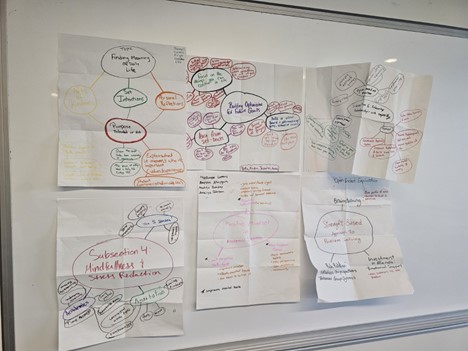
On the second day, students were given poster paper and markers to create mind maps of their ideas and help gain clarity on their discussions from the previous day. Each group placed their chosen topic at the center of the mind map and organized the associated ideas around it. The mind mapping exercise allowed students to visually connect their thoughts and discussions from day one.
One member from each group was nominated to circulate among the other groups, engaging in discussions about each team’s subsection of the article. This not only gave students a broader perspective on how their topics related to the overarching theme of student wellness but also facilitated the flow of information between teams. After gathering input from other teams, the group representative brought the new insights back to their original group, enhancing their understanding of their own topic and how it fit into the larger article. To ensure continuity, students took photos of their mind maps, which would later serve as guides for the writing process.
Day 3: Writing and Research Alignment
On the third day, each group was tasked with creating a document that contained a minimum of five references, with each group member responsible for contributing at least one reference. The document consisted of chunks of article drafts accompanied by their respective references. Students were asked to align these references with the ideas discussed during the earlier sessions and integrate them into their mind maps. Next, students took 15 minutes individually within a shared Google doc to write about their subsection, drawing from their mind maps and class discussions. This individual writing time allowed students to consolidate their thoughts and begin crafting their portion of the collaborative article.
Day 4: Ethical Use of AI in the Writing Process
The fourth day focused on ethical AI usage. We began with a discussion on how students had been using AI tools like ChatGPT and how they envisioned using any type of AI tools in the creation of this article. Together, we created an AI disclosure statement, agreeing on how AI would be used during the editing phase.
We explored specific AI prompts that could enhance their writing, including:
“Rephrase for clarity.”
“Organize this paragraph for the introduction, summary, or conclusion.”
“Give me a starting sentence for this paragraph.”
These prompts were designed to guide students in using AI as a tool to enhance clarity and organization rather than relying on it to write the content.
Day 5: Final Writing and Cohesive Editing
On the final day, students returned to their group documents and spent 15 minutes revising their sections. Afterward, they worked together to co-edit the document without the use of AI, striving to make the article more cohesive and polished. Finally, we revisited the agreed-upon AI prompts, and students were given the option to use AI only when they felt it was necessary for tasks like rephrasing sentences or organizing paragraphs.
The project culminated in a completed article on student wellness, co-authored by students and enhanced by responsible AI usage. The collaborative process not only demystified research and writing but also empowered students to see these activities as positive, engaging, and enjoyable experiences.
Takeaways From This Teaching Experience
The AI writing project was a valuable learning experience for the students, as it incorporated individual and collaborative learning elements alongside technology-based approaches. Reflecting on this experience, I have identified several key takeaways to carry forward into the new semester of teaching and learning.
The Importance of Throwback Learning Experience: Something Familiar Traditional tools like markers and poster boards remain essential in fostering cohesion, socialization, and competence-building. These activities encouraged students to engage in discussions and create visual representations of their ideas, which helped build their confidence and reinforce the collaborative process.
Starting With Original Ideas Matters Students benefited from discussing their ideas within the context of originality before integrating AI-generated content. Generative AI poses a potential threat to originality, emphasizing the need for human thought, discussion, and creativity to provide a benchmark for comparing the quality and intentionality of AI contributions.
Clear Parameters and Prompts Are Essential Defining the role of AI in the writing process was critical for success. Many students initially viewed AI as a tool for producing entire works. By discussing the parameters beforehand, it became clear that AI was to be used to supplement and enhance cohesion rather than replace the creative process.
The Importance of Prompt Development Students gained a growing understanding of the importance of crafting effective prompts for AI. Recognizing how prompts influence AI outputs is a crucial skill that was previously underdeveloped in many students. Moving forward, this skill will be vital as they navigate the intersection of human creativity and AI assistance.
Final Thoughts
Developing effective AI prompts is a pivotal skill that empowers students to use AI intentionally and meaningfully in their learning. A well-crafted prompt acts as the foundation for generating accurate, relevant, and cohesive responses, highlighting the importance of clarity, specificity, and purpose in the initial instructions given to the AI. By understanding how to formulate prompts, students can better harness the potential of AI to support their ideas, enhance their creativity, and improve the quality of their work without relying on AI to replace their original contributions.
This skill also encourages critical thinking, as students must evaluate the type of input needed to achieve a desired outcome, troubleshoot issues in responses, and refine their prompts for better results. Moreover, it aligns with the broader need for digital literacy in education, preparing students to interact responsibly and effectively with technology in academic, professional, and personal contexts.
Lastly, incorporating intentional AI use into teaching strategies ensures that students not only learn how to use these tools but also understand their limitations and ethical considerations. By balancing traditional methods, which foster originality and human connection, with innovative technologies like AI, educators can create a holistic learning environment that values both creativity and technological fluency. This balance will be crucial as AI continues to play an increasingly integral role in education and beyond.
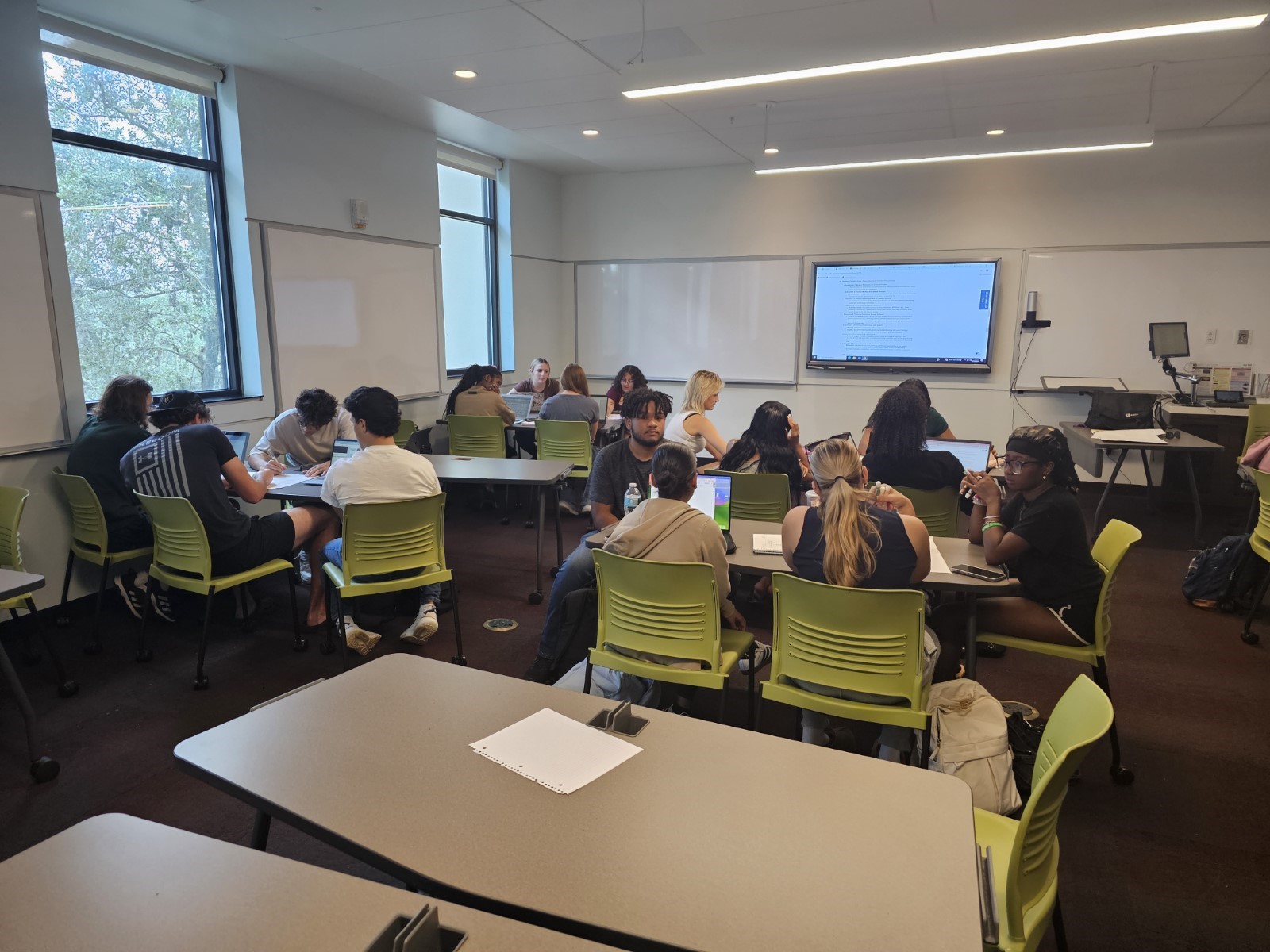
Dr. Courtney Plotts’ students in class.A snapshot of the students’ work.
Special Note of Pride: I would like to note that this group of students worked on this project during class and completed this while two natural disasters accrued, power outages, remote and in person learning and did a great job considering the circumstances. I am so proud of each of them! We originally had bigger visions for the project but due to weather we had to make some changes to the plan!
Freshman College Students’ Advice to Peers for Health & Wellness in 2025
The new year always comes with the possibility of change and growth. As students, much of our growth focus is academics and learning-based. Being academically successful isn’t an easy task. Student wellbeing is an important factor in the learning process (Frazier & Doyle-Fosco, 2024). And for most of us, throwing ourselves into our studies and homework can come with negative side effects like burnout, stress, and decreased mood and motivation. But being successful doesn’t have to come at the risk of your mental health. In our view, academic success means more than good grades and knowledge. Although you may have gone through something last year, or are still going through it now, it doesn’t have to affect you in a negative way. There is so much more that goes into being successful. Success requires dedication, consistency, self-care, and a positive mindset. But for many of us a positive mind set is hard to come by.
The Collective Obstacle
The average age of our class is 19.7 years of age. We have lived with social media all of our lives. A lot of voices have imparted information. Some good, some not so good. The negativity that is readily accessible on social media can lead to negative self-talk. “Negative self-talk refers to your inner voice making critical, negative, or punishing comments. These are the pessimistic, mean-spirited, or unfairly critical thoughts that go through your head when you are making judgements about yourself” (Scott, 2023). Negative self-talk can be detrimental to your psychological well-being. It can really bring you down after you do it for too long. Negative self-talk can also induce stress, depression, and relationship problems. How you can start to believe the negative self-talk: you can start to believe negative self-talk after a while of you doing it. The more you start to tell yourself you can’t do something, the more you’ll start to believe it.
The effects of positive self-talk are the opposite of negative self-talk. It will improve your mental health, can reduce stress, lessen depression, and improve relationships. This not only impacts academics, but other aspects of life. To minimize negative self-talk, you can catch your inner critic when it’s happening and change your thinking to think more positive thoughts, remember that thoughts are not facts, contain your negativity, shift your perspective, think like a friend, or other trusted advisors.
Two Positive Ideas to Embrace in 2025
Two ideas to embrace in the new year that can jumpstart your positivity are evaluating how you think about failure and the control of your future. Failure is an inevitable part of life, but it is through our setbacks that we find opportunities for growth and success. How we respond to failure matters more than the failure itself, and cultivating a mindset of optimism is key to overcoming challenges (Hilppö & Stevens, 2020). Optimism, combined with grit—the perseverance and passion to achieve long-term goals—forms the foundation for a positive and resilient lifestyle. Together, these qualities enable us to turn obstacles into stepping stones and approach life’s difficulties with determination and hope. Think of failures as learning opportunities. Think about the knowledge you gain from hindsight when thinking about failure.
Additionally, understanding the distinction between what we can and cannot control is crucial for maintaining positivity and health (Pourhoseinzadeh, Gheibizadeh,& Moradikalboland, Cheraghian, 2017). Accepting that not everything is within our power allows us to shift our focus to areas where we can make a difference and grow from the experience. Remaining positive during challenging situations and remembering the aspects we can influence help us navigate adversity with a constructive mindset. It’s also important to respect that some factors are beyond our control and may happen for reasons we do not yet understand. By seeking to understand why certain things are outside our control, we can cultivate acceptance and use these moments as opportunities for reflection and personal growth.
The Importance of Health Communication in 2025
Healthy communication is critical to positive personal growth. Asking open-ended questions is important when engaging in meaningful communication because it ensures that there are no assumptions being made. One researcher found that assumptions “lead to consistent and unnecessary community failures” (Macrae, 2018, p.5). Additionally, healthy communication can build true connections among people and better understanding. Also, avoiding assumptions is a way to stay present in the moment allowing you to determine if there is genuine interest in the conversation. Most importantly, health aspects of communication like listening, reflecting, and pausing encourage new thinking and can develop new ideas just about anything.
In addition to healthy communication, think about sharing more of your experiences with peers. Starting from a place of curiosity and health, inquire about someone’s well-being. You can start with a simple phrase like “Are you ok?” Or be ready and willing to share your own personal experience when the time is right. Not only can this help someone else but sharing your story can also help you process what you have been through. Sharing and listening to each other’s experiences can show understanding and help you feel more willing to share now and in the future. Understanding and being present is a power combination for communication.
Lastly, remember that relationships are complex. Whether parental, academic, or personal, everyone has their relationships challenges. One tactic to strengthen relationships is humor. Remember to laugh and enjoy life and the people around you. Most people forget about light heartedness and humor, and how humor can help strengthen and resolve issues within a relationship. Humor can improve the quality of relationships by reducing the stress, tension, and anxiety of the people within the relationship. This effect can only occur if humor is used respectfully in relationships. When used right, humor also can create a more comfortable relationship with less anxiety and sadness for those in it. It’s ok to laugh—even in challenging times.
Summary
A positive mindset is the root of achieving any goal you put your mind to. As a collective voice, we hope the information we shared is valuable information. Our goal was to share meaningful information for your new year and new journey in 2025. As students, we fully understand the importance of mental health, especially because all of us experienced covid at some of the most challenging times of our lives. We hope this information helps you in the new year as much as it helped us learn and grow. Remember to stay happy, healthy, and safe in the new year and think positive!
Dr. Courtney Plotts is a Dynamic Keynote Speaker, Author, and Professor. Dr. Plotts is the National Chair of the Council For At-Risk Student Education and Professional Standards, the country’s only organization that provides standards for working with marginalized and nontraditional students in Kindergarten to College. Her role as National Chair includes training, consulting, and research. Her subject matter expertise has been used in a variety of book publications. Most recently “Small Teaching Online” By Flower Darby with James M. Lang published in June 2019. Dr. Plotts was recognized in 2017 by the California State Legislature for a bold commitment to change in education. She is currently in talks with higher education institutions to launch an institute that focuses on diversity and best practices in online teaching spaces to launch in 2021.
References
Frazier, T., & Doyle Fosco, S. L. (2024). Nurturing positive mental health and wellbeing in educational settings – the PRICES model. Frontiers in public health, 11, 1287532. https://doi.org/10.3389/fpubh.2023.12875
Hilppö, J., & Stevens, R. (2020). “Failure is just another try”: Re-framing failure in school through the FUSE studio approach. International Journal of Educational Research, 99, 101494. https://doi.org/10.1016/j.ijer.2019.101494
Macrae, C. (2018). When no news is bad news: Communication failures and the hidden assumptions that threaten safety. Journal of the Royal Society of Medicine, 111(1), 5–7. https://doi.org/10.1177/0141076817738503
Pourhoseinzadeh, M., Gheibizadeh, M., & Moradikalboland, M., Cheraghian, B. (2017). The Relationship between Health Locus of Control and Health Behaviors in Emergency Medicine Personnel. International journal of community based nursing and midwifery, 5(4), 397–407.
If we think about research as a means of driving innovation and by extension economic growth, there is a need to consider the lives of the people who are doing the research.
The UK has a significant strength in the quality and diversity of its higher education system – which trains a large proportion of the staff who end up working in universities (and elsewhere) performing research. We should, in other words, be better than we are at sustaining and shaping research capacity through supporting the people who contribute research throughout their careers.
Certainly, that’s the case that the University and College Union makes in last week’s research staff manifesto – noting that nearly two thirds of research staff are on fixed term contracts, following research funding and strategic decisions around the country at a significant detriment to their personal lives and professional development.
How does the system work?
Precarity is not an accident of the system – it is the entire design of the system. Becoming a postdoc is not the final stage of the undergraduate to postgraduate to researcher pipeline: it is a step into a new system where the trial of job-hopping, house moving, city shifting work, may one day lead to a full time post.
The first step after undertaking a doctorate is, unsurprisingly post-doctoral work – the postdoc. The term is confusing as it implies simply the job someone does after being awarded a PhD. Over time the taxonomy has changed to take on a specific meaning. It has become synonymous with precarious employment tied to grant funding. As an example, Imperial College London describes their postdocs as follows
a member of staff who will have a PhD, and be employed to undertake research
commonly on an externally funded grant secured by their principal investigator (PI) e.g. Research Council standard grant
responsible for their own career development but entitled to the support of their PI and the PFDC
entitled to 10 days development per year
entitled to 25 days leave plus bank holidays and college closure dates (if full time, pro-rata for part time)
entitled to regular one-to-one meetings with their line manager
entitled to a mid and final probation review
entitled to a Personal Review and Development Plan (PRDP) meeting once per year
Crucially, in the section which describes what a postdoc is not, it includes being “a permanent member of academic staff.”
This is often the case because postdocs are tied to grant funding and grant funding is limited to a certain period of time to cover a specific project. UKRI, for example, does not fund postdocs directly but funds research organisations directly through a mix of focused studentships and capacity funding. Research organisations then fund postdocs.
This means that the flexible deployment of resources is the very start of the system. It’s not an accident or a quirk, it is that the UK’s research system is built around incentivising human capital to move to the organisations and places that most closely aligns to their research skills. The upside of this is that, in theory, it should mean resources are efficiently deployed to the people and places that can use them most productively. In reality, it means that instability and structural barriers to progressing to full research contracts are the norm.
It’s not that UKRI are not aware of this problem. In a 2023 blog on team research Nik Ogryzko, Talent Programme Manager at UKRI, wrote that
We’ve built a system where research groups sometimes act as their own small business inside an institution. And this leads to a very particular set of weaknesses.
Employment contracts have become linked to individual research grants, with research staff often highly dependent on their principal investigator for career progression, or even their continued employment.
Group leaders are often not equipped to support their staff into anything other than an academic career, and we know most research staff do not end up there.
We also know such precarious employment and power imbalances can in some cases lead to bullying, harassment and discrimination. Such structural factors further compromise the integrity of our research, despite the strong intrinsic motivation of our researchers and innovators.“
[…]some of the areas of most concern to researchers, such as the prevalence of fixed-term contracts and enforced mobility, will require long term systemic changes, which can only be realised through collective action across stakeholders.
Again, should a researcher be lucky enough to pass through their postdoc a permanent role is not guaranteed or even the norm. In reading through the websites of universities the reasons for fixed term contracts are various including; to align with grant-funding, to cover peak demand, to meet uncertain demand, to cover staff absence, to cover time-limited projects, secondments, training, and to bring in specialist skills.
It is not that universities don’t recognise the issue of fixed term contracts, institutions like the University of Exeter has a whole framework on the appropriate use of these contacts, it’s that in a funding system which places a premium on project working it is necessary to have a highly flexible staff force.
However, this does not mean that this system is inevitable or that the number of fixed term contracts is desirable.
What is going on?
According to HESA data, that number is slowly falling – both numerically and proportionally – for research only academic staff. As of the 2023-24 academic year, 63.9 per cent of “research only” academic staff (64,265) are on a fixed term contract. This sounds like a lot, but it is down slightly from a peak of 68 per cent (70,050) in 2019-20.
The proportion of fixed term contracts for teaching only academics (another prominent early career route, often coupled with weekends at the kitchen table writing literature reviews for publication in an attempt to bolster credentials for a research job in an underfunded field) is also on a downward trajectory. Some 44.3 per cent of teaching only contracts (equating to 64,300 people) were fixed term in 2019-20 – by 2023-24 the numbers were 35.7 per cent and 63,425.
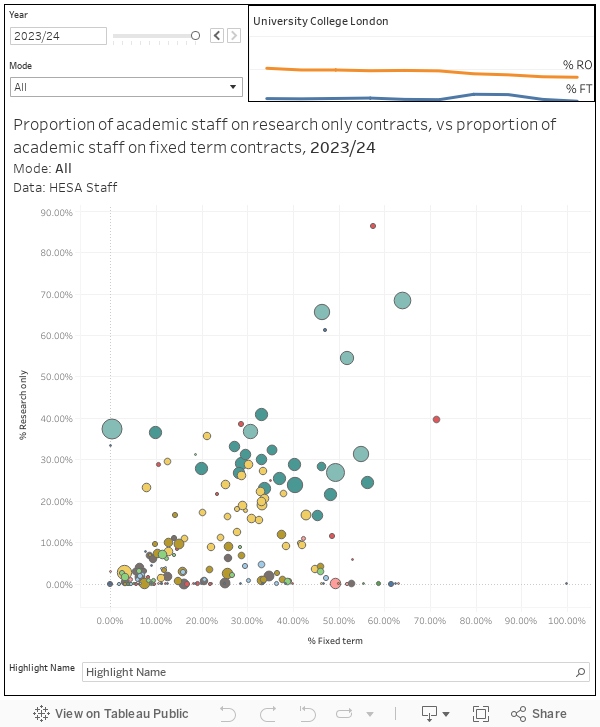
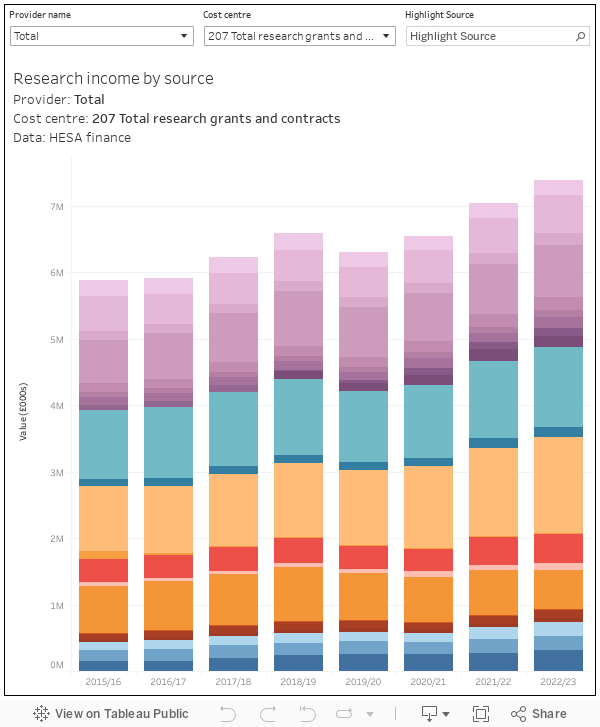
If we take this to provider level we can see that a significant research focus is no predictor of a reliance on fixed term contracts. This chart shows the proportion of all academic staff on research only contracts on the y axis, with the proportion of all academic staff on fixed term contracts on the x axis.
What this chart shows is that a strong focus on research (with many research only academic contracts) does not predict a reliance on fixed term contracts – indeed, there are many providers with a significant proportion of fixed term contracts that have no research only academic staff at all. While a fixed term contract is a poor basis on which to plan long term as an individual, for many higher education institutions it is a useful answer to wildly varying income and recruitment. Whereas for more traditional institutions it makes sense to maintain capacity even as prevailing conditions worsen, in smaller and more precarious providers unutilised capacity is a luxury that is no longer as affordable.
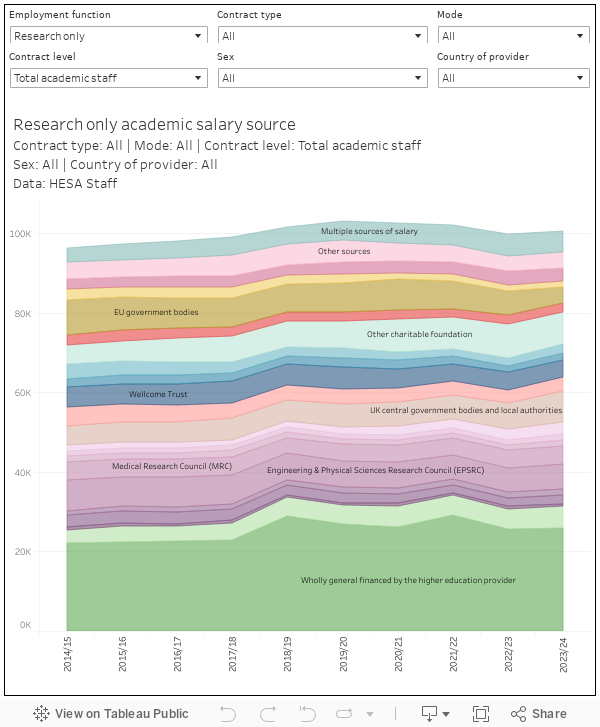
If you look back to the first chart, you may notice a “salary source” filter. One of the prevailing narratives around fixed term contracts is that these necessarily link to the “fixed term” nature of funded research projects – the argument being that once the money is finished, the staff need to find new jobs. In fact, this is less of a factor than you might imagine: the proportions of research only academic staff on fixed term contracts is higher for externally funded than those funded internally, but the difference isn’t huge.
Plotting the same data another way shows us that around a quarter of research only salaries are funded entirely by the higher education provider, with a further five per cent or so partially supported by the host institution – these figures are slightly lower for fixed-term research only staff, but only very slightly.
So we can be clear that fixed term salaries are (broadly) a research thing, but there’s not really evidence to suggest that short term external funding is the whole reason for this.
As a quick reminder, the research councils represent about a quarter of all external research funding, with the UK government (in various forms) and the NHS representing about another (swiftly growing)fifth. That’s a hefty chunk of research income that comes from sources that the government has some degree of control over – and some of the language used by Labour before the election about making this more reliable (the ten year settlements of legend) was seen as a recognition of the way funding could be reprofiled to allow for more “livable” research careers and an expansion of research capacity.
This chart also allows you to examine the way these proportions land differently by provider and subject area (expressed here as HESA cost code). The volatility is higher at smaller providers, as you might expect – while research in the arts and humanities is more likely to be funded by research councils than in STEM or social sciences. But it is really the volume, rather than the source, of research funding that determines how researcher salaries are paid.
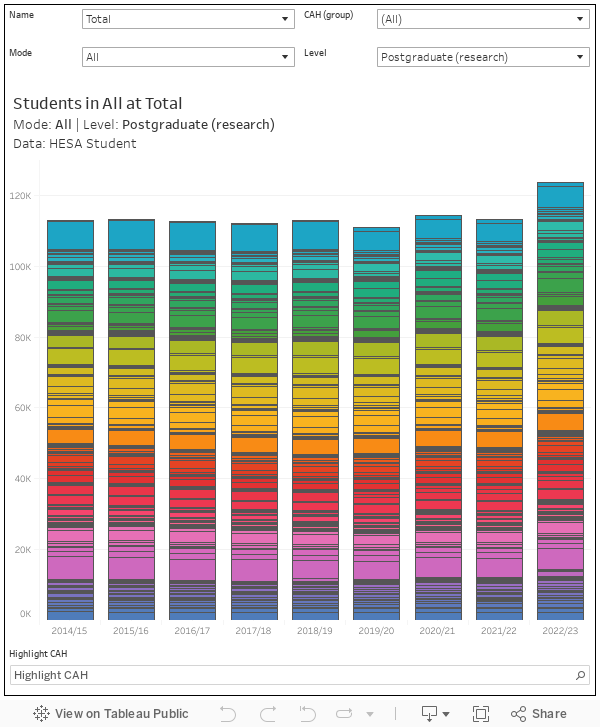
Although the established pathway from research postgraduate to research is by no means the only one available (many postgraduate research students do not become academics) it is an established maxim – dating back to the post-war Percy and Barlow reviews – that to produce the researchers we need requires training in the form of postgraduate research provision.
Although it’s not really the purpose of this article, it is worth considering the subject and provider level distribution of postgraduate research students in the light of how funding and capacity for research is distributed. As the early research career is often dominated by the need to move to take on a fixed term contract, one way to address this might be to have research career opportunities and research students in the same place from the start.
Research capacity, and – for that matter – research training capacity, can’t be turned off and on at a whim. Departments and research centres need more than one short-term funded project to begin delivering for the UK at their full potential, because developing capacity and expertise takes time and experience. That’s a part of the reason why we have non-ringfenced funding: streams like those associated with QR in England – to keep research viable between projects, and to nurture developing expertise so it can contribute meaningfully to national, regional, and industrial research priorities. It’s funds like these that support researcher training and supervision, and the infrastructure and support staff and components that make research possible.
But what the data suggests is that while the short-term nature of project funding does have an impact, especially at smaller providers and emerging research centres, there are many universities that are able to sustain research employment between projects. A part of this is bound to be sheer scale, but it doesn’t happen at all large research performing organisations by any stretch of the imagination. A part of the answer then, must be the strategic decisions and staffing priorities that makes sustaining researcher employment possible.
That’s not to let the funding side of the equation off the hook either. There is a sense that the Labour party was moving in the right direction in considering longer term research funding settlements – but we have yet to learn how this will work in practice. By its very nature, research is discovery and opportunity led: a few years ago artificial intelligence research was a minor academic curiosity, currently it is big money – but will it be a priority in 2035? Could there be some areas – medical and healthcare research, large scale physics, engineering – where we can be more sure than others?
You’ll note we didn’t mention the arts, humanities, and social sciences in that list – but these may be some of the most valuable areas of human activity, and government-supported research plays a more prominent role in sustaining not just discovery and innovation but the actual practice of such activity. Such is the paucity of money available in the arts that many practitioners subsidise their practice with research and teaching – and it feels like arts funding more generally needs consideration.
Sure, the UK punches above its weight in the sciences and in health care – but in arts, heritage, and social policy the work of the UK is genuinely world leading. It has a significant economic impact (second only to financial services) too. Research funding is a part of the picture here, but a long term commitment to these industries would be one of the most valuable decisions a government can make.
What are the other choices?
The fundamental challenge is maintaining a system which is dynamic, where the dynamism is not solely reliant on a highly transient workforce. A simple, albeit extremely limited, conclusion from the data would be that there is too great a supply of researchers to meet the demand for their skills.
The more important question is what is the value of such a highly educated workforce and how can society make the most of their talents. This is not to say the UK should operate a supply led model. A world where funding is allocated based purely on the academic interests of researchers might be good for placing emphasis on intellectual curiosity but it would not allow funders to match social and economic priorities with researcher’s work. Put another way, it isn’t sufficient to tackle climate change by hoping enough researchers are interested in doing so. It would also not necessarily create more permanent jobs – just different ones.
Conversely, a system which is largely demand led loses talent in other ways. The sheer exhaustion of moving between jobs and tacking research skills to different projects in the same field means stamina, not just research ability, is a key criterion for success. This means researchers whose abilities are needed are not deployed because their personal incentive for a more stable life trumps their career aspirations.
The current system does penalise those who cannot work flexibly for extended periods of time, but more fundamentally the incentives in the system are misaligned to what it hopes to achieve. There can be no dynamism without some flexibility, but flexibility should be demonstrable not permanently designed. Flexibility of employment should be used to achieve a research benefit not only an administrative one.
This is not wholly in the gift of universities. A careful consideration by government, funders, institutions, and researchers, of how flexibility should be used is the key to balance in the system. There are times where the research system requires stability. For example, the repeated use of fixed term contracts on the same topic is a clear market signal for more stable employment. Furthermore, it is undesirable to have a forever changing workforce in areas governments have singularly failed to make progress on for decades. Nobody is arguing that if only research into productivity was a bit more transient the UK’s economies woes could be fixed.
The need is coordinated action. And unlike in Australia there is no single review of what the research ecosystem is for. Until then as priorities change, funders work on short time horizons, and institutions respond to ever changing incentives, the downstream effect is a workforce that will be treated as entirely changeable too.
At a time when resources within research organisations are stretched, the PGR experience, and the role doctoral supervisors play in supporting that experience, needs closer attention.
The release of the pilot indicators for the REF People Culture and Environment (PCE) has promoted a flurry of conversations across UK universities as to what ‘counts’. For the first time, institutions may evidence that “infrastructure, processes and mechanisms in place to support the training and supervision of research students are working effectively” and are invited to consider the inclusion of “pre and post training assessments” for supervisors.
This signals to institutions that research supervision needs to be taken seriously– both in terms of quality and consistency of PGR experience, as well as the support and recognition for supervisors themselves. In doing so it validates the contribution of doctoral research to the research ecosystem.
Accelerated prioritisation of research supervision shouldn’t come as a complete surprise. This lack of consistency in PGR experience was recognised less than a year ago in the UKRI New Deal for Postgraduate Research, which stated that “All PGR students should have access to high quality supervision and Research Organisations should ensure that everyone in the supervisory team is well supported, including through induction for new supervisors and Continuous Professional Development (CPD)”. That messaging has been repeated in the UKRI Revised Statement of Expectations for Doctoral Training (2024), alongside a call to research organisations to “build supervisor awareness of PGR mental health, wellbeing, bullying and harassment, and equality, diversity and inclusion issues.”
So, what do we know about research supervision?
Data from the UK Research Supervision Survey 2024 (UKRSS) confirms that, overwhelmingly, research supervision is considered valuable, rewarding and enjoyable by those who undertake it. Supervision also positively impacts upon their own research. However, a third of respondents reported feeling anxious about supervision and reported their main challenge was fostering student confidence and focus, followed by offering compassionate support to students facing difficult issues ranging from mental health and wellbeing, to finances and funding.
Lack of time continues to be a barrier to high quality supervision practice, and rising supervisor-to-candidate ratios complicate this further. While early career supervisors were likely to be allocated one to two candidates, those later in their career could be supervising five to ten– only 30 per cent of UKRSS respondents reported that their institution had a policy on maximum candidate numbers. Respondents also made it clear that doctoral research supervision is not being adequately calculated into workload allocations, with a typically described workload model allocating 42 hours per candidate, per year, but supervisors reporting investing an average of 62 hours.
Time constraints like these contribute greatly to the ability of supervisors to participate in CPD opportunities. This itself is a barrier to good supervision practice, as the UKRSS revealed that supervisors who engage in regular, mandatory CPD reported higher levels of confidence in all areas of supervisory practice. A staggering 91 per cent of respondents who had experienced mandatory induction reported they felt able to enact their institutions’ procedures around supervision– compared to 66 per cent of those for whom induction was not mandatory and 55 per cent who reported no mandatory requirements..
The data illustrates that supervisors care about and take satisfaction from supporting the next generation of researchers, but they are getting a raw deal from their institutions in terms of time, reward, recognition and opportunities to develop and enhance their own practice. Underscoring this point, just 56 per cent of supervisors reported feeling valued by their institution, compared to 90 per cent who felt valued by their students. Until now this has gone under the radar, making the inclusion of the PCE indicators a welcome sign for those of us working to make changes within the sector.
Engaging supervisors with high quality Continuing Professional Development
Focus groups conducted with supervisors at five UK universities as part of the Research England funded Next Generation Research SuperVision Project (RSVP), have provided insight into what CPD is considered useful, meaningful and relevant. Supervisors were well aware of the need to develop and improve their practice, with one participant reflecting “… there isn’t sufficient training for supervision, you have a huge responsibility to another person’s career. So I think the idea that we ‘wing it’ perhaps shouldn’t be acceptable.”
An overwhelming majority of participants reported that the most important aspects of their supervision practice and development come from interactions with, and support from, their peers and more experienced colleagues. The idea that supervision practice is best developed by watching other supervisors on the job and through communities of practice was repeated by participants across experience levels, genders, disciplines, and institutions– with some even claiming this to be the only way to become a truly good supervisor.
Far from being reluctant to engage in professional development, many supervisors welcomed the idea of having the space and time to reflect on their practice. What they were less keen on was anything perceived as a ‘tick-box’ exercise– examples given included short courses without time for discussion, and self-directed online modules. There was a recognition by some that these approaches can be useful, but should form part of a more varied approach to CPD.
Generally speaking, supervisors with less experience were more likely to engage in facilitated workshops and other interventions that help them understand their role and the doctoral journey. Those with more experience expressed a strong preference for discussion-based CPD, including peer reading groups, opportunities for facilitated reflection and mentoring.
Recognising supervision as part of research culture
Whatever the final version of the PCE metrics look like, there is now a growing body of empirical evidence to suggest that a revision in the way we manage, reward and recognise research supervision is needed. When government enabled universities to introduce fees for undergraduates the issue of quality assurance quickly surfaced. It was recognised that students should be taught by properly trained staff with a knowledge and understanding of pedagogy and approaches to learning and teaching. Arguably that moment has now come for research supervision.
If the UK HE sector wishes to attract capable, committed, creative doctoral candidates from a range of backgrounds then those supervising them need to be treated, and trained, as professional practitioners. This means creating the time and space to enable supervisors at all levels of experience to engage in meaningful exchanges about their practice and to refresh their knowledge of policies and new areas as they arise.
Quick wins?
For institutions looking for ways to bolster their supervision support there are some empirically grounded ways to improve practice
Firstly, tap into existing levers for change. The Concordat to Support the Career Development of Researchers outlines the need for PIs (many of whom are supervisors) to engage in professional development. Postdoctoral researchers are also required to engage in “10 days of professional development.” Since postdoctoral researchers are often informally involved in doctoral supervision (15% of the UKRSS respondents identified themselves as ‘early career researchers’) their engagement in CPD could also be counted. Actively recognising and celebrating the diversity of doctoral researchers and their supervisors also aligns with Athena Swan.
Secondly, increase the visibility of provision. Many supervisors in the UKRSS and focus groups didn’t know what CPD was available in their institution. Very few knew about routes to recognition of supervisory practice (e.g.through the UKCGE Research Supervision Recognition Programme). There is little to be lost in an institution showcasing themselves to prospective researchers and funders as one which takes the quality of supervision seriously and actively invests, rewards and recognises supervisors.
Thirdly, actively enable conversations about supervision. Aside from the formal training it is the time spent together which is often valuable. This may include offering simple opportunities for new and experienced supervisors to come together to talk about their experiences on topics that matter to them. It may mean enlisting a few champions who will speak about their experience. If there is already a mentoring scheme research supervision could be added to the list of topics that can be discussed as part of that relationship. It is also helpful to encourage supervisors to engage with the UKCGE Supervisor’s Network which offers cross-disciplinary and national level value as a community of practice.
Finally, use existing PGR and supervisor networks and expert spaces to find out what works well and where the gaps are. Including working with RSVP which is designing, with 58 partners, CPD interventions for new and more experienced supervisors around the topics identified above. Following pilots and evaluation these will be made freely available to the sector. Specific resources to support supervisors to engender a *neurodiversity-affirmative culture will be available later this year. Webpages to support mentoring will be available very soon. Join the RSVP mailing list to be kept up to date.
*with thanks to Professor Debi Riby at the centre for Neurodiversity & Development at Durham University
Arguably, the most recognisable example of translational research in recent years was the swift development and rollout of the COVID-19 mRNA vaccine. The world was waiting for this research to meet its real-world ambition. Many members of the public would recognise that some of this research was undertaken at Oxford University and, with some exceptions, would also recognise the beneficial impact of the vaccine for both individuals and society. Following the rollout, there was even a public discussion that touched upon the idea of interdisciplinarity. How could the benefits of the COVID-19 vaccine be communicated to communities who felt reluctant to have the jab or distrustful of medical science?
However, there was another piece of research that was translated into real-world effect with serendipitous timing.
In 2013, Professor Andrew Ellis was working at the Aston Institute of Photonic Technologies. Ellis had previously worked at BT, where his observations and experience suggested that the ‘capacity’ needed in the telephone infrastructure had and would increase consistently over time and was consistently underestimated. Ellis recalls an ongoing refrain of ‘surely we have enough capacity already’. This continued to be true once the copper phone lines were used to deliver data for home internet usage.
At this point, most residential properties were on ADSL (Asymmetric Digital Subscriber Line) internet connections. That is where copper wires are used to deliver broadband internet. Homes were typically working at speeds of around 8 megabits per second (Mbps).
The Government had developed a strategy setting out that the majority of residential properties should be able to work at speeds of ‘at least 2 Mbps per second and 95% of the UK receiving far greater speeds (at least 24 Mbps) by 2017’. Fibre broadband was beginning to be rolled out, which used fibre optic cables to transmit data much more quickly. However, these fibre optic cables were generally only used to reach the street cabinet, with copper wires connecting the street cabinets to individual homes, restricting the broadband speed that could be achieved.
From his previous work, Ellis could see that this ambition was neither competitive internationally nor of sufficient use long-term when demand for emerging applications was taken into account. He demonstrated that capacity was falling well below the predicted need and that the UK was slipping down the league table for connectivity in economically developed countries. Estonia, Poland, Korea and Norway were all streaking ahead.
Ellis contacted MPs working on this strategy via the Industry and Parliament Trust. Two breakfast meetings and a dinner meeting were held to discuss the lack of ambition in the strategy. However, only the fortuitous attendance of a senior civil servant at the dinner meeting led to a policy breakthrough. Further momentum and publicity were generated by a meeting organised by the Royal Society to discuss ‘Communication networks beyond the capacity crunch’, including a presentation by Dr Andrew Lord.
Ellis was lobbying for an increase in ambition. There was resistance to this as there was no additional money to spend on improving infrastructure outside of the spending review cycle. Ellis convinced the Government that no additional spending was needed to change the ambition. Changing a number in a policy document wouldn’t (on this occasion) cost the government any more money. (The terms ‘pure-fibre’ and ‘full-fibre’ were also coined at these meetings, meaning using fibre optics cables to the street cabinet and from the cabinet to individual homes.)
With the Government changing their ambition, providers such as Clear Fibre, Gigaclear and BT Openreach would need to improve the infrastructure to deliver faster broadband to our homes.
It was estimated that upgrading the whole UK to full fibre would cost £40-60 billion as part of the EU-funded Discus project. Research by the AiPT team showed that it would be closer to £8-10 billion if the network was reconfigured according to their research proposals, a one-for-one replacement of network equipment from copper to fibre-based ones. Further, research demonstrated that fibre is also more energy efficient.
Optical networks were using about 2% of the electricity in the developing world. (Ellis explained that BT objected to this figure, stating that it was, in fact, 1.96%!) Not only was a full-fibre network faster, it was also more energy efficient. (This now pales in significance to the energy consumption that will increasingly be needed to power AI data centres.)
BT began rolling out full-fibre broadband to 80% of the UK. In 2019, BT hired heavily for this work, much of which was completed in the first few months of 2020. The increased activity and presence of BT vans helped fuel the 5G coronavirus conspiracy!
In a moment of serendipity, this meant that by the 23rd of March 2020, when the then Prime Minister, Boris Johnson, announced the first lockdown, there was enough access capacity for many of us to begin working at home. As we got used to Zoom and Teams, multiple people were using video calls in one household for work and homeschooling. Not only did this allow for a relatively smooth transition to remote working, but it allowed our children to continue accessing their education and for us to keep in touch with friends and family (Zoom quiz, anyone?) The societal shift to remote working, prompted by lockdowns but enabled by full-fibre, remains both contested in terms of productivity and profound in terms of impact.
I asked Andrew what challenges he faced when trying to inform industry and policy of his research. He noted three key barriers:
To impact Government policy, one needs to know the right person to talk to. There must be barriers to prevent a free-for-all lobbying system of civil servants. However, policy institutes, research impact centres and organisations such as the IPT should be able to facilitate connections when this is helpful to both parties.
The second – is the structure of academic contracts. New ideas often come from, and are certainly implemented by, PhD students and Research Assistants. However, given that most research assistants are on two- or three-year contracts, their eyes are firmly on improving their CV to land the next contract. This often leads them to focus almost entirely on publications. To build good links with industry and engage in long-term strategy, longer-term job contracts are needed.
Similarly, he feels a strong tension between metrics, such as 4* papers, required for REF and rapid publication of results in outlets read or attended by decision-makers in industry, where solutions are often required in months rather than years
Whilst the success of the COVID vaccine development may have made global headlines, the work of the AiPT’s team (Andrew believes that others lobbied on the same topic, including Professor Dimitra Simeonidou at the University of Bristol, Professor Polina Bayvel CBE at University College London and Professor Sir David Payne at Southampton University) quietly allowed many of us to continue working and to be connected to our colleagues, friends, and family throughout the pandemic. Further, as Professor Sarah Gilbert, Professor of Vaccinology at the Jenner Institute and lead scientist on the vaccine project, explains, the ability to work remotely with trial volunteers (giving them information via video instead of in-person presentations) and collaborating with colleagues across the globe was vital in the vaccine production itself.
For more than a decade, University of Kansas researchers have been developing a virtual reality system to help students with disabilities, especially those with autism spectrum disorder, to learn, practice and improve social skills they need in a typical school day. Now, the KU research team has secured funding to add artificial intelligence components to the system to give those students an extended reality, or XR, experience to sharpen social interactions in a more natural setting.
The U.S. Office of Special Education Programs has awarded a five-year, $2.5 million grant to researchers within KU’s School of Education & Human Sciences to develop Increasing Knowledge and Natural Opportunities With Social Emotional Competence, or iKNOW. The system will build on previous work and provide students and teachers with an immersive, authentic experience blending extended reality and real-world elements of artificial intelligence.
iKNOW will expand the capabilities of VOISS, Virtual reality Opportunity to Integrate Social Skills, a KU-developed VR system that has proven successful and statistically valid in helping students with disabilities improve social skills. That system contains 140 unique learning scenarios meant to teach knowledge and understanding of 183 social skills in virtual school environments such as a classroom, hallway, cafeteria or bus that students and teachers can use via multiple platforms such as iPad, Chromebooks or Oculus VR headsets. The system also helps students use social skills such as receptive or expressive communication across multiple environments, not simply in the isolation of a classroom.
IKNOW will combine the VR aspects of VOISS with AI features such as large language models to enhance the systems’ capabilities and allow more natural interactions than listening to prerecorded narratives and responding by pushing buttons. The new system will allow user-initiated speaking responses that can accurately transcribe spoken language in real-time. AI technology of iKNOW will also be able to generate appropriate video responses to avatars students interact with, audio analysis of user responses, integration of in-time images and graphics with instruction to boost students’ contextual understanding.
“Avatars in iKNOW can have certain reactions and behaviors based on what we want them to do. They can model the practices we want students to see,” said Amber Rowland, assistant research professor in the Center for Research on Learning, part of KU’s Life Span Institute and one of the grant’s co principal investigators. “The system will harness AI to make sure students have more natural interactions and put them in the role of the ‘human in the loop’ by allowing them to speak, and it will respond like a normal conversation.”
The spoken responses will not only be more natural and relatable to everyday situations, but the contextual understanding cues will help students better know why a certain response is preferred. Rowland said when students were presented with multiple choices in previous versions, they often would know which answer was correct but indicated that’s not how they would have responded in real life.
IKNOW will also provide a real-time student progress monitoring system, telling them, educators and families how long students spoke, how frequently they spoke, number of keywords used, where students may have struggled in the system and other data to help enhance understanding.
All avatar voices that iKNOW users encounter are provided by real middle school students, educators and administrators. This helps enhance the natural environment of the system without the shortcomings of students practicing social skills with classmates in supervised sessions. For example, users do not have to worry what the people they are practicing with are thinking about them while they are learning. They can practice the social skills that they need until they are comfortable moving from the XR environment to real life.
“It will leverage our ability to take something off of teachers’ plates and provide tools for students to learn these skills in multiple environments. Right now, the closest we can come to that is training peers. But that puts students with disabilities in a different box by saying, ‘You don’t know how to do this,’” said Maggie Mosher, assistant research professor in KU’s Achievement & Assessment Institute, a co-principal investigator for the grant.
Mosher, a KU graduate who completed her doctoral dissertation comparing VOISS to other social skills interventions, found the system was statistically significant and valid in improving social skills and knowledge across multiple domains. Her study, which also found the system to be acceptable, appropriate and feasible, was published in high-impact journals Computers & Education and Issues and Trends in Learning Technologies.
The grant supporting iKNOW is one of four OSEP Innovation and Development grants intended to spur innovation in educational technology. The research team, including principal investigator Sean Smith, professor of special education; Amber Rowland, associate research professor in the Center for Research on Learning and the Achievement & Assessment Institute; Maggie Mosher, assistant research professor in AAI; and Bruce Frey, professor in educational psychology, will present their work on the project at the annual I/ITSEC conference, the world’s largest modeling, simulation and training event. It is sponsored by the National Training & Simulation Association, which promotes international and interdisciplinary cooperation within the fields of modeling and simulation, training, education and analysis and is affiliated with the National Defense Industrial Association.
The research team has implemented VOISS, available on the Apple Store and Google Play, at schools across the country. Anyone interested in learning more can find information, demonstrations and videos at the iKNOW site and can contact developers to use the system at the site’s “work with us” page.
IKNOW will add resources for teachers and families who want to implement the system at a website called iKNOW TOOLS (Teaching Occasions and Opportunities for Learning Supports) to support generalization of social skills across real-world settings.
“By combining our research-based social emotional virtual reality work (VOISS) with the increasing power and flexibility of AI, iKNOW will further personalize the learning experience for individuals with disabilities along with the struggling classmates,” Smith said. “Our hope and expectation is that iKNOW will further engage students to develop the essential social emotional skills to then apply in the real world to improve their overall learning outcomes.”
Mike Krings,KU News Service
Mike Krings is a Public Affairs Officer with the KU News Service at the University of Kansas.
Latest posts by eSchool Media Contributors (see all)