Any critique about the neoliberal university ought to confront and acknowledge its colonial roots. Victoria Reyes, in her book Academic Outsider (Stanford University Press, 2022), highlights that higher education was never designed for the global majority, particularly people of color from low-income backgrounds. It was built by and for the elite—predominantly white, cisgender, male and affluent individuals—whose privilege shaped the norms that dominate higher education today. These norms actively harm oppressed communities. People of color in positions of power within higher education, such as tenured faculty or administrators, often perpetuate these systems of oppression when they conform to institutional norms instead of challenging them.
The positivist research paradigm (a.k.a. positivism) sustains oppression in academia by prioritizing quantifiable data while dismissing subjective experiences and social contexts in pursuit of “objective” truths. This fragmented approach erases the complexity of lived experiences and ignores the interplay of privilege and oppression in shaping identities. Positivism fuels deficit-based research, white saviorism and helicopter science, invalidating diverse epistemologies and methodologies. Deficit-based research highlights negative conditions in oppressed communities, framing them as lacking while ignoring systemic causes of inequities, such as settler colonialism and structural racism. Legacies of positivism reinforce harmful stereotypes and stigmatization toward communities of color in higher education.
In contrast, a transformative paradigm offers an alternative to positivism by centering the voices and experiences of oppressed communities. It prioritizes knowledge democracy and dismantling of power imbalances that have historically excluded marginalized communities from the research process. Over the past 25 years, community-engaged research (CEnR) and community-based participatory research (CBPR) have emerged as crucial approaches in health education, public health and the social sciences to address social inequities. Both approaches emphasize equitable, reciprocal community-academic partnerships, to foster genuine collaboration and systemic change.
As a woman of color from the Global South and an immigrant scientist who studies health equity, I have witnessed firsthand both the transformative potential of CEnR in addressing social injustice and the discriminatory practices that neoliberal universities perpetuate in my own research with low-income and immigrant communities of color. While CEnR and CBPR are integral to addressing complex health and social inequities by empowering communities and fostering sustainable interventions, a question remains: Can these approaches thrive within the neoliberal university?
White Saviorism and the Neoliberal University
Unfortunately, the rise of CEnR within neoliberal universities, particularly during the COVID-19 pandemic, was driven not by a genuine shift toward equity, but by a desire for funding and institutional prestige. As Megan Snider Bailey notes, “Market forces … shape university-community partnerships,” reinforcing a colonial mindset rooted in the white savior complex. This complex positions universities as gatekeepers of resources and legitimacy, exploiting oppressed communities under the appearance of “helping” them to secure funding from entities like the National Institutes of Health, the National Science Foundation and the Patient-Centered Outcomes Research Institute.
The white savior complex describes privileged individuals, often white, who see themselves as “saviors” or “benevolent rescuers” of oppressed communities. This paternalistic mindset creates exploitative dynamics and replicates patterns of subjugation. For instance, universities often profit significantly from research with oppressed communities, taking up to 50 percent of grant funds as indirect costs for expenses such as facility maintenance and administration. These funds rarely return to the communities that need them most. Instead, universities divert these resources to maintain their own operations, exposing the hypocrisy of institutions that claim to support equity and justice. These exploitative practices raise a critical question: Who benefits the most from the oppression and illness of communities of color?
The answer often points back to the universities themselves. They profit from the appearance of equity while perpetuating social injustice. The harm caused by white saviorism extends beyond finances. Transactional and extractive research methods are normalized in the neoliberal university. These methods reinforce patterns of subjugation and undermine long-term partnerships that could foster social justice and radical healing. As scholarshave shown, a human-centered, liberatory approach must replace the transactional and extractive methods often associated with white supremacy and settler colonialism.
Precarity in the Academy
Universities that claim to promote social justice and CEnR often perpetuate exploitative practices and precarious working conditions. They frequently hire community leaders, promotoras de salud (community health workers), students and scholars of color on short-term contracts with little job security and no benefits. These precarious positions create dependency on higher institutions that exploit labor while controlling access to resources.
As Anne Cafer and Meagen Rosenthal explain, moral outrage often drives short-term involvement in community projects. CEnR that fails to address inequitable power dynamics becomes another tool of oppression disguised as allyship. Superficial, performative community-academic partnerships deepen mistrust of academic institutions in oppressed communities and reinforce power dynamics and social injustice.
Raquel Wright-Mair and Samuel Museus highlight how academia’s power hierarchies instill a fear of retaliation, silencing junior scholars of color from challenging systemic inequities. Scholars of color are often forced to align their work with institutional goals while sickening their bodies and damaging their mental health. The market-driven model of the neoliberal university prioritizes profits and productivity, limiting justice-oriented research. To address these issues in higher education, we must ask urgent questions:
What can we do to dismantle white-led initiatives that perpetuate dependence and subjugation?
How can institutions eliminate the white savior complex embedded in their structures?
How can we ensure fair calculation of indirect costs in CEnR that prevent the exploitation of community needs for grant funding and institutional prestige?
Recommendations for Conducting Respectful and Liberatory CEnR
The neoliberal university perpetuates the white savior complex, commodifies community needs and exploits people of color through short-term appointments designed to maintain systemic inequities. Therefore, it is pivotal to embrace the liberatory nature of CEnR that prioritizes social justice and structural change.
Transformative practices. Researchers must critically reflect on how their own positionality and privilege influence the liberation or oppression of marginalized communities. Universities must recognize and amplify the expertise of community members in shaping research agendas and outcomes. Furthermore, institutions must actively embrace linguistic justice and culturally relevant methods, respecting the languages, traditions and cultural contexts of the communities they engage. By prioritizing these practices, institutions can foster decolonial, respectful and inclusive collaborations that effectively challenge and dismantle oppressive systems in higher education.
Accountability is essential. Funding agencies must prioritize equitable representation and tangible benefits for communities over superficial metrics when evaluating CEnR. Neoliberal universities must stop exploiting community researchers and scholars of color through precarious, short-term appointments that reinforce tokenization and systemic inequities. Universities often hire people of color temporarily to build trust for community-academic partnerships while maintaining the overrepresentation of white faculty. To disrupt this cycle, funding agencies must require universities to intentionally hire and retain leaders, scholars and students from oppressed communities, ensuring they have job security. Empowering these voices permits CEnR to address community-specific needs, build local infrastructure and foster authentic partnerships rooted in equity, respect and shared power, dismantling the traditional hierarchies of academic research.
Rejecting unpaid labor is nonnegotiable. Unpaid labor perpetuates inequities, exploiting oppressed communities. Ethical CEnR demands equitable compensation, collaboration and empowerment, ensuring all participants are treated with dignity and are compensated fairly. These principles are critical to advancing liberation and driving systemic change.
Advancing CEnR that truly serves oppressed communities requires dismantling the colonial, patriarchal and exploitative structures underpinning higher education. Embracing a transformative paradigm prioritizes genuine representation, community needs and liberation over market-driven motives, creating a model for lasting social change and liberation in an increasingly inequitable world.
A Strategic Examination of Research and Development review is to evaluate how to maximise Australia’s existing research and development (R&D) spend, and convince industry to adopt innovation.
Please login below to view content or subscribe now.
Remember the spring budget, when the Federal government announced a heavily back-ended $1.8 billion (spread over five years) boost to research grant funding, as well as the creation of a capstone research organization which might have its own funds to co-ordinate challenge-based research? Well, the federal government has recently been fleshing out these announcements through a series of badly coordinated media releases. And so today, we’re going to go on a quick government press release safari to try to work this out.
The three granting councils have all issued statements about how much new funding they expect to receive over the next five years. SSHRC says that its share of the $1.8 billion will be $316 million. CIHR says it is in line for $540 million over five years. NSERC does not provide a figure over five years, but it does say it what it will receive in years one and five, and since these figures are both pretty close to the numbers CIHR cites, I’m going to go ahead and say that NSERC is set to get something around $540 million as well. Total to the councils is therefore $1.396 Billion over five years.
Now, if you’re counting carefully, you’ll realize that total government announcements total to $2.03 billion. Which, it should be superfluous to add, is not $1.8 billion.
Confused? Me too.
And the government is not done with announcements. Recall from the spring budget that one of the key announced changes was the creation of a “capstone” organization which would sit above the tri-councils without actually directing them. Details on what it would do and how were scarce, mainly because ISED and Finance were at loggerheads over the issue and so the feds did what they always do and punted the question for a few months with the magic words “details to come in the Fall Economic Statement.”
Now, it’s not entirely clear that there actually will be a Fall Economic Statement (Dec. 21st is fast approaching and there’s still no date set), but one key question it was meant to resolve was whether or not the capstone organization would, as recommended by l’Université de Montréal’s estimable Frederic Bouchard and the rest of his Advisory Panel, have funds of its own (beyond those run by each of the tri-councils) for a) multi- and interdisciplinary research that falls through the cracks between the councils and b) mission-driven research. I think the general assBudumption in the research community is that while the capstone organization might not get a ton of money for these activities, the sum would nevertheless be non-zero. So we’re more than likely not just $200 million dollars over the originally-announced budget but probably $300 million or more.
It’s not peculiar that this government might go over budget on something. What is peculiar is that the current government, famous for believing (or at least giving every evidence of doing so) that spending money is in and of itself evidence of program effectiveness, wouldn’t take credit for it. If they were actually bumping up their overall spend, past form suggests they’d be shouting it from the rooftops instead of letting some random higher education blogger work it out on his own and then share it with a few thousand of his closest followers.
A mystery to be cleared up soon I guess.
One other point of note here is a wrinkle in how the additional indirect support grants will work. Overall, indirect support has been equal to about 22% of “direct” funding: that is, for every dollar of tri-council grant that goes out, 22 cents accompanies it to cover overhead (most informed observers think actual overhead is closer to 50 cents, but this is another story). The sum being allocated in these announcements—$354 million to accompany a $1.4 billion increase in council grants—is more or less in line with this figure.
BUT—and this will be a big but for some people—the money is only going to be given to institutions which receive more than $7M/year in tri-council grants, which basically means the U15 plus a half-dozen others. Why? Well, because that 22% average is just that: an average. The biggest tri-council grant recipients (i.e. the U15) only get indirect funding equal to about 18% of their tri-council grant haul. At some of the smallest institutions, the figure can be as high as 80%. This equalization formula has, as you can imagine, driven the U15 absolutely spare over the two decades it has been in force, and so you can read this part of the announcement as a victory for the Big Rich Universities.
More when we get a Fall—or possible a Winter—Economic Statement. See you then.
A while ago, I made the claim that Oregon State University has the longest streak of consecutive years of fall-over-fall enrollment growth of any public, Research 1 university in America. A few people have asked me, not exactly doubting the claim, but thinking maybe I had made a mistake, for the source of it.
This started as a curiosity: I knew from our own internal documentation that the last time OSU (the oldest OSU…not the one in Ohio or Oklahoma) had a fall-to-fall enrollment drop was 1996, and I was curious to see if any other institution could make that claim. So I went to the IPEDS Data Center and downloaded the data.
It’s below. First, a few points: My comparison group is 108 Public, four-year, Research 1 Universities as designated by the Carnegie Commission on Higher Education as of Fall, 2022, the latest IPEDS data available. The R1 designation is actually called “Doctoral Institutions: Very High Research Activity” but the nickname R1 is a holdover from prior years. The category contains those institutions who produce the highest research activity and output among American universities.
What you can’t see here is that 2023 showed an increase (it’s not yet in IPEDS, but trust me), and that 2024 will also show an increase once our census is final. So OSU’s record is the 26 shown, plus last year, plus this coming year, for a total of 28 years.
There are a couple of small anomalies with the data, as there always seems to be. First, some institutions missed a year or two in their reporting. Even if those years had shown an increase, they were already nullified by other decreases. And Penn State has bounced around from being one institution to being several to being one again; this too does not seem to make a difference in the tally.
The first chart here shows all years and all institutions (you’ll have to scroll down to see them all using the bar on the right.) You’ll notice that every institution shown (other than OSU) has at least two years with a blue box after 1997, meaning a decrease. Hover over the box for details. Orange shows an increase from the prior year.
The second chart shows individual enrollment data for any institution you select, using the filter at the top. The bars are colored similarly: Orange for increase, and blue for decrease.
If I’ve missed something or you think these data points are wrong, let me know. If a university decided intentionally to shrink, for whatever reason, that’s interesting, but not the point of this visualization. If you want to look at just graduates or undergraduates or men or women or students of color or some other variable, I encourage you to read my posts here and here about how to download IPEDS data for yourself.
And as always, leave a comment below if you find something interesting.
What should go on my research lab website? Hi everyone! My name is Jennifer van Alstyne. Welcome to The Social Academic, my blog/podcast about managing your online presence in academia.
Today I want to talk about what is a research lab website? And, why should I have one?
This is a question that I’m asked often. Now that I’ve been doing this for 6 years, I have some new perspectives I’d like to share with you. So the 1st thing you need to know is that a research lab website is kind of a lot of work, and if you’re not willing to listen to this idea that it’s a lot of work, you probably aren’t going to be able to enjoy the benefits, and I promise you that the hard work is worth it.
The conversation today is going to be about structure, like what goes on a website. We’re going to talk about whether you need help, whether you want to hire professional support to make your website happen and what you need to consider before you actually take that step. We’ll get into all of the details.
Before we get into your research lab website, I want to give a shout out to my friend Dr. Sheena Howard, whose new book Academic Branding: A Step-by-Step Guide to Increased Visibility, Authority, and Income for Academics is out February 27, 2024.
Let’s talk about the structure of a research lab website. There are so many more pages that you could have on your website than people might expect, so I’m going to go through some ideas today and you can use whatever you find helpful and just not create pages for anything that you don’t.
Everyone needs a Homepage, a main landing page for your research lab website. That’s going to be the only page if you have a one page website, but a lot of people want more.
They want to be able to highlight the people who are involved in their lab, like their team. So you can have a Team page.
You could also have a page that really specifically focuses on your Research Impact and the people who your research is most trying to help: that end user that you’re trying to reach.
Definitely include a page for Publications. Your lab probably has a number of publications that come out every year, and while the individuals who work on those publications, it would be great for them to share them online. Having a research lab share those publications in one place makes it easy for anyone who cares deeply about the research that you’re doing. And helps people, find collaborators.
I love having a News page for research labs because it shows people all of the new things that you have going on, any events, conferences, meetings. This is a great place to curate that for people who are curious.
Speaking Engagements is a page that a lot of research labs don’t think about, to be honest. It’s not a common page on research lab websites, but it’s highly recommended. The people who are in your lab are going out and presenting research. They’re going to conferences. They’re spending money on that travel, whether it’s funded through the lab or self-funded beyond whatever professional development budget there is for that year. I want to make sure that if you have a research lab and the people who are in it are going out and presenting work that they’re doing associated with the lab, that people can still engage and come back and learn about the rest of the research that you’re doing through that Speaking Engagements page. Even though it’s not a common page, I do recommend it.
I love when research labs have a Photo Gallery, something that shows when you get together. Maybe it is just at the annual meeting, but that kind of personal touch makes such a difference for researchers. For students who are considering joining your lab and joining that particular research subject, knowing how personal it is can make a big difference. People are looking to understand the lab culture that you create as a P.I., and I want to make sure that they can see that through different visuals on your website whether you have a Photo Gallery page or just visuals on other pages of the website.
I highly recommend that the P.I., the principal investigator of the lab, has their own page, something that includes a bio, a photo, how people can get in touch with them, and the research topics that they care most about.
If you have a personal academic website that is separate from this page, your research lab should still have this page even if you have your own website. That’s because people really want to understand why you do the work that you do, what kind of impact that you hope to create in the world, and the values that you care about. If you can share that in your bio on your website, it makes a massive difference. Each co-P.I. should get their own page. So if there are multiple P.I.s in your lab, make sure that each person has their own page with their bio, headshot, and any links like contact information that they should have.
Some people really consider whether they want a Team page that has a bunch of bios on it or photos on it. Some people actually like to create an individual Bios pages for each member of their lab, more like a faculty profile. This is more work, but it can really help create an online presence for people who might not have one otherwise. And it’s a wonderful way to highlight staff and other supporters in your lab who may be there more permanently.
I want to make sure that you know that you can have a Team page with a number of bios on it, but each person could also have their own page if you’d find it helpful. This is particularly helpful if you are at a research center or have a larger group with multiple teams of researchers or multiple teams of P.I.s. The more people there are in a research lab, the better it is to have that information out there so people can better understand the person that they’re most closely collaborating with.
Anywhere on the website is a great place to have contact information, whether you’re on an individual bio for someone or on the homepage of the website. You want to make sure that that contact information is easy to find. Some people like having a form on their website, but I found that forms don’t always function correctly across different devices. Sometimes in different areas of the world. Having an email address at minimum is super helpful. Where you include that contact information? Definitely include it on the homepage. Include contact information on any bios. I like to have a contact button or a contact space in the upper menu in the heading. Even having contact information in the site footer. Basically, if you want people to be able to contact your lab, get in touch with you, if you want media to be interested in your research and be able to actually reach out to talk about it, having that contact information easy to find is super important.
Another question you want to consider is, do you want an email list? A lot of labs already have some kind of internal email list of members of the lab, people that they’re already communicating with. Would you like people to be able to subscribe to a larger email list or maybe a newsletter that you’re planning on having? That’s something to consider when you have a website because there are legal permissions and requirements that are involved when making that decision.
You want to make sure that you think about that when you’re starting that website project. So if you work with a developer, they know to make sure that you have all of the permissions correct. Basically, you want to protect people’s privacy and make sure that they’re legally opting in to receiving email from you. You’re not just sending it without permission.
I always recommend having a Research Funders page somewhere where you can thank the people who are helping fund your research and helping it really make an impact. So if you can have a Research Funders page to thank people? That is wonderful.
You might also consider a Partnerships page, especially if you partner with corporations or organizations.
The next question is with all of these pages in mind…and you don’t need all of these pages! You definitely can start with a 1, 2, or even 3 page website. You can grow it over time. So don’t feel like even though I just listed 15 pages or something that you have to have all of those.
But when you think about the website that you want and dream about for your research lab, or your research group, or your research center, are you like, “Oh yeah, we could do this ourselves! We actually, we have a communications person on staff or at the university who can support this project. I actually think that we can do this in house.”
Well hey, that’s great! Now you have a bunch of page ideas. You can start putting together a document that actually will support that person in making changes to your website.
But if you think about that question, “Can I do this myself?” And your answer is like, “Oh, I don’t think so. I definitely need to hire help with that.”
Let’s talk about what that looks like.
When people ask me questions like, “Can I do this myself?” I often turn that around and say, “Do you want to do this yourself? Is that something you want for yourself? Because the question of can I is of course. I mean you’re a professor, you’re likely a PhD. You can learn this. You can totally learn to build a website and develop those skills if you want to. And now you have a list of website pages that you might consider including on your research lab website. So not only can you develop the skills, you know what to put on the website.”
A question is, do you want to develop those skills? Because a lot of people that I talk to are like, “No, I’m busy doing my research. I’m busy being a mentor and doing these leadership positions on campus. I don’t have time. I don’t have time to develop these skills even if I wanted to.” And to be honest, most people that I talk to, they just don’t want to.
Now, if you want to develop the skills, I promise this is possible. You can create a personal academic website. And if you want a research lab website that doesn’t involve a lot of decision making, you just want to be able to add these pages? I highly recommend Owlstown. It is an academic website builder from my friend Dr. Ian Li. He knows that research labs need websites. He’s created a free service to help you create one yourself. Please know there are options for you if you want to do-it-yourself.
Another question that I typically have for people who come to me and say, “Can I do this myself? Do I need to hire help?” is, “Do you have time to do this?”
Because you might not have the time. You’re already doing a lot. You’re already adding value to the world. You might not have the capacity to build another skillset.
And even though you can create your website yourself, it may not be the best use of your time. You are someone who prioritizes your time very well. That’s why you’re in academia and being successful at it. But that also means knowing when to say no. So if you don’t want to do it yourself, but you want a website, hire help. If you don’t have the time or capacity to do it yourself, but you want a website, hire help. I mean, that is my goal, is to help you get help whether it’s working with me or whether I can direct you to someone else who’s better suited to help you.
“The truth is you either have to invest the time. Or you have to invest the money. To get it done in the best way possible, it often takes both.”
Hiring professional support for your research group website
Let’s talk about how to hire help. Most developers don’t know how to make a research lab website unless you know what you’re looking for, like the pages you want and the content that you want to share on those pages. These are also things that you need to build yourself. If you want to D.I.Y., your research lab website, so know what pages that you want to have and what you’d like to be included on each of those pages. Either way, that’s the step you’re going to need to take.
Actually, that is even a block for people like what to put on your website? You don’t know what goes on the page, what to say. There’s so many things to think about like photos or links or buttons. Sometimes it becomes hard to communicate with a website developer if you’ve not already thought about some of those things in advance.
I highly recommend that you create a Word Doc or any kind of document processor that you use, something that you can share with your website developer. If you already know your bio and you know what you want to link, like publications, now you have a Publications page. If you want to highlight team members and their bios, you got to gather all of that stuff. Put it into a document. That’s some work that you do have to do upfront. But once you have those things, the developer can make you a great website.
You need the vision and hopes for your website before you start talking to the website developer. That’s something that becomes surprising for a lot of people. And I want to tell you this because I’m trying to save you money.
The cost of a website can range wildly depending on the skill level of the developer, what country they’re located in. It can range from about $1,500 USD to over $65,000. A P.I. reached out to me at the end of 2023 who had been given a quote by a website design agency for their research lab website of $65,000. This is a huge range for professional websites that are specific like a research lab, research group, research center, or other grant-funded initiative.
But if you don’t know what you want on the website, the quote that a developer gives you is not going to be specific to your needs. They’re going to quote you what they think you need. Having things prepared in terms of what you want to be on your website in advance will result in a more accurate quote.
Your website will be launched quicker and you’ll be celebrating your new website. That’s what I want for you.
Doing this work, thinking about this, being a little introspective about what you want on your website upfront? Really helps set expectations for you and the website developer or designer on this project. I want to avoid any miscommunication. Having that information upfront will help you both know what to expect.
How a lab website can be life-changing for researchers
Okay, so what are the benefits now that we’ve gone through all the things you can have on your website, and if you need to hire help. Now you’re really like, “Oh, this is kind of tangible now. How is this going to affect my life?”
Well, a research lab website is great. It highlights the research that your lab does. Research can go on your Homepage, News, Research Impact pages. I mean, it shows visitors how they can actually engage with your research. And, with you, as a researcher and a person to potentially collaborate with in the future.
It really helps people invite you for speaking engagements that are really specific to your topic, because I know that there are things you have to say no to, that aren’t going to fit into your schedule.
I want to make sure that when people are reaching out to you, it’s even closer aligned to what you hope for that relationship in the future. Again, not everyone cares about that Speaking Engagements page, but that’s where you’re out talking with people who are in your research field and who already care about it. That’s why they’re coming to the talk. So having that page is something I highly recommend. I hope that maybe this podcast and blog makes an impact on research centers out there. I think that this is a page more people should have.
The impact of the hard work that you do for your research is apparent on each page of your website, but people can’t really explore that in any way now. When you don’t have a website, people are probably engaging with your research when they come across your publication, if they’re searching for it. When they see you on Twitter or LinkedIn, these are all kind of momentary.
Even meeting at a conference, it’s great to see the people that you care about, but you don’t always catch up on all the cool things that they’re doing. There’s just not time. And oftentimes that’s not the main topic of conversation.
When people can explore that in advance before they even come and meet you at the conference? Your lab website gives something for the conversation to be informed by. And it can really prompt new relationships, new collaborations, and help people better refer you or recommend you to the people who care about your research, whether it’s their students, their research funders, or other potential collaborators for you. I think it’s so great when you can highlight your research, media mentions, publications, collaborators, funders, events, speaking engagements. Gosh, there’s so much you can include on a research lab website, and it’s all really exciting.
Your website works for you even when you’re sleeping, even when you’re traveling, or going to conferences and meeting people in person. Your research lab website is a tool. It’s a boost to every in-person interaction that you’ll have in the future.
When people meet you or consider going to your talk, I mean they Google you, they just do, and they look at your research lab and sometimes they decided if they wanted to go to your panel or they want to go to someone else’s. Your website really helps them make that decision. And gets people excited to be in your audience.
People are already searching for you and the change that you want to see in the world. I want your research lab, your research group, or your research center to be more findable. I want your research lab to be the answer to the question that they’re looking for.
You are a part of your research lab website too
A lot of P.I.s are specifically looking for a research lab website, like, “This isn’t about me, it’s about my research or my team.”
I get it. They want ‘to remove the ego’ from their website. But a good research lab website is direct and clear about how you help people, and it actually helps people because it’s clear. And that includes sharing a bit about yourself as the P.I.
Be a little bit more open than you might be comfortable with.
Be proud of the research that your lab does and your team. Your website can proudly stand behind your work for you.
The labs, research centers, and grant funded initiatives that I work with care deeply about their team and their collaborators. They want their people, their staff, postdoctoral researchers, students, and sometimes the people that their research supports to actually inform the plan for their website. It gets everyone excited about the project.
My strategic website planning service starts with in-depth interviews with the principal investigators and members of your team. It’s my favorite part of the process because I get to discover all the amazing things you do. Especially the things that aren’t being communicated with your online presence. I’d love to help you with your research lab, research center, or grant funded initiative website.
I’m Jennifer van Alstyne. You can find me on social media @HigherEdPR. Thanks for listening to this episode of The Social Academic podcast. Please share it with a friend or a colleague who might find it helpful.
Subscribe to The Social Academic so you don’t miss the next one.
For more page ideas and tips for your academic lab website, check out this episode of the Beyond Your Science Podcast from my friend Brittany Trinh. I love her tip about updating your website content before recruitment season. Brittany and I love collaborating to create your website for you in as little as a single Team VIP Day.
Get inspired with the award winning lab websites from the 2023 Best Personal Academic Websites Contest which Brittany and I judged along with Dr. Ian Li from free academic website builder, Owlstown.
Julia started Wise Investigator to help researchers get funding for their research
I had this picture of what getting research funding looks like in my head. I had sought small grants and travel funding in grad school. But never the big funding proposals my online presence clients write. I know that research funding might be integral to your career. It may also be something you’ve never attempted before, and has recently become a goal for you.
I learned so much about getting your research funded the 1st time I met Dr. Julia Barzyk.
After 10 years at a major United States funding organization, geoscientist Dr. Julia Barzyk left to start Wise Investigator. She helps Principal Investigators (PIs) get funding for their research to grow their careers.
I’m delighted to feature Julia here on The Social Academic. Let’s uncover some of the hidden curriculum together to get your research funded.
Jennifer: Hello, everyone. I am Jennifer van Alstyne. Welcome to The Social Academic. Today, I’m talking with Dr. Julia Barzyk of the Wise Investigator LLC. We’re gonna be talking about research funding.
Save this for later, because you’re gonna wanna come back to it.
Julia, I’m so glad you joined us today. Would you please introduce yourself?
Julia: Thanks, Jennifer.
I’m Julia Barzyk. I’m speaking to you from my home in Durham, North Carolina. I spent most of my career as a geoscientist.
Right now I’m working full-time helping university researchers get funding for their research, and by doing so, grow their careers more generally.
Jennifer: Why is this something that’s important to you? Why did you decide to do this full-time?
Julia: I’m gonna tell you a little bit about my responsibilities that I had in the position that I was in prior to what I’m doing now, because I think that answers a good bit of the question.
“I’m a geoscientist. I spent many years working at a major United States funding organization managing a portfolio of research in geoscience and civil engineering.”
These are projects that researchers at universities, otherwise known as professors, or principal investigators, or PIs, are performing on university campuses. They’re conducting their research with these funds, they’re supporting students with these funds, and they’re supporting themselves in terms of some salary with these funds.
My duties involved going out into the academic and the scientific community and letting people know about the opportunities through the organization I was with.
I had a lot of interactions with people as part of this outreach. Then we would have conversations that would go to the actual research topics that people were interested in pursuing, discuss and refine those topics.
Some of these people would then submit proposals. I was in charge of managing the proposal evaluation process. I directed that by sending these out for review, getting the comments from those evaluators, synthesizing all of that, and making recommendations on what was gonna be funded.
Some of these proposals were funded, and after that, I followed the work. I managed certain aspects of it. I was also responsible for connecting those university researchers with government scientists and engineers who wanted to collaborate with them. The government only has the capacity that it has in its labs with the staff that it has, and so they can extend that capacity by partnering with extramural researchers, otherwise known as university researchers.
The reason why I went into all of that was because as I was going through this process, year after year…
“I realized that the vast majority of these PIs, or professors, that I was working with were not prepared to know how to engage to their full advantage with this process.”
Generally, the advice that they’re given and the support that they’re given centers around the preparation of the proposal itself. Now, proposal preparation is very important, so I don’t wanna diminish that. This is one of those things where you’ve gotta check all the boxes. So I’m not saying don’t worry about the proposal. Get all of the support that you can on the proposal is my advice to anyone.
But, all those other steps that I described were aspects of the process that principal investigators didn’t even really know existed. By learning about the broader process, they can have a lot more success and not waste time writing proposals for an opportunity that may not even be a great fit because it’s a huge effort to write that proposal. Even if someone is not interested in funding your work, I feel like you would much rather know that before you put in those dozens of hours on writing a proposal. I decided the best way I could fix the situation was to resign from that position to dedicate myself fully to doing what I’m doing now, which is teaching this hidden curriculum to these principal investigators (PIs).
Jennifer: Tell me a little bit more about this hidden curriculum. It sounds like universities are providing some support for researchers, especially when it comes to preparing that proposal, but there’s a lot of things that researchers don’t know about that process.
Can you give me an example of some part of the hidden curriculum that your work supports?
Julia: Just one example of all of these pieces of information that piece together to form this hidden curriculum is when you’re interacting with someone from one of these organizations, is it a community-driven organization like National Science Foundation, or is it a mission-driven organization like something maybe with the Department of Defense?
Because while they’re both gonna be supporting basic research and they may also be supporting more applied research, that is just one thing that can really help guide somebody’s understanding and decisions and the questions they ask and the way they pursue that opportunity because there may be more that an organization wants to get out of a relationship with an investigator than only supporting the science or the research itself.
These are the kinds of things I talk about with clients so they can kind of wrap their heads around the bigger picture and then know how to use that to their advantage and know where the best places for them to engage are or the best places for them to say, “I’m gonna pass on that.”
Jennifer: Yeah, actually, just the word that you said, “relationship,” like it’s an ongoing relationship. It’s not just a proposal that’s going to be funded or not funded, it’s a longer journey.
That’s something that I did not recognize when I was still applying for research funds. I am so happy that someone like you exists because universities just aren’t providing the kind of support that researchers actually need to launch themselves into the world into this more funded reality. I want that for researchers. And so I’m so glad that we’re talking today.
Now, one thing that I wanted to ask you about specifically was a LinkedIn video that you had posted in the last couple of weeks. And you talked about how important it is to ask open-ended questions when you first connect with someone at a funding agency. Can you tell me a little bit more about that?
Julia: The short answer is that there are so many opportunities and by that I mean funding opportunities that are available that any one representative will know about. Even if this person at the funding organization is responsible primarily for one program or one opportunity, they are going to know about many, many other opportunities within their organization and even at other organizations.
At the same time, the researcher is going to have many different ideas for research that they would like to pursue. They may go into a conversation thinking, “Oh, I think this topic would be a good fit for this opportunity based on something I read.”
But if you go in with that narrow focus, you could get a “no” or even if you got a “yes,” you could still be missing out on more information.
It’s the open-ended conversation is for both parties to say kind of, here’s an overview of the opportunities and someone to say, here’s an overview of my interests and what I do. And even beyond the research topic, are they engaged with the community? Are there other aspects of what they do that are important and could be relevant to that funder? But with a yes or no question, you may not get to that.
Jennifer: Oh, that’s fascinating. So it really is a conversation starter. And it’s because both of you as the person submitting the proposal and the research funder are able to bring information to that conversation that can help you both get closer to your goals. I really like that. I really have never thought about it this way before.
Can I ask, do you get pushback from people who are coming to work with you? Are they like, wait, this is how it works? Like, I had no idea. Is there a lot of shock?
Julia: Really, their reaction is really one of relief. Because it’s like they know that there’s more to the picture. Because these are very bright people. And they’ve seen aspects of this manifest here and there. But to have somebody put all of those pieces together, it does provide a relief.
It’s not so much that they’re shocked, but that it’s like, “Oh, okay, now I see it.” And then once you see it, it’s one of those things you don’t really unsee it.
And that’s why we talk about a kind of a transformation because once you know this stuff, you know it, you don’t have to relearn it. You just really are getting to that next stage of your career where the relationship building is important and not in a way, sometimes people would have a feeling of, oh, if it’s a relationship, you know, that can go the wrong way.
If you have a closed network and you’re calling on the same people for opportunities all the time, it’s not letting other people into that circle, into those opportunities. And that’s the way we don’t wanna go where people say, “Oh, it’s an old boys club,” or something like that.
At the same time, we all are building relationships with each other. So we wanna take the positive and the good and the productive aspects of building relationships and sharing opportunities, not the kind of relationship building that closes the opportunities for other people.
Jennifer: I like that. When we first met, one of the things that I pointed out was how much I liked your bookcase behind you. I really like all the things that are on your bookcase and it tells me something about you. You actually talked about how that was like a conscious decision, isn’t that right?
Julia: Yeah, I think definitely you want to, if we’re talking about the remote-first environment, you really want to be setting yourself up with the tools that you need, with the environment that makes you feel good.
That way, when you have an opportunity to be on a podcast, or to have a meeting with a potential collaborator or a client that you can just get right to it. Just like if you met in a coffee shop and you were just set. You got your cup of tea or got your cup of coffee and you sat down and you got right to it.
And so that’s something that’s overlooked, especially now. I mean, if we’re talking about the funding environment, where I believe we can consider the funding environment or the funding landscape to be remote-first. I feel like a lot of professors, they definitely had to adapt to a lot with the pandemic and teaching on Zoom. Fortunately, they’ve really restarted the campus life environment and that’s wonderful. But it could be the case that they start thinking, “Oh, I’m back here all in real life again and I have this dynamic environment in my lab, in my building, in my office.”
“But the funding environment, I believe we should think about that as remote first. I think everybody should set themselves up to be able to thrive in that remote environment.”
Jennifer: I love that, remote-first. That’s definitely a new idea for a lot of researchers. I mean, at least when I talk to the professors who I work with on their online presence, a lot of them say, “I don’t network online. I network in person when I’m at conferences. I network at these in-person events,” but when you think about research funding as a remote-first environment, it means that you also need to reconsider how you are able to and want to network. I really love that you brought that insight to us.
Jennifer: Now, the professors that I work with at least have anxiety about talking about their work, about talking about their research online. And I really help them with that process and build their confidence.
Why is that helpful for research funders to see? Why is having an online presence helpful for people who are actually funding that research?
Julia: First of all, the most practical reason would be just to be findable. If you have something online that has some ability to show up in a search engine and a LinkedIn page is good for that because search engines like that, website can be optimized to show up in a search engine. And that’s a way that when people at a funding organization are looking for experts…
And of course we think, “Oh, they’re looking at me so I can review proposals. Well, that’s more work.” And that is true. They may be looking for you so that you can hopefully do some work for them, or let’s just say for the community. And that’s something that comes to mind first.
But there are other reasons why people in the government or at funding organizations will be looking for experts:
to serve on a panel
to serve on a committee
to speak at a workshop
or participate in a workshop
And so you do want to be findable. Then maybe you’re findable and that does lead being fundable.
Then beyond that, you do wanna stay top of mind. That’s a spaced repetition type thing. It’s that if you keep seeing somebody, then when you are in a conversation with a colleague, I need an expert in this, or who could I talk to about that? That’s the person that’s going to pop to mind as well as building this know, like, and trust, which is important for relationships, especially in the virtual environment.
Beyond that, I would say it moves into being supporting inclusivity, because like I was saying before, I definitely know that people at these organizations want to bring out and bring new people into the conversation. They can do that most easily if people are findable.
“Beyond that, moving into can it bring you any kind of advantage to a proposal, to a funding decision? Well, decisions are going to be made based on strict evaluation criteria. And that’s the way that they should be made. That said, I think very much a picture is worth a thousand words in this case.”
Julia: Because when you are writing a proposal, there is either a strict page limit on the project description, or there’s an effective page limit because evaluators don’t want to read, more than a certain number of pages.
But if you can show that you’ve engaged in the community, people know that about you because there’s some information that demonstrates that, be it photos, or a press release, or something like that on the internet they may have seen. Then it’s demonstrating, “Oh, this person has done this community-based work that they’re talking about doing in the proposal.” Or, “Oh, we’re really hoping that these researchers could maybe collaborate with some of our government scientists and engineers. Here is some evidence that they did that in years past with another group of collaborators.”
These are things that anyone can demonstrate about themselves online. It kind of proves the point more than just writing a few sentences saying, “Oh, we’ve got these great ideas. We promise we’re gonna do all this stuff.”
Jennifer: I love that. It’s like more social proof, more engaging places that those research funders can explore about you. Now, I am curious. Let’s say I’m a researcher who’s ready to start finding some research funding. Where do I start? It sounds like it’s not with the proposal. I need to have a conversation. So where do I start?
Julia: The first place to start would be to go to, and now I’m gonna speak mostly about federal government opportunities, but it would be to go to Grants.gov and to search by keyword for funding opportunities that you may be able to submit to. You’re gonna see a lot of stuff come up from all different agencies and organizations. It’s a lot to start working your way through.
If you’re at a university, your institution may have, or probably does have a subscription to commercial tools that will help you do these kinds of searches too. I would say, sure, do that. And that’s something most people think to do because they know that that’s available. That’s kind of what I’m calling like a bottom-up approach.
They should also be doing a top-down, which is to actually go to the websites of these various organizations. It’s time-consuming and it’s cumbersome because many of these websites are not easy to navigate. Some of them may say clearly, oh, “Find funding” or “Grants”, and you can go there. And even if you go there, you may get a little tripped out because it may be kind of a dead end or something. But if you’re persistent, try to find it on the website because then you’re getting the big picture view of what is this organization broadly.
“What you wanna do is when you’re going top-down or going from the bottom up is look for the names of actual people. These are your program officers, or program directors, program managers, technical points of contact that could be called or other points of contact. And you want to reach out to them because there is so much information out there.”
Julia: There is no hope. I mean, I don’t mean to sound too pessimistic, but there’s very little hope of being able to sort through it all on your own. And you don’t wanna find yourself behind your computer, just scrolling PDF after PDF hundreds of pages of this stuff, trying to think where your research could fit when it’s a much better option to
send the email
a video call
an audio call
Get on the phone with someone who works at one of these organizations and ask them “What would be the best opportunity for me?” Have that back and forth conversation. I encourage people to reach out because I worked with many of these folks for many years and they are friendly people.
Their email inboxes do get very full. So if you don’t get a response at first, just write back, but they wanna hear from you and they want to help you. I promise that. So don’t hesitate to reach out.
Jennifer: I love that. They wanna hear from you and they want to help you and follow up if you don’t hear back because they do wanna hear from you. That’s so important for people to know. Thank you for sharing that.
Wise Investigator, a program for researchers like you
Jennifer: Tell me more about your program. I wanna hear all about it because I think some people listening are gonna wanna join.
Julia: When we start out in this 10-week program, which they’re able to participate in by asynchronously in terms of watching some recorded classes, but then also each week have a one-on-one meeting with me so that we can then talk about how they’re getting their materials and their situation aligned with the material that we’re focusing on that week, if that makes sense. They do have some assignments week to week and we go over that each week so they get that one-on-one feedback and support.
We start off talking about a research vision and getting clear on that. And that aligns with the focus on the online presence and really up-leveling that because your online presence should be guided by your overall career and even life vision.
From there, we break down the mechanics of the funding process. And that’s some of the stuff I was talking about when we started the call about what are actually all of the steps that occur for something to go from a conversation to a funded research project and then after, what happens after it’s funded. By pulling back the curtain on this, then that really helps clients start to see, “Oh, how can I help move this process forward? How can I be a more active participant in these various steps and build these win-win-win relationships?”
“It should be a win for the person performing the research or the Principal Investigator, a win for the individual that you’re working with, that program officer, and a win for the broader organization.”
Julia: By learning what goes on behind the scenes, that helps support achieving these outcomes.
From there, we go into framing research questions effectively. This is something that it’s pretty spotty in terms of, some faculty have had some training in this previously, but many of them have had no training in it whatsoever.
This is very much an iterative process in terms of looking at their ideas. They get ideas out on paper and we iterate on that to get those framed in a way that’s going to be most advantageous for them to be able to present this material to a general audience, to an audience of scientists who are maybe not in their specialty, but just have general technical knowledge. And then of course, they still have to explain it down in the weeds to the technical experts who will eventually do the evaluations on the proposal.
From there, we talk about the approaches of actually getting in contact with these program officers so that they can have the most productive conversations possible. That really provides a lot of relief for clients because that’s something that they hear a lot, kind of like what I was just saying about, just talk to them, just reach out, just talk to them. And they don’t necessarily know, “Well, what should I say in the email? How should I start the conversation?” And so we go over all of that and I provide that information, which is helps people get started on those conversations.
Jennifer: Oh, this feels like such a supportive process. I really like that. What is the thing that you say people are getting most from your work together?
Julia: You know, it’s been interesting that the feedback that I’ve gotten in terms of what has been most valuable has really varied from client to client. Some of them definitely, that framing of the research question where people have said, “No one has ever sat down with me and gone through this before.” And these are people who are Assistant Professor positions at top programs and they’ve accomplished so much in their careers, yet they never had that helping hand to just take the time to work through a one-page document and pull out the parts that are kind of most important and need to be emphasized and reorder them and draw out the impact. That’s an exercise that many of them have never been through before.
Others have appreciated the fact that this provides a broader framework for them to approach the entire process. And many of them have really had a reaction that they weren’t expecting to have about how good they felt about starting that online presence.
In fact, one of my clients, just six weeks into working with me, using what she learned in the program, and it wasn’t even something that I had coached her to do specifically, but she took the information she was learning, she hadn’t finished the program, but she came in and said that she had actually gotten additional funding just by sending an email.
So while you’re not going to get a $300,000 reward by asking for it in an email, and that’s not the way we want things to run, she had a situation where she was able to take some beautiful photos that had been taken of her working with a student in the lab, attach those with the description of the progress that she had made to an internal funding body within her organization, and said, “Hey, look at this, look at this great work.” And they said, “Yeah, just here’s the funding to support this person over the summer,” just like that.
Those are those quick wins, which of course it’s great to get that support for the summer. But also just how she was beaming with excitement to say, “Oh yeah, it doesn’t always have to be so hard because now I know I should just ask for it, and I’ve got these great photos, and I know what to say on the email.” And that’s a quick win. So that’s a really great outcome.
Jennifer: Oh, that made me feel so warm, I love that, like an email with photos of her working with the students. That’s great.
Julia, it has been wonderful to talk with you about Wise Investigator and your program and all of the amazing work that you’re doing. How can people keep in touch with you after this call?
I think you understand just how much of a privilege it is to work with the clients that we work with because we work with such talented people. I don’t know if a person can really take credit for a gift of talent, but they can take credit for the hard work and dedication on top of the talent that these folks put in.
We’re so fortunate here in the United States that we have people coming from all over the world to continue their studies here and make lives here, and not only to do the research that they’re doing, which is what I support them with, but the contribution they make in teaching, which is enormous.
I’m just inspired by my clients every day, and just a shout out to them because that’s why I’m doing this. I’m here to serve them. I just wanted to give them the credit they deserve for all of the hard work they’ve done to get to the point that they’re at, and what I’m able to do with them is really a small, give them a small helping hand just to get to this mid-career stage after all of the years and years that they have put in. It’s a privilege to be able to do that.
Jennifer: Thank you so much for joining me on The Social Academic. This has been a conversation with Dr. Julia Barzyk of Wise Investigator. Be sure to subscribe so you don’t miss the next interview.
Julia Barzyk founded Wise Investigator LLC to help U.S.-based university researchers get funded so they can grow their careers with the intention and resources they need to thrive. Prior to starting Wise Investigator, she managed a portfolio of basic research in geoscience and civil engineering at the U.S. Army Research Office. She received her Ph.D. in Geophysical Sciences from the University of Chicago. Julia lives in Durham, North Carolina, with her husband and two teenagers.
A few weeks ago, I had the pleasure of presenting for an Undergraduate Research Group at my university. When they initially asked me about presenting about visual presentations, I had to think back to the numerous presentations that I have been fortunate to facilitate all over America.
Then, I thought about the items that I wish I would have had on site when I saw the place where I needed to place my poster. So, I decided to make a “Poster Presentation Survival Kit”. This kit contains: masking tape, t-pins, white out, sharpie markers, and cuticle clippers (to serve as scissors for your poster (just in case)).
The presentation was well received and they asked for a copy. I was very impressed with this group and their questions focused on research and the presentation process. We also had a great conversation about presenting information that has not yet been published.
Here’s the presentation:
Here are some additional resources. Thanks UNC, UC Davis, and Bucknell!
Enjoy! Please let me know if you have any questions.
As previous research from CUPA-HR has shown, America’s colleges and universities are in the midst of a talent crisis, as many employees are considering other employment opportunities due to a number of factors. As a follow-up to the initial findings of CUPA-HR’s 2022 Higher Education Employee Retention Survey, CUPA-HR has released new findings focused specifically on those in supervisory roles, and the data show that many supervisors are overwhelmed, under-resourced, and struggling to fill positions and maintain morale.
The newly published report, The CUPA-HR 2022 Higher Education Employee Retention Survey: Focus on Supervisors, explores supervisors’ likelihood of looking for new employment, their current challenges and working environments, and which job aspects specific to supervisors are associated with their retention. The report analyzes data from the 3,815 higher ed administrators, professionals and non-exempt staff, most (57 percent) of whom were supervisors, who responded to CUPA-HR’s 2022 Higher Education Employee Retention Survey.
Findings
Higher ed supervisors are looking for other employment opportunities, and less than half would seek new opportunities at their current institution. Nearly two in five (36 percent) supervisors indicate they are likely to look for other employment in the next 12 months, and only 40 percent say they would seek job opportunities at their current institution. The most common cited reason for seeking other employment is pay.
Most higher ed supervisors work long hours and have absorbed more duties since the onset of the COVID-19 pandemic. Data show that supervisors are more likely than non-supervisors to work additional hours. Fewer than half (47 percent) of non-supervisors work more hours than what is considered full-time. However, 89 percent of area supervisors and 76 percent of other supervisors work more hours per week than what is considered full-time at their institution. Additionally, supervisors are more likely than non-supervisors to agree that they have absorbed additional responsibilities of other staff who have left the institution since the onset of COVID-19. Supervisors are also more likely than non-supervisors to report that they experienced an increase in job expectations since the start of the pandemic.
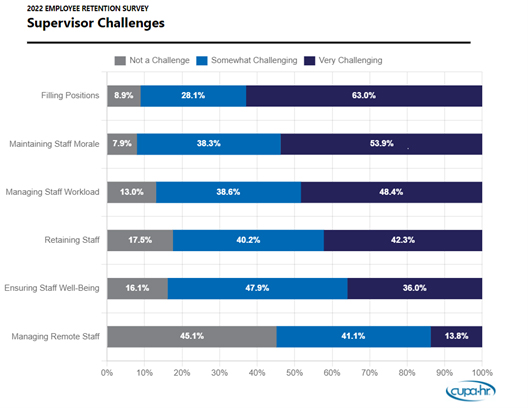
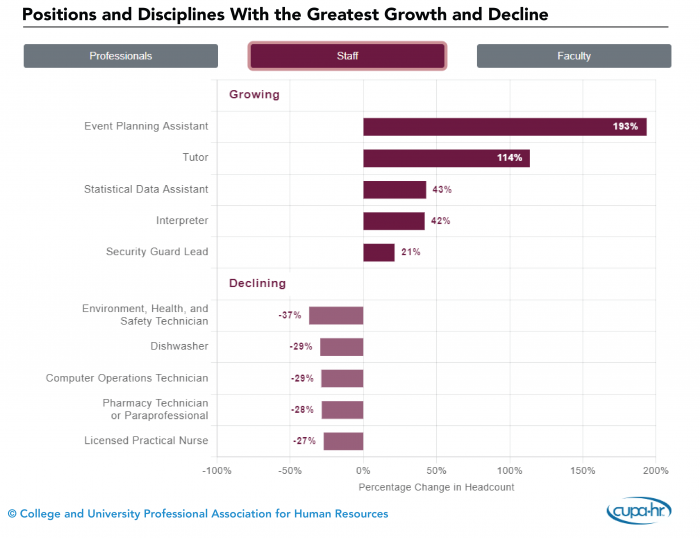
Filling positions and maintaining morale are supervisors’ top challenges. As shown in the figure below, almost two-thirds (63 percent) of supervisors indicated they find filling positions very challenging and over half (54 percent) found maintaining staff morale very challenging.
Higher ed supervisors report a lack of adequate training and support. Only three in five supervisors agree that they have resources and support in their supervisory role. Less than half (46 percent) agree that they have been provided with adequate management training for their supervisory role. However, when supervisors have more resources and support in their supervisory roles, more power to advocate for their staff, more power to allow flexible schedules, and more power to allow their staff to work remotely, they are less likely to seek other employment.
Implications of Supervisor Turnover and How to Combat It
Turnover in any role can impact an institution due to loss of talent, institutional knowledge and team or interdepartmental rapport. However, turnover in a supervisor role has more far-reaching implications. Supervisor turnover also impacts direct reports, who must adjust to a new supervisor and may need to adapt to new team priorities and vision. Loss of supervisors also equates to a loss of leaders who are key to succession plans.
In light of what the data show, there are several actions higher ed institutions can take to keep their supervisors:
Provide supervisors with resources and support in their capacity as supervisors, particularly around filling empty positions and managing staff morale.
Ensure supervisors have the ability, knowledge and resources to advocate for their staff.
Give supervisors more autonomy to determine their staff’s working arrangements, as the data show that supervisors who have more power to allow their staff to work remotely and have flexible schedules are less likely to seek other employment.
Commit to reducing supervisor workload.
If possible, raise salaries for supervisors (but not at the expense of non-supervisors).
Note: In the findings, “area supervisors” refer to those supervisors who are the top-most leaders in their department, units or areas (self-identified in the survey; 26 percent of respondents). “Other supervisors” are those who self-identified as having at least one direct report but were not the top-most leader in their department (31 percent of respondents).“Non-supervisors” are those employees who have no direct reports (43 percent of respondents).
CUPA-HR Research
CUPA-HR is the recognized authority on compensation surveys for higher education, with its workforce surveys designed by higher ed HR professionals for higher ed HR professionals and other campus leaders. CUPA-HR has been collecting data on the higher ed workforce for more than 50 years, and we maintain one of the largest workforce databases in existence. CUPA-HR also publishes numerous research publications and interactive graphics highlighting trends and issues around higher ed workforce planning, pay equity, representation of women and racial/ethnic minorities and more. Learn more about CUPA-HR research.
How do you get the news media to care about your research? Dr. Sheena Howard helps academics who want a larger media presence. She’s been featured in ABC, PBS, BBC, NPR, NBC, The L.A. Times, The New York Times, and The Washington Post.
We talk about gaining visibility for your research. And the income you can make as an authority from things like speaking engagements! We even get into how much to charge when you speak. What should a PhD charge for a 60 minute talk? The minimum is probably more than you think.
Dr. Sheena Howard is a Professor of Communication at Rider University. She won an Eisner Award for her book, Black Comics: Politics of Race and Representation. She is founder of the Power Your Research program. See full bio.
Meet Dr. Sheena Howard
Jennifer: Hello, everyone! Welcome to The Social Academic. I’m so excited for this interview today.
I’m speaking with Dr. Sheena Howard, a Professor of Communication. And she’s an expert at helping academics really find the media attention that they deserve. So, Sheena, I’m so excited that you’ve joined me today.
Would you mind introducing yourself for everyone?
Sheena: Sure, I’m happy to be here. A big fan of your work, Jennifer.
My name is Dr. Sheena Howard. I am the founder of Power Your Research, an academic branding company. I’m also a full professor and an author.
Jennifer: Not only are you an author, you’re an award-winning author. I’m so impressed with the amount of research that you’ve been able to produce and you’re also helping these people in so many different ways!
Can you tell me a little bit more about your research?
Sheena: My writing career started out as an academic. I did my dissertation on gender and race in comics like: comic books, comic strips, superheroes. That’s what my dissertation was on. Also, looking at African-American communication dynamics in Black comics.
Since then, I’ve been publishing fiction, non-fiction. I write comic books and graphic novels.
“All of my work is there to really inspire people to challenge the status quo, stand up for themselves, and to feel empowered when they are in situations where they feel like they need to sort of speak truth to power or just stand up for themselves.”
Jennifer: Oh, that’s really interesting! I recently got your book Why Wakanda Matters: What Black Panther Reveals About Psychology, Identity, and Communication. Your chapter was just fascinating to me. I hadn’t really thought about Black Panther in that kind of deep understanding of how people are communicating, how people are making decisions. I was just fascinated. I’m so excited for the new movie that’s coming out. I can’t wait to re-watch both of them now that I have your book.
Sheena: Yes.
Jennifer: One of those things that was really interesting to me is how much media attention you’ve been able to get for your comic research. I loved your appearance in Milestone Generations on HBO. I’d love to hear a little bit about how gaining media attention for your research has impacted you.
Sheena: Yeah. There’s a lot of research out there that shows that when you get media coverage and visibility it actually brings more people to your academic research articles. I know these things sound separate where academics are publishing in academic journals, and those things tend to only be read by academics.
But when you start branching out to get media coverage on NPR, BBC, all of the places you may have seen me—It actually translates into more academics citing your work, using your work. It also helps you to reach the people, the everyday people who are not in academe.
That has always been super important to me. I want to help and change the lives of people who are not in Higher Ed, who are not in the academic space. But who are actually the people that I research, and write about, and for.
Jennifer: Hmm. That’s something that so many people don’t consider, much less taking steps to even approach that.
How much should PhDs charge for a talk or speaking engagement?
Jennifer: I know one of the reasons why some women professors especially are hoping to get more media attention is because they want to speak more about their research. They want to actually bring in some money from speaking fees. I know you have amazing advice for this.
What’s your advice for women PhDs who are looking to speak more about their research?
Sheena: When you have a PhD, or even a master’s degree, being in Higher Ed for so long in that way, especially if you are a faculty member, or want to be a faculty member…It makes us forget that our work actually has value outside of Higher Ed. By the time you get a PhD, in your mind, unfortunately for a lot of us the only thing we can do is be a professor, is to be a faculty member.
In my academic branding program I’m helping people to understand that no matter what your PhD is in, you have value outside of Higher Ed. That translates into speaking engagements because a lot of academics are asked to speak for free. Or, are asked to do a 1 hour talk for $500 or $1000. And when people do that, especially women right? When women with academic credentials do speaking engagements at those low rates, it’s actually a disservice to everybody with a PhD who is interested in doing speaking engagements.
Because it happens so often, and is so prevalent. Particularly universities and institutions think that it’s okay and normal to ask someone with a PhD to do a speaking engagement for $500 and $1000.
I’m really doing the work to empower people not to accept those rates. Because we’re in our own world, in silos, we think we have to accept those rates. Particularly for women. We like to tell ourselves, “Well I need to do these free ones, and I need to do these speaking engagements for $500 because I have to build up my speaking career. But that is not true. You already have a PhD. You’ve already defended a dissertation. You are already a subject matter expert, more so than someone that doesn’t have a PhD. And people without academic credentials are charging $10,000 for 1 hour talks. And they are not even subject matter experts in the traditional educational way.
Jennifer: We’re talking about a really big difference from what many—especially academic women—are accepting for their speaking fees (an honorarium of maybe $500 to $1000) and what other people are getting paid for their speaking fees (up to $10,000). Maybe even more depending on the talk. That’s a huge range.
What do you recommend for women? What even is a speaking fee that might be acceptable for PhDs?
Sheena: “I teach people that your speaking rate is $3500 if you have a master’s degree or a PhD for a 1 hour talk. It’s $3500. And you shouldn’t be paying to travel there so that $3500 is just the speaking fee.”
Because you have to think about the hours that you’re spending preparing the 1 hour talk. And then the talking that you have to do after you come off stage.
$3500 for a 1 hour talk is not unreasonable. It might sound unreasonable to a listener who has been only doing speaking engagements for that low rate. But I can assure you that your male counterparts are charging more than $500 or $1000 for a talk.
A lot of this is psychological. Because if you just say, “Yes,” then you’re always going to be offered $500 or $1000. Sometimes it’s as simple as responding with an email saying, “I am so honored that you reached out to me. I would love to speak at your institution. But, my speaking engagement rate is $3,500.”
Jennifer: I love that! It sounds like a simple email thanking them for the invitation and setting your rate (regardless of what they offered you) is the next move. And that’s something that’s so scary for so many people.
I mostly work with academics who are not already looking for this kind of really big paid speaking engagement rate. Or, they haven’t done it before. So if I mentioned it to them, “Oh, you should get in touch with Dr. Sheena Howard if you want to do more speaking and media things. She’s an expert in that! But your minimum rate should be $3500.” I mean their minds are just blown. It’s just a totally new concept for so many people.
And many universities too. I think you’re so right when universities get the positive reinforcement that that is the fee people are willing to accept, they are more likely to offer it to you whether they have a bigger budget or not.
Sheena: Exactly.
Jennifer: So setting your own rate is how to protect yourself and ensure that you’re getting paid for the quality work that you’re doing:
Stop doing free talks for exposure by setting boundaries
Sheena: Right. This is why I say most of this is psychological, because a lot of times the academic will convince themselves that, “Well I don’t know. This High-End University asked me to speak. And I’ll be getting exposure.”
“No. You’re not going to get exposure. You’re not going to get a return on that investment. You’re literally only going to get what they’re paying you.”
Sometimes you have to tell them, “Hey, I suggest you come back to me once you have a chance to connect with other student organizations so you can put your budgets together.” I’ve had to tell people that and a lot of times, magically, all of a sudden they find the money.
But the point is, when you have boundaries right? Because setting your rate, not just changing the rate based on who’s asking you, means you have to have boundaries. When you have boundaries, the ball is in your court. Because if they come back and say, we really don’t have $3,500 in our budget. Well then now you get to decide.
I would say don’t do it. But now at least you get to decide. Because the best leverage you have is to walk away.
Jennifer: Right! Walking away is always an option.
One of the things that I love about what you share on LinkedIn and on Twitter, is that it is a decision-making process. Choosing whether to do that free talk, or not, is a decision-making process. You have a number of steps that you go through to decide whether it’s something that you’re open to, things like
Having a past connection with the organization
Being able to reach the public
Helping more people
You have things that you’re looking for, that you will get out of the talk instead of money. I think that that’s really important too. Like, it is okay to take a free talk. But you want to think about
How it’s going to help you
How it’s going to help other people
How it’s going to look like in your schedule
What’s going to work for you
I just love everything you share about it.
Sheena: That’s right. I do teach people part of your boundaries is actually having a checklist of when you will do a speaking engagement for free.
But you shouldn’t be wavering from that checklist. If your checklist has 4 things on it, right? I’ll do a free speaking engagement if it meets X, Y, Z criteria…it has to meet all those criteria for you to do it for free. If it doesn’t, you can’t do it for free. I walk people through a criteria around doing a speaking engagement for free to determine if you should be doing that or not.
Jennifer: I love how much you’re talking about setting boundaries for yourself. Was that something that was hard for you when you first started speaking? Or, did that come naturally?
Sheena: When I talk about building a brand, you’re essentially building a business. Because you’re making money off of leveraging your academic credentials. That money goes into your business pot, not your personal pot. Because you are the business and you can’t run a successful business if you don’t have boundaries. Right?
I run my coaching program. If I just change my coaching schedule based off of everybody else’s schedule, I wouldn’t have a coaching program. Right? This is my schedule. This is when I’m available for coaching calls. I’m not going outside of that. Otherwise, I wouldn’t have a business to run because it would be completely out of control.
It’s the same thing when we’re thinking about speaking engagements to be quite honest. You can’t really build your brand successfully and leverage your academic credentials successfully if you’re trying to financially protect your future. If you don’t have boundaries.
And yes, I had to learn that because I wouldn’t be where I am with my two businesses if I didn’t. You have to take the emotion out of boundaries. These are the parameters and that’s it.
Jennifer: Now not only are those the parameters but like that’s how you make it work with your lifestyle: with being a Professor, with actually having two businesses. It wouldn’t work unless you kept those boundaries.
Sheena: Oh my God. Jennifer, that is so true. I am a single mom. I am a full Professor at a university. I run two businesses.
I have to have boundaries to make all of this work. Yeah. I mean it’s just so important.
Jennifer: Now we’ve talked a little bit about speaking engagements and how having that kind of online presence and being found by the media can help get more attention to your research.
What makes up your online presence?
Sheena: One thing that’s really important is to know when your name is mentioned anywhere on the internet.
Now they have paid tools where you can monitor when you’re mentioned. I don’t use any of those paid tools. I just use Google Alerts. All different versions of my name are in Google Alerts—Sheena Howard, Dr Sheena Howard, Sheena Howard PhD, like all different versions are in Google Alerts.
This is really important because sometimes the media will quote me in things that I didn’t even know they were quoting me in. Or, I didn’t know the article was out. But I get it immediately when my name is mentioned. This is important in having a digital footprint, a digital presence. To just even know what is out there about you because you need to be intentional about your digital space.
The other thing is your personal website.
I teach people you need to own your virtual real estate. Your stuff online is real estate. You literally can make money off of it. And you need to think about your online presence as literally the equity that you’re building in your house.
When you have your website, you should own your name. So SheenaCHoward.com, I should own that URL. DrSheenaHoward.com, I should own that URL.
If you don’t own your name right now in the virtual space, in terms of buying that URL which you can do for like $15 a year on like GoDaddy or something like that. You need to go and buy all those different versions of your name. That makes up your digital footprint as well, just owning your virtual real estate.
Your website should have good SEO [Search Engine Optimization]. When someone types in like “black comics,” I want my name to come up. It will, if anybody’s listening to this they type in “black comics,” something about me is going to come up on the 1st or 2nd page of Google Search results.
But also when someone types in my name, I want my website to come up because I’m controlling my brand to some extent. This is what I want people to know about me when they type in my name. Not some random video that I did 10 years ago.
Your website is definitely something that makes up your brand. And then everything that people are saying about you, like reviews: Google reviews, all of those public places where people can leave reviews about you, your business, your work makes up your digital footprint, your online presence.
Jennifer: I love that you talk about it like real estate. I speak with so many professors that have maybe been given space on their University website to create a page, or they use a page that has been given to them by Humanities Commons, or another organization. It’s different than owning your own space, than having complete control over a website and a domain that you own.
I love what you said about comparing it to owning real estate and really investing in having control over your own name. Thank you for sharing that.
Sheena: Yeah, for sure. It’s about ownership because it’s kind of like your website is hosted by wherever it’s hosted by. And obviously you don’t own that company, but you own it more than you own your Instagram page, or your Facebook page, or your or your Twitter page. Right? You can directly be in contact with people. You can track your traffic to your website. You can send them to your mailing list.
If something happens with any of these platforms you still can be in direct communication with the people that are your fans and followers and that kind of thing.
Jennifer: I love that because you’re really talking about people who are trying to make those kind of longer term connections, inviting people to their website.
A lot of the people that I work with have never really thought about the audiences for their website before. They’re just thinking of other academics, or other researchers at that point when they first reach me. So that’s really normal if you’ve never thought about it before. That’s normal.
However, your website will reach so many more people. And it does invite more people, and media, and other researchers of course. But also the public, to explore your work. Owning that real estate is not just inviting people to your research, it’s inviting people to learn more about you as a person and see how your work can help them. I really enjoyed that comparison to real estate. That’s great.
Why you want a larger media presence for your work
Jennifer: You’ve created the Power Your Research program because you want to help academics have a larger media presence, to get real recognition for their work. Why should academics want that?
Sheena: There’s two reasons why I created Power Your Research. The 1st is because unfortunately a lot of people with PhDs are living paycheck to paycheck. Or, they’re not getting the income that they want to be getting from their universities. So you have people with PhDs who can’t even break into academe, because at this point getting a tenure track position is almost like making it to the NFL, if we’re being honest.
Then, we have people who are on tenure tracks, or who have tenure, who now all of a sudden they realize, “Oh my goodness, there is a pay ceiling to this once I get tenure, I got to go for Full.” And Full [Professor] is the highest promotion that you can get. You’re just not going to make any more money for the rest of your career because you’re a Full Professor. What a lot of people will do is they’ll go the administration route because they want to make more money, not necessarily because that’s what they want to do.
I created the Power Your Research program to empower people. To say, “Hey, look. You can make more money building your brand than any university or institution can ever pay you anyway.” If you have tenure you might as well do that because your work can leave an impact on people. You can reach more people. You can really do the things that you want your work to do.
If you’re not on a tenure track, and you’re one of these PhDs or people with master’s degrees that are not even in Higher Ed, you can leverage your academic credentials to make six figures and more.
That’s the 1st reason why I created the program: to empower people to own their academic credentials in their career.
The 2nd reason why I created Power Your Research is because with these free tools that we have out here, unfortunately, educators and academics are not the ones with the microphones reaching everybody. And they are the subject matter experts.
There are people who are very good at digital media, good at using these tools, who are not subject matter experts who have the microphone and are reaching millions of people.
I personally believe that society is better when the subject matter experts have the microphone. And have the visibility and media coverage to reach more people. Because they’ve done the academic and educational work. They should also be the ones out there on the forefront.
Those are the two reasons why I created Power Your Research for my academics and educators.
Jennifer: I love it! Oh that sounds amazing. I think there’s so many women who are listening right now that are like, “Oh, I need six figures. That sounds like the program for me.”
Can you tell people a little bit about what to expect from the program? Like who should reach out and actually book a call with you to talk about this.
Because more people should be in this program and get that expertise to actually communicate and get the money that they deserve.
Sheena: Yeah, so there are kind of two buckets of people in the program. There’s people who, have PhDs, some people have master’s degrees, who are not like working as faculty members. But they might have a small business that they just started and they’re trying to get lead generation and just trying to figure it out. Maybe they have a different full-time job, they’re trying to figure it out.
The other bucket of people are people who are on tenure track positions or who are tenured, who are the people that we just spoke about, where they’re like, “Hey, there’s a pay ceiling.” They’re feeling unfulfilled in Higher Ed. They’re looking for the next thing. They want to make more money. They’re living paycheck to paycheck, or not making the income that they want to make.
Basically anybody with academic credentials, I can teach you how to leverage those so that you can own your future, and protect your future, and build equity in your brand.
Being an academic expert in a documentary
Milestone Generations (2022) was released recently on HBO. It is a documentary that asks, “Where are the Black superheros?” exploring the history of Milestone Media hosted by Method Man.
Jennifer: You’ve done it for yourself. You really are an expert who’s been on all of the national outlets, and in documentaries, on TV shows.
What was it like being in Milestone Generations? I know you’ve been on other TV spots before, but that was the one that just came out and I watched it.
Sheena: Oh, thank you.
Yeah, that was that cool. It’s always awesome to kind of get recognition like that, in my opinion. Because I get to reach more people. I get to help more people.
It was amazing. I got to go to New York. I was on set. It was during COVID, so we had to do multiple COVID-19 tests. But it was amazing.
It was a big honor and, to be honest, I worked hard to be able to get positioning like that without spending money on a publicist. I don’t pay publicists.
I do this all on my own by just really honing in on the things that I teach academics to do around leveraging their brand. And I’m focused. I’m just focused.
Once you get the media coverage and visibility, and you’re consistent for a period of time, you don’t have to pitch yourself anymore because you already have the online presence. When someone types in “black comics” or whatever, something about me is gonna come up. And so I’ll be able to kind of get to the top of the list of experts that can talk about black comics, the comic space, that kind of thing.
Anybody can do that with their educational backgrounds. This is really what I want people to understand. Anybody can get to that place, just a period of time that you have to do a specific set of activities until you can kind of sit back and kind of enjoy the fruits of your labor.
Jennifer: You just mentioned something that I’d like to ask about. Because I think a bunch of people are maybe going to have this question.
Sheena: Yeah.
Jennifer: Can you hire a publicist? And if so, how much does it cost? You teach people how to do it themselves, but hiring a publicist probably sounds more attractive to some people. So what does that actually look like? I think it’s really expensive, right?
Sheena: Hiring a publicist sounds more attractive because people actually have a misconception about what publicists do. I actually did a live video on this the other day.
“People think they’re going to hire a publicist, the publicist is going to do all the work for them. They’re going to put their content out there, they’re going to run their social medias, they’re going to get them media spots. That is not what a publicist is there for.”
You have to provide the publicist with the content. You need to come to the publicist with something for the publicist to put out into the world. A publicist doesn’t just work with you and then call up The New York Times and be like, “Hey, I got a client.” You have to be the publicist for things.
You have to work with the publicist for at least 3-6 months before you see any results because they have to build up to getting you that media coverage and visibility. But they also have to have something to build upon.
A publicist is like $3,000-$5,000 a month.
You’re not gonna see results for a while. You’ll probably get a couple of media spots. But you will have no idea what your brand is, who you’re trying to reach, or any of that.
I want to be clear that publicists are not scams or anything like what people might be thinking. Publicists are actually really good at their job, so they have to have something to work with.
I used a publicist one time. And I might use a publicist in the future. But there’s a very specific way you should go about this so that you’re not paying $3,000 to $5,000 a month. The 1st is to build your brand on your own. Have something for the publicist to build off of. So do the work.
The second is if there’s a high-end media outlet that you want to be on…Let’s take me for example. I was on The Breakfast Club, it’s a very high-end podcast known worldwide. You see politicians go on there all the time.
I did the work on that. I got in contact with Charlamagne tha God, who is the host, on my own. I got him to follow me on Twitter. Eventually, after about 6-8 months, I got the email address of the producer. I emailed the producer on my own. Then at that point, I hired a publicist to just go into the end zone and lead the rest of the way because that was high-end.
Instead of me having to pay $3,000 to $5,000 a month, I could pay a little bit less for a shorter period of time. Because I just wanted the publicist to really do that one thing. So, that’s a different way to go about getting a publicist. Save yourself some money.
But I mean for all the places I’ve been, I have not had a publicist with me—ABC, Good Morning America, Digital BBC, NPR—that was all me working working the systems that I teach.
Jennifer: Amazing! Well for everyone who’s listening, Power Your Research, is the program that’s going to teach you how to do that. You get to work with Dr. Sheena Howard and learn how to really control your own media. And reach out to people and actually make those connections yourself.
Dr. Howard, is there anything else you’d like to discuss before we wrap up?
Sheena: I want to say since I did mention the publicist that I worked with for a little bit, shout out to Sam Mattingly, the publicist that I did work with a few years ago. She was amazing, and believed in me, and believed in my mission, and believed in my message. But I came to her with things for her to use to promote my brand. I had been promoting my brand for years before I reached out to her for that limited period of time. Shout out to her.
Hopefully your listeners found this valuable. Hopefully there are some things in there they can take and implement right now. That is my goal: to empower all of my academics and educators.
Jennifer: Well thank you so much for coming on the show, Dr. Howard. Thank you so much!
Sheena C. Howard, is a Professor of Communication. She is an award-winning author, filmmaker, and scholar. In 2014, Sheena became the first Black woman to win an Eisner Award for her first book, Black Comics: Politics of Race and Representation. She is also the author of several critically acclaimed books and comics books on a range of topics. Sheena is a writer and image activist, with a passion for telling stories, through various mediums, that encourage audiences to consider narratives that are different than their own.
In 2014, Sheena published Black Queer Identity Matrix and Critical Articulations of Race, Gender and Sexual Orientation. Sheena is the author/editor of the award-winning book, Encyclopedia of Black Comics and the cowriter of the comic book Superb, about a teenage superhero with Down Syndrome. In 2016, through her company Nerdworks, LLC, Sheena directed, produced and wrote the documentary Remixing Colorblind, which explores the ways the educational system shapes our perception of race and “others.”
According to data recently released by CUPA-HR, the higher ed workforce positions that saw the greatest growth from 2020-21 to 2021-22 were event planning assistant (up 193%), institutional research analyst (up 161%), head of campus museum (up 120%) and tutor (up 114%). These increases reflect an increase in the number of people hired to fill existing or newly created positions since 2020-21.
The positions that saw the greatest decline in number of employees were environment, health and safety technician (down 37%), head of campus learning resources center (down 36%), online instruction operations manager (down 32%) and dishwasher (down 29%). These decreases reflect a decrease in the number of people in these positions since 2020-21, either because the institution has reduced the number of available positions or because those positions have unfilled vacancies.
In many cases, the growth and decline in these positions over the past year reflect the impact of the COVID-19 recession that began in the spring of 2020. Like so many employers, institutions have experienced the effects of the Great Resignation and the subsequent challenges of talent recruitment amid the growing availability of remote and flexible work options.
Other factors may also be at work. The return to in-person events, the growing demand for data to inform institutional decision-making, and the continued interest in honoring the cultural histories of institutions may have increased demand for the positions that saw the greatest increases. Also, as the high school graduates most impacted by the pandemic’s disruption of classroom learning make their way to college, more tutors may be needed to help them bridge anticipated gaps.
Smaller Shifts in Faculty
Overall, tenure-track faculty saw much smaller increases and declines in the years analyzed. Disciplines with the highest growth were Library Science (up 8.4%), Liberal Arts and Sciences (up 7.0%), and Area, Ethnic, Cultural, Gender and Group Studies (up 2.3%). Disciplines with the greatest declines were Communications Technologies (down 22%), Agriculture (down 9%) and Engineering Technologies and Technicians (down 6.4%).
More About the Results
The data for these results came from CUPA-HR’s annual Professionals in Higher Education Survey, Staff in Higher Education Survey and Faculty in Higher Education Survey. Analyses included more than 600 institutions that participated in each survey in both years of the comparison. For additional details, see the interactive graphic in the Research Center. These data and more are available through CUPA-HR’s DataOnDemand subscription service.



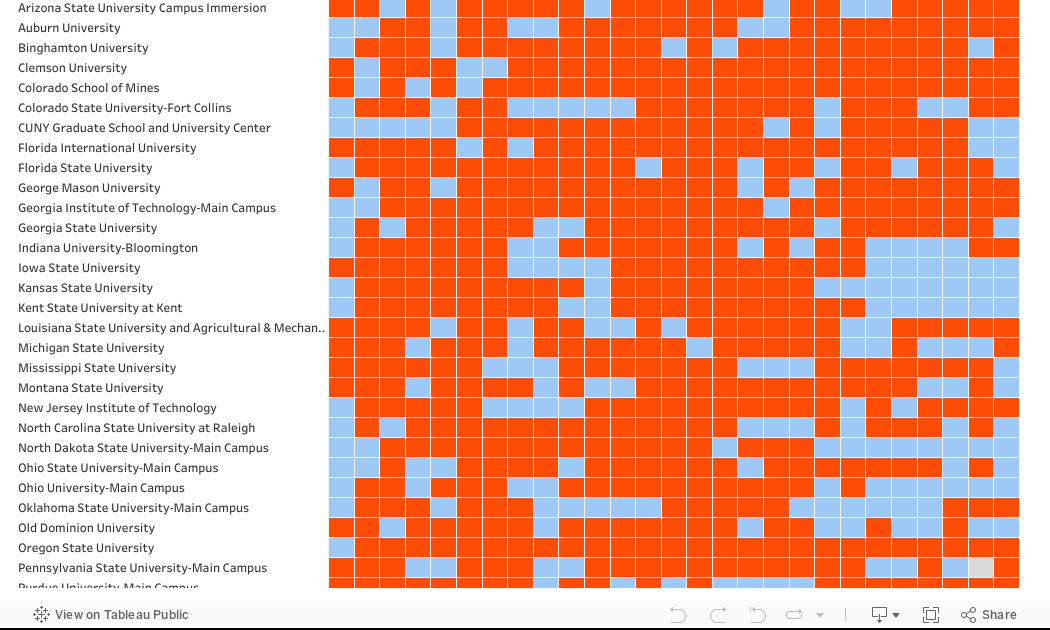
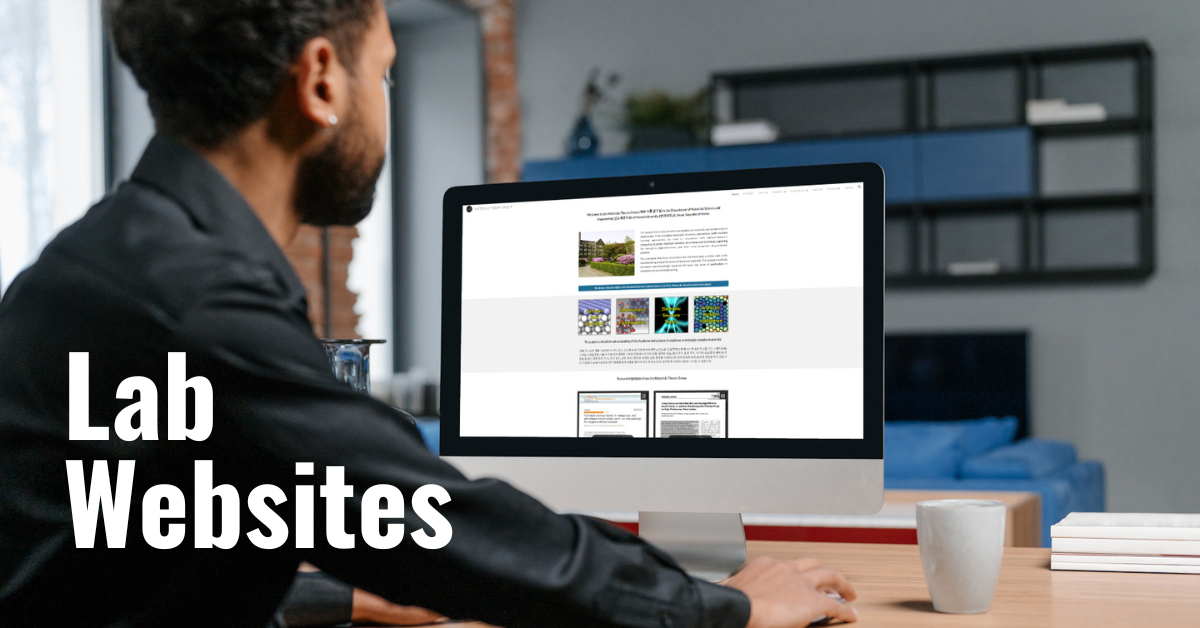
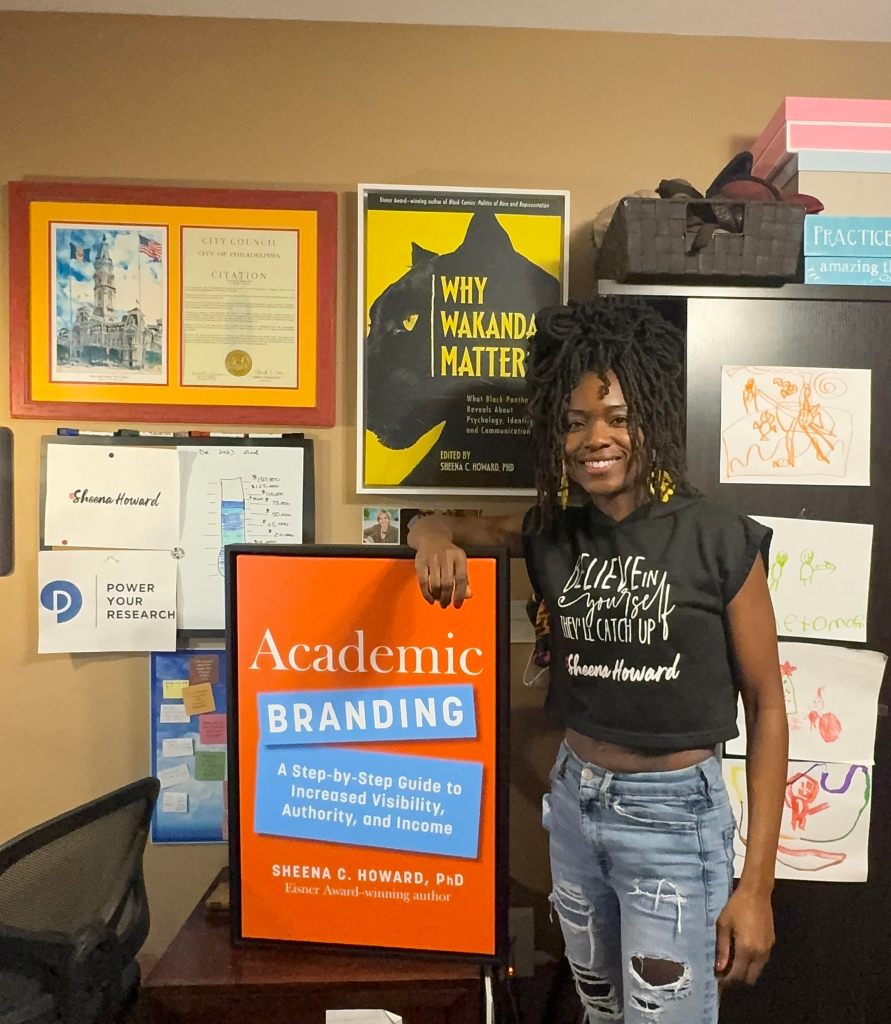


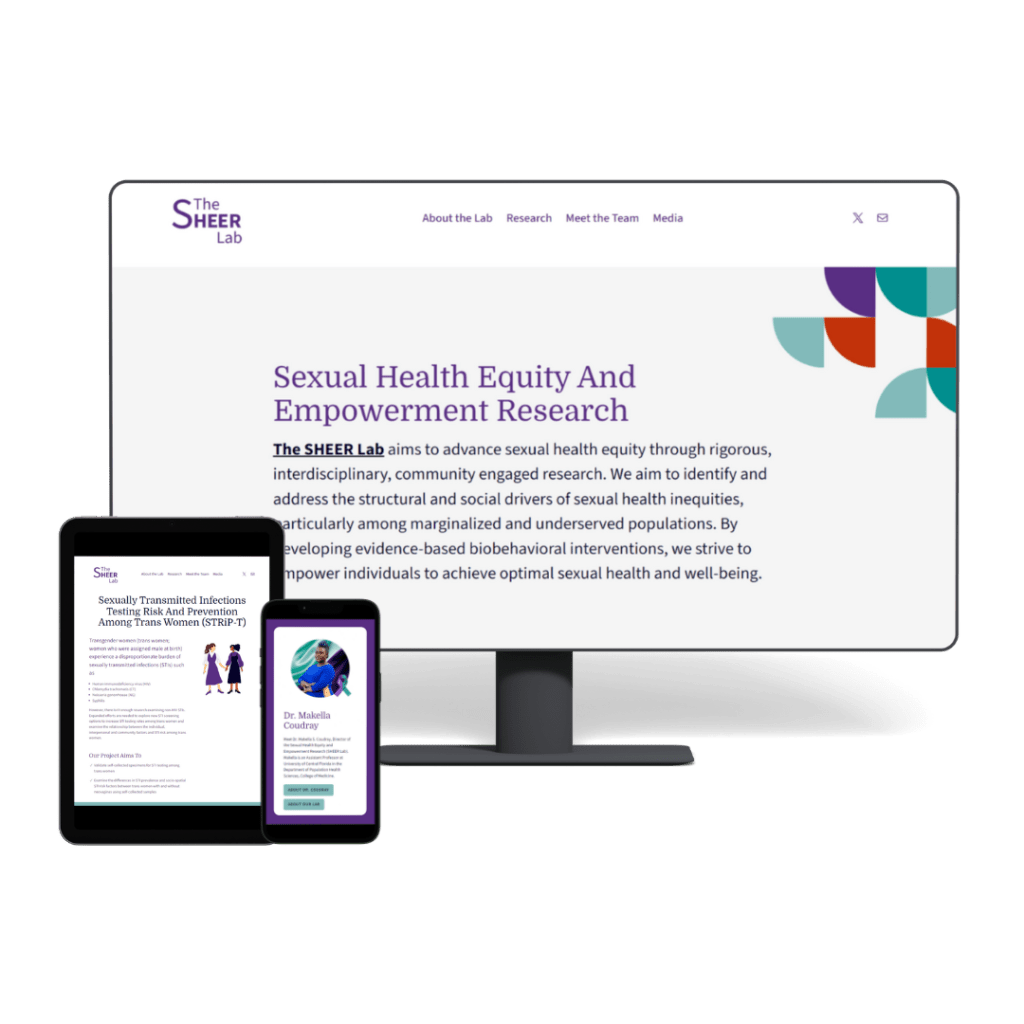




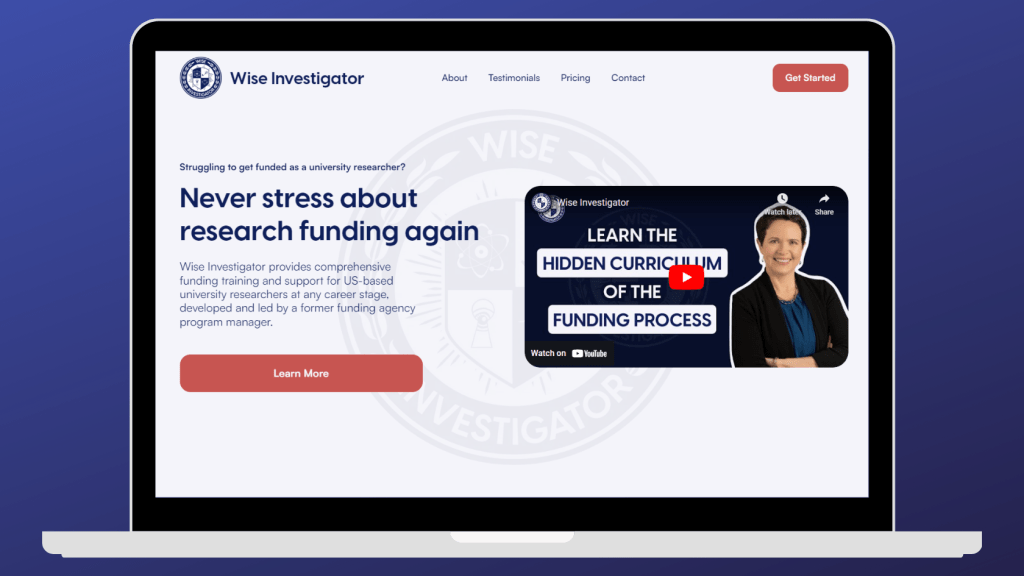







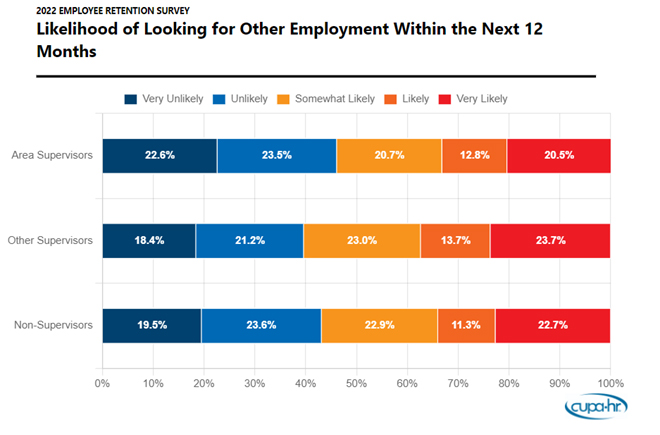 Most higher ed supervisors work long hours and have absorbed more duties since the onset of the COVID-19 pandemic. Data show that supervisors are more likely than non-supervisors to work additional hours. Fewer than half (47 percent) of non-supervisors work more hours than what is considered full-time. However, 89 percent of area supervisors and 76 percent of other supervisors work more hours per week than what is considered full-time at their institution. Additionally, supervisors are more likely than non-supervisors to agree that they have absorbed additional responsibilities of other staff who have left the institution since the onset of COVID-19. Supervisors are also more likely than non-supervisors to report that they experienced an increase in job expectations since the start of the pandemic.