On-campus engagement is one metric that can predict student success, but external factors including needing to work, caretaking responsibilities or living off campus can hinder students’ participation in activities.
At Stony Brook University, part of the State University of New York system, institutional data showed retention rates lagged for students in the humanities and social science disciplines. In response, leaders created several programs to incentivize students in those majors to build relationships with others in their field and engage in hands-on work.
Three Stony Brook leaders—Tiana De Jesus, lead academic success advisor and retention specialist; Richard Tomczak, director of faculty engagement; and Jennifer Rodriguez, associate director of the student success and retention center—shared details of the program and initial results at NASPA’s Student Success in Higher Education conference in Denver last month.
The background: The Undergraduate Retention Initiatives and Success Engagement (U-RISE) office houses a variety of innovative retention supports, including a research lab, called SSTAR, and re-engagement advising.
One of the more recent projects the staff at SSTAR—short for Student Success Through Applied Research—have taken on is addressing gaps in retention for non-STEM students.
University data pointed to six majors in the humanities and social sciences with the lowest retention rates as well as relatively high admission rates of students with lower grade point averages from high school.
Research shows that students who are engaged on campus are more likely to feel a deep sense of belonging and establish meaningful relationships with peers and faculty, as well as develop career skills. Students who have a strong sense of belonging in their major program are also more likely to have higher retention rates and levels of faculty connection.
SSTAR team members sought to foster relationships between students and their instructors, improve students’ academic readiness and provide financial support to ensure equitable retention for students across socioeconomic groups.
A National Picture
Research from the Student Experience in the Research University Consortium at the University of California, Berkeley, found fewer students participating in faculty-led research post-pandemic compared to their peers enrolled in 2019, showing a gap in experiential learning opportunities.
One of the more common reasons why students are unable to take on research roles is a lack of pay or needing to work for pay. A significant number of colleges have established financial aid for students to receive a stipend for participating in unpaid or underpaid experiential learning opportunities, ensuring the inability to pay does not prevent participation.
To accomplish these goals, campus leaders created three interventions: research assistantship positions in faculty-led research, a first-year seminar for academic preparation and paid on-campus jobs for humanities students.
In focus: This past spring, Stony Brook hired 12 first-year students out of an application pool of over 100 to serve as research assistants. Each student was matched with a faculty member from one of a variety of departments, including English, art, history, linguistics and Asian and Asian American studies. Research assistants committed to eight to 10 hours of work per week and were paid a stipend. Funding came from the provost’s office.
The projects varied; one English and sociology student analyzed TikTok videos of social activists to challenge stereotypes, while an English and psychology student trained artificial intelligence on European literature from the 1700s, according to a university press release.
The impact: Across interventions, students who participated in the programs were more likely to say they feel connected to their peers, see the value of their degree and intend to persist, according to pre- and post-survey data.
Many students said the experiences helped open their eyes to the career and research opportunities available to them in their field and made them feel faculty were more accessible to them. Of the students who participated in the three interventions, 92.8 percent enrolled as a sophomore the following year, compared to 91.8 percent of their peers who didn’t participate, surpassing the university’s 92 percent retention goal. Students also had higher cumulative GPAs, showing a correlation between engagement and academic achievement.
An unexpected finding was that before participating in the program, many students said they felt stigmatized for their major choice (Stony Brook is a majority of STEM learners), but afterward they felt more connected to those in similar fields, even if not in their exact major.
In the future, researchers hope to recruit a larger number of students and expand their work to other humanities and social sciences majors.
Indianapolis, IN — Project POTUS, a national middle school history initiative from the Benjamin Harrison Presidential Site, has named winners for this year’s competition.
Since the founding of our nation, there have been nearly half a billion American citizens. Of those, over 12,000 of us have served in Congress. Just 115 have become Supreme Court Justices. Only 45 citizens have become President of the United States. There’s something exceptional about each POTUS — good, bad, or otherwise. Project POTUS? challenges students in middle school to research an American president and create a video, 60 seconds or less, representing the POTUS chosen in a way that is creative, supported by good history research, and fun. A Citizen Jury made up of nearly 100 people reviewed all qualifying submissions and selected this year’s winners.
Grand Jury’s Grand Prize and Spotlight Award Selections
Grand Prize Winner ($500 award)
6th grader Peter Gestwicki from Muncie, Indiana won grand prize for his video about Theodore Roosevelt. Watch his winning video here.
Spotlight Award Winners ($400 award winners)
8th grader Grace Whitworth from St. Richard’s Episcopal School in Indianapolis, Indiana won for her video about President Thomas Jefferson. Watch her winning video here.
8th grader Izzy Abraham from Sycamore School in Indianapolis, Indiana for her video about President Calvin Coolidge. Watch his winning video here.
8th grader Clara Haley from St. Richards Episcopal School in Indianapolis, Indiana for her video about President George W. Bush. Watch his winning video here.
8th graders Delaney Guy and Nora Steinhauser from Cooperative Middle School in Stratham, New Hampshire for their video about President James Polk. Watch their winning video here.
37 students throughout the country each won their Presidential Category and received $100 awards. Check out all of their videos here.
The 2026 Project POTUS competition begins Election Day, November 4, 2025 and all submissions must be entered by Presidents Day, February 16, 2026. Learn more here.
Project POTUS is made possible by the generous support from Russell & Penny Fortune.
About the Benjamin Harrison Presidential Site
The Benjamin Harrison Presidential Site is the former home of the 23rd U.S. President. Now celebrating its 150th anniversary, it is a stunningly restored National Historic Landmark that shares the legacy of Indiana’s only President and First Lady with tens of thousands of people annually through guided tours, educational programs, special events and cultural programs. Rated “Top 5 Stately Presidential Homes You Can Visit” by Architectural Digest, the Harrison’s 10,000 square foot Italianate residence in downtown Indianapolis houses nearly 11,000 curated artifacts spanning more than two centuries of American and presidential history. Recently expanded and restored through a $6 million campaign, the Benjamin Harrison Presidential Site is also consistently ranked a Top 5 Thing To Do in Indianapolis by TripAdvisor. Signature programs and initiatives include: Future Presidents of America; Project POTUS, Candlelight Theatre; Juneteenth Foodways Festival; Wicket World of Croquet; and Off the Record. Founded in 1966 as a private 501c(3) that receives no direct federal support, the Benjamin Harrison Presidential Site is dedicated to increasing public participation in the American system of self-government through the life stories, arts and culture of an American President. Find out more at PresidentBenjaminHarrison.org.
eSchool Media staff cover education technology in all its aspects–from legislation and litigation, to best practices, to lessons learned and new products. First published in March of 1998 as a monthly print and digital newspaper, eSchool Media provides the news and information necessary to help K-20 decision-makers successfully use technology and innovation to transform schools and colleges and achieve their educational goals.
In SRHE News and Blog a series of posts is chronicling, decade by decade, the progress of SRHE since its foundation 60 years ago in 1965. As always, our memories are supported by some music of the times (which had improved somewhat after the nadir of 1975).
In 1985 Ronald Reagan became the US President, which seemed improbable at the time, but post-Trump now appears positively conventional – that joke isn’t funny any more. Reaganomics fuelled the present US multi-$trillion national debt; it was the era of supply-side economics. President Reagan was of course popular with UK Prime Minister Margaret Thatcher. She was by then at her peak after the 1982 Falklands War restored her own popularity, helping her in 1985 to bring an end to the miners’ strike and to ride out riots in Handsworth in Birmingham and Broadwater Farm in London.
Vodafone enabled the first commercial mobile phone call in the UK; the BBC micro was the computer of choice for schools. Beverley Hills Cop was one of the top movies in 1985, with Eddie Murphy featured by the Pointer Sisters as they sang “I don’t wanna take it any more”, a 1980s theme song for some in universities. Globalism was in vogue; everybody wants to rule the world. International pop stars came together to sing We are the world in January and then perform at the Live Aid concert at Wembley in July with Queen’s legendary showstopping performance. Nintendo prepared to conquer the world with the launch of Super Mario, but global multinationals took a hit with one of the biggest marketing blunders ever, as Coca-Cola changed its formula, released New Coke in April, then went back to the original less than three months later.
Higher education in 1985
Global HE had its own marketing and governance issues after what Guy Neave (then UCL, now Twente) described as a period of consolidation from 1975 to 1985:
“ … it was during this decade … that these systems assumed the level of dealing with mass higher education … By the late 1980s or 1990s … there are certain countries which anticipate participation rates in higher education of over 30% (Neave, 1984a). Highest amongst them are Denmark and Finland with 40% of the appropriate age group, the Federal Republic with 35% and France with 33%. … In effect, transition to mass higher education gave rise to additional bodies to control, monitor and hold accountable a sector of increasing significance in government social expenditure. Such intermediary agencies stand as a response to the advent of mass higher education, not an anticipation of it.”
This was prescient: who’s gonna tell you things aren’t so great? Later Paul Windolf (Heidelberg) would take a very long view in his comparative analysis of Cycles of expansion in higher education 1870-1985 in Higher Education (1992:23, 3-19): “For most countries the data confirm the theory of ‘status competition’ (perverse effects): universities expand particularly fast during times of an economic recession … The human capital theory is not confirmed by this longitudinal analysis.” However human capital theory dominated policy thinking in many parts of the world, especially the UK, as Adam Matthews (Birmingham) argued in his blog for Wonkhe on 12 June 2024:
“Despite so much adversarial and ideologically polarised politics in the 1980s domestically and internationally, we do find consensus around higher education and universities. Growth was still on the agenda. As the country found itself economically struggling, teaching and research was seen as the solution rather than the problem, particularly around research findings being applied to real world issues.”
UK HE in 1985: a ferment of planning
In that decade of consolidation after 1975, in the UK no new universities were created until the 1980s. By 1985 there were just two: the University of Buckingham and the University of Ulster. Expansion of UK HE in the 1980s was driven by the polytechnics, especially after the UGC’s unevenly distributed and dramatic financial cuts of 1981. The universities and UGC had tried and failed to protect the so-called ‘unit of resource’, the level of funding per full-time equivalent (FTE) undergraduate student, and the UGC’s established pattern of quinquennial funding had been reluctantly abandoned. Neave noted that:
“Strictly speaking, university finance in the United Kingdom did not involve change to the basic unit of resource, an issue raised only under dire economic pressure in the period following the 1981 reductions in university budgets. Nor was the abandonment of quinquennial funding a response to mass higher education per se, so much as to the country’s parlous economic status.”
The UK economy and HE were in Dire Straits: there was no money for nothing. The rapid expansion of the polytechnics, driving down costs, was the dominant influence on policy. A National Advisory Body for Local Authority Higher Education (NAB) had been set up on 1 February 1982 to advise the Secretary of State for Education and Science on matters relating to academic provision and the approval of advanced courses, reconstituted as the National Advisory Body for Public Sector Higher Education (PSHE) from 1 February 1985. In 1985 there were 503,000 students in PSHE in Great Britain, of whom 214,000 were part-time. Universities had 291,000 full-time and 114,000 part-time students. PSHE in England included 29 polytechnics, 30 major colleges, 21 voluntary colleges, and 300 others. In Wales there was one polytechnic, 7 major colleges and 16 others. The Further Education Act 1985 gave more powers to local authorities, who still governed the whole of PSHE, to supply goods and services, especially teaching and research, through educational institutions.
Clive Booth, principal private secretary to the Secretary of State for Education and Science since 1975, later to become Director of Oxford Polytechnic, foretold government policy in 1987, reviewing HE planning since 1965 in Higher Education Quarterly:
“The development of a planning body for public sector higher education in England has created the potentiality for an integrated planning approach to university and non-university higher education.”
“Looking back from 2015, some of these observations and recommendations do seem quite tentative. But in 1985 they were dynamite. After the extraordinary and unprecedented cuts of 1981 and Keith Joseph’s unsuccessful approach to introduce fees in 1984 this seemed like another attack on universities.”
“… to my mind one of the most damaging inquiries into higher education over the last half-century was the Jarratt report … a mischievous and malevolent investigation (which, inter alia, popularised if it did not invent the notion that students are “customers”, which foisted on the sector the delusion that factory-floor “performance indicators” are entirely suited to a higher-education setting, and which led to the abolition of academic tenure and the concomitant triumph of managerialism in the academy) … Jarratt was self-inflicted. The inquiry was not a government creation. It was established by the Committee of Vice-Chancellors and Principals. … Jarratt was betrayal from within.”
For Greatrix:
“Looking back these do not look like the proposals filled with malevolence or mischief. Many of these changes were inevitable, most were long overdue, a lot would have happened in any case. … From today’s viewpoint it looks more like that what Jarratt offered were some pointers and directions in this strange new terrain.”
The Green Paper, still Green and not White, announced by Secretary of State Keith Joseph in May 1985, came as the preliminary conclusion to this ferment of planning. He said in Parliament that “…it is vital for our higher education to contribute more effectively to the improvement of the performance of the economy. This is not because the Government place a low value on the general cultural benefits of education and research or on study of the humanities.” But HE mostly heard only the first sentence, and thought we were on the road to nowhere, rather than seeing the opportunities.TheThatcher White Paper Higher Education: Meeting the Challengewould not appear until 1987, and NAB and the UGC would survive only until 1988. REO Speedwagon captured the mood: Can’t fight this feeling any more.
SRHE and research into higher education in 1985
The chairs of SRHE from 1975-1985 included some great names: Lewis Elton (Surrey) 1977-78, Gareth Williams (Lancaster, later London Institute of Education) 1978-80 (and 1986-88), Donald Bligh (Exeter) 1980-82, David Warren-Piper (London Institute of Education) 1982-84, and Michael Shattock (Warwick, later London Institute of Education/UCL) 1984-86. The outstanding highlight of the decade was a major review into higher education organised by the Society. As Gareth Williams wrote:
“With the help of a substantial grant from the Leverhulme Trust, the Society for Research into Higher Education set up a comprehensive programme of study into the future of higher education which I directed. The aim of the programme was not to undertake new research but rather to focus recent research findings and the views of informed people on the major strategic options likely to be available to higher education institutions and policy making bodies in the 1980s and 1990s.”
The programme ran from 1980 to 1983 and led to nine themed reports, an overall review and a final report. SRHE had, in Michael Shattock’s words:
“… established itself as an important voice in policy. It was addressed by higher education Ministers (William Waldegrave 1982, Peter Brooke 1983), at an SRHE/THES Conference on the Green Paper by Sir Keith Joseph the Secretary of State, in 1985. Most unusually it received a visit from the former Prime Minister, Edward Heath, in February 1983 who wished to seek the Society’s advice about higher education.”
SRHE might have hoped like Madonna to be Into the Groove policywise, but the Prime Minister had a list of questions which were more about living in a material world:
To what extent (if any) has the balance between disciplines been inappropriate for Britain’s economic needs?
How far should the labour market determine the shape of higher education?
Are research and teaching indivisible in higher education if standards are to be maintained?
Is it better to have a few research institutions or many, given financial constraints?
Is the binary line appropriate?
Are the links between HE and industry poor by comparison with other major countries?
What are the merits of shorter courses – two years liberal arts followed by two years vocational?”
“The interest of these questions is both the extent to which the issues were addressed and answered in the Leverhulme Programme and the fact that their underlying assumptions formed the basis of the 1985 Green Paper. It was clear that the Society was at the sharp end of discussions about the future policy.”
The Leverhulme findings were perhaps just too balanced for the times – can’t get there from here. Shattock as SRHE chair initiated an Enquiry on ‘Questions of Quality’ which became the theme of SRHE’s 1985 annual conference, and one of SRHE’s founders, Graeme Moodie (York), edited a 1986 bookStandards and Criteria in Higher Education. Shattock also established the influential SRHE Policy Forum, a seminar involving leading academics, civil servants and HE managers which met five times a year under the alternate chairmanship of Michael Shattock and Gareth Williams.
Nevertheless it was not long after 1985 that a special meeting of SRHE’s Council at the FE Staff College received a report, probably from its administrator Rowland Eustace, saying: “general knowledge and understanding of the Society remains relatively low in higher education despite attempts over recent years to give the Society a higher profile”. Perhaps still a little out of touch, hoping for glory days, still running up that hill, hoping or even believing that things can only get better.
Rob Cuthbert is editor of SRHE News and the SRHE Blog, Emeritus Professor of Higher Education Management, University of the West of England and Joint Managing Partner, Practical Academics. Email [email protected]. Twitter/X @RobCuthbert.
The Higher Education Inquirer has filed 34 Freedom of Information requests with the US Department of Education over the last two years. The documents that we receive have been essential ingredients in the legitimacy of our articles. We also submit FOIA requests to the Federal Trade Commission, the Department of Veterans Affairs, and the Department of Defense, as well as media requests with the State Department and Securities and Exchange Commission. As a public service, we also provide the documents, in digital form, at no cost to those who request them.
When a white teacher at Decatur High School used the n-word in class in 2022, students walked out and marched in protest. But Reyes Le wanted to do more.
Until he graduated from the Atlanta-area school this year, he co-led its equity team. He organized walking tours devoted to Decatur’s history as a thriving community of freed slaves after the Civil War. Stops included a statue of civil rights leader John Lewis, which replaced a Confederate monument, and a historical marker recognizing the site where Rev. Martin Luther King, Jr. was jailed for driving with an out-of-state license.
Reyes Le, a Decatur High graduate, sits at the base of Celebration, a sculpture in the town’s central square that honors the city’s first Black commissioner and mayor. (Linda Jacobson/The 74)
But Le feared his efforts would collapse in the face of the Trump administration’s crackdown on diversity, equity and inclusion. An existing state law against “divisive concepts” meant students already had to get parent permission to go on the tour. Then the district threw out two non-discrimination policies April 15.
“I felt that the work we were doing wouldn’t be approved going into the future,” Le said.
Decatur got snared by the U.S. Department of Education’s threat to pull millions of dollars in federal funding from states and districts that employed DEI policies. In response, several organizations sued the department, calling its guidance vague and in violation of constitutional provisions that favor local control. Within weeks, three federal judges, including one Trump appointee, blocked Education Secretary Linda McMahon from enforcing the directives, and Decatur promptly reinstated its policies.
The reversal offers a glimpse into the courts’ role in thwarting — or at least slowing down — the Trump education juggernaut. States, districts, unions, civil rights groups and parents sued McMahon, and multiple courts agreed the department skirted the law in slashing funding and staff. But some observers say the administration is playing a long game and may view such losses as temporary setbacks.
“The administration’s plan is to push on multiple fronts to test the boundaries of what they can get away with,” said Jeffrey Henig, a professor emeritus of political science and education at Teachers College, Columbia University. “Cut personnel, but if needed, add them back later. What’s gained? Possible intimidation of ‘deep state’ employees and a chance to hire people that will be ‘a better fit.’ ”
A recent example of boundary testing: The administration withheld nearly $7 billion for education the president already approved in March.
But the move is practically lifted from the pages of Project 2025, the right-wing blueprint for Trump’s second term. In that document, Russ Vought, now Trump’s director of the Office of Management and Budget, argues that presidents must “handcuff the bureaucracy” and that the Constitution never intended for the White House to spend everything Congress appropriated.
The administration blames Democrats for playing the courts. White House Deputy Chief of Staff Stephen Miller accused “radical rogue judges” of getting in the president’s way.
The end result is often administrative chaos, leaving many districts unable to make routine purchases and displaced staff unsure whether to move on with their lives.
While the outcome in the lower courts has been mixed, the Supreme Court — which has looked favorably on much of Trump’s agenda — is expected any day to weigh in on the president’s biggest prize: whether McMahon can permanently cut half the department’s staff.
In that case, 21 Democratic attorneys general and a Massachusetts school district sued to prevent the administration from taking a giant step toward eliminating the department.
“Everything about defunding and dismantling by the administration is in judicial limbo,” said Neal McCluskey, director of the libertarian Cato Institute’s Center for Educational Freedom. As a supporter of eliminating the department, he lamented the slow pace of change. “If the Supreme Court allows mass layoffs, though, I would expect more energy to return to shrinking the department.”
The odds of that increased last week when the court ruled that mass firings at other agencies could remain in effect as the parties argue the case in the lower courts.
While the lawsuits over the Education Department are separate, Johnathan Smith, chief of staff and general counsel at the National Center for Youth Law, said the ruling is “clearly not a good sign.” His case, filed in May, focuses on cuts specifically to the department’s Office for Civil Rights, but the argument is essentially the same: The administration overstepped its authority when it gutted the department without congressional approval.
Solicitor General John Sauer, in his brief to the Supreme Court, said the states had no grounds to sue and called any fears the department couldn’t make do with a smaller staff merely “speculative.”
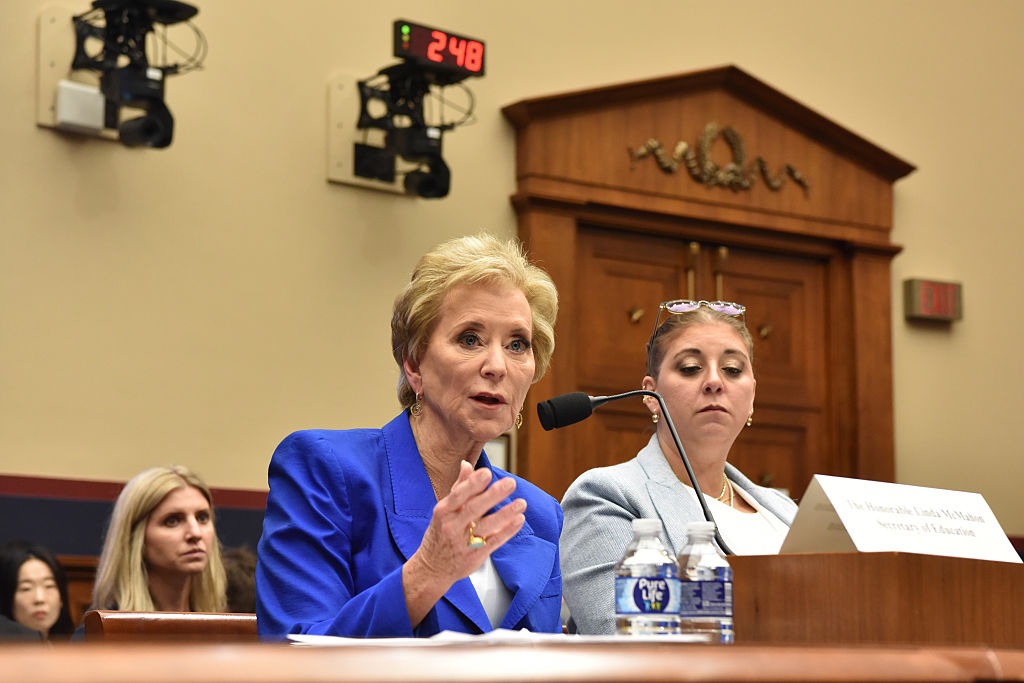
Education Secretary Linda McMahon defended her cuts to programs and staff before a House education committee June 4. (Sha Hanting/China News Service/VCG via Getty Images)
Even if the Supreme Court rules in McMahon’s favor, its opinion won’t affect previous rulings and other lawsuits in progress against the department.
Here’s where some of those key legal battles stand:
COVID relief funds
McMahon stunned states in late March when she said they would no longer receive more than $2 billion in reimbursements for COVID-related expenses. States would have to make a fresh case for how their costs related to the pandemic, even though the department had already approved extensions for construction projects, summer learning and tutoring.
On June 3, a federal judge in Maryland blocked McMahon from pulling the funds.
Despite the judicial order, not all states have been paid.
The Maryland Department of Education still had more than $400 million to spend. Cherie Duvall-Jones, a spokeswoman, said the agency hasn’t received any reimbursements even though it provided the “necessary documentation and information” federal officials requested.
The cancellation forced Baltimore City schools to dip into a reserve account to avoid disrupting tutoring and summer school programs.
Madison Biedermann, a spokeswoman for the department, declined to comment on why it had yet to pay Maryland or how much the department has distributed to other states since June.
Mass firings
In the administration’s push to wind down the department, McMahon admits she still needs staff to complete what she calls her “final mission.” On May 21, she told a House appropriations subcommittee that she had rehired 74 people. Biedermann wouldn’t say whether that figure has grown, and referred a reporter to the hearing video.
“You hope that you’re just cutting fat,” McMahon testified. “Sometimes you cut a little in the muscle.”
The next day, a federal district court ordered her to also reinstate the more than 1,300 employees she fired in March, about half of the department’s workforce. Updating the court on progress, Chief of Staff Rachel Oglesby said in a July 8 filing that she’s still reviewing survey responses from laid off staffers and figuring out where they would work if they return.
Student protestors participate in the “Hands Off Our Schools” rally in front of the U.S. Department of Education on April 4 in Washington, D.C. (Getty Images)
But some call the department’s efforts to bring back employees lackluster, perhaps because it’s pinning its hopes on a victory before the Supreme Court.
“This is a court that’s been fairly aggressive in overturning lower court decisions,” said Smith, with the National Center for Youth Law.
His group’s lawsuit is one of two challenging cuts to the Office for Civil Rights, which lost nearly 250 staffers and seven regional offices. They argue the cuts have left the department unable to thoroughly investigate complaints. Of the 5,164 civil rights complaints since March, OCR has dismissed 3,625, Oglesby reported.
In a case brought by the Victim Rights Law Center, a Massachusetts-based advocacy organization, a federal district court judge ordered McMahon to reinstate OCR employees.
Even if the case is not reversed on appeal, there’s another potential problem: Not all former staffers are eager to return.
“I have applied for other jobs, but I’d prefer to have certainty about my employment with OCR before making a transition,” said Andy Artz, who was a supervising attorney in OCR’s New York City office until the layoffs. “I feel committed to the mission of the agency and I’d like to be part of maintaining it if reinstated.”
DEI
An aspect of that mission, nurtured under the Biden administration, was to discourage discipline policies that result in higher suspension and expulsion rates for minority students. A 2023 memo warned that discrimination in discipline could have “devastating long-term consequences on students and their future opportunities.”
But according to the department’s Feb. 14 guidance, efforts to reduce those gaps or raise achievement among Black and Hispanic students could fall under its definition of “impermissible” DEI practices. Officials demanded that states sign a form certifying compliance with their interpretation of the law. On April 24, three federal courts ruled that for now, the department can’t pull funding from states that didn’t sign. The department also had to temporarily shut down a website designed to gather public complaints about DEI practices.
The cases, which McMahon has asked the courts to dismiss, will continue through the summer. In court records, the administration’s lawyers say the groups’ arguments are weak and that districts like Decatur simply overreacted. In an example cited in a complaint brought by the NAACP, the Waterloo Community School District in Iowa responded to the federal guidance by pulling out of a statewide “read-In” for Black History Month. About 3,500 first graders were expected to participate in the virtual event featuring Black authors and illustrators.
The department said the move reflected a misunderstanding of the guidance. “Withdrawing all its students from the read-In event appears to have been a drastic overreaction by the school district and disconnected from a plain reading of the … documents,” the department said.
Desegregation
The administration’s DEI crackdown has left many schools confused about how to teach seminal issues of American history such as the Civil Rights era.
It was the Civil Rights Act of 1964 that established “desegregation centers” across the country to help districts implement court-ordered integration.
In 2022, the Biden administration awarded $33 million in grants to what are now called equity assistance centers. But Trump’s department views such work as inseparable from DEI. When it cancelled funding to the centers, it described them as “woke” and “divisive.”
Judge Paul Friedman of the U.S. District Court for the District of Columbia, a Clinton appointee, disagreed. He blocked McMahon from pulling roughly $4 million from the Southern Education Foundation, which houses Equity Assistance Center-South and helped finance Brown v. Board of Education over 70 years ago. His order referenced President Dwight Eisenhower and southern judges who took the ruling seriously.
“They could hardly have imagined that some future presidential administration would hinder efforts by organizations like SEF — based on some misguided understanding of ‘diversity, equity, and inclusion’ — to fulfill Brown’s constitutional promise to students across the country to eradicate the practice of racial segregation.”
He said the center is likely to win its argument that canceling the grant was “arbitrary and capricious.”
Raymond Pierce, Southern Education Foundation president and CEO, said when he applied for the grant to run one of the centers, he emphasized its historical significance.
“My family is from Mississippi, so I remember seeing a ‘colored’ entrance sign on the back of the building as we pulled into my mother’s hometown for the holidays,” Pierce said.
Trump’s Justice Department aims to dismiss many of the remaining 130 desegregation orders across the South. Harmeet Dhillon, assistant attorney general for civil rights, has said the orders force districts to spend money on monitoring and data collection and that it’s time to “let people off the hook” for past discrimination.
But Eshé Collins, director of Equity Assistance Center-South, said the centers are vital because their services are free to districts.
“Some of these cases haven’t had any movement,” she said. “Districts are like ‘Well, we can’t afford to do this work.’ That’s why the equity assistance center is so key.”
Eshé Collins, director of Equity Assistance Center-South and a member of the Atlanta City Council, read to students during a visit to a local school. (Courtesy of Eshé Collins)
Her center, for example, works with the Fayette County schools in Tennessee to recruit more Black teachers and ensure minority students get an equal chance to enroll in advanced classes. The system is still under a desegregation order from 1965, but is on track to meet the terms set by the court next year, Collins said. A week after Friedman issued the injunction in the foundation’s case, Ruth Ryder, the department’s deputy assistant secretary for policy and programs, told Collins she could once again access funds and her work resumed.
Research
As they entered the Department of Education in early February, one of the first moves made by staffers of the Department of Government Efficiency was to terminate nearly $900 million in research contracts awarded through the Institute for Education Sciences. Three lawsuits say the cuts seriously hinder efforts to conduct high-quality research on schools and students.
Kevin Gee from the University of California, Davis, was among those hit. He was in the middle of producing a practice guide for the nation on chronic absenteeism, which continues to exceed pre-pandemic levels in all states. In a recent report, the American Enterprise Institute’s Nat Malkus said the pandemic “took this crisis to unprecedented levels” that “warrant urgent and sustained attention.” Last year’s rate stood at nearly 24% nationally — still well above the 15% before the pandemic.
Gee was eager to fully grasp the impact of the pandemic on K-3 students. Even though young children didn’t experience school closures, many missed out on preschool and have shown delays in social and academic skills.
Westat, the contractor for the project, employed 350 staffers to collect data from more than 860 schools and conduct interviews with children about their experiences. But DOGE halted the data collection midstream — after the department had already invested about $44 million of a $100 million contract.
Kevin Gee, an education researcher at the University of California, Davis, had to stop his research work when the Trump administration cancelled grants. (Courtesy of Kevin Gee)
“The data would’ve helped us understand, for the first time, the educational well-being of our nation’s earliest learners on a nationwide scale in the aftermath of the pandemic,” he said.
The department has no plans to resurrect the project, according to a June court filing. But there are other signs it is walking back some of DOGE’s original cuts. For example, it intends to reissue contracts for regional education labs, which work with districts and states on school improvement.
“It feels like the legal pressure has succeeded, in the sense that the Department of Education is starting up some of this stuff again,” said Cara Jackson, a past president of the Association for Education Finance and Policy, which filed one of the lawsuits. “I think … there’s somebody at the department who is going through the legislation and saying, ‘Oh, we actually do need to do this.’ ”
Mental health grants
Amid the legal machinations, even some Republicans are losing patience with McMahon’s moves to freeze spending Congress already appropriated.
In April, she terminated $1 billion in mental health grants approved as part of a 2022 law that followed the mass school shooting in Uvalde, Texas. The department told grantees, without elaboration, that the funding no longer aligns with the administration’s policy of “prioritizing merit, fairness and excellence in education” and undermines “the students these programs are intended to help.”
The secretary told Oregon Democratic Sen. Jeff Merkley in June that she would “rebid” the grants, but some schools don’t want to wait. Silver Consolidated Schools in New Mexico, which lost $6 million when the grant was discontinued, sued her on June 20th. Sixteen Democrat-led states filed a second suit later that month.
The funds, according to Silver Consolidated’s complaint, allowed it to hire seven mental health professionals and contract with two outside counseling organizations. With the extra resources, the district saw bullying reports decline by 30% and suspensions drop by a third, according to the district’s complaint. Almost 500 students used a mental health app funded by the grant.
A judge has yet to rule in either case, but Republican Rep. Brian Fitzpatrick of Pennsylvania and other members of a bipartisan task force are holding McMahon to her word that she’ll open a new competition for the funds.
“These funds were never intended to be a theoretical exercise — they were designed to confront an urgent crisis affecting millions of children,” Fitzpatrick said in a statement. “With youth mental health challenges at an all-time high, any disruption or diversion of resources threatens to reverse hard-won progress and leave communities without critical supports.”
A not-for-profit research centre that provided media training for academics and disseminated education research to the public will close after eight years of operation.
Please login below to view content or subscribe now.
Nearly two-thirds of teachers utilized artificial intelligence this past school year, and weekly users saved almost six hours of work per week, according to a recently released Gallup survey. But 28% of teachers still oppose AI tools in the classroom.
The poll, published by the research firm and the Walton Family Foundation, includes perspectives from 2,232 U.S. public school teachers.
“[The results] reflect a keen understanding on the part of teachers that this is a technology that is here, and it’s here to stay,” said Zach Hrynowski, a Gallup research director. “It’s never going to mean that students are always going to be taught by artificial intelligence and teachers are going to take a backseat. But I do like that they’re testing the waters and seeing how they can start integrating it and augmenting their teaching activities rather than replacing them.”
At least once a month, 37% of educators take advantage of tools to prepare to teach, including creating worksheets, modifying materials to meet student needs, doing administrative work and making assessments, the survey found. Less common uses include grading, providing one-on-one instruction and analyzing student data.
A 2023 study from the RAND Corp. found the most common AI tools used by teachers include virtual learning platforms, like Google Classroom, and adaptive learning systems, like i-Ready or the Khan Academy. Educators also used chatbots, automated grading tools and lesson plan generators.
Most teachers who use AI tools say they help improve the quality of their work, according to the Gallup survey. About 61% said they receive better insights about student learning or achievement data, while 57% said the tools help improve their grading and student feedback.
Nearly 60% of teachers agreed that AI improves the accessibility of learning materials for students with disabilities. For example, some kids use text-to-speech devices or translators.
More teachers in the Gallup survey agreed on AI’s risks for students versus its opportunities. Roughly a third said students using AI tools weekly would increase their grades, motivation, preparation for jobs in the future and engagement in class. But 57% said it would decrease students’ independent thinking, and 52% said it would decrease critical thinking. Nearly half said it would decrease student persistence in solving problems, ability to build meaningful relationships and resilience for overcoming challenges.
In 2023, the U.S. Department of Education published a report recommending the creation of standards to govern the use of AI.
“Educators recognize that AI can automatically produce output that is inappropriate or wrong. They are well-aware of ‘teachable moments’ that a human teacher can address but are undetected or misunderstood by AI models,” the report said. “Everyone in education has a responsibility to harness the good to serve educational priorities while also protecting against the dangers that may arise as a result of AI being integrated in ed tech.”
Hrynowski said teachers are seeking guidance from their schools about how they can use AI. While many are getting used to setting boundaries for their students, they don’t know in what capacity they can use AI tools to improve their jobs.
The survey found that 19% of teachers are employed at schools with an AI policy. During the 2024-25 school year, 68% of those surveyed said they didn’t receive training on how to use AI tools. Roughly half of them taught themselves how to use it.
“There aren’t very many buildings or districts that are giving really clear instructions, and we kind of see that hindering the adoption and use among both students and teachers,” Hrynowski said. “We probably need to start looking at having a more systematic approach to laying down the ground rules and establishing where you can, can’t, should or should not, use AI In the classroom.”
Disclosure: Walton Family Foundation provides financial support to The 74.
It might not be news that the UK research sector is strikingly international, but the scale of our global collaboration is striking – and it’s growing.
Over 60 per cent of Russell Group academics’ publications involved an international co-author in 2023, 16 per cent higher than in 2019, and in 2022 this proportion was higher for UK academics than any of our global competitors. Pooling ideas and talent makes for better research and more innovation, so supporting them to do more matters deeply to researchers – as our universities are well aware, given their own longstanding global connections.
International collaboration matters for the UK at large too, helping us tackle shared challenges and forming a large part of our global contribution. In a more uncertain world, protecting and growing research collaborations is becoming more important – complementing the government’s efforts to deepen links with the EU, protect ties with the US, and build relationships in India.
These initiatives are bound up with both security and growth. This is no accident: a strong economy is the route to creating jobs and supporting public services. We have always argued that international university partnerships should be part of the wider offer to global investors and trade partners, but we need to find new ways to demonstrate their value.
To that end, Jisc has done new analysis for the Russell Group looking at the scale and value of international research partnerships. Jisc’s unique data-matching analysis of UK, US and EU patent data held by the European Patents Office covers over 30 years of international collaboration in patent applications. The data identifies partnerships that UK institutions hold with both international companies and universities.
It’s booming
So what did we learn? Jisc’s analysis shows the proportion of patents co-filed by UK universities and an international partner grew from 12 per cent in 2000 to 22 per cent in 2022. It also found a remarkably high share of collaborations with international businesses, not just fellow academics: 43 per cent of co-filings since 2018 were with an overseas company and 36 per cent with a university abroad.
Since 2018, the data shows UK universities filed over 100 EU, US and UK patents with international partners every year. The analysis also allows us to see individual patents, not just numbers, so we can understand how impactful this work is not just to academic excellence, but to society. For example:
the world’s first gene therapy for adults with severe haemophilia A, from pioneering research between University College London and St. Jude Children’s Research Hospital in the US
a new type of gene therapy from Newcastle University and the University of Heidelberg in Germany, which can help to protect and strengthen muscles in people with muscular dystrophy
improvements to machine-learning models by the University of Edinburgh and University of Manchester with Toyota in Japan – refining the ability to interpret images, a step on the way to driverless cars.
These projects, and many more of their kind, demonstrate the cutting-edge R&D that can underpin the government’s growth mission, industrial strategy and NHS ambitions. Jisc’s analysis therefore suggests that to make the most of universities’ strengths, and secure a global advantage for the UK, support for both home-grown innovation and high-value overseas collaborations will be crucial.
Potential for even more
This includes additional support for the work universities do with and for businesses, in sectors like clean energy and advanced manufacturing. Academics and innovators can do much of this themselves, but government can help by working with us to deliver a stable platform to build on including reliable funding streams, improved incentives for SME-university collaboration and a long-term strategy for industrial renewal.
We also need a strategic focus on higher education’s financial sustainability, so universities can maximise the impact of the £86bn government is committing to R&D over the next few years and support plans for economic growth and public service improvement.
It also means maintaining a supportive, stable and cost-effective visa system for staff and students – further expanding the commitments already made on building global talent pathways – so UK universities can attract and educate our future academics, innovators and collaborators, as well as securing important cross-subsidies for research and teaching. A strategic approach to skills and infrastructure across the UK would complement this, ensuring all nations and regions can benefit.
Finally, building the right platform for international collaboration means backing stable, flexible routes for academics and innovators to work together. UKRI’s work to develop lead agency agreements with counterparts in other countries has been a positive and warmly-welcomed example. Above all, however, our relationship with the world’s largest international collaborative programme for R&D – Horizon Europe, and its successor Framework Programme 10 – will be vital.
We’re currently awaiting the European Commission’s official “first draft” for FP10. We know it will be a standalone programme with a research and innovation focus, which is very reassuring. At the moment, Horizon Europe is providing more collaborative research opportunities than any one country can alone, as well as helping UK universities attract top researchers. Universities are working hard to boost Horizon participation, taking the lead in European Research Council Advanced Grant wins in 2024, and nurturing the encouraging green shoots in the collaborative Pillar II. Keeping this going is vital for global collaborations which contribute so much to our, and our partners’, economic and societal progress.
Researchers need certainty so they can rely on a shared long-term framework when building collaborations. The more open FP10 is to like-minded countries, and the more positive the UK is about association early on, the more confidence academics can be in continuing – and indeed expanding – invaluable international partnerships.
This year marks 100 years since the Leverhulme Trust was established. It’s a moment for us to reflect on the extraordinary research the Trust has supported over that period – but also to look forward.
That’s why the Leverhulme Trust Board has decided to commit an additional £100 million to UK university research over the next few years, on top of our usual £120m annual spend.
Investing in the future
This is not a nostalgic gesture. It is a deliberate investment in a university sector that continues to deliver world-class research, even as it faces immense financial pressure. The UK’s research base is one of the country’s greatest assets. However, it is under strain, despite the welcome increase in funding for research and development in the recent spending review.
Universities are grappling with rising costs and uncertainty around international student income. In this context, the Trust’s centenary investment is a celebration of the sector’s excellence and, we hope, a timely contribution to sustaining that excellence.
We are directing this funding where we believe it can make the greatest difference: into blue skies research and supporting the next generation of researchers. These are areas where funding has become increasingly difficult to secure, and where we can therefore add the most value. We are, however, not changing our usual approach, which is to leave academics, who are at the forefront of their fields, to determine the questions that are most important and pressing.
Blue sky bedrock
Blue skies research – curiosity-driven, often interdisciplinary, and sometimes high-risk – is the core mission of the Trust. This kind of research is also the bedrock on which much social, technological and economic progress rests. It is easy to identify vitally important blue skies research retrospectively. Much harder to prove its value in advance.
Our award to Kostya Novoselov early in his career looks prescient – he went on to win the Nobel for his work on graphene. But predicting which of the novel projects we fund will pay off in the long term is very tricky. While the Trust’s support for Chris Stringer’s work with the Natural History Museum completely changed our understanding of early human life in Britain, it’s hard to put a value on that.
The need to demonstrate likely impact, combined with research funding streams that are more focused on specific economic priorities, has made it harder for some disciplines to pursue discovery research. The value of quality research (QR) funding in England, which was once the major source for discovery research, has also declined by 15 per cent since 2010.
Yet, it is blue skies research that often leads to the most profound breakthroughs. Charity funding that is patient and takes risks can therefore make a real contribution here.
Investment at every stage
To that end, the Trust will use £50m to establish new research centres, each receiving up to £10 million to tackle big questions over a decade. This research centre model has proven to be highly effective, not only in addressing critical issues, but also in building research capacity. Previous Leverhulme Centres have contributed to areas such as climate change, wildfires, the origins of life, ethical AI, and demographic modelling, to name but a few.
We are also investing in the next generation of researchers. We will commit an additional £20m to doctoral training, doubling our usual spend, to support approximately 200 PhD students. This is another area under financial pressure, particularly in some arts and humanities fields.
This investment is not just about producing future academics. We know that not all PhD graduates will stay in academia. Nor should they. One of the strengths of the UK’s research system is its ability to develop talent that contributes across a range of sectors. I recently spoke with a Leverhulme-funded doctoral student whose work explores the ethics of algorithmic decision-making. Their research is deeply theoretical, but its implications are hugely practical. Whether they end up in academia, government, or industry, their skills will be vital in tackling the AI-related challenges ahead.
And funding academics at the beginning of their career is only part of the story. Our centenary awards will support mid-career researchers in building their first research team, a challenging transition given the increasing teaching demands in some institutions. We will also provide funding to support aspiring scholars from underrepresented groups, as well as provide mentoring and networking opportunities. We want to ensure that talented individuals from all backgrounds can access research careers and thrive within them.
Charity funding as part of a research ecosystem
Charities like the Leverhulme Trust have long played a significant role in supporting UK research, contributing about £2 billion per annum in total. But charity funding is not designed to support the basic infrastructure of universities. This means that any grant we award to a university also requires a contribution from the institution itself because, like most charities, we do not cover overhead costs, which is undoubtedly a challenge for universities.
As the Nurse Review highlighted, both domestic student teaching and university research are cross-subsidised from other income streams. Further, while the UK’s research system is one of the most productive and internationally connected in the world, it is also one of the most financially exposed and the model of relying on the cross-subsidy of research with income from international students has come under immense pressure.
We therefore need to find additional ways to sustain the research capacity that underpins so much of the UK’s economic, social, and cultural life. This is not just about protecting and preserving what we have; it is about shaping what comes next. Research is not a luxury. It is a necessity, especially in a world facing complex challenges, from climate change to economic and technological disruptions.
To maintain the UK’s position as a global research leader, we need a funding system that provides long-term stability.
We hope our investment will not only help to sustain the intellectual ambition that defines the UK’s research community but also prompt a wider conversation – one about how we value research, how we fund it, and how we ensure that its benefits are shared as widely as possible.
The government wants to reinvent the NHS (in England) through three radical shifts – hospital to community, analogue to digital, and sickness to prevention.
Whether like the chief executive of the NHS you believe Labour’s 10-year health plan for England is about creating “energy and enthusiasm”, whether like the secretary of state you believe this is about building a NHS which is about “the future and a fairer Britain,” or whether across its 168 pages you find the government’s default to techno-optimism, AI will solve everything, one more dataset will fix public services, approach to governance to be somewhere between naive and unduly optimistic, it is clear that the NHS is expected to change and do so quickly.
This is a plan that is as much about the reorganisation of the economy as it is about health. It is about how health services can get people into work, it is a guide to economic growth through innovation in life sciences, it is a lament for the skills needed and the skills not yet thought about for the future of the NHS.
One of the premises of the plan is that the 2023 Conservative long-term workforce plan was a mistake. The NHS clearly cannot go on as it currently is, and to facilitate this transformation a “very different kind of workforce strategy” is needed:
Until 2023, [the NHS] had never published a long-term workforce plan. The one it did publish did little more than extrapolate from past trends into the future: concluding there was no alternative than continuation of our current care model, supported by an inexorable growth in headcount, mostly working in acute settings.
A new workforce place is being put together, to appear “later this year” and taking a “decidedly different approach”:
Instead of asking ‘how many staff do we need to maintain our current care model over the next 10 years?’, it will ask ‘given our reform plan, what workforce do we need, what should they do, where should they be deployed and what skills should they have?’
The bottom line is that, therefore, “there will be fewer staff in the NHS in 2035 than projected by the 2023 workforce plan” – but these staff will have better conditions, better training, and “more exciting roles”.
So one immediate question for universities in England is what this reduced staffing target means for recruitment onto medical, nursing and allied health degrees. Places have been expanding, and under previous plans were set to expand at growing rates in the coming years, including a doubling of medical school places by 2035. There were questions about how optimistic some of the objectives were – the National Audit Office last year criticised NHS England for not having assessed the feasibility of expanding places, in light of issues like attrition rates and the need to invest in clinical placement infrastructure.
We won’t get a clear answer of what Labour is proposing until the new workforce plan emerges – especially as there is an accompanying aspiration in today’s plan to reduce the NHS’ dependence on international recruitment. But there are some clear directions of travel. Creating more apprenticeships gets a mention – though of course not at level 7 – but the key theme is a tight link between growing medical student numbers and widening participation:
Expansion of medical school places will be targeted at medical schools with a proven track record of widening participation… The admissions process to medical school will be improved with better information, signposting and support for applicants, and more systematic use of contextual admissions.
This is accompanied by endorsement of the Sutton Trust’s recent research into access disparities. And in one of those “holding universities to account” measures that everyone is so keen on, part of reinforcing this link will be done via work with the Department for Education to “publish data on the relevant background of university entrants, starting with medicine.” If you are thinking that we already did that – yes we did. The UK-wide HESA widening participation performance indicator was last published in 2022 – each regulator now has their own version (for example this from the Office for Students) which doesn’t quite do the same thing.
Education and students
Of course, creating more pathways into working in the NHS is one mechanism to grow its workforce. The other is to unblock current pathways that prevent people from getting into and getting on with their chosen careers in health.
For example, there is a (somewhat tepid) commitment on student support: the plan commits to “explore options” on improving the financial support on offer to medical students from the lowest socioeconomic backgrounds.
For nursing students, the offer is slimmer still – a focus on the “financial obstacles to learning”, including faster reimbursement of placement expenses, and tackling the time lag between completing a course and being able to start work. This latter measure will involve working with higher education institutions to revise the current approach to course completion confirmation, and is billed for September 2026. The Royal College of Nursing has suggested that these “modest” changes go nowhere near far enough.
Nursing and midwifery attrition also comes under scrutiny – the government spots that reducing the rate of non-continuation by a percentage point would result in the equivalent of 300 more nurses and midwives joining the NHS each year. But rather than looking deeper at why this is a growing issue, the buck is handed over to education providers to “urgently address attrition rates.”
Elsewhere the interventions into education provision are more substantial. There’s an already ongoing review of medical training for NHS staff, due to report imminently. On top of this, the plan sets out how the next three years will see an “overhaul” of education and training curricula, to “future-proof” the workforce. There’s lots of talk about faster changes to course content as and when needed, to reflect changes in how the NHS will operate. This comes with a warning:
Where existing providers are unable to move at the right pace, we may look to different institutions to ensure that the education market is responsive to employer needs.
Clinical placement tariffs for undergraduate and postgraduate medicine will be reformed – the plan suggests the tariff system currently “provides limited ability to target funding at training where it is most needed to modernise delivery,” and wants to do more in community settings and make better use of simulation. There will also be expansion of clinical educator capacity, though this will be “targeted” (which is often code for limited).
And course lengths could fall – the plan promises to “work with higher education institutions and the professional regulators as they review course length in light of technological developments and a transition to lifelong rather than static training.” While this does not explicitly suggest shorter medical and nursing programmes – and a consequent growth in provision aimed at professionals – the preference is pretty obvious.
On that last point every member of NHS staff will get their own “personalised career coaching and development plan” which will come alongside the development of “advanced practice models” for nurses (and all the other professional roles in the NHS: radiographers, pharmacists, and the like).
Data and (wider) employment
The plan stretches much wider than simply making commitments on training though and, as the plan makes clear, if the answer isn’t always going to be more money there has to be more efficiency.
There’s a fascinating set of commitments linking health and work – one of those things that feel clunky and obvious until you note that “getting the long-term sick back into work” has just been a soundbite with punitive vibes until now.
Of course, everything has a slightly cringeworthy name – so NHS Accelerators will support local NHS services to have an “impact on people’s work status”, something that may grow into specific and measurable outcomes linking to economic inactivity and unemployment and link in other local government partners. And health support in the traditional sense will link with wider holistic support (as set out in the Pathways to Work green paper) for people with disabilities.
There’s also a set of commitments on understanding and supporting the mental health needs of young people – although the focus is on schools and colleges, there is an expectation that universities will play a part in a forthcoming National Youth Strategy (due from the Department of Culture, Media, and Sport “this summer”) which will cover support for “mental health, wellbeing, and the ability to develop positive social connections.”
All these joined up services will need joined up data, so happy news, too, for those looking for wrap-around support in transitions between educational phases – there will be a single unique identifier for young people: the NHS number. And for fans of learner analytics, a similar approach (with a sprinkling of genomics) will “tell [the NHS] the likelihood of a person developing a condition before it occurs, support early detection of disease, and enable personalised prevention and treatment”.
For some time, universities and other trusted partners have benefited from access to deidentified NHS healthcare administrative data via ADRUK – which has been used for everything from developing new medicine to understanding health policy. This will be joined by a new commercially-focused Health Data Research Service (HDRS) backed by the Wellcome Trust. This is not a new announcement, but the slant here is that it will support the private sector – and as such there will be efforts to “make sure the NHS receives a fair deal for providing access”, which could include a mix of access charges and equity stakes in new developments.
Research, research, research
In effect, the government’s proposals set out how improving the conditions, configurations, and coordination of the NHS workforce, and the information provided to them and their partners, can improve healthcare. The next challenge then is targeting the right kinds of information in the right places, and this depends on the quality of research the NHS can access, make use of, and produce.
The health of the nation does not begin and end at the hospital door. As The King’s Fund points out, “we can’t duck the reality that we are an international outlier with stagnating life expectancy and with millions living many years of life in poor health.” The point of this plan is not only about making health services better but about narrowing health inequalities and using life sciences research to grow the economy.
The plan talks about making up for a “lost decade” of life sciences research. In doing so, it cites an IPPR report (the author is now DHSC’s lead strategy advisor) which demonstrates that the global research spend on life sciences in the UK has reduced and that this has had an impact on life sciences GVA. Following this line of thought suggests that if the UK had maintained levels of investment the economy would have got bigger, people’s lives would have been better and because of the link between poverty and ill health, the NHS would be under less pressure.
The issue with this citation is that the figures used are from 2011–16 and some of the remedies, like association to Horizon Europe, are things the UK has done. Though the plan makes clear that “the era of the NHS’ answer always being ‘more money, never reform’ is over,” it is in fact the case that the government has ploughed record levels of public money into R&D without fundamental reform to the research ecosystem. The premise that economic growth can be spurred by research and leads to better health outcomes is correct – but it isn’t necessary to reference research carried out in 2019 to make the case.
This isn’t merely an annoyance – it speaks to a wider challenge within the plan which oscillates widely between the optimism that “all hospitals will be fully AI-enabled” within the next ten years (80 per cent of hospitals were still using pagers in 2023 despite their ban in 2019), and the obviously sensible commitment to establish Health Innovation Zones which will bring health partners within a devolved framework to experiment in service innovation.
The fundamental challenge facing innovation within health is the diffusion of priorities. There are both a lot of things the NHS and life science researchers might focus their time on, and a lot of layers of bureaucracies that inhibit research. The plan attempts to organise research priorities around five “big bets” (read missions but not quite missions). These include the use of health data, the use of AI (again), personalised health, wearables, and the use of robots. One of the mechanisms for aligning resources will be:
a new bidding process for new Global Institutes. Supported by NIHR funding, these institutes will be expected to marshal the assets of a place – industry, universities, the NHS – to drive genuine global leadership on research and translation.
It’s very industrial strategy – the government is setting out big ideas with some incentives, and hoping the public and private sector follows.
There are some more structural changes to research aside from the political rhetoric. Significantly, there is a proposal to change the funding approaches of the Medical Research Council and National Institute for Health and Care Research to pivot funding toward “prevention, detection and treatment of longterm conditions”. The hope is this approach will drive private investment. Again, like the industrial strategy, the rationale is that the state can be an enabling force for growing the economy.
Ten years’ time
The ten year plan, if it is to mean anything, has to be focused on delivering a different kind of health service. The fundamental shift is about moving toward personalised community orientated care. The concern is that the plan is light on delivery, which would tally with reports that a ninth chapter on delivery is missing all together.
The NHS is stuck in a forever cycle of reform, failing to reform, entering crises, and then being bailed out from crises. The mechanisms to break the cycle includes changes to the workforce, new skills provision, using data differently, and reorientating life sciences research toward prevention and economic growth.
The higher education sector, research institutes, and companies working in research are not only central to the new vision of a NHS but with the amount of investment placed on their capacity to bring change they are no less than the midwives of it. The government’s biggest bet is that it can grow the economy, improve people’s lives, and in doing so reduce pressure on public services. Its biggest risk is that it believes it can do this without fundamental reform to higher education or research as well.