On May 19, the U.S. Department of Education released an FAQ document which confirms that Higher Education Emergency Relief Fund (HEERF) monies can be used to support the mental health of faculty, staff, and students. The document addresses commonly asked questions and provides specific examples on how some institutions have already used HEERF funding to improve their mental health programming and support.
While the document notes that institutions generally have “broad flexibility” to use these funds to create and maintain mental health resources, it does offer several ideas for acceptable use of HEERF grants to help your campus get started. These include:
In-person mental health professionals
Telehealth
Wellness activities
Suicide prevention training
Peer support programs
Mental health hotlines
Screening, brief intervention, and referral to treatment
The performance period for the HEERF grants has also been extended and will now continue until June 30, 2023.
CUPA-HR will keep members apprised of any updates related to HEERF grants.
Meditation is an umbrella term for achieving an intense level of focus. Humans have been meditating in various ways for thousands of years, and research suggests there’s good reason why. Meditation can increase concentration, reduce stress, reduce anxiety and depression, improve physical health and help us become more resilient in our personal and professional lives.
If you’d like to dip your toe into meditation, try one of the free resources below. Don’t be afraid to try a few different approaches — some methods might click with you better than others. If meditation intimidates you, try starting with guided imagery meditation or a physical form of meditation like yoga or tai chi.
Mantra Meditation
Create deep focus by continuously chanting or mentally repeating a word or phrase.
Guided Meditation
Create deep focus by using as many of your five senses as possible to anchor yourself in the moment.
Mindfulness Meditation
Create deep focus by increasing your awareness of the moment. This method of meditation usually involves focusing on your breath.
Physical Forms of Meditation
Check out this blog post and on-demand webinar for more practical steps HR pros can take to build resilience into work and life.
It’s Employee Learning Week — a great reminder for employers to showcase their commitment to talent development by highlighting development opportunities available to employees. Whether you’re an HR practitioner in search of professional development ideas for yourself and your HR peers, or you’re looking for ideas to engage and develop other employees at your institution, here are several tools, tips and resources to help you take the next step.
Professional Development Tools for the HR Pro
CUPA-HR Learning Framework — A tool that assists in defining HR practitioners’ knowledge, skills and attributes and then helps create an action plan for growth and set developmental goals. Jump start your development by using the quick start guide, then build your skills further by diving deeper into the framework competencies.
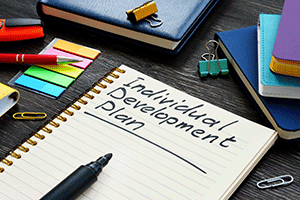
Creating Your Individual Development Plan — A must-have for anyone who wants to map out a strategy for career success in higher ed HR. This free CUPA-HR e-learning course provides an introduction to individual development plans (IDPs) and will guide you through the process of creating your plan, discussing your career with your leaders and implementing your strategy for success. CUPA-HR e-Learning is sponsored by PageUp.
Ideas for the Higher Ed Community
Apart from their own professional development, HR pros often create and help facilitate professional development opportunities for employees at their institutions. Here are some jump-start ideas from the article Optimize Your Hybrid or Remote Work Workforce — Considerations for Higher Ed HR Leaders, featured in the fall issue of Higher Ed HR Magazine.
Encourage managers to use an employee’s development plan to guide regular coaching calls.Gallup suggests ongoing coaching conversations — rather than annual performance reviews — can be of great benefit to both the employee and the employer. These meaningful conversations highlight the organization’s commitment to employee engagement, which can help retain employees for the long-haul. Encourage managers to use employees’ development plans during coaching calls as a guide to the conversation. Setting up the right systems and processes to help employees perform their best from any location is a great operational step, but reorienting managers to think about performance and productivity around outcomes instead is an important strategy.
Get creative with your learning and professional development offerings. William Paterson University’s HR team created a university-wide development program so all 600 non-faculty employees had a chance to participate. Their unique approach to talent development demonstrated institutional support for professional development, provided a platform for employees to engage and collaborate, and inspired additional ways to support employees, such as mentorship programs, goal setting and career advancement. Read more about the program in the special awards issue of Higher Ed HR Magazine to learn how the HR team adapted it to a virtual format — a great alternative for employees working in a hybrid or remote setting!
Last week, I had the opportunity to present at the Open Education Conference. It was virtual and the content was definitely interesting!
My session was held on Monday, October 18 • 3:45pm – 4:25pm and it was titled, “Designing an Interactive OER Syllabus as an Equitable Practice”.
During the session, I talked about my interactive OER syllabus and I had the opportunity to network with some amazing colleagues. One of the amazing faculty members from my institution attended as well – shout out to Dr. Trina Geye!
I am passionate about open educational resources and I like fact that OERs can save students money. This is very important for our Texas college students. Open Educational Resources are equitable resources!
Here are the notes from the presentation:
I know some of you are wondering WHY I incorporate OERs instead of textbooks for my courses…. This is why…
Day-One Access/No-Cost (Equitable)
Easier for the Student
Mobile Access
Linkable to Canvas
Easier for the Professor (Updates/Changes)
I always emphasize partnering with the library to find additional educational resources. Here are some starting points!
Podcast Links
Guides from Prior Semesters (Student Approved Work)
YouTube Videos
Database Article Links
E-Books
Lib Guides
As you transition from semester-to-semester, I always recommend this checklist for “refreshing” your OER syllabus:
Check Your Links
Check for More Relevant Resources
Develop a Pre and Post Semester Checklist
Integrate Your OER Endeavors with Research
In fact, here’s a copy of my OER syllabi:
I also design a syllabus and Canvas tour for my students to help them become more familiar with the content.
Students in my classes (both graduate and undergraduate students) REALLY enjoy the free resources and they are also “more up-to-date” than a traditional textbook.