Tag: Response

  • EEOC asks court to force Penn response in antisemitism probe

    EEOC asks court to force Penn response in antisemitism probe

    This audio is auto-generated. Please let us know if you have feedback.

    Dive Brief:

    • A Pennsylvania federal district court should force the University of Pennsylvania to comply with a subpoena requesting information in an ongoing investigation of alleged discrimination against Jewish employees at the institution, the U.S. Equal Employment Opportunity Commission said in a Tuesday filing.
    • EEOC said it first issued the subpoena in July, to which Penn submitted a petition to revoke the subpoena in its entirety. EEOC denied the petition but served Penn with a partially modified subpoena that it said addressed objections raised by the university. EEOC claimed Penn did not comply with a response deadline of Sept. 23.
    • The agency asked the U.S. District Court for the Eastern District of Pennsylvania to direct Penn to produce all requested information, including data pertaining to discrimination complaints made by employees as well as participants in listening sessions held by a Penn antisemitism task force. In an email, a Penn spokesperson denied EEOC’s claims, stating that the university “responded in good faith to all the subpoena requests” but objected to providing personal and confidential information of Jewish employees without their consent.

    Dive Insight:

    The filing is part of an ongoing EEOC investigation as well as a broader series of inquiries regarding alleged Jewish discrimination and antisemitism at prominent U.S. universities. In a press release, EEOC said Tuesday’s filing stemmed from a 2023 commissioner’s charge filed by Andrea Lucas, its current chair.

    Per court documents, EEOC said the charge alleged a pattern of antisemitic behavior and that Penn subjected Jewish employees to a hostile work environment based on national origin, religion and race.

    “An employer’s obstruction of efforts to identify witnesses and victims undermines the EEOC’s ability to investigate harassment,” Lucas said in EEOC’s press release. “In such cases, we will seek court intervention to secure full cooperation.”

    The Penn spokesperson told HR Dive that Penn “cooperated extensively with the EEOC, providing over 100 documents, totaling nearly 900 pages” but refused to provide lists of, or personal contact information for, Jewish employees, Jewish student employees and persons associated with Jewish organizations.

    The spokesperson also denied EEOC’s claims that the university obstructed access to employees who may have submitted discrimination claims and said that it provided the information of employees who consented to doing so. EEOC rejected Penn’s offer to help the agency reach employees who were willing to speak with EEOC, the spokesperson said.

    “Penn has worked diligently to combat antisemitism and protect Jewish life on campus,” the spokesperson said.

    The agency’s investigation mirrors similar probes of alleged antisemitic discrimination at California State University and Columbia University. Faculty members at Columbia and Columbia-affiliated Barnard College reportedly received text messages from EEOC asking them to complete a survey last April.

    Penn and other institutions drew criticism and scrutiny for their handling of on-campus demonstrations and other related incidents amid the Israel-Hamas war. Former Penn President Elizabeth Magill was among the administrators asked to testify before the U.S. House of Representatives in 2023 — just months after the conflict began — on responding to antisemitism. House Republicans later launched their own probe of Penn’s and other universities’ antisemitism responses, Higher Ed Dive reported.

    Penn convened an antisemitism task force in response to these developments, which published a report in May 2024 containing findings and recommendations for the university and condemning antisemitism.

    Lucas and EEOC have since publicly encouraged workers who have experienced antisemitism on college campuses to submit employment discrimination charges to the agency.

    Source link

  • Volunteer EMTs Provide Medical Response Support on Campus

    Volunteer EMTs Provide Medical Response Support on Campus

    On a normal day on the Florida State University campus, it’s not unusual to see a student drive by in a vehicle equipped with sirens and the name “Medical Response Unit” plastered to the side.

    “I saw everybody driving around in the golf carts and I really wanted to know what was happening,” said neuroscience major Anakha Vargheese.

    The vehicles are part of a student-led emergency medical response unit, connected to the student health center, that trains student volunteers to provide health care and assistance to their peers.

    For the university, the unit provides emergency response support and health education to all students. For volunteers, the experience gives them needed work-based learning and professional development for future careers as medical professionals.

    In action: FSU’s Medical Response Unit includes more than 150 trained student volunteers on staff, including Vargheese, who serves as director of administration for the unit. Volunteers are certified in various roles, including emergency medical technicians and paramedics.

    To be eligible, students must be empathetic and committed to improving campus health and welfare. All volunteers agree to participate for four semesters including training, so students are primarily admitted in their first or second year of college.

    The unit is well-known on campus, and the competition to earn a spot on the crew is fierce. In the most recent application cycle, MRU received 350 applications for 50 positions, said Bryce Couey, a senior biology major who serves as executive director for the MRU.

    At the start of the term, students accepted to the program are assigned to a crew of three or four people, including one trainee who shadows the crew for the semester. Crews serve two-hour-and-fifteen-minute shifts between 7:45 a.m. and 6 p.m. and may be called on to help bandage a sprained ankle, provide transport to the campus health center or address whatever other issues may arise.

    MRU volunteers provide care for campus community members at campus events, including football tailgates and an annual carnival.

    During the academic year, volunteers cover various campus events, including football tailgates, baseball games, student organization events, intramural sports, the homecoming parade and an annual circus event, which is Vargheese’s favorite.

    “One thing coming into the MRU that I really wanted to gain was clinical experience,” Vargheese said. “But another additional thing that I got out of it was the community and the people. So just being able to spend time with your friends and your crew at these really special events, it’s really fun.”

    The unit has an assortment of vehicles to perform emergency responses, including SUVs, electric carts and a mobile first aid trailer, each equipped with emergency lights, sirens and medical equipment.

    The unit also provides educational training sessions and certification for other students, including Stop the Bleed, which provides a national training certificate for bystanders to control a bleeding emergency before professionals arrive.

    In addition, the unit leads two trainings developed in house for FSU students to recognize and respond to emergency situations, said program director Michael Stewart-Meza; one is tailored for students in fraternity and sorority life and another for the general campus population.

    The impact: The unit is one way FSU hopes to destigmatize receiving help among the campus community.

    “Before and after their shifts, [volunteers] are roaming around campus and attending class in their MRU uniforms,” Stewart-Meza said. “It develops a comfortability that other students will have with them. They’re their classmates, they’re their friends and they’re in the sororities and fraternities with them.”

    Both Couey and Vargheese initially joined MRU to gain clinical experience for their premed education, but the experience has also taught them personal and professional skills, as well as helped them create a sense of connection on campus.

    “It has made me a better person,” Couey said. “I was very introverted when I joined the unit, and I feel as if the people in the unit and the unit itself have gotten me out of my shell and allowed me to grow into the best version of myself.”

    “Being out there in the field and treating patients, caring for them in whatever way that we can, it’s really affirming and rewarding,” said Vargheese. “Without MRU here at college, I don’t know what I’d be doing. I really found my place.”

    Source link

  • What might lower response rates mean for Graduate Outcomes data?

    What might lower response rates mean for Graduate Outcomes data?

    The key goal of any administered national survey is for it to be representative.

    That is, the objective is to gather data from a section of the population of interest in a country (a sample), which then enables the production of statistics that accurately reflect the picture among that population. If this is not the case, the statistic from the sample is said to be inaccurate or biased.

    A consistent pattern that has emerged both nationally and internationally in recent decades has been the declining levels of participation in surveys. In the UK, this trend has become particularly evident since the Covid-19 pandemic, leading to concerns regarding the accuracy of statistics reported from a sample.

    A survey

    Much of the focus in the media has been on the falling response rates to the Labour Force Survey and the consequences of this on the ability to publish key economic statistics (hence their temporary suspension). Furthermore, as the recent Office for Statistics Regulation report on the UK statistical system has illustrated, many of our national surveys are experiencing similar issues in relation to response rates.

    Relative to other collections, the Graduate Outcomes survey continues to achieve a high response rate. Among the UK-domiciled population, the response rate was 47 per cent for the 2022-23 cohort (once partial responses are excluded). However, this is six percentage points lower than what we saw in 2018-19.

    We recognise the importance to our users of being able to produce statistics at sub-group level and thus the need for high response rates. For example, the data may be used to support equality of opportunity monitoring, regulatory work and understand course outcomes to inform student choice.

    So, HESA has been exploring ways in which we can improve response rates, such as through strategies to boost online engagement and offering guidance on how the sector can support us in meeting this aim by, for example, outlining best practice in relation to maintaining contact details for graduates.

    We also need, on behalf of everyone who uses Graduate Outcomes data, to think about the potential impact of an ongoing pattern of declining response rates on the accuracy of key survey statistics.

    Setting the context

    To understand why we might see inaccurate estimates in Graduate Outcomes, it’s helpful to take a broader view of survey collection processes.

    It will often be the case that a small proportion of the population will be selected to take part in a survey. For instance, in the Labour Force Survey, the inclusion of residents north of the Caledonian Canal in the sample to be surveyed is based on a telephone directory. This means, of course, that those not in the directory will not form part of the sample. If these individuals have very different labour market outcomes to those that do sit in the directory, their exclusion could mean that estimates from the sample do not accurately reflect the wider population. They would therefore be inaccurate or biased. However, this cause of bias cannot arise in Graduate Outcomes, which is sent to nearly all those who qualify in a particular year.

    Where the Labour Force Survey and Graduate Outcomes are similar is that submitting answers to the questionnaire is optional. So, if the activities in the labour market of those who do choose to take part are distinct from those who do not respond, there is again a risk of the final survey estimates not accurately representing the situation within the wider population.

    Simply increasing response rates will not necessarily reduce the extent of inaccuracy or bias that emerges. For instance, a survey could achieve a response rate of 80 per cent, but if it does not capture any unemployed individuals (even when it is well known that there are unemployed people in the population), the labour market statistics will be less representative than a sample based on a 40 per cent response rate that captures those in and out of work. Indeed, the academic literature also highlights that there is no clear association between response rates and bias.

    It was the potential for bias to arise from non-response that prompted us to commission the Institute for Social and Economic Research back in 2021 to examine whether weighting needed to be applied. Their approach to this was as follows. Firstly, it was recognised that for any given cohort, it is possible that the final sample composition could have been different had the survey been run again (holding all else fixed). The sole cause of this would be a change in the group of graduates who choose not to respond. As Graduate Outcomes invites almost all qualifiers to participate, this variation cannot be due to the sample randomly chosen to be surveyed being different from the outset if the process were to be repeated – as might be the case in other survey collections.

    The consequence of this is that we need to be aware that a repetition of the collection process for any given cohort could lead to different statistics being generated. Prior to weighting, the researchers therefore created intervals – including at provider level – for the key survey estimate (the proportion in highly skilled employment and/or further study) which were highly likely to contain the true (but unknown) value among the wider population. They then evaluated whether weighted estimates sat within these intervals and concluded that if they did, there was zero bias. Indeed, this was what they found in the majority of cases, leading to them stating that there was no evidence of substantial non-response bias in Graduate Outcomes.

    What would be the impact of lower response rates on statistics from Graduate Outcomes?

    We are not the only agency running a survey that has examined this question. Other organisations administering surveys have also explored this matter too. For instance, the Scottish Crime and Justice Survey (SCJS) has historically had a target response rate of 68 per cent (in Graduate Outcomes, our target has been to reach a response rate of 60 per cent for UK-domiciled individuals). In SCJS, this goal was never achieved, leading to a piece of research being conducted to explore what would happen if lower response rates were accepted.

    SCJS relies on face-to-face interviews, with a certain fraction of the non-responding sample being reissued to different interviewers in the latter stages of the collection process to boost response rates. For their analysis, they looked at how estimates would change had they not reissued the survey (which tended to increase response rates by around 8-9 percentage points). They found that choosing not to reissue the survey would not make any material difference to key survey statistics.

    Graduate Outcomes data is collected across four waves from December to November, with each collection period covering approximately 90 days. During this time, individuals have the option to respond either online or by telephone. Using the 2022-23 collection, we generated samples that would lead to response rates of 45 per cent, 40 per cent and 35 per cent among the UK-domiciled population by assuming the survey period was shorter than 90 days. Similar to the methodology for SCJS therefore, we looked at what would have happened to our estimates had we altered the later stages of the collection process.

    From this point, our methodology was similar to that deployed by the Institute for Social and Economic Research. For the full sample we achieved (i.e. based on response rate of 47 per cent), we began by generating intervals at provider level for the proportion in highly skilled employment and/or further study. We then examined whether the statistic observed at a response rate of 45 per cent, 40 per cent and 35 per cent sat within this interval. If it did, our conclusion was there was no material difference in the estimates.

    Among the 271 providers in our dataset, we found that, at a 45 per cent response rate, only one provider had an estimate that fell outside the intervals created based on the full sample. This figure rose to 10 (encompassing 4 per cent of providers) at a 40 per cent response rate and 25 (representing 9 per cent of providers) at a 35 per cent response rate, though there was no particular pattern to the types of providers that emerged (aside from them generally being large establishments).

    What does this mean for Graduate Outcomes users?

    Those who work with Graduate Outcomes data need to understand the potential impact of a continuing trend of lower response rates. While users can be assured that the survey team at HESA are still working hard to achieve high response rates, the key-take away message from our study is that a lower response rate to the Graduate Outcomes survey is unlikely to lead to a material change in the estimates for the proportion in highly skilled employment and/or further study among the bulk of providers.

    The full insight and associated charts can be viewed on the HESA website:
    What impact might lower response rates have had on the latest Graduate Outcomes statistics?

    Read HESA’s latest research releases. If you would like to be kept updated on future publications, please sign-up to our mailing list.

    Source link

  • Educators push for virtual schooling in response to ICE raids

    Educators push for virtual schooling in response to ICE raids

    This audio is auto-generated. Please let us know if you have feedback.

    Educators are pushing for virtual schooling as an option for students and families who are living in fear of the increasing Immigrations and Customs Enforcement presence in and around school communities nationwide. 

    “This is an emergency,” said Chicago Board of Education member Anusha Thotakura during a public board meeting on Oct. 23. “Although the safest place for kids is at school, even if there is something that we can do to prevent one family being separated or one child coming back home to see that their parents are not there, we need to explore those avenues.”

    The Chicago area, including its schools and students, has been hit hard in recent weeks by the federal government’s immigration crackdown. There have been multiple individuals apprehended by ICE on or near school grounds, including near elementary schools. 

    The Trump administration said the increased enforcement is needed to reduce illegal immigration and is important for national security and safety. Changes issued in January to Department of Homeland Security policy no longer protect schools from enforcement raids. Since then, schools have witnessed apprehensions during drop-off and pick-up hours

    In an effort to resist, school communities in Chicago —  including oftentimes their teachers and education leaders — have formed school patrols and walking school buses, are providing families with groceries, and are also taking part in neighborhood watches by blowing whistles to alert community members when enforcement agents are nearby, Chicago education leaders have said. 

    However, travel to and from school is the main concern, said board member Emma Lozano during Thursday’s board meeting. 

    “Safe passage does not exist right now, they are all over the street,” Lozano said, saying that community members were being apprehended as recently as Thursday morning, leaving children frightened that they’d return to an empty house after school. “Our parents are asking for remote learning if possible.” 

    However, such a decision would likely require Illinois Gov. JB Pritzker to declare a state of emergency, board members said.

    Chicago Teacher’s Union President Stacy Davis Gates also pushed the district earlier this week, saying to K-12 Dive that while a virtual academy already exists, it is not yet available to all students. In the meantime, educators are being as flexible and creative as possible to ensure students can still complete their assignments, she said.

    Chicago wouldn’t be the first to float the idea of a virtual academy as a way to ensure both the safety and academic continuation for children of immigrants and immigrant children. In August, the Los Angeles Unified School District emphasized its virtual school option after a 15-year-old LAUSD student with disabilities was detained outside of a district high school at gunpoint. 

    In March, the New York State Education Department also told superintendents across the state that school districts were allowed to offer virtual learning “to individual students who may be unable or averse to attending school, including during times of political uncertainty.” Those students could include English Language Learners, immigrant and migrant students, as well as “others who may be affected and reluctant to attend school in person due to concerns about their personal safety and security,” said the letter.

    The option for remote schooling comes as recent immigration enforcement policies under the Trump administration — including vagueness surrounding who will be arrested and how long they may be detained — is causing chronic anxiety in students. These federal immigration enforcement policies have been linked to absenteeism, classroom disengagement and heightened emotional distress, according to a July report released by psychiatric researchers at University of California, Riverside and New York University. This, the researchers wrote, has led students “to avoid school or withdraw from public life.”

    Source link

  • Beyond the First Response: Prompting with Purpose in University Classrooms – Faculty Focus

    Beyond the First Response: Prompting with Purpose in University Classrooms – Faculty Focus

    Source link

  • Student acceptance of violence in response to speech hits a record high

    Student acceptance of violence in response to speech hits a record high

    The sickening assassination of Charlie Kirk at a campus speech this week has brought attention to worrying trends in political violence and the public’s stated support for it. 

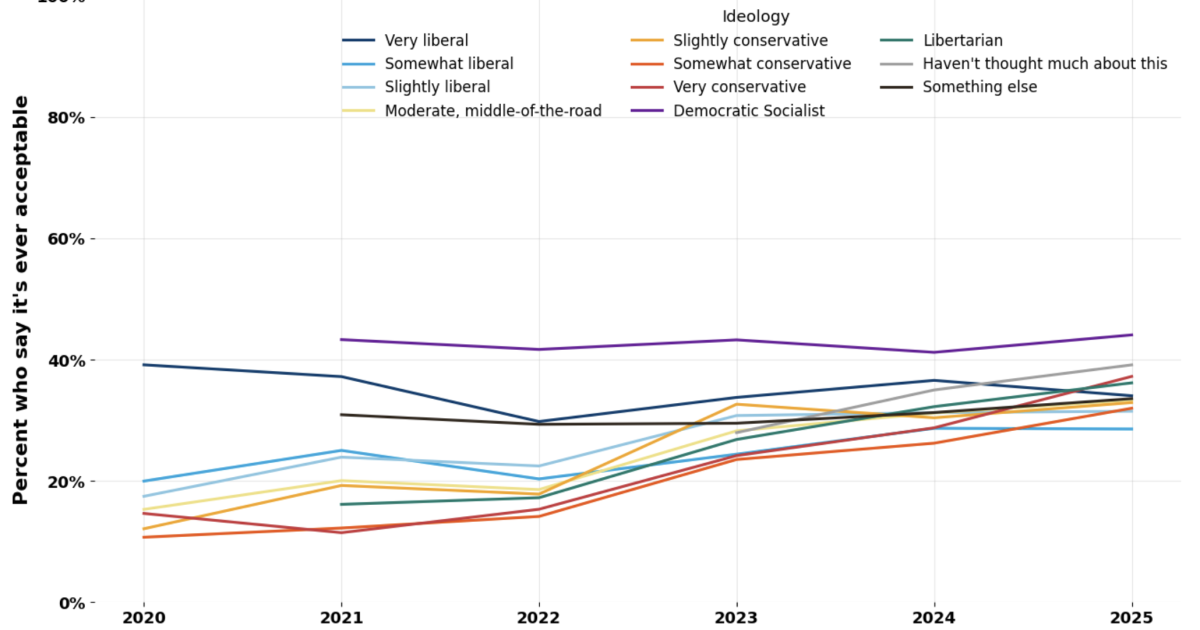
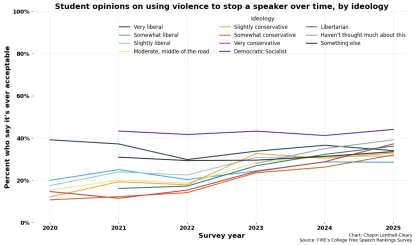
    According to FIRE’s annual College Free Speech Rankings survey, in 2020, the national average showed about 1 in 5 students said it was ever acceptable to use violence to stop a speaker. That number has since risen to a disturbing 1 in 3 students.

    While we have seen no evidence that Kirk’s shooter is a student, there’s no doubt that the 50% increase in this level of support for political violence among college students over the last 5 years has broad implications for the future of the country.

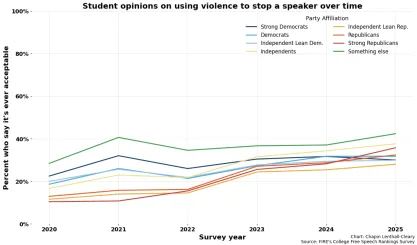
    When we subdivide by party affiliation, we see a more complete story, but the trends are roughly the same.

    Student opinions by party

    Students who identify as “Strong Democrats” are one of the few groups that haven’t markedly increased in support for using violence to stop a speaker, but only because they started at a higher rate of acceptance. Once the second most accepting of violence, they are now the second least accepting, thanks to a rise in acceptance by other groups. In other words, they didn’t get better — everyone else got worse. But consistently the worst group of all remains those who identify as “Something else.” 

    The portions of “Strong Republicans” and “Republicans” who accept the use of violence to stop a speaker have more than tripled in four years. Even acceptance among “Independents” has more than doubled. To give you a sense of how bad things have gotten, the group that currently accepts violence the least, Republican-leaning independents, would have ranked alongside those who accepted it the most back in 2020.

    Now let’s take a closer look at the problem by switching from party affiliation to examining specific ideologies:

    Student opinions by ideology

    Those students who are the furthest to the left have been the most accepting of violence for as long as we’ve asked the question. That includes very liberal and democratic socialist students. But a rising tide of acceptance of violence has raised all boats. Now, regardless of party or ideology, students across the board are more open to violence as a way to shut down a speaker. What was once an extreme and fringe opinion has become normalized.

    Where do we go from here? Violence is antithetical to free speech, and political violence is wholly incompatible with — and toxic to — democracy. As FIRE Executive Vice President Nico Perrino put it, it is a cancer in our body politic. Hopefully, the horrific image of the assassination of a young father, in front of his family, during a campus speech will show students who say they support violence what that actually looks like in practice.

    The great innovation of free speech is that we settle disputes with words and arguments, not violence. Too many have turned away from this principle. For the sake of all Americans, we must return to it.

    Source link

  • Multiple HBCUs Go On Lockdown in Response to Threats

    Multiple HBCUs Go On Lockdown in Response to Threats

    At least seven historically Black colleges and universities across the country went into lockdown on Thursday after institutions received threats, which they did not elaborate on.

    Southern University and A&M College in Louisiana asked those on campus to shelter in place in response to a “potential threat to campus safety.”

    The lockdown applied to the “entire Baton Rouge landmass,” including the Southern University Law Center, the Agricultural Research and Extension Center, and the university’s Laboratory School, according to a statement from the institution.

    The lockdown lifted in the afternoon, but all classes and campus activities were canceled through the weekend.

    Alabama State University also received a “terroristic threat,” university officials told local media outlets, and shut down campus as law enforcement officials checked buildings. The university sent an all-clear notice later in the day, noting that “the immediate threat has been resolved,” but told students to continue to shelter in place.

    Two HBCUs in Virginia were also targeted.

    Virginia State University went into lockdown while local, state and federal law enforcement agencies investigated the credibility of a threat received earlier that day, according to a message from the Virginia State University Office of Communications and University Relations. University officials assured students, “No injuries or incidents have been reported in connection with the threat” and said they would be provided with meals in university housing during the lockdown.

    Hampton University canceled all activities and classes for both Thursday and Friday in response to a potential threat. Students were discouraged from moving across campus unless absolutely necessary, and all nonessential employees were told to “evacuate immediately” in a notice on the university’s website.

    A threat at Bethune-Cookman University in Florida also forced the university to cancel classes and go into lockdown. A notice from the university told students to go to their dorms and faculty and staff members to leave campus.

    Spelman College in Atlanta didn’t receive a threat but issued a shelter-in-place order because of its proximity to Clark-Atlanta University, which did. The order was lifted around 2 p.m.

    Howard University, in Washington, D.C., assured students the institution hadn’t received any threats but would maintain “heightened security.”

    “At Howard, we denounce all acts of hate designed to foster fear in our communities,” an update from the university read. “Howard stands in solidarity with our fellow HBCUs.”

    A predominantly white institution, the University of Central Florida, also reported receiving a threat Thursday. The Orlando Sentinel, which obtained a copy via an anonymous tipster, reported that the expletive-laden message threatened Black students and referenced the killing of Iryna Zarutska, a Ukrainian refugee stabbed on a train in North Carolina.

    A message from the UCF Police Department Thursday afternoon said, “Similar messages have been reported at other universities around the country.” The police department added it was working with the Federal Bureau of Investigation to assess the threat but does not consider it “to be credible.”

    In what appears to be an unrelated incident, the U.S. Naval Academy in Annapolis, Md., went on lockdown Thursday evening after suspicious activity was reported on campus, The Baltimore Banner reported. One person was injured as Naval Security Forces cleared a building.

    Florida A&M University, an HBCU, did not receive any threats but put out a statement of solidarity with institutions on lockdown.

    Rep. Troy A. Carter, a Democrat from Louisiana, posted on X that he was “outraged and deeply disturbed” by the threats to HBCUs.

    “These reprehensible acts are not only an attack on institutions of higher learning—they are an attack on our history, our culture, and the promise of opportunity that HBCUs represent for generations of students,” Carter wrote. In a statement, he called on the federal government “to utilize every available resource to identify, apprehend, and prosecute those responsible.”

    The Congressional Black Caucus also put out a statement calling for action from the U.S. Department of Justice and FBI. Caucus members described the threats as a “chilling reminder of the relentless racism and extremism that continues to target and terrorize Black communities in this country.”

    The rash of violent threats is reminiscent of a wave of bomb threats that targeted HBCUs in 2022 and prompted the FBI to get involved. The HBCU campus lockdowns also come on the heels of a series of false calls to colleges and universities about active shooters last month; an online extremist group claimed responsibility for the hoaxes.


    Source link

  • Violence must never be a response to speech

    Violence must never be a response to speech

    We are horrified by yesterday’s assassination of Charlie Kirk on the campus of Utah Valley University. We are horrified first and foremost because two children lost their father and a wife lost her husband. And we are further horrified because all of us at FIRE have dedicated ourselves to the defense of free speech and open debate on college campuses.

    At their best, America’s colleges and universities provide a unique venue to discover truth, talk across lines of difference, and develop a deeper and fuller understanding of the world. Over the years, students and student groups have invited Kirk to speak at hundreds, if not thousands, of campuses. At these events, he would share his opinions and invite others to do the same. America must be an open society where this sort of debate can take place, where we feel safe to share our ideas in the public square, not just from behind bulletproof glass and bulletproof vests.


    WATCH VIDEO: FIRE Executive Vice President Nico Perrino on CNN to discuss free speech on college campuses in the aftermath of the Charlie Kirk shooting at Utah Valley University.

    Sigmund Freud once said civilization started the day man first cast a word instead of a stone. He was right. Words are not violence. Words are what we use instead of violence to resolve our differences. We must not lose sight of this civilization-defining distinction.

    Unfortunately, since 2021, we’ve seen a steady rise in support for violence in response to speech on campus. Earlier this week, we released our finding that one in three students express some support for the use of violence to stop a campus speech. That’s up from 20 percent only three years ago. While we do not know the identity of the gunman, what happened yesterday is indicative of a broader cancer in our body politic that we must address.

    Rewarding threats of violence by taxing speech or silencing speakers will only invite more threats and more violence.

    But it must not be addressed with censorship. 

    For more than 25 years, FIRE has challenged colleges that use speculative and amorphous security rationales to justify censoring controversial speakers. Through public records requests and other means, we’ve often found these rationales serve as a pretext to shut down debate and capitulate to demands for censorship. Indeed, according to our Deplatforming Database, Kirk was the subject of at least 14 attempts to stop him from speaking on campuses since 2021. Over the years, FIRE has repeatedly written to colleges that sought to silence Kirk’s organization and supporters.

    Moving forward, we can expect colleges and universities to place even greater emphasis on security ahead of controversial speakers arriving on campus. But administrators must not pass security costs along to speakers or use security concerns as pretext to cancel a speaker’s appearance. They have a moral and legal obligation to redouble their efforts to protect free speech. Rewarding threats of violence by taxing speech or silencing speakers will only invite more threats and more violence.

    Yesterday, an assassin’s veto silenced Charlie Kirk, just as it silenced the journalists and cartoonists at Charlie Hebdo a decade ago, and just as it attempted to silence Salman Rushdie in 2022. But we cannot let the censors win. We cannot let violence prevail. We can and must come together in defense of our rights to be who we are and to speak our minds.

    Source link

  • GAZA, GENOCIDE, AND THE GLOBAL MEDICAL RESPONSE (Saint Cecilia Parish, Boston)

    GAZA, GENOCIDE, AND THE GLOBAL MEDICAL RESPONSE (Saint Cecilia Parish, Boston)

    WEDNESDAY, JULY 30 | 6:30PM | PARISH HALL (Boston)

    Join us for a special presentation by Dr. Kuemmerle, a neurologist at Children’s Hospital and the co-founder of Doctors Against Genocide. Founded in 2023, Doctors Against Genocide is a coalition of healthcare professionals who seek to unite their voices in uproar against the genocide in Gaza. This presentation will be livestreamed on our Youtube channel

    Doctors Against Genocide is currently raising $737,000 to fund the construction of a 140-bed field hospital with 4 operating rooms on the grounds of Al-Shifa hosptial. Gaza’s largest hospital has been bombed, burned, and pushed past its limits. After the forced shutdown of the Indonesian, Al-Awda, and Kamal Adwan hospitals, Al-Shifa is the last major hospital left standing in North Gaza. 

    Right now, occupancy is at 200–300%. Patients are being treated on floors, in hallways, and tents. There are no more beds. No more space. But there is a way forward with your help. If you would like donate, please visit: https://doctorsagainstgenocide.org/donate.

    Source link

  • Universities “At Risk of Overassessing” in Response to AI

    Universities “At Risk of Overassessing” in Response to AI

    The number of assessments set by universities is steadily rising, but there are worries this could result in student burnout and prove counteractive if implemented without centering learning.

    recent report by the U.K.-based Higher Education Policy Institute (Hepi) and Advance HE found that assessments at U.K. institutions have risen to 5.8 summative assignments and 4.1 formative assignments per semester in 2025, compared to five summative assessments and 2.5 formative assessments in 2020.

    Josh Freeman, policy manager at Hepi and co-author of the report, said the advent of AI is “reducing the accuracy of assessments as a measure of students’ performance,” prompting universities to re-evaluate their examination methods.

    “It’s possible that course organizers are assessing students more to improve the confidence they have in their assessments,” he said.

    “It’s also possible that, as they redo assessment models, which may have remained the same for a long time, they are switching to alternative models of assessment—for example, those that assess students on an ongoing basis, rather than simply once at the end of the year.”

    However, rising numbers of exams risks universities “overassessing” students, he added, as “students now face an intense battle over their time,” noting that the number of hours that students spend studying has fallen.

    “[Many are making] sacrifices around social activities, sports and societies. These ‘extra’ activities are the first to go when students are squeezed and would probably be cut further if the academic elements of university become more demanding.”

    Some 68 percent of students in the U.K. are now undertaking part-time work during term time, a record high, largely in response to cost-of-living pressures.

    Michael Draper, a professor in legal education at Swansea University and chair of the university’s academic regulations and student cases board, said that some universities have begun supplementing assessments with “some form of in-person assessment” to counteract AI “credibility concerns.” But “that of course does lead to perhaps overassessment or more assessments than were in place before.”

    “Students have got so many competing claims on their time, not just in relation to work, but care responsibilities and work responsibilities, that you run the risk of student burnout,” he continued.

    “That is not a position you actually want to be in. You want to make sure that students have got a fair opportunity to work consistently and get the best grade possible. You want students to have a chance to reflect upon their feedback and then to demonstrate that in other assessments, but if they’re being continuously assessed, it’s very difficult to have that reflection time.”

    However, Thomas Lancaster, principal teaching fellow in the Department of Computing at Imperial College London, speculated that a rise in the number of exams could be a sign that assessments are being “split into smaller stages,” with more continuous feedback throughout the process, which could also simultaneously have benefits for counteracting AI use.

    “This is something I’ve long recommended in response to contract cheating, where it’s good practice to see the process, not just the final product. So I do hope that the revised assessment schedules are being put in place to benefit the students, rather than purely as a response to AI.”

    While breaking assessments down could prove beneficial to student learning, Drew Whitworth, reader at the Manchester Institute of Education, questioned, “How does one count what constitutes ‘separate’ assessments?”

    “If a grade is given partway through this process … this is actually quite helpful for students, answering the question ‘How am I doing?’ and giving them a pragmatic reason to show [their work and that they are working] in the first place.

    “But does this count as a separate assessment or just part of a dialogue taking place that helps students develop better work in response to a single assessment?”

    Source link