Tag: Restrict

  • DHS Moves to Restrict How Long Foreign Students Can Stay

    DHS Moves to Restrict How Long Foreign Students Can Stay

    Photo illustration by Justin Morrison/Inside Higher Ed | aapsky/iStock/Getty Images | Chip Somodevilla/Getty Images

    After months of speculation, the Department of Homeland Security publicly released its plans to limit how long international students can stay in the United States—a proposal that advocates say will only add to uncertainty and chaos that this group is already facing.

    Currently, students can stay in the country as long as they are enrolled at a college or university. But the proposed rule released Wednesday would allow students to stay for the duration of their program, but no longer than four years. That isn’t enough time for students to complete a doctoral program, and it’s less time than the average student takes to complete a bachelor’s degree. Students who want to stay longer would have to seek authorization to extend their visa.

    The first Trump administration tried to make this change, which would roll back at 1991 rule known as duration of status. However, the Biden administration withdrew the proposal. Officials said in a news release that setting a fixed time for students on visas to stay would curb what they call abuses and allow the government to better oversee these individuals. Additionally, officials alleged that the current policy incentivizes international students to “become ‘forever’ students,” who are “perpetually enrolled in higher education courses to remain in the U.S.”

    DHS will take public comments on the proposal until Sept. 29. Before the agency can finalize the rule, it will have to review and respond to those comments.

    Advocates for international students have been sounding the alarm about this plan since DHS first sought approval in June to make the proposal, and those warnings continued this week now that the plan is public. Changing the rule, they say, would be another hurdle for international students who want to come to the United States. These others include vetting students’ social media profiles and more scrutiny on current visa holders. Since President Trump took office, the State Department has revoked 6,000 student visas.

    More than one million students from other countries enrolled in at a U.S. college or university in 2024, making up about 6 percent of the total student population. Experts predict the number of international students to drop off significantly this academic year.

    Fanta Aw, executive director of NAFSA, the association of international educators, said in a statement that the DHS proposal is a “bad idea” and “a dangerous overreach by government into academia.”

    “These changes will only serve to force aspiring students and scholars into a sea of administrative delays at best, and at worst, into unlawful presence status—leaving them vulnerable to punitive actions through no fault of their own,” Aw added.

    Miriam Feldblum, president and CEO of the Presidents’ Alliance on Higher Education and Immigration, described the proposal in a statement as “another unnecessary and counterproductive action aimed against international students and scholars.”

    “This proposed rule sends a message to talented individuals from around the world that their contributions are not valued in the United States,” she said. “This is not only detrimental to international students—it also weakens the ability of U.S. colleges and universities to attract top talent, diminishing our global competitiveness. International students, scholars, and exchange visitors contribute economically, intellectually, and culturally to American society. They drive innovation, create jobs, and advance groundbreaking research.”
    Source link

  • Efforts to Restrict or Protect Libraries Both Grew This Year – The 74

    Efforts to Restrict or Protect Libraries Both Grew This Year – The 74


    Get stories like this delivered straight to your inbox. Sign up for The 74 Newsletter

    State lawmakers across the country filed more bills to restrict or protect libraries and readers in the first half of this year than last year, a new report found.

    The split fell largely along geographic lines, according to the report from EveryLibrary, a group that advocates against book bans and censorship.

    Between January and July 2025, lawmakers introduced 133 bills that the organization deemed harmful to libraries, librarians or readers’ rights in 33 states — an increase from 121 bills in all of 2024. Fourteen of those measures had passed as of mid-July.

    At the same time, legislators introduced 76 bills in 32 states to protect library services or affirm the right to read, the report found.

    The geographic split among these policies is stark.

    In Southern and Plains states, new laws increasingly criminalize certain actions of librarians, restrict access to materials about gender and race, and transfer decision-making power to politically appointed boards or parent-led councils.

    Texas alone passed a trio of sweeping laws stripping educators of certain legal protections when providing potentially obscene materials; banning public funding for instructional materials containing obscene content; and giving parents more authority over student reading choices and new library additions.

    Tennessee lowered the bar to prosecute educators for sharing books that might be considered “harmful to minors.”

    A New Hampshire bill likewise would’ve made it easier for parents or the state attorney general to bring civil actions against school employees for distributing material deemed harmful to minors, but it was vetoed by Republican Gov. Kelly Ayotte.

    In Nebraska, a new law allows for real-time alerts for parents every time a student checks out a book. South Dakota requires libraries and schools to install filtering software. New laws in Idaho heighten the requirements to form library districts and mandate stricter internet filtering policies that are tied to state funding.

    In contrast, several Northeastern states have passed legislation protections for libraries and librarians and anti-censorship laws.

    New Jersey, Delaware, Rhode Island and Connecticut have each enacted “freedom to read” or other laws that codify protections against ideological censorship in libraries.

    Connecticut also took a major step in modernizing libraries in the digital age, the report said, becoming the first state in the nation to pass a law regulating how libraries license and manage e-books and digital audiobooks.

    Stateline reporter Robbie Sequeira can be reached at [email protected].

    Stateline is part of States Newsroom, a nonprofit news network supported by grants and a coalition of donors as a 501c(3) public charity. Stateline maintains editorial independence. Contact Editor Scott S. Greenberger for questions: [email protected].


    Get stories like these delivered straight to your inbox. Sign up for The 74 Newsletter

    Source link

  • Facing NIH cuts, colleges restrict grad student admissions

    Facing NIH cuts, colleges restrict grad student admissions

    Several colleges and universities are pausing admissions to some graduate programs, reducing class sizes or rescinding offers to students in an effort to cut costs amid uncertainty in federal funding.

    The disruption to graduate school admissions is the latest cost-cutting move for colleges. After the National Institutes of Health proposed cutting reimbursements for costs related to research, several colleges and universities said they would pause hiring and cut spending, Inside Higher Ed previously reported. (A federal judge has blocked the NIH plan from taking effect for now.)

    In recent days, the University of Pittsburgh, the University of Pennsylvania and several other institutions have stopped doctoral admissions, at least temporarily. Some colleges are pausing admissions to some programs such as in the biomedical sciences, Stat News reported. At others, the pause is universitywide. The University of Southern California and Vanderbilt University temporarily paused graduate student admissions, though both universities later said that they’d ended the pause.

    A University of Pittsburgh spokesperson told WESA, a local NPR station, that the university “temporarily paused additional Ph.D. offers of admission until the impacts of that [NIH] cap were better understood … the University is in the process of completing that analysis and expects to be in a position to resume offers soon.”

    Meanwhile, the University of Pennsylvania is planning to cut graduate admissions rates, The Daily Pennsylvanian reported, citing an email from the interim dean of the School of Arts and Sciences, Jeffrey Kallberg, who wrote that the cuts were a “necessary cost-saving measure” to adjust to the NIH proposal.

    “This is not a step any of us wanted to take,” Kallberg wrote, according to the Daily Penn. “We recognize that graduate students are central to the intellectual life of our school—as researchers, teachers, collaborators, and future scholars. However, we must ensure that we can continue to provide strong support for those students currently in our programs and sustain the school’s core teaching and research activities.”

    Tom Kimbis, executive director of the National Postdoctoral Association, wrote in an email to Inside Higher Ed that academic institutions reliant on federal funding “are being forced to make tough decisions to support these researchers in a difficult environment.”

    “The decisions in Washington to pause or cease funding for science and research is impacting early-career researchers across a wide range of disciplines,” Kimbis added. “Slowing or stopping their work, on topics from cancer and Alzheimer’s research to social science issues, hurts Americans in all 50 states.”

    In the last week, some faculty began tracking the reductions in the biomedical sciences via a shared spreadsheet that includes verified cuts and unverified decisions based on word of mouth and internal emails. Faculty on social media said the cuts will have long-term ramifications for sciences as fewer students enter the field. On TikTok, several students who had applied to grad school shared their dismay at how the funding cuts meant they might have to say goodbye to their career plans and research.

    Accepting graduate students, particularly for Ph.D. programs and in the biomedical sciences, requires universities to make a long-term financial commitment, which is more difficult now that the NIH has stopped making new grant awards and is aiming to cut funds. Colleges receive billions from the NIH to support research. If the proposed rate cuts move forward, institutions say they would have to shut down some labs and lay off employees.

    “University research and scholarship operate on a time scale of years and decades,” the Rutgers AAUP-AFT chapter wrote in a letter to New Jersey senators Cory Booker and Andy Kim. “Higher education would become impossible in the face of capricious and arbitrary withholding of funding, elimination of entire areas of grant support for critical scientific research, and cancellation of long-held contracts.”

    They went on to warn that the threat to funding would diminish the country’s strength as a research superpower. “The best scientists, the best scholars, and the best students will make the rational decision to take their talents elsewhere. Once lost, the historic excellence of United States universities, including world-leading institutions in New Jersey, both public and private, will not be easily regained.”


    Source link

  • Oklahoma Bills Would Restrict Student Cellphone Use, Social Media, Sex Ed – The 74

    Oklahoma Bills Would Restrict Student Cellphone Use, Social Media, Sex Ed – The 74


    Get stories like this delivered straight to your inbox. Sign up for The 74 Newsletter

    OKLAHOMA CITY — Oklahoma lawmakers filed hundreds of bills affecting education for the next legislative session.

    Oklahoma Voice collected some of the top trends and topics that emerged in legislation related to students, teachers and schools. The state Legislature will begin considering bills once its 2025 session begins Feb. 3.

    Bills would restrict minors’ use of cellphones and social media

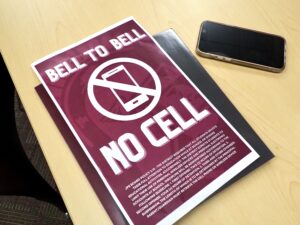
    A poster reads, “bell to bell, no cell” at the Jenks Public Schools Math and Science Center on Nov. 13. The school district prohibits student cellphone use during class periods. (Nuria Martinez-Keel/Oklahoam Voice)

    As expected, lawmakers filed multiple bills to limit student cellphone use in public schools, an issue that leaders in both chambers of the Legislature have said is a top priority this year.

    The House and Senate each have a bill that would prohibit students from using cellphones during the entire school day. Some Oklahoma schools already made this a requirement while others allow cellphone access in between classes.

    After encouraging all districts to establish cellphone restrictions, Gov. Kevin Stitt visited multiple schools in November that have done so.

    Senate Bill 139 from Education Committee vice chair Sen. Ally Seifried, R-Claremore, would require all districts to ban students from accessing their cellphones from the morning bell until dismissal, and it would create a $2 million grant program to help schools enact phone-free policies.

    Legislation from a House leader on education funding, Rep. Chad Caldwell, R-Enid, would prohibit student cellphone use while on school premises.

    Multiple bills target children’s social media use. Sen. Kristen Thompson, R-Edmond, aims to ban social media accounts for anyone under 16 with SB 838 and, with SB 839, to deem social media addictive and dangerous for youth mental health. 

    A bill from Seifried would outlaw social media companies from collecting data from and personalizing content for a minor’s account, which a child wouldn’t be allowed to have without parent consent

    SB 371 from Sen. Micheal Bergstron, R-Adair, would require districts to prohibit the use of social media on school computers or on school-issued devices while on campus. SB 932 from Sen. Darcy Jech, R-Kingfisher, would allow minors or their parents to sue a social media company over an “adverse mental health outcome arising, in whole or in part, from the minor’s excessive use of the social media platform’s algorithmically curated service.”

    School chaplain bill reemerges

    Multiple lawmakers have refiled a bill seeking to enable religious chaplains to counsel students in public schools. A version of the controversial bill passed the House last year but failed in the Senate.

    Its original author, Rep. Kevin West, R-Moore, refiled it as House Bill 1232. Sen. Shane Jett, R-Shawnee, and Sen. Dana Prieto, R-Tulsa, filed similar school chaplain bills with SB 486 and SB 590.

    More restrictions suggested for sex education, gender expression

    Another unsuccessful bill returning this year is legislation that would have families opt into sex education for their children instead of opting out, which is the state’s current policy.

    Students wouldn’t be allowed to take any sex education course or hear a related presentation without written permission from their parents under SB 759 from Prieto, HB 1964 from Danny Williams, R-Seminole, and HB 1998 from Rep. Tim Turner, R-Kinta.

    Sen. Dusty Deevers, R-Elgin, would have any reference to sex education and mental health removed from health education in schools with SB 702.

    Prieto’s bill also would exclude any instruction about sexual orientation or gender identity from sex education courses. It would require school employees to notify a child’s parents before referring to the student by a different name or pronouns.

    Other bills similarly would limit students’ ability to be called by a different name or set of pronouns at school if it doesn’t correspond to their biological sex.

    Deevers’ Free to Speak Act would bar teachers from calling students by pronouns other than what aligns with their biological sex or by any name other than their legal name without parent consent. Educators and fellow students could not be punished for calling a child by their legal name and biological pronouns.

    Rep. Gabe Woolley, R-Broken Arrow, filed a similar bill.

    No public school could compel an employee or volunteer to refer to a student by a name or pronoun other than what corresponds with their sex at birth under SB 847 from Sen. David Bullard, R-Durant, nor could any printed or multimedia materials in a school refer to a student by another gender.

    Corporal punishment in schools

    Once again, Oklahoma lawmakers will consider whether to outlaw corporal punishment of students with disabilities. State law currently prohibits using physical pain as discipline on children with only the most significant cognitive disabilities.

    In 2020, the state Department of Education used its administrative rules to ban corporal punishment on any student with a disability, but similar bills have failed to pass the state Legislature, drawing frustration from child advocates.

    Sen. Dave Rader, R-Tulsa, was an author of last year’s bill to prohibit corporal punishment of students with any type of disability. He filed the bill again for consideration this session.

    HB 2244 from Rep. John Waldron, D-Tulsa, would require schools to report to the Oklahoma State Department of Education the number of times they administer corporal punishment along with the age, race, gender and disability status of the students receiving it. The state Department of Education would then have to compile the information in a report to the Oklahoma Commission on Children and Youth.

    Oklahoma Voice is part of States Newsroom, a nonprofit news network supported by grants and a coalition of donors as a 501c(3) public charity. Oklahoma Voice maintains editorial independence. Contact Editor Janelle Stecklein for questions: [email protected].


    Get stories like these delivered straight to your inbox. Sign up for The 74 Newsletter

    Source link

  • Trump Issues Executive Order to Restrict Gender Ideology in the Federal Government

    Trump Issues Executive Order to Restrict Gender Ideology in the Federal Government

    by CUPA-HR | January 22, 2025

    On January 20, the Trump administration issued an executive order (EO) titled, “Defending Women from Gender Ideology Extremism and Restoring Biological Truth to the Federal Government.” The EO was one of several executive orders and actions published by the Trump administration on its first day in office.

    The EO states that the United States government will recognize only two sexes — male and female — and defines sex as “an individual’s immutable biological classification as either male or female.” The definition continues to say that sex is “not a synonym for and does not include the concept of ‘gender identity.’” The executive order also defines “woman” and “girl” and “man” and “boy” to be adult and juvenile human females and males, respectively.

    The EO orders the secretary of health and human services to provide guidance expanding on the definitions established in the EO. It also directs all federal agencies to use the definitions set forth in the order “when interpreting or applying statutes, regulations, or guidance and in all other official agency business, documents, and communications.” All federal agencies will also be directed to use the term “sex” and not “gender” when administering or enforcing sex-based distinctions in applicable federal policies and documents.

    It also appears that the Trump administration hopes to codify these definitions into law through Congressional action. Specifically, the EO directs the assistant to the president for legislative affairs to provide the president proposed bill text to codify the definitions set in the order within 30 days.

    The EO also discusses the Supreme Court’s decision in Bostock v. Clayton County, which held that Title VII of the Civil Rights Act of 1964 protects employees from discrimination on the basis of sexual orientation or gender identity. The EO states that the Biden administration argued that the Bostock decision “requires gender identity-based access to single-sex spaces under, for example, Title IX of the Educational Amendments Act,” which the Trump administration states is “legally untenable.” As such, the EO directs the U.S. attorney general to issue guidance to federal agencies to “correct the misapplication” of Bostock to “sex-based distinctions in agency activities.” The EO also directs the attorney general to issue guidance and assist federal agencies in protecting sex-based distinctions.

    The EO directs all federal agencies to submit an update to the Trump administration on implementation of this order within 120 days. The update is required to include information on changes to agency documents and agency-imposed requirements on federally funded entities, including federal contractors, that were implemented to comply with the order. The head of each federal agency is also directed to rescind all guidance documents inconsistent with the requirements of the order, and the EO includes a partial list of documents that the administration deems as inconsistent, including several Department of Education guidance documents on Title IX and the Equal Employment Opportunity Commission’s 2024 Enforcement Guidance on Harassment in the Workplace.

    Finally, the EO directs agencies to take “all necessary steps, as permitted by law, to end the federal funding of gender ideology” and to “assess grant conditions and grantee preferences” to “ensure grant funds do not promote gender ideology.”

    Federal agencies will soon begin to take action and announce guidance to comply with the EO requirements. Institutions should therefore be aware of forthcoming guidance from the Department of Education on Title IX as a result of this EO. There could also be future ramifications for institutions that receive federal funds, including grants and contracts. CUPA-HR will continue to monitor for agency actions as well as any additional updates from the Trump administration as it relates to sex and gender-related policy.


    Source link