Tag: Results

  • Tutoring was supposed to save American kids after the pandemic. The results? ‘Sobering’

    Tutoring was supposed to save American kids after the pandemic. The results? ‘Sobering’

    Rigorous research rarely shows that any teaching approach produces large and consistent benefits for students. But tutoring seemed to be a rare exception. Before the pandemic, almost 100 studies pointed to impressive math or reading gains for students who were paired with a tutor at least three times a week and used a proven curriculum or set of lesson plans. 

    Some students gained an extra year’s worth of learning — far greater than the benefit of smaller classes, summer school or a fantastic teacher. These were rigorous randomized controlled trials, akin to the way that drugs or vaccines are tested, comparing test scores of tutored students against those who weren’t. The expense, sometimes surpassing $4,000 a year per student, seemed worth it for what researchers called high-dosage tutoring.

    On the strength of that evidence, the Biden administration urged schools to invest their pandemic recovery funds in intensive tutoring to help students catch up academically. Forty-six percent of public schools heeded that call, according to a 2024 federal survey, though it’s unclear exactly how much of the $190 billion in pandemic recovery funds have been spent on high-dosage tutoring and how many students received it. 

    Related: Our free weekly newsletter alerts you to what research says about schools and classrooms.

    Even with ample money, schools immediately reported problems in ramping up high-quality tutoring for so many students. In 2024, researchers documented either tiny or no academic benefits from large-scale tutoring efforts in Nashville, Tennessee, and Washington, D.C.

    New evidence from the 2023-24 school year reinforces those results. Researchers are rigorously studying large-scale tutoring efforts around the nation and testing whether effective tutoring can be done more cheaply. A dozen researchers studied more than 20,000 students in Miami; Chicago; Atlanta; Winston-Salem and Greensboro, North Carolina; Greenville, South Carolina; schools throughout New Mexico, and a California charter school network. This was also a randomized controlled study in which 9,000 students were randomly assigned to get tutoring and compared with 11,000 students who didn’t get that extra help.

    Their preliminary results were “sobering,” according to a June report by the University of Chicago Education Lab and MDRC, a research organization.

    The researchers found that tutoring during the 2023-24 school year produced only one or two months’ worth of extra learning in reading or math — a tiny fraction of what the pre-pandemic research had produced. Each minute of tutoring that students received appeared to be as effective as in the pre-pandemic research, but students weren’t getting enough minutes of tutoring altogether. “Overall we still see that the dosage students are getting falls far short of what would be needed to fully realize the promise of high-dosage tutoring,” the report said.

    Monica Bhatt, a researcher at the University of Chicago Education Lab and one of the report’s authors, said schools struggled to set up large tutoring programs. “The problem is the logistics of getting it delivered,” said Bhatt. Effective high-dosage tutoring involves big changes to bell schedules and classroom space, along with the challenge of hiring and training tutors. Educators need to make it a priority for it to happen, Bhatt said.

    Related: Students aren’t benefiting much from tutoring, one new study shows

    Some of the earlier, pre-pandemic tutoring studies involved large numbers of students, too, but those tutoring programs were carefully designed and implemented, often with researchers involved. In most cases, they were ideal setups. There was much greater variability in the quality of post-pandemic programs.

    “For those of us that run experiments, one of the deep sources of frustration is that what you end up with is not what you tested and wanted to see,” said Philip Oreopoulos, an economist at the University of Toronto, whose 2020 review of tutoring evidence influenced policymakers. Oreopoulos was also an author of the June report.

    “After you spend lots of people’s money and lots of time and effort, things don’t always go the way you hope. There’s a lot of fires to put out at the beginning or throughout because teachers or tutors aren’t doing what you want, or the hiring isn’t going well,” Oreopoulos said.

    Another reason for the lackluster results could be that schools offered a lot of extra help to everyone after the pandemic, even to students who didn’t receive tutoring. In the pre-pandemic research, students in the “business as usual” control group often received no extra help at all, making the difference between tutoring and no tutoring far more stark. After the pandemic, students — tutored and non-tutored alike — had extra math and reading periods, sometimes called “labs” for review and practice work. More than three-quarters of the 20,000 students in this June analysis had access to computer-assisted instruction in math or reading, possibly muting the effects of tutoring.

    Related: Tutoring may not significantly improve attendance

    The report did find that cheaper tutoring programs appeared to be just as effective (or ineffective) as the more expensive ones, an indication that the cheaper models are worth further testing. The cheaper models averaged $1,200 per student and had tutors working with eight students at a time, similar to small group instruction, often combining online practice work with human attention. The more expensive models averaged $2,000 per student and had tutors working with three to four students at once. By contrast, many of the pre-pandemic tutoring programs involved smaller 1-to-1 or 2-to-1 student-to-tutor ratios.

    Despite the disappointing results, researchers said that educators shouldn’t give up. “High-dosage tutoring is still a district or state’s best bet to improve student learning, given that the learning impact per minute of tutoring is largely robust,” the report concludes. The task now is to figure out how to improve implementation and increase the hours that students are receiving. “Our recommendation for the field is to focus on increasing dosage — and, thereby learning gains,” Bhatt said.

    That doesn’t mean that schools need to invest more in tutoring and saturate schools with effective tutors. That’s not realistic with the end of federal pandemic recovery funds.  

    Instead of tutoring for the masses, Bhatt said researchers are turning their attention to targeting a limited amount of tutoring to the right students. “We are focused on understanding which tutoring models work for which kinds of students.” 

    Contact staff writer Jill Barshay at 212-678-3595, jillbarshay.35 on Signal, or [email protected].

    This story about tutoring effectiveness was written by Jill Barshay and produced by The Hechinger Report, a nonprofit, independent news organization focused on inequality and innovation in education. Sign up for Proof Points and other Hechinger newsletters.

    The Hechinger Report provides in-depth, fact-based, unbiased reporting on education that is free to all readers. But that doesn’t mean it’s free to produce. Our work keeps educators and the public informed about pressing issues at schools and on campuses throughout the country. We tell the whole story, even when the details are inconvenient. Help us keep doing that.

    Join us today.

    Source link

  • Behind the scenes at UCAS on level 3 results day

    Behind the scenes at UCAS on level 3 results day

    In Cheltenham they call it “UCAS Christmas” and it’s not hard to see why. Months of preparation, a whole lot of expectation riding on a single day, highs and lows of emotion, and more snacks than you can shake a stick at.

    Level 3 results day at UCAS HQ has the kind of jittery manic energy that comes when a lot of people have been anticipating this day for months, and half of them have been up since 2.00am the night before. By the time I arrive, the marquee moment – the national release of admissions decisions into 700k-plus inboxes at 8.00am – has passed without a hitch and the main business of Clearing, fielding queries from anxious applicants (and their parents), is under way.

    Nerve centre

    At the heart of the building sits Joint Operations Centre, or JOC for short, a room humming with the quiet buzz of people making sure the right things are happening. Courteney Sheppard, UCAS head of operations, explains that today, most UCAS people who have decision-making power on results day convene in this one space so that if anything happens that needs speedy resolution the right person is on hand. Those with deep subject expertise are housed temporarily in the office next door, ready to jump in to address issues as they arise.

    All along one wall there are massive screens – at least twenty and probably more like thirty, all monitoring different data in real time. One screen simply shows the current time (because in the critical two minutes before 8.00am release there are actions that are coordinated to the second); others track web traffic, database capacity, maximum wait times for calls, social media traffic, applicant behaviours, and much more besides. Opposite the screens is a flipchart where there are already a ream of jotted notes about ways to improve for next year.

    It’s easy to underestimate the logistical and technological challenge facing UCAS on results day but consider how rare it is for any system to have to cope with close to simultaneous login of every possible user. All over the country at 8.00am on the dot applicants’ UCAS results portal goes live and they can login to see whether they have secured their preferred course and higher education institution. Simultaneously they receive an email from UCAS with the same information. And, I’m told, UCAS creates a static web page for each and every applicant with the same information so that if there is any delay at all in getting into the portal, even of only a few seconds, the applicant can be redirected to the information they are looking for.

    “The 8 o’clock moment is always hairy,” says Lynsey Hopkins, UCAS director of admissions. “The preparation is incredible, and takes months, because there are so many moving parts. The tech is really complex and is getting more so all the time. You always worry that if any applicant wasn’t able to see their outcomes that could ramp up their anxiety on one of the highest stakes and most stressful experiences of their young lives.”

    But getting information on admissions decisions out to applicants is only the beginning. The vast majority – in fact the highest number on record this year – will have a place confirmed at their first choice of institution. Most of those will segue seamlessly into celebrating and looking forward to taking up their place. But a substantial number will pass through Clearing – and not only because they have been unlucky enough not to receive an offer from their preferred institution. Some applicants’ plans will have changed since they made their application through UCAS and will wish to decline their place in favour of a different option; others don’t even start applying until the Clearing period. Where UCAS holds data on applicants’ previous choices and qualifications the system will suggest possible matches for applicants to help them begin to sift their options.

    “The largest group of people in Clearing are those who have actively put themselves there,” says Ben Jordan, UCAS head of strategy. “Clearing doesn’t have negative connotations among young people at all – it’s just a brand.”This year 92 per cent of all higher education providers are offering courses through Clearing, and there are more than 30,000 courses available, offering an enormous degree of choice to applicants.

    Holding hands

    In theory, applicants contact institutions directly, and once they have secured an offer, are able to update their applications via their UCAS portal and have the application confirmed by the institution, without active intervention from UCAS. In practice, many applicants still need help and support from the central admissions service.

    Over in the “west wing” there’s the traditional call centre staffed by a mixture of UCAS’ customer service team, volunteers from across the business, and temporary staff, all sporting UCAS t-shirts, headsets and query cards they can wave to summon a senior staff member to help them answer the more complicated questions. On a normal day, UCAS has 50-60 people working on customer services; today it’s around 200.

    It’s not uncommon for calls to simply consist of an applicant saying, “My UCAS portal says I got in. Did I get in?” To which the correct answer is, “Yes, you got in, hurray!” Job done to everyone’s satisfaction. But it’s much more likely that applicants have more complicated questions – predictably many lose their login information, don’t fully understand the process, and generally need a bit of hand-holding at a stressful time.

    “We don’t just handle questions, we handle emotions,” says Jordan Court, customer call handler. “There can be so much riding on this day for applicants, they can get so anxious, it’s understandable they can sometimes lose the ability to deal with administrative stuff.” Every call handler, especially those volunteering receive detailed training, with a strong focus on emotional intelligence. “We tell people, ‘Imagine how you would want your child or your sibling to be treated’” says Courteney. “Nine of ten times what people want from the call is reassurance or validation, especially if they’re not able to get support from a school or college.”

    While the calls come in steadily, in this day and age much of the queries are via social media or the UCAS chatbot, Cassy, which is able to resolve the more transactional questions, reducing the overall call load by around 30 per cent. Some issues require intervention: Jordan is able to resolve one query by noticing from a screenshot that an applicant is trying to access his UCAS portal via a web browser that has been designed for gamers – advising the applicant to try again with a more mainstream browser.

    Without fail, everyone I speak to talks in glowing terms about their experience of being “on the phones” for Clearing. It’s clearly a formative experience for many UCAS staff, giving them a strong sense of purpose and of the importance of the work they do to connect applicants to higher education, as well as occasionally throwing up useful insight about how to improve the applicant experience.

    Lines to take

    Elsewhere in the building Jo Saxton, UCAS chief executive, is fielding media appearances and questions alongside minister for skills Jacqui Smith, who has the day before recorded a special message of congratulations to applicants from UCAS’ very own professional recording studio.

    UCAS director of data and analysis Maggie Smart talks me through the extraordinary process of data analysis that underpins the talking points everyone is reading in the morning papers. As a voluntary signatory to the UK Statistics Authority’s code of practice for statistics, Maggie is responsible for making sure that anything UCAS says about what the data indicates should be verifiable with actual data published on its website.

    Results day for the UCAS data team starts at 11.00pm the night before, capturing live operational data at 12.01am, wrestling it into a format that is publishable as public data, creating different datasets to inform governments in each of the UK Nations, and analysing the key insights that will inform the press release and briefing to the senior team until 5.00am. The press release covering the agreed talking points is signed off and released at 7.00am.

    Following results day the team will track and publish daily Clearing data, updating the public dashboards by 11.00am each day. One innovation for this year will be publication of weekly data on use of the “decline my place” function, seeking to understand more about which applicants are more likely to take up that option.

    In recent years the media around results day has presented something of a mixed picture, with celebratory stories of achievement and advice on securing a university place mixed with more critical queries of the value of higher education. For UCAS, engagement with stakeholders in government and in media is partly about giving confidence in the robustness of the system and partly about landing messages about the continued importance of higher education opportunity, in line with the emphasis on breaking down barriers to participation in UCAS’ recently published strategy.

    In its next strategic period, UCAS will focus on the 250k-odd individuals who register for UCAS but never get to the point of making an application. Understanding the experiences, hopes and aspirations of that cohort will help to inform not just UCAS, but the whole HE sector on how to meet the needs of those of that cohort that could potentially benefit from higher education.

    Given the complexity of the policy landscape for HE it’s invigorating to spend a day with people who share a core belief in the power of higher education to change lives, of which Ben Jordan is possibly one of the most heartfelt. As the policy narrative on access to university takes on a more regional and skills-led flavour, Ben argues that the enormous diversity of the higher education offer needs to be better understood so that students can truly appreciate the breadth of the options they have.

    “I’ve seen purpose-built factories, I’ve seen racing car courses on university campuses,” he says. “These days the majority of applicants aren’t those with just A levels, it’s a much more mixed picture, and it’s so important that they understand not only what is opened up or closed off by the choices they make but how much higher education has to offer them. It’s our job to get that message out.”

    This article is published in association with UCAS.

    Source link

  • The Numbers Don’t Lie: HSI Funding Delivers Results

    The Numbers Don’t Lie: HSI Funding Delivers Results

     Dr. William Casey Boland A lawsuit challenging Hispanic-Serving Institution (HSI) federal funding represents another figurative bomb lobbed in the current war on U.S. higher education. Galvanized by the President’s blitzkrieg on social funding and education, this assault on the alleged reverse racism of HSI funding reflects the ugly political tenor of the times in the U.S. It also conveniently ignores the evidence of the positive impact of such governmental support. 

    l’ll acknowledge my bias: I teach at a large urban college that recently received an HSI grant. Nearly all my students are students of color, with roughly half being Hispanic. Many are the first in their families to enroll in college. Most of their parents were not born in the U.S.  We are amongst the 20% of all colleges in the U.S. that are eligible to apply for an HSI grant, which are made available through the Higher Education Act of 1965 (Title III and Title V). 

    Why did we apply for this grant? State funding per student to public HSIs is $6,396.59 compared to $15,526.13 for non-HSIs. The ongoing disparities in postsecondary educational attainment based on race and ethnicity reveal more about a deficit in public policy to address the equitable distribution of resources and less about the ability of students of color to obtain a college degree. Despite modest gains over time, gaps in attainment continue. 28% of the Hispanic population in the U.S. received an associate degree or higher compared to 48% of the white population. The average graduation rate in four-year postsecondary institutions was 52% for Hispanic students compared to 65% for white students. HSI grants are made available in part to narrow this gap in college outcomes amongst Hispanic students.

    What is my college doing with its HSI grant? To advance retention, persistence, and specific course completion, the grant will improve the First Year Seminar, provide professional develop with a focus on culturally responsive pedagogy, integrate tutoring, peer mentoring, academic and career coaching, and target intervention in gateway courses.

    Many HSI-eligible colleges look like mine, but not all. They are two and four-year public and private non-profit institutions that are under-resourced, become eligible to apply when their undergraduate enrollment reaches 25% Hispanic and at minimum 50% receive some form of financial aid. The rising number of colleges eligible for HSI grants reflects the growth of the Hispanic population in the U.S. Between 2010 and 2022, the Hispanic population accounted for 34 percent of the overall increase in the U.S. population. Hispanic participation in colleges and universities rose from 14 percent in 2010 to 20 percent in 2022.

    Several characteristics are common across institutions designated as HSIs. First, Hispanics tend to enroll in HSI-designated colleges more than non-HSIs. This is largely due to Hispanic students wanting to enroll in a college close to their community. Second, Hispanic students attending HSIs are often the first in their family to seek a college degree. Third, Hispanic students enrolled in HSIs on average graduated from high schools with large classroom sizes, disproportionate levels of racially minoritized student populations, and lower standardized test scores. Many argue that HSIs offer such students an opportunity to participate in postsecondary education that they would not otherwise have.

    Evidence-based research demonstrates the ROI on the federal government’s investment in HSIs. When colleges receive HSI grants, there is a positive effect on Hispanic students. I found that grant receipt increases Hispanic bachelor’s degree completion by nearly 30 percent and associate degrees by almost 25 percent. In another study, we found a 10% increase in Hispanic students obtaining STEM associate’s degrees. We also found benefits for non-Hispanic students, with an 11% increase in the number of those students receiving STEM associate’s degrees. This echoes another study focusing on the initial year HSI STEM grants were awarded with the authors finding HSI STEM grant receipt directly led to an 8% increase in Hispanic students receiving such degrees in community colleges. 

    I doubt the architects of this recent lawsuit challenging HSI funding have ever spoken to someone who graduated from an HSI. I teach a graduate course on minority serving institutions (MSIs). Nearly all my students are students of color from the New York City metropolitan area. Most attended different MSIs as undergraduates. While experiences vary, most extol the virtues of having attended an MSI. They speak to the level of support they received, the power of being surrounded my others who shared their background, the willingness of HSIs and other MSIs to welcome students’ families and community to campus, amongst many other characteristics that made them glad they chose an HSI or MSI over a PWI.

    It is important to evaluate the effectiveness of postsecondary programs funded through tax-payer dollars. Yet recent political antagonism directed towards higher education looks more like red meat being tossed to appease the red base as opposed to thoughtful, evidence-based decision-making. Acknowledging the effectiveness of HSI funding and similar efforts would weaken the core animating principle of the current Republican mission to decimate political support for such programs and reduce the existence of government more broadly.

    Dr. William Casey Boland is an assistant professor in the Marxe School of Public and International Affairs at Baruch College-City University of New York.

    Source link

  • Reflections on the demand for higher education – and what UCAS data reveal ahead of Results Day 2025

    Reflections on the demand for higher education – and what UCAS data reveal ahead of Results Day 2025


    This HEPI blog was kindly authored by Maggie Smart, UCAS Director of Data and Analysis

    As we pass the 30 June deadline for this year’s undergraduate admissions cycle, UCAS’ data offers an early view of applicant and provider behaviour as we head into Confirmation and Clearing. It also marks a personal milestone for me, as it’s my first deadline release since rejoining UCAS. I wanted to take a deeper look at the data to reflect on how much things have changed since I worked here 10 years ago.

    Applicant demand has always been shaped by two key elements: the size of the potential applicant pool, and their propensity to apply. Since I last worked at UCAS in 2016, these two factors have continuously interchanged over the better part of the past decade – sometimes increasing or decreasing independently but often counterbalancing each other. Let’s take a look at how things are shaping up this year.

    Overall, by the 30 June there have been 665,070 applicants (all ages, all domiciles) this year, compared to 656,760 (+1.3%) in 2024. This is an increase in applicants of over 64,000 since UCAS last reported in January, although the profile of these additional applicants is very different. At the January Equal Consideration Deadline (ECD), over half of the total number of applicants were UK 18-year olds, who are the most likely group to have applied by that stage in the cycle. They represent just 8% of the additional applicants since January, among a much larger proportion of UK mature and international students.

    As we saw at January, the differences in demand for places between young people from the most advantaged (POLAR4 Quintile 5) and most disadvantaged (POLAR4 Quintile 1) areas at June remain broadly the same as last year – with the most advantaged 2.15 times more likely to apply to HE than those from the least advantaged backgrounds, compared to 2.17 last year.

    UK 18-year-old demand

    Demand for UK higher education (HE) has long been shaped by the 18-year-old population – the largest pool of applicants. Despite the well-known challenges facing the HE sector at present, at the 30 June deadline we see record numbers of UK 18-year-old applicants, with 328,390 applicants this year – up from 321,410 (+2%) in 2024. This trend was almost entirely locked in by the January deadline, given the vast majority of UK 18-year-old applicants have applied at this stage in the cycle.

    During my previous tenure at UCAS, the size of the UK 18-year-old population had been falling year on year but from 2020, it began to increase. This continued growth drives the increase in UK 18-year-old applicant numbers we have observed in recent cycles. But when we look at their overall application rate to understand the strength of demand among this group, the data shows a marginal decline again this year – down to 41.2% from 41.9% in 2024. The historically strong growth in the propensity of UK 18-year-olds to apply for HE, which we’ve observed across the last decade, has clearly plateaued.

    This could be due to a range of factors, such as young people choosing to take up work or an apprenticeship, or financial barriers. We know that cost of living is increasingly influencing young people’s decisions this year, with pre-applicants telling us that financial support – such as scholarships or bursaries – ranks as the second most important consideration for them (46%), followed closely by universities’ specific cost-of-living support (34%).

    Interesting to note is the number of UK 19-year-old applicants. When separating the data to distinguish 19-year-olds applying for the first time (as opposed to those reapplying), there has been a decent increase – from 46,680 last year to 48,890 this year (+4.7%). For many years, the number of first-time UK 19-year-old applicants had been falling year on year, but since 2023 this trend has started to reverse. This suggests that demand among young people may be holding up as they decide to take a year out before applying to university or college.

    Mature students

    For UK mature students (aged 21+), the picture looks very different. The number of mature students applying to university or college ebbs and flows depending on the strength of the job market, so since I was last at UCAS, we have typically seen applications decrease when employment opportunities are strong and vice versa. Alongside fluctuations linked to the employment market, rising participation at age 18 means there is a smaller pool of potential older applicants who have not already entered HE. The falling demand from mature students continues in 2025, although in recent years there have been small but significant increases in the volume of mature applicants applying after the 30 June deadline and directly into Clearing. 

    As of this year’s 30 June deadline there have been 86,310 UK mature (21+) applicants, compared to 89,690 (-3.8%) in 2024, meaning a fall in demand compared to the previous year at this point in the cycle for the fourth year in a row. However, whereas at the January deadline mature applicants were down 6.4% compared to the same point last year, at June the figure is only 3.8% down showing some recovery in the numbers. This is another indication that mature students are applying later in the cycle. While it remains too early to say whether we will see continued growth in mature direct to Clearing applicants in 2025, last year 9,390 UK mature students who applied direct to Clearing were accepted at university or college, an increase of 7.4% on 2023 and 22.7% higher than 2022.

    International students

    When looking at the UCAS data through the lens of international students, the landscape has changed significantly since 2016. Brexit led to a sharp decline in EU applicants, offset by strong growth elsewhere, the pandemic caused disruption to international student mobility, and we’ve seen intensified global competition, shifting market dynamics and geopolitics which are increasingly influencing where they choose to study. This year we’re seeing growth once more, with 138,460 international applicants compared to 135,460 in 2024 (+2.2%) – although this stood at +2.7% at January. It should be noted that UCAS does only see a partial view of undergraduate international admissions (we tend to get a more complete picture by the end of the cycle) and we don’t capture data on postgraduate taught and research pathways.

    Interest among Chinese students in UK education has held firm since my time at UCAS, and this year we’re seeing a record number of applicants from China – 33,870, up from 30,860 (+10%) in 2024. This year’s data also shows increases in applicants from Ireland (6,060 applicants, +15%), Nigeria (3,170 applicants, +23%) and the USA (7,930 applicants, +14%). 

    Offer-making

    We are releasing a separate report on offer-making this year, alongside the usual data dashboard for applications. This additional data covers offers and offer rates over the past three years, from the perspective of applicants according to their age and where they live, and from the perspective of providers by UK nation and tariff group.

    What we’re seeing as the natural consequence of increased applications this year is an uplift in offers. Universities have made more offers than ever before this year, with 2.0 million main scheme offers to January deadline applicants overall, largely driven by the rise in UK 18-year-olds applicants (who are the most likely to use their full five choices while applying). This record high surpasses the previous peak of 1.9 million offers set last year (+3.8%).

    While the main scheme offer rate has increased across all provider tariff groups, the most notable uplift is for higher tariff providers – up 3.2 percentage points to 64.4% this year.  Despite the increase in offer rates, higher tariffs do still remain the lowest, partly due to being the most selective institutions. Offer rates by medium and lower tariff providers have also increased, by 0.9 percentage points to 77.0% among medium tariff providers, and by 1.5 percentage points to 81.7% among lower tariff providers. This means that, among those who applied by the Equal Consideration Deadline in January, 72.5% of main scheme applications received an offer this year, also a record high, and 1.8 percentage points higher than in 2024.

    It’s worth noting that we’ll be updating our provider tariff groupings in time for the 2026 cycle, to reflect changes in the higher education landscape.

    Looking ahead

    For students who are intent on going to university or college, it makes this a very good year, with more opportunities than ever before. A record 94.5% of students who applied by the January deadline will be approaching the critical summer period having received at least one offer. High levels of offer-making by universities and colleges typically translates into more acceptances, which should give applicants plenty of confidence heading into results day. 

    I’m delighted to be back at UCAS, and my team will continue to dig further into the data as Confirmation and Clearing draws nearer to see how demand translates into accepted places come results day.

    UCAS

    UCAS, the Universities and Colleges Admissions Service, is an independent charity, and the UK’s shared admissions service for higher education.

    UCAS’ services support young people making post-18 choices, as well as mature learners, by providing information, advice, and guidance to inspire and facilitate educational progression to university, college, or an apprenticeship.

    UCAS manages almost three million applications, from around 700,000 people each year, for full-time undergraduate courses at over 380 universities and colleges across the UK.

    UCAS is committed to delivering a first-class service to all our beneficiaries — they’re at the heart of everything we do.

    Source link

  • 10 Smart Enrollment Marketing Tactics That Drive Results

    10 Smart Enrollment Marketing Tactics That Drive Results

    Reading Time: 12 minutes

    Today’s prospective students aren’t waiting for a glossy brochure to arrive in the mail. They’re researching schools on their phones between classes, watching campus tours on YouTube, and chatting with peers online to compare experiences. They’re digital-first and impatient, and expect the same seamless experience from a college as they would from Netflix or Amazon.

    To stand out in this noisy, fast-moving environment, your enrollment marketing needs to work smarter. That means shifting away from static promotions and embracing data-driven, student-centric strategies that guide each prospect from curiosity to commitment.

    Here’s how you can make that happen: 10 tactics that schools across North America (and beyond) are using to win the attention, trust, and enrollment of today’s students.

    Struggling with enrollment?

    Our expert digital marketing services can help you attract and enroll more students!

    1. Understand Your Audience (Better Than They Expect)

    The best enrollment marketing strategies begin with deep audience insight. Not the surface-level kind (like age ranges or postal codes), but real, behavior-based understanding.

    Instead of just collecting names at events or counting clicks on a landing page, take the time to analyze what your audience is doing. Are they spending five minutes reading your nursing program page but bouncing quickly from your homepage? Is there a spike in traffic after you post student testimonials on Instagram? These are the clues that shape smart decisions.

    Tools like Google Analytics, HubSpot, or Slate reveal exactly where prospects engage and where they drop off. Segmenting audiences based on their actions, rather than assumptions, lets you personalize outreach that feels meaningful. If a student explores your hospitality program at 11:00 p.m. from another time zone, your strategy should reflect that interest and context.

    Personalization builds a connection. And connection drives conversion.

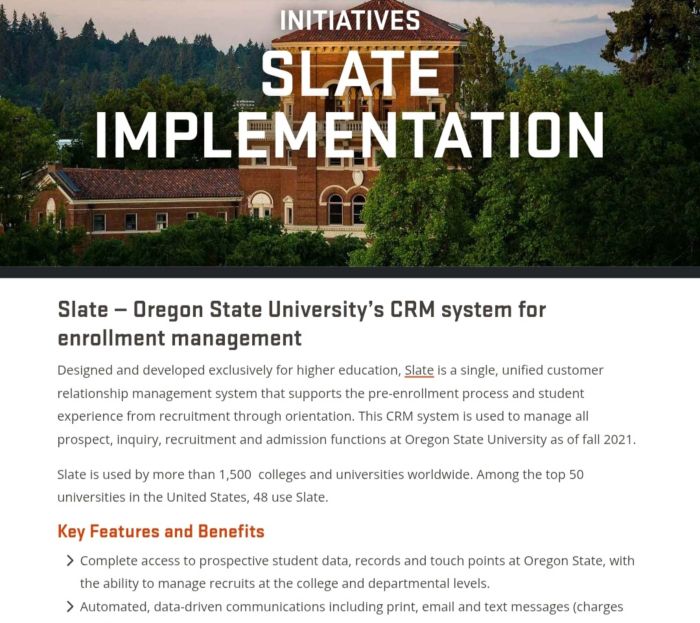
    Example: Oregon State University implemented a modern CRM (Slate) to segment and personalize outreach. OSU filters prospective students by interests, major, and location to trigger automated, tailored communications (email, text, print) for each segment. With this approach, Oregon State University ensures that prospects receive information relevant to them. For example, engineering-minded students get content on OSU’s tech programs, improving engagement and application conversion.

    HEM Blog Post Image 2HEM Blog Post Image 2

    Source: Oregon State University

    2. Turn Your Website Into a Top-Performing Recruiter

    Think of your website as your lead admissions counselor. It works 24/7 and never forgets a prospect’s name, if it’s built right.

    A compelling site doesn’t just list programs. It creates an experience. Navigation should be intuitive, especially on mobile, where the majority of users browse. Application deadlines should never be more than one click away. Program benefits should be clear, outcomes measurable, and support services obvious.

    Equally important is online visibility. Students won’t land on your site if it isn’t optimized for search. That means including the phrases they’re typing into Google: “Best business diploma in Vancouver” or “Top graphic design college Canada.” A steady stream of blog content around these themes builds your authority and search rankings over time.

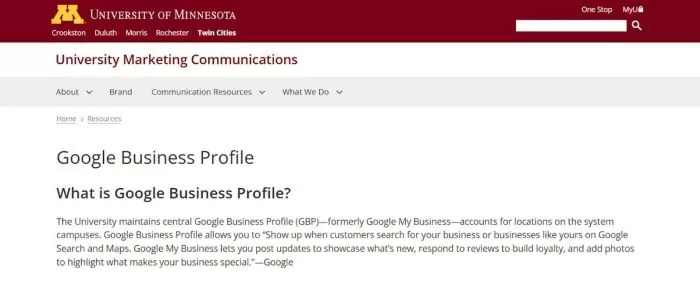
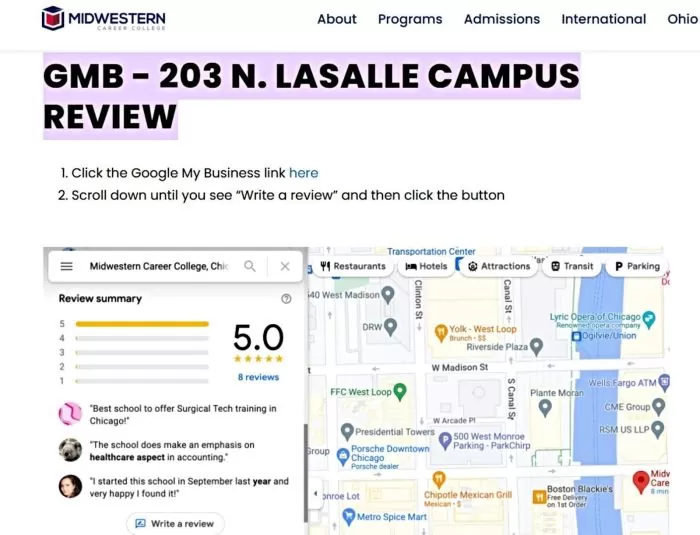
    Don’t underestimate local search either. Schools that claim their Google Business listing and keep it updated with reviews, photos, and FAQs tend to show up higher in local results, right when families are deciding which campuses to visit.

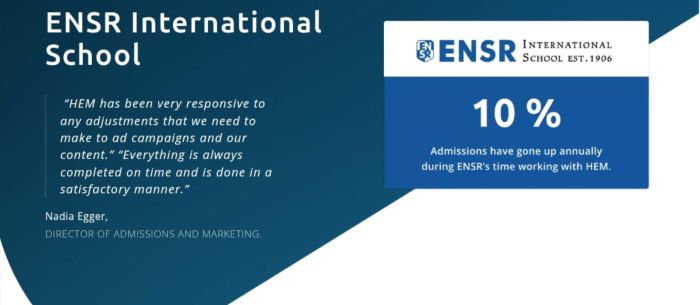
    Example: ENSR partnered with HEM to revamp its website for better usability and search visibility. Targeted SEO optimizations (including multilingual content and Google Ads campaigns) were implemented to attract more qualified traffic. ENSR also improved site speed and navigation. As a result, the school saw a 10% year-over-year increase in admissions, clear evidence that an optimized, easy-to-find website translates into more student enrollments.

    HEM Blog Post Image 3HEM Blog Post Image 3

    Source: HEM

    How can schools use SEO to reach more prospective students? Schools can use SEO by optimizing their website and content with keywords students search for, like program names or “colleges near me.” Creating informative blog posts, improving site speed, and using clear navigation help boost search rankings, making it easier for prospects to find and explore the school online.

    3. Meet Students Where They Scroll

    Social media is no longer just a promotional tool; it’s where brand trust is built. And guess what? Students don’t want picture-perfect posts. They want a glimpse into real student life: the awkward, the inspiring, and everything in between.

    How do social media platforms help attract prospective students? Social media platforms help attract prospective students by showcasing authentic campus life, student stories, and academic highlights where students already spend time. Targeted ads and engaging content build awareness, answer questions, and create emotional connections that encourage students to explore programs and take the next step toward applying.

    The most effective schools blend behind-the-scenes campus life, student takeovers, and authentic voices with strategic, paid campaigns. Engagement is key. Answer comments, reply to DMs, and ask questions. Your presence shouldn’t just be felt; it should be responsive.

    And when a student visits your site but doesn’t apply? A retargeting ad reminding them about a scholarship deadline can bring them back with a purpose.

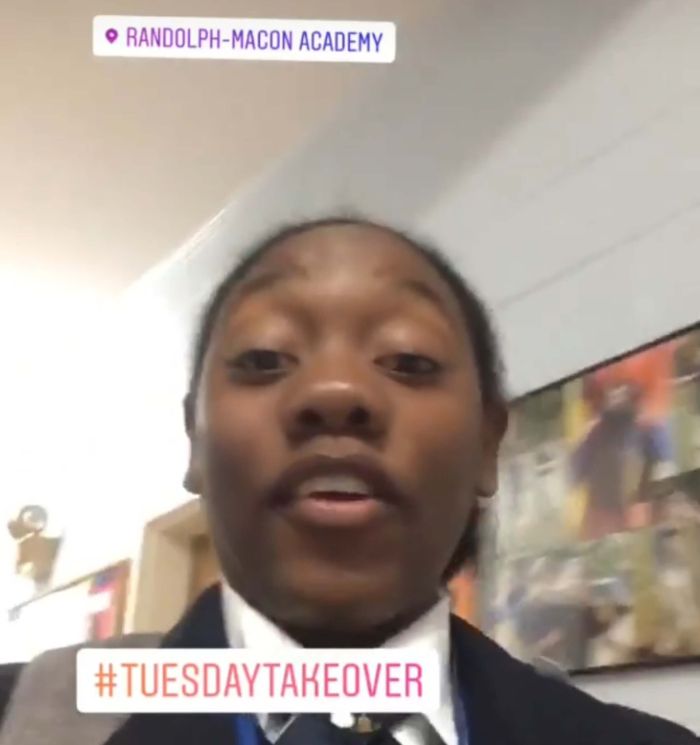
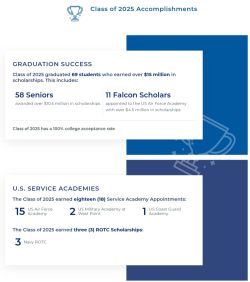
    Example: Randolph-Macon Academy utilizes student-driven social media takeovers and campaigns to humanize its brand. For example, on “Takeover Tuesdays,” R-MA students run the school’s Instagram Stories, giving followers a genuine day-in-the-life look at campus life. These peer perspectives resonate with prospective students and parents. R-MA also shares posts on LinkedIn celebrating achievements (like its seniors earning $16 million+ in scholarships) to boost credibility. By strategically targeting content on platforms like Instagram, Facebook, and LinkedIn, R-MA expands its reach and builds trust with specific audiences.

    HEM Blog Post Image 4HEM Blog Post Image 4

    Source: R-MA Instagram

    4. Bring Your Campus to Their Couch

    Campus visits are powerful but not always possible. Virtual tours bridge that gap beautifully when done right. 

    Why are virtual tours important for school admissions marketing? Virtual tours are important because they let prospective students explore campus facilities, culture, and student life from anywhere. They provide a first-hand experience that builds familiarity and trust, especially for international or remote students who can’t visit in person, helping them feel more confident about applying.

    The most compelling virtual experiences go beyond slideshows or still images. They immerse visitors in 360° visuals of your labs, residences, lounges, and dining halls. Add narration, clickable maps, and interactive hotspots to create a sense of discovery.

    Want to make it even more engaging? Offer live tours hosted by current students. Answer questions in real-time. Make the conversation two-way. This kind of hybrid interaction not only informs, but it also builds comfort and connection.

    Gamifying the experience with small touches like hidden easter eggs or quizzes can boost session time, making students stay longer and remember more.

    Example: Eastern New Mexico University: In January 2025, ENMU launched an upgraded 360-degree interactive virtual tour of its campus, in partnership with a virtual tour platform. The tour lets prospective students anywhere in the world explore campus landmarks at their own pace with panoramic views and clickable info points. New interactive stops even feature current students sharing their experiences via video, and users can access photos and descriptions of traditions at each location. This immersive virtual experience makes viewers feel “like they are on campus,” even if they cannot visit in person.

    HEM Blog Post Image 5HEM Blog Post Image 5

    Source: ENMU

    5. Let Video Carry the Message

    Nothing conveys emotion, trust, and energy quite like video. That’s why it’s the top-performing format across all platforms.

    Students use video to explore, compare, and decide. A 30-second clip showing campus energy can hook them, while a three-minute video of a student explaining why they chose your school can tip the scales.

    The best videos aren’t always the most polished. Often, it’s the realness that lands, the quiet moment in a dorm room, a laugh during class, a genuine answer about overcoming a challenge. When current students tell their story on camera, it resonates far more than scripted promos ever could.

    And don’t stop with publishing. Upload to YouTube (the second largest search engine in the world), share snippets on social media, and embed videos in your emails or on your site. It keeps your message moving, even when you’re not.

    Example: The Academy of Applied Pharmaceutical Sciences regularly produces short videos featuring student success stories and hands-on training highlights. These testimonials and “day in the life” videos are shared on AAPS’s website and social channels, providing an authentic glimpse into student outcomes. AAPS also posts video content of alumni in their new careers or students in lab classes, which personalizes the school’s message.

    HEM Blog Post Image 6HEM Blog Post Image 6

    6. Be There Instantly with Smart Chatbots

    Picture this: a student is exploring your program page at 10:45 p.m. They want to know if scholarships are still open, but your office is closed.

    This is where chatbots shine. When used effectively, they answer FAQs, guide students to relevant pages, and even collect lead info for follow-up, all in real time.

    Today’s best bots go beyond text. They can speak multiple languages, schedule tours, and connect students with human counselors. They’re not a replacement for your staff. They’re the frontline, making sure no interest goes cold.

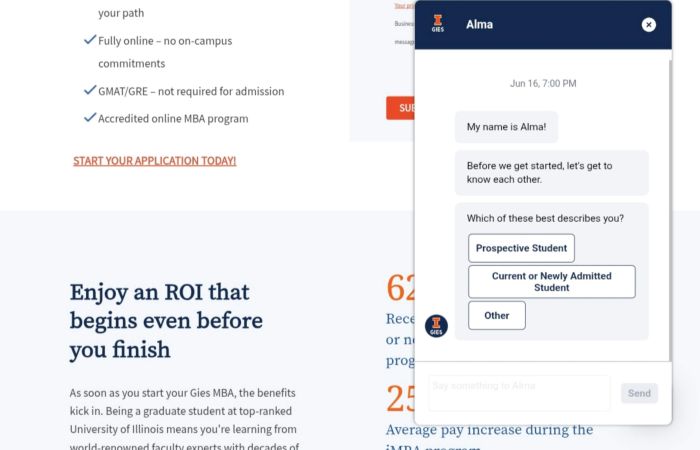
    Example: The University of Illinois Gies College of Business deployed an AI chatbot named “Alma” on its online MBA program website to handle common questions and nurture leads. The chatbot was built with a no-code AI platform and programmed to answer prospective students’ free-text questions about the program, provide key information (e.g., deadlines, curriculum), and even collect contact info for follow-up.

    HEM Blog Post Image 7HEM Blog Post Image 7

    Source: Gies College of Business

    7. Let Students Do the Talking

    Your school can say it’s great. But it means more when others say it for you.

    Prospective students read reviews before making decisions. That’s true whether they’re buying shoes or choosing a college. A few well-placed, authentic reviews from happy students or parents can tip the scale in your favor.

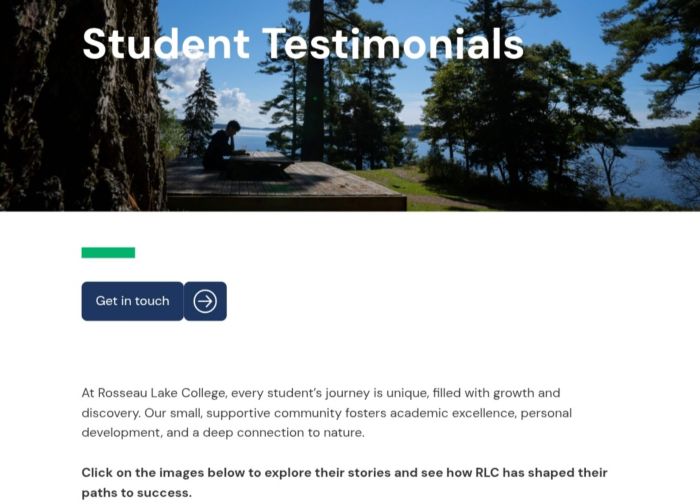
    Example: Rosseau Lake College actively highlights student and parent testimonials on its official site to manage its online reputation. RLC’s admissions section features a dedicated “Student Testimonials” page with quotes, stories, and even videos from current students and recent graduates.

    HEM Blog Post Image 8HEM Blog Post Image 8

    Source: RLC

    Make it easy for your community to share their voice. Follow up after tours or events with a simple request for feedback. Prompt graduating students to reflect on their journey. And most importantly, respond graciously to both praise and criticism.

    Highlight these testimonials in your marketing materials, emails, and website. Some schools even have dedicated pages that feature alumni quotes, rankings, and outcomes all in one place.

    Example: Discovery Community College leverages Google reviews and social media to boost its reputation. When the college receives a glowing review online, the marketing team amplifies it; for instance, Discovery CC shared a student’s 5-star Google review on Instagram with a thank-you message.

    HEM Blog Post Image 9HEM Blog Post Image 9

    Source: DCC Instagram

    When you let your results speak for themselves, people listen.

    8. Nurture With Purpose: Email and Text Messaging

    Email isn’t outdated. It’s just misused.

    Too often, schools blast the same generic message to every lead. But with marketing automation tools like HubSpot or Slate, you can do better. Much better.

    Send personalized messages based on actual behavior. If someone downloaded a course calendar, send a follow-up series about faculty highlights, career paths, or student testimonials from that program. If a student clicked a scholarship link but didn’t apply, follow up with a helpful guide or checklist.

    Text messages are the perfect complement: fast, direct, and effective. Use them for urgent nudges like deadline reminders or event RSVPs. But be respectful. Less is more when it comes to texting.

    9. Host Webinars That Educate and Inspire

    Done right, webinars are student recruitment gold. They let students interact with faculty, hear from alumni, and ask real questions, all from the comfort of home.

    Think beyond the program overview. What are students anxious about? Admissions essays? Career prospects? Financial aid? Offer sessions that solve these problems, not just sell solutions.

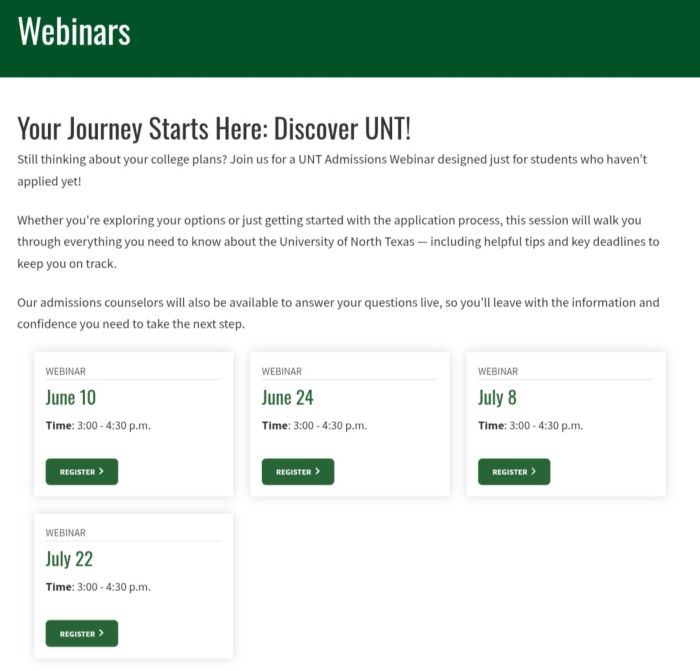
    Example: The University of North Texas runs themed Admissions Webinars for targeted audiences of students who haven’t yet applied. UNT invites high schoolers to sign up for sessions like “Why UNT? & How to Apply,” where recruiters walk through programs, campus life, and the application process via Zoom.

    HEM Blog Post Image 10HEM Blog Post Image 10

    Source: University of North Texas

    Live Q&As make these events feel dynamic. A student asking a question and getting an answer in the moment, that’s engagement. That’s trust.

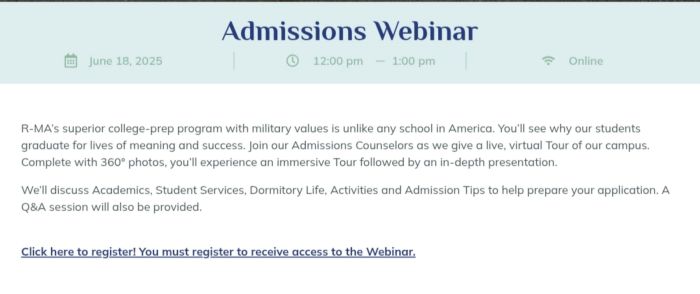
    Example: Randolph-Macon Academy hosts regular live webinars for prospective families as part of its recruitment strategy. During these virtual info sessions, R-MA’s admissions counselors present an overview of the school, share up-to-date facts, and then open the floor for Q&A. They often incorporate a live virtual campus tour within the webinar. This format has been effective in converting attendees to applicants – families get to interact directly with staff and students from home, addressing any doubts in real time.

    HEM Blog Post Image 11HEM Blog Post Image 11

    Source: R-MA

    And once the event ends, the content lives on. Recordings become lead magnets. Clips fuel your social strategy. Recaps can power blog posts. Every webinar is a long-term asset when you plan it right.

    10. Showcase What Comes After: Alumni Success

    Prospective students are investing time and money. What they want to know is simple: “Will it pay off?”

    Highlighting alumni outcomes is one of the most persuasive things you can do. Share job placement rates, grad school acceptances, average salaries, whatever metrics tell the story of success.

    Even more powerful are personal stories. The alum who launched a startup. The student who landed a dream internship. The graduate who returned to school to mentor others. These aren’t just achievements, they’re proof points.

    Example: Randolph-Macon Academy publicizes its alumni and student success outcomes as a core part of marketing. R-MA’s communications showcase statistics like 100% college acceptance and millions in scholarships earned by each graduating class. In 2025, R-MA proudly shared that its 69 seniors collectively secured over $10.5 million in scholarships for college. Alumni success stories (military academy appointments, leadership roles, etc.) are featured on the school blog and newsletters.

    HEM Blog Post Image 12HEM Blog Post Image 12

    Source: R-MA

    Some schools use interactive alumni maps to show where grads are working across the globe. Others run weekly spotlight stories on social or newsletters. However you do it, make sure it’s easy for prospects to imagine their own future in the successes of those who came before.

    When you say, “Here’s where our grads go, and here’s how we help them get there,” the value of your school becomes real.

    Enrollment Marketing Is Not About Tactics. It’s About Trust.

    Each of these enrollment strategies works on its own. But when you combine them into a cohesive enrollment plan, powered by data and driven by empathy, you don’t just generate interest. You build relationships.

    From a student’s first Google search to their final enrollment decision, every interaction matters. So make them count. Use tools like CRMs to track engagement. Align marketing with admissions. And most importantly, keep the student experience at the center of it all.

    Because in today’s world, enrollment isn’t about volume. It’s about value. Give your prospects content that answers questions, support that feels personal, and stories that inspire. Do that, and the results will follow.

    Need help building your enrollment marketing plan

    HEM offers expert services tailored to higher education institutions across Canada and beyond. Contact us today to learn more.

    Struggling with enrollment?

    Our expert digital marketing services can help you attract and enroll more students!

    Frequently Asked Questions

    Question: How do social media platforms help attract prospective students?

    Answer: Social media platforms help attract prospective students by showcasing authentic campus life, student stories, and academic highlights where students already spend time. Targeted ads and engaging content build awareness, answer questions, and create emotional connections that encourage students to explore programs and take the next step toward applying.

    Question: Why are virtual tours important for school admissions marketing?

    Answer: Virtual tours are important because they let prospective students explore campus facilities, culture, and student life from anywhere. They provide a first-hand experience that builds familiarity and trust, especially for international or remote students who can’t visit in person, helping them feel more confident about applying.

    Question: How can schools use SEO to reach more prospective students?

    Answer: Schools can use SEO by optimizing their website and content with keywords students search for, like program names or “colleges near me.” Creating informative blog posts, improving site speed, and using clear navigation help boost search rankings, making it easier for prospects to find and explore the school online.


    Source link

  • Victorian universities table 2024 financial results – Campus Review

    Victorian universities table 2024 financial results – Campus Review

    A majority of Victorian universities posted operating losses in 2024 but continued to boost the salaries of their vice-chancellors, annual reports reveal.

    Please login below to view content or subscribe now.

    Membership Login

    Source link

  • Unlock Your Enrollment Potential: Real Strategies for Real Results

    Unlock Your Enrollment Potential: Real Strategies for Real Results

    Engaging students wherever they are is critical to enrollment success.

    With eight years of experience at Ruffalo Noel Levitz working with more than 100 campuses across the country and following more than two decades leading enrollment efforts on campus, I know firsthand the challenges you face in enrollment. And in today’s environment it can feel like information overload on what you should be doing.

    I recently hosted a webinar sharing insights from our 2025 Marketing and Recruiting Best Practices for Undergraduate Students study, where 114 institutions of all types completed our survey about their use and effectiveness of recruitment strategies. We covered everything from the fundamentals of outreach to the latest in AI-powered chatbots. In survey responses, we found a lot of shared experiences and opportunities for strategy enhancement. Specifically, we identified seven strategies that should form the foundation of your annual marketing and recruitment plan, as well as a few others we recommend incorporating to drive your recruitment to the next level.

    Let’s talk real numbers (and real support)

    In our survey, we asked about written marketing and recruitment plans. Only 29% of institutions have a fully implemented, data-driven plan. So if you’re among the 71% of institutions still working on creation of a full plan, you’re in good company—we’re all trying to navigate this evolving landscape. The encouraging part is you’re committed to improvement. We found that most institutions rate their plans as “good,” but you’re aiming for “excellent.” That drive to excel is what we’re here to support.

    Discovering what truly works (together)

    Through survey responses, we found some powerful strategies that are working for colleges right now. Virtually every institution that uses them rates personalized videos and video calls with students as effective, although fewer than half of you are using those outreach tactics. And implementing new AI-based digital assistants on your website will meet an expectation that students and families have to receive real-time answers to their questions 24/7 about application status, academic programs, and aid packages—but only 22% of institutions have taken this important step.

    Search engine optimization (SEO) stood out as a leading strategy with 75% of institutions pursuing this and 100% of institutions rating it as effective. But we also know that most institutions don’t invest enough or broadly in SEO. Students are increasingly turning to search sites to find university sites and program information, and if you’re not in the top seven links, you’re effectively invisible. You need to incorporate into our annual plans ongoing SEO across your website to develop and maintain relevant content that speaks directly to student interest, both for traditional search engines and AI tools like ChatGPT and Gemini. You then need to track site traffic to measure ROI and so you know when it’s time to revisit those pages again. SEO is not a one-and-done process! Let’s make your website a powerful tool for student recruitment.

    7 practical steps to optimizing your enrollment management outreach

    1. Revisit your core: start with the fundamentals. Don’t underestimate the power of the basics! Make sure those foundational strategies are rock-solid and you have a documented plan for implementation. A strong foundation allows you to build from there and creates the space you’ll need to deal with mid-cycle unforeseen challenges.
    2. Refine your digital approach: digital marketing practices and calls to action. Take a fresh look at your digital marketing. Are your calls to action clear and compelling? Personalize your ad content to the audiences you’re targeting.
    3. Boost your visibility through SEO. SEO is key to being found. Make sure your website content is discoverable by both traditional searches and AI tools. Track your traffic so you know what’s working and what isn’t.
    4. Advertising strategies. Get smart about your advertising. Are you spending your dollars where your students are today or just where you have always spent them? In the last 4 years we’ve seen a significant shift away from “traditional media” and to digital advertising.
    5. Connect authentically on social media. Focus on the platforms where your students are spending their time. Remember, authenticity is key. They’re looking for real glimpses into campus life, not just polished perfection. Show them the genuine experience.
    6. Create tailored experiences with personalized video. Imagine how students will feel when they receive a video that’s just for them! Work to create personalized, customized content based on each student’s interests and watch who’s watching by incorporating tracking metrics.
    7. Enhance student support with AI chatbots. Digital assistants have come a long way in just a couple of years. Use today’s technology to provide 24/7 support so your prospective students can get specific answers in real time.

    We can help you navigate the digital shift and engage students 24/7

    While the ongoing shift toward digital strategies can feel overwhelming, we’re here to support you every step of the way. We’ll help you find the right balance for your institution and your audience.

    Source link

  • Tailored for Student Success and Built to Drive Results

    Tailored for Student Success and Built to Drive Results

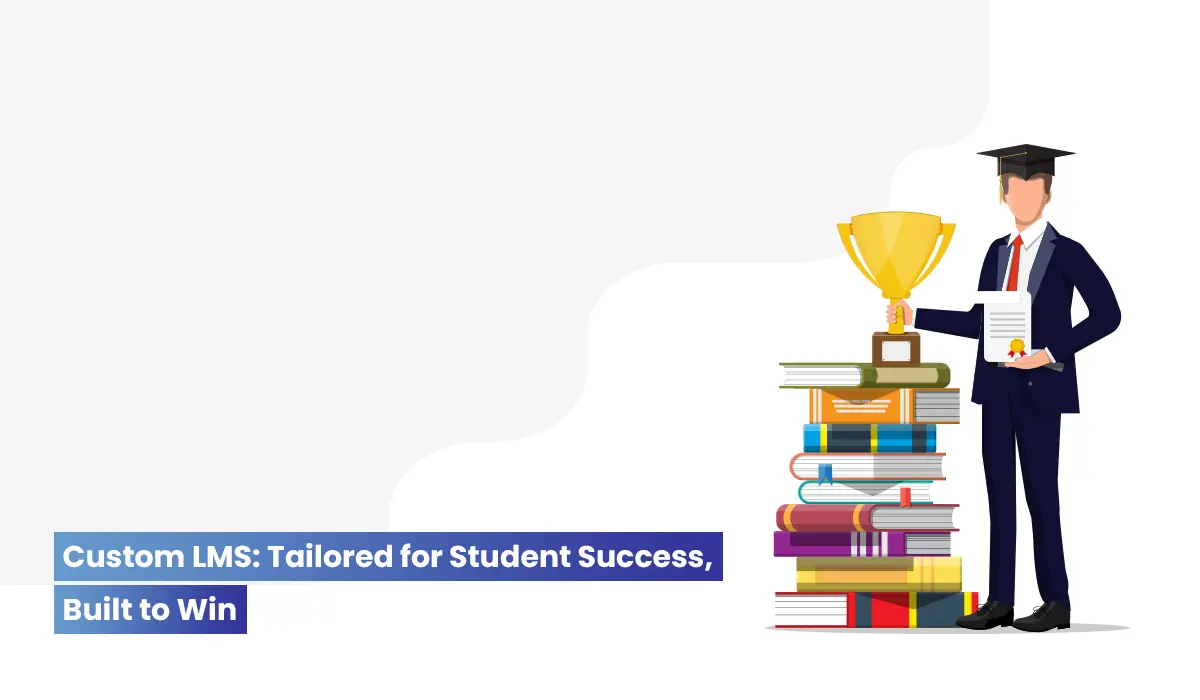
    Why would you settle for a generic LMS when your university deserves one based on its own learning path? Custom LMS development creates a customized experience that drives student achievement from day one, not only provides tools.


    Why Universities Need a Custom LMS

    Custom LMS systems are much needed in modern institutions since off-the-shevel LMS solutions usually fail to satisfy their various needs. Custom LMS development is hence quite relevant. Customized solutions can fit the processes, academic framework, and student needs of your university, therefore promoting improved institutional effectiveness and learning results.

    Did you realize?

    • A 2023 EDUCAUSE study shows that 78% of leaders in higher education feel that tailored learning environments directly help to ensure student success.
    • Using custom LMS solutions, universities noted a 25% increase in student involvement and a 19% increase in course completion rates.


    Key Benefits of a Custom LMS Development for Student Success


    • Students advance at their own speed under customized content delivery depending on performance.
    • Interactive materials, multimedia integration, and group projects all help to keep students engaged.
    • Modern analytics—real-time student performance—allows teachers to modify their plans to raise results.
    • Linkages with current SIS, CRM, and outside tools help to simplify procedures.
    • Flexibility and scalability help you to ensure long-term viability as your university develops. 


    How to Develop a Custom LMS for Universities

    Customizing the best LMS for student success is about matching the platform with the mission of your university, not only about technology. Here’s a breakdown:

    • Name the main goals: Describe for your university what student success means.
    • Plot the course of the student. Recognize several student kinds, from those needing more help to fast learners.
    • Design for User Experience: Make sure teachers and students alike have a simple, mobile-friendly interface.
    • Leverage data: To create reporting and analytics tools to monitor performance and interaction.
    • Test, refine, and scale: Beginning with a pilot program, get comments, and always improve. 


    The Future of Learning with Creatrix Campus

    Creatrix Campus provides a best-in-class LMS for student success, therefore enabling universities to design individualized, data-driven learning environments. Features like automatic reporting, assignment administration, and engagement tracking enable our platform to help colleges uncover new academic successes without sacrificing cost-effectiveness.

    Ready to change the educational process at your university? Your way, let us create an best LMS for student success that propels student success.

    Source link

  • Results of Women’s March Madness Bracket Based on Academics

    Results of Women’s March Madness Bracket Based on Academics

    Tyler Schank/NCAA Photos/Getty Images

    Women’s basketball has experienced a surge in popularity of late, and this year is no different. The Athletic reported that regular season viewing of women’s college basketball was up 3 percent on ESPN—even if this year’s Big Ten championship didn’t quite hit the record-breaking viewership of 2024’s, fueled by fans of then–University of Iowa point guard Caitlin Clark.

    Here at Inside Higher Ed, though, we celebrate the start of March Madness a little differently from the 1.44 million people who tuned in earlier this month to this year’s Big Ten championship face-off between the University of Southern California and the University of California, Los Angeles. For every tournament since 2006, we’ve created a bracket of who would take home the trophy if the winners were selected based on academic, rather than athletic, achievement.

    If you’re new here (or you didn’t see the men’s bracket from yesterday), here’s how it works: Matchups are decided by which team had the higher academic progress rate—the NCAA’s own metric for measuring academic performance—based on the most recent data available, from 2022–23. The academic progress rate measures student athlete retention and academic eligibility, though some outside experts have criticized the metric for painting an incomplete picture of a team’s academic achievement.

    There are, inevitably, at least a handful of ties every year. In those cases, we used several different graduation metrics to select winners. First, we used the team’s 2023–24 graduation success rate, which shows whether athletes graduated within six years of entering an institution. If teams tied again, we then turned to the teams’ federal graduation rates, which are more inclusive than the NCAA’s metric. Finally, when teams were matched up on all three of those measures, we turned to the institution’s overall GSR across their athletics programs.

    It’s worth noting that federal graduation rate data is not available for Ivy League teams, so for GSR ties involving Ivies, we skipped right to the overall GSR metric. That caused some chaos in a bracket that ended up seeing a total of seven ties featuring Ivy League institutions.

    Another note on methodology: Although two of the First Four games were decided before publication, we used academic metrics to select the winners of those matchups as well.

    This tournament was intense. There were not two, not three, but four matchups in the second round in which both teams had perfect APRs of 1,000. Kudos to those teams!

    The championship matchup was between two Ivies, Harvard University and Columbia University, both of which had perfect APRs and GSRs and whose overall GSRs were perfectly matched at 99. We’ve never seen this before in Inside Higher Ed’s 19 years of academic March Madness, so, although not ideal, we had to resort to a (virtual) coin flip. Naturally, Harvard was heads, because both start with “H.”


    Women’s 2025 Academic Performance Bracket Fullscreen

    But, in the end, we got tails. Congratulations to the Columbia Lions—who have now won Inside Higher Ed’s academic tournament two years in a row!


    Source link

  • Results of Men’s March Madness Bracket Based on Academics

    Results of Men’s March Madness Bracket Based on Academics

    Michael Allio/Icon Sportswire/Getty Images

    No shame if you forgot National Collegiate Athletic Association’s Division I basketball championships were coming up—after all, this March has been filled with more than enough madness in higher ed, even without paying attention to basketball.

    Nonetheless, the biggest event in college sports kicks off this week. If you’ve been a little too concerned with the news cycle to fill out your bracket, we’re here to help. Every year since 2006, Inside Higher Ed has determined which teams would win in the men’s and women’s tournaments if the results were based on academic, rather than athletic, performance.

    To determine the winners, we used the NCAA’s key academic performance metric, known as the academic progress rate, for the 2022–23 academic year, the most recent data available. The academic progress rate measures student athlete retention and academic eligibility, though some outside experts have said the metric paints an imperfect picture of a program’s academic performance.

    (Full disclosure, we did use this metric to determine the winners of the First Four matchups, even though two of the four games will be determined before publication Wednesday morning.)

    If two colleges had the same APR, we used 2023–24 graduation success rate, the proportion of athletes who graduated within six years of entering an institution, as tiebreakers. If teams tied again, we turned to the team’s six-year federal graduation rates, which is a more inclusive metric.

    Luckily, none of the teams tied in all three categories. Still, there were a handful of nail-biting victories. For instance, the Clemson University Tigers tied the Liberty University Flames on both the academic progress and graduate success rates. But when looking at the overall graduation rate, Clemson won by one point. After besting the Flames in the Final Four, the Tigers beat out the University of Louisville to win the whole thing.


    Men's 2025 Academic Performance Bracket Fullscreen

    Now, the Inside Higher Ed bracket likely won’t win you any money. But there’s no bad time to celebrate the academic achievements of student athletes alongside their athletic prowess.

    Congrats, Clemson Tigers!


    Source link