Tag: Retention

  • Impact of Technology on Student Retention Report

    Impact of Technology on Student Retention Report

    A report from your end users

    In partnership with Inside Higher Ed, Collegis surveyed 450 students to gauge the impact of higher education technology on both their learning experiences and opinions of the school. Higher ed leaders will want to read our report, “Tech Troubles: How Technology-Student Interactions Impact Retention,” to dive deeper into how technology environments can help (or hinder) the student journey.

    Students raise high-stakes concerns

    While our study indicates colleges and universities are succeeding in some aspects of technology usage (digital communications, for one), the results also exposed several areas where technology hurdles are damaging, or even disastrous, to the student experience:

    • Website application hurdles: A quarter of students report some level of difficulty.
    • No internet, no class? Technical issues cause distractions and lost class time, both on and off campus.
    • Retention at risk: Over 40% of students who experienced tech issues question whether to continue their education at the institution.

    Plus! Included in the report are reactions to the findings from higher ed leaders. They share the top challenges their schools face in addressing the issues raised by students.

    Download the report for summaries by topic, stand-out results from audience segments, charts that show the intensity of student sentiment, and recommendations for technology investments to improve student success.

    Source link

  • How Three Institutions Built Winning Retention Programs – CUPA-HR

    How Three Institutions Built Winning Retention Programs – CUPA-HR

    by Julie Burrell | May 21, 2024

    New CUPA-HR data show some improvement in turnover in the higher ed workforce, but staffing hasn’t fully bounced back to pre-pandemic levels. Managers still face challenges filling positions and maintaining morale, while employees are seeking jobs where their satisfaction and well-being are prioritized.

    CUPA-HR’s recent webinar offers solutions that may move the needle on employee retention. Retaining Talent: Effective Employee Retention Strategies From Three Institutions brings together HR pros who showcase their high-impact, cost-effective approaches to increasing satisfaction and well-being, including:

    • Professional development programs driven by employees’ interests
    • Effective supervisor-employee communication, including stay interviews
    • Actionable campus climate surveys using liaisons
    • Mentoring programs and leadership pipelines
    • Recognition programs and community-building events
    • Employee Resource Groups to enhance belonging

    Here are some of the highlights from their programs.

    Stay Interviews at Drake University

    A stay interview is a structured, informal conversation between an employee and a trained supervisor — and can be key to retaining top talent. Maureen De Armond, executive director of human resources at Drake, considers stay interviews to be a critical tool that nevertheless go underused in higher ed. Overall, only 8% of employees stated that they participated in a stay interview in the past year, according to The CUPA-HR 2023 Higher Education Employee Retention Survey.

    De Armond stresses that stay interviews can build trust, increase communication, and show that you care about employees as people, not just their job performance. If you’re looking to get started, De Armond recommends checking out the Stay Interviews Toolkit.

    Actionable Climate Surveys at the University of Texas Rio Grande Valley

    What’s worse than not conducting a climate survey? Not doing anything with the answers employees have taken the time to provide, says Nicole Englitsch, organizational development manager at UTRGV. To make surveys actionable, they’ve enlisted campus climate liaisons.

    These liaisons, who are mostly HR professionals, are assigned to specific departments. The liaisons have been trained by their external survey partners to help their departments understand the results and engage in action planning, guided by a three-year timeline. This network of partners helps ensure that UTRGV’s goals of making survey results both transparent and actionable are achieved.

    For more on their employee engagement and retention efforts, see Building Leaders From Within: UT Rio Grande Valley Blends Leadership Development With a Master’s in Higher Ed Administration.

    Recognition and Community-Building at Rollins College

    How can institutions create a culture of belonging and valuing employees? David Zajchowski, director of human resources at Rollins, explains how their high-impact recognition and community-building programs range from informal coffee-and-doughnuts gatherings to special awards ceremonies for employees.

    Probably the most popular way of valuing employees while increasing connection is Rollins’s annual Fox Day. On a random day in spring, the president surprises employees and students with a day off from work and class to participate in community-building college traditions.

    Despite the effectiveness of employee recognition, many employers may be leaving this low-cost retention incentive on the table, as only 59% of higher ed employees said they received regular verbal recognition for their work in the Employee Retention Survey. Wondering how your employee recognition program stacks up? See a comparison of recognition programs and take a self-assessment here.


    Source link

  • At Hudson County Community College, Inclusion Drives Recruitment and Retention – CUPA-HR

    At Hudson County Community College, Inclusion Drives Recruitment and Retention – CUPA-HR

    by Julie Burrell | February 27, 2024

    The motto at Hudson County Community College is “Hudson is Home,” a saying created by their students that reflects HCCC’s commitment to community across their three New Jersey campuses. Located in one of the densest and most ethnically diverse counties in the country, HCCC uses inclusive strategies to boost employee recruitment and retention.

    HCCC’s focus on promoting a culture of care and belonging positions them well to contend with voluntary turnover, which remains on the rise nationally as higher ed employees report feeling overworked and undervalued. HCCC’s inclusion and belonging initiatives, including their new peer-to-peer recognition program, address the top three predictors that employees will seek work elsewhere: recognition for contributions, being valued at work, and having a sense of belonging.

    In their recent CUPA-HR webinar, HCCC’s Anna Krupitskiy, vice president for human resources, and Stephanie Sergeant, assistant director of human resources, explained how they use inclusive strategies to engage their approximately 1,000 employees, including:

    Prioritizing a Culture of Care

    Addressing the needs of parents is one way HCCC creates a culture of care through inclusion. In the past, parents who were employees or students were confronted with unclear and inconsistent guidelines. But the institution’s new parent-friendly children on campus policy makes it clear that children are welcome on HCCC’s three campuses. With the new policy, Krupitskiy says, “we wanted to make sure that there’s a strong message that we do allow children on campus.” HR has also collaborated with campus partners on their Take Your Child to Work Day program, where children of employees engage in a range of campus activities, like participating in science projects or watching a nursing demonstration, before ending the day with an ice cream social.

    Using Checkpoints During Recruitment to Ensure Inclusive Hiring

    HCCC has created checkpoints to ensure there are meaningful milestones to reflect on inclusion during the recruitment and selection process. The first checkpoint is the composition of the hiring committee itself. Krupitskiy and Sergeant stress that screening committees should be representative of HCCC, not just in terms of demographics, but also such characteristics as how long a person has been employed at HCCC, what role or level of position they hold, what union affiliation they have, etc. They’ve also invited students to participate in searches when appropriate.

    Job descriptions are another area they’ve scrutinized, asking if certain minimum qualifications inherently limit a pool of applicants. Might a minimum qualification, like years of experience, be listed as a preferred qualification instead?

    Implementing a Peer-to-Peer Recognition Program  

    Recognizing employee contributions is a critical retention tool. Only 59% of higher ed employees say they receive regular verbal recognition for doing good work, according to CUPA-HR data. To address recognition, HCCC holds a years-of-service event, with awards for five to 40-plus years of service for both part-time and full-time employees. Their new Hudson is Home employee recognition program allows colleagues to nominate each other for awards ranging from Collaboration and Team Achievement to a Part-Time Spotlight award. Employees receive an email notification when they’ve been nominated, which has driven up participation overall.

    To learn more about the programs and initiatives at HCCC — including working to close pay equity gaps and establishing professional development funds — view the recording of Retention Strategies for an Inclusive and Engaged Workforce. For data on higher ed retention challenges and recommendations, see The CUPA-HR 2023 Higher Education Employee Retention Survey.


    Source link

  • PeopleAdmin A PowerSchool Company

    PeopleAdmin A PowerSchool Company

    2023 in Blogs: Key Topics and Top Tips for HigherEd

    As 2023 comes to a close, here at PeopleAdmin, we’re looking back at some of the top resources we shared this year! From onboarding to compliance, from retention to employee development, from recruitment marketing to candidate experience, we covered so many topics. Check out some of our favorite reads below!

    Hiring across campus roles

    HigherEd hiring processes are unique for many reasons, but one key reason is the different types of positions found on campus. Position types can include faculty, staff, student workers, temporary seasonal workers, hourly workers, and more, and often, each of these categories has different requirements, approvals, forms, and hiring steps. Our customers are tackling this challenge thanks to Position Management and Applicant Tracking System, and they have some tips for others to get started. Read more!

    Can digitized onboarding really make that much of a difference?

    The answer is yes! In this competitive hiring market, and with many universities facing retention challenges, onboarding is key, and digitized onboarding is the standard that organizations need to meet today. Read more from HigherEd institutions who are saying “no” to onboarding paperwork and bringing an engaging onboarding process to every new hire.

    What’s an employer brand?

    If you’re wondering what an employer brand is, you’re probably not leveraging recruitment marketing techniques to your advantage! Creating a cohesive employer brand is an important aspect of building a talent pool today. Learn more about employer branding, and check out some of our top tips to get your hiring teams to start thinking like marketers.

    Search committees don’t have to be slow

    Your team has probably dealt with the challenge of creating effective search committees, and you might have struggled to get those committees to adopt new and efficient technology. Well, our customers have tackled that challenge too. Hear from the University of Alabama – Birmingham about how they successfully leveled up their search committee experience.

    Connecting your systems

    In a PeopleAdmin poll, HigherEd institutions were asked “How connected are the various systems on your campus?” 30% responded “Not connected—we have to manually enter data in multiple systems; there’s no data flow,” while 36% responded “connected but could be better.” Notably, no one chose the option: “Very connected—there are few issues that impact my team.” With interoperability still a key issue on campus, building seamless data flow and integrating your technology should be a top priority for your team. Check out some key takeaways from a webinar about interoperability, and hear from customers about how they’re leveraging integrations.

    Career advancement impacts retention

    44% of HigherEd employees disagreed that they have opportunities for advancement, and 34% disagree that their institution invests in their career development. According to the Harvard Business Review, 86% of professionals would change jobs for more professional development opportunities—clearly, career growth is something today’s workers care about. For more, check out this post about the link between retention and career growth.

    Final thoughts

    These are just a few of the topics that we researched and wrote about here at PeopleAdmin this year! Check out more resources on our website, and dive into our Annual Report on the State of HigherEd for an in-depth look at the challenges of 2023!

    Source link

  • Hybrid, Remote and Flexible Work: The Secret Sauce for Employee Retention? – CUPA-HR

    Hybrid, Remote and Flexible Work: The Secret Sauce for Employee Retention? – CUPA-HR

    by CUPA-HR | September 19, 2023

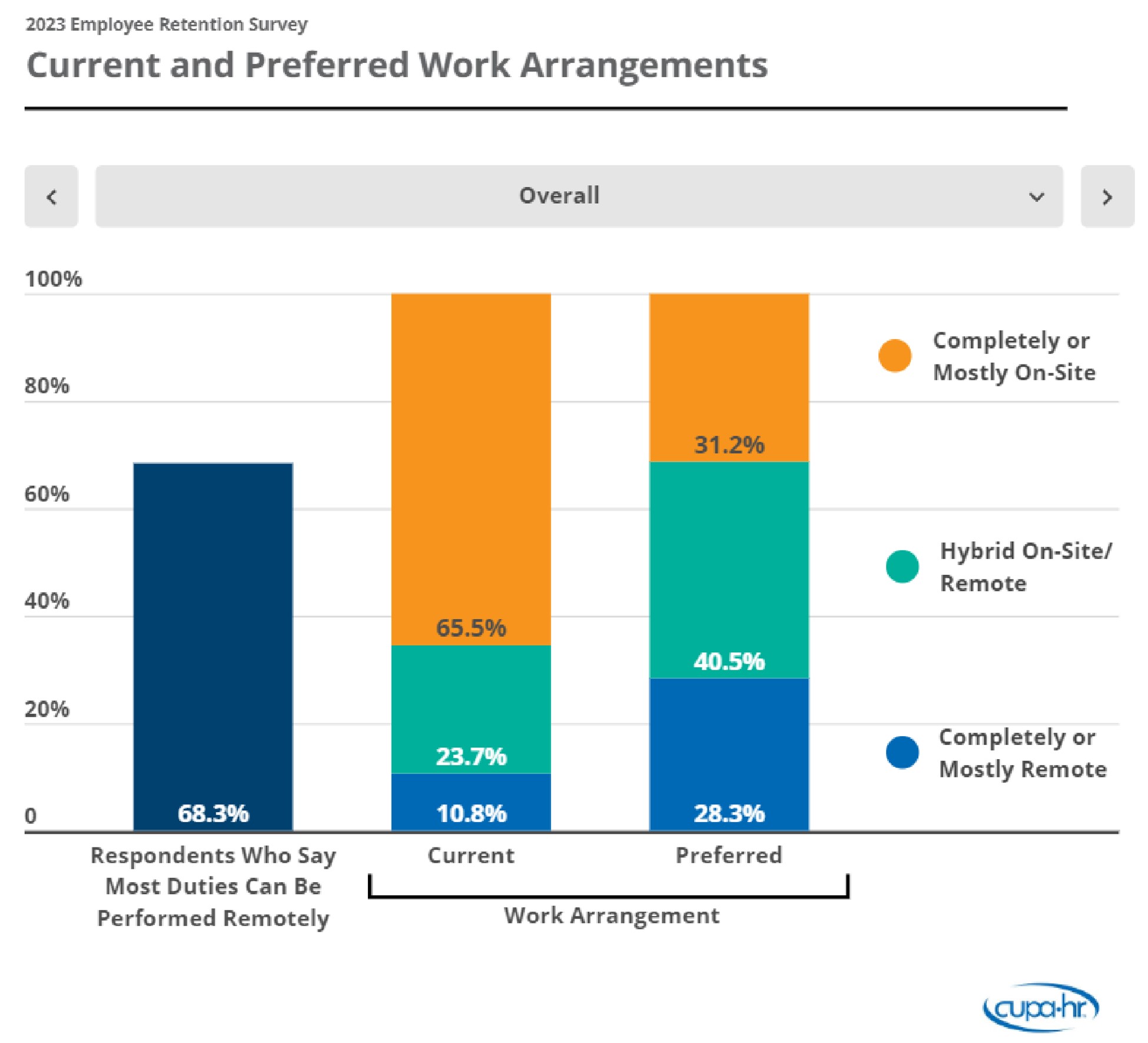
    Given the number of employees who successfully executed their work remotely at the height of the pandemic, it may come as no surprise that a substantial gap exists between the work arrangements that higher ed employees want and what institutions offer. According to the new CUPA-HR 2023 Higher Education Employee Retention Survey, although two-thirds of employees state that most of their duties could be performed remotely and two-thirds would prefer hybrid or remote work arrangements, two-thirds of employees are working completely or mostly on-site.

    Inflexibility in work arrangements could be costly to institutions and contribute to ongoing turnover in higher ed. Flexible work is a significant predictor of employee retention: Employees who have flexible work arrangements that better align with their preferences are less likely to look for other job opportunities.

    Flexible Work Benefits: A No-Brainer for Retention

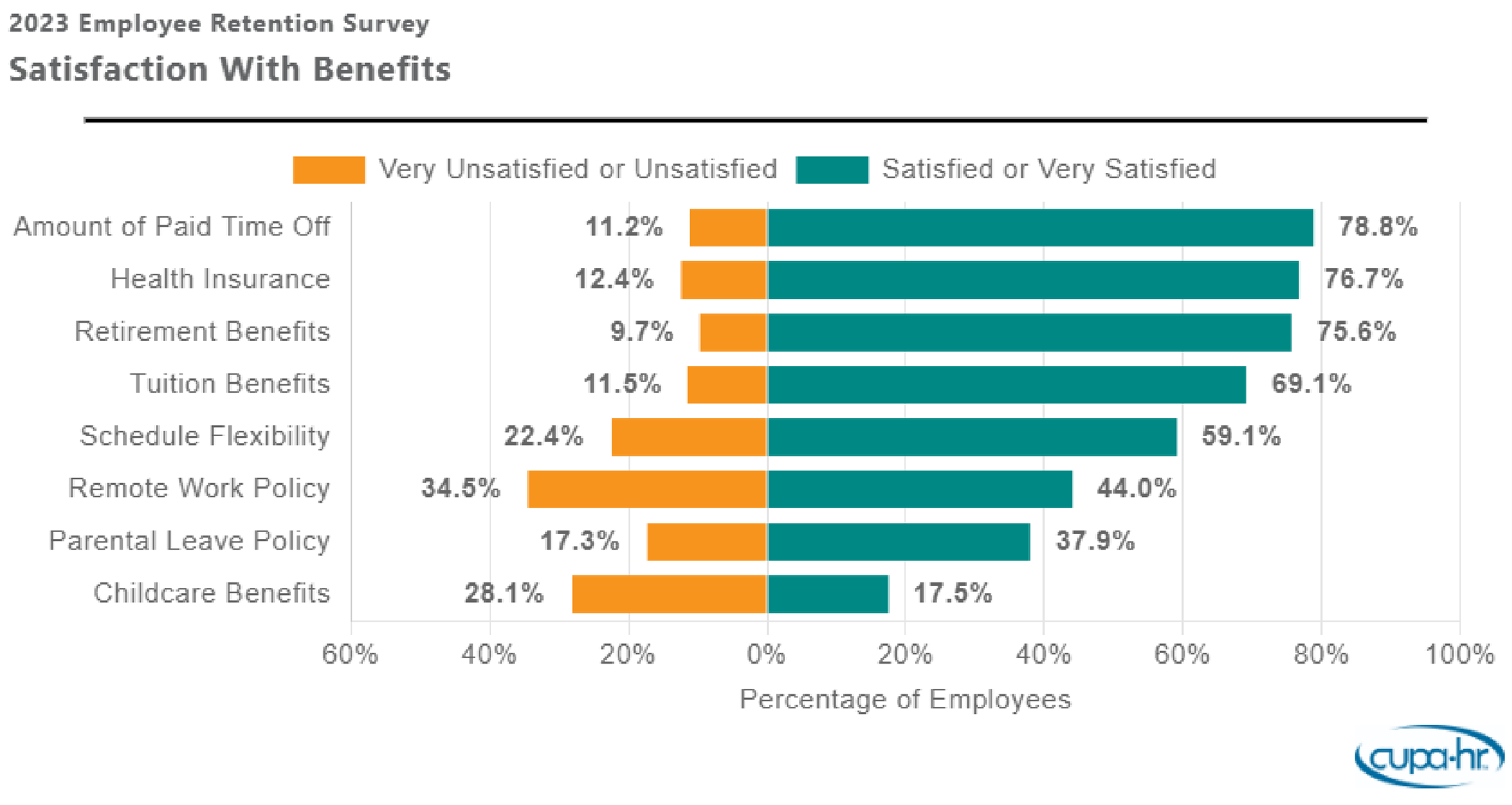
    While more than three-fourths of employees are satisfied with traditional benefits such as paid time off and health insurance, survey respondents were the most dissatisfied with the benefits that promote a healthier work-life balance. These include remote work policies and schedule flexibility, as well as childcare benefits and parental leave policies.

    Most employees are not looking for drastic changes in their work arrangements. Even small changes in remote policies and more flexible work schedules can make a difference. Allowing one day of working from home per week, implementing half-day Fridays, reducing summer hours and allowing employees some say in their schedules are all examples of flexible work arrangements that provide employees some autonomy in achieving a work-life balance that will improve productivity and retention.

    A more flexible work environment could be an effective strategy for institutions looking to retain their top talent, particularly those under the age of 45, who are significantly more likely not only to look for other employment in the coming year, but also more likely to value flexible and remote work as a benefit. Flexible work arrangements could also support efforts to recruit and retain candidates who are often underrepresented: the survey found that women and people of color are more likely to prefer remote or hybrid options.

    Three Things You Can Do

    1. Use Data to Make a Case for Change. The CUPA-HR 2023 Higher Education Employee Retention Survey provides multiple data points that support remote, hybrid and flexible work for the retention and recruitment of top talent.
    1. Explore CUPA-HR Resources. Discover best practices and policy models for navigating the challenges that come with added flexibility, including managing a multi-state workforce:
    1. Remember the Two-Thirds Rule. In reevaluating flexible and remote work policies, remember: Two-thirds of higher ed employees believe most of their duties can be performed remotely and two-thirds would prefer hybrid or remote work arrangements, yet two-thirds are compelled to work mostly or completely on-site.

    You may also be interested in:


    Source link

  • The Top Predictor of Higher Ed Employee Retention May Surprise You – CUPA-HR

    The Top Predictor of Higher Ed Employee Retention May Surprise You – CUPA-HR

    by CUPA-HR | September 12, 2023

    In 2022-23, turnover of higher ed employees was the highest in five years. A new report from CUPA-HR explores the issue of higher ed employee retention and the factors that impact retention.

    The CUPA-HR 2023 Higher Education Employee Retention Survey analyzed data from 4,782 higher ed employees — administrators, professionals and non-exempt staff, with faculty excluded — from 529 institutions. It found that 33% of higher ed employees surveyed answered they were “very likely” or “likely” to look for new employment opportunities in the next year. More than half (56%) of employees are at least somewhat likely to search for a new job in the coming year.

    Top Reasons Higher Ed Employees Are Looking for a New Job

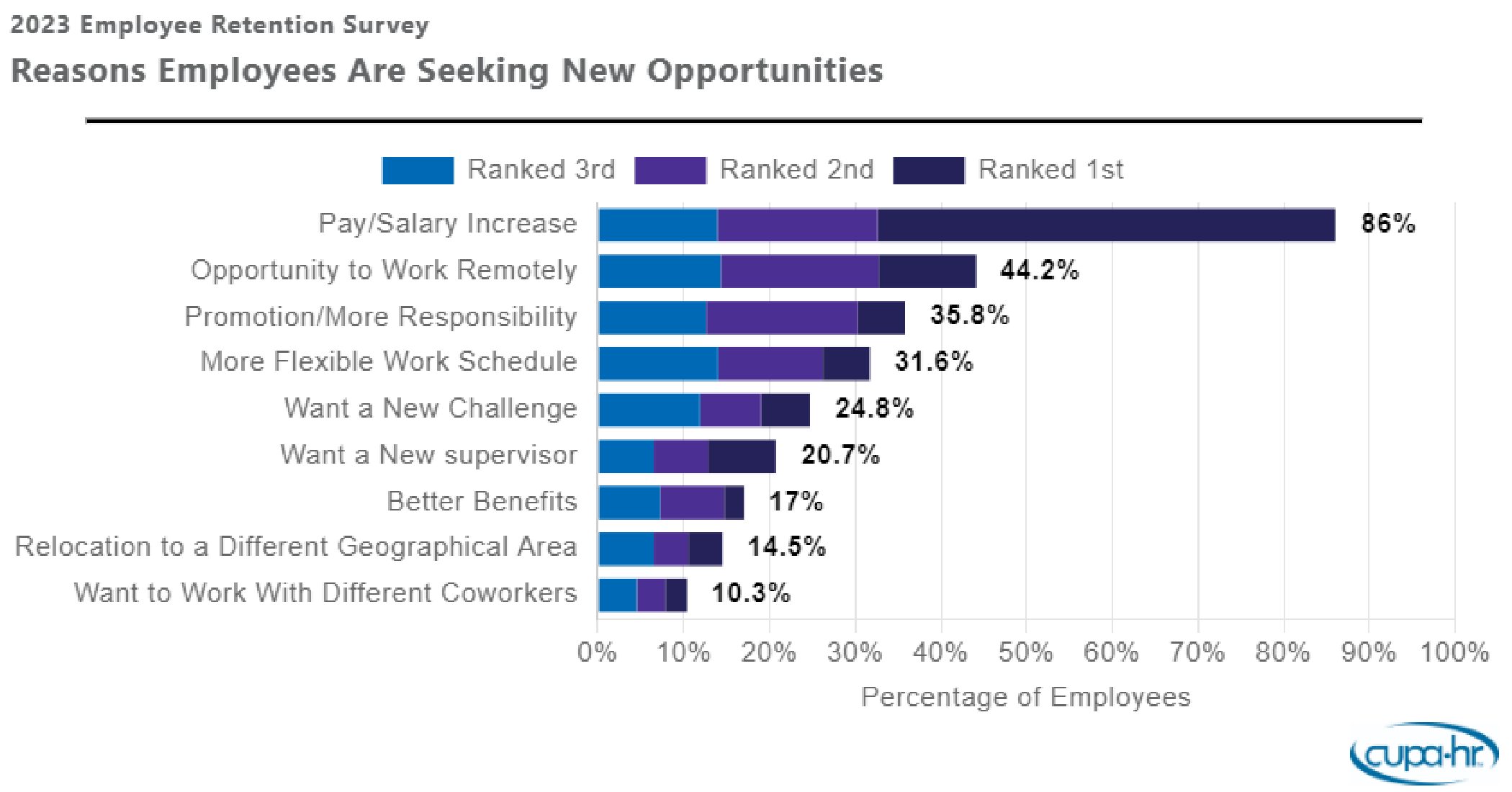
    According to the findings, respondents say that pay is the number one reason they’re looking for a new job. Other influential reasons are an opportunity to work remotely, desire for a promotion or more responsibility, and the need for a more flexible work schedule.

    But while pay is the top concern mentioned by employees, retention challenges are more complex.

    Strongest Predictors of Retention

    Digging deeper into the data, the strongest predictors of retention are factors related to job satisfaction and well-being. Only 58% of higher ed employees are generally satisfied with their jobs. Of the 16 aspects of job satisfaction and well-being the survey measured, the three that have the most impact on retention are:

    • Recognition for Contributions
    • Being Valued by Others at Work
    • Having a Sense of Belonging

    Only 59% of respondents say they receive regular verbal recognition for doing good work. The good news is that programs, training and policies that increase employee satisfaction in these areas can make a significant impact on retention without necessarily breaking the budget.

    Three Things You Can Do

    Employees are not necessarily planning to flee higher ed. Most job seekers will be looking within higher ed, and nearly half will be looking within their own institution, indicating that it’s not too late to implement retention strategies. Here are three things you can do to assess and address job satisfaction:

    1. Read the Report. The CUPA-HR 2023 Higher Education Employee Retention Survey provides not only data but also a model for understanding higher ed retention. (Looking for an overview of report findings? Check out our press release.)
    2. Explore CUPA-HR Resources. Here are several that focus on aspects of job satisfaction:
    1. Plan Next Steps. Share the report or press release with leaders on your campus. Determine areas where your institution could strengthen career development and implement training to increase job satisfaction.


    Source link