
Tag: Returning

  • Trump celebrates returning education to the states in national address

    Trump celebrates returning education to the states in national address

    This audio is auto-generated. Please let us know if you have feedback.

    In an address to the nation on Wednesday night, President Donald Trump celebrated increased state involvement and decreased federal oversight in education — a task he said his administration has accomplished in the last 11 months.  

    “We have broken the grip of sinister woke radicals in our schools,” he said, “and control over those schools is back now in the hands of our great and loving states, where education belongs.” 

    Trump, however, remained silent on his education plan for 2026.

    Increased state control over education — partly by gutting the U.S. Department of Education — loomed large among U.S. Secretary of Education Linda McMahon’s priorities when entering the office in March. McMahon has since announced at least two rounds of layoffs at the department, pauses in some federal funding, and reorganization and outsourcing of key parts of the department itself. 

    Trump’s comments come a month after the Education Department announced six interagency agreements, shifting management of major programs to other federal agencies. The agreements included sending the Office of Elementary and Secondary Education to the U.S. Department of Labor.

    However, increasing state control over education and decreasing federal oversight has deeply divided the education community. 

    While Republican-led states have celebrated Trump’s education agenda as allowing them to tailor education to local needs, Democratic-leaning states and lawmakers have said decreased oversight will create more challenges. 
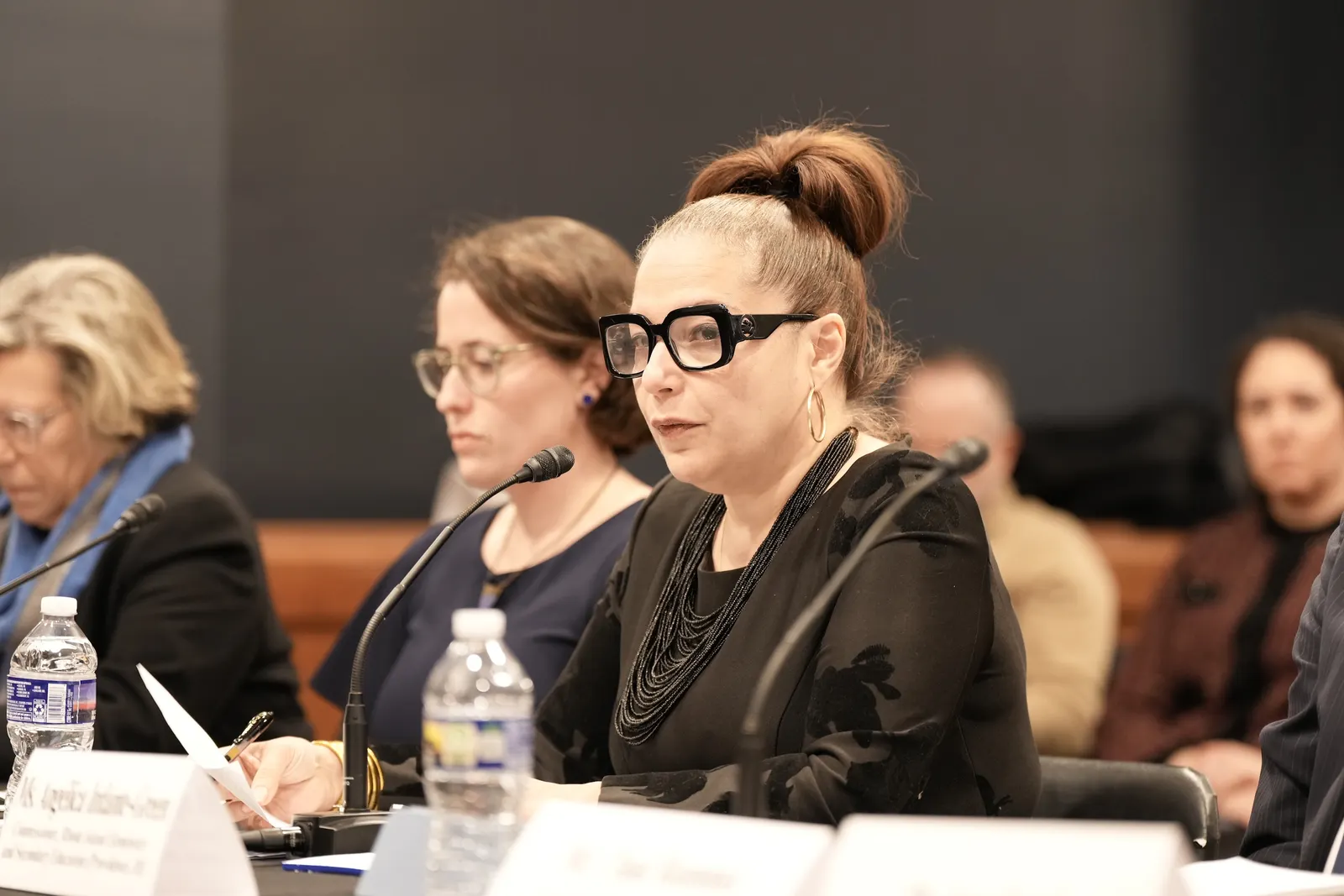
    An adult sits at a table with a name tag and microphone in front of them.

    Angelica Infante-Green, Rhode Island commissioner of elementary and secondary education, speaks during a spotlight forum on the Trump administration’s impact on education on Dec. 16, 2025, on Capitol Hill in Washington, D.C.

    Courtesy of U.S. Sen. Mazie Hirono


    “After a year that included mass firings, canceling critical grant funds for our local schools, and cutting access to student loans, the Trump administration is trying to make good on their promise to shutter the Department of Education,” said Sen. Chris Van Hollen, D-Md., according to a statement from a forum convened by Sen. Mazie Hirono, D-Hawaii, a day before the president’s address.

    Van Hollen added, “While there are many ways to improve our education system, dismantling the department piece by piece only threatens our longstanding goal of ensuring that every child has access to a quality education.” 

    Angelica Infante-Green, Rhode Island commissioner of elementary and secondary education, told Van Hollen and other lawmakers at the Dec. 16 forum that by stepping back from federal support of education, the Trump administration has created “chaos and concern.” 

    Red states, meanwhile, have already begun submitting waiver requests to the Every Student Succeeds Act, a bipartisan measure passed under President Barack Obama that gave increased flexibility to states compared to its predecessor, the No Child Left Behind Act.

    Indiana, Kansas and Iowa are among those that have so far sought waivers, and the Education Department’s response to them could pave the path for future waivers in other states.

    Source link

  • Quality Teaching in Practice is returning in 2025 – Campus Review

    Quality Teaching in Practice is returning in 2025 – Campus Review

    Quality Teaching in Practice returns for its fourth consecutive year, as one of the leading educational research and practice conference for teachers, school leaders and policymakers.

    Please login below to view content or subscribe now.

    Membership Login

    Source link

  • From Pause to Progress: Predictors of Success and Hurdles for Returning Students

    From Pause to Progress: Predictors of Success and Hurdles for Returning Students

    Title: Some College, No Credential Learners: Measuring Enrollment Readiness

    Source: Straighterline, UPCEA

    UPCEA and StraighterLine carried out a survey to examine the driving factors, obstacles, preparedness, and viewpoints of individuals who started but did not finish a degree, certificate, technical, or vocational program. This population, according to the National Student Clearinghouse Research Center, has grown to 36.8 million, a 2.9 percent increase from the year prior. A total of 1,018 participants completed the survey.

    Key findings related to respondents’ readiness to re-enroll include:

    • Predictive factors: Mental resilience, routine readiness, a positive appraisal of institutional communication, and belief in the value of a degree strongly predict re-enrollment intentions.
    • Academic preparedness: A majority of respondents (88 percent) feel proficient in core academic skills (e.g., reading, writing, math, critical thinking), and 86 percent feel competent using technology for learning tasks.
    • Financial readiness: More than half (58 percent) believe they cannot afford tuition and related expenses, while only 22 percent feel financially prepared.
    • Career and personal motivations: The top motivators for re-enrolling include improving salary (53 percent), personal goals (44 percent), and pursuing a career change (38 percent).
    • Beliefs in higher education: Trust in higher education declines after stopping out. While 84 percent of those who had been enrolled in a degree program initially believed a degree was essential for their career goals, only 34 percent still hold that belief. Additionally, just 42 percent agree that colleges are trustworthy.
    • Grit readiness: Four in five respondents feel adaptable and persistent through challenges, and 71 percent say they can handle stress effectively.
    • Flexibility and adaptability: Three-fourths of respondents are open to changing routines and adjusting to new environments.
    • Learning environment: Half of respondents report having access to a study-friendly environment, but 11 percent report not having such access.
    • Time management: Nearly two-thirds are prepared to dedicate the necessary time and effort to complete their education.
    • Support systems: About three in every five respondents receive family support for continuing education, but only 31 percent feel supported by their employers.

    Key findings related to enrollment funnel experiences include:

    • Preferred communication channels: When inquiring about a program, 86 percent of respondents like engaging via email, 42 percent through phone calls, and 39 percent via text messages, while only 6 percent want to use a chatbot.
    • Timeliness and quality of communication: A majority (83 percent) agree or strongly agree that the communication they received when reaching out to a college or university about a program was timely, and 80 percent found it informative.
    • Enrollment experience: Among those who re-enrolled, 88 percent found that the enrollment process was efficient, 84 percent felt adequately supported by their institution, and 78 percent found the process easy.
    • Challenges from inquiry to enrollment: Nearly one-third (31 percent) encountered difficulties with financial aid support, 29 percent experienced delays in getting their questions answered, and 21 percent reported poor communication from the institution.

    Click to read the full white paper.

    —Nguyen DH Nguyen


    If you have any questions or comments about this blog post, please contact us.

    Source link

  • The essential PLUS for returning to learning at Liverpool by Sarah Hanson – ALL @ Liverpool Blog

    The essential PLUS for returning to learning at Liverpool by Sarah Hanson – ALL @ Liverpool Blog

    If you are a mature student, returner to learning or someone who has experienced a disrupted education, you may be anxious about the support available for anyone not familiar with higher education and its challenges.  Starting your higher education journey is one of the most exciting times of your life, but we realise you might have some concerns as well. Whatever they might be, you don’t need to worry as the University of Liverpool offers lots of support.

    Our Student Services team, who offer a huge range of services, including mental health support like counselling, a Mental Health Advisory Service and wellbeing support including self-help guides, workshops and events. They also provide financial advice, including guidance on managing the rising cost of living and support for disabled students through initiatives like Disability Coaches, a peer support service of trained students with lived experience of disability and accessing disability support. Disability Coaches can help with initial enquiries, support plans, obtaining medical evidence and Disabled Students’ Allowance (DSA).

    The Liverpool Guild of Students offer free and confidential advice to all students about the options available to you, covering academic, housing, wellbeing issues and more. Through the Guild you can  access a huge range of Societies, providing a brilliant opportunity to make new friends through shared interests. They also provide schemes like Give It A Go and lots of volunteering programmes, giving you the chance to enhance your student experience.

    From September 2024, Go Higher students will be able to access Liverpool Plus, a brand new post-entry support programme. Including an Enhanced Welcome package, 1-2-1 support with your transition into first year, bespoke events with University services like Global Opportunities and Libraries, and priority access to schemes like the Liverpool Advocate programme.

    With Liverpool Plus, we’ll provide the support you need to make the most out of your time at University

    Source link