Tag: returns

  • We cannot afford to dismantle Head Start, a program that builds futures, strengthens families and delivers proven returns

    We cannot afford to dismantle Head Start, a program that builds futures, strengthens families and delivers proven returns

    The first words I uttered after successfully defending my dissertation were, “Wow, what a ride. From Head Start to Ph.D.!” Saying them reminded me where it all began: sitting cross-legged with a picture book at the Westside Head Start Center, just a few blocks from my childhood home in Jackson, Mississippi. 

    I don’t remember every detail from those early years, but I remember the feeling: I was happy at Head Start. I remember the books, the music, the joy. That five-minute bus ride from our house to the Westside Center turned out to be the shortest distance between potential and achievement. 

    And my story is not unique. Every year, hundreds of thousands of children — kids whose names we may never know, though our futures depend on them — walk through Head Start’s doors. Like me, they find structure, literacy, curiosity and belonging.  

    For many families, Head Start is the first place outside the home where a child’s potential is nurtured and celebrated. Yet, this program that builds futures and strengthens families is now under threat, and it’s imperative that we protect it. 

    Years later, while training for high school cross-country meets, I’d run past the park next to the center and pause, flooded with memories. Head Start laid the foundation for everything that followed. It gave me structure, sparked my curiosity and built my early literacy skills. It even fed my short-lived obsession with chocolate milk.  

    More than that, Head Start made me feel seen and valued. 

    Related: A lot goes on in classrooms from kindergarten to high school. Keep up with our free weekly newsletter on K-12 education. 

    There’s a clear, unbroken line between the early lessons I learned at Head Start and the doctoral dissertation I defended decades later. Head Start didn’t just teach me my ABCs — it taught me that learning could be joyful, that I was capable and that I belonged in a classroom.  

    That belief carried me through elementary school, Yale and George Washington University and to a Ph.D. in public policy and public administration. Now, as part of my research at the Urban Institute, I’m working to expand access to high-quality early learning, because I know firsthand what a difference it makes.  

    Research backs up what my story shows: Investments in Head Start and high-quality early childhood education change lives by improving health and educational achievement in later years, and benefit the economy. Yet today there is growing skepticism about the value of Head Start, reflecting an ongoing reluctance to give early childhood education the respect it deserves.  

    If Head Start funding is cut, thousands of children — especially from communities like mine in Jackson, where families worked hard but opportunities were limited — could lose access to a program that helps level the playing field. These are the children of young parents and single parents, of working families who may not have many other options but still dare to dream big for their kids.  

    And that is why I am worried. Funding for Head Start has been under threat. Although President Donald Trump’s proposed fiscal 2026 budget would maintain Head Start funding at its current $12.3 billion, Project 2025, the influential conservative policy document, calls for eliminating the program. The administration recently announced that Head Start would no longer enroll undocumented children, which a group of Democratic attorneys general say will force some programs to close.  

    Related: Head Start is in turmoil 

    I feel compelled to speak out because, for our family, Head Start wasn’t just a preschool — it was the beginning of everything. For me, it meant a future I never could have imagined. For my mother, Head Start meant peace of mind — knowing her son was in a nurturing, educational environment during the critical developmental years. My mother, Nicole, brought character, heart and an unwavering belief in my potential — and Head Start helped carry that forward. 

    My mother was just 18 when she enrolled me in Head Start. “A young mother with big dreams and limited resources,” she recounted to me recently, adding that she had “showed up to an open house with a baby in my arms and hope in my heart.” 

    Soon afterward, Mrs. Helen Robinson, who was in charge of the Head Start in Jackson, entered our lives. She visited our home regularly, bringing books, activities and reassurance. A little yellow school bus picked me up each morning. 

    Head Start didn’t just support me, though. It also supported my mother and gave her tips and confidence. She took me to the library regularly and made sure I was always surrounded by books and learning materials that would challenge and inspire me. 

    It helped my mother and countless others like her gain insight into child development, early learning and what it means to advocate for their children’s future.  

    Twenty-five years after those early mornings when I climbed onto the Head Start bus, we both still think about how different our lives might have been without that opportunity. Head Start stood beside us, and that support changed our lives. 

    As we debate national priorities, we must ask ourselves: Can we afford to dismantle a program that builds futures, strengthens families and delivers proven returns? 

    My family provides living proof of Head Start’s power.  

    This isn’t just our story. It is the story of millions of others and could be the story of millions more if we choose to protect and invest in what works. 

    Travis Reginal holds a doctorate in public policy and public administration and is a graduate of the Head Start program, Yale University and George Washington University. He is a former Urban Institute researcher. 

    Contact the opinion editor at [email protected]. 

    This story about the Head Start funding was produced by The Hechinger Report, a nonprofit, independent news organization focused on inequality and innovation in education. Sign up for Hechinger’s weekly newsletter. 

    The Hechinger Report provides in-depth, fact-based, unbiased reporting on education that is free to all readers. But that doesn’t mean it’s free to produce. Our work keeps educators and the public informed about pressing issues at schools and on campuses throughout the country. We tell the whole story, even when the details are inconvenient. Help us keep doing that.

    Join us today.

    Source link

  • The risk of unrepresentative REF returns hasn’t gone away

    The risk of unrepresentative REF returns hasn’t gone away

    The much awaited Contributions to Knowledge and Understanding (CKU) guidance for REF 2029 is out, and finally higher education institutions know how the next REF will work for the outputs component of the assessment. Or do they?

    Two of us have written previously about the so-called portability issue, where if a researcher moves to a new institution, it is the new institution to which the research outputs are credited and potentially future REF-derived funding flows.

    We and others have argued that this portability supports the mobility of staff at the beginning of their careers and the mobility of staff that are facing redundancy. We believe that this is an important principle, which should be protected in the design of the current REF. If we believe that the higher education system should nurture talent, then the incentive structure underpinning the REF should align with this principle.

    We maintain that the research, its excellence, and the integrity with which it is performed depends upon the people that undertake it. Therefore, we continue to support some degree of portability as per REF 2021, acknowledging that the situation is complex and that this support of individual careers can come at the expense of the decoupling and the emerging focus on institutions. The exceptions delineated around “longform and/or long process outputs” in the CKU guidance are welcome – the devil will lie in the detail.

    Who the return represents

    Leaving aside portability, the decoupling of outputs from individuals has also resulted in a risk to the diversity of the return, especially in subject areas where the total number of eligible outputs is very high.

    In previous REF exercises the rules were such that the number of outputs any one researcher could return to the department/unit’s submission was restricted (four in REF 2014 and five in REF 2021). This restriction ensured that each unit’s return comprised a diversity of authors, a diversity of subdisciplines and diversity of emerging ideas.

    We recognise that one could argue the REF is an excellence framework, not a diversity framework. However – like many – we believe that REF also has a role to play in supporting the inclusive research community we all wish to champion. REF is also about a diversity – of approaches, of methodologies, of research areas – research needs diversity to ensure the effective teams are in place to deliver on the research questions. What would the impact be on research strategies if individual units increasingly are dominated by a small number of authors?

    How the system plays out

    Of course, the lack of restriction on output numbers does not preclude units from creating a diverse return. However, especially in this time of sector-wide financial pressures, those in charge of a submission may feel they have no option other than to select outputs to maximise the unit score and hence future funding.

    This unbounded selection process will likely lead to intra-unit discord. Even in an ideal case will result in the focus being on outputs covering a subset of hot topics, or worse, subset of perceived high-quality journals. The unintended consequence of this focus could place undue importance on the large research groups led by previously labelled “research stars”. For large HEIs with large units including several of these “stars”, the unit return might still appear superficially diverse, but the underlying return might be remarkably narrow.

    While respecting fully the contribution made by these traditional leaders, we think the health of our research future critically depends upon the championing of the next and diverse generation of researchers and their ideas too. We maintain the limits imposed in previous exercises did this, even if that was not their primary intent.

    Some might, for a myriad of reasons, think that our concerns are misplaced. The publication of the guidance suggest that we have not managed to land these important points around diversity and fairness.

    However, we are sure that many of those who have these views wish to see a diverse REF return too. If we have not persuaded Research England and the other funding councils to reimpose output limits, we urge them at least to ensure that the data is collected as part of the process such that the impact upon the diversity of this unrestricted return can be monitored and hence that future REF exercises can be appropriately informed. This will then allow DSIT and institutions to consider whether the REF process needs to be adjusted in future.

    Our people, their excellence and their diversity, we would argue, matter.

    Source link

  • With help of FIRE, University of Washington professor returns to classroom after bread knife incident

    With help of FIRE, University of Washington professor returns to classroom after bread knife incident

    In Soviet-era Romania, police falsely accused engineer Aurel Bulgac and his wife of espionage and imprisoned him for six months. Seeking refuge in America, Bulgac channeled his passion for physics into a professorship at the University of Washington in Seattle, where he taught without incident for more than 30 years. 

    That would change in the fall of 2023 when Bulgac used a hypothetical involving a small bread knife to encourage students to take the subject seriously. Through a surreal disciplinary process he describes as more nightmarish than Cold War repression, UW banned him from campus and hid evidence to get him to confess to a crime he didn’t commit. Fortunately, Bulgac reached out to FIRE’s Faculty Legal Defense Fund, which set him up with legal representation to vindicate his rights and restore him to the classroom.

    Teaching physics on the cutting edge

    In October 2023, during office hours with two students, Bulgac referred to a Japanese yakuza ritual where members cut off a portion of their little finger as an act of atonement or display of loyalty, called “yubitsume”. To drive home his point about taking physics more seriously, Bulgac took out a small bread knife, placed it on his desk, and asked students if they were confident enough in their answers to physics questions to voluntarily cut off their own pinky fingers if they were wrong.

    It was an intense hypothetical, to be sure, but the two students took it as nothing more than colorful hyperbole. They remained in Bulgac’s office, continued in class, and earned good grades.

    One student later told an advisor about the incident, making clear he never felt threatened. Even after the advisor encouraged the student to file a complaint with campus safety, the student declined. The story should have ended here. 

    But administrators were already demanding their pound of flesh. Instead of dismissing the situation as the student wished, UW banned Bulgac from campus, framing the decision as a “form of protection” for Bulgac. The university failed to provide a clear timeline or indication of when Bulgac could return to in-person teaching. And the university never actually told him whether a formal complaint about the situation existed, making it difficult to defend himself. 

    Though Bulgac certainly didn’t expect university administrators to behave like Soviet-era apparatchiks, he knew his rights and fought back with FIRE’s help.

    For nearly a year, Bulgac could not offer in-person office hours, attend scientific seminars, interact with his peers in the department, or work effectively on his Department of Energy research grants. With no end in sight to the university’s investigation, Bulgac was in procedural limbo. So he contacted FIRE’s Faculty Legal Defense Fund, which provides legal representation for public university faculty facing administrative discipline. FLDF immediately put him in touch with FLDF attorney Michael Brown of Seattle’s Gordon Tilden Thomas & Cordell LLP. 

    With Brown on Bulgac’s side, the pair got to work.

    Bread knife of Damocles

    The university never actually told Bulgac whether a complaint about the incident even existed, making it difficult to defend himself. Brown had to file open records requests to get any information from the university about the specific allegations. Finally, in early 2024, UW offered to reinstate Bulgac, but only if he took multiple training courses on communication, attended at least 10 coaching sessions with a university-approved instructor, and apologized to the students. Cutting deeper, UW conceded there was no threat—yet still sought sanctions.

    Brown countered by explaining why Bulgac’s speech was protected by academic freedom. UW itself defines academic freedom as “the freedom to discuss all relevant matters in teaching, to explore all avenues of scholarship, research, and creative expression, and to speak or write without institutional discipline.” He also pointed out the university’s hypocrisy in violating its pledge that “faculty members are free to express ideas and teach as they see fit, based on their mastery of their subjects and their own scholarship.”

    Bulgac’s rhetorical question did not approach the line of being an unprotected, punishable true threat, or a “serious expression” of an intent to commit unlawful violence, and academic freedom gives faculty breathing room to determine how best to approach their own pedagogy.

    In September 2024, the university finally restored Bulgac to the classroom — no apologies or training required.

    “This disciplinary process should have ended with Bulgac’s explanation and the student’s confirmation that he did not feel threatened,” said Brown. “Bulgac’s hypothetical fell well within the zone of academic freedom afforded professors to teach as they see fit, without fear of reprisal from the university administration. As the courts have made clear, that freedom is critical to the proper functioning of universities as places for open and robust sharing of ideas. We were very pleased to work with FIRE to secure a resolution that brought this episode to a close without further damage to Bulgac’s ability to continue to do the important work he has been doing at UW since 1993.”

    Though Bulgac certainly didn’t expect university administrators to behave like Soviet-era apparatchiks, he knew his rights and fought back with FIRE’s help. If you are a faculty member facing punishment for your expression or teaching, contact FIRE

    Source link

  • Scholar-Athlete Turned NBA Coach Returns Home: Jacque Vaughn Joins Kansas Staff

    Scholar-Athlete Turned NBA Coach Returns Home: Jacque Vaughn Joins Kansas Staff

    Jacque VaughnThe University of Kansas has made a significant addition to its basketball coaching staff with the hiring of alumnus Jacque Vaughn.

    Vaughn returns to Kansas as an assistant coach under Bill Self, becoming the first former NBA head coach to join the Jayhawks’ coaching staff.

    Vaughn brings more than 15 years of NBA coaching experience, having served as head coach for both the Orlando Magic and Brooklyn Nets. During his coaching tenure, he mentored NBA All-Stars including Kevin Durant, Kyrie Irving, and Ben Simmons, as well as former Kansas players Markieff Morris and Jalen Wilson.

    “We’re very excited to welcome Jacque and Laura into the fold,” Self said. “I’ve known Jacque from a distance for several years now and have always admired how he has conducted himself professionally and how he has treated people.”

    Vaughn’s Kansas career from 1993-97 established him as one of the program’s most exceptional student-athletes. He concluded his collegiate career as the Big Eight Conference’s all-time assists leader with 804 assists, earning second-team All-American honors during his senior season under Roy Williams while maintaining extraordinary academic standards.

    His scholarly achievements were equally impressive, earning Academic All-American First Team selections in both 1996 and 1997. Most notably, Vaughn received the 1997 Academic All-American of the Year award, joining Cole Aldrich as the only Kansas players to earn this prestigious national recognition. Additionally, he was honored by Diverse with the Arthur Ashe Jr. Scholar-Athlete Award in 1996, cementing his status as a role model for student-athletes nationwide.

    Following his collegiate career, Vaughn was drafted 27th overall by the Utah Jazz in 1997 and enjoyed a 12-season NBA playing career that included stops with five teams and culminated in an NBA Championship with the San Antonio Spurs in 2007. He transitioned to coaching as an assistant with San Antonio before becoming head coach of the Orlando Magic in 2012, later leading the Brooklyn Nets to playoff appearances in 2020 and 2023.

    “I’m truly honored and overwhelmed with excitement to return to my alma mater,” Vaughn said. “I couldn’t pass up the opportunity to bring those experiences back to the school that means so much to me.”


    Vaughn replaces Norm Roberts, who recently retired, representing a powerful example of how academic excellence and athletic achievement can create pathways for continued leadership in higher education.

    Source link

  • Endowments grew 4% in FY2024 on investment returns, donations

    Endowments grew 4% in FY2024 on investment returns, donations

    Dive Brief:

    • The value of college endowments collectively grew 4% in fiscal 2024 thanks to a combination of strong investment returns and a rise in donations, according to the latest data from the National Association of College and University Business Officers and asset management firm Commonfund.
    • The total value of the endowments of the 658 institutions that participated in the study reached $873.7 billion for the year, with a median endowment value of $243 million. Of the survey respondents, 144 had endowments of $1 billion or more, comprising roughly 86% of the total value reported.
    • Gifts to endowments rose to $15.2 billion from $12.7 billion last year, according to the study. Draws on funds rose as well, by 6.4% year over year to $30.1 billion in spending at institutions. 

    Dive Insight:

    Investment returns remained strong through 2024, supporting institutions’ spending from their endowments. Ten-year average annual returns stood at 6.8% for fiscal 2024, down slightly from last year but still robust enough to make spending with endowment money “possible and prudent,” NACUBO and Commonfund said in a press release. The average one-year return hit 11.2%, a 3.5 percentage point increase over 2023.

    On average, endowments funded 14% of institutions’ operating budget, up from 10.9% in fiscal 2023, according to the NACUBO-Commonfund study. 

    Student aid represented the largest share by far of endowment spending, at 48.1%, followed by academic programs and research at 17.7%. 

    Colleges spend the largest share of endowment funds on student financial aid

    Endowment spending distribution by function in fiscal 2024

    “Faculty and staff certainly benefit from this philanthropy, but students remain the primary beneficiaries, as the bulk of these resources is used to maintain student aid and affordability,” NACUBO President and CEO Kara Freeman said in a statement.

    The list of the largest endowments looks very similar to that of years past. In the No. 1 spot, once again, is Harvard University, with a value of about $52 billion, up 5% from last year. Harvard is followed by the University of Texas System ($47.5 billion) and Yale University ($41.4 billion). 

    Harvard University has the largest endowment — again

    Endowment sizes in fiscal 2024 by total market value and value per student

    Those wealthy endowments are once again in the spotlight as President Donald Trump and Republicans eye higher tax rates on colleges’ investment funds.

    During Trump’s first term, he signed a tax bill containing a 1.4% levy against the investment income of private colleges whose endowments are valued at $500,000 or more per student. House Republicans this year floated a plan to jack that rate up to 14%. Others have proposed yet higher rates, including 21%, to be in line with the same rates paid by for-profit corporations. 

    NACUBO addressed the politics around endowments in its release of the latest data. 

    Pointing to how institutions use their endowments on student aid and other core functions, Freeman said, “This is incredibly important work and demonstrates how short-sighted it would be to further tax these funds and divert them from their true purpose.” 

    Mark Anson, Commonfund CEO and chief investment officer, said at a Tuesday media briefing that institutions would have to take a close look at post-tax investment returns should higher rates become law. That could in turn push many to look at more aggressive investing strategies, while others would likely see the share of their operations financed by endowments fall, Anson added.

    Source link

  • Endowment returns climb amid fiscal uncertainty

    Endowment returns climb amid fiscal uncertainty

    Endowment returns climbed in fiscal year 2024, offering a boost to university coffers at a time when even the richest institutions have been gripped with financial uncertainty amid the Trump administration’s attempts to freeze federal funding and change research reimbursements.

    One-year returns averaged 11.2 percent for FY 2024, according to the latest study by the National Association of College and University Business Officers and the Commonfund Institute—up from 7.7 percent in FY 2023 and negative returns in FY 2022.

    The overall 10-year return averaged 6.8 percent, the study found.

    In a press call Tuesday, Commonfund Institute executive director George Suttles noted that FY24 “was characterized by a strong U.S. economy, steady consumer spending, strong employment data, including higher wages, easing inflation accompanied by the prospect of lower interest rates, reasonable energy costs” and a prosperous technology sector, among other factors.

    The endowment study also noted increased philanthropy in FY 2024. Donors contributed $15.2 billion in new gifts to university endowments included in the study—a nearly 20 percent bump from the $12.7 billion donated in FY23.

    Altogether, 658 institutions with combined endowment values of almost $874 billion participated in the voluntary survey, with the median endowment value at $243 million. Nearly a third (30 percent) of the respondents reported an endowment valued at $100 million or less.

    “While a handful of institutions receive wide public attention for the size of their endowments, the vast majority of colleges and universities are working with a much smaller set of resources,” NACUBO CEO Kara Freeman said on Tuesday’s press call. “And as we review the total market value, 86 percent was held by endowments with more than $1 billion in assets.”

    NACUBO has conducted annual college endowment studies since 1974. This year’s iteration had slightly fewer participants than the 688 who responded last year.

    Top Endowments

    The nation’s richest institutions kept their status in this year’s study, with no changes among the top 10 and only minor fluctuations among the 25 universities with the largest endowments.

    Harvard University is still the nation’s wealthiest institution with an endowment of almost $52 billion, followed by the University of Texas system ($47.4 billion), Yale University ($41.4 billion), Stanford University ($37.6 billion) and Princeton University, with just over $34 billion.

    Endowment values grew at all of the five wealthiest universities except Princeton.

    Though average annual one-year returns for FY 2024 were 11.2 percent, the nation’s top 25 wealthiest universities mostly missed that mark. The outlier among those was Johns Hopkins University, which had a nearly 24 percent one-year return in FY 2024.

    In all, 149 of the 658 participating institutions reported endowments valued at or over $1 billion.

    Endowment Performance

    Like last year, smaller endowments performed better on one-year returns than large ones. Institutions with endowments valued under $50 million saw an average return of 13 percent, while those with endowments over $5 billion had the lowest one-year returns, with an average of 9.1 percent.

    However, larger endowments outperformed smaller ones over the long term.

    Across the 10-year mark, institutions with assets above $5 billion reported returns of 8.3 percent, compared to 6.5 percent for those with less than $50 million. Large endowments also fared better on 25-year returns, reporting 8.5 percent compared to 4.5 percent for those under $50 million.

    On the spending side, endowments funded an average of 14 percent of the annual operating budgets at the institutions surveyed, up from 10.9 percent in FY23. That figure was slightly higher at institutions with multibillion-dollar endowments.

    Study respondents spent a total of $30 billion from their endowments in FY24, up from $28.4 billion in FY23. The most common use of endowment dollars was for financial aid.

    Issues Affecting Endowments

    With the return of Donald Trump to the White House, college leaders have publicly and privately fretted about the likelihood that Republicans will ratchet up endowment taxes.

    During his first term, the Trump administration passed an endowment excise tax of 1.4 percent on investment income at universities with endowment holdings of at least $500,000 per student and a minimum of 500 students. Earlier this month, Republican congressman Mike Lawler proposed raising that rate to 10 percent and changing the per-student endowment threshold from $500,000 to $200,000, which would affect more institutions. Another legislative proposal would raise that rate to 21 percent.

    In a question-and-answer session on Tuesday’s press call, the tax issue was the first to arise.

    Freeman said NACUBO “remains opposed to the endowment excise tax,” arguing that it “diminishes the charitable resources that would otherwise be available” to universities for financial aid, student services, academic support, research and innovation, among other uses.

    Mark Anson, CEO of Commonfund, said the tax could hit some universities hard, including many Ivy League institutions whose robust endowments make up a higher percentage of their operating budgets.

    On the press call, Inside Higher Ed asked about the fallout of last spring’s pro-Palestinian protests, in which students at numerous universities demanded divestment of their endowment holdings from Israel or companies profiting off the war in Gaza. While the study did not touch on that issue, experts noted the protests sparked questions from colleges; Anson said some asked for more information about their holdings.

    While colleges have largely rejected student divestment demands, one win for protesters has been more transparency around institutional investments.

    “What’s come out of this is a continued push for transparency around how endowments are invested,” Suttles said. “Thinking about transparency for stakeholders is an important part of this work. I am encouraged by the calls for transparency, but in terms of actual investment or divestment strategies and a shift in that, we haven’t seen much from our perspective.”

    Source link

  • Small College America Podcast Returns for a New Season – Edu Alliance Journal

    Small College America Podcast Returns for a New Season – Edu Alliance Journal

    Dean Hoke and Kent Barnds Relaunch Acclaimed Series to Explore the Future of Small Colleges

    Bloomington, Indiana – February 3, 2025 – Small College America, the podcast dedicated to exploring the strengths, challenges, and future of small colleges, is officially relaunching with a new season. The series is co-hosted by Dean Hoke, Managing Partner of Edu Alliance Group and former President/CEO of the American Association of University Administrators, and Kent Barnds, Executive Vice President for Strategy and Innovation at Augustana College in Rock Island, Illinois.

    Both Hoke and Barnds are passionate advocates for small colleges, having graduated from Urbana University (OH) and Gettysburg College (PA), respectively. Their personal experiences and professional expertise have shaped their commitment to highlighting the vital role these institutions play in American higher education.

    “The landscape for small colleges is shifting rapidly, and we believe now is the time to amplify the conversation about their future,” said Kent Barnds. ” Dean and I are both passionate advocates for these institutions because we’ve experienced firsthand the impact of a small college education.”  Dean Hoke stated, “The first season of Small College America confirmed that there is a deep need for dialogue about the opportunities and challenges facing these schools. With this new season, we aim to engage with higher education leaders to explore innovative strategies that will help small colleges not just survive but thrive in an evolving higher education environment.”

    The original four-part series first aired on January 10, 2023, and was hosted by Dean Hoke and Tom Davisson, who now serves as Charter Commissioner for the National Association for Academic Excellence (NAAE). The inaugural season featured insightful conversations with small college presidents, including:

    • Dr. Barry Ryan, Former President of Woodbury University (Burbank, California)
    • Stefanie Niles, President of Cottey College (Nevada, Missouri)
    • Ryan Smith, President of the University of Rio Grande and Rio Grande Community College (Rio Grande, Ohio)
    • Janelle Vanasse, President of Alaska Pacific University (Anchorage, Alaska)

    The new season of Small College America will continue its mission of bringing critical discussions to the forefront by interviewing higher education leaders, policy experts, and innovators. The podcast will delve into the evolving role of small colleges, their economic impact, innovative strategies for sustainability, and how they can continue to provide a highly personalized educational experience.

    Season Two will begin weekly on March 11th at 11AM Eastern. More details, including upcoming, will be announced soon.

    For updates, visit [Podcast Website] or follow Small College America on [Social Media Links].

    About the Hosts

    Kent Barnds is the Executive Vice President for Strategy and Innovation at Augustana College, where he has been a senior administrator since 2005. A recognized thought leader in enrollment management and institutional strategy, Barnds is deeply invested in the success of small colleges and the students they serve.

    Dean Hoke is Managing Partner of Edu Alliance Group, a higher education consultancy, and formerly served as President/CEO of the American Association of University Administrators (AAUA). With decades of experience in higher education leadership, consulting, and institutional strategy, he brings a wealth of knowledge on small colleges’ challenges and opportunities.

    ### END ###

    Source link

  • An early look at 2023–24 financial returns shows providers working hard to balance the books

    An early look at 2023–24 financial returns shows providers working hard to balance the books

    In most larger UK providers of higher education, the 2023–24 financial year ended on 31 July 2024.

    Five months and two weeks after this date (so, on or before 14 January 2025) providers are obliged to have published (and communicated to regulators) audited financial statements for that year.

    I’ve got a list of 160 large, well known, providers of higher education who should, by now, have made this disclosure – 43 of them are yet to do so. Of the 117 that have, just 15 (under 13 per cent) posted a deficit for that financial year (to be fair, this includes eight providers in Wales, where the deadline – for bilingual accounts – is the end of the month). This was as of the data of publication, there’s been a few more been discovered since then and I have added some to the charts below.

    If you’ve been aware of individual providers, mission groups, representative bodies, trade unions, regulators, and politicians coming together to make the case that the sector is severely underfunded this may surprise you. If you work in an institution that is curtailing courses, making staff redundant, and undergoing the latest in a long series of cost-cutting exercises, the knowledge that your university has posted a surplus may make you angry.

    But these results are not surprising, and a surplus should not make you angry (there are plenty of other reasons to be angry…) Understanding what an annual account is for, what a surplus is, why a university will pull out all of the stops to post a surplus, and what are the more alarming underpinning signals that we should be aware of will help you understand why we have what – on the face of it – feels like a counter-intuitive position in university finances.

    Why are so many results missing?

    There’s a range of reasons why a provider may submit accounts late – those who are yet to publish will already be deep in conversation with regulators about the issues that may have caused what is, technically, a breach of a regulatory condition. In England, this is registration condition E3. which is underpinned by the accounts direction.

    If you are expecting regulators to get busy issuing fines or sanctions for late submissions – you should pause. There’s a huge problem with public sector audit capacity in the UK – the big players have discrete teams that move on an annual cycle between higher education, NHS, and local government audit. You don’t need to have read too much into public finances to know that our councils are under serious pressure right now – and this pressure results in audit delays, hitting the same teams who will be acting as external university auditors.

    That’s one key source of delay. The other would be the complexities within university annual accounts, and university finances more generally, that offer any number of reasons why the audit signoff might happen later than hoped.

    To be clear, very few of these reasons are going to be cheerful ones. If a provider has yet to publish its accounts because they have not signed off their accounts, it is likely to be engaging with external auditors about the conditions under which they will sign off accounts.

    To give one example of what might happen – a university has an outstanding loan with a covenant attached to it based on financial performance (say, a certain level of growth each year). In 2023–24, it did not reach this target, so needs to renegotiate the covenant, which may make repayments harder (or spread out over a longer period). The auditor will need to wait until this is settled before it signs off the accounts – technically if you are in breach of covenant the whole debt is repayable immediately, something which would make you fail your going concern test.

    We’ve covered covenants on the site before – a lender of whatever sort will offer finance at an attractive rate provided certain conditions are met. These can include things like use of investment (did you actually build the new business school you borrowed money to build?), growth (in terms of finances or student numbers), ESG (are you doing good things as regards environment, society, and governance?) and good standing (are you in trouble with the regulator?) – but at a fundamental level will require a sense that your business is financially viable. If covenant conditions are breached lenders will be keen to help if they hear in advance, but your cost of borrowing (the interest rate charged, bluntly) will rise. And you will find it harder to raise finance in future.

    This is an environment where it is already hard to raise finance – and in establishing new borrowing, or new revolving credit (kind of like an overdraft facility) many universities will end up paying more than in previous years. This all needs to be shown in the accounts.

    Going concern

    When your auditor signs off your accounts, you would very much hope that it will agree that they represent a “going concern” – simply put, that in most plausible scenarios you will have enough money to cover your costs during the next 12 months. If your auditor disagrees that you are a going concern you are in serious trouble – all of the 117 sets of accounts I have read so far have been agreed on a going concern basis.

    This designation tells everyone from regulators to lenders to other stakeholders that your business is viable for the next year – and comes into force on the day your accounts are signed off by the university and external auditor. This is nearly always for a specific technical reason – additional information that is needed in order to make the determination. For some late publications, it is possible that the delay is a deliberate plan to make the designation last as far into the following financial years as possible. This year (2024–25) is even more bleak than last year – anything that keeps finance cheaper (or available!) for longer will be helpful.

    Breaking even and beyond

    So your provider had a surplus last year – that’s good right? It means it took in more money than it spent? Up to a point.

    In 2023–24 we got the very welcome news that Universities Superannuation Scheme (USS) has been revalued and contributions reduced for both members and employers. From the annual accounts perspective, this will have lowered staff costs (very often one of the most significant costs, if not the most significant cost, for most) in USS institutions. Conversely, the increase in Teachers Pension Scheme (TPS) contributions will have substantially raised costs in institutions required by law (yes, really!) to offer that scheme to staff.

    That’s some of the movement in staff costs. However, for USS, the value of future contributions to the current calculated scheme debt (which is shared among all active employers in the scheme) has also fallen. Indeed, as the scheme is currently in surplus, it shows as income rather than expenditure This is not money that the university actually has available to spend, but the drop shows out in staff costs – though most affected separate this out into a separate line it also shows up in the overall surplus or deficit (to be clear this is the accounting rules, there’s no subterfuge here: if you are interested in why I can only point you to BUFDG’s magisterial “Accounting for Pensions” guidelines).

    For this reason, many USS providers show a much healthier balance than accurately reflects a surplus they can actually spend or invest. This gives them the appearance of having performed as a group much better than TPS institutions, where the increase in contributions has made it more expensive to employ staff.

    Here I show the level of reported surplus(deficit) after tax, both with and without the USS valuation effect. Removing the impact of valuation puts 35 providers (including big names like Hull, Birmingham, and York) in deficit based on financial statements published so far.

    [Full screen]

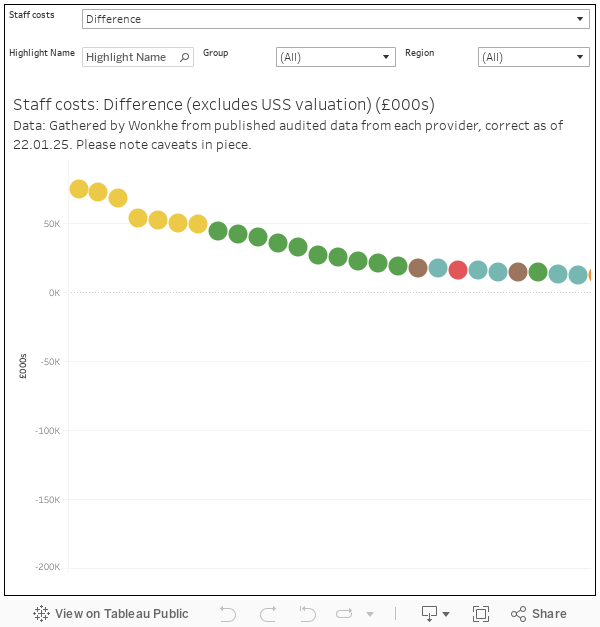
    And here I show underlying changes in staff costs (without the USS valuation effect). This is the raw spend on employing staff, including pay and pensions contributions. A drop could indicate that economies have been sought – employing fewer staff, employing different (cheaper) staff, or changes in terms and conditions. But it also indicates underlying changes in TPS contributions (up) or USS contributions (down) with respect to current employees on those schemes.

    [Full screen]

    Charts updated 11am 27 January to remove a handful of discrepancies.

    Fee income

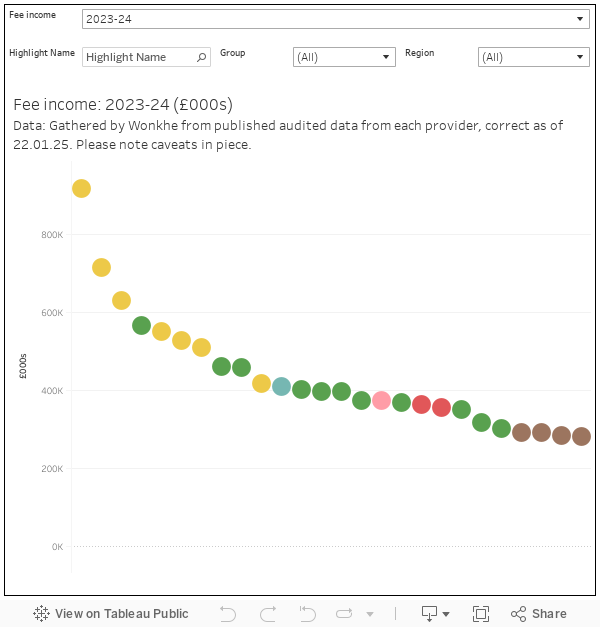
    For most universities the main outgoing is staff costs, and the main source of income is tuition fees. Much has been made of the dwindling spending power of home undergraduate fees because of a failure to uprate with inflation, but this line in the accounts also includes unregulated fees – most notably international fees and postgraduate fees. The full name of the line in the accounts is “tuition fees and educational contracts”, so if your provider does a lot of bespoke work for employers this will also show up here.

    Both of these areas of provision have seen significant expansion in many providers over recent years – and the signs are that 2023–24 was another data point aligned with this trend for postgraduate provision. For this reason, the total amount of fee income has risen in a lot of cases, and when we get provider level UCAS data shortly it will make it clear that just how much of this is due to unregulated fees. International fees are another matter, and again we need the UCAS end of cycle data to unpick it, but it appears from visa applications and acceptances that from some countries (China, for example) demand has remained stable, while for others (Nigeria, India) demand has fallen.

    Here I show fee income for the past two years, and the difference. This is total fee income, and does not discriminate between types of fees.

    [Full screen]

    One very important thing to bear in mind is that these are figures for the financial year, and represent fees relating to that year rather than the total amount of fees per student enrolled. For example, if a student started in January (an increasingly common start point for some courses at some institutions) you will only see the proportion of fees that had been paid by 31 July shown in the accounts. If you teach a lot of nursing students who start at non-traditional times of the year this will have a notable impact, as will a failure to recruit as many international students as you had hoped to do in January 2024 (though this will also show up in next year’s accounts).

    And it is also worth bearing in mind that income from fees paid with respect to students registered at the provider but studying somewhere else via an academic partnership, or involved in a franchise arrangement (something that has seen a lot of growth in some providers) shows up in this budget line.

    Other movements

    Quite a number of providers have drawn down investments or made use of unrestricted reserves. This is very much as you would expect, these are very much “rainy day” provisions and even if it is not actually raining now the storm clouds are gathering. Using money like this is a big step though – you can only spend it once, and the decision to spend it needs to link to plans not to need to spend it in the near future. So even if your balance looks healthy, a shift like this speaks eloquently of the kinds of cost-saving measures (up to and including course closures and staff redundancy) that you may currently see happening around you.

    Similarly, a provider may choose to sell assets – usually buildings – that it does not have an immediate or future use for. The costs of running and maintaining a building can quickly add up – a decision to sell releases the capital and can also cut running costs. Other providers choose to hang on to buildings (perhaps as assets that can be sold in future) but drastically cut maintenance and running costs for this reason. Again, you can (of course) only sell a building once, and a longer term maintenance pause can make it very expensive to put your estates back into use. I should note that the overall condition of university estates is not great and is declining (as you can read in the AUDE Estates Management Report) , precisely because providers have already started doing stuff like this. If the heating seems to be struggling, if the window doesn’t open, that’s why.

    In some cases we have seen decisions to pause capital programmes – not borrowing money and not building buildings as was previously planned. Here, the university makes an on-paper saving equivalent to the cost of finance if it was going to borrow money, or frees up reserves for other uses if it was using its own funds. Capital programmes don’t just include buildings – perhaps investment in software (the kind of big enterprise systems that make it possible to run your university) has been paused, and you are left struggling with outdated or unsuitable finance, admissions, or student record systems.

    Where we are talking about pausing building programmes it is important to remember that these exist to facilitate expansion or strategic plans for growth. The “shiny new building” is often perceived as a vice chancellor’s vanity project – in reality that new business school and the recruitment it makes possible may represent the university’s best hope of growing home fee income faster than inflation.

    What’s next?

    We see financial information substantially after the financial year ends – and for most larger providers this comes alongside the submission of an annual financial return to their regulator. We know for instance that the Office for Students is now looking at ways of getting in year data in areas where it has significant concerns, but financial data (by dint of it being checked carefully and audited) is generally historic in nature.

    For this reason what is happening on your campus right now is something that only your finance department has any hope of understanding, and there may be unexpected pressures currently driving strategy that are not shown (or even hinted at) in last years’ accounts. Your colleagues in finance and planning teams are working hard to forecast the end of year result, to calculate the KFIs (Key Financial Indicators) that others rely on, and to plan for the issues that could arise in the 2025 audit. The finance business partners or faculty accountants – or whatever name they have where you work – will be gathering information, exploring and explaining scenarios, and anticipating pressures that may require a change in financial strategy.

    The data I have presented here is drawn from published accounts – the data submitted to regulators that eventually ends up on HESA may be modified and resubmitted as understanding and situations change – for this reason come the early summer figures might look very different than what are presented here (I should also add I have transcribed these by hand – for which service you should absolutely buy me a pint) – so although I have done my best I may have made transcription errors which I will gladly and speedily correct.

    However scary your university accounts may be, I would caution that the next set (2024–25 financial year) will be even more scary. The point at which the home undergraduate fee increase in England kicks in for those eligible to charge it (2025–26) feels a long way off, and we have the rise in National Insurance Contributions (due April 2025) to contend with before then.

    There are a small but significant number of large providers looking at an unplanned deficit for 2024–25, as you might expect they will already be in contact with their regulator and their bank. Stay safe out there.

    If you are interested in institutional finances, I must insist that you read the superb BUFDG publication “Understanding University Finance” – it is both the most readable and the most comprehensive explanation of annual university accounts you will find.


    Source link