Tag: Reveal

  • What Ofsted inspections reveal about university leadership and culture

    What Ofsted inspections reveal about university leadership and culture

    The arrival of Ofsted inspections of degree apprenticeships in higher education was never going to be smooth. But what’s become clear is just how underprepared some universities were for the emotional and organisational demands that these inspections bring.

    As part of my doctoral research, I conducted a qualitative study, based on 20 semi-structured interviews with academic and professional services (PS) staff from 19 English universities. What I found reveals more than just overstretched teams or complaints about workload. It tells a story of institutional neglect within a sector where the rhetoric is one of apprenticeships being embraced while quietly sidelining the staff delivering this provision.

    As government policy surrounding apprenticeships, flexible/modular provision, and the growth and skills levy starts to become clearer, the findings act as a warning shot. The issues higher education staff face during Ofsted inspections reflect deeper structural and cultural problems – ones that won’t be solved with another “you’ve got this!” email from the vice chancellor’s office.

    A marginalised provision

    Apprenticeships have always had an awkward status in HE. They’re professionally significant and they can attract noteworthy employer relationships, but they remain institutionally peripheral. As one participant put it, “we’ve never been invited to a senior leader’s meeting to talk about apprenticeships.”

    Almost all academic participants described their apprenticeship work as invisible in workload models and poorly understood by senior leaders. One participant reported that they get “50 hours a year to look after apprenticeships, even though I would consider it to be my full-time role.” Another simply said, “we feel like the poor relation.” PS staff described the work during the Ofsted inspection creating “a permanent status of panic” and detailed 12-hour working days that ran through weekends until they were “running on fumes”. One cancelled a long-planned family holiday. Others reported stress-related illness, insomnia, extended sick leave, and the need for medication.

    The most striking point during many of the interviews wasn’t just the volume of work to support apprenticeship delivery or the Ofsted inspection – it was the sense that senior leaders within their institution didn’t acknowledge it or even care.

    Inspections as emotional events

    There are multiple other accountability mechanisms within HE: the Teaching Excellence Framework, the Office for Students’ conditions of registration, the Quality Assurance Agency, the Department for Education apprenticeship accountability framework, and professional accreditation processes. This results in a complex and multi-agency system of regulation and scrutiny. However, among participants, Ofsted inspections weren’t experienced as just another audit or review. They were felt as emotional, personal, a question of professional competence, and in many cases traumatic.

    The anticipation alone triggered stress symptoms and anxiety. One PS participant said:

    Before the inspection started, I was terrified because I was going to be representing my university. What if I get it wrong? I kept feeling sick.

    Another participant feared that the inspection outcome, if unsuccessful, could undermine years of hard work and this loss of control and emotional volatility left them feeling depleted and unwilling to experience an Ofsted inspection again:

    I cannot be here in five years’ time. I’m not going through that again. I had some stress symptoms which didn’t let up for six to eight months.

    Teaching staff viewed the inspection as a test of professional credibility and the emotional toll was compounded by the expectation to present calm professionalism: “I spent time telling everyone to be careful and not let your guard down” while managing their own fears and “the impending pit of doom” and those of their colleagues. Another said: “I was really worried about my colleague being pulled into an observation with an inspector. Her practice is wonderful, but she would have fallen apart. I wanted to protect her wellbeing.”

    The need to “perform professionalism” while internally unravelling created a specific kind of emotional labour which was often invisible to those in leadership roles. It was obvious that participants weren’t just preparing evidence: they were absorbing institutional risk. In doing so, they became the shock absorbers for their university’s unpreparedness.

    The problem isn’t Ofsted, it’s us

    One might assume the findings are a critique of Ofsted. In fact, most participants described the inspectors as “courteous”, “professional”, “kind”, “amazing” or “approachable”. The frustration wasn’t aimed at the inspectors; it was aimed at the system.

    One problem was the mismatch between Ofsted’s frameworks and the reality of delivering apprenticeships in higher education. Teaching staff spoke of “squeezing your programme, pedagogy, everything into an arbitrary box” that didn’t reflect their practice. Others questioned why Ofsted couldn’t operate more like consultants, “sharing best practice and providing exemplars” rather than simply evaluating.

    While almost all participants described inspectors as courteous and supportive, they also expressed concerns about the disempowering effects of inspection dynamics. One noted

    The power dynamic is… ‘If we don’t think you’re good enough, we’re going to close you down’. There are other regulatory bodies that don’t have the ability to put people out of jobs. It’s crazy.

    That perception of existential risk was heightened because many institutions appeared to have no clear inspection plan. No training. No joined-up strategy. “We only got Ofsted training two days before the inspection,” said one participant. Others had to “design and deliver” their own training from scratch “without any support” from their leadership which meant it was difficult to get people to engage with it.

    Teaching staff shared their views that traditional academic CPD (such as research outputs and pedagogic innovation) continues to be prioritised over compliance-linked work like Ofsted inspections, despite the institutional reputational risks:

    If any of us wanted to go off to London to present a research paper, we would have accommodation paid for us, we’d be able to go to that conference, no problem. But if we ask for £150 worth of CPD on how to improve apprenticeship delivery it wouldn’t be allowed. It’s not a business priority.

    Not malicious, just indifferent

    Overall, my research tells a story about institutional neglect. Unlike toxic leadership or micro-management, this form of harm is quieter. It’s not what leaders do; it’s what they fail to do. It’s the absence of engagement and the unwillingness to fund training. Most importantly, it’s the lack of psychological safety during a high-pressured event like an Ofsted inspection. As one participant said, “when the Ofsted inspectors came in, it was really hard to listen to senior leaders talking about how much they support staff… the reality is very different.”

    This isn’t about bad management, it’s about structural marginalisation. Apprenticeship provision was described as falling outside the strategic priorities of some institutions and their senior leaders were perceived as having “no awareness, no understanding” and that they “don’t particularly care about apprenticeships”. Research, undergraduate teaching, and the TEF occupied the centre of institutional gravity. Apprenticeships did not.

    Some participants said they almost wished for a “requires improvement” judgement just to get leadership to take them seriously. One observed:

    I had hoped that we would get ‘requires improvement’ because it would have made senior leadership pay attention to the changes we need to make. Senior staff have this sense of complacency as if the ‘good’ rating shows that we’re fine.

    The government is watching

    With this government promising a reshaping of apprenticeships and skills, and the growth and skills levy pushing modular/skills learning into new territory, the pressures experienced in apprenticeship provision in HE are likely to spread. Inspection and regulation in this space aren’t going away. Nor should they. But my findings suggest the real threat to quality and staff wellbeing is not external scrutiny, it’s internal culture.

    The risks here are reputational and ethical. Strategic responsibility for inspection readiness and staff wellbeing needs to sit at the top table, not with the most overworked and marginalised staff in the room. Here are five things that universities should do, right now:

    Stop marginalising apprenticeship teams. If universities are serious about their current apprenticeship provision and the imminent skills/flexible learning opportunities coming our way, the teams supporting these activities must be embedded into institutional strategy, not treated as marginalised, compliance-heavy provision.

    Build inspection readiness into annual planning, not panic-mode two days before the inspection starts.

    Invest in meaningful CPD for apprenticeships, including training on inspection frameworks, evidence expectations, managing emotional load during inspection periods, and conference attendance for the skills and apprenticeships agenda.

    Create psychological safety. No one should feel personally responsible for the entire institution’s regulatory fate.

    Use governance structures to ask hard questions. Boards and Senates should demand answers: how are we resourcing our skills and apprenticeship provision? What preparations do we have in place for the new skills/modular provision that will inevitably be inspected? Does leadership in schools/faculties understand their skills and apprenticeships provision fully? Do all colleagues get equal access to relevant CPD to do their job effectively?

    Ofsted didn’t bring stress into higher education; it just exposed a stretched system and the fragility of institutional operations and governance which relies on invisible labour.

    With the introduction of the growth and skills levy and a significant shift toward modular and flexible provision, the emotional and operational burdens seen in apprenticeship delivery and Ofsted inspections risk being replicated at scale unless universities adapt. When senior leaders are thinking about the structures and metrics for expanding into new opportunities such as modular/skills provision, they also need to carefully consider culture, responsibility, support, and compassionate leadership.

    If they replicate the same dynamics – underfunded, misunderstood, marginalised, and shouldered by isolated staff – universities risk institutionalising burnout and anxiety as conditions of participation in apprenticeships and skills.

    Source link

  • Reflections on the demand for higher education – and what UCAS data reveal ahead of Results Day 2025

    Reflections on the demand for higher education – and what UCAS data reveal ahead of Results Day 2025


    This HEPI blog was kindly authored by Maggie Smart, UCAS Director of Data and Analysis

    As we pass the 30 June deadline for this year’s undergraduate admissions cycle, UCAS’ data offers an early view of applicant and provider behaviour as we head into Confirmation and Clearing. It also marks a personal milestone for me, as it’s my first deadline release since rejoining UCAS. I wanted to take a deeper look at the data to reflect on how much things have changed since I worked here 10 years ago.

    Applicant demand has always been shaped by two key elements: the size of the potential applicant pool, and their propensity to apply. Since I last worked at UCAS in 2016, these two factors have continuously interchanged over the better part of the past decade – sometimes increasing or decreasing independently but often counterbalancing each other. Let’s take a look at how things are shaping up this year.

    Overall, by the 30 June there have been 665,070 applicants (all ages, all domiciles) this year, compared to 656,760 (+1.3%) in 2024. This is an increase in applicants of over 64,000 since UCAS last reported in January, although the profile of these additional applicants is very different. At the January Equal Consideration Deadline (ECD), over half of the total number of applicants were UK 18-year olds, who are the most likely group to have applied by that stage in the cycle. They represent just 8% of the additional applicants since January, among a much larger proportion of UK mature and international students.

    As we saw at January, the differences in demand for places between young people from the most advantaged (POLAR4 Quintile 5) and most disadvantaged (POLAR4 Quintile 1) areas at June remain broadly the same as last year – with the most advantaged 2.15 times more likely to apply to HE than those from the least advantaged backgrounds, compared to 2.17 last year.

    UK 18-year-old demand

    Demand for UK higher education (HE) has long been shaped by the 18-year-old population – the largest pool of applicants. Despite the well-known challenges facing the HE sector at present, at the 30 June deadline we see record numbers of UK 18-year-old applicants, with 328,390 applicants this year – up from 321,410 (+2%) in 2024. This trend was almost entirely locked in by the January deadline, given the vast majority of UK 18-year-old applicants have applied at this stage in the cycle.

    During my previous tenure at UCAS, the size of the UK 18-year-old population had been falling year on year but from 2020, it began to increase. This continued growth drives the increase in UK 18-year-old applicant numbers we have observed in recent cycles. But when we look at their overall application rate to understand the strength of demand among this group, the data shows a marginal decline again this year – down to 41.2% from 41.9% in 2024. The historically strong growth in the propensity of UK 18-year-olds to apply for HE, which we’ve observed across the last decade, has clearly plateaued.

    This could be due to a range of factors, such as young people choosing to take up work or an apprenticeship, or financial barriers. We know that cost of living is increasingly influencing young people’s decisions this year, with pre-applicants telling us that financial support – such as scholarships or bursaries – ranks as the second most important consideration for them (46%), followed closely by universities’ specific cost-of-living support (34%).

    Interesting to note is the number of UK 19-year-old applicants. When separating the data to distinguish 19-year-olds applying for the first time (as opposed to those reapplying), there has been a decent increase – from 46,680 last year to 48,890 this year (+4.7%). For many years, the number of first-time UK 19-year-old applicants had been falling year on year, but since 2023 this trend has started to reverse. This suggests that demand among young people may be holding up as they decide to take a year out before applying to university or college.

    Mature students

    For UK mature students (aged 21+), the picture looks very different. The number of mature students applying to university or college ebbs and flows depending on the strength of the job market, so since I was last at UCAS, we have typically seen applications decrease when employment opportunities are strong and vice versa. Alongside fluctuations linked to the employment market, rising participation at age 18 means there is a smaller pool of potential older applicants who have not already entered HE. The falling demand from mature students continues in 2025, although in recent years there have been small but significant increases in the volume of mature applicants applying after the 30 June deadline and directly into Clearing. 

    As of this year’s 30 June deadline there have been 86,310 UK mature (21+) applicants, compared to 89,690 (-3.8%) in 2024, meaning a fall in demand compared to the previous year at this point in the cycle for the fourth year in a row. However, whereas at the January deadline mature applicants were down 6.4% compared to the same point last year, at June the figure is only 3.8% down showing some recovery in the numbers. This is another indication that mature students are applying later in the cycle. While it remains too early to say whether we will see continued growth in mature direct to Clearing applicants in 2025, last year 9,390 UK mature students who applied direct to Clearing were accepted at university or college, an increase of 7.4% on 2023 and 22.7% higher than 2022.

    International students

    When looking at the UCAS data through the lens of international students, the landscape has changed significantly since 2016. Brexit led to a sharp decline in EU applicants, offset by strong growth elsewhere, the pandemic caused disruption to international student mobility, and we’ve seen intensified global competition, shifting market dynamics and geopolitics which are increasingly influencing where they choose to study. This year we’re seeing growth once more, with 138,460 international applicants compared to 135,460 in 2024 (+2.2%) – although this stood at +2.7% at January. It should be noted that UCAS does only see a partial view of undergraduate international admissions (we tend to get a more complete picture by the end of the cycle) and we don’t capture data on postgraduate taught and research pathways.

    Interest among Chinese students in UK education has held firm since my time at UCAS, and this year we’re seeing a record number of applicants from China – 33,870, up from 30,860 (+10%) in 2024. This year’s data also shows increases in applicants from Ireland (6,060 applicants, +15%), Nigeria (3,170 applicants, +23%) and the USA (7,930 applicants, +14%). 

    Offer-making

    We are releasing a separate report on offer-making this year, alongside the usual data dashboard for applications. This additional data covers offers and offer rates over the past three years, from the perspective of applicants according to their age and where they live, and from the perspective of providers by UK nation and tariff group.

    What we’re seeing as the natural consequence of increased applications this year is an uplift in offers. Universities have made more offers than ever before this year, with 2.0 million main scheme offers to January deadline applicants overall, largely driven by the rise in UK 18-year-olds applicants (who are the most likely to use their full five choices while applying). This record high surpasses the previous peak of 1.9 million offers set last year (+3.8%).

    While the main scheme offer rate has increased across all provider tariff groups, the most notable uplift is for higher tariff providers – up 3.2 percentage points to 64.4% this year.  Despite the increase in offer rates, higher tariffs do still remain the lowest, partly due to being the most selective institutions. Offer rates by medium and lower tariff providers have also increased, by 0.9 percentage points to 77.0% among medium tariff providers, and by 1.5 percentage points to 81.7% among lower tariff providers. This means that, among those who applied by the Equal Consideration Deadline in January, 72.5% of main scheme applications received an offer this year, also a record high, and 1.8 percentage points higher than in 2024.

    It’s worth noting that we’ll be updating our provider tariff groupings in time for the 2026 cycle, to reflect changes in the higher education landscape.

    Looking ahead

    For students who are intent on going to university or college, it makes this a very good year, with more opportunities than ever before. A record 94.5% of students who applied by the January deadline will be approaching the critical summer period having received at least one offer. High levels of offer-making by universities and colleges typically translates into more acceptances, which should give applicants plenty of confidence heading into results day. 

    I’m delighted to be back at UCAS, and my team will continue to dig further into the data as Confirmation and Clearing draws nearer to see how demand translates into accepted places come results day.

    UCAS

    UCAS, the Universities and Colleges Admissions Service, is an independent charity, and the UK’s shared admissions service for higher education.

    UCAS’ services support young people making post-18 choices, as well as mature learners, by providing information, advice, and guidance to inspire and facilitate educational progression to university, college, or an apprenticeship.

    UCAS manages almost three million applications, from around 700,000 people each year, for full-time undergraduate courses at over 380 universities and colleges across the UK.

    UCAS is committed to delivering a first-class service to all our beneficiaries — they’re at the heart of everything we do.

    Source link

  • National Junior College Athletic Association Head Coaches Reveal Athletic Equity is Present

    National Junior College Athletic Association Head Coaches Reveal Athletic Equity is Present

    Dr. Riann MullisImagine going through a typical work week without a colleague or coworker inserting an analogy or anecdote from sports into the conversation. Regardless of the reason, from comparison to training, or overcoming adversity, “Collegiate athletics have been a part of the American culture since the 1800s” (Lewis, 2013). Sports significantly influence colleges and universities nationwide, acting as a driving force for institutional culture. The National Junior College Athletic Association (NJCAA) is no stranger to cultivating a positive environment for student-athletes. The association has been providing student-athletes with opportunities to compete in collegiate athletics since 1938 (NJCAA, 2025). Community college athletics traditionally have not received the majority of attention from national media; however, discussion is crucial at this foundational level, especially for the more than 45,000 NJCAA student-athletes pursuing academic and athletic opportunities each year.

    Mainstream media’s focus on ticket sales, influential athletes, and comparisons of athletic experience have contributed to a heightened sense of awareness of athletics at all levels. A significant change for athletics occurred more than 50 years when President Richard Nixon signed Title IX of the Education Amendment (Title IX) into law in 1972 (Valentin, 1997). “Implementing Title IX requires institutions to provide equal athletic opportunities for members of both sexes and to accommodate students’ athletic interests and abilities effectively” (U.S. Department of Education [USDE], 2020b).

    Dr. Jennifer SpielvogelDr. Jennifer Spielvogel The ability to conceptualize the similarities and differences of sports becomes critical to recognize what is considered fair opportunities and experiences for student-athletes. This informs the concept of athletic equity. Though major progress has been made since the enactment of this law, questions remain as to what equity looks like in athletics (Jensen, 2022).

    In a recently published study, “The Assessment of Athletic Equity by Head Men’s and Women’s Coaches in the National Junior College Athletic Association”, (Mullis, 2024) head coaches from a variety of NJCAA sports at Division I (DI) and Division II (DII) institutions were surveyed and interviewed to glean their opinions pertaining to implementation and best practices of athletic equity. Questions focused on observations, opportunities, and experiences.

    The NJCAA head coaches’ opinions about athletic equity initially focused on facilities, scholarships, and travel provided for teams. They were asked to assess the level of agreement on a 4-point Likert (1932) scale ranging from 4 (strongly agree) to 1 (strongly disagree) and the mean (M) was calculated for each question. The head coaches assessed facility equity (M = 2.8), scholarship equity (M = 2.8) and travel equity (M = 3.2) at prominent levels, indicating equity is present. The survey data also were disaggregated by team, with no significant differences found from head coaches of men’s and women’s teams in any sport. Further, the coaches agreed that equity is present for all teams at their institutions.

    In the study, head coaches also rank ordered the importance of six distinct coaching roles: advisor, advocate, fundraiser, leader, mentor, and role model. All 192 survey respondents were consistent in ranking leader as the most significant role. The coaches were confident about their relationships and impact on the student-athletes. Most impressively, when interviewed, none of the coaches mentioned wins and losses. Rather, their focus, shared with enthusiasm, highlighted the importance of each of their identified roles and their overwhelming responsibility to advance athletic equity through fair experiences and opportunities for their student-athletes.

    Collectively, the head coaches conveyed enhanced advocacy accountability for their athletes and teams. Case in point, when coaches were asked in the interviews if they had a responsibility to advocate for athletic equity, an NJCAA DII women’s basketball coach confidently expressed:

    Yes. Absolutely. If I do not advocate for my kids [women’s basketball student-athletes], who is going to do that? That is my job. My goal is to make sure they are getting the same treatment the same opportunities that every other sport, whether it be male or female, is getting on campus.

    With similar conviction, when posed the question if he considered himself responsible for advocating for athletic equity, a DII softball coach sharply stated, “No question.” In the interviews many coaches indicated that campus athletic directors and presidents should be involved and aware of athletic needs. From their perspective, there is a need for effective collaboration and communication, as the administration’s decisions can significantly impact the advancement of athletic equity.

    The assessments and opinions from NJCAA DI and DII head coaches offer a never-before-seen insight into athletic equity implementation at the NJCAA level. Continuing the conversations around the best practices of athletic equity through the voice of the coaches is imperative for the future of collegiate athletics. Implementing progressive ideas such as campus forums, shared documentation, and open discussion around the student-athlete and how to best provide equitable experiences for everyone involved will lead to the continuation of athletic equity at the two-year college level.

    Dr. Riann Mullis serves as Athletic Director and Title IX Coordinator at Neosho County Community College (KS).

    Dr. Jennifer Spielvogel serves as Professor of Practice, Community College Leadership Program, Department of Educational Leadership, at Kansas State University.

    The Roueche Center Forum is co-edited by Drs. John E. Roueche and Margaretta B. Mathis of the John E. Roueche Center for Community College Leadership, Department of Educational Leadership, College of Education, Kansas State University.

    References: 

    Jensen, M. (2022, June 23). What would starting Title IX from scratch look like? Philadelphia Inquirer. https://www.inquirer.com/college- sports/title-ix-anniversary-polls-issues 20220623.html 

    Lewis, G. (2013). The beginning of organized sport. American Quarterly, 22(2), 222–229. https://history.msu.edu/hst329/files/2015/05/ LewisGuy-TheBeginning.pdf 

    Likert, R (1932). A technique for the measurement of attitudes. Retrieved May 4, 2025 from https://archive.org/details/likert-1932/ page/14/mode/2up

    Mullis, R. (2024). The assessment of athletic equity by head Men’s and Women’s coaches in the national junior college athletic association (Order No. 31489530). Available from Dissertations & Theses @ Kansas State University; ProQuest One Academic. (3097398397). Retrieved from https://er.lib.k-state.edu/ login?url=https://www.proquest.com/dissertations- theses/assessment-athletic-equity- head-men-s-women/docview/3097398397/ se-2

    National Junior College Athletic Association. (2025). About. History. Retrieved May 4, 2025 from https://www.njcaa.org/about/history/ index 

    U.S. Department of Education. (2020b). Intercollegiate athletics policy: Three part test – part three. https://www2.ed.gov/about/offices/ list/ocr/docs/title9-qa-20100420.html 

    Valentin, I. (1997). Title IX: A brief history. 25 years of Title IX. WEEA Digest. Women’s Educational Equity Act Resource Center at EDC. https://eric.ed.gov/?id=ED414271


    Source link

  • Trump Budget Will Reveal How Extensive ED is Dismantled in 2025

    Trump Budget Will Reveal How Extensive ED is Dismantled in 2025

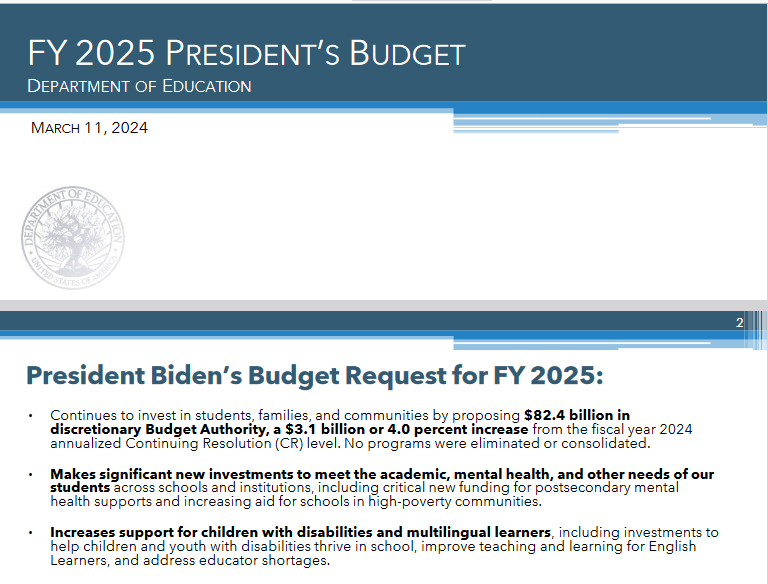
    Some time this March, President Trump’s US Budget proposal will be submitted. It would not be out of the realm of possibility that budget cuts to the US Department of Education exceed 70 percent if the $1.7 Trillion Student Loan Portfolio is transferred to the US Treasury. President Biden’s 2024 Budget for the US Department of Education was published March 11, 2024. This is what the proposal typically looks like.  

    Source link