Tag: RFK

  • Fired CDC director says RFK Jr. aims to change childhood vaccine schedule

    Fired CDC director says RFK Jr. aims to change childhood vaccine schedule

    This audio is auto-generated. Please let us know if you have feedback.

    Health secretary Robert F. Kennedy Jr. plans to soon make changes to the childhood vaccine schedule, according to former Centers for Disease Control and Prevention Director Susan Monarez, who Kennedy ousted from her role earlier this month.

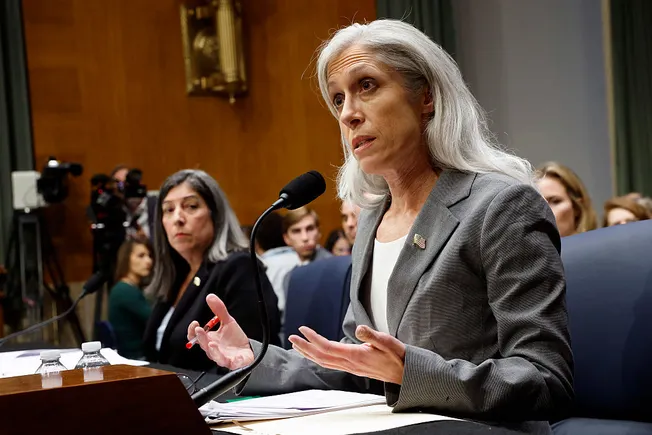
    Monarez informed U.S. lawmakers of Kennedy’s plans Wednesday during a hearing hosted by the Senate Health, Education, Labor and Pensions Committee. The hearing is the first public appearance by Monarez since her firing, which spurred several other high-ranking CDC officials to resign in protest.

    In a Sept. 4 op-ed in The Wall Street Journal and again Wednesday, Monarez said she was removed for refusing to rubber-stamp vaccine guidelines without supportive evidence.

    “He just wanted blanket approval,” Monarez said during the hearing, referring to Kennedy. “If I could not commit to an approval to each of the recommendations, I would need to resign.”

    Monarez said Kennedy plans to change recommendations for childhood vaccinations against COVID-19 and hepatitis B. Both shots will be discussed at a meeting this week of the CDC’s Advisory Committee on Immunization Practices, which is tasked with formulating guidelines.

    “In the first meeting [with Kennedy], he asked me to commit to firing scientists or resign. He asked me to pre-commit to signing off on each one of the forthcoming ACIP recommendations, regardless of whether or not there was scientific evidence.”

    Debra Houry, the CDC’s former chief medical officer who resigned after Monarez’s ouster, also testified at the hearing Wednesday.

    ACIP’s meeting, which will take place Thursday and Friday, will be closely watched. A draft agenda indicates the committee will discuss and vote on guidelines for vaccines against hepatitis B, COVID, and measles, mumps, rubella and varicella.

    Monarez and Houry told senators that they were not aware of any scientific evidence to support changing the age at which children can get those vaccines.

    Sen. Bill Cassidy, R-La, expressed support for the inclusion of the hepatitis B vaccine in the childhood immunization schedule. The shot is recommended for all infants.

    “That is an accomplishment to make America healthy again, and we should stand up and salute the people that made that decision, because there’s people who would otherwise be dead if those mothers were not given that option to have their child vaccinated,” Cassidy said.

    Since becoming head of HHS, Kennedy has remade ACIP, firing its previous 17 members and stacking it with seven advisers he picked. This week, just days ahead of the committee’s meeting, Kennedy added five new members, including individuals whose backgrounds are atypical for the panel. Now among the panel’s members are critics of COVID vaccine policies and skeptics of vaccine technologies like messenger RNA.

    At an earlier meeting in June, the seven advisers first chosen by Kennedy indicated they held doubts about the evidence supporting COVID vaccines and voted to remove a little-used, but controversial preservative that’s been targeted by anti-vaccine groups.

    Typically, CDC working groups prepare data in support of ACIP votes on guidelines. Houry said no working groups besides one for COVID have been convened ahead of this week’s meeting, however.

    Monarez indicated she would be open to changing the childhood vaccine schedules if there was supporting evidence to do so.

    “Kennedy responded that there was no science or evidence associated with the childhood vaccine schedule, and he elaborated that CDC had never collected the science or the data to make it available related to the safety and efficacy,” Monarez said.

    Studies supporting the vaccines included in the childhood immunization schedule are public, and the current schedule has been supported by medical associations.

    “I worry about our medical institutions having to take care of sick kids that could have been prevented by effective and safe vaccines,” Monarez said. “I worry about the future of trust in public health.”

    Source link

  • Pediatricians Back COVID Vaccines, in Split From RFK Jr. – The 74

    Pediatricians Back COVID Vaccines, in Split From RFK Jr. – The 74


    The American Academy of Pediatrics recommends that children ages 6 to 23 months should receive a COVID-19 vaccine.


    Source link

  • RFK Jr. Falsely Claims New Vax Board Member Works at GWU

    RFK Jr. Falsely Claims New Vax Board Member Works at GWU

    Robert F. Kennedy Jr., secretary of the Department of Health and Human Services, falsely said he named a doctor from George Washington University to a federal vaccine advisory board, reported News 4, the NBC affiliate in Washington, D.C. 

    Last Monday, Kennedy, who denies that vaccines are safe and effective and whose department has previously cited fake studies to support parts of its public health agenda, fired all 17 members of the federal Advisory Committee on Immunization Practices. By Wednesday, he posted on X that he had “repopulated” it with eight new members.

    “The slate includes highly credentialed scientists, leading public-health experts, and some of America’s most accomplished physicians,” he wrote. “All of these individuals are committed to evidence-based medicine, gold-standard science, and common sense.”

    One of them, according to Kennedy, is Michael A. Ross, a clinical professor of obstetrics and gynecology at George Washington University and Virginia Commonwealth University, with a career spanning clinical medicine, research and public health policy.

    But a GWU spokesperson told News 4 that Ross hasn’t taught there in eight years; a VCU spokesperson also said Ross hasn’t taught there for four years. Instead, Ross is listed as an operating partner for the private equity fund Havencrest, and his company bio says he “serves on the boards of multiple private healthcare companies.”

    Kennedy’s post on X made no mention of Ross’s current involvement with the company.


    Source link

  • RFK Jr.’s Autism Misinformation Undermines Equity—and the Role of Higher Education

    RFK Jr.’s Autism Misinformation Undermines Equity—and the Role of Higher Education

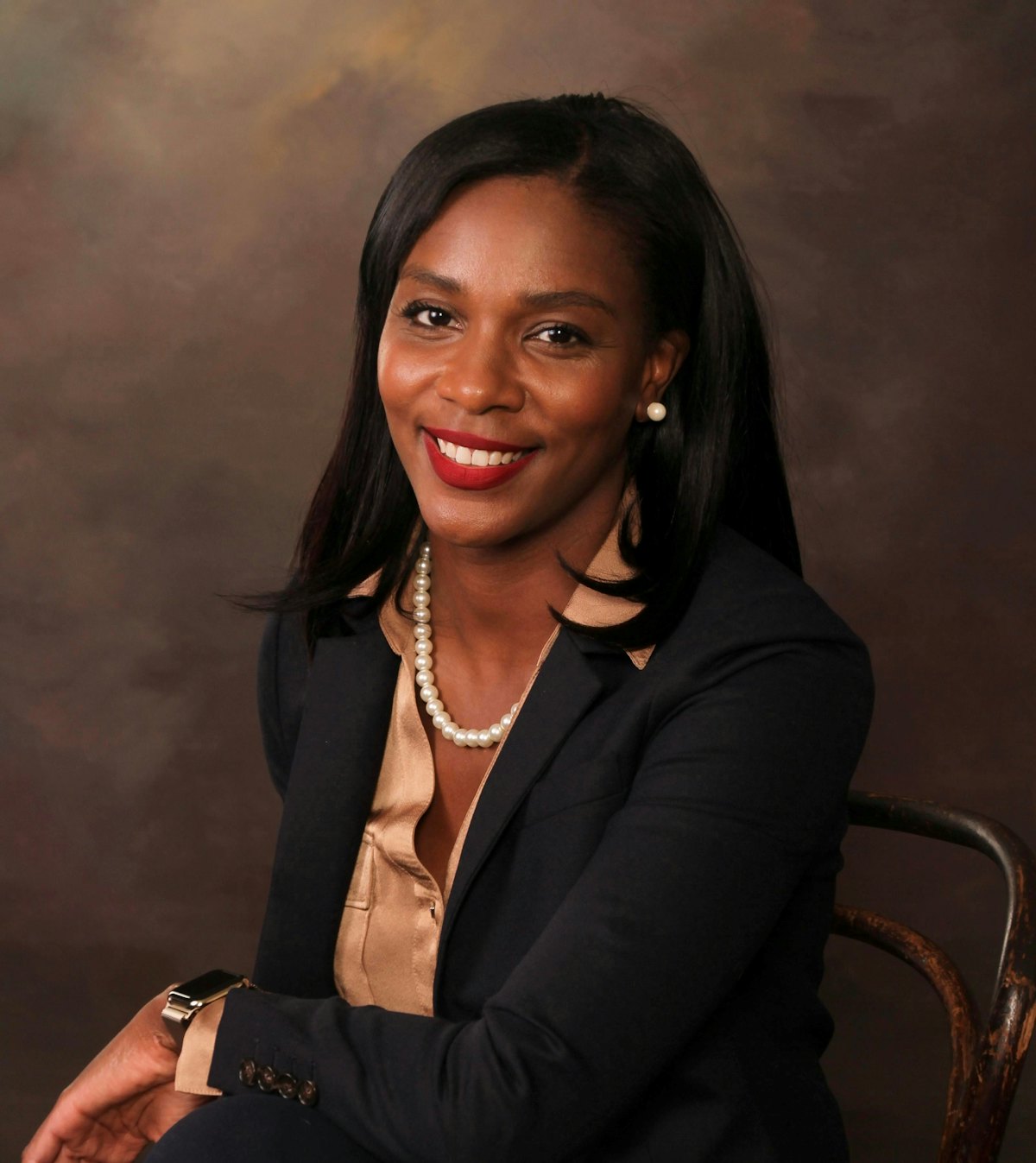
    Dr. Yolanda WigginsRobert F. Kennedy Jr.’s recent claims about rising autism rates directly contradict the findings of a rigorous, peer-reviewed study from the Centers for Disease Control and Prevention. While the CDC attributes the increase to better diagnostic tools and broader awareness—especially among historically underdiagnosed populations—Kennedy has revived a discredited suggestion that environmental factors, including vaccines, may be responsible.

    This isn’t just political theater. It’s part of a broader and troubling pattern: a sustained attack on scientific research, the public institutions that produce it, and the higher education system that trains the researchers behind it.

    As a sociology professor at a public university, I’ve watched with concern as public trust in science and expertise has eroded. The pandemic magnified these trends, but they have long been in motion—accelerated by social media, political polarization, and the growing popularity of conspiratorial thinking. The resurgence of autism misinformation is just the latest iteration.

    The CDC’s study represents the best of public-facing science: it’s evidence-based, transparent, and focused on improving equity. The data show that more children—especially Black, Latino, and low-income children—are finally being diagnosed and receiving support. For decades, these children were overlooked in clinical research and excluded from early intervention programs. Their families often lacked access to diagnostic services, and cultural stigma around disability further compounded delays in recognition and care.

    That makes this progress all the more important. It means health and education systems are becoming more responsive to the needs of diverse communities. It’s a win for public health, for special education, and for racial equity. But Kennedy’s remarks obscure that progress and instead imply institutional deceit, further corroding the already fragile relationship between the public and research institutions.

    This moment should concern everyone in higher education. When research is publicly undermined by powerful voices, it isn’t just scientists or health experts who lose credibility—it’s the entire academic enterprise. Faculty working in controversial or misunderstood fields face online harassment. Public universities face funding cuts. Politicians introduce legislation to restrict what can be taught, who can be included, and which research is “acceptable.” These are not isolated attacks. They are part of a broader campaign to delegitimize the role of higher education in a democratic society.

    We’ve seen it before. Climate science, gender studies, and even basic public health data have been politicized and distorted. In many cases, these attacks are racialized, aimed at scholars of color or those researching topics related to race, equity, and social justice. The goal is not simply to disagree with findings—it’s to sow public doubt about the legitimacy of the research process itself.

    If higher education wants to defend its role in shaping public understanding and policy, we must do more than produce knowledge—we must also protect it. That means publicly pushing back when bad actors distort science. It means communicating our research clearly and accessibly, especially in communities where trust in institutions has historically been low. And it means preparing the next generation of students not only to be critical thinkers, but to be defenders of fact in an era that increasingly devalues it.

    The consequences of not responding are far-reaching. When misinformation takes root, it influences public health decisions, erodes confidence in life-saving vaccines, and increases distrust in institutions we rely on during crises. The damage isn’t abstract—it’s measurable in declining vaccination rates, increased health disparities, and growing skepticism toward experts in medicine, climate science, and education. The ripple effects extend into classrooms, clinics, and communities, where the stakes are all too real.

    It also threatens the progress being made in autism awareness and support, particularly in communities that have only recently gained access to diagnostic and therapeutic services. When Kennedy promotes falsehoods about the cause of autism, he doesn’t just mislead the public—he makes it harder for families to trust medical providers, harder for schools to advocate for neurodiverse students, and harder for researchers to do their work without facing backlash.

    Kennedy’s remarks may seem like a fringe view to those of us working in higher ed. But their reach—and their harm—are real. If we remain silent, we risk allowing misinformation to fill the vacuum we leave behind. That vacuum won’t remain empty. It will be filled with falsehoods that, once embedded in public consciousness, are incredibly difficult to reverse.

    This is a time for the academic community to speak clearly and often. We must show that science is not about dogma—it’s about rigor, peer review, and accountability. We must reaffirm that public universities serve not just students, but society. And we must reclaim our role in informing the public—not just in lecture halls and labs, but in newspapers, social media, and public discourse.

    We can’t afford to treat this moment as politics as usual. It’s a test of our collective commitment to truth, equity, and the public good. The integrity of science—and the credibility of higher education—depends on it.

    Dr. Yolanda Wiggins is an Assistant Professor of Sociology at San José State University.


    Source link

  • Parents, Medical Providers, Vaccine Experts Brace for RFK Jr.’s HHS Takeover – The 74

    Parents, Medical Providers, Vaccine Experts Brace for RFK Jr.’s HHS Takeover – The 74


    Get stories like this delivered straight to your inbox. Sign up for The 74 Newsletter

    While Robert F. Kennedy Jr. ‘s Senate confirmation to head the Department of Health and Human Services was not unexpected, it still shook medical providers, public health experts and parents across the country. 

    Mary Koslap-Petraco, a pediatric nurse practitioner who exclusively treats underserved children, said when she heard the news Thursday morning she was immediately filled with “absolute dread.”

    Mary Koslap-Petraco is a pediatric nurse practitioner and Vaccines for Children provider. (Mary Koslap-Petraco)

    “I have been following him for years,” she told The 74. “I’ve read what he has written. I’ve heard what he has said. I know he has made a fortune with his anti-vax stance.”

    She is primarily concerned that his rhetoric might “scare the daylights out of people so that they don’t want to vaccinate their children.” She also fears he could move to defund Vaccines for Children, a program under the Centers for Disease Control and Prevention that provides vaccines to kids who lack health insurance or otherwise wouldn’t be able to afford them. While the program is federally mandated by Congress, moves to drain its funding could essentially render it useless.

    Koslap-Petraco’s practice in Massapequa Park, New York relies heavily on the program to vaccinate pediatric patients, she said. If it were to disappear, she asked, “How am I supposed to take care of poor children? Are they supposed to just die or get sick because their parents don’t have the funds to get the vaccines for them?” 

    And, if the government-run program were to stop paying for vaccines, she said she’s terrified private insurance companies might follow suit. 

    Vaccines for Children is “the backbone of pediatric vaccine infrastructure in the country,” said Richard Hughes IV, former vice president of public policy at Moderna and a George Washington University law professor who teaches a course on vaccine law.

    Kennedy will also have immense power over Medicaid, which covers low-income populations and provides billions of dollars to schools annually for physical, mental and behavioral health services for eligible students.

    If Kennedy moves to weaken programs at HHS, which experts expect him to do, through across-the-board cuts in public health funding that trickle down to immunization programs or more targeted attacks, low-income and minority school-aged kids will be disproportionately impacted, Hughes said. 

    “I just absolutely, fundamentally, confidently believe that we will see deaths,” he added.

    Anticipating chaos and instability

    Following a contentious seven hours of grilling across two confirmation hearings, Democratic senators protested Kennedy’s confirmation on the floor late into the night Wednesday. The following morning, all 45 Democrats and both Independents voted in opposition and all but one Republican — childhood polio survivor Mitch McConnell of Kentucky — lined up behind President Donald Trump’s pick.

    James Hodge, a public health law expert at Arizona State University’s Sandra Day O’Connor College of Law, said that while it was good to see senators across the political spectrum asking tough questions and Kennedy offering up some concessions on vaccine-related policies and initiatives, he’s skeptical these will stick.

    “Whatever you’ve seen him do for the last 25 to 30 years is a much, much greater predictor than what you saw him do during two or three days of Senate confirmation proceedings,” Hodge said. “Ergo, be concerned significantly about the future of vaccines, vaccine exemptions, [and] how we’re going to fund these things.”

    Hodge also said he doesn’t trust how Kennedy will respond to the consequences of a dropoff in childhood vaccines, pointing to the current measles outbreak in West Texas schools.

    “The simple reality is he may plant misinformation or mis-messaging,” he said.

    During his confirmation hearings, Kennedy tried to distance himself from his past anti-vaccination sentiments stating, “News reports have claimed that I am anti-vaccine or anti-industry. I am neither. I am pro-safety … I believe that vaccines played a critical role in health care. All of my kids are vaccinated.”

    He was confirmed as Linda McMahon, Trump’s nominee to head the Department of Education, was sitting down for her first day of hearings. At one point that morning, McMahon signaled an openness to possibly shifting enforcement to HHS of the Individuals with Disabilities Education Act — a federal law dating back to 1975 that mandates a free, appropriate public education for the 7.5 million students with disabilities — if Trump were to succeed in shutting down the education department.

    This would effectively put IDEA’s $15.4 billion budget under Kennedy’s purview, further linking the education and public health care systems.

    In a post on the social media site BlueSky, Randi Weingarten, president of the American Federation of Teachers, wrote she is “concerned that anyone is willing to move IDEA services for kids with disabilities into HHS, under a secretary who questions science.”

    Keri Rodrigues, president of the National Parents Union and a parent of a child with ADHD and autism, told The 74 the idea was “absolutely absurd” and would cause chaos and instability. 

    Kennedy’s history of falsely asserting a link between childhood vaccines and autism — a disability included under IDEA coverage — is particularly concerning to experts in this light.

    “You obviously have a contingent of kids who are beneficiaries of IDEA that are navigating autism spectrum disorder,” said Hughes, “Could [we] potentially see some sort of policy activity and rhetoric around that? Potentially.”

    Vaccines — and therefore HHS — are inextricably linked to schools. Currently, all 50 states have vaccine requirements for children entering child care and schools. But Kennedy, who now has control of an agency with a $1.7 trillion budget and 90,000 employees spread across 13 agencies, could pull multiple levers to roll back requirements, enforcements and funding, according to The 74’s previous reporting. And Trump has signaled an interest in cutting funding to schools that mandate vaccines.

    “There’s a certain percentage of the population that is focused on removing school entry requirements,” said Northe Saunders, executive director of the pro-vaccine SAFE Communities Coalition. “They are loud, and they are organized and they are well funded by groups just like RFK Jr.’s Children’s Health Defense.”

    Kennedy will also have the ability to influence the makeup of the committees that approve vaccines and add them to the federal vaccine schedule, which state legislators rely on to determine their school policies. Hodge said one of these committees is already being “re-organized and re-thought as we speak.”

    “With him now in place, just expect that committee to start really changing its members, its tone, the demeanor, the forcefulness of which it’s suggesting vaccines,” he added.

    Hughes, the law professor, said he is preparing for mass staffing changes throughout the agency, mirroring what’s already happened across multiple federal departments and agencies in Trump’s first weeks in office. He predicts this will include Kennedy possibly asking for the resignations “of all scientific leaders with HHS.” 

    Kennedy appeared to confirm that he was eyeing staffing cuts Thursday night during an appearance on Fox News’s “The Ingraham Angle.”

    “I have a list in my head … if you’ve been involved in good science, you have got nothing to worry about,” Kennedy said.


    Get stories like these delivered straight to your inbox. Sign up for The 74 Newsletter

    Source link

  • Affirmative Action, DEI Dead? Ask Tulsi Gabbard, Kash Patel, And RFK Jr.

    Affirmative Action, DEI Dead? Ask Tulsi Gabbard, Kash Patel, And RFK Jr.

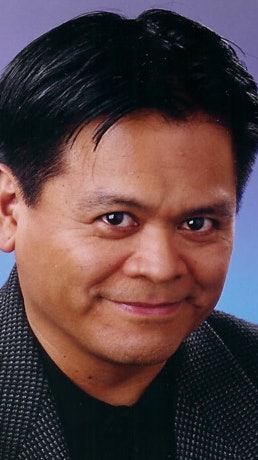
    I feel for Nan Zhong, a Chinese American who is suing the University of California because they rejected his son, Stanley, a child prodigy hired by Google at age 18.Emil Guillermo

    They think we live in a land of meritocracy where affirmative action is dead. Well, it depends on who’s boss. Zhong has accused the UC system and the U.S. Department of Education of discrimination against Asian American applicants, the third of its kind in recent weeks, according to AsAm News.

    Earlier this month, the Students Against Racial Discrimination sued the UC system over its holistic approach to admissions. Another group, The Equal Protection Project sued four Pennsylvania state universities for discrimination against Asians. If you thought the Harvard case which used Asians Americans to end affirmative action last year settled things, you’re wrong.

    Some Asian Americans apparently will keep suing until their kid gets in. No lawyer would take Zhong’s case, so he used AI to file his suit. It’s worth it to Zhong to press on because as he puts it, he’s “really p—sed off.”

    But Zhong’s anger helps exposed how legal discrimination exists and how it’s allowed to happen. And there’s nothing to do about it. Not when it’s dictated from the top.

    TRUMP’S PERSONAL “DEI” LANDSCAPE

    For example, I don’t know any Asian Americans or Native Hawaiians cheering Tulsi Gabbard’s rise to Director of National Intelligence. Maybe Kash Patel—the guy who wants to run the FBI.  Like Gabbard, Patel and let’s include RFK Jr.—the wormhead, former dope addict, and anti-vax mercenary who has now been confirmed to run the Department of Health and Human Services– are all allied. They are three peas in a pod, three objectively unqualified people, who have risen to the top, not because of merit, but because of allegiance to one man, Donald Trump.

    The records of Gabbard, Patel and RFK Jr have all been exposed and are not stellar. Gabbard has never worked for an intelligence agency and is considered by some conservative legislators a dupe for how she has dealt with Russia and Syrian leaders. Would you share secrets with the U.S. with Gabbard at the helm of intelligence?

    Patel has ties to key Jan. 6 figures. He’s been an original denier that Trump lost the 2020 election. But if you think those are partisan issues, then what about just the idea of managing an agency like the FBI. He doesn’t have a resume to match any of the previous FBI directors.

    And then there’s RFK Jr Let’s just say the worm in his brain qualifies him for a disability, mental and physical. If you put aside the controversial issues like vaccinating his kids, but publicly being anti-vax in situations where people have died, just go with his management experience. Has he ever led anything that qualifies him to run an organization with 13 supporting agencies, 80,000 employees, and a budget around $1.7 trillion in mandatory funding, and $130.7 billion in discretionary funding.

    Is he the guy you choose on merit? The answer to RFK Jr is no. As it is for Gabbard and Patel. And the fact is they wouldn’t be hires in a traditional DEI world either, because there are way more qualified people of color to fill the positions. But in this era, they are hires in Trump’s made to order “DEI.” Trump’s pets. They get in when congressional decision makers fold fearing losing their elected positions from candidates funded by the richest man in the world, Elon Musk.

    And this is the model of meritocracy at the federal level that trickles down to higher ed and in private practice? It essentially says what the boss wants goes. It’s more than “who you know.” You have to get to the top person’s approval and give them your undivided loyalty. To the man, not the constitution. And then your owned. It’s antithetical to diversity, equity and inclusion, AND merit. It works well for Trump, but nobody else.

    Look at Pete Hegseth, the former Fox weekend anchor, now Sec. of Defense, now negotiating away Ukraine’s rights as he seeks Trump-Putin’s vision of an end to war. Trump has a younger more telegenic man standing in for him. And the world is a lot worse off. And that’s where we are in these Trump times. It’s sobering. But so is the fact the Harvard case that went all the way to the Supreme Court really didn’t end disputes in higher ed over who gets into the best schools.

    The Asian “winners” weren’t winners after all, in their quest for meritocracy. They were used of course, by the anti-affirmative action folks. Duped. They only want want’s fair. Unfortunately, they were betrayed. I join them in bristling at the headlines about Gabbard and RFK Jr. Meritocracy?

    And I wish Zhong good luck with his suit against UC. At least his son, Stanley, without a degree, has that great job with Google.

    Emil Guillermo is an award-winning journalist, commentator, and adjunct professor. 


    Source link