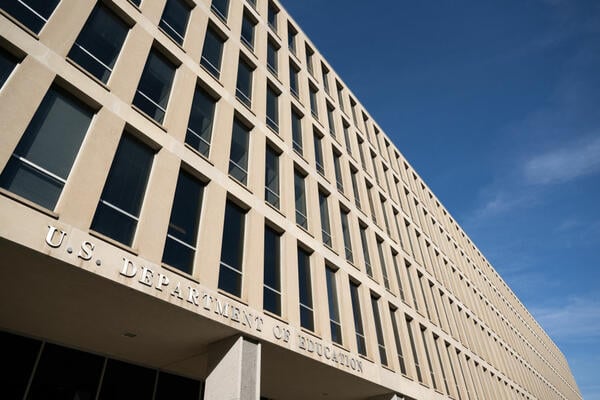
During this tumultuous year at the U.S. Department of Education that saw about half of the 4,133 employees leave due to layoffs, buyouts and early retirements, the staff at the Office of Special Education Programs stayed mostly stable.
That changed on Friday, however, when the Trump administration issued reduction-in-force notices across the federal government, including at the Education Department. Court filings show that 466 employees at the Education Department were impacted and several special education association leaders say most of the OSEP staff was laid off.
On Friday, the department’s press office confirmed that the RIFs affected staff at the Education Department but did not provide more details.
The National Association of State Directors of Special Education, in a statement on Sunday, said informal reports that NASDSE believes to be true indicate that only the two most senior staff remain in OSEP and just one staff member remains in the Rehabilitation Services Administration. Both offices are part of the Education Department’s Office of Special Education and Rehabilitative Services.
NASDSE said it was “confused and concerned” by the staffing changes, adding that the Education Department under the Trump administration has repeatedly said it supports federal funding and implementation of the Individuals with Disabilities Education Act and special education for children with disabilities.
“These RIFs, if true, will make it impossible for the Department to fulfill those responsibilities,” the NASDSE statement said. “There is significant risk that not only will Federal funding lapse, but children with disabilities will be deprived” of a free, appropriate public education.
Like NASDSE, several other organizations in the special education field wondered how the Education Department would support special education services across the country with such a limited staff.
“The rumored near elimination of the Office for Special Education Programs is absolutely devastating to the education of people with disabilities,” said Chad Rummel, executive director of the Council for Exceptional Children, in an email on Saturday.
Rummel said OSEP’s oversight, technical assistance and accountability efforts are critical to supporting the implementation of IDEA, which celebrates its 50th anniversary next month. About 8.4 million infants, toddlers, children and young adults received services under IDEA in 2023.
“Eliminating federal capacity to support IDEA is harmful to people with disabilities, their families, and the professionals who serve them, and it runs counter to everything our members work toward every day,” he said.
Myrna Mandlawitz, policy and legislative consultant for the Council of Administrators of Special Education, said on Sunday that the OSEP staff reductions will put an “extreme burden on states and locals that are already really stretched.”
IDEA, Mandlawitz noted, is implemented collectively by local, state and federal agencies. The federal staff reductions take away “one very vital piece of the partnership. It’s just hard to understand how it can possibly function,” she said.
Promises to protect special education
The RIFs came two weeks into the federal government shutdown that began Oct. 1 as Congress remains at a funding impasse for fiscal year 2026. During the shutdown, the Education Department planned to furlough about 95% of its non-Federal Student Aid staff for the first week, according to a Sept. 28 memo from U.S. Education Secretary Linda McMahon.
Federal staff are not paid during a government shutdown, but typically receive retroactive compensation. However, there are reports that the Trump administration may try to withhold back pay for this current shutdown, according to the American Federation of Government Employees, a union representing over 820,000 workers in nearly every agency of the federal government.
McMahon said in the memo that school systems could still draw down federal grants awarded over the summer and processing would continue for the Free Application for Federal Student Aid. Title I and IDEA grants would be distributed as well.
However, the agency is pausing Office for Civil Rights investigations, new grant-making activities and technical assistance support during the shutdown.
For several months, McMahon has repeatedly told Congress that federal funding for special education activities would be protected. The Trump administration’s proposed FY 26 budget level funded IDEA at $15.5 billion despite an overall 15% drop in the recommended agency budget.
The Education Department, in an April 28 letter to Sen. Lisa Blunt Rochester, D-Del., said no employees in OSEP or at RSA were subject to massive layoffs at the agency that took place on March 11.
Nonetheless, McMahon and Trump have voiced support for moving special education programming out of the Education Department and into the U.S. Department of Health and Human Services. No plan has been publicly released, and opponents say such a move would require congressional approval. Court documents show that between 1,100 and 1,200 employees at HHS were expected to receive RIF notices on Friday.
The broader layoffs and the talk of moving special education programs are in line with vows from candidate and now-President Donald Trump to shutter the Education Department. Trump’s stated aim is to reduce federal bureaucracy and to give states and school districts more authority in education funding decisions.
This summer, about a dozen former federal senior special education officials wrote to Congress urging that lawmakers reject transferring oversight of special education services out of the Education Department. The former officials and others said keeping special education within the Education Department is essential for properly implementing IDEA regulations.
Looking back at OSEP
Before Friday’s RIFs, morale at OSEP was already at a low point, say former OSEP employees and others familiar with the office.
Larry Wexler, who retired last year as OSEP director of research to practice, said he had talked with current and former OSEP employees before and after Friday’s RIFs.
“If the mood could be described as despondent, it would be such an improvement over what it is,” Wexler said on Sunday. “These people are shattered.”
Former and current OSEP staff have also been saddened by the death of long-time OSEP official Gregg Corr, who died Sept. 28 from an aggressive form of lung cancer. His friends, family and former OSEP colleagues gathered for his memorial service Oct. 11 in Washington, D.C., to pay tribute to his life, including his 38 years at OSEP.
When Corr retired from OSEP in December 2024, he said, “My time in OSEP has been nothing short of extraordinary,” according to his obituary. Corr added that during his career he visited nearly every state, connecting with state offices, local programs, parents and advocates.
“These experiences have been deeply inspiring and have strengthened my belief in the importance of the work we do. Hearing firsthand from families about the impact of our efforts has been both humbling and motivating,” Corr said. “Over the years, I’ve witnessed remarkable progress in the field, yet I know there is still so much more to achieve.”