
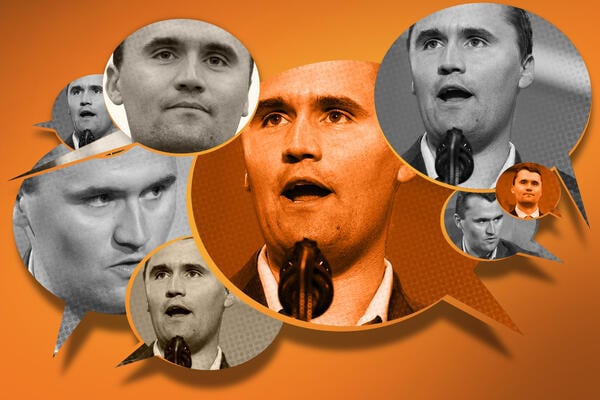
Faculty and staff members at Auburn University, Eastern New Mexico University–Roswell and Coastal Carolina University are among those who have been punished for their comments on Charlie Kirk’s death.
Photo illustration by Justin Morrison/Inside Higher Ed | Anna Moneymaker/Getty Images | Nordin Catic/Getty Images/The Cambridge Union | Andrew Harnik/Getty Images
College faculty and staff members have become popular targets of the right-wing doxing firestorm that ignited in the hours after Charlie Kirk was shot and killed last week during an event at Utah Valley University. As of Thursday afternoon, Inside Higher Ed had identified 37 faculty and staff members who are being harassed online for allegedly critical or insensitive social media posts about Kirk. So far, at least 24 of those employees have been terminated, suspended or put on administrative leave, including employees at Auburn University, Eastern New Mexico University–Roswell and Coastal Carolina University.
The force and scale of the doxing campaigns—and the speed with which institutions have moved to suspend or terminate their targets—paints a grim picture of free speech rights on public college campuses. Widespread doxing as a political tool to punish universities and academics is not a new phenomenon, but right now it’s particularly virulent, explained Keith Whittington, a professor at Yale Law School and an expert on free speech. “The size of the activity, the pressure campaign and the … short period of time is highly unusual,” he said. “Universities feel like they’re under intense pressure to mollify right-wing activists and try not to draw negative attention from the [Trump] administration.”
Most of the higher education targets of doxing campaigns have been identified first by users on X, Facebook or other social media sites. Then anonymous accounts broadcast their name, employer, photo and contact information, along with calls for their firing. A group that calls itself the Charlie Kirk Data Foundation has also asked the public to submit via email or online the names, identifying information and screenshots of any person who has criticized Kirk or appeared to celebrate his death. On Sunday, the group claimed to have received more than 63,000 unique names.
The first call-outs that gained traction were particularly inflammatory. For example, a University of Toronto professor—who has since been placed on leave—posted in a comment on X, “shooting is honestly too good for so many of you fascist cunts.” This type of speech is often “universally condemned,” but it should still be protected by universities committed to First Amendment values, Whittington said. (Or Section 2 of the Canadian Charter of Rights and Freedoms.) Now, doxers are attacking even those who engage in mild criticism of Kirk or his supporters, as well as those who merely quote Kirk’s own views on gun control and other topics in juxtaposition to the news of his death.
“We do seem to see a pattern in which activists are very quickly moving beyond [more egregious] instances to much more marginal cases, where … we might not think that these particular examples of speech violated any widespread view that it is inappropriate or beyond the pale,” Whittington said.
A staff member at Wake Forest University in North Carolina was doxed and later terminated after posting on social media the lyrics, “He had it coming, he had it coming” from the Chicago song “Cell Block Tango.” One University of South Carolina professor was targeted by doxers for a critical Facebook comment about a state representative who supported Kirk and was later relieved of teaching duties because of it. A faculty member at East Tennessee State University was put on administrative leave after posting, “You can’t be upset if one of those deaths in [sic] yours #charliekirk” in response to a news headline that quoted Kirk saying, “It’s worth [it] to have a cost of, unfortunately, some gun deaths every single year so that we can have the Second Amendment.” Inside Higher Ed has opted not to name employees that haven’t been confirmed by their university in order to prevent further harassment.
The number of doxing campaigns targeting educators is on the rise. Experts say higher ed employees can stay safe by keeping work and personal accounts separate, using email masks, and removing personal information from data broker sites. For more tips, see our story here.
So far no higher ed institution has faced as swift and fierce a condemnation from conservatives online as Clemson University, which, in response to the political pressure, has now terminated two faculty members and one staff member over their social media posts about Kirk. An assistant professor at Clemson was among the first to be named and shamed. On Sept. 10, the day Kirk was shot and killed, they posted, “Today was one of the most beautiful days ever. The weather was perfect, sunny with a light breeze. This was such a beautiful day.” Kirk’s supporters interpreted this comment as a celebration of his death. The Clemson professor also reposted jokes about the killing—including “no one mourns the Wicked” and “[N-word] worried about DEI and DIED instead.”
From there, the doxing machine roared to life. The student group Clemson College Republicans was the first to identify the professor and share their posts, according to U.S. representative Russell Fry, whose Sept. 11 post on X about the professor garnered 1.2 million views. The post was amplified by hundreds of right-wing accounts and other politicians, including U.S. representative Nancy Mace, who has commented on and reposted dozens of similar call-outs. Clemson officials issued a statement on Sept. 12, writing that “the deeply inappropriate remarks made on social media in response to the tragic murder of Charlie Kirk are reprehensible and do not reflect the University values and principles that define our University community.” They made no mention of disciplining the employees involved and noted only that the university will “take appropriate action for speech that constitutes a genuine threat which is not protected by the Constitution.”
The pressure campaign continued. Two other employees of the public university—a staff member and another professor—were also targeted for their posts about Kirk’s death, and Republican politicians called for their firing, too. Clemson officials issued another statement a day later, stating that an employee had been suspended and reiterating that officials would take action “in cases where speech is not protected under the U.S. Constitution and the First Amendment.”
The university did not name any employees or say what the suspended employee posted. However, the posts circulating online from the three Clemson employees in question appear to be protected speech, according to the way most First Amendment scholars interpret it.
Over the weekend, U.S. representative Ralph Norman, the X account for the U.S. House Committee on the Judiciary Republicans and Sen. Lindsey Graham of South Carolina joined in the calls for the employees’ firing, and some politicians called for the State Legislature to defund Clemson. So did President Donald Trump, who reposted a Truth Social post from South Carolina state representative Jordan Pace that said, “Now Clemson faculty is inciting violence against conservatives. It’s time for a special session to end this. Defund Clemson. End Tenure at State colleges.”
Clemson officials did not respond to Inside Higher Ed’s request for comment. The university’s academic freedom policy for faculty states, “When they speak or write as private persons, faculty shall be free from institutional censorship or disciplinary action, but they shall avoid creating an impression that they are speaking or acting for the University.” The Faculty Handbook doesn’t outline any clear exceptions to this rule but does note that “as professional educators and academic officers, they are aware that the public may judge their profession and their institution by their utterances. Hence, faculty members should endeavor to be accurate, to exercise due restraint, to show respect for the utterances of others, and, when appropriate, to indicate that they are not officially representing Clemson University.”
On Monday, Clemson announced it had terminated the staff member and removed both faculty members from their teaching duties. By Tuesday, all three employees had been terminated. South Carolina attorney general Alan Wilson told Clemson’s president he had the “full legal authority” to terminate the employees, writing in a statement, “The First Amendment protects freedom of speech, but it does not shield threats, glorification of violence, or behavior that undermines the mission of our state institutions.” This contradicts what experts at the Foundation for Individual Rights and Expression and other free speech experts have said in recent days: that speech, even if it’s poorly timed, tasteless, inappropriate, controversial or a nonspecific endorsement of violence, is protected by the U.S. Constitution.
While these name-and-shame campaigns constitute a particularly harsh attack on campus speech, they are nothing new. In fact, they’ve increased in frequency since 2023, when many pro-Palestinian academics were targeted, said Heather Steffen, a humanities professor at Georgetown University and director of the American Association of University Professors’ Faculty First Responders group.
“Faculty who speak about certain issues have been more vulnerable to doxing for a long time,” Steffen said. “So anyone who talks about issues of race or racism, gender and sexuality, or Palestine tends to be more likely to be doxed or somehow otherwise attacked in a politically motivated fashion, as do academics who are faculty of color, or queer faculty, or trans faculty or pro-Palestinian faculty.”
Ultimately, it’s not about what the employees said, Whittington explained. It’s about the political outcomes.
“This is primarily about exercising political power and trying to silence and suppress people who disagree with you politically,” he said. “It doesn’t matter that the offense is trivial … What matters is you’re identifying people that you politically disagree with and you have a moment in which you can exercise power over those people. And there are lots of people willing to take advantage of those opportunities.”

The modern EdTech industry is often portrayed as a neutral, innovative force, but its origins are deeply political. Its growth has been fueled by a fusion of neoliberal economics, right-wing techno-utopianism, patriarchy, and classism, reinforced by racialized inequality. One of the key intellectual architects of this vision was George Gilder, a conservative supply-side evangelist whose work glorified technology and markets as liberating forces. His influence helped pave the way for the “Gilder Effect”: a reshaping of education into a market where technology, finance, and ideology collide, often at the expense of marginalized students and workers.
The for-profit college boom provides the clearest demonstration of how the Gilder Effect operates. John Sperling’s University of Phoenix, later run by executives like Todd Nelson, was engineered as a credential factory, funded by federal student aid and Wall Street. Its model was then exported across the sector, including Risepoint (formerly Academic Partnerships), a company that sold universities on revenue-sharing deals for online programs. These ventures disproportionately targeted working-class women, single mothers, military veterans, and Black and Latino students. The model was not accidental—it was designed to exploit populations with the least generational wealth and the most limited alternatives. Here, patriarchy, classism, and racism intersected: students from marginalized backgrounds were marketed promises of upward mobility but instead left with debt, unstable credentials, and limited job prospects.
Clayton Christensen and Michael Horn of Harvard Business School popularized the concept of “disruption,” providing a respectable academic justification for dismantling public higher education. Their theory of disruptive innovation framed traditional universities as outdated and made way for venture-capital-backed intermediaries. Yet this rhetoric concealed a brutal truth: disruption worked not by empowering the disadvantaged but by extracting value from them, often reinforcing existing inequalities of race, gender, and class.
The rise and collapse of 2U shows how this ideology plays out. Founded in 2008, 2U promised to bring elite universities online, selling the dream of access to graduate degrees for working professionals. Its “flywheel effect” growth strategy relied on massive enrollment expansion and unsustainable spending. Despite raising billions, the company never turned a profit. Its high-profile acquisition of edX from Harvard and MIT only deepened its financial instability. When 2U filed for bankruptcy, it was not simply a corporate failure—it was a symptom of an entire system built on hype and dispossession.

2U also became notorious for its workplace practices. In 2015, it faced a pregnancy discrimination lawsuit after firing an enrollment director who disclosed her pregnancy. Women workers, especially mothers, were treated as expendable, a reflection of patriarchal corporate norms. Meanwhile, many front-line employees—disproportionately women and people of color—faced surveillance, low wages, and impossible sales quotas. Here the intersections of race, gender, and class were not incidental but central to the business model. The company extracted labor from marginalized workers while selling an educational dream to marginalized students, creating a cycle of exploitation at both ends of the pipeline.
Financialization extended these dynamics. Lenders like Sallie Mae and Navient, and servicers like Maximus, turned students into streams of revenue, with Student Loan Asset-Backed Securities (SLABS) trading debt obligations on Wall Street. Universities, including Purdue Global and University of Arizona Global, rebranded failing for-profits as “public” ventures, but their revenue-driven practices remained intact. These arrangements consistently offloaded risk onto working-class students, especially women and students of color, while enriching executives and investors.
The Gilder Effect, then, is not just about technology or efficiency. It is about reshaping higher education into a site of extraction, where the burdens of debt and labor fall hardest on those already disadvantaged by patriarchy, classism, and racism. Intersectionality reveals what the industry’s boosters obscure: EdTech has not democratized education but has deepened inequality. The failure of 2U and the persistence of predatory for-profit models are not accidents—they are the logical outcome of an ideological project rooted in conservative economics and systemic oppression.

Hillsdale College—a small, private Christian liberal arts institution in Michigan—has increasingly turned to digital advertising, including Microsoft’s MSN platform, to extend its reach and solicit donations. Known for its conservative ideology and its refusal to accept any federal or state funding, Hillsdale is relying more than ever on mass digital engagement to sustain its growing national influence.
Hillsdale sponsors content across digital news aggregators like MSN using native advertising platforms such as Taboola. These sponsored links promote Hillsdale’s free online courses in subjects like the U.S. Constitution and Western political philosophy. Readers who click are typically prompted to provide an email address, after which they are placed into a recurring stream of newsletters and donation appeals. Hillsdale’s marketing strategy combines educational branding with ideological and political themes designed to deepen audience loyalty and increase donor conversion.
The school’s strategy is informed by its unique financial model. Unlike most colleges, Hillsdale accepts no Title IV federal funds and avoids other forms of government support. While this independence allows Hillsdale to circumvent Department of Education oversight, it also necessitates a highly developed fundraising operation. Hillsdale reportedly raises between $100 million and $200 million annually through private donations, which support its growing campus, online educational infrastructure, Imprimis publication, and a national network of affiliated classical charter schools.
Hillsdale’s digital fundraising and brand-building efforts align closely with its broader ideological mission. On February 19, 2025, Turning Point USA founder Charlie Kirk delivered a keynote lecture at Hillsdale’s National Leadership Seminar in Phoenix. Titled “Hitting the Ground Running: The Trump Transition and Early Priorities,” the event illustrated how Hillsdale fuses academic outreach with conservative political messaging. The speech was promoted on Hillsdale’s social media platforms and streamed via its Freedom Library website.
[Charlie Kirk speaks at Hillsdale College in February 2025.]
Hillsdale’s collaboration with platforms like MSN reflects a wider shift in how politically-aligned institutions use digital media ecosystems to bypass traditional gatekeepers. Because MSN blends sponsored content into its main news feed using algorithmic curation, promotional material from ideological institutions can appear alongside conventional journalism—without the benefit of editorial transparency or disclaimers. For Hillsdale, this means access to millions of readers, many of whom may not realize they’re engaging with sponsored political content masked as civic education.
This convergence of ideology, education, and marketing raises critical questions about the future of higher education outreach and the role of big tech platforms in shaping political narratives. Hillsdale’s success in these spaces underscores how easily lines between education, influence, and revenue can blur in the digital age.
Sources
https://online.hillsdale.edu/courses/promo/constitution-101
https://freedomlibrary.hillsdale.edu/programs/national-leadership-seminar-phoenix-arizona/hitting-the-ground-running-the-trump-transition-and-early-priorities
https://about.ads.microsoft.com/en/solutions/ad-products-formats/display
https://www.hillsdale.edu/about/frequently-asked-questions/
https://en.wikipedia.org/wiki/Hillsdale_College
https://imprimis.hillsdale.edu
https://www.facebook.com/hillsdalecollegemichigan/posts/livestream-today-1000-pm-et-watch-charlie-kirks-speech-hitting-the-ground-runnin/905074171834140
