The campus, set to be established in the capital of Colombo with its first intake by mid-2026, will initially offer courses in business and early childhood education, with programs in IT, psychology, engineering, and health “earmarked” for future expansion.
“We are excited to bring Charles Sturt’s world-class courses to students in Sri Lanka. It will also facilitate new and valuable academic and research connections and build greater awareness of Charles Sturt University and our regional communities internationally,” stated Charles Sturt vice-chancellor, Renée Leon.
Despite over 160,000 Sri Lankan students seeking tertiary education each year, roughly three-quarters miss out due to limited spaces across just 20 public universities.
But with a private education market worth over USD$1.1 billion and more than 60,000 Sri Lankan students pursuing transnational education (TNE) each year, Charles Sturt University aims to make its programs more accessible while generating revenue that can be reinvested into its regional education mission.
“The benefits of this venture are not limited to the students in Sri Lanka and the skills and knowledge they will bring to their nation’s workforce,” Leon said.
“This vital and underfunded regional mission remains at the heart of Charles Sturt. It is why we are here and why we are important.”
It (Sri Lanka campus) will also facilitate new and valuable academic and research connections and build greater awareness of Charles Sturt University and our regional communities internationally
Renée Leon, Charles Sturt
The university will lean on Prospects Education for its TNE delivery in Sri Lanka, similar to its longstanding China Joint Cooperation program, another key TNE venture.
According to Mike Ferguson, pro vice-chancellor (international) at Charles Sturt, the new Sri Lanka campus “will create high-quality university places in areas of skills priority, aligning closely with the Australian government’s priorities”, he said in a post on LinkedIn.
Sri Lanka already hosts two Australian institutions: Edith Cowan University, launched in August 2023, and Curtin University in December 2024. Australia’s TNE enrolments in Sri Lanka reached 3,145 in 2022.
When the Independence School District announced it was switching to a four-day week during the 2023-24 school year, it drew questions from local families and statewide officials.
Parents wondered what kind of child care they would have on days without classroom instruction. And lawmakers debated whether the state needed to intervene.
Ultimately, Missouri’s General Assembly passed a law requiring a vote for non–rural school districts to authorize a four-day week.
On Tuesday, the Independence and Hallsville school districts became the first large districts to receive the approval of voters to continue with four-day weeks.
“I knew that the majority of our community supported it,” Hallsville Superintendent Tyler Walker told The Independent. “I was a little bit surprised to see how much support it was.”
In Hallsville, residents had two questions on the ballot related to the school district. One asked about the four-day week and the other was a bond measure previously passed in April but not confirmed by the State Auditor.
The election drew 25% of registered voters, according to the Boone County Clerk, and 75% of those voted in favor of the four-day school week. The vote authorizes the schedule for the next 10 years, when then the district will have to hold another special election.
Walker didn’t think the margin would be that wide. Earlier surveys from the district’s 2022 adoption of the schedule put approval at around 60%.
He believes that the district’s growing success on standardized tests and other publicly available metrics have given families confidence that the four-day week isn’t such a bad thing.
“Our community has grown to appreciate the four day week more after experiencing it for a few years,” he said.
Todd Fuller, director of communications for the Missouri State Teachers Association, told The Independent that voters in districts who have already been operating in a four-day week like Independence and Hallsville have an idea of how it works for their students. The state law, passed in 2024, will require a vote prior to the schedule’s adoption for those who do not already adopt the abbreviated week.
“Anyone who’s a constituent of the district has had time to digest this process, and they’ve been able to decide over a two-year period whether it’s been beneficial or not beneficial for their kids,” Fuller said. “So if they are expressing that feeling with their vote, then we’re going to have a pretty good understanding of what they really want.”
The association doesn’t have an official stance on the four-day week. But Fuller said the teachers it represents have been pleased with the schedule.
Jorjana Pohlman, president of Independence’s branch of the Missouri National Education Association, told The Independent that the overall sentiment is positive from the district’s educators.
Mondays out of the classroom have become a good time for teachers to have doctor’s appointments, spend time with their families and plan for the week ahead, she said.
“In the beginning, it was fear of the unknown for families as well as teachers,” she said. “A lot of teachers had the attitude of, ‘Let’s try it.’ They, I think overall, felt it was a positive thing.”
A study by Missouri State University researchers looked at recent applicants to teaching positions in Independence, finding that the four-day week was a key part of the district’s recruitment.
In particular, 63% of applicants rated the four-day schedule as a top-three reason for applying, and 27% said it was their top priority.
The study also looked at the value of the four-day week for applicants, asking how much they would sacrifice in salary to work at a district with the schedule. On average, applicants were willing to sacrifice $2267 annually for the four-day week.
Walker said the schedule has also improved recruitment in Hallsville, with a dramatic uptick in veteran teachers applying to positions.
With teachers coming to Independence schools particularly for their schedule, some worried that returning to a five-day week would have large consequences for staffing. But Pohlman said a survey showed that the loss of educators is less than many would think.
“The educators, they care deeply about their students, and they want what’s best for students and for the community, whether it’s four day week or five day week,” she said. “They are still going to be committed.”
Almost a third of Missouri districts have adopted a four-day week, with around 91% of those districts in rural settings. Only districts in cities with at least 30,000 residents, or those located in Jackson, Clay, St. Louis, Jefferson and St. Charles counties, must call for a vote before moving to a four-day week.
Missouri Independent is part of States Newsroom, a nonprofit news network supported by grants and a coalition of donors as a 501c(3) public charity. Missouri Independent maintains editorial independence. Contact Editor Jason Hancock for questions: [email protected].
Did you use this article in your work?
We’d love to hear how The 74’s reporting is helping educators, researchers, and policymakers. Tell us how
For the past twelve months, the National Coordinating Centre for Public Engagement has been leading a project to reimagine the future of the engaged university: Engaged Futures. It’s been a rollercoaster ride, taking in everything from the baked-in prejudices of our sector, to debating the very purpose of higher education.
And it feels that this is the right time to ask that question, as universities seek to change, diversify, remodel and restructure. What is the purpose at the heart of our universities? Is it the same regardless of type, or size, or age of institution? Is it something set in stone at inception, or can it be remoulded by leadership teams?
And crucially, is it fit for purpose?
As a sector we have always talked a good game about being integral to the success of our region, whether we call this place-based, civic or “locally-rooted”, or are badged as an “anchor institution”. Show me a university that hasn’t made this claim.
I would argue that this is the very purpose of the university. Universities should be rooted in their region; responsive and reactive, open and honest; curators of conversations and collaborations; compassionate nurturers; apolitical agents of change.
Cohesion with place
But there is evidence that this work is taking a back seat as the sector grapples with financial challenge and looks for new ways to operate. The National Civic Impact Accelerator report on the “fragile foundations of civic” shone a light on the quiet diminishing of the civic commitment, with work moving under the umbrella of public affairs, or innovation, or marketing. And civic university agreements left on the shelf for later.
It remains to be seen if transformative measures such as mergers, the creations of super universities, takeovers by private providers and (hopefully not) provider closures, take universities further away from this work.
At the Labour party conference, the phrase of the moment was “social cohesion”. Politicians are talking about how to rebuild civic pride – in fact, they are actively directing funds to this. But there is no mention of the role of universities in delivering this type of social impact, despite all the fanfare of the civic movement.
So in this space, let’s consider an alternative transformational model: the local university. Local isn’t a word you hear very often in universities, with “globally-connected”, “world-leading” and “internationally-recognised” being preferred terms.
A local, social purpose university, would build on the university centre model we have seen operate effectively in cold spots such as Scarborough.
But I would take this one step further, envisaging an institution so deeply knitted into its place, that the campus and community interact seamlessly.
Another kind of merger
As our university campuses have expanded, filled with multimillion-pound pioneering buildings, our high streets have decayed, public spaces have closed and communities have fractured. Local offerings, such as libraries, community centres and even banks have shut up shop.
Rather than developing shared services with another university, perhaps instead a university could merge with its place? There are assets, facilities and buildings that could work for both students and residents. Activities that could leave campus and take place in spaces that would otherwise be closed, to an augmented audience. And costs could be shared with other public sector organisations, providing the much needed savings to the public purse.
Beyond the physical assets, consider business operations – the social purpose university would make intentional decisions about partnerships, procurement, campus developments and ensure that purpose stands alongside profitability. Spending locally, lobbying for improvements in infrastructure, listening and being open to change. There might even be a residents’ panel, feeding into decision-making… or is that a dream too far?
Willingness to change
What would we need for this to be successful? Well, a shift in the success criteria for a start. Like it or not, the metrics that the sector is judged by would need to change, as outcomes for the local university are unlikely to be the same as the super-university. We would need a broader way of speaking about our sector, of acknowledging the ecosystem of higher education that doesn’t slip into hierarchy. And we’d need to be willing to change, evolve and work in genuine co-creation.
Throughout Engaged Futures – a conversation there is still the opportunity to contribute to – we have looked at the art of the possible and are now sketching a blueprint for a different higher education experience.
One which is genuinely inclusive, not simply ticking boxes and publishing policies. One which is accessible to all, without the deep-rooted hierarchies that make it harder for everyone to find their space. One which values all forms of knowledge, wherever and however it is created. One that makes space for compassion, is self-reflective, accepts criticism and challenge.
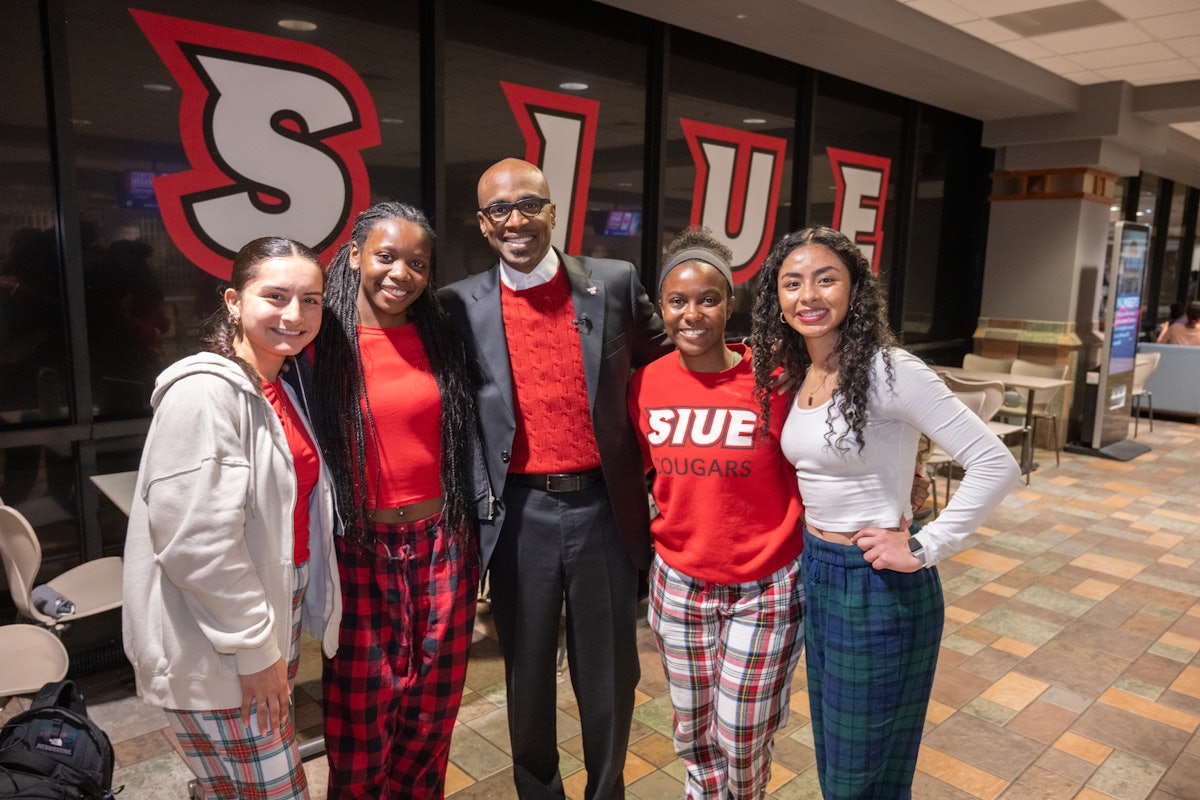
The second line band’s brass instruments gleamed in the morning sun as they led nearly a thousand first-year students out of the Vadalabene Center arena. The festive New Orleans style procession wound its way across Southern Illinois University Edwardsville’s campus, past the towering Cougar statue where students would soon gather for their traditional class photo. Parents lined the walkway, some having extended their stay just to witness this moment—their children’s ceremonial entry into college life.
Among the crowd, one mother approached Dr. James T. Minor with tears in her eyes.
“That’s my son,” she said, pointing to a young man adjusting his position for the photo. “This is so great. I can’t believe what you’re doing. I’m so proud of him.”
Dr. James Minor talking to a SIUE student. For Minor, SIUE’s first African American chancellor, this moment embodied everything he hopes to achieve at the institution he has led since March 2022. A Detroit native with a Ph.D. from the University of Wisconsin-Madison and a distinguished career spanning federal government, the California State University system, and scholarship in educational policy, Minor brings both academic rigor and practical experience to his transformational vision.
“This is as close as I get to what’s truly special about university communities,” he reflects on the school’s most recent convocation. “You’ve got thousands of young people who have made a decision about their life—that they’re going to pursue a college degree—and the university has a responsibility to facilitate that.”
But behind this celebratory scene lies a story of dramatic transformation, one that has seen SIUE emerge from serious fiscal challenges to become a model for how regional public universities can thrive in challenging times.
A $18 Million Wake-Up Call When Minor arrived on campus in March 2022, he brought credentials that positioned him uniquely for the challenges ahead. As the 10th chancellor in SIUE’s history, his appointment followed distinguished service as deputy assistant secretary at the Department of Education, where he administered more than $7 billion in federal higher education programming. His most recent role as assistant vice chancellor and senior strategist at California State University—where he helped achieve the system’s highest graduation rates in history and secured hundreds of millions of dollars for graduation initiatives—prepared him for the complex work of institutional transformation.
But even this impressive background couldn’t ready him for what he discovered within his first 45 days: an $18 million structural deficit that had been masked by years of poor budget practices.
“I was giving a university budget presentation that was not particularly pleasant,” Minor recalls of those early days in his tenure. “That was not on my list of things to do in the first 100 days—to organize and understand this structural deficit, communicate it to the university community, and then lay out a plan for managing it.”
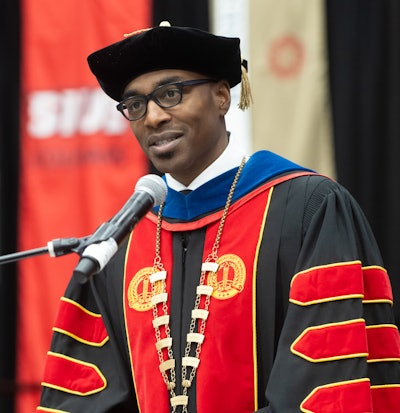
Dr. James T. Minor at commencement.The distinction between a structural deficit and a spending deficit became crucial to Minor’s communication strategy. Unlike a simple overspend that could be corrected immediately, SIUE faced a fundamental mismatch between fixed expenses and revenue. The number of people, buildings, and courses— the structural components of the budget—exceeded revenue by roughly $18 million.
“We had available cash sources and other things that we could manipulate to cover it,” Minor explains. “We operated that way for a number of years before I arrived, but we all know that’s not sustainable.”
The solution required what Minor calls “environmental responsiveness”— the ability of institutions to expand and contract according to changing conditions. This meant making hard choices about class sizes, graduate assistantships, and operational efficiencies that some within the university community initially resisted.
Fast forward to September 2025, and Minor will soon announce to the campus community that SIUE has effectively resolved its structural deficit, maintains one of the best cash positions among Illinois universities, and accomplished this transformation without spending a single dollar from its cash reserves.
Building a Culture of Student-Centered Data Perhaps even more significant than the financial turnaround has been Minor’s campaign to make SIUE fluent in its own student success metrics. When he arrived, he was stunned by what he discovered during informal surveys of faculty and staff.
“I would walk into a room and ask, ‘Who here can tell me our four-year and six-year graduation rates?’” Minor recalls. “These are people who presumably should have an idea— people who work here, not people shopping at Target or in the grocery store. I would ask about our first-to-second-year retention rate, and it wasn’t meant to embarrass people. It was to underscore the lack of awareness we had as a university community about the most important thing we do.”
Today, when Minor walks into any room on campus, hands shoot up when he asks those same questions. “People expect the question,” he says with satisfaction. “I have promised them, I don’t care if we’re talking about the paint in the stairwell, I will start every conversation here at the university about our student outcome data.”
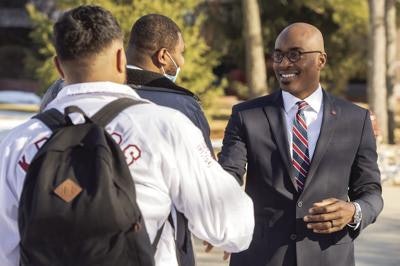
Dr. James Minor meeting students on campus.This data-driven approach has yielded measurable results for the institution that boasts more than 12,000 students. First-to-second-year retention rates have increased, graduation rates have ticked up, and the university is expecting growth—a major accomplishment in today’s challenging enrollment environment.
Dr. Robin Hughes, dean of the School of Education, Health and Human Behavior, sees Minor’s unique combination of scholarship and leadership as precisely what SIUE needed.
“Chancellor Minor is by far what most institutions look for and want in an organizational leader,” Hughes observes. “He is a distinguished scholar whose work focuses on the study of higher education organizations. He is also an experienced organizational leader who brings both academic insight and institutional expertise to his work. A strong advocate for students, he makes organizational decisions that positively impact their success both during their studies and beyond.”
Dr. Jessica Harris, acting chief of staff and vice chancellor for Anti-racism, Diversity, Equity and Inclusion, chaired the search committee that brought Minor to SIUE.
“I remember reading his cover letter and saying to my mom, ‘I think this is our next chancellor,’” Harris recalls. “Every accomplishment he talked about in his career was about how it positively impacted or transformed the experience for students. That was a consistent thread throughout his cover letter.”
Nearly four years into his tenure, Harris sees that student-centered focus as the driving force behind institutional change.
“One of the major shifts I’ve seen is a very clearly articulated and collective focus on student success,” she explains. “Not that it wasn’t a commitment before, but there’s a level of intentionality I didn’t see across all areas before he started. Every presentation starts with mission—this is why we’re here, these are our enrollment numbers, retention and graduation numbers. He keeps it front of mind for us.”
Dr. Earleen Patterson, associate vice chancellor for Student Opportunities, Equity, Diversity and Inclusion, has witnessed this transformation firsthand.
“There’s a reason I’m still here,” she says of her longevity at the university that began in 1990. “Over the course of time, I’ve seen a lot of evolution of this journey of progress toward being inclusive, toward offering opportunities to every sector of our population.”
The results are visible in SIUE’s incoming class, which Patterson describes as having “the highest African American enrollment in the history of the university.” This fall’s freshman class includes nearly 600 Black students in the Boundless Scholars Experience alone—a comprehensive academic program designed to promote belonging, academic achievement and degree completion. At a time when voices opposing diversity, equity and inclusion efforts grow louder across the higher education landscape, SIUE has chosen to double down on its mission, letting results speak louder than rhetoric.
The focus on student success extends far beyond enrollment numbers. Patterson describes a comprehensive approach to retention that begins before students even attend their first class. The Boundless Scholars Experience moved students in early, gathering them with their families in the campus ballroom for what Patterson calls “real talk” about college expectations.
“What they saw was a room that reflected who they are,” Patterson explains. “But we let them know, come Monday, as you walk out into the university community, you may be the only one in your biology course, in your chemistry course, in your economics course. But you have a community, you have a village.”
This village includes strategic course placement with faculty who are particularly effective with first-year students, early warning systems that track attendance and performance, and support staff who can call students by name when they miss class.
“It marvels them when they come into my office, and I already know you missed chemistry on Tuesday,” Patterson says with a chuckle. “They’re like, ‘How do you know?’ I care enough to know about that—about all of these students.”
For Dominic Dorsey, president of the Black Faculty and Staff Association and director of the Access (Disability Services) Department, representation at the leadership level makes a tangible difference for students.
“We’ve been blessed not just to have Dr. Minor as our first Black chancellor, but to have a chancellor that’s an actual thought leader and transformational in the truest sense of the word,” he says.
Dorsey’s own department has seen dramatic growth, with registered students with disabilities increasing from about 650 when he arrived in 2018 to nearly 1,400 today. This growth reflects SIUE’s broader commitment to inclusive excellence that extends beyond traditional diversity metrics.
Town-Gown Collaboration The transformation at SIUE also stretches beyond campus borders through an unprecedented partnership with the city of Edwardsville. Mayor Art Risavy, a small business owner who has served as mayor for five years after a decade as an alderman, describes an intentional effort to strengthen university- city relations.
“Early on, when I became mayor, one of the first things we decided collectively was we wanted to work on our relations with the university,” Risavy explains. “We reached out to the chancellor, and it didn’t take long—Chancellor Minor wants to do stuff pretty quickly—before we had a meeting set up.”
These conversations led to concrete initiatives: improved website integration between city and university, the Hashbrown Huddle breakfast meetings that bring students directly into downtown Edwardsville, and shared committee appointments that give the university voice in city governance.
“We want to see students in our businesses, involved in our organizations,” Risavy says. “We want them to feel comfortable downtown, going through our shops and participating in our events. This is their home for four years or five or six years.”
The collaboration extends to shared programming, with Minor and Risavy regularly attending each other’s events, from the city’s state of the city address to SIUE’s ice cream social that draws over a thousand participants.
Navigating Challenges with Bold Leadership The success story at SIUE is unfolding against a backdrop of national political tensions around higher education, particularly concerning diversity, equity, and inclusion efforts. For leaders like Dorsey and Patterson, this context requires strategic adaptation without abandoning core values.
“The way that we approach the work has not changed,” Dorsey explains. “We just don’t publicize the way the work is done. Our ancestors created an underground railroad for a reason—it’s a reason why it wasn’t an above ground railroad.”
This approach allows SIUE to continue providing scholarships, celebration opportunities, and support systems for underrepresented students while focusing public attention on broader institutional success metrics that benefit all students.
Patterson emphasizes the importance of drowning out external noise.
“If we were to play into that distraction, we wouldn’t be able to focus on the charge that is in front of us. And these students are in front of us,” she said.
Doug James, immediate past president of the Staff Senate, describes an administration focused on “majoring on the major things” while maintaining awareness of smaller concerns.
“I think there was an appetite for honest conversation,” he says. “Let’s get in a room and talk about what are our challenges, where are we winning, what are the things we get to celebrate, and what needs our attention.”
Yet Harris points to concrete evidence of this collective effort.
“You don’t see 10 percentage point increases in Black student retention without people doing work inside and outside of the classroom. We’ve hit historic fundraising goals since Chancellor Minor’s been here. He’s helping to shift our culture. He often talks about us being first and best in class.”
Looking ahead, Harris envisions SIUE becoming “a model regional public institution with a national reputation” within the next three to five years. The university is already approaching 80% retention for domestic students and has set an ambitious goal of 90% first-to-second-year retention—a benchmark that would distinguish SIUE among institutions of its type.
“In the midst of all the challenges facing higher education, all the anti-DEI efforts, all the darts being thrown at us,” Harris reflects, “we are keeping on. We’re not deterred. In fact, we are making really great progress.”
The Price of Progress Minor’s transformation of SIUE hasn’t come without resistance. As the first African American chancellor in the institution’s history, he acknowledges the complexity of his position with remarkable candor.
“Some people think about it individually. I haven’t,” he tells me. “I’ve thought about what it means for other people and what it means for this university community with respect to our ability to move forward.”
Quite frankly, the university community has had to adjust to new leadership and some members have experienced dissonance with the very idea that a Black man is in charge.
“Sometimes it’s passive resistance, sometimes it’s active resistance, sometimes it’s a level of questioning and verifying before we can participate or agree to move in the right direction, and quite honestly, sometimes it’s blatant sabotage,” the chancellor admits.
Yet Minor approaches these challenges with the same organizational theory perspective he brings to budget management and student success metrics. For him, institutional transformation requires acknowledging and managing all forms of resistance while maintaining a clear focus on the core mission.
Still, the significance of this representation isn’t lost on the broader SIUE community, particularly among Black alumni who lived through earlier eras of the institution. Minor recalls one particularly poignant encounter with an alumna from the mid-1960s: “She came up to me, grabbed my hand and started patting my hand as any good grandmother would do, and said, ‘Baby, I’m so proud of you. It’s so wonderful to see you in this role.’ And as she was patting my hand, she leaned in and said, ‘Now, don’t you mess this up.’”
The exchange captures the weight of expectation that comes with being a first—representing not just personal achievement, but the hopes and dreams of those who paved the way.
“For individuals from that era, that generation, I represent their hopes and dreams for equity and equality and opportunity,” Minor reflects.
A Model for Regional Public Universities
The SIUE story offers lessons for similar institutions nationwide. Minor’s approach demonstrates that even universities without massive endowments can achieve significant transformation through strategic focus, data-driven decision- making, and commitment to operational efficiency.
“Regional public institutions don’t have the margin to be inefficient,” Minor argues. “We’ve got 1960s infrastructures and boilers and aging infrastructure that we have to manage. You can’t manage that and be grossly inefficient at the same time.”
As SIUE prepares for its next chapter, the metrics tell a story of remarkable progress. The university maintains a strong financial position, has achieved record fundraising including the largest single gift in institutional history, and expects continued enrollment growth in a challenging market.
But for Minor, the real measure of success remains that moment during convocation when a parent’s pride reflects the transformative power of higher education.
“The idea that I get to help facilitate the environment in which young people have an opportunity to transform their life—it’s a dream job,” he says. “It’s not the title, it’s not the status, it’s not the position. It is having the opportunity to facilitate the environment in which young people have an opportunity to transform their life.
“I love university communities. I love the power of institutions,” he adds. “I love the idea that they could be beacons of social and economic opportunity. I love the idea that the teaching and learning environment can transform the mind, prepare people professionally in a way that changes the trajectory of their life and their children’s lives. That, to me, is powerful in its own right.”
That transformation happens every day, every semester, every academic year at SIUE. And as the second line band plays on, leading another class of students toward their futures, the sound carries a promise—that this institution, this community, this partnership between town and gown will continue rising above the noise to focus on what matters most: changing lives through education.
While Wall Street celebrates record highs, Main Street grapples with rising costs that strain household budgets.Dollar Tree, once synonymous with affordability, has seen its pricing structure evolve significantly.In 2021, the company increased its baseline price from $1 to $1.25, and by 2025, introduced items priced up to $10 in select stores.
For residents in food deserts—areas with limited access to affordable and nutritious food—stores like Dollar Tree serve as essential sources for groceries.However, these stores often stock predominantly ultra-processed foods, contributing to dietary challenges.A study by Tufts, Harvard, and the USDA found that while dollar store food purchases scored low on the Healthy Eating Index, households shopping there didn’t significantly differ in overall diet quality from those shopping primarily at grocery stores.
The expansion of dollar stores in low-income communities has been linked to exacerbating food insecurity.These stores often lack fresh produce and healthy staples, leading to diets high in processed foods.Research indicates that small food retailers are less likely than supermarkets to sell healthy staple foods, further entrenching food insecurity in these areas.
Despite the financial gains reflected in the stock market, the affordability gap widens for working-class families.Economic gains at the top do not trickle down to the communities that need them most.As investment portfolios swell, the affordability gap grows, and the promise of basic necessities remains increasingly out of reach.For working-class families and those living in under-resourced neighborhoods, the soaring market feels less like a sign of prosperity and more like a reminder of growing inequality.
In addition to rising costs, recent changes to the Supplemental Nutrition Assistance Program (SNAP) are further impacting low-income households.A new law backed by the Trump administration and signed in July 2025 is set to reduce SNAP benefits for 2.4 million Americans by expanding work requirements to additional groups, including parents of children aged 14 and up, adults aged 55–64, veterans, former foster youth, and homeless individuals.The legislation requires these groups to work, volunteer, or participate in job training for at least 80 hours per month to qualify.This expansion is expected to shift more costs to states and redistribute resources, increasing income for middle- and high-income households while reducing benefits for low-income households.
The Center on Budget and Policy Priorities (CBPP) notes that people in food-insecure households spend roughly 45% more on medical care annually than those in food-secure households.SNAP participation has been linked to improved health outcomes and reduced healthcare costs.For instance, early access to SNAP among pregnant mothers and in early childhood improved birth outcomes and long-term health as adults.Elderly SNAP participants are less likely than similar non-participants to forgo their full prescribed dosage of medicine due to cost.
The reduction or loss of SNAP benefits can lead to increased food insecurity and poorer health outcomes.A study published in Health Affairs found that the loss of SNAP benefits was associated with food insecurity and poor health in working families with young children.The study indicated that reduced benefits were associated with greater odds of fair or poor caregiver and child health.
As the affordability gap widens and access to essential resources becomes more challenging, the combination of rising costs and reduced support systems underscores the growing inequality faced by working-class families and communities in need.
This story was produced by The 19th and reprinted with permission.
On July 4, Nory Sontay Ramos stepped off a flight from San Antonio into a country she hardly recognized: Guatemala.
The summer wasn’t supposed to start this way. The 17-year-old had plans. In early June, she wrapped up 11th grade on a high note, having made the honor roll and represented her Los Angeles high school in the city finals for track. With track season over, she turned her attention to cross-country, showing up to campus for practice after the school year ended.
Everything changed when she and her mother, Estela Ramos — both undocumented — appeared at what they thought was a standard check-in visit with immigration officials on June 30.
“ICE took us to a room, and they ended up telling my mom, ‘Your case is over, so we have to take you guys with us,’” Sontay Ramos told The 19th. Over the objections of their attorney, federal agents led them away.
The next day, she and her mother were shipped to Texas. And by July 4, they were on a plane to Guatemala, a country where neither of them have lived for over a decade. On Independence Day — an occasion associated with freedom, with hope — their American dream shattered. Sontay Ramos has no idea what will become of the friends, family members and school community her deportation forced her to leave behind in Los Angeles.
A lawyer hired after she and her mother were detained said Monday that a motion to reopen the case has been filed with the Board of Immigration Appeals but provided no other information to The 19th.
A year shy of becoming a high school graduate in the United States, the teen’s life — and opportunities — completely changed in the span of five days.
“I’m confused,” Sontay Ramos said, her voice breaking. “I don’t know. I’m just really sad about everything.”
President Donald Trump campaigned for a return to office with the promise of mass deportations, characterizing undocumented immigrants as criminals and threats to women and girls. But as his administration has ramped up enforcement of his policy priority, undocumented people with no criminal backgrounds have made up the largest share of immigrants targeted. Those who are pursuing legal status through the proper channels have also become vulnerable — showing up to check-ins, like Sontay Ramos and her mother — only to be detained. These developments, recent polls reveal, have led to public disapproval of the Trump administration’s strategies.
Civil liberties and advocacy groups have raised concerns that undocumented immigrants are being removed so quickly they have been denied the right to due process. With Trump’s One Big Beautiful Bill Act directing $150 billion more toward mass deportations, expedited removals of undocumented immigrants will almost certainly increase — and those immigrants who arrived in the United States as children like Sontay Ramos stand to get caught in the middle.
The Trump administration deported more than 93,800 people from January 20 to June 11, with ICE more than doubling its arrests compared with the same period in 2024, revealed an analysis by the Washington Post based on information from the Deportation Data Project. (The data does not reflect arrest and removal numbers from Customs and Border Protection.) Of those, 61 percent did not have criminal records and almost 90 percent were men, underscoring how relatively uncommon it is for a mother and daughter to be removed.
The Trump administration has not provided a tally of how many minors have been deported this year, but The 19th’s review of figures from the Deportation Data Project found that only about 3 percent of removals involved children. When ICE targets juveniles, the incidents often make national headlines, such as when a 9-year-old boy and his father living in Torrance, California, were detained in May and swiftly deported to Honduras. In states including Michigan, Massachusetts and New York, the detainment of teenagers, including those who are technically legal adults, have also garnered widespread media attention this year.
But when Sontay Ramos and her mother exited their Guatemala-bound flight on Friday, they weren’t met with fanfare. None of their family members in the Central American nation knew to expect them. With the help of an internet connection, they managed to contact one of Sontay Ramos’ older sisters, with whom they’re now living. The teenager isn’t sure which part of Guatemala she’s in, though she describes the area as rural.
Just six when she left Guatemala, Sontay Ramos struggles to recall what life there was like. But she remembers the emotion she felt as a small child: fear.
“I was scared because there’s gangsters here, and they tried to kill my mom,” she said. A family member involved in a gang threatened her mother, once attacking her so badly she needed to be hospitalized, she said. “My mom was scared.”
A research study exploring the root causes of immigration from Guatemala from 2012 to 2019 found violence, poverty, climate change and corruption to be among the driving factors and that many such migrants hail from rural parts of the country.
“The two major reasons, especially if we look at families, have to do with violence and drought,” said David Leblang, a coauthor of that study and politics professor at the University of Virginia. “It has been drought and then flood, hurricane and then drought that has just decreased the ability for families to put food on the table, so you see a combination of economic insecurity, but more so for families, food insecurity — because when you can’t feed your kids, that’s when families are going to pick up and they’re going to move first to more urban areas and then out of the country.”
About 11 years ago, Sontay Ramos and her mother headed by car to the United States in search of safety and opportunity. There, other family members awaited them and they hoped to be granted asylum, she said.
The transition was not easy. They left behind three of Sontay Ramos’ older siblings who did not want to come to the United States, she said. Her father remained in Guatemala, too. His death from illness shortly after she moved away was devastating.
“Unfortunately, her dad passed away at a young age, just like two weeks after her arrival to the States,” recalled Jennifer Ramos, Sontay Ramos’ 22-year-old cousin who lives in Los Angeles. “She grew up with her dad, so that also hit her at such a young age, just coming to a new country at six years old and not knowing the language here and losing her father. It was definitely hard for her.”
Getting accustomed to life in Los Angeles also wasn’t easy. Sontay Ramos and her mother are Indigenous Guatemalans, fluent in K’iche’. Few resources in their native tongue made assimilation more challenging in a city where English and Spanish are the primary languages.
Jennifer Ramos helped her little cousin learn to speak English. “She would come over, and I would help her with her homework. When she first came to the States, my younger sister was kind of her only friend in school because she didn’t know anybody and, again, the language barrier. She actually does struggle speaking Spanish.”
In time, Sontay Ramos and her mother adjusted to life in California. Her mother ultimately became a garment worker, employed as a seamstress until physical setbacks — illness and surgery — sidelined her earlier this year. Her deportation has separated her from her life partner, with whom she and her daughter shared an apartment in the Westlake District of Los Angeles, the neighborhood where an ICE raid at a Home Depot close to an elementary school in June panicked families, and days of demonstrations in nearby downtown escalated after Trump deployed 4,000 National Guard troops and 700 Marines.
Los Angeles is a deeply blue city in a liberal state, with the nation’s highest concentration of immigrants — a place that the president has made ground zero for his immigration raids. In November, the City Council voted unanimously to make L.A. a sanctuary city, which bars it from using resources for immigration enforcement. Last week, the Trump administration filed suit, challenging the law. Meanwhile, advocacy groups including the American Civil Liberties Union of Southern California and Public Counsel are suing the Trump administration for what it describes as a pattern of federal violations during immigration raids in Greater Los Angeles.
Before Trump’s immigration policies roiled her neighborhood and upended her life, Sontay Ramos was indistinguishable from her peers born in the United States. She grew up on the Netflix shows “Stranger Things” and “Cobra Kai,” enjoys the music of Lana Del Rey and The Weeknd and dotes on her cat, Max, who turned one on May 15. He is black — one of her two favorite colors. In her spare time, Sontay Ramos practices taekwondo, which she’s been learning for nearly four years.
“I just liked it,” she said of the martial art. Knowing how to fight, she added, helps her feel protected.
Sontay Ramos never sensed she was in danger before the immigration check-in that would push her out of the United States.
But her cousin Jennifer Ramos worried. The night before, Ramos’ father invited the family over to have Sunday dinner with his wife and three daughters. The evening was largely festive. Her father made shrimp ceviche and was eager for his family to enjoy the tangy, citrusy dish — especially Estela Ramos, who had just celebrated her 45th birthday. But when Estela mentioned that she and her daughter had an immigration check-in scheduled, everyone fell quiet.
“We were kind of scared,” Jennifer Ramos said. “We were like, ‘Are you sure you should go?’”
Estela Ramos poses for a picture with Jennifer Ramos at her quinceanera in 2017. Credit: COURTESY OF JENNIFER RAMOS
But her aunt tried to reassure them by letting them know their lawyer said it would be fine. After all, they had shown up for previous check-ins without incident, and if they didn’t appear, immigration officials would just find them at home.
Now, Jennifer Ramos doesn’t know when she’ll see her aunt and cousin again.
“It is unfair that a young student like her has been detained,” she said. “She’s the most deserving person. This should be the least of her worries.”
Sontay Ramos couldn’t help but tear up when she described what she was looking forward to about senior year — graduation, her friends, track-and-field and cross-country.
Although excited to reunite with family members they hadn’t seen in years, she and her mother have been weeping off and on since they arrived in Guatemala.
“I was happy, but I was expecting to see them in another way,” she said of her relatives. “Not like this.”
Sleeping and eating have been tough as has the constant feeling of disorientation. She doesn’t know where she is. In K’iche’, she asked her mother for the name of the town they’re in, but it didn’t register.
She also continues to feel blindsided about why she and her mother were deported at all. She doesn’t understand how or why their case was closed.
Recent polls, particularly those conducted after the immigration raids in Los Angeles, reveal that the Trump’s administration’s immigration crackdowns may be unpopular with the majority of the public. A PBS News/NPR/Marist poll released July 1 found that just 43 percent of Americans support Trump’s tactics.
Sixty-four percent of registered voters support giving most undocumented immigrants in the United States a pathway to legal status, with 31 percent preferring deportation for most of them, according to a Quinnipiac University national poll released June 26. Six months ago, only 55 percent of voters supported giving unauthorized immigrants a path to legal status, while 36 percent backed deportation.
Leblang, the politics professor, said that ultimately the economy will sway the public to take a stand on immigration.
“All of those people who are being deported, they’re consuming goods that are produced by natives,” he said. “So, what the evidence suggests is that’s going to affect native workers’ wages, so across the board, this is going to have a negative effect on the economy.”
For Manuel Guevara — a physical education teacher and coach at the Miguel Contreras Learning Complex, where Sontay Ramos is enrolled as a student — immigration isn’t an economic issue but a personal one. He came to the United States at 11 months in the mid-1980s amid El Salvador’s horrific 12-year civil war, becoming a citizen as a teenager. He fears that more deportations of youth from his school are imminent. He knows some families skipped school graduations in the area due to their concerns over raids. Some are so worried they refuse to let their children attend football practice. He’s heard that other families intend to self deport.
“This is not normal,” Guevara said. “Our whole community is beyond vulnerable. A lot of their [students’] parents, sad to say, don’t know how to read and write. Their kids need to do that for them. If they’re presented with [immigration] paperwork, they might not even be able to read it because that’s not their primary language.”
Before her deportation, Nory Sontay Ramos was recognized at school for her academic and athletic achievements. Credit: COURTESY OF JENNIFER RAMOS
He can hardly believe that Sontay Ramos, whom he taught for most of her high school years, is gone.
“She was smiling, happy-go-lucky,” Guevara said. He’s astounded that she was detained and deported in less than a week. “Nory is going into her senior year, which is another thing that’s just killing me. She was going into her senior year with all this momentum.”
Guevara fondly recalled the teen’s high-pitched voice that gets even higher when she’s excited.
“You could tell when she’s coming from down the hallway, for sure,” he said. But her trademark voice is now subdued due to her deportation ordeal. Through tears, she expressed gratitude for how her teachers, classmates and other supporters have donated nearly $7,000 to her GoFundMe campaign.
“I just want to thank everybody for the support and tell them to just be safe out there and be strong no matter what’s going to happen,” she said.
If she can’t return to the United States, she will figure out how to finish her education in Guatemala, Sontay Ramos said.
Guevara is certain she has the aptitude for greatness. Her academics and extracurricular activities are just hints of what she’s capable of, he said.
“She was about to reach cruising altitude,” he said. “Some of our students are capable of reaching the clouds up there and doing some great things. And I really believe that she was on her way.”
The Hechinger Report provides in-depth, fact-based, unbiased reporting on education that is free to all readers. But that doesn’t mean it’s free to produce. Our work keeps educators and the public informed about pressing issues at schools and on campuses throughout the country. We tell the whole story, even when the details are inconvenient. Help us keep doing that.







.jpg)