Tag: risk

  • Trump’s Deportation Database Puts Students at Risk – The 74

    Trump’s Deportation Database Puts Students at Risk – The 74

    School (in)Security is our biweekly briefing on the latest school safety news, vetted by Mark KeierleberSubscribe here.

    Tennessee state Sen. Bo Watson wants to eject undocumented students from public school classrooms. But first, he needs their data

    Watson seeks to require students statewide to submit a birth certificate or other sensitive documents to secure their seats — one of numerous efforts nationwide this year as Republican state lawmakers seek to challenge a decades-old Supreme Court precedent enshrining students’ right to a free public education regardless of their immigration status.

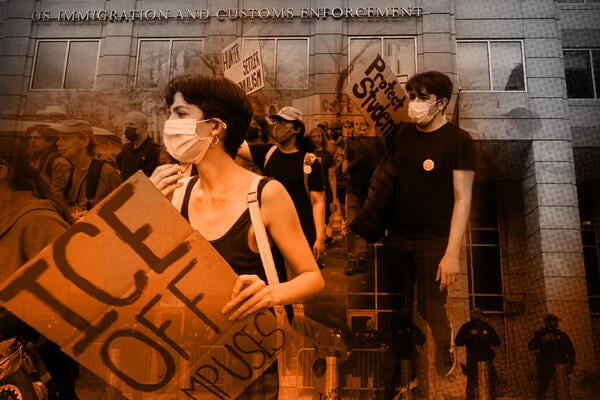
    Some 300 demonstrators participate in a Waukegan, Illinois, rally on Feb. 1 to draw attention to an increase in Immigration and Customs Enforcement activity in the area. Privacy advocates warn student records could be used to assist deportations. (Scott Olson/Getty Images)

    In my latest feature this week, I dive into why those efforts have alarmed student data privacy advocates, who warn that efforts to compile data on immigrant students could be used not just to deny them an education  — it could also fall into the hands of Immigration and Customs Enforcement.

    As the Trump administration ramps up deportations and tech billionaire Elon Musk’s Department of Government Efficiency reportedly works to create a “master database” of government records to zero in on migrants, data privacy experts warn that state and federal data about immigrant students could be weaponized. 


    In the news

    Cybercriminals demanded ransom payments from school districts nationwide this week, using millions of K-12 students’ sensitive data as leverage after the files were stolen from education technology giant PowerSchool in a massive cyberattack late last year. The development undercuts PowerSchool’s decision to pay a ransom in December to keep the sensitive documents under wraps. | The 74

    Gutted: Investigations at the Education Department’s civil rights office have trickled to a halt as the Trump administration installs a “shadow division” to advance cases that align with the president’s agenda. | ProPublica

    • Civil rights groups, students and parents have asked courts to block the Education Department’s civil rights enforcement changes under Trump, saying they fail to hold schools accountable for racial harassment and abuses against children with disabilities. | K-12 Dive
    • Among the thousands of cases put on the back burner is a complaint from a Texas teenager who was kneed in the face by a campus cop. | The 74

    ‘The hardest case for mercy’: Congratulations to Marshall Project contributor Joe Sexton, who was named a Pulitzer Prize finalist for his reporting on a legal team’s successful bid to spare the Parkland, Florida, school shooter from the death penalty. | The Marshall Project
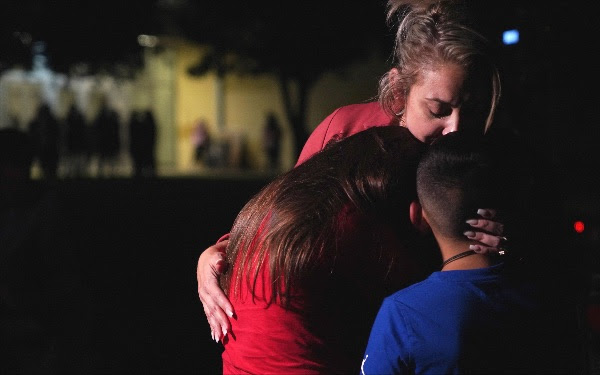
    The city council in Uvalde, Texas, approved a $2 million settlement with the families of the victims in the 2022 shooting at Robb Elementary School, the first lawsuit to end with monetary payouts since 19 children and two teachers were killed. | Insurance Journal 

    • In Michigan, a state commission created in the wake of the 2021 school shooting at Oxford High School, which resulted in the deaths of four students, issued a final report calling for additional funding to strengthen school mental health supports. | Chalkbeat
    • Meanwhile, at the federal level, the Education Department axed $1 billion in federal grants designed to train mental health professionals and place them in schools in a bid to thwart mass shootings. | The 74

    A high school substitute teacher in Ohio was arrested on accusations she offered a student $2,000 to murder her husband. | WRIC

    Connecticut schools have been forced to evacuate from fires caused by a “dangerous TikTok trend” where students stab school-issued laptops with paper clips to cause electrical short circuits. | WFSB

    Eleven high school lacrosse players in upstate New York face unlawful imprisonment charges on accusations they staged a kidnapping of younger teammates who thought they were being abducted by armed assailants. | CNN

    Sign-up for the School (in)Security newsletter.

    Get the most critical news and information about students’ rights, safety and well-being delivered straight to your inbox.

    The Future of Privacy Forum has “retired” its Student Privacy Pledge after a decade. The pledge, which was designed to ensure education technology companies were ethical stewards of students’ sensitive data, was ended due to “the changing technological and policy landscape regarding education technology.” | Future of Privacy Forum

    • The pledge had previously faced scrutiny over its ability to hold tech vendors accountable for violating its terms. | The 74
    • New kid on the block: Almost simultaneously, Common Sense Privacy launched a “privacy seal certification” to recognize vendors that are “deeply committed to privacy.” | Business Wire

    Google plans to roll out an artificial intelligence chatbot for children as the tech giant seeks to attract young eyeballs to its AI products. | The New York Times

    Kansas schools plan to spend state money on AI tools to spot guns despite concerns over reports of false alarms. | Beacon Media


    ICYMI @The74
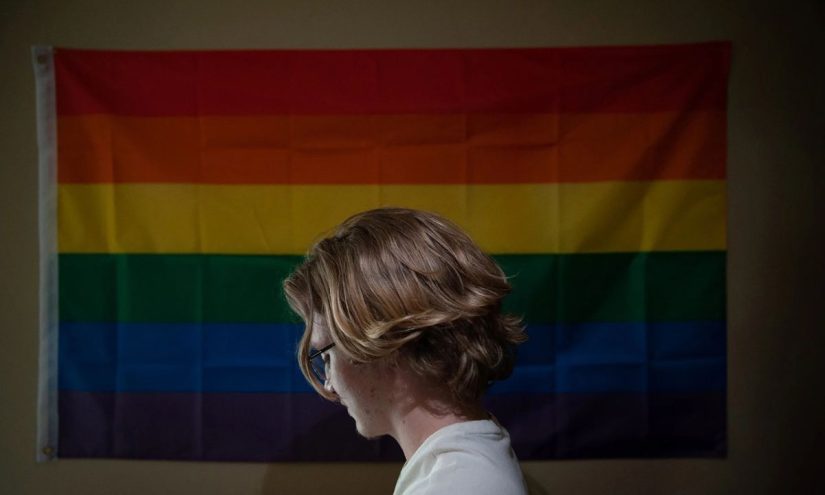
    A new report from the Department of Health and Human Services suggests gender-affirming health care puts transgender youth at risk but the report ignores years of research indicating otherwise. (Getty Images)

    HHS Condemns Gender-Affirming Care in Report That Finds ‘Sparse’ Evidence of Harm

    Chicago Public Schools’ Black Student Success Plan Under Investigation Over DEI

    SCOTUS to Rule in Case That Could Upend Enforcement of Disabled Students’ Rights


    Emotional Support

    Birds are chirping. Flowers are blooming. And 74 editor Bev Weintraub’s feline Marz is ready to pounce.


    Get stories like these delivered straight to your inbox. Sign up for The 74 Newsletter
    Source link

  • New ICE Policy Puts International Students at Greater Risk

    New ICE Policy Puts International Students at Greater Risk

    The Trump administration issued plans earlier this week for a new policy that vastly expands federal officials’ authority to terminate students’ legal residency status, according to newly released court documents.

    The policy detailed in the filings asserts that immigration officials have the “inherent authority” to terminate students’ legal residency status in the Student Exchange and Visitor Information System “as needed.” It also explicitly lays out two new justifications for SEVIS terminations: the vague “evidence of failure to comply” with nonimmigrant visa terms, and a visa revocation, which can be issued without evidence of a violation by the State Department—and which, crucially, is not subject to court challenges.

    Immigration attorneys told Inside Higher Ed that if implemented, the new policy would enshrine broad permission for ICE to begin deporting students practically at will.

    “This is very bad news for foreign students,” said Charles Kuck, an immigration attorney representing 133 international students in the largest lawsuit challenging recent SEVIS terminations. “Any student who’s arrested, literally for any reason, is probably going to have their status terminated going forward.”

    Last Friday a U.S. attorney promised an official update to ICE policy on SEVIS terminations. On Tuesday, U.S. attorneys presented the document as evidence in a court filing in Arizona, describing it as “recently issued … policy regarding the termination of SEVIS records.”

    It was the first time that details of a new SEVIS termination policy were made public, and it was not at first clear whether it reflected official federal policy. On Tuesday, U.S. attorney Johnny Walker confirmed during another hearing for a SEVIS lawsuit in D.C. that it did, though the policy had yet to be finalized. Spokespeople for ICE did not respond to multiple questions from Inside Higher Ed.

    The plan comes less than a week after the administration began restoring thousands of foreign students’ SEVIS statuses after a series of court decisions overturned hundreds of status terminations. Kuck said the plan seemed to be a way for ICE to get around those rulings.

    “This is basically a cover-your-ass policy,” he said. “The fact that ICE initially reinstated visas was no surprise. They probably had U.S. attorneys screaming at them, ‘What are you doing?’ Now they’re trying to retroactively develop a policy that would allow them to do what they already did.”

    Immigration lawyer and Columbia University Immigrants’ Rights Clinic director Elora Mukherjee has been counseling international students across New York City for the past two months. After the visa-restoration decision last week, some students wanted to know if they were in the clear; she cautioned them against celebrating prematurely.

    “Whiplash is a good way to describe it,” she said. “Students are losing sleep—not just those whose visas have been terminated but those who are worried theirs could be next any day.”

    Fly-by-Night Policymaking

    The updated policy was outlined in an internal Department of Homeland Security memo filed as evidence in an Arizona federal court on Wednesday, where one of more than 100 lawsuits challenging visa revocations is being litigated.

    The unorthodox manner in which it was publicized has left immigration attorneys scratching their heads and international students’ advocates wondering how to respond.

    It also appears to have taken some federal officials by surprise. Kuck said that when he heard about the memo and brought it before the judge in his own case in Georgia, the U.S. attorney defending the government asked if he could send him a copy.

    Fanta Aw, president of NAFSA, an association of international educators, wrote in an email to Inside Higher Ed that the document “should not be relied upon as ICE’s new policy.” She also emphasized that there is no change to ICE’s visa termination policy included in the memo, only SEVIS terminations.

    The document is labeled as a “broadcast message … for internal SEVP use only,” meaning it would have been sent to Designated School Officials working in colleges’ international student offices. But Aw said that’s not accurate, either, because it lacks the customary broadcast message number, and DSOs in her organization said they had not received it.

    Kuck said the lack of a rule-making process for a sweeping policy change like the one outlined in the memo is most likely unlawful, and he was working on filing an amendment to challenge it on Thursday. But that doesn’t mean it should be taken lightly.

    “People should view this as the future,” Kuck said. “This is clearly the power ICE wants to give itself, so they’re going to move ahead with it.”

    ‘A Nightmare Booby Trap’

    Mukherjee said such a broad license to terminate SEVIS status would allow ICE to deport international students far more quickly and with less accountability. The new policy, if implemented and upheld by the courts, wouldn’t just revert to the status quo of the last few months, she said; it would create a landscape in which ICE could begin deportation proceedings with impunity.

    “We’ve already seen many students whose SEVIS terminations led directly to removal proceedings,” Mukherjee said. “It’s terrifying.”

    Kuck said it’s crucial that students understand that they’re still in danger of deportation even if their status was restored last week—and not just because of the new policy plan.

    The few hundred students who won a temporary restraining order in court over the past week have had their statuses reinstated and backfilled to when they were revoked. But the status of thousands more who did not file lawsuits was only reactivated from that point onward. That means they have a gap in status for the days or weeks in between—which, according to ICE policy, is grounds for removal from the country, even if their initial SEVIS termination was accidental.

    “This is a nightmare booby trap for these kids,” Kuck said.

    The only way to protect them, he said, is by filing a class action lawsuit for all affected international student visa holders. Kuck said he’s working on filing an injunction for one right now, and he is acting with urgency.

    In the meantime, Mukherjee said students—both those in the country and those who had planned to come in the fall—are “deeply unsettled.” She’s been asking them questions she’d never been concerned about before: whether they have any social media accounts or even tattoos.

    “I’m talking to international students who are currently in the U.S., to international students who’ve been admitted to study in the U.S. starting in the fall, and they’re asking, ‘Will we be able to complete our degree program?’” she said. “The answer is that it’s unclear.”

    Source link

  • Trump’s sex and gender order could create risk for colleges

    Trump’s sex and gender order could create risk for colleges

    While running for president, Donald Trump pledged to fight the Biden administration’s efforts to expand protections for transgender students. On day one of his second term in office, he got to work fulfilling that promise.

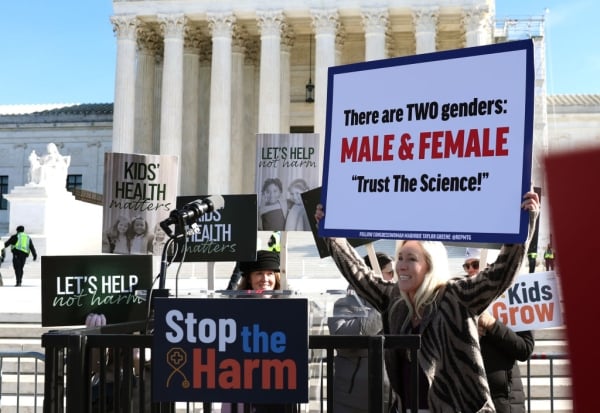
    In an executive order, which is part of a broader effort to restrict the rights of transgender people, Trump declared that there are only two sexes and banned the federal funding of “gender ideology.” His supporters hailed the move as a return to common sense, while LGBTQ+ advocates saw it as an attack seeking to erase the existence of trans people.

    For colleges and universities, the order raises more questions than it answers, and its immediate implications are unclear. As with other executive orders, it includes many provisions that require the Education Department to take action and issue guidance about how colleges should comply. But depending on how the department responds, the order could complicate institutions’ efforts to accommodate transgender students and eventually change how the federal government enforces Title IX of the Education Amendments of 1972.

    Susan​​​​ Friedfel, a higher education attorney at Jackson Lewis, a New York City law firm that works with colleges and other employers, said more information is needed from the Education Department to determine how the order will affect higher ed institutions, especially since other federal and state laws protect LGBTQ+ students.

    “We have a lot of questions,” she said. “It’s challenging because we have conflicting laws that apply to the same space.”

    In the meantime, she encouraged colleges to revisit their Title IX policies to ensure they are in compliance with the 2020 regulations put in place by the first Trump administration and to think about how best to accommodate everybody.

    The order, titled “Defending Women From Gender Ideology Extremism And Restoring Biological Truth to the Federal Government,” defines “sex,” “male” and “female,” among other terms, and orders federal agencies to use those definitions when “interpreting or applying statutes, regulations, or guidance and in all other official agency business, documents, and communications.”

    The order is likely to face legal challenges, said Cathryn Oakley, senior director of legal policy at the Human Rights Campaign, who argues that it’s unlawful.

    “It is important that people not give this executive order more credence than it deserves,” she said.

    Other LGBTQ+ advocates echoed Oakley, emphasizing that executive orders don’t create or change laws.

    “Discrimination based on sex, including discrimination against transgender, nonbinary, and intersex people, remains illegal, and it cannot be legalized through this executive order,” Fatima Goss Graves, president and CEO of the National Women’s Law Center, said in a statement.

    But Republican lawmakers, conservative legal organizations and other anti-trans advocates applauded Trump’s order, saying it would protect women and girls from discrimination and ground federal law in “biological fact.”

    “Blatant and deliberate attempts to redefine our sons’ and daughters’ identities by questioning biology itself has done significant harm to our children and society,” said Representative Tim Walberg, the Michigan Republican who chairs the House education committee. “[The] action by the Trump administration acknowledges the biological differences between men and women. In doing so, it is protecting women from discrimination and securing the progress women have made over the decades.”

    What’s in the Order

    In addition to defining “sex” and other terms, the order outlines a plan to combat “gender ideology,” which the Trump administration defines as replacing “the biological category of sex with an ever-shifting concept of self-assessed gender identity, permitting the false claim that males can identify as and thus become women and vice versa.”

    Federal officials were told to remove any internal or external documents that “inculcate gender ideology” and take “any necessary steps to end the federal funding of gender ideology.” Additionally, agencies will now only use the term “sex” instead of “gender” in all applicable federal policies and documents, according to the order. The Biden administration gave people the option on passport applications to mark their gender as X rather than choose male or female. That option is now being eliminated.

    On Thursday, Secretary of State Marco Rubio said that the State Department wouldn’t process any passport applications seeking to change the applicant’s gender from male to female or requesting the X option, The Guardian reported.

    Agencies are required to give an update on their efforts to implement the order in 120 days.

    The Trump administration also directed the attorney general to correct the Biden administration’s “misapplication” of the Supreme Court’s 2020 decision in Bostock v. Clayton County, which said that LGBTQ+ individuals were protected from discrimination in the workplace on the basis of sexual orientation or gender identity under Title VII of the Civil Rights Act of 1964.

    The first Trump administration said that Bostock didn’t apply to Title IX, which bars sex-based discrimination in education settings. But the Biden administration reversed that guidance in June 2021.

    The Bostock decision was key to the Biden administration’s new Title IX regulations, which clarified that the law also prohibits discrimination based on sexual orientation or gender identity. A federal judge ruled earlier this month that the new Title IX rule was unlawful and wiped the regulations off the books.

    Trump’s executive order also requires the education secretary to rescind a number of guidance documents related to the now-vacated Title IX regulations, as well as resources for supporting LGBTQ+ students. That includes the Education Department’s June 2021 Dear Colleague letter that said Title IX protects LGBTQ+ students from discrimination based on their sexual orientation or gender identity.

    In addition, the Trump administration is rescinding a back-to-school message for transgender students from the Departments of Education, Justice and Health and Human Services that provided resources for students who experience bullying or discrimination.

    ‘Nothing Radical’

    Kim Hermann, the executive director of the Southeastern Legal Foundation, a conservative legal organization that sued the Biden administration over the Title IX regulations, said Trump’s order immediately restores the privacy and physical safety rights of women, so colleges that don’t comply could face federal civil rights investigations or lawsuits.

    “There’s nothing radical about this executive order,” she said. “All it does is solidify Congress’s original intent when they passed the laws … Our girls and our women on college campuses are sick of their rights being eroded.”

    Friedfel said the current Trump administration will likely investigate complaints from cisgender students who are uncomfortable sharing spaces with transgender students.

    “That doesn’t mean that they necessarily have to do anything radically different, but recognize that there’s that risk there,” she said.

    Oakley said that guidance from the department is necessary for universities to understand what’s expected of them and how the Office for Civil Rights will enforce Title IX. She doesn’t expect OCR to take discrimination against LGBTQ+ faculty, staff and students seriously.

    “It’s also going to be very difficult to understand how to be in compliance when the folks who are enforcing the law are not respecting the actual case law,” she said. “So it is going to create a tremendous amount of confusion.”

    Source link

  • New Research Finds Higher Ed Institutions Are at Risk of Losing Supervisors to Other Employers – CUPA-HR

    New Research Finds Higher Ed Institutions Are at Risk of Losing Supervisors to Other Employers – CUPA-HR

    by CUPA-HR | January 11, 2023

    As previous research from CUPA-HR has shown, America’s colleges and universities are in the midst of a talent crisis, as many employees are considering other employment opportunities due to a number of factors. As a follow-up to the initial findings of CUPA-HR’s 2022 Higher Education Employee Retention Survey, CUPA-HR has released new findings focused specifically on those in supervisory roles, and the data show that many supervisors are overwhelmed, under-resourced, and struggling to fill positions and maintain morale.

    The newly published report, The CUPA-HR 2022 Higher Education Employee Retention Survey: Focus on Supervisors, explores supervisors’ likelihood of looking for new employment, their current challenges and working environments, and which job aspects specific to supervisors are associated with their retention. The report analyzes data from the 3,815 higher ed administrators, professionals and non-exempt staff, most (57 percent) of whom were supervisors, who responded to CUPA-HR’s 2022 Higher Education Employee Retention Survey.

    Findings

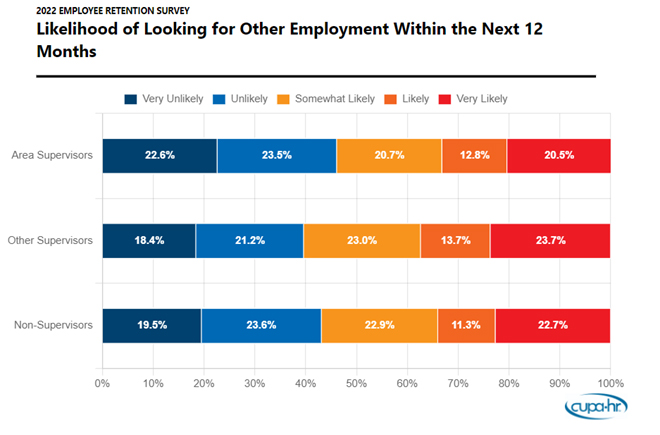
    Higher ed supervisors are looking for other employment opportunities, and less than half would seek new opportunities at their current institution. Nearly two in five (36 percent) supervisors indicate they are likely to look for other employment in the next 12 months, and only 40 percent say they would seek job opportunities at their current institution. The most common cited reason for seeking other employment is pay.

    Most higher ed supervisors work long hours and have absorbed more duties since the onset of the COVID-19 pandemic. Data show that supervisors are more likely than non-supervisors to work additional hours. Fewer than half (47 percent) of non-supervisors work more hours than what is considered full-time. However, 89 percent of area supervisors and 76 percent of other supervisors work more hours per week than what is considered full-time at their institution. Additionally, supervisors are more likely than non-supervisors to agree that they have absorbed additional responsibilities of other staff who have left the institution since the onset of COVID-19. Supervisors are also more likely than non-supervisors to report that they experienced an increase in job expectations since the start of the pandemic.
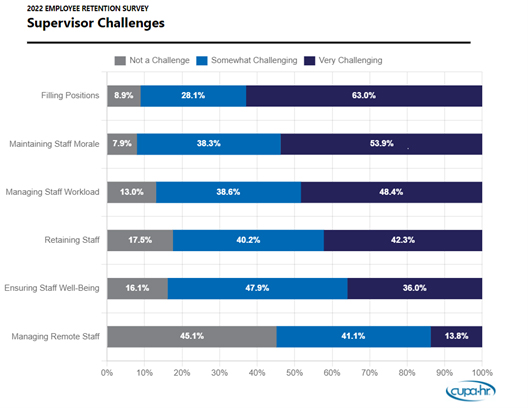
    Filling positions and maintaining morale are supervisors’ top challenges. As shown in the figure below, almost two-thirds (63 percent) of supervisors indicated they find filling positions very challenging and over half (54 percent) found maintaining staff morale very challenging.

    Higher ed supervisors report a lack of adequate training and support. Only three in five supervisors agree that they have resources and support in their supervisory role. Less than half (46 percent) agree that they have been provided with adequate management training for their supervisory role. However, when supervisors have more resources and support in their supervisory roles, more power to advocate for their staff, more power to allow flexible schedules, and more power to allow their staff to work remotely, they are less likely to seek other employment.

    Implications of Supervisor Turnover and How to Combat It

    Turnover in any role can impact an institution due to loss of talent, institutional knowledge and team or interdepartmental rapport. However, turnover in a supervisor role has more far-reaching implications. Supervisor turnover also impacts direct reports, who must adjust to a new supervisor and may need to adapt to new team priorities and vision. Loss of supervisors also equates to a loss of leaders who are key to succession plans.

    In light of what the data show, there are several actions higher ed institutions can take to keep their supervisors:

    • Provide supervisors with resources and support in their capacity as supervisors, particularly around filling empty positions and managing staff morale.
    • Ensure supervisors have the ability, knowledge and resources to advocate for their staff.
    • Give supervisors more autonomy to determine their staff’s working arrangements, as the data show that supervisors who have more power to allow their staff to work remotely and have flexible schedules are less likely to seek other employment.
    • Commit to reducing supervisor workload.
    • If possible, raise salaries for supervisors (but not at the expense of non-supervisors).

    For a deeper look into the data, read the full report.

    Note: In the findings, “area supervisors” refer to those supervisors who are the top-most leaders in their department, units or areas (self-identified in the survey; 26 percent of respondents). “Other supervisors” are those who self-identified as having at least one direct report but were not the top-most leader in their department (31 percent of respondents). “Non-supervisors” are those employees who have no direct reports (43 percent of respondents).

    CUPA-HR Research

    CUPA-HR is the recognized authority on compensation surveys for higher education, with its workforce surveys designed by higher ed HR professionals for higher ed HR professionals and other campus leaders. CUPA-HR has been collecting data on the higher ed workforce for more than 50 years, and we maintain one of the largest workforce databases in existence. CUPA-HR also publishes numerous research publications and interactive graphics highlighting trends and issues around higher ed workforce planning, pay equity, representation of women and racial/ethnic minorities and more. Learn more about CUPA-HR research.


    Source link