Dive Brief:
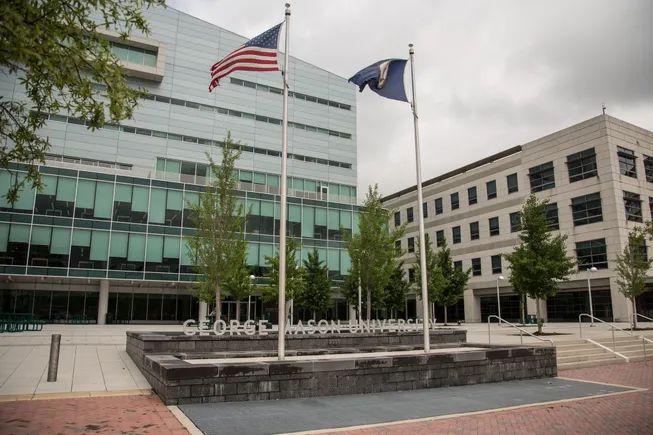
- George Mason University’s faculty senate on Wednesday urged the public Virginia institution’s leadership to rebuke any deal with the Trump administration that would undermine its independence.
- In a newly passed resolution, the senate said recent federal deals struck by other colleges have set a precedent in which “administrative convenience takes precedence over the faculty’s constitutional and professional responsibility.” The resolution urged George Mason’s board and president to reject any similar settlement with the Trump administration to end federal investigations into the university.
- George Mason leaders must also decline the administration’s separate higher education compact, it said, as that proposal seeks to “blur the constitutional distinction between voluntary funding conditions and compelled oversight.”
Dive Insight:
Under President Donald Trump, the departments of Education and Justice have opened at least four investigations into George Mason since this summer, targeting the university’s diversity, equity and inclusion work.
George Mason’s faculty senate warned the governing board Wednesday against cutting a deal with the DOJ that puts the university under “continuing federal supervision.” And any settlement must involve “transparent deliberation and meaningful faculty consultation,” as required by George Mason’s shared governance policies, the senate said.
Faculty cited the University of Virginia’s recent deal with the federal government as one that did not meet these standards.
The state flagship in October agreed, in part, to adhere to the DOJ’s guidance against DEI efforts and to make quarterly oversight reports for three years. In exchange, the federal government suspended and will eventually end five DOJ investigations into UVA and continued to give the university access to research funding.
The resolution from George Mason’s faculty senate said UVA had “negotiated in secrecy, without faculty consultation” and imposed “years of federal monitoring and mandatory reporting that chill free inquiry, constrain legitimate academic debate, and erode shared governance.”
Just six weeks after the Education Department announced a probe into George Mason, it formally accused the university of illegally using race and other protected characteristics when making hiring and promotion decisions. As in other federal investigations into George Mason, the department singled out the university’s president, Gregory Washington, who has been an ardent supporter of diversity initiatives during his five-year tenure.
The agency gave the university 10 days to meet a list of demands to resolve the investigation. Among other requirements, one condition would have compelled Washington to publicly apologize. The president instead firmly rebuked the Education Department’s findings, with his lawyer calling them “a legal fiction.”
In contrast, George Mason’s governing board said that it would seek to negotiate with the Trump administration to resolve the allegations. The board also said Washington’s attorney would be involved in talks with the Education Department.
The faculty senate resolution pushed George Mason’s leaders to not accept Trump’s proposed higher education compact or any agreement that “conditions federal funding on the surrender of institutional autonomy or faculty governance.”
Through the compact, the Trump administration seeks to have colleges voluntarily agree with its policy agenda in exchange for research funding incentives rather than its playbook of seeking compliance through unprecedented punitive actions.
But the faculty senate argued in their resolution that the compact’s “promise of ‘excellence’ masks a fundamental shift of authority from university faculty and governing boards to federal agencies.”
Further complicating matters, George Mason’s board currently has just six voting members — down from the usual 16 — meaning it doesn’t have a quorum. Since June, the governing bodies of George Mason and two other Virginia public colleges have been in a state of political flux due to a fight between a Democrat-controlled state Senate committee and Republican Gov. Glenn Youngkin over his university board selections.
The committee rejected many of Youngkin’s selections, and despite his efforts to install them anyway, court decisions have blocked them from serving.
The faculty senate on Wednesday said that the board should not negotiate or sign off on any substantial agreement “affecting curriculum development, research priorities, faculty governance, or the allocation of university resources” without members who are “properly appointed and duly confirmed” by the Virginia General Assembly.
Virginia’s governor-elect, Democrat Abigail Spanberger, last month raised similar concerns over potential actions taken by UVA’s board, which has 12 of its intended 17 members.
George Mason’s board — and the board’s leader — have come under scrutiny from faculty and lawmakers.
In July, the George Mason chapter of the American Association of University Professors voted no-confidence in the board and urged it to defend Washington.
And the leaders of Virginia’s state senate accused Charles Stimson, head of George Mason’s board, of a conflict of interest in September and called for him to resign if he did not recuse himself from discussions related to the federal investigations.
Stimson is a senior legal fellow at The Heritage Foundation, a right-wing think tank the AAUP found to be among those behind the wave of state-level anti-DEI legislation. The foundation also created Project 2025, a wide-ranging conservative blueprint for Trump’s second term whose policies the president has embraced after distancing himself from the handbook as a candidate.
Stimson, whose term runs through June 2027, rejected calls to either recuse himself or step down.