Tag: Role

  • UNCF Taps Veteran HBCU Leader Dr. Walter M. Kimbrough for Key Research and Engagement Role

    UNCF Taps Veteran HBCU Leader Dr. Walter M. Kimbrough for Key Research and Engagement Role

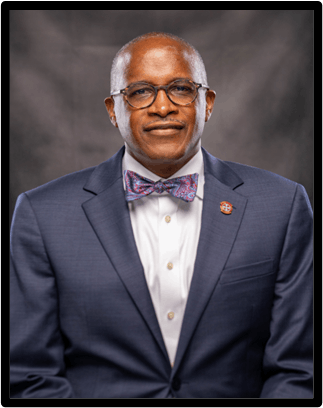
    Dr. Walter M. KimbroughThe United Negro College Fund (UNCF) has appointed Dr. Walter M. Kimbrough, a seasoned higher education administrator known for his transformational leadership at historically Black colleges and universities, to serve as Executive Vice President of Research & Member Engagement, effective September 2, 2025.

    The appointment represents a strategic move by UNCF to strengthen its support for member institutions through enhanced research capabilities and deeper engagement initiatives. 

    Kimbrough, who is an expert on Black fraternities and sororities, brings decades of presidential experience from multiple UNCF member institutions, positioning him uniquely to understand the challenges and opportunities facing HBCUs today.

    “Dr. Kimbrough’s appointment is the culmination of our lengthy search for a transformational leader,” said Dr. Michael L. Lomax, UNCF President and CEO, in announcing the selection to UNCF staffers.

    Kimbrough’s extensive presidential portfolio includes leadership roles at three UNCF member institutions: Dillard University in New Orleans, Philander Smith College (now University) in Arkansas, and most recently as interim president at Talladega College in Alabama. UNCF officials add that this breadth of experience across different regions and institutional contexts provides him with an insider’s perspective on the diverse needs of UNCF’s 37 member institutions.

    In his new role, Kimbrough will report directly to the Office of the President, working alongside Dr. Lomax on strategic initiatives while collaborating with the Chief Operating Officer on operational priorities. His portfolio encompasses four major UNCF initiatives that span the educational pipeline from K-12 through higher education.

    The Frederick D. Patterson Research Institute (FDPRI), one of the key components under his leadership, serves as UNCF’s research arm, producing critical data and analysis about HBCUs and their impact on American higher education. As chief research officer and principal editor of research publications, Kimbrough will guide the institute’s scholarly output while serving as a spokesperson for UNCF in media appearances and external engagements.

     Kimbrough will also oversee the Institute for Capacity Building (ICB), positioning him as UNCF’s lead consultant for member institutions seeking to strengthen their operational and academic capabilities. This role leverages his presidential experience, allowing him to provide peer-to-peer guidance to current HBCU leaders navigating similar challenges he has faced throughout his career.

    His responsibilities also extend to HBCUv® Digital Learning Solution, UNCF’s innovative technology platform designed to support online and hybrid learning at member institutions—a particularly relevant initiative in the post-pandemic educational landscape.

    “I have had the great honor to serve four UNCF member institutions, three as president, and for over 20 years I benefited from the advocacy and support of UNCF,” Kimbrough told Diverse. “This position allows me to pour back into UNCF, its member institutions and students.”

    Source link

  • Religion’s Ever-Shifting Role in American Higher Education

    Religion’s Ever-Shifting Role in American Higher Education

    Religion, particularly Protestantism, was central to the mission of the country’s first universities. Chapels were constructed at the center of campuses. University presidents, often devout, worried over the salvation of their students.

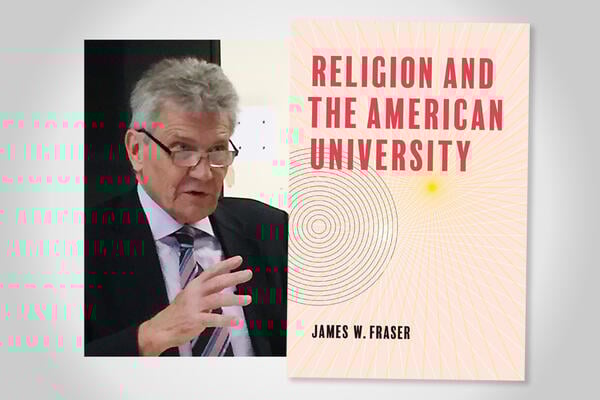
    James W. Fraser’s new book, Religion and the American University (Johns Hopkins University Press), offers a detailed history of how religion’s role in higher ed has been upended again and again by transformative events, including the discovery of evolution, the emergence of biblical criticism, the Industrial Revolution and the advent of the modern-day research university.

    It outlines how religion cropped up in students’ lives in new ways as they continued to grapple with moral and ethical questions and as various denominations and faiths vied for their attention and adherence. The book charts how the academic study of religion developed, how campus chaplains and religious student groups diversified along with student bodies, and how religious differences on campuses created new learning opportunities and tensions.

    Fraser, a professor emeritus of history and education at New York University and a United Church of Christ minister, argues that while much of academe pushes religion to its periphery, today’s students are still concerned with questions of spirituality and meaning.

    Fraser spoke with Inside Higher Ed about the new book. The conversation has been edited for length and clarity.

    Q: Your book details massive changes in the role of religion in higher ed, from Protestant-dominated universities to institutions with more diverse student bodies and chaplaincies, and from religion-centric to more secularized. You describe a shift away from the idea of colleges that “transmitted knowledge” to colleges that “created new knowledge” as research universities came about. What do you think higher ed has gained or lost in these transitions?

    A: There is no question that the transition from the old-fashioned teaching college to the research university has done a couple of really important things, not only for students but for society. One is that being able to invite students to be fellow researchers in the pursuit of knowledge is always a much better pedagogical approach than “You will learn this, and you will learn that,” and people can learn it and forget it pretty quickly.

    I also think for all of us who criticize the research university, we have to remember all of the extraordinary accomplishments. Human life is twice as long because of medical research. Food supplies are much more plentiful because of agricultural research. Educational studies have helped more and more students learn how to read. The list goes on and on. The breakthroughs of the research university are huge.

    In terms of what is lost, I think the clearest issue is in some ways described by Julie A. Reuben in The Making of the Modern University. The intellectual developments have gotten so much stronger than … attention to issues of meaning, purpose and belonging … Attention to issues of spirituality and faith have been marginalized significantly, and there’s certainly a norm in the research university now that scientific research—what you can count—counts the most. And what you care about and what you value count less. And that I find very problematic.

    Q: You discuss in the book how today’s students have a deep interest in meaning-making and spirituality, if not religion, per se. Do you think it’s part of a college’s role to address that, and if so, how should institutions go about it?

    A: I think it better be a part of colleges’ role, and I would say that for a couple of reasons. One is, asking questions of meaning, purpose, belonging, questions of faith, questions of morality, are pretty essential if we’re going to maintain and protect our democracy and our society in the 21st century. And if we simply say institutions are going to do this very specific kind of research and are going to teach professional skills, and we’re going to evaluate universities by how much money the students make when they graduate, we stop teaching about things that will sustain our society and will sustain human beings in the future. That’s a huge loss. The second issue is, I just think it’s stupid for universities to disregard student interest when it’s there. If students are interested in these things, we should find ways to talk about it.

    I also think—and this is an issue explored in the book a lot—it’s often in the extracurricular areas that the students are able to pursue these [questions]. They pursue them with chaplains, they pursue them with their own individual groups, whether it’s Baháʼí Fellowship or InterVarsity Christian Fellowship. They find other ways … But I don’t think that lets faculty off the hook to develop the kinds of courses [that] let it be done as part of the regular academic curriculum. That’s what we do as professors, and that’s something we ought to offer our students. I think it’s cheap letting ourselves off the hook when we say, “Oh well, they’ll find it elsewhere.”

    Q: In the book, you repeatedly highlight a tension within religious communities as to whether to invest in and urge students toward explicitly religious colleges or whether to prioritize building up religious infrastructure at unaffiliated colleges—like chaplains, Hillels and other religious student organizations. Do you think that tension plays out today, and if so, in what ways?

    A: I think it plays out very much today. There are people who feel like their young people will only be safe in religious institutions. And there are other people who say, “No, let’s go to the best college we can find. Let’s go to the best state university we can find.”

    I have a bias. I favor the religious groups that are finding ways to make a place for themselves in the larger universities. As a conclusion of this book, I talk about Baylor University, which is trying so hard to do both—to both be a religious school and a Research-1 university. And I wish them luck. I admire them. And I think it’s going to be more difficult than they think it’s going to be.

    But I think that for many universities … religion finds its own place on the margins, and that can be with chaplains, that can be with student groups. But students care about these issues, and they’re not going to disappear.

    Q: The book touches on the beauties of campus religious diversity but also some of the challenges, including the ways that campuses have been rocked by the October 2023 attack on Israel by Hamas and Israel’s invasion of Gaza. Since then, campus antisemitism has been a flash point for the Trump administration’s dealings with higher ed and institutions have been penalized for how they’ve handled pro-Palestinian protests. Having watched how these issues played out, is there anything you would have added to the book on the topic?

    A: I mentioned it in one paragraph in the end because it was just going to press, but I would have done a lot more with the challenges that religious diversity [brings]. We live in a world where the Trump administration is attacking diversity, and yet religious diversity is a kind of diversity. Chaplains are telling me they’re feeling tensions about that.

    I think the violence, particularly since the Hamas attack on Israel and Israel’s response in Gaza, has set student against student in a way that is going to take decades to recover. Whether you’re a Jewish chaplain or a Muslim chaplain or a chaplain of some other faith, trying to deal with that, with that kind of student pain and student anger and student lashing out and student response, is making it very difficult. Discussions about religion are more difficult than they were two years ago.

    And the same is true for religious studies. We’ve seen several examples of religious studies professors who have gotten in trouble. One got in trouble for showing a picture of the Prophet Muhammad in class when some interpretations of Islam say you can’t do it. Another professor lately, who The New York Times profiled, got fired. She was a Jewish professor, but she was outspoken in defense of Gaza, the Palestinian population, and she got fired for it. These things are going to happen. And the pressure on universities—a couple of chaplains have told me they feel like the administration is looking over their shoulders in a way that was not true two years ago and asking, “What are you saying to the students? What are they praying about? Why do we need this kind of disruption?”

    I was talking to one of my [former] students, a current chaplain, and he said that this last year has been the most difficult of his decades in chaplaincy. I think that’s not rare.

    Q: You focus a sizable chunk of the book on the role of religion at public universities, which aren’t necessarily the first institutions that come to mind when we think about higher education and religion. Why was it important to you to include these institutions and make them a focus?

    A: The obvious answer is the majority of American students go to public universities, by far. And to do a study of any aspect of American higher education that ignores public universities is simply silly. I’ve read some other studies that I thought were very thoughtful about religion that didn’t include public universities, and I thought, “But that’s where the students are. We’ve got to do that.”

    The second issue is, I found public universities’ relationship with religion very interesting and far more complicated than I thought. In the 1880s, University of Illinois expelled a student for not attending chapel. As late as the eve of World War II in 1939, a quarter of state universities had chapel services—not always required, but they offered them. So, state universities were … pretty much generic Protestant institutions until really the 1960s, 1970s. Faculty culture wasn’t particularly religious in the way it was in the 19th century, but the campus culture and the campus assumptions were.

    The other thing I found is that there’s a wily religious life on state university campuses of one sort or another. It’s often led by chaplains working around the margins, and they feel marginalized, but they’re also very effective working around the margins … I was intrigued.

    [For example,] I was intrigued by the University of Nevada, Reno, a public university barred by the state Constitution from supporting religion, but it fosters dialogue. I wish more universities were willing to do that. They hosted a conversation on the role of women in religion [in partnership with a local synagogue]. A public university cannot take a stand—we favor this or we favor that—but they don’t need to be afraid of hosting conversations on a variety of topics … That engages with the community. I think universities hold back from engaging with communities on all sorts of issues, but they certainly hold back from engaging with religious communities.

    Source link

  • Harvard Has a Role to Protect Democracy

    Harvard Has a Role to Protect Democracy

    When it comes to politics, most of us have only two outlets: a voice and a vote.

    Votes come, at best, once a year, the most consequential votes for national office every two and four years. We all only have one voice, though some of us also have the additional power of a megaphone to amplify that voice.

    This column is my megaphone. It ain’t huge, but it’s something.

    Because the Supreme Court has declared that money is speech, if you are fabulously wealthy, perhaps the CEO of a car company, a space company, a company that tortures monkeys by implanting stuff in their brains and the owner of a social media platform, your voice can get very loud indeed, drowning out the voices of others.

    Some have genuine political power. Elected officials have political power. People with voices big enough to resonate with larger groups, or with enough money to purchase access to the levers of government, have political power. This is a fairly narrow class of people and organizations, and one of the things that has distressed me as of late is the refusal of some with genuine political power to use that political power in order to resist what I think is undeniable: that there is an ongoing attempt at an authoritarian takeover of our democracy.

    I understand that there are differing minds around the likelihood of success of this attempted takeover, as well as the manner in which it is best resisted, but I’m reasonably certain that if you were to feed even a wee dram of truth serum to those attempting this takeover, they would admit that this is the case. They pretty much already have.

    Voices are by no means meaningless. The recent “No Kings” protests, which brought out millions of people distributed all across the country to object to this takeover, demonstrated the capacity for collective voices to aggregate into something like political power.

    But in this moment, when we are still more than a year away from our next consequential national election, the immediate power of resistance rests elsewhere, which is why the authoritarian threat has been busy trying to undermine and destroy democratic institutions like the free press and higher education.

    This is why they have targeted Harvard. No one should seriously believe this is a principled dispute. The Trump administration does not care about genuinely fighting antisemitism, nor are they concerned about lax record-keeping regarding foreign students. The cancellation of NIH grants was done on a sweeping, ad hoc basis—pure destruction, no deliberation.

    This is also why I declared that “We are all Harvard” now, a recognition that in this moment, we must express total solidarity in the fight against the authoritarian forces. Up to now, Harvard has been fighting admirably in both the courts and the world of public opinion, winning on both of these fronts. For example, just this week a judge ruled for Harvard in its motion to allow international students to continue to enroll.

    But there are reasons to worry. A New York Times article clearly sourced to people inside Harvard—and (here I’m speculating) being used as a trial balloon to gauge public sentiment—ran under the headline “Behind Closed Doors, Harvard Officials Debate a Risky Truce With Trump.”

    The article frames Harvard’s present dilemma this way: “Despite a series of legal wins against the administration, though, Harvard officials concluded in recent weeks that those victories alone might be insufficient to protect the university.”

    It is clear that Harvard is suffering from these attacks. It is causing harm on all kinds of fronts, and the damage is real and probably lasting. It must be tempting if relief is promised to explore what it might take to realize that relief.

    All this being true, and me obviously not being privy to any inside knowledge of Harvard, I still don’t think it is a difficult call to not engage in any kind of settlement with Trump.

    There are two obvious reasons not to take the deal:

    1. Trump won’t stick to it. My evidence is 50 years of Trump’s modus operandi.
    2. Public opinion will turn against Harvard, causing possible lasting reputational damage (see: Columbia University).

    But there is an even bigger reason: Doing a deal with Trump legitimizes the authoritarian approach to government of using illegal intimidation to validate the power of the authoritarian. Long term, Harvard does not survive in an authoritarian state, because independent higher education institutions are not part of authoritarian states.

    Maybe it’s unfair that Harvard, by virtue of its wealth and status, has become one of the levers of democracy by which authoritarianism can be resisted, but this is where we find ourselves. In better times, Harvard arguably disproportionately benefits from our system; now it is being disproportionately harmed. It should very much want to return as much as possible to the previous status quo, rather than attempting to reach an accommodation that may keep it atop a significantly diminished and consistently eroding pile.

    If you merely see Trump and Trumpism as a temporary phenomenon that could be dispatched at the ballot box in three years, giving Trump a symbolic victory over Harvard (assuming anything Harvard gives in on will truly not be substantive) perhaps make sense.

    How certain are we of this? How much of Harvard’s (and the country’s) future are we willing to gamble?

    Because I still believe we are all Harvard, I hope it does the right thing and uses the power it possesses to defend our democracy.

    Source link

  • LEO has a role to play in picking winners

    LEO has a role to play in picking winners

    Perhaps we have LEO all wrong?

    In the week of the industrial strategy, which brought confirmation as to how central higher level skills will be to our plans for national growth, the annual release of longitudinal education outcomes (LEO) data) hits a bit different.

    In the past, ministers and higher education obsessives, have seen the release as a chance to rank universities and subjects – and perhaps even a chance to spot the infamous “low quality courses” – based on median graduate earnings. As we’ve been through time and time again on Wonkhe, this doesn’t really work.

    But quietly, and at the instigation of the former Unit for Future Skills which now forms a part of Skills England, earnings have taken something of a back seat to more detailed information about subject areas, place, and industrial sectors. If you wanted to understand the way in which investment in particular subjects might translate to benefits to particular industries (to support changes to the allocation of the Office for Students Strategic Priorities Grant, for example), LEO is where you would look.

    Factory model

    And you can illustrate this with today’s release of LEO data on graduate outcomes and provider level data. (There’s even a new DfE dashboard.)

    Let’s take a worked example. Advanced manufacturing is one of the eight sectors named in the industrial strategy as a national priority. As a sector it is going to be receiving £4.3bn over the next five years, including £2.8bn in research and development, from the state. Of the “frontier industries” within the manufacturing sector battery technology and advanced materials feel like clear priorities – and exactly the kind of things that might need the higher level skills that a university education might bring – although manufacturing as a whole will be in a similar position.

    How do you develop these skill sets?

    First up, we can see what graduates that work in manufacturing industries have studied. Engineering is the main route (and the route to the kind of high earnings that suggest senior roles) – just over 1,900 people with a first degree in engineering are working in the sector.

    [Full screen]

    But it is clear that manufacturing also needs business expertise (there are 1,350 business graduates in the field) and design capability (890 creative arts and design graduates). Both these groups earn rather less than the engineers – the low level of pay for creative arts graduates suggests that these workers may have recently moved into the sector or are in non-graduate roles, or (whisper it) we might need to pay them better. This latter interpretation is backed up by the fact that similar proportions of graduates are in this sector a year after graduation, and designers are consistently paid less.

    There is a regional component to this too (using the purple filters at the bottom of the chart, note that you can only use one of these at once) as we can see that when we look at London we can see that salary differentials shrink between our top three.

    In terms of specific manufacturing specialisms giving design graduates good jobs ten years on, another plot of the same data suggests automotive, and aircraft/space craft, manufacturing are particularly positive destinations. That said, they are not the primary destinations for creative arts and design graduates ten years out: as with many subject areas teaching is well represented, as are retail and advertising.

    [Full screen]

    The regional dimension

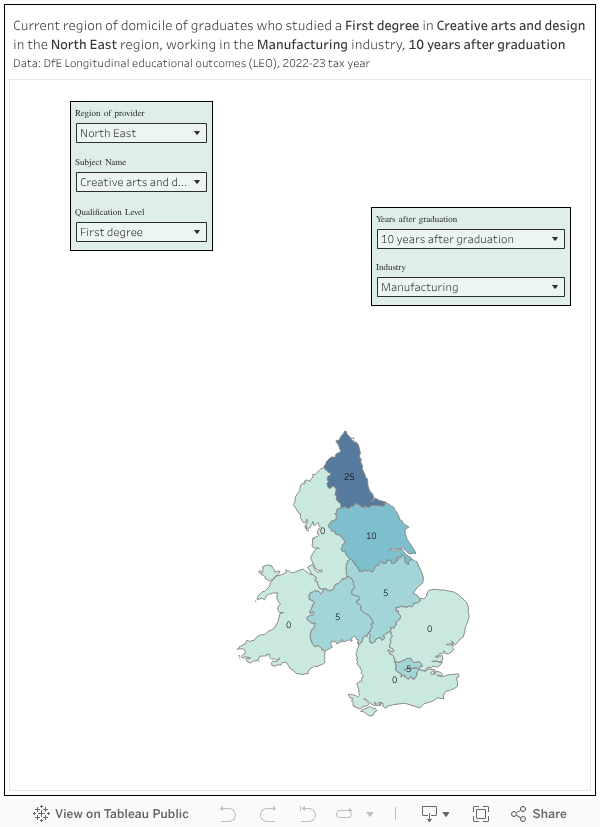
    Let’s say that we also want to use state investment in skills for manufacturing to have a regional benefit – and we wanted to focus on manufacturing in the north east. Would we need to specifically grow design provision in the north east of England in order to provide design graduates for firms there?

    Based on the data, the answer is yes. Most design graduates who studied in the north east working in manufacturing, are working in the north east ten years on. Though the numbers are small, the same appears to be true at other career points.

    [Full screen]

    Do we know if design students (rather than creative arts students) are the ones working in manufacturing? We don’t for certain but we can be reasonably sure. There are more design students than any other subjects in the creative arts and design area – and they tend to earn more ten years on than their peers in the arts. The median salaries also seem to match up – designers aren’t big earners, but they do earn more than some more traditional “skills priority” areas like ecology and mineral technology.

    [Full screen]

    Picking winners

    Seasoned LEO-watchers will be aware that there are issues when you look at specific sub-groups within the data. One of the drawbacks here is that we can’t track design specifically by provider – it would be helpful, if we decide we need more product designers in the north east, we knew which existing provider was landing them that well paid senior roles later in their careers. Best we can tell (and only five years out) it might be Newcastle and Northumbria – but we also need to factor in more granular effects (is Newcastle more likely to offer higher-paid design jobs than Sunderland or Middlesborough – I’d expect so, but we don’t get that data).

    [Full screen]

    It’s also likely that Teesside and Sunderland will be recruiting students with less traditional backgrounds, and we know that will have an impact on careers and salaries – but interestingly it appears to be Northumbria that are getting the best results for students from a domicile in a POLAR4 quintile one area.

    So there we have it: if we want to invest in advanced manufacturing in the north east of England in a way that gets the best results for local people, we need to support the design courses at Northumbria University. Which is something of a shame as we cut state support for design provision a couple of years ago.

    Source link

  • Military education committees and universities’ civic role

    Military education committees and universities’ civic role

    The publication of the Strategic Defence Review (SDR) in early June 2025 emphasised a whole-of-society approach to defence and recognised the importance of societal engagement and resilience-building.

    But there was also an element of missed opportunity – the review should also have been a moment to highlight the role of the network of 19 regional military education committees (MECs) which exist to foster good relations between universities and the armed forces, and their associated university service units (USUs).

    Although universities were prominently featured in the SDR, the focus was narrowly confined to their ability to serve as a talent pipeline and to provide technology to support “warfighting” and “lethality”.

    What’s missing is a more engaged understanding of the broader value universities provide for defence, particularly the role of MECs in fostering this relationship, building on Haldane’s earlier vision of a civic university with strong links to the armed forces.

    We see a need to outline a broad vision for MECs that builds on the SDR but also looks beyond it, offering a future-focused perspective for leaders in the armed forces and academia.

    Universities and civil-military relations

    Universities play a crucial – though often overlooked – role at the interface of civil-military relations. Our graduates are the officers of the future, and with seven per cent of UK households including a veteran, and over 180,000 currently serving, many of our students’ university experiences are inherently shaped by military life, whether as part of service families or as future personnel.

    Established as part of the Haldane Reforms of the armed forces in 1908, MECs were initially created to ensure that officer cadets received a balanced education, combining academic study with military training.

    Today, MECs are a vital bridge between two distinct worlds: academia and the military. They offer a unique forum where these cultures meet, enabling universities to better understand the particular pressures facing students in university service units and students from service families, while helping the military appreciate the academic environment through the eyes of those teaching their officer cadets.

    Military education committees and the student experience

    MECs support students serving in university service units by helping them navigate the dual demands of academic study and armed forces activities. These officer cadets face unique pressures and challenges, but also gain valuable opportunities for skills development, leadership training, and even paid experiences through social and sporting activities including overseas trips and training deployments. For those interested in an armed forces career, scholarships are available which provide a crucial route to higher education, often for those who would otherwise find it financially prohibitive.

    A recent commentary from the Royal United Services Institute underscores the importance of these activities, particularly the role of the University Officer Training Corps (UOTCs) in the British Army’s officer training pipeline. The authors warn against proposals to centralise all training at the Royal Military Academy Sandhurst, which they argue would undermine the historical and practical value of UOTCs as springboards for leadership and national resilience. They argue that UOTCs are vital for building the skills and networks needed for future mobilisations and for sustaining the Army Reserve’s capacity.

    This vital role underscores how the meeting of minds facilitated by MECs is more than just symbolic. In practical terms, MECs bring together universities and university service units for events ranging from Remembrance Sunday commemorations, to officer cadet-led debates on topical issues, to high-profile guest lectures, like Newcastle’s annual defence lecture.

    It has also helped bridge defence and the lecture hall. For example, through the Hacking 4 MoD module, facilitated by the Common Mission Project, where students tackle real-world challenges set by the Ministry of Defence. To date, this is run in over 20 universities across the UK, and is often led by MEC members, whose insights into defence make it easier for academics with no military background to teach and engage confidently in this space to better support students.

    Pluralism, oversight, and civic values

    The relationship between academic and the military is not without its critics. Some argue that engagement with the armed forces risks the militarisation of academic spaces, threatening academic freedom and raising ethical concerns.

    Yet universities have never been entirely “de-militarised” spaces. The concept of the “military-university nexus” is useful here in that it challenges any simplistic binary between civilian and military spheres, requiring us to consider each relationship on its own merits.

    MECs provide essential civilian oversight of USUs, establishing lines of communication that build trust and mutual understanding. As autonomous institutions, universities thrive on debate and competing viewpoints – this pluralism is vital if they are to remain places of innovation and critical thought.

    Challenges and opportunities ahead

    Looking to the future, MECs face the challenge of adapting to a rapidly changing educational and geopolitical landscape – one in which the UK will increasingly rely on societal resilience, whether to counter misinformation or respond to threats against NATO allies. Universities therefore have a crucial role in national security, not as talent pipelines alone, but as civic institutions producing future leaders, both civilian and military.

    The national security landscape outlined in the SDR echoes Haldane’s idea of a “nation in arms”, fostering closer ties between the army and society to mobilise civilian resources during wartime.

    The risk of the SDR, however, is that it frames universities too narrowly, as talent pipelines supporting STEM innovation in service of “lethality”, rather than recognising the wider civic contribution they make. In a democracy, we expect the armed forces to reflect the society they serve, in both composition and leadership values. Tomorrow’s officers are shaped in part by their university experiences – ignoring this reality is a missed opportunity.

    Moreover, the emphasis in the SDR on AI, cyber warfare, and space defence requires a re-evaluation of MECs and their engagement with USUs. This sits alongside a broader shift from civic universities to a more regionally-engaged model – globally connected but rooted in local innovation and committed to addressing societal challenges. Universities and their respective MECs will need to foster adaptability and technological literacy, preparing students and staff for non-conventional challenges, whether in warfare or not.

    Diversity and inclusive leadership

    Taking a whole society approach to defence, MECs will need to redouble their efforts to champion inclusivity and diversity, fostering lesson-sharing between universities and USUs.

    The armed forces struggle to be representative of the society they serve – with a level of ambition set for 30 per cent intake of women by 2030 (currently at 11.6%) and only incremental improvement in ethnic minority representation (currently 15.3 per cent).

    Many USUs in contract already achieve or approach gender balance, though challenges remain in recruiting ethnic minority cadets, and translating the gender balance into those who chose to go through the full officer selection process. That said, MECs need to focus efforts to ensure the offer from USUs is inclusive, addressing barriers to participation and creating welcoming environments for all. At the Northumbrian Universities Military Education Committee, for example, we have a standing agenda item for USUs to report on the status of women within their units. This has led to several collaborations between university colleagues and their military counterparts to tackle the issue head-on.

    The civic role, reimagined

    The civic role of universities in supporting societal resilience – essential for an effective defence, through fostering informed debate, critical thinking, and understanding – is too important to lose. MECs remain central to this mission, ensuring that universities continue to be spaces of pluralism and partnership, bridging military and academic worlds for the benefit of both.

    As universities reimagine their civic role, it is crucial that engagement with the armed forces remains anchored in inclusivity and democratic values, rather than reduced to recruitment pipelines or simply extracting STEM expertise in service of “lethality”. MECs have a key role in this, bringing together academic and military leaders to create spaces for reimagining civil-military partnerships – championing diversity, civic leadership, and mutual understanding in all areas of their work.

    Source link

  • Top govt figure in the dock for role in Kenyan scholarship scandal

    Top govt figure in the dock for role in Kenyan scholarship scandal

    Jonathan Bii, governor of Uasin Gishu, one of Kenya’s prominent counties, is now facing legal scrutiny over his alleged involvement in the controversial Uasin Gishu Finland/Canada Scholarship Program. 

    Bii, a member of the United Democratic Alliance, an affiliate of Kenya’s ruling coalition, is accused of supporting the scholarship scheme and requesting additional payments from students.

    As per media reports, he later distanced himself from the initiative amid allegations of misappropriation of over KSh 1.1 billion meant for scholarships.

    Individual accounts by parents of the students revealed that payments ranged from KSh 650,000 to over KSh 1.2 million (approximately USD$5,000–$9,230), with some families reportedly paying up to KSh 3 million (around USD$23,100). 

    These amounts covered expenses such as tuition, visa and insurance fees, and accommodation deposits.

    Kenyan news outlet Daily Nation reported that a key witness, Mitchelle Jeptanui, testified before senior principal magistrate Peter Ndege that in June 2023, Bii held a meeting with parents to assure them that the overseas trip would receive approval shortly.

    The parents, already anxious as their children had received admission letters from universities in Canada and Finland, were allegedly asked to pay an additional KSh 200,000 to KSh 300,000 (approximately USD$1,540 to $2,310) for accommodation fees. 

    However, despite the payments, none of the students were able to travel abroad.

    My son never travelled. I am still hoping either for a refund or support for him to go
    Benjamin Kibet, parent

    When parents once again demanded answers, Bii allegedly shifted the blame to his predecessor, Jackson Mandago, who initiated the program.  

    However, testimony from seven out of eight witnesses last week confirmed they made their payments after Bii assumed office.

    Benjamin Kibet, a parent of one of the affected student, told the court that he took out a loan of KSh 650,000 (around USD$5,000) to fund his son’s education at Stenberg College in Canada, after being introduced to the programme by Mandago and Bii.

    “My son never travelled. I am still hoping either for a refund or support for him to go,” Kibet told reporters. 

    As the case unfolds, Mandago, along with former county officials Meshack Rono and Joshua Lelei, is expected to face criminal charges related to the alleged misappropriation of the scholarship funds.

    Over the past two years, the scandal has shaken Kenya’s growing middle class, who have aspirations for overseas education.

     A 2020 survey had found that more than half of Kenyan students preferred studying at international universities over local institutions.

    Moreover, Kenya has been identified as a “high-growth potential” source market for international education.

    It ranked as the leading East African market for US universities, with enrolments rising by 45% in 2022 compared to 2019.

    Canadian institutions, a key draw for many of the students who ultimately became entangled in the scholarship scandal, also recorded a 12% rise in Kenyan student enrolments during the same period. 

    Kenyan parents have taken to the streets across Uasin Gishu County over the past few years, demanding answers, as the scandal has left over 300 students stranded at home.

    Many of them have reportedly been expelled from Finnish universities or deported, as previously reported by The PIE News. 

    Source link

  • The Role of Apprenticeships: Cultivating an Entrepreneurial Mindset in UK Higher Education

    The Role of Apprenticeships: Cultivating an Entrepreneurial Mindset in UK Higher Education

    • Gary Gillon is a lecturer in business and management at the University of the West of Scotland. Alan Martin is a lecturer in enterprise at the University of the West of Scotland. Dr Robert Crammond is a senior lecturer in enterprise at the University of the West of Scotland.

    In its competitive market, the UK’s universities face growing pressure to be enterprising and produce graduates with real-world skills and innovative thinking. Employers frequently voice concerns about graduates lacking practical skills required in today’s workplace. At the same time, a new generation of students is more entrepreneurial and digitally agile than ever.

    A 2023 survey published by the Association of Accounting Technicians found 64% of Generation Z (aged 16 – 25) have started or plan to start their own business, in addition to nearly 5,000 start-ups that were established in UK universities during the 2022-2023 academic session.

    With regards to university students specifically, around 27% are managing a business (around 14.4% amongst graduates) or intend to do so. A good figure, but it represents a fraction of the overall student population: so what are universities missing?

    Bridging this gap between academic learning and enterprise-ready skills is critical. One promising solution, which links universities and industry, lies in apprenticeships. Called Graduate Apprenticeships (GAs) in Scotland or Degree Apprenticeships (DAs) in England, these programmes combine university study with paid and relevant work experience.

    By design, GAs or DAs place students in work-based projects from day one, nurturing an entrepreneurial mindset through hands-on problem-solving, collaboration with industry, and continuous skills development. Through this comprehensive work-integrated learning model, students simultaneously acquire practical expertise while pursuing a degree qualification.

    Bridging Theory and Practice through Apprenticeships

    Admired by politicians and desired by university management wishing to bolster their institutional offering, apprenticeships have become an integral policy instrument for addressing skills shortages in fields from STEM to digital technology.

    Introduced in 2016, they have been central to Scotland’s efforts to reduce youth unemployment. The appeal of the GA pathway is clear: apprentices earn a wage, gain a degree, and directly apply academic theory to workplace projects. Government and industry bodies recognise the value of GAs for building a skilled, innovative workforce.

    The Scottish Government’s Future Skills Action Plan (2019) highlights the role of work-based learning in addressing skills gaps and promoting economic growth. Similarly, the UK Innovation Strategy (2021) identifies apprenticeships as essential for creating an “innovation-ready workforce”.

    In short, apprenticeships effectively bridge the gap between knowing and doing and naturally encourage an entrepreneurial way of thinking far better than traditional lecture-based university programmes, producing graduates who are work-ready and adept at translating theory into practice. In addition, they reward lifelong learning and lead to the gaining of new knowledge, experiencing varied modes of learning, and the acquisition of relevant skills development for today’s organisations and markets.

    However, forms of apprenticeships have their critics. Equitable, structured accessibility and supportive routes towards the degree award, amidst low completion rates and arguable bureaucracy, remain particular challenges.

    Therefore, drastic reform on regulation and administration, as well as an image change to increase the desirability of apprenticeships to meet demand, are needed.

    This can be achieved through universities highlighting enterprising and business growth benefits as key outcomes of the apprenticeship programme.

    Entrepreneurship in Action, Not Just in Theory

    A common criticism of higher education, often expressed in media outlets, is that it teaches ‘about’ entrepreneurship rather than providing opportunities ‘for’ entrepreneurship. Apprenticeships flip this script. By spending most of their time on industry projects, apprenticeship students learn entrepreneurship by doing: identifying opportunities, testing ideas, implementing solutions and seeing results. This ‘learning by doing’ approach is far more effective than studying entrepreneurship only in theory, and apprenticeships exemplify its success.

    Hands-on work-based learning projects allow students to generate original solutions to real needs and act on them even as conditions change. This is the essence of the entrepreneurial mindset. Crucially, the aim of apprenticeships is not to turn every student into a start-up founder, but to instil entrepreneurial thinking that applies in any context, including within established organisations.

    Many apprentices initially see themselves as employees rather than ‘entrepreneurs’, so educators frame entrepreneurship as personal development, taking initiative, adapting to change, and solving problems on the job. By graduation, apprenticeship students may still pursue a conventional career but carry an entrepreneurial mindset that drives them to innovate and add value in any role. In essence, universities are creating intrapreneurs with the initiative and vision to act like entrepreneurs inside established companies.

    Key Skills Developed on the Job

    Fostering an entrepreneurial mindset requires developing a broad suite of skills and attributes. Apprenticeships are uniquely positioned to strengthen these through on-the-job learning.

    These include:

    1. opportunity recognition (spotting inefficiencies and identifying opportunities for improvement),
    2. creative problem-solving (inventing solutions under real constraints),
    3. comfort with uncertainty (making decisions with incomplete information and learning from failure),
    4. self-direction (taking initiative and managing projects independently),
    5. communication (building professional relationships), and
    6. resilience (maintaining a work-life balance).

    These are qualities employers seek in graduates. A national survey of hiring managers identified such traits as key markers of ‘work-ready’ graduates. By embedding these capabilities, Apprenticeships produce alumni who are not only academically qualified but also primed to drive innovation.

    Developing an Entrepreneurial Culture for All Students

    Maximising the impact of apprenticeships and making them more appealing requires universities to actively build a supportive entrepreneurial culture. This means going beyond isolated modules or one-off initiatives and making enterprise and innovation a core part of the learning experience.

    The University of the West of Scotland (UWS) provides a compelling example. UWS has promoted an ‘entrepreneurial mentality’ across its Business Management portfolio. Initiatives include a Student Innovation Hub where students, staff and industry partners collaborate on projects to expand their knowledge and skills around innovation and entrepreneurship in one space that leads to industry recognition.  

    Other universities are taking similar steps, integrating entrepreneurship into curricula and extracurricular activities, leveraging alumni and partners to provide students with project opportunities. Some universities have set up innovation hubs or incubators accessible to all students, offering resources to help turn ideas into ventures. This inclusive approach ensures that even those who do not identify as ‘entrepreneurs’ can gain entrepreneurial experience – whether by launching a social initiative, improving a workplace process, or starting a side business.

    By normalising entrepreneurial activity as a valued part of education, universities help students see it as a natural extension of their studies rather than a risky deviation. Combining this notion with apprenticeship offerings affirms the university as being at the service of its immediate community, transforming individuals and businesses, and contributing to local and regional economic growth.

    Professional Insights and Recommendations

    To fully realise the potential of apprenticeships in developing entrepreneurial mindsets, universities, employers and policymakers must work together. Here, we outline our recommendations:

    • Integration of entrepreneurship across the curriculum: embed entrepreneurial projects and assessments in all disciplines. National funding initiatives in Scotland already encourage such integration.
    • Empower and mentor educators: academic staff delivering apprenticeship programmes need targeted support and recognition. Well-supported educators can better guide apprentices in recognising opportunities, creating and building resilience.
    • Leverage alumni and industry networks: involve successful entrepreneurs and industry leaders in apprenticeship programmes as in-residence professionals or guest speakers. This gives apprentices expanded networks and firsthand insight into entrepreneurial careers.

    Conclusion: Shaping an Entrepreneurial Generation

    Universities appreciate that an entrepreneurial mindset is increasingly essential for creating value, whether someone is founding a company, driving change within an existing organisation, or thriving within an enterprise ecosystem. Apprenticeships provide a powerful model for contributing to this ecosystem by developing entrepreneurial mindsets and blending academic theory with practical application. This aligns higher education with the needs of a changing economy and with students’ aspirations for self-directed, innovative careers.

    Embedding entrepreneurship in higher education requires a deliberate culture change, supportive structures, and community engagement – it will not happen automatically. Apprenticeships shed light on business and societal realities, which can aid in this endeavour.

    But when achieved, the payoff is significant. Graduates leave university not only with a degree and work experience, but also with the ability to think and act entrepreneurially.

    By championing apprenticeships and entrepreneurial mindsets for all students, UK universities can drive innovation from within and empower the next generation to shape their own futures beyond graduation.

    Source link

  • Banking on Human Capital: How RBC Sees the Future of Talent, Innovation, and the Role of Post-Secondary Institutions

    Banking on Human Capital: How RBC Sees the Future of Talent, Innovation, and the Role of Post-Secondary Institutions

    Canada’s heading into some pretty choppy waters in 2025. For a century or so, we’ve had a one track economic strategy, closer integration with the United States. Now, the Trump administration with its faith in tariffs as an instrument of both power and corruption, has essentially nuked that strategy, at least as far as the trading goods is concerned. There’s a lot of change coming to Canada, and it’ll be costly. In much the same way that diplomatic evolution and defense needs are forcing European countries to look at higher education in a different light, Canadian universities are looking around at their new situation very nervously too.

    In Canada right now, a few people are making the case for change as strongly as John Stackhouse. John’s the ex editor-in-chief of the Global Mail. He’s now a Senior Vice President at the Royal Bank of Canada, leading that organization’s economics and thought leadership group. He’s the lead author of a recent report called “A Smarter Path, the Case for Post-Secondary Reform.” This report makes a number of, shall we say, uncomfortable observations about the relationship between Canadian higher education and the Canadian knowledge economy, in particular, between high spending and high graduate numbers on the one hand, and low productivity and significant levels of graduate underemployment on the other.

    Though the report does not directly address the issue of Trump or tariffs — it was released 48 hours before Liberation Day — it has added to the sense in Canada that the higher education sector is headed for and indeed needs a shakeup. And just to come clean for a moment, we here at Higher Education Strategy Associates are in a partnership with John and RBC and the Business Higher Education Roundtable, putting together a series of events culminating in a policy summit on post-secondary education in late September of this year.

    In the interview today, I talked to John about what the Canadian system’s biggest challenges are, how universities and businesses can more effectively partner with one another, and why Canadian political parties are increasingly shy about betting on the knowledge economy. But enough for me. Let’s turn it over to John.


    The World of Higher Education Podcast
    Episode 3.30 | Banking on Human Capital: How RBC Sees the Future of Talent, Innovation, and the Role of Post-Secondary Institutions

    Transcript

    Alex Usher (AU): Okay, John, why does a bank care so much about post-secondary education?

    John Stackhouse (JS): That’s a fair question, Alex—and thank you for including us in the podcast. If I can put it in terms of capital, maybe that’s what people would expect from a bank. Our economy, and the society that depends on it, relies on different kinds of capital. We have natural capital, technology capital, and of course, financial capital—which you’d expect from a bank. But just as critical is human capital. That’s core to the economy.

    There’s nothing new in saying that, except to emphasize that from RBC’s perspective, when we look at Canada’s prospects through the 2030s and the prosperity we hope to achieve, we need to think seriously about how we harness all these forms of capital: natural, financial, technological—and critically—human capital.

    We need to develop a more prosperous economy and society, but also the kind of vibrant communities that companies want to be part of, and that we as individuals want to contribute to. As a bank, that matters to us. Our purpose is to help clients thrive and communities prosper—and both of those depend on human capital. We hear that from our clients, our community partners, and our employees. So those are just some of the reasons why RBC is leaning into the post-secondary conversation.

    AU: In the paper you co-wrote, you describe Canada’s post-secondary education system as being slow, costly, and often out of sync with the economy. I think those are fairly common criticisms of higher education around the world. Do you think there’s something specific to Canada in that critique? Or is this more of a general observation about modern higher ed?

    JS: There’s probably some parchment from a thousand years ago where an education critic wrote, “You’re too slow, too costly, and out of touch with the economy.” -Signed, the monks of higher education. But yes, it’s fair to say that Canada isn’t alone in facing these challenges. That said, there are a few things that may be more pronounced here. One is that we’ve been a bit of a victim of our own success. We have a lot of post-secondary education in this country, but we haven’t differentiated enough within the system.

    Continental Europe, for example, continues to differentiate in ways we haven’t. So we end up producing graduates with degrees and diplomas that are too similar—and not always aligned with specific needs.

    We also haven’t allowed the business model to evolve at the pace of the economy or society, or even the expectations of students and educators. Many of them know the world is moving faster than our institutions are.

    And then on the research side—which I’m sure we’ll get to—we really lag behind. As an advanced economy, a G7 country, we’re not where we should be in post-secondary research. Part of the issue lies with the private sector—we haven’t integrated research and business to the degree that an advanced economy will need to in the 2030s.

    AU: RBC has been a really strong voice on the education–work connection. What are employers still not getting from the current system? And what responsibility do you think they have in helping to improve it?

    JS: There’s definitely a shared responsibility—and thanks for mentioning RBC’s commitment to work-integrated learning. One of the reasons we’re so invested in this is because our CEO, Dave McKay, is a product of the co-op system at Waterloo. He has a deep belief that work-integrated learning not only improves the student experience, but also strengthens the education system itself.

    When students return to the classroom after applying their knowledge in the real world, it deepens their learning. And it also improves the organizations they work with. At RBC, we hire a couple thousand co-op students every year—not just programmers from Waterloo, but fantastic interns from TMU and a wide range of colleges and universities across the country.

    We benefit from that. It improves how we work. Yes, it creates a talent pipeline—but we’ve also seen something more transformative. Over the past decade, we’ve started giving our co-op students real challenges to solve. We form teams, provide some management support, and tell them: here are some of our biggest problems—see you in August. Then they present their ideas to senior leadership in what’s essentially a competitive showcase. We’ve had around a hundred patents come out of that system.

    Students bring critical thinking, fresh perspectives, and a collaborative mindset that they develop in post-secondary. They often arrive with stronger teamwork skills than we could teach them from scratch, and they’re able to apply those skills to real problems.

    So what do employers need to do? They need to treat this as a serious investment in their own businesses. It’s a way to drive change, but it requires resources. You have to hire people who are good at managing these programs. Students don’t just walk in and figure it out on their own—it’s not Lord of the Flies. It takes organizational effort.

    AU: Let’s talk about what educational institutions are doing. I got the impression from the report that you think they still need to do more to align educational outputs with labor market needs. That said, there’s been a lot of progress over the last decade: growth in work-integrated learning, the rise of microcredentials, experiments with competency-based learning. But it sounds like you don’t think that’s enough. What more needs to happen?

    JS: Sadly—or depending on your perspective, maybe excitingly—none of us are doing enough. That’s partly because of technology, but also because of broader global forces. The world around us is changing faster than most of us are able to keep up with—including large organizations, small businesses, and educational institutions.

    The pace of change is accelerating, and it will only continue to do so. Institutions need to become much more change-minded in how they operate. That’s hard in education, for all the reasons your listeners will understand.

    One major challenge is the business model. It’s becoming a crisis. Post-secondary institutions aren’t getting the funding they need. Everyone knows that—but they’re losing the argument in the public square when it comes to making the case for new funding. And given the pressures society is under, I don’t see that changing in a meaningful way anytime soon.

    So institutions need more freedom to change—to evolve their business models, including how they generate revenue. And that means becoming more connected to, and responsive to, the broader economy around them. That’s where many of the new opportunities lie.

    AU: John, we’ve been talking mostly about human capital, which you’ve said is a key concern for RBC. But what about research and the co-production of knowledge? What are the respective roles of post-secondary institutions and businesses? Why don’t we see the kind of close connection between enterprises and universities that exists in parts of Europe or the U.S.? What’s the missing link?

    JS: That’s a tough nut to crack—and one that people far smarter than me have studied and debated for decades. But part of the challenge lies in the private sector itself. In many ways, we’ve become too much of a “branch plant” and “hinterland” economy—living off the wealth of the land, our access to the U.S. market, and the dividends of an innovation economy.

    I wouldn’t say that’s coming to an end—because that would be overly dramatic—but we’re clearly experiencing a sharp shift. In an odd way, the Trump challenge to Canada is a bit of a gift. It’s forcing us to acknowledge that we can’t be so dependent on the U.S. market. That’s become a broadly shared Canadian view. We need to build stronger connections with other parts of the world—and that’s going to require more serious investment in R&D from our businesses.

    If we want to transform branch plants into independent, globally competitive facilities, especially ones that can succeed in European and Asian markets—despite the distance—we need to invest in research and development in a way we haven’t for a generation.

    New governments—federal and provincial—need to act with urgency. They should bring business leaders together and ask, “What do we need to build?” And not just through one-off tax incentives. We need to foster a culture of collaboration and dynamism between universities, colleges, polytechnics, and businesses to shape what I’d call a post-Trump Canadian economy.

    That’s not going to happen by copying Germany’s Fraunhofer model or Japan’s approach—those are deeply rooted in specific cultural contexts. We need to develop something uniquely Canadian.

    And we can’t afford to spend years on a Royal Commission or slow-moving studies. This needs to happen quickly. A new federal government could seize this moment to bring together the provinces and private sector with a sense of urgency—and maybe even a crisis mindset.

    AU: I’ll come back to the Trump issue in a moment, but going back to the report—you lay out a number of challenges in the sector: outdated budget models, over-credentialed but under-skilled graduates, and so on. What do you think is the most pressing reform Canadian post-secondary needs right now? What’s the weakest link in the system?

    JS: That’s a great question—and a hard one to answer. But I’d go back to the funding model. Post-secondary institutions need more flexibility to innovate with how they’re funded. They need to move beyond the constraints of provincial funding and develop new approaches to tuition and fees—ones that are more closely tied to performance, outputs, and outcomes.

    There also needs to be more competition within the sector. Most people I know in post-secondary are pretty enthusiastic about that idea—though, understandably, they’d like the model to be structured so they have a good shot at succeeding.

    I think provinces need to be nudged—and maybe not even that much—to open the door to more innovation, more competition, and a bit more daring on the institutional side.

    AU: I think the words you used in the report were “reasonable deregulation.” Tell me more about increased competition—are there things we could do to incentivize more new players in the system who might be more disruptive?

    JS: There’s nothing quite like new players. I’ve studied enough sectors over the years to see that when it comes to innovation, nothing works quite as well as a vibrant, well-funded new entrant. Encouraging that kind of disruption would move us forward significantly—and it would give creative people across the sector permission to come up with ideas they’re not even thinking about yet. That’s the power of competition.

    So one key step is reducing the regulatory barriers that prevent those new players from entering the space.

    I also think employers can play a bigger role by sending clearer market signals. That could be as simple as hiring differently. We tend to recruit from the same institutions over and over—often for good reasons—but “like hires like.” If we want to encourage new entrants, we have to show that their graduates will have good job prospects. That kind of signal travels fast—even down to the high school level, where students are making decisions about their future.

    AU: Outside the scope of the report, you’ve been very outspoken in recent months about the gravity of the threat Canada faces from the U.S. under Trump. You spoke at the Business + Higher Education Roundtable event, and I know people who heard your remarks were quite sobered by them.

    There are clearly big changes coming to the country as a whole. What are the implications for universities? What changes do you think are now baked into the systems of government subsidy and regulation because of the shifting geopolitical situation?

    JS: It’s unfortunate that colleges and universities aren’t more central to the Trump-related conversation. We’re hearing a lot about pipelines, export infrastructure, and ports—which are all important. We’re also hearing a lot about trade-exposed sectors: autos, steel, aluminum, even pharmaceuticals. Guess what? All of those sectors depend on post-secondary institutions.

    So how are we thinking about the steel plant of the future that might be exporting more to Europe or Asia? It’s going to need incentives to retool. The same goes for auto plants that may need to shift into different kinds of manufacturing—including, potentially, defense production as we scale up defense spending. What kind of talent will be needed for that? How are schools in those regions adapting? And to your point about research—how can we better integrate the research side of those institutions into this transformation?

    They’ll need to develop new models—and we need to incentivize that shift. The good news is, I think there will be more money on the table. But it will be different kinds of research and institutional funding than what we’ve seen in the past. And that could be a good thing.

    So how do colleges and universities rise to that challenge? There could be tens of billions of dollars available to support economic transition. They’ll need to step up and play a leading role—and if they do, they’ll be rewarded for it.

    Interestingly, there’s already growing enthusiasm to attract academic talent from the U.S.—what some are calling “Trump intellectual refugees.”

    I’ve seen similar cycles before. After 9/11, during the Bush years, there was a similar kind of excitement. Star academics moved here as a sort of cultural vote for Canada. But that kind of movement doesn’t tend to be sustainable—or even all that interesting—from a long-term perspective.

    So how do we make it sustainable and interesting? One idea, from someone else, is to create a kind of Canada Research Chairs 2.0 for the late 2020s.

    Not a play to say “Come escape Trump,” but rather to say: if you’re an entrepreneurial, ambitious academic working in areas that matter to Canada, there’s no better place in the world to be right now than here.

    AU: One of the points you touched on earlier is that political parties seem to be responding to aggressive tariffs on exports by doubling down on producing goods. I find that kind of strange—surely one of the answers is to pivot more toward services. We’re not especially strong in that area, and in theory, that’s where universities should have an advantage. Why do you think we’re pushing so hard on goods while letting the services side drift?

    JS: That’s a great observation. We’ve become more of a services—or maybe better put, an intangibles—economy. A knowledge economy. That was a popular thing to say a decade ago, though it’s become a bit derided since.

    But we need both. You can have intangibles on their own, but the best ones tend to emerge from tangible activities.

    We need to play to our strengths, and that includes our resource economy. One of the things we noted in our study is that post-secondary doesn’t align with the resource economy as well as it should. That doesn’t mean just producing miners and rig operators—though those roles will still matter for years to come. There’s a whole spectrum of science and discovery we’ve long excelled at, and we need to scale that up if we want to lead in critical minerals, for example.

    It’s not just about having critical mineral mines or processing plants. We’ve shut down many of our best mining schools in this country, while China has established far more than we have—far more than you’d expect based on population size alone.

    So yes, we need to invest in the intangible—knowledge—side of that tangible sector. It’s not just manufacturing, as you said. It’s also processing and resource extraction, which are highly sophisticated fields. Those have earned Canada substantial academic recognition over the decades.

    We need to ensure that the intangible capacity we’re building in our universities and colleges remains closely tied to the real economy—especially to manufacturing and resource development.

    AU: Best case scenario—ten years from now—what does the Canadian post-secondary system look like? How is it different from today?

    JS: It would have much more variation. In fact, we might see something entirely new emerge—something that’s not quite a college, university, or polytechnic, but a distinct Canadian model.

    Just as Canada pioneered community colleges in the 1950s and ’60s, we have a chance to create a new tier. And this wouldn’t be at the expense of the existing systems—but something more suited to evolving needs.

    We’d have institutions that reflect and respond to the economy across all regions, including the far North. We don’t need to be physically present everywhere—we can do a lot of this remotely—but we do need our institutions to better reflect the realities of the country and the economy. And they need to be more connected to the world.

    You and I have talked a lot about the situation with international students. The real tragedy of what’s happened over the last decade would be if we abandoned the whole model. We had something that was largely good—it got mucked up—but that doesn’t mean we throw it out.

    We need to fix what went wrong. And we need to remain a destination for the best and most ambitious students from around the world. Ideally, we want them to stay—but even if they go back home, they can help connect us to the world.

    Because if we’re being honest with ourselves, what we’re really saying as Canadians—though maybe not quite this explicitly—is that we want to be a more global country. And our post-secondary system is one of the best tools we have to make that happen. But it will take a deliberate effort to reach out to the world—and there’s no sector better positioned to do that than post-secondary.

    AU: John, thanks so much for being with us today.

    JS: Thanks, Alex. I’ve really enjoyed it.

    Alex Usher: And it just remains for me to thank our excellent producers, Tiffany MacLennan, Sam Pufek, and you, our viewers, listeners, and readers for following us. If you have any questions or concerns about today’s episode or suggestions for future ones, please don’t hesitate to get in touch with us at [email protected]. Run, don’t walk to our YouTube page and hit subscribe. That way you’ll never miss an episode of the World of Higher Education Podcast.

    Join us next week when our guest will be Rómulo Pinheiro. He’s a professor at the University of Agder in Norway, and we’ll be talking about university’s role in the economic development strategies of rural and remote regions. Bye for now.

    *This podcast transcript was generated using an AI transcription service with limited editing. Please forgive any errors made through this service. Please note, the views and opinions expressed in each episode are those of the individual contributors, and do not necessarily reflect those of the podcast host and team, or our sponsors.

    This episode is sponsored by KnowMeQ. ArchieCPL is the first AI-enabled tool that massively streamlines credit for prior learning evaluation. Toronto based KnowMeQ makes ethical AI tools that boost and bottom line, achieving new efficiencies in higher ed and workforce upskilling. 

    Source link

  • RFK Jr.’s Autism Misinformation Undermines Equity—and the Role of Higher Education

    RFK Jr.’s Autism Misinformation Undermines Equity—and the Role of Higher Education

    Dr. Yolanda WigginsRobert F. Kennedy Jr.’s recent claims about rising autism rates directly contradict the findings of a rigorous, peer-reviewed study from the Centers for Disease Control and Prevention. While the CDC attributes the increase to better diagnostic tools and broader awareness—especially among historically underdiagnosed populations—Kennedy has revived a discredited suggestion that environmental factors, including vaccines, may be responsible.

    This isn’t just political theater. It’s part of a broader and troubling pattern: a sustained attack on scientific research, the public institutions that produce it, and the higher education system that trains the researchers behind it.

    As a sociology professor at a public university, I’ve watched with concern as public trust in science and expertise has eroded. The pandemic magnified these trends, but they have long been in motion—accelerated by social media, political polarization, and the growing popularity of conspiratorial thinking. The resurgence of autism misinformation is just the latest iteration.

    The CDC’s study represents the best of public-facing science: it’s evidence-based, transparent, and focused on improving equity. The data show that more children—especially Black, Latino, and low-income children—are finally being diagnosed and receiving support. For decades, these children were overlooked in clinical research and excluded from early intervention programs. Their families often lacked access to diagnostic services, and cultural stigma around disability further compounded delays in recognition and care.

    That makes this progress all the more important. It means health and education systems are becoming more responsive to the needs of diverse communities. It’s a win for public health, for special education, and for racial equity. But Kennedy’s remarks obscure that progress and instead imply institutional deceit, further corroding the already fragile relationship between the public and research institutions.

    This moment should concern everyone in higher education. When research is publicly undermined by powerful voices, it isn’t just scientists or health experts who lose credibility—it’s the entire academic enterprise. Faculty working in controversial or misunderstood fields face online harassment. Public universities face funding cuts. Politicians introduce legislation to restrict what can be taught, who can be included, and which research is “acceptable.” These are not isolated attacks. They are part of a broader campaign to delegitimize the role of higher education in a democratic society.

    We’ve seen it before. Climate science, gender studies, and even basic public health data have been politicized and distorted. In many cases, these attacks are racialized, aimed at scholars of color or those researching topics related to race, equity, and social justice. The goal is not simply to disagree with findings—it’s to sow public doubt about the legitimacy of the research process itself.

    If higher education wants to defend its role in shaping public understanding and policy, we must do more than produce knowledge—we must also protect it. That means publicly pushing back when bad actors distort science. It means communicating our research clearly and accessibly, especially in communities where trust in institutions has historically been low. And it means preparing the next generation of students not only to be critical thinkers, but to be defenders of fact in an era that increasingly devalues it.

    The consequences of not responding are far-reaching. When misinformation takes root, it influences public health decisions, erodes confidence in life-saving vaccines, and increases distrust in institutions we rely on during crises. The damage isn’t abstract—it’s measurable in declining vaccination rates, increased health disparities, and growing skepticism toward experts in medicine, climate science, and education. The ripple effects extend into classrooms, clinics, and communities, where the stakes are all too real.

    It also threatens the progress being made in autism awareness and support, particularly in communities that have only recently gained access to diagnostic and therapeutic services. When Kennedy promotes falsehoods about the cause of autism, he doesn’t just mislead the public—he makes it harder for families to trust medical providers, harder for schools to advocate for neurodiverse students, and harder for researchers to do their work without facing backlash.

    Kennedy’s remarks may seem like a fringe view to those of us working in higher ed. But their reach—and their harm—are real. If we remain silent, we risk allowing misinformation to fill the vacuum we leave behind. That vacuum won’t remain empty. It will be filled with falsehoods that, once embedded in public consciousness, are incredibly difficult to reverse.

    This is a time for the academic community to speak clearly and often. We must show that science is not about dogma—it’s about rigor, peer review, and accountability. We must reaffirm that public universities serve not just students, but society. And we must reclaim our role in informing the public—not just in lecture halls and labs, but in newspapers, social media, and public discourse.

    We can’t afford to treat this moment as politics as usual. It’s a test of our collective commitment to truth, equity, and the public good. The integrity of science—and the credibility of higher education—depends on it.

    Dr. Yolanda Wiggins is an Assistant Professor of Sociology at San José State University.


    Source link

  • Bridging the Skills Divide: Higher Education’s Role in Delivering the UK’s Plan for Change

    Bridging the Skills Divide: Higher Education’s Role in Delivering the UK’s Plan for Change

    • Dr Ismini Vasileiou is Associate Professor at De Montfort University, Director of the East Midlands Cyber Security Cluster and Director and Co-Chair of UKC3.

    Higher education has always played a critical role in skills development, from professional fields like Medicine, Dentistry, and Engineering to more recent models such as degree apprenticeships. However, as the UK’s digital economy evolves at an unprecedented pace, there is a growing need to rebalance provision, ensuring that universities continue to equip graduates with both theoretical expertise and industry-ready capabilities in areas such as AI, cybersecurity, and automation.

    The government’s strategic focus on workforce development underscores the importance of these changes, with higher education well-placed to lead the transformation. As industries adapt, the need for a highly skilled workforce has never been greater. The UK Government’s Plan for Jobs outlines a strategic vision for workforce development, placing skills at the heart of economic growth, national security, and regional resilience.

    With the new higher education reform expected in Summer 2025, the sector faces a pivotal moment. The Department for Education has announced that the upcoming changes will focus on improving student outcomes, employment pathways, and financial sustainability in HE. While universities are autonomous institutions, government policy and funding mechanisms are key drivers influencing institutional priorities. The increasing emphasis on workforce development – particularly in cybersecurity, AI, and other high-demand sectors- suggests that universities will likely need to adapt, particularly as new regulatory and funding structures emerge under the forthcoming HE reform.

    The National Skills Agenda: Why Higher Education Matters

    The skills gap is no longer an abstract policy concern; it is a pressing challenge with economic and security implications. The introduction of Degree Apprenticeships in 2015 was a landmark shift towards integrating academic learning with industry needs. Subsequent initiatives, including MSc conversion courses in AI and Data Science, Level 6 apprenticeships, and the Lifelong Learning Entitlement (LLE) serve as policy levers designed to encourage and facilitate a more skills-oriented higher education landscape, rather than evidence of an inherent need for change. Through mechanisms such as Degree Apprenticeships, AI conversion courses, and the Lifelong Learning Entitlement, the government is actively shaping pathways that incentivise greater emphasis on employability and applied learning within universities.

    The Plan for Change accelerates this momentum, funding over 30 regional projects designed to enhance cyber resilience and workforce readiness. One example is the CyberLocal programme, a government-backed initiative (Department for Science, Innovation and Technology) focused on upskilling local authorities, SMEs, and community organisations in cybersecurity. CyberLocal connects universities, businesses, and local governments to deliver tailored cyber resilience training, addressing the increasing threats to national digital security. More information can be found through CyberLocal’s page.

    Financial Pressures and the Case for Skills-Based Education

    At the same time, the financial landscape of HE is shifting. Declining student enrolments in traditional subjects, increasing operational costs, and a competitive global market have left many institutions reassessing their sustainability strategies. The upcoming higher education reform will shape policy from 2025 onwards, and universities must determine how best to adapt to new funding models and student expectations.

    While skills-based education is often positioned as a solution, it is not an immediate financial fix. Many Degree Apprenticeships are run at a loss due to administrative complexities, employer engagement challenges, and high operational costs. Several articles, including those previously published at HEPI, highlight that while demand is growing, institutions face significant challenges in delivering these programmes at scale.

    Government-backed funding in AI training and cybersecurity resilience offers targeted opportunities, but these remain limited in scope. Some universities have found success in co-designed upskilling and reskilling initiatives, particularly where regional economic growth strategies align with HE capabilities. The Institute of Coding, a national collaboration between universities and employers funded by the Office for Students, has developed industry-focused digital skills training, particularly in software development and cybersecurity. Additionally, the Office for Students Short Course trial has enabled universities to develop flexible, modular programmes that respond directly to employer demand in areas such as AI, digital transformation, and cybersecurity. Other examples include the National Centre for AI in Tertiary Education, which supports universities in embedding AI skills into their curricula to meet the growing demand for AI literacy across multiple sectors. However, a broader financial model that enables sustainable, scalable skills education is still required.

    Regional Collaboration and Workforce Development

    Since 2018, the Department for Education (DfE) has supported the creation of Institutes of Technology (IoTs), with 19 now operational across England and Wales. These institutions prioritise digital and cyber education, aligning with local skills needs and economic strategies. Strengthening collaboration between HE and IoTs could enable universities to support regionally tailored workforce development.

    Examples such as the East Midlands Freeport, the Leicester and Leicestershire Local Skills Observatory, and CyberLocal illustrate the power of localised approaches. The Collective Skills Observatory, a joint initiative between De Montfort University and the East Midlands Chamber, is leveraging real-time workforce data to ensure that training provision matches employer demand. These initiatives could provide a blueprint for future HE collaboration with regional skills networks, particularly as the UK government reviews post-2025 skills policy.

    Cyber Resilience, AI, and the Challenge of Adaptive Curricula

    The government’s focus on cyber resilience and AI-driven industries underscores the urgent need for skills development in these areas. With AI poised to reshape global industries, universities must ensure graduates are prepared for rapidly evolving job roles. However, one of the biggest challenges is the slow pace of curriculum development in higher education.

    Traditional course approval processes mean new degrees can take two to three years to develop. In fields like AI, where breakthroughs happen on a monthly rather than yearly basis, this presents a serious risk of curricula becoming outdated before they are even launched. Universities must explore faster, more flexible course design models, such as shorter accreditation cycles, modular learning pathways, and micro-credentials.

    Government-backed initiatives, such as the Institute of Coding, have demonstrated alternative models for responsive skills training. As the HE reform unfolds, universities will need to consider how existing governance structures can adapt to the demands of an AI-driven economy.

    A New Skills Ecosystem: HE’s Role in the Post-2025 Landscape

    The forthcoming higher education reform is expected to introduce significant policy changes, including revised funding structures, greater emphasis on employability and skills-based education, and stronger incentives for industry partnerships, particularly in STEM and digital sectors.  

    Higher education must position itself as a leader in skills development. The recent Universities UK (UUK) blueprint, calls for deeper collaboration between the further and higher education sectors, recognising their complementary strengths. Further education offers agility and vocational expertise, while higher education provides advanced research and higher-level skills training – together, they can create a seamless learner journey.

    At the same time, national initiatives such as Skills England, the Digital Skills Partnerships, and Degree Apprenticeships present opportunities for universities to engage in long-term skills planning. The integration of Lifelong Learning Entitlement (LLE) loans will further support continuous upskilling and career transitions, reinforcing the role of HE in lifelong workforce development.

    Conclusion: Shaping the Future of HE Through Skills and Collaboration

    With the HE reform announcement expected in Summer 2025, universities must act now to align with the government’s long-term skills agenda. The future of HE is being written now, and skills must be at the heart of it.

    Source link